ISSN Online: 2152-7393 ISSN Print: 2152-7385
DOI: 10.4236/am.2018.93020 Mar. 29, 2018 264 Applied Mathematics
A Study on the Inj-Equitable Graph of a Graph
Hanaa Alashwali
1*, Ahmad N. Alkenani
1, A. Saleh
2, Najat Muthana
11Department of Mathematics, King Abdulaziz University, Jeddah, KSA 2Department of Mathematics, Jeddah University, Jeddah, KSA
Abstract
For any graph G, the Inj-equitable graph of a graph G, denoted by IE G
( )
, isthe graph with the same vertices as G and for any two adjacent vertices u and v in IE G
( )
, degin( )
u −degin( )
v ≤1, where for any vertex w V G∈( )
,( )
{
( )
( )
}
degin w = w′∈V N w: ′ N w ≠φ . In this paper, Inj-equitable graphs of some graphs are obtained, and some properties and results are established. Moreover, complete Inj-equitable graph and the Inj-equitable graph are defined.
Keywords
Domination, Injective Equitable Graph, Equitable Matrix, Injective Matrix
1. Introduction
We consider only finite undirected graphs G=
(
V E,)
without loops andmultiple edges. X will denote the subgraph of G induced by a set of vertices
X. For any vertex v V G∈
( )
the open neighborhood of v is the set( )
{
( )
:}
N v = ∈u V G uv∈E . The closed neighborhood of v is N v
[ ]
=N v( )
v.The degree of a vertex v in G is deg
( )
v = N v( )
. ∆( )
G andδ
( )
G are themaximum and minimum vertex degree of G respectively. The distance d u v
( )
,between any two vertices u and v in a graph G is the number of the edges in a shortest path. The eccentricity of a vertex u in a connected graph G is
( )
max{
( )
, ,}
e u = d u v v V∈ . The diameter of G is the value of the greatest
eccentricity, and the radius of G is the value of the smallest eccentricity. The clique number of G, denoted by
ω
( )
G , is the order of the maximal completesubgraph of G. The Inj-neighborhood of a vertex u V G∈
( )
denoted by( )
inN u is defined as Nin
( )
u = ∈{
v V G( ) ( )
:Γ u v, ≥1}
, where Γ( )
u v, is thenumber of common neighborhood between the vertices u and v. The cardinality
How to cite this paper: Alashwali, H., Alkenani, A.N., Saleh, A. and Muthana, N. (2018) A Study on the Inj-Equitable Graph of a Graph. Applied Mathematics, 9, 264-273.
https://doi.org/10.4236/am.2018.93020
Received: February 13, 2018 Accepted: March 26, 2018 Published: March 29, 2018
Copyright © 2018 by authors and Scientific Research Publishing Inc. This work is licensed under the Creative Commons Attribution International License (CC BY 4.0).
DOI: 10.4236/am.2018.93020 265 Applied Mathematics of Nin
( )
u is called injective degree of the vertex u and is denoted by degin( )
u in G. The corona product G H is obtained by taking one copy of G and( )
V G copies of H and by joining each vertex of the i-th copy of H to the i-th
vertex of G, where 1≤ ≤i V G
( )
. The cartesian product G H× is a graph withvertex set V G
( ) ( )
×V H and edge set E G(
×H)
={
(
(
u u, ′) (
, v v, ′)
)
:u=v and(
u v′ ′ ∈,)
E H( )
, or u′=v′ and( )
u v, ∈E G( )
}
. For more terminologies andnotations, we refer the reader to [1][2][3] and [4].
The common neighborhood graph (congraph) of a graph G, denoted by
( )
con G , is the graph with vertex set
{
v v1, ,2 ,vn}
, in which two vertices areadjacent if and only if they have at least one common neighbor in the graph G
[5]. The equitable graph of a graph G, denoted by e
G , is the graph with vertex
set V G
( )
and two vertices u and v are adjacent if and only if( )
( )
deg u −deg v ≤1 [6].
2.
IE
-Graph of a Graph
The Inj-equitable dominating sets on graphs which introduced in [7] motivated us to define two new graphs: the IE-graph of a graph and the IE-graph. In this section, we define the Inj-equitable graph of a graph and study some properties of this graph. Also, the injective equitable graph of some graph’s families are found.
Definition 1 Let G=
(
V E,)
be a graph. The injective equitable (Inj-equitable)graph of a graph G, denoted by IE G
( )
, is defined as the graph with the samevertices as G and two vertices u and v are adjacent in IE G
( )
if( )
( )
degin u −degin v ≤1.
Example 2 Let G be a graph as in Figure 1. Then, IE G
( )
≅K7K5K2. The Inj-equitable graph of some known graphs are given in the following observation:Observation 3
(i) For any path Pn with n vertices, IE P
( )
n ≅Kn. (ii) For any cycle Cn with n vertices, IE C( )
n ≅Kn. (iii) For any complete graph Kn, IE K( )
n =IE K( )
n =Kn. Proposition 4 For any complete bipartite graph Kr s, ,( )
,if 1;
otherwise.
r s r s
r s
K r s
IE K
K K
+
− ≤
≅
Proof. Let G≅Kr s, be a complete bipartite graph with partite sets A and B such that A=r, B =s. Clearly for any vertex v from A, degin
( )
v = −r 1 andfor any vertex u from B, degin
( )
u = −s 1. Therefore, for any two vertices u and vin Kr s, , degin
( )
u −degin( )
v = −r s . If r− ≤s 1, then IE K( )
r s, =Kr s+ . Otherwise, IE K( )
r s, =KrKs.We will generalize Proposition 4 in the following result.
DOI: 10.4236/am.2018.93020 266 Applied Mathematics
Figure 1.A graph G.
(
n n1,2, ,nm)
rIE K =K , where r=
∑
im=1ni.Proof. Let G be a multipartite graph Kn n1 2, , ,nm where m≥3. Then for every
vertex u in G, degin
( )
u = + + +n1 n2 nm−1. Hence, IE K(
n n1,2, ,nm)
=Kr ,where 1 m
i i
r=
∑
=n .Bi-star graph is the graph obtained by joining the apex vertices of two copies of star K1,n.
Proposition 6 For any bi-star graph B s t
( )
, ,( )
(
)
21 1
if 1;
,
otherwise.
s t
s t
K s t
IE B s t
K K
+ +
+ +
− ≤
=
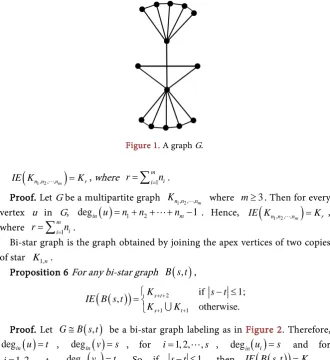
Proof. Let G≅B s t
( )
, be a bi-star graph labeling as in Figure 2. Therefore,( )
degin u =t , degin
( )
v =s , for i=1, 2,,s , degin( )
ui =s and for1, 2, ,
j= t , degin
( )
vj =t . So, if s t− ≤1 , then IE B s t(
( )
,)
=Ks t+ +2 . Otherwise, IE B s t(
( )
,)
=Ks+1Kt+1.A firefly graph Fr s t, , is a graph on 2r+2s t+ +1 vertices that consists of r triangles, s pendant paths of length 2 and t pendant edges sharing a common vertex.
Proposition 7 For any firefly graph Fr s t, , , r≥1,s≥1 and t≥1,
(
, ,)
22 22 1, 22 1
if 1;
if 2;
if 2.
r s s
r s t r s s s
r s t s
K K t
IE F K K K t
K K K t
+ +
+ + +
+ +
=
= =
>
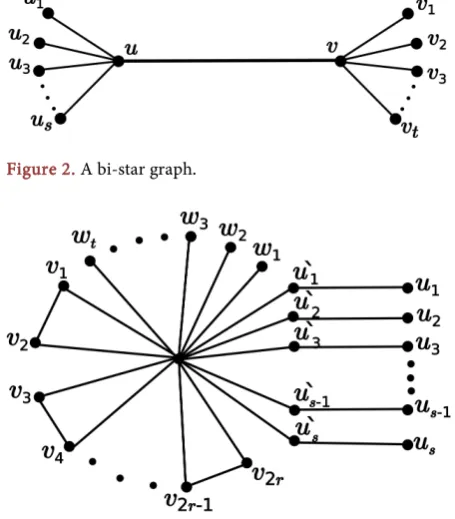
Proof. Let G be a firefly graph Fr s t, , as in Figure 3, where r≥1,s≥1 and
1
t≥ . Let v be the center vertex, v ii, =1, 2,, 2r be any vertex from the
triangle other than v. w ii, =1, 2,,t be any end vertex in the pendant edge. ui and u ii′ =, 1, 2,,s be any end vertex and internal vertex respectively in the
pendant path. Then, degin
( )
v =2r+s, degin( )
vi =2r+ +s t,( )
degin wi =2r+ + −s t 1, degin
( )
ui′ =2r+ + −s t 1 and degin( )
ui =1. There arethree cases:
Case 1. Suppose that t=1. Then, degin
( )
v −degin( )
vi =1,( )
( )
degin v −degin wi =0, degin
( )
v −degin( )
ui′ =0,( )
( )
DOI: 10.4236/am.2018.93020 267 Applied Mathematics
Figure 2. A bi-star graph.
Figure 3. A firefly graph.
( )
( )
degin wi −degin ui′ =0. Hence, IE F
( )
r s t, , ≅K2r s+ +2Ks.Case 2. Suppose that t=2. Then, degin
( )
v −degin( )
wi =1,( )
( )
degin v −degin ui′ =1, degin
( )
vi −degin( )
wi =1,( )
( )
degin vi −degin ui′ =1 and degin
( )
wi −degin( )
ui′ =0.Hence IE F
( )
r s t, , ≅K2r s+ +2K1,s+2Ks.Case 3. Suppose that t≤2. Then, degin
( )
vi −degin( )
wi =1,( )
( )
degin vi −degin ui′ =1 and degin
( )
wi −degin( )
ui′ =0.Hence IE F
( )
r s t, , ≅K2r s t+ + K1 Ks.Definition 8 A complete chain graph denoted by CC n s n s
(
1, ,1 2, ,2,sr−1,nr)
is a chain of complete graphs Kn1,Kn2,,Knr such that there are si commonvertices between Kni and Kni+1, for i=1, 2,,r−1.
Proposition 9 Let G be a graph such that G≅Pm×P2. Then
( )
2(
)
if 4;8, 4, 2 4 if 5.
m
K m
IE G
CC m m
≤
= − ≥
Proof. Let G be a graph such that G≅Pm×P2. Then there are two cases: Case 1. If m≤4, for all v V G∈
( )
, either degin( )
v =2 or degin( )
v =3.Therefore, for any two vertices u and v, degin
( )
u −degin( )
v ≤1. Hence,( )
2mIE G ≅K .
Case 2. If m≥5, there are 4 vertices with Inj-degree 2, 4 vertices with
Inj-degree 3 and 2m−8 vertices with Inj-degree 4. Therefore,
( )
(
8, 4, 2 4)
IE G ≅CC m− .
[image:4.595.259.487.76.336.2]DOI: 10.4236/am.2018.93020 268 Applied Mathematics
( )
(
(
10, 4, 6)
)
if 4;10, 4, 2 2, 2 6, 3 10 if 5.
CC m
IE G
CC m m m m
=
= − − − ≥
Proof. Suppose that, G≅Pm×P3. Then we have two cases:
Case 1. If m=4, then there are 6 vertices have Inj-degree 3, 4 vertices have
Inj-degree 4 and 2 vertices have Inj-degree 5. Therefore, IE G
( )
≅CC(
10, 4, 6)
.Case 2. If m≥5, then there are 6 vertices have Inj-degree 3, 4 vertices have
Inj-degree 4, 2m−6 vertices have Inj-degree 5 and m−4 vertices of degree 6.
Therefore, IE G
( )
≅CC(
10, 4, 2m−2, 2m−6,3m−10)
.Theorem 11 Let G be a graph such that G≅Pm×Pn, where m n, ≥5. Then
( )
(
12,8, 2 2 4, 2 2 12, 2 2 8, 4, 2 2 8, 2 2 12,IE G ≅CC m+ n− m+ n− m+ n− m+ n− m+ n−
(
n−2)(
m−2)
)
.Proof. Suppose that G≅Pm×Pn . Therefore, there are 4 vertices have Inj-degree 3, 8 vertices have Inj-degree 4, 2m+2n−12 have Inj-degree 5, 4
vertices have Inj-degree 6, 2m+2n−12 have Inj-degree 7 and
(
n−4)(
m−4)
have Inj-degree 8. Hence IE P
(
m×Pn)
≅CC(
12,8, 2m+2n−4, 2m+2n−12,(
)(
)
)
2m+2n−8, 4, 2m+2n−8, 2m+2n−12, n−2 m−2 .The generalized Petersen graph GP m n
(
,)
is defined by taking(
)
(
,)
{
i, i: 0 1}
V GP m n = u v ≤ ≤ −i m
and
(
)
(
,)
{
i i1, i i, i i n: 0 1}
E GP m n = u u+ u v v v+ ≤ ≤ −i m
where the subscripts are integers modulo m, m≥5 and 1 1 2 m n − ≤ ≤ . Theorem 12 Let G be a generalized Petersen graph GP m n
(
,)
. Then,( )
m nIE G ≅K + .
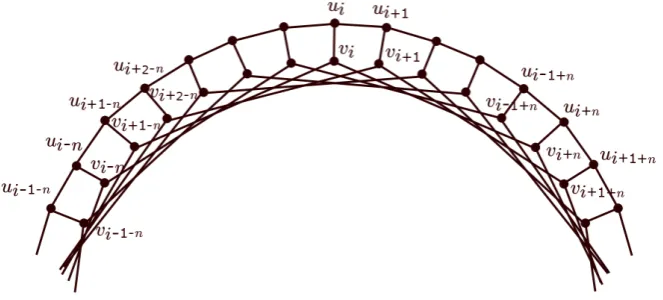
Proof. Let G be a generalized Petersen graph GP m n
(
,)
with vertices as inFigure 4. Then, Nin
( ) {
ui = ui+2,ui−2,vi n+ ,vi n− ,vi−1,vi+1}
and( ) {
1, 1, , , 2 , 2}
in i i i i n i n i n i n
N v = u+ u− u+ u− v+ v− . Therefore, for 0≤ ≤ −i m 1,
( )
( )
degin ui =degin vi =6. Hence, IE G
( )
≅Km n+ .Proposition 13 Let G≅Cm×P3. Then IE G
( )
≅K3m. Proof. Let G≅Cm×P3. We have three cases:Case 1. If m=3, then for all v V G∈
( )
, degin( )
v =5. Therefore, all thevetrices have the same Inj-degree. Hence, IE G
( )
≅K3m.Case 2. If m=4, then for all v V G∈
( )
, degin( )
v =4 or 5. Therefore,( )
3mIE G ≅K .
Case 3. If m≥5, then for all v V G∈
( )
, degin( )
v =5 or 6. Therefore, forany two vertices u and v in G,
( )
( )
degin u −degin v =1. Hence, IE G
( )
≅K3m.Theorem 14 For any graph G such that G≅Cm×Pn,
( )
2m m n( 2)IE G ≅K K − , where n≥5.
Proof. Suppose that G≅Cm×Pn. Then we have 2m vertices of injective degree 5, 2m vertices of injective degree 7 and m n
(
−4)
vertices of injectiveDOI: 10.4236/am.2018.93020 269 Applied Mathematics
Figure 4. Generalized Petersen graph GP m n
(
,)
.Proposition 15 For any graph G, such that G≅Cn×Cm, IE G
( )
≅Knm. Proof. Let G be a graph such that G≅Cn×Cm. Then every vertex in G has injective degree 8. Hence, IE G( )
≅Knm.Proposition 16 IE K
(
nKm)
=KnKnm.Proof. Consider the corona KnKm. The interior vertices have injective degree
(
n−1)(
m+1)
and the outer vertices have injective degree n m+ −2.Therefore IE K
(
nKm)
=KnKnm.Theorem 17 For any graph G with
δ
≥2, if G is k-regular or(
k k, +1)
-biregular, then
(
m)
n mn,IE G K =K K
where n is the number of vertices inG.
Proof. Let G be a k-regular graph with n vertices and
δ
≥2. Suppose that{
u u1, 2,,un}
and{
v v1, ,2,vm}
are the vertex sets of G and Km, respectively. Therefore, for i=1, 2,,n , degin( ) (
ui =k m+1)
and for j=1, 2,,m ,( )
degin vj = + −k m 1. Therefore, degin
( )
ui −degin( )
vj =m k(
− + >1)
1 1. Hence,(
m)
n mnIE G K =K K . Similarly, we can prove if G is
(
k k, +1)
-biregular, then(
m)
n mnIE G K =K K .
Proposition 18 For any cycle graph Cn, IE C
(
nK1)
=2Kn.Proof. Let ui be any vertex on the cycle Cn and vi be any vertex outside the cycle Cn. Then degin
( )
ui =4 and degin( )
vi =4. Therefore,(
n 1)
2 nIE C K = K .
Definition 19 Let G=
(
V E,)
be a graph. A subset D of V is called degreeInj-equitable set if the difference between the injective degree of any two vertices in D less then or equal one. The maximum cardinality of a degree Inj-equitable set in G is called degree Inj-equitable number of G and is denoted by Die
( )
G . the minimum cardinality of a maximal degree Inj-equitable set is called the lower degree Inj-equitable number of G and is denoted by die( )
G .Observation 20 For any integer
δ
≤ ≤ ∆ −i 1, let Si= ∈{
v V: degin( )
v =i or}
1
i+ . A nonempty subset A of V is a maximal degree Inj-equitable if and only if
i
DOI: 10.4236/am.2018.93020 270 Applied Mathematics
( )
min{
: 1ie i
d G = S
δ
≤ ≤ ∆ −i and Si ≠0 .}
Observation 21 Let G=
(
V E,)
be a graph. The intersection graph ofmaximal degree Inj-equitable sets denoted by Gin is defined on the family of all maximal degree Inj-equitable sets of G and has the property that any two vertices are adjacent if their intersection is not empty.
Theorem 22 For any graph G,
( )
(
IE G)
Die( )
G 1∆ = −
and
( )
(
IE G)
die( )
G 1.δ
= −Proof. Since Si is complete subgraph in IE G
( )
and from Observation 20 Die( )
G =max{
Si :δ
≤ ≤ ∆ −i 1 and Si≠0}
, then Die( )
G is the order ofthe maximum complete subgraph in IE G
( )
. Therefore, for any vetrex in themaximum complete subgraph has degree Die
( )
G −1. Hence( )
(
IE G)
Die( )
G 1∆ = − .
Similarly, we can show that δ
(
IE G( )
)
=die( )
G −1. The following proposition can be proved straightforward. Proposition 23 For any graph G,(i) diam IE G
(
( )
)
= ∆in( )
G −δ
in( )
G .(ii)
ω
(
IE G( )
)
=Die( )
G , whereω
(
IE G( )
)
is the clique number of IE G( )
. Theorem 24 Let G be any graph. The number of edges in IE G( )
is given by:(
)
(
)
1 1
1 1
1 1
2 2
i i i i i i
i i
S S S S S S
δ δ ∆− ∆− + − = = − − −
∑
∑
where Si= ∈
{
v V: degin( )
v =i or i+1}
.Proof. Let G be any graph. Since each Si is complete subgraph graph in
( )
IE G , then Si has
(
1)
2
i i
S S −
edges. But the edges in Si+1Si are
counted twice in
(
1)
2
i i
S S −
. Hence the number of edges in IE G
( )
is givenby
(
)
(
)
1 1 1 1 1 1 . 2 2i i i i i i
i i
S S S S S S
δ δ ∆− ∆− + − = = − − −
∑
∑
Theorem 25 Let G be any graph. Then the following are equivalent: (i) IE G
( )
is connected graph.(ii) The distinct sequence of the Inj-equitable degrees are
( ) ( )
, 1,( )
2, ,( )
in G i G in G in G
δ
δ
+δ
+ ∆ .(iii) The intersection graph of maximal degree Inj-equitable sets Gin is a path. Proof. (i)⇒(ii): Assume to the contrary, that IE G
( )
is connected and thereexist an integer
δ
in( )
G ≤ ≤ ∆i in( )
G . Then Si and Si−1 has no common vertices, that means IE G( )
is not connected which is a contradiction. Hence,the distinct sequence of the Inj-equitable degrees are
( ) ( )
, 1,( )
2, ,( )
in G i G in G in G
DOI: 10.4236/am.2018.93020 271 Applied Mathematics (ii)⇒(iii): Suppose that the distinct sequence of the Inj-equitable degrees are
( )
,( )
1,( )
2, ,( )
in G in G in G in G
δ
δ
+δ
+ ∆ . Then SiSi+1≠φ and SiSj =φ if2
i− ≥j . Hence, the intersection graph of maximal degree Inj-equitable sets
in
G is a path.
(iii)⇒(i): Suppose that Gin is a path. Then SiSi+1≠φ. Since Si is complete, then IE G
( )
is connected.Proposition 26 For any graph G, IE G
( )
is totally disconnected if and onlyif G≅K1.
Proof. Let G be a graph such that IE G
( )
is totally disconnected. Therefore,( )
(
IE G)
δ
(
IE G( )
)
0∆ = = . So, from Theorem 22, Die
( )
G − =1 die( )
G − =1 0.Therefore, Die
( )
G =die( )
G =1. Hence, G≅K1.Conversely, suppose that G≅K1. Therefore, G has only one maximal degree Inj-equitable set of order one. So, Die
( )
G =die( )
G =1. Therefore,( )
(
IE G)
δ
(
IE G( )
)
0∆ = = . Hence, IE G
( )
is totally disconnected.Theorem 27 For any graph G with n vertices, IE G
( )
≅Kn if and only if G has only one maximal degree Inj-equitable set.Proof. Let G be a graph of order n and IE G
( )
≅Kn. Therefore, for any vertices u and v in G, degin( )
u −degin( )
v ≤1. Hence, G has only one maximaldegree Inj-equitable set. Conversely, suppose that G has only one maximal degree Inj-equitable set Si . Since Si is complete in IE G
( )
, then( )
nIE G ≅K .
Next theorem gives the relation between the IE G
( )
, Con G( )
and eG .
Theorem 28 For any graph G, IE G
( )
≅(
con G( )
)
e.Proof. Let G be any graph and consider con G
( )
and IE G( )
. Both graphshave the same vertices. Now, let f =uv be any edge in IE G
( )
. Then,( )
( )
degin u −degin v ≤1 in G. Since degin
( )
u in G is equal deg( )
u in( )
con G , then, deg
( )
u −deg( )
v ≤1 in con G( )
. Therefore, f is an edge in( )
(
)
econ G . Hence IE G
( )
is a subgraph of(
con G( )
)
e. Similarly we can show that(
( )
)
econ G is a subgraph of IE G
( )
.3. Injective Equitable Graphs
Definition 29 A graph G is said to be injective equitable graph (IE-graph) if there exists a graph H such that IE H
( )
≅G.For example, any complete graph is IE-graph.
Definition 30 The family of graphs H which satisfy the condition
( )
IE H ≅G is called the injective equitable family of G and denoted by GIE.
i.e,
( )
{
:}
.IE
G = H IE H ≅G
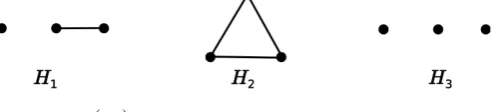
Example 31 Let H H1, 2 and H3 be figures as an Figure 5. Then,
( )
i 3IE H =K for all i=1, 2, 3.
Lemma 32 Any path Pn is not IE-graph.
DOI: 10.4236/am.2018.93020 272 Applied Mathematics
Figure 5. IE H
( )
i =K3.any vertices in G such that v1 adjacent to v2 and v2 adjacent to v3. Suppose that degin
( )
v1 =i in H. Therefore, degin( )
v2 = −i 1 or i or i+1.Case 1. degin
( )
v2 = −i 1. Therefore, degin( )
v3 = −i 2 or i−1 or i. If( )
3degin v = −i 1 or i, then v1 and v3 are adjacent which contradicts that G is a path. So, degin
( )
v3 = −i 2.Case 2. degin
( )
v2 =i. Therefore, degin( )
v3 = −i 1 or i or i+1. So, v1 and 3v are adjacent which contradicts that G is a path. Hence, degin
( )
v2 ≠i.Case 3. degin
( )
v2 = +i 1. Therefore, degin( )
v3 =i or i+1 or i+2 . If( )
3degin v =i or i+1, then v1 and v3 are adjacent which contradicts that G is a path. So, degin
( )
v3 = +i 2.Hence the graph H has different injective degrees which contradicts that any graph with n vertices has at least two vertices of the same Inj-degree. Therefore,
n
P is not IE-graph.
Lemma 33 Any cycle Cn is not IE-graph, where n≥4.
Proof. Suppose, to the contrary, that G is a cycle such that G is IE-graph. Therefore, there exist a graph H such that IE H
( )
≅G. Let v v1, 2 and v3 be any vertices in G such that v1 adjacent to v2 and v3. Let degin( )
v1 =i in H. Therefore, degin( )
v2 =i or i−1 or i+1 and degin( )
v3 = −i 1 or i or i+1. Case 1. degin( )
v2 =i. If degin( )
v3 = −i 1 or i or i+1 then v2 and v3 are adjacent which contradicts that G is a cycle.Case 2. degin
( )
v2 = −i 1. If degin( )
v3 =i or i−1, then v2 and v3 are adjacent which contradicts that G is a cycle. Therefore, degin( )
v3 = +i 1.Case 3. degin
( )
v2 = +i 1. If degin( )
v3 =i or i+1, then v2 and v3 are adjacent which contradicts that G is a cycle. Therefore, degin( )
v3 = −i 1.Hence the graph H has different injective degrees which contradicts that any graph with n vertices has at least two vertices of the same Inj-degree. Therefore, any cycle Cn is not IE-graph.
Lemma 34 Any bipartite graph is not IE-graph.
Proof. Suppose, to the contrary, that G is a bipartite graph such that G is IE-graph. Therefore, there exists a graph H such that IE H
( )
≅G. Let v v1, 2and v3 be any vertices in G such that v1 adjacent to v2 and v2 adjacent to
3
v . Let degin
( )
v1 =i in H. Therefore degin( )
v2 = −i 1 or i or i+1.Case 1. degin
( )
v2 =i. If degin( )
v3 = −i 1 or i or i+1 then v2 and v3 are adjacent in G. So, G contains an odd cycle which contradicts that G is a bipartite graph.DOI: 10.4236/am.2018.93020 273 Applied Mathematics Case 3. degin
( )
v2 = +i 1. If degin( )
v3 =i or i+1, then v2 and v3 are adjacent in G. So, G contains an odd cycle which contradicts that G is a bipartite graph. Therefore, degin( )
v3 = −i 1.Hence the graph H has different injective degrees which contradicts that any graph with n vertices has at least two vertices of the same Inj-degree. Therefore, any bipartite graph is not IE-graph.
Theorem 35 A connected graph G is IE-graph if G is a chain of complete graphs.
Proof. Suppose that G is a connected IE-graph. Then there exists a graph H such that IE H
( )
≅G. Each Si is complete in IE H( )
and there are1
i i
S S+ common vertices between Si and Si+1 . Therefore, G is a chain of complete graphs.
4. Conclusion
In this paper, we introduced the injective equitable graph of a graph IE G
( )
and the injective equitable graph IE-graph. We defined these graphs and presented some of their properties. Also, we found the Inj-equitable graph of some graph’s families. The degree injective equitable set, the degree injective equitable number of a graph and the lower degree injective equitable number are defined. Relations on those parameters in terms of maximum vertex degree, minimum vertex degree, diameter and clique number of the injective equitable graph are established. The connectedness of IE G
( )
and relations between the( )
IE G , Con G
( )
and eG are studied. In the last of this paper, the sufficient
condition for a connected graph G to be IE-graph is presented.
References
[1] Alwardi, A., Alqesmah, A. and Rangarajan, R. (2016) Independent Injective Domi-nation of Graphs. International Journal of Applied Mathematics and Mechanics, 3, 142-151.
[2] Balakrishnan, R. and Ranganathan, K. (2000) A Textbook of Graph Theory. Sprin-ger-Velag, New York.https://doi.org/10.1007/978-1-4419-8505-7
[3] Chartrand, G. and Lesniak, L. (2005) Graphs and Diagraphs. 4th Edition, CRC press, Boca Raton.
[4] Harary, F. (1969) Graphs Theory. Addison-Wesley, Reading Mass. https://doi.org/10.21236/AD0705364
[5] Alwardi, A., Arsic, B., Gutman, I. and Soner, N.D. (2012) The Common Neighbor-hood Graph and Its Energy. Iranian Journal of Mathematical Sciences and Infor-matics, 7, 1-8.
[6] Dharmalingam, K.M. (2012) Equitable Graph of a Graph. Proyecciones Journal of Mathematics, 31, 363-372.https://doi.org/10.4067/S0716-09172012000400005 [7] Alkenani, A., Alashwali, H. and Muthana, N. (2016) On the Injective Equitable