Zero-Shot Activity Recognition with Verb Attribute Induction
Rowan Zellers and Yejin Choi
Paul G. Allen School of Computer Science & Engineering University of Washington
Seattle, WA 98195, USA
{rowanz,yejin}@cs.washington.edu
Abstract
In this paper, we investigate large-scale zero-shot activity recognition by modeling the visual and linguistic attributes of ac-tion verbs. For example, the verb “salute” has several properties, such as being a light movement, a social act, and short in dura-tion. We use these attributes as the internal mapping between visual and textual rep-resentations to reason about a previously unseen action. In contrast to much prior work that assumes access to gold standard attributes for zero-shot classes and focuses primarily on object attributes, our model uniquely learns to infer action attributes from dictionary definitions and distributed word representations. Experimental re-sults confirm that action attributes inferred from language can provide a predictive signal for zero-shot prediction of previ-ously unseen activities.
1 Introduction
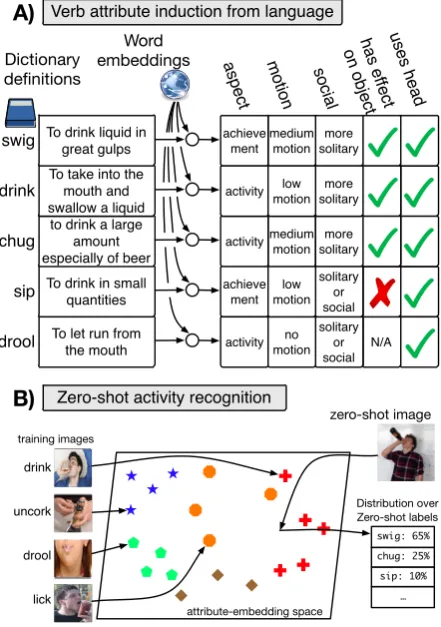
We study the problem of inferring action verb at-tributes based on how the word is defined and used in context. For example, given a verb such as “swig” shown in Figure 1, we want to infer var-ious properties of actions such as motion dynam-ics (moderate movement), social dynamics (soli-tary act),body partsinvolved (face, arms, hands), andduration(less than 1 minute) that are generally true for the range of actions that can be denoted by the verb “swig”.
Our ultimate goal is to improvezero-shot learn-ing of activities in computer vision: predicting a previously unseen activity by integrating back-ground knowledge about the conceptual properties of actions. For example, a computer vision system may have seen images of “drink” activities during
Dictionary definitions
drool drink
chug
sip
swig To drink liquid in great gulps
to drink a large amount especially of beer
To drink in small quantities
To let run from the mouth To take into the
mouth and swallow a liquid
medium motion
more solitary
N/A activity more
solitary more solitary medium
motion
achieve ment
solitary or social activity
achieve ment
activity
solitary or social no motion
low motion
low motion
Word embeddings
zero-shot image
… sip: 10% chug: 25% swig: 65% Distribution over Zero-shot labels
attribute-embedding space Verb attribute induction from language
A)
B) Zero-shot activity recognition
training images
asp ect
mo tion
use s he
ad ha
s e ffect on
ob ject so
ci al
uncork
drool
[image:1.595.309.530.228.542.2]lick drink
Figure 1: An overview of our task. Our goal is twofold. A: we seek to use use distributed word embeddings in tandem with dictionary definitions to obtain a high level understanding of verbs. B: we seek to use these predicted attributes to allow a classifier to recognize a broader set of activities than what was seen in training time.
training, but not “swig”. Ideally, the system should infer the likely visual characteristics of “swig” us-ing world knowledge implicitly available in dictio-nary definitions and word embeddings.
However, most existing literature on zero-shot learning has focused on object recognition with only a few notable exceptions (see Related Work
in Section8). There are two critical reasons: ob-ject attributes, such as color, shape, and texture, are conceptually straightforward to enumerate. In addition, they have distinct visual patterns which are robust for current vision systems to recognize. In contrast, activity attributes are more difficult to conceptualize as they involve varying levels of abstractness, which are also more challenging for computer vision as they have less distinct visual patterns. Noting this difficulty,Antol et al.(2014) instead employ cartoon illustrations as intermedi-ate mappings for zero-shot dyadic activity recog-nition. We present a complementary approach: that of tackling the abstractness of verb attributes directly. We develop and use a corpus of verb at-tributes, using linguistic theories on verb seman-tics (e.g., aspectual verb classes ofVendler(1957)) and also drawing inspiration from studies on lin-guistic categorization of verbs and their properties (Friedrich and Palmer, 2014; Siegel and McKe-own,2000).
In sum, we present the first study aiming to re-cover general action attributes for a diverse collec-tion of verbs, and probe their predictive power for zero-shot activity recognition on the recently in-troduced imSitu dataset (Yatskar et al.,2016). Em-pirical results show that action attributes inferred from language can help classifying previously un-seen activities and suggest several avenues for fu-ture research on this challenging task. We publicly share our dataset and code for future research.1
2 Action Verb Attributes
We consider seven different groups of action verb attributes. They are motivated in part by poten-tial relevance for visual zero-shot inference, and in part by classical literature on linguistic theories on verb semantics. The attribute groups are sum-marized below.2 Each attribute group consists of
a set of attributes, which sums toK = 24distinct attributes annotated over the verbs.3
[1] Aspectual Classes We include the aspectual verb classes ofVendler(1957):
• state: a verb that does not describe a chang-ing situation (e.g. “have”, “be”)
1Available athttp://github.com/rowanz/verb-attributes 2The full list is available in the supplemental section. 3Several of our attributes are categorical; if converted to binary attributes, we would have 40 attributes in total.
• achievement: a verb that can becompletedin a short period of time (e.g. “open”, “jump”)
• accomplishment: a verb with a sense of
com-pletion over a longer period of time (e.g. “climb”)
• activity: a verb without a clear sense of com-pletion (e.g. “swim”, “walk”, “talk”)
[2] Temporal Duration This attribute group re-lates to the aspectual classes above, but provides additional estimation of typical time duration with four categories. We categorize verbs by best-matching temporal units: seconds, minutes, hours, or days, with an additional option for verbs with unclear duration (e.g., “provide”).
[3] Motion Dynamics This attribute group fo-cuses on the energy level of motion dynamics in four categories: no motion (“sleep”), low motion (“smile”), medium (“walk”), or high (“run”). We add an additional option for verbs whose motion level depends highly on context, such as ‘finish.’ [4] Social Dynamics This attribute group fo-cuses on the likely social dynamics, in particular, whether the action is usually performed as a soli-tary act, a social act, or either. This is graded on a 5-part scale from least social(−2)to either(+0)
to most social(+2)
[5] Transitivity This attribute group focuses on whether the verb can take an object, or be used without. This gives the model a sense of the im-plied action dynamics of the verb between the agent and the world. We record three variables: whether or not the verb is naturally transitive on a person (“I hug her” is natural), on a thing (“I eat it”), and whether the verb is intransitive (“I run”). [6] Effects on Arguments This attribute group focuses on the effects of actions on agents and other arguments. For each of the possible tran-sitivities of the verb, we annotate whether or not it involveslocation change(“travel”),world change
(“spill”), agent or object change (“cry”) , or no visible change(“ponder”).
Action Attributes and Contextual Variations In general, contextual variations of action at-tributes are common, especially for frequently used verbs that describe everyday physical activi-ties. For example, while “open” typically involves “hands”, there are exceptions, e.g. “open one’s eyes”. In this work, we focus on stereotypical or prominent characteristics across a range of actions that can be denoted using the same verb. Thus, three investigation points of our work include: (1) crowd-sourcing experiments to estimate the dis-tribution of human judgments on the prominent characteristics of everyday physical action verbs, (2) the feasibility of learning models for inferring the prominent characteristics of the everyday ac-tion verbs despite the potential noise in the human annotation, and (3) their predictive power in zero-shot action recognition despite the potential noise from contextual variations of action attributes. As we will see in Section 7, our study confirms the usefulness of studying action attributes and moti-vates the future study in this direction.
Relevance to Linguistic Theories The key idea in our work that action verbs project certain expec-tations about their influence on their arguments, their pre- and post-conditions, and their implica-tions on social dynamics, etc., relates to the orig-inal Frame theories ofBaker et al.(1998a). The study of action verb attributes are also closely related to formal studies on verb categorization based on the characteristics of the actions or states that a verb typically associates to (Levin, 1993), and cognitive linguistics literature that focus on causal structure and force dynamics of verb mean-ings (Croft,2012).
3 Learning Verb Attributes from Language
In this section we present our models for learn-ing verb attributes from language. We consider two complementary types of language-based in-put: dictionary definitions and word embeddings. The approach based on dictionary definitions re-sembles how people acquire the meaning of a new word from a dictionary lookup, while the approach based on word embeddings resembles how people acquire the meaning of words in context.
Overview This task follows the standard super-vised learning approach where the goal is to pre-dict K attributes per word in the vocabulary V.
Letxv ∈ X represent the input representation of a wordv∈ V. For instance,xvcould denote a word embedding, or a definition looked up from a dic-tionary (modeled as a list of tokens). Our goal is to produce a modelf :X →Rdthat maps the input to a representation of dimensiond. Modeling op-tions include using pretrained word embeddings, as in Section3.1, or using a sequential model to encode a dictionary, as in Section3.2.
Then, the estimated probability distribution over attributekis given by:
ˆ
yv,k=σ(W(k)f(xv)). (1)
If the attribute is binary, thenW(k)is a vector of
dimensiondandσis the sigmoid function. Other-wise,W(k)is of shapedk×d, wheredkis the
di-mension of attributek, andσis the softmax func-tion. Let the vocabularyV be partitioned into sets
VtrainandVtest; then, we train by minimizing the cross-entropy loss overVtrainand report attribute-level accuracy over words inVtest.
Connection to Learning Object Attributes This problem has been studied before for zero-shot object recognition, but there are several key dif-ferences. Al-Halah et al.(2016) build the ‘Class-Attribute Association Prediction’ model (CAAP) that classifies the attributes of an object class from its name. They apply it on the Animals with At-tributes dataset, a dataset containing 50 animal classes, each described by 85 attributes (Lampert et al.,2014). Importantly, these attributes are con-crete details with semantically meaningful names such as “has horns” and “is furry”. The CAAP model takes advantage of this, consisting of a ten-sor factorization model initialized by the word embeddings of the object class names as well as the attribute names. On the other hand, verb at-tributessuch as the ones we outline in Section2, are technical linguistic terms. Since word embed-dings principally capture common word senses, they are unsuited for verb attributes. Thus, we evaluate two versions of CAAP as a baseline: one where the model is preinitialized with GloVe embeddings (Pennington et al., 2014) for the at-tribute names (CAAP-pretrained), and one where the model is learned from random initialization (CAAP-learned).
(Mikolov et al.,2013). Intuitively, we expect sim-ilar verbs to have simsim-ilar distributions of nearby nouns and adverbs, which can greatly help us in zero-shot prediction. In our experiments, we use 300-dimensional GloVe vectors trained on 840B tokens of web data (Pennington et al.,2014). We use logistic regression to predict each attribute, as we found that extra hidden layers did not improve performance. Thus, we letfemb(xv) = wv, the GloVe embedding ofv, and use Equation1to get the distribution over labels.
We additionally experiment with retrofitted em-beddings, in which embeddings are mapped in accordance with a lexical resource. Follow-ing the approach of Faruqui et al. (2015), we retrofit embeddings using WordNet (Miller,1995), Paraphrase-DB (Ganitkevitch et al., 2013), and FrameNet (Baker et al.,1998b).
3.2 Learning from Dictionary Definitions We additionally propose a model that learns the attribute-grounded meaning of verbs through dic-tionary definitions. This is similar in spirit to the task of using a dictionary to predict word embed-dings (Hill et al.,2016).
BGRU encoder Our first model involves a Bidi-rectional Gated Recurrent Unit (BGRU) encoder (Cho et al.,2014). Let xv,1:T be a definition for verb v, with T tokens. To encode the input, we pass it through the GRU equation:
~
ht=GRU(xv,t, ~ht−1). (2)
Leth~ 1denote the output of a GRU applied on the
reversed inputxv,T:1. Then, the BGRU encoder is
the concatenationfbgru=~hTkh~ 1.
Bag-of-words encoder Additionally, we try two common flavors of a Bag-of-Words model. In the standard case, we first construct a vocabulary of 5000 words by frequency on the dictionary def-initions. Then, fbow(xv) represents the one-hot encoding fbow(xv)i = [i∈xv], in other words, whether wordiappears in definitonxvfor verbv. Additionally, we try out a Neural Bag-of-Words model where the word embeddings in a defini-tion are averaged (Iyyer et al., 2015). This is
fnbow(x
v,1:T) = |T1|PTt=1femb(xv,t).
Dealing with multiple definitions per verb One potential pitfall with using dictionary defini-tions is that there are often many defnidefini-tions asso-ciated with each verb. This creates a dataset bias
To drink in large draughts
swig
Attributes
concat W(k)
femb ~
h1 ~h2 ~h3 ~h4 ~h5 ~
h1 ~
h2 ~
h3 ~
h4 ~
[image:4.595.325.508.63.197.2]h5
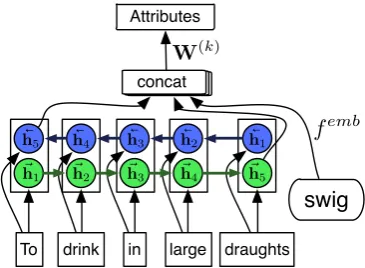
Figure 2: Overview of our combined dictionary + embedding to attribute model. Our encoding is the concatenation of a Bidirectional GRU of a defini-tion and the word embedding for that word. The encoding is then mapped to the space of attributes using parametersW(k).
since polysemic verbs are seen more often. Ad-ditionally, dictionary definitions tend to be sorted by relevance, thus lowering the quality of the data if all definitions are weighted equally during train-ing. To counteract this, we randomly oversample the definitions at training time so that each verb has the same number of definitions.4 At test time,
we use the first-occurring (and thus generally most relevant) definition per verb.
3.3 Combining Dictionary and Embedding representations
We hypothesize that the two modalities of the dic-tionary and distributional embeddings are comple-mentary. Therefore, we propose an early fusion (concatenation) of both categories. Figure 2 de-scribes the GRU + embedding model – in other words, fBGRU+emb = fBGRUkfemb. This can likewise be done with any choice of definition en-coder and word embedding.
4 Zero-Shot Activity Recognition 4.1 Verb Attributes as Latent Mappings Given learned attributes for a collection of activi-ties, we would like to evaluate their performance at describing these activities from real world images in a zero-shot setting. Thus, we consider several models that classify an image’s label by pivoting through an attribute representation.
Overview A formal description of the task is at follows. Let the space of labels beV, partitioned into Vtrain and Vtest. Let zv ∈ Z represent an image with labelv ∈ V; our goal is to correctly predict this label amongst verbsv ∈ Vtest at test time, despite never seeing any images with labels inVtestduring training.
Generalization will be done through a lookup table A, with known attributes for each v ∈ V. Formally, for each attributekwe define it as:
A(vk0,i) =
(
1 if attributekfor verbv0isi
−1 otherwise (3)
For binary attributes, we need only one entry per verb, makingA(k)a single column vector. Let our
image encoder be represented by the mapg:Z →
Rd. We then use the linear map in Equation1 to produce the log-probability distribution over each attributek. The distribution over labels is then:
P(·|zv) =softmax v0
X
k
A(k)W(k)g(z
v)
!
(4)
whereW(k) is a learned parameter that maps the
image encoder to the attribute representation. We then train our model by minimizing the cross-entropy loss over the training verbsVtrain. Convolutional Neural Network (CNN) Encoder Our image encoder is a CNN with the Resnet-152 architecture (He et al.,2016). We use weights pre-trained on ImageNet (Deng et al.,2009) and per-form additional pretraining on ImSitu using the classesVtrain. After this, we remove the top layer and set g(xv) to be the 2048-dimensional image representation from the network.
4.1.1 Connection to other attribute models Our model is similar to those ofAkata et al.(2013) and Romera-Paredes and Torr(2015) in that we predict the attributes indirectly and train the model through the class labels.5 It differs from
sev-eral other zeroshot models, such asLampert et al.
(2014)’s Direct Attribute Prediction (DAP) model, in that DAP is trained by maximizing the probabil-ity of predicting each attribute and then multiplies the probabilities at test time. Our use of joint train-ing allows the recognition model to directly op-timize class-discrimination rather than attribute-level accuracy.
5Unlike these models, however, we utilize (some) cate-gorical attributes and optimize using cross-entropy.
CNN embedding
prediction
attribute prediction attribute lookup embedding
lookup
Wemb
A(k)
W(k)
g
Aemb
+
label prediction
z
v
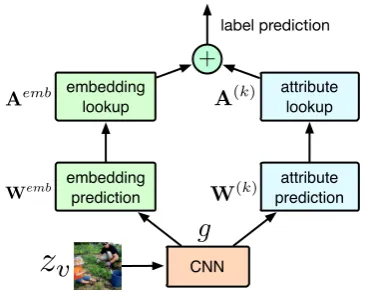
Figure 3: Our proposed model for combin-ing attribute-based zero-shot learncombin-ing and word-embedding based transfer learning. The embed-ding and attribute lookup layers are used to predict a distribution of labels overVtrainduring training andVtestduring testing.
4.2 Verb Embeddings as Latent Mappings An additional method of doing zero-shot image classification is by using word embeddings di-rectly.Frome et al.(2013) build DeVISE, a model for zero-shot learning on ImageNet object recog-nition where the objective is for the image model to predict a class’s word embedding directly. De-VISE is trained by minimizing
X
v0∈Vtrain\{v}
max{0, .1+(wv0−wv)Wembg(zv)}
for each imagezv. We compare against a version of this model with fixed GloVe embeddingsw.
Additionally, we employ a variant of our model using only word embeddings. The equation is the same as Equation4, except using the matrixAemb as a matrix of word embeddings: i.e., for each la-belvwe consider, we haveAemb
v =wv. 4.3 Joint prediction from Attributes and
Embeddings
To combine the representation power of the at-tribute and embedding models, we build an en-semble combining both models. This is done by adding the logits before the softmax is applied:
softmax v0
X
k
A(k)W(k)g(z
v) +AembWembg(zv)
!
[image:5.595.324.507.64.210.2]we train the model to minimize the cross entropy of three sources independently: the attributes only, the embeddings only, and the sum, weighting each equally.
Incorporating predicted and gold attributes We additionally experiment with an ensemble of our model, combining predicted and gold at-tributes ofVtest. This allows the model to hedge against cases where a verb attribute might have several possible correct answers. A single model is trained; at test time, we multiply the class level probabilitiesP(·|zv)of each together to get the fi-nal predictions.
5 Actions and Attributes Dataset
To evaluate our hypotheses on action attributes and zero-shot learning, we constructed a dataset using crowd-sourcing experiments. TheActions and
At-tributes dataset consists of annotations for 1710
verb templates, each consisting of a verb and an optional particle (e.g. “put” or “putup”).
We selected all verbs from the ImSitu cor-pus, consisting of images representing verbs from many categories (Yatskar et al., 2016), then extended the set using the MPII movie vi-sual description dataset and ScriptBase datasets, (Rohrbach et al., 2015; Gorinski and Lapata,
2015). We used the spaCy dependency parser (Honnibal and Johnson,2015) to extract the verb template for each sentence, and collected annota-tions on Mechanical Turk to filter out nonliteral and abstract verbs. Turkers annotated this filtered set of templates using the attributes described in Section 2. In total, 1203 distinct verbs are in-cluded. The templates are split randomly by verb; out of 1710 total templates, we save 1313 for train-ing, 81 for validation, and 316 for testing.
To provide signal for classifying these verbs, we collected dictionary definitions for each verb us-ing the Wordnik API,6 including only senses that
are explicitly labeled “verb.” This leaves us with 23,636 definitions, an average of 13.8 per verb. 6 Experimental Setup
BGRU pretaining We pretrain the BGRU model on the Dictionary Challenge, a collection of 800,000 word-definition pairs obtained from
6Available athttp://developer.wordnik.com/ with access to American Heriatge Dictionary, the Century Dictionary, the GNU Collaborative International Dictionary, Wordnet, and Wiktionary.
Wordnik and Wikipedia articles (Hill et al.,2016); the objective is to obtain a word’s embedding given one of its definitions. For the BGRU model, we use an internal dimension of 300, and embed the words to a size 300 representation. The vocab-ulary size is set to 30,000 (including all verbs for which we have definitions). During pretraining, we keep the architecture the same, except a differ-ent 300-dimensional final layer is used to predict the GloVe embeddings.
Following Hill et al. (2016), we use a ranking loss. Letwˆ = Wembf(x) be the predicted word embeddings for each definitionxof a word in the dictionary (not necessarily a verb). Let wbe the word’s embedding, andwe be the embedding of a random dictionary word. The loss is then given by:
L= max{0, .1−cos(w,w) + cos(w,ˆ w)e }
After pretraining the model on the Dictionary Challenge, we fine-tune the attribute weights
W(k)using the cross-entropy over Equation1.
Zero-shot with the imSitu dataset We build our image-to-verb model on the newly introduced imSitu dataset, which contains a diverse collection of images depicting one of 504 verbs. The images represent a variety of different semantic role labels (Yatskar et al., 2016). Figure4 shows examples from the dataset. We apply our attribute split to the dataset and are left with 379 training classes, 29 validation classes, and 96 test classes.
Zero-shot activity recognition baselines We compare against several additional baseline mod-els for learning from attributes and embeddings.
Romera-Paredes and Torr(2015) propose “Em-barassingly Simple Zero-shot Learning” (ESZL), a linear model that directly predicts class labels through attributes and incorporates several types of regularization. We compare against a variant of Lampert et al.(2014)’s DAP model discussed in Section4.1.1. We additionally compare against DeVISE (Frome et al.,2013), as mentioned in Sec-tion4.2. We use a Resnet-152 CNN finetuned on the imSituVtrain classes as the visual features for these baselines (the same as discussed in Section
4.1).
acc-macro acc-micro Body Duration Aspect Motion Social Effect Transi. most frequent class 61.33 75.45 76.84 76.58 43.67 35.13 42.41 84.97 69.73
Emb
CAAP-pretrained 64.96 78.06 84.81 72.15 50.95 46.84 43.67 85.21 71.10 CAAP-learned 68.15 81.00 86.33 76.27 52.85 52.53 45.57 88.29 75.21
GloVe 66.60 79.69 85.76 75.00 50.32 48.73 43.99 86.52 75.84
GloVe + framenet 67.42 80.79 86.27 76.58 49.68 50.32 44.94 88.19 75.95 GloVe + ppdb 67.52 80.75 85.89 76.58 51.27 50.95 43.99 88.21 75.74 GloVe + wordnet 68.04 81.13 86.58 76.90 54.11 50.95 43.04 88.34 76.37
Dict
BGRU 66.05 79.44 85.70 76.90 51.27 48.42 40.51 86.92 72.68
BoW 62.53 77.61 83.54 76.58 48.42 35.76 36.39 86.31 70.68
NBoW 65.41 78.96 85.00 76.58 52.85 42.41 43.35 86.87 70.78
D+E
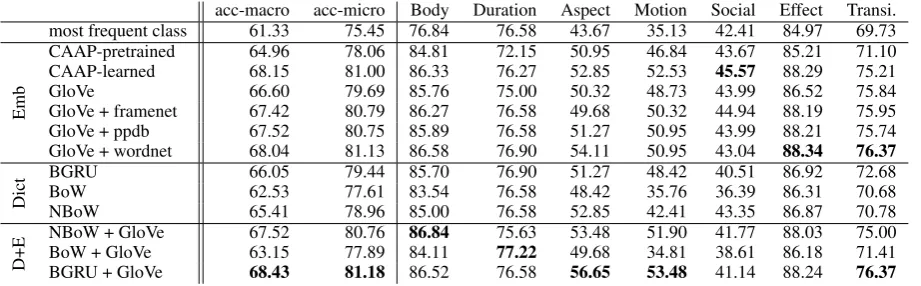
[image:7.595.67.528.62.205.2]NBoW + GloVe 67.52 80.76 86.84 75.63 53.48 51.90 41.77 88.03 75.00 BoW + GloVe 63.15 77.89 84.11 77.22 49.68 34.81 38.61 86.18 71.41 BGRU + GloVe 68.43 81.18 86.52 76.58 56.65 53.48 41.14 88.24 76.37 Table 1: Results on the text-to-attributes task. All values reported are accuracies (in %). For attributes where multiple labels can be selected, the accuracy is averaged over all instances (e.g., the accuracy of “Body” is given by the average of accuracies from correctly predicting Head, Torso, etc.). As such, we report two ways of averaging the results: microaveraging (where the accuracy is the average of accuracies on the underlying labels) and macroaveraging (where the accuracy is averaged together from the groups).
7 Experimental Results
7.1 Predicting Action Attributes from Text Our results for action attribute prediction from text are given in Table1. Several examples are given in the supplemental section in Table3. Our results on the text-to-attributes challenge confirm that it is a challenging task for two reasons. First, there is noise associated with the attributes: many verb at-tributes are hard to annotate given that verb mean-ings can change in context.7 Second, there is a
lack of training data inherent to the problem: there are not many common verbs in English, and it can be difficult to crowdsource annotations for rare ones. Third, any system must compete with strong frequency-based baselines, as attributes are gener-ally sparse. Moreover, we suspect that were more attributes collected (so as to cover more obscure patterns), the sparsity would only increase.
Despite this, we report strong baseline results on this problem, particularly with our embedding based models. The performance gap between embedding- and definition-based models can pos-sibly be explained by the fact that the word em-beddings are trained on a very large corpus of real-worldexamplesof the verb, while the definition is only a single high-level representation meant to be understood by someone who already speaks that language. For instance, it is likely difficult for the definition-based model to infer whether a verb is transitive or not (Transi.), since definitions might assume commonsense knowledge about the
under-7As such, our attributes have a median Krippendorff Al-pha ofα=.359.
lying concepts the verb represents. The strong performance of embedding models is further en-hanced by using retrofitted word embeddings, sug-gesting an avenue for improvement on language grounding through better representation of linguis-tic corpora.
We additionally see that both joint dictionary-embedding models outperform the dictionary-only models overall. In particular, the BGRU+GloVe model performs especially well at determining the aspect and motion attributes of verbs, particularly relative to the baseline. The strong performance of the BGRU+GloVe model indicates that there is some signal that is missing from the distributional embeddings that can be recovered from the dictio-nary definition. We thus use the predictions of this model for zero-shot image recognition.
Based on error analysis, we found that one com-mon mode of failure is where contextual knowl-edge is required. To give an example, the embed-ding based model labels “shop” as a likely soli-tary action. This is possibly because there are a lack of similar verbs inVtrain; by random chance, “buy” is also in the test set. We see that this can be partially mitigated by the dictionary, as evidenced by the fact that the dictionary-based models label “shop” as in between social and solitary. Still, it is a difficult task to infer that people like to “visit stores in search of merchandise” together.
7.2 Zero-shot Action Recognition
Attributes used v∈ Vtest Model atts(P) atts(G) GloVe top-1 top-5
Random 1.04 5.20
DeVISE X 16.50 37.56
ESZL X X 3.60 14.813.27 13.21
DAP X X 3.35 16.694.33 17.56
Ours
X 4.79 19.98
X 7.04 22.19
X X 7.71 24.90
X 17.60 39.29
X X 18.10 41.46
X X 16.75 40.44
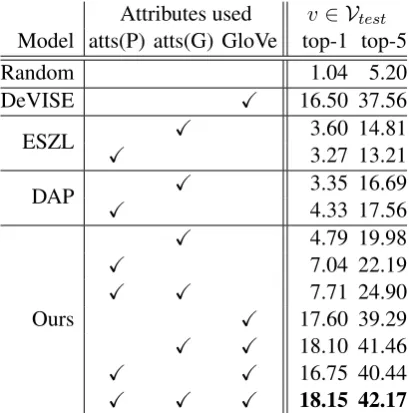
X X X 18.15 42.17 Table 2: Results on the image-to-verb task. atts(P) refers to attributes predicted from the BGRU+GloVe model described in Section 3, atts(G) to gold attributes, and GloVe to GloVe vec-tors. The accuracies reported are amongst the 96 unseen labels ofVtest.
our models show predictive power. Although our attribute models do not outperform our embed-ding models and DeVISE alone, we note that our joint attribute and embedding model scores the best overall, reaching 18.10% in top-1 and 41.46% in top-5 accuracy when using gold attribute anno-tations for the zero-shot verbs. This result is possi-bly surprising given the small number of attributes (K = 24) in total, of which most tend to be sparse (as can be seen from the baseline performance in Table1). We thus hypothesize that collecting more activity attributes would further improve perfor-mance.
We also note the success in performing zero-shot learning with predicted attributes. Perhaps paradoxically, our attribute-only models (along with DAP) perform better in both accuracy met-rics when given predicted attributes at test time, as opposed to gold attributes. Further, we get an ex-tra boost by ensembling predictions of our model when given two sets of attributes at test time, giv-ing us the best results overall at 18.15% top-1 ac-curacy and 42.17% top-5. Interestingly, better per-formance with predicted attributes is also reported byAl-Halah et al.(2016): predicting the attributes with their CAAP model and then running the DAP model on these predicted attributes outperforms the use of gold attributes at test time. It is
some-what unclear why this is the case - possibly, there is some bias in the attribute labeling, which the at-tribute predictor can correct for.
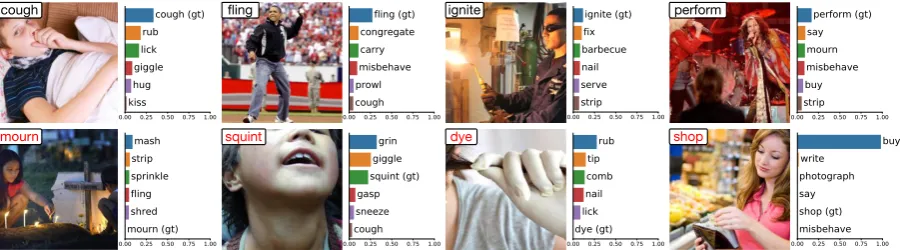
In addition to quantitative results, we show some zero-shot examples in Figure 4. The ex-amples show inherent difficulty of zero-shot ac-tion recogniac-tion. Incorrect predicac-tions are of-ten reasonably related to the situation (“rub” vs “dye”) but picking the correct target verb based on attribute-based inference is still a challenging task.
Although our results appear promising, we ar-gue that our model still fails to represent much of the semantic information about each image class. In particular, our model is prone tohubness: the overprediction of a limited set of labels at test time: those that closely match signatures of ex-amples in the training set. This problem has pre-viously been observed with the use of word em-beddings for zero-shot learning (Marco and Geor-giana,2015) and can be seen in our examples (for instance, the over-prediction of “buy”). Unfortu-nately, we were unable to mitigate this problem in a way that also led to better quantitative results (for instance, by using a ranking loss as in DeVISE (Frome et al.,2013)). We thus leave resolving the hubness problem in zero-shot activity recognition as a question for future work.
8 Related Work
Learning attributes from embeddings
Rubinstein et al.(2015) seek to predict McRae et al. (2005)’s feature norms from word embed-dings of concrete nouns. Likewise, the CAAP model ofAl-Halah et al.(2016) predicts the object attributes of concrete nouns for use in zero-shot learning. In contrast, we predict verb attributes. A related task is that of improving word embeddings using multimodal data and linguistic resources (Faruqui et al., 2015; Silberer et al., 2013; Ven-drov et al., 2016). Our work runs orthogonal to this, as we focus on word attributes as a tool for a zero-shot activity recognition pipeline.
Zero-shot learning with objects Though dis-tinct, our work is related to zero-shot learn-ing of objects in computer vision. There are several datasets (Nilsback and Zisserman, 2008;
Welinder et al., 2010) and models developed on this task (Romera-Paredes and Torr(2015); Lam-pert et al. (2014); Mukherjee and Hospedales
[image:8.595.79.284.62.269.2]shop
squint dye
perform cough fling ignite
[image:9.595.74.525.63.188.2]mourn
Figure 4: Predictions on unseen classes from our attribute+embedding model with gold attributes. The top and bottom rows show successful and failure cases respectively. The bars to the right of each image represent a probability distribution, showing the ground truth class and the top 5 scoring incorrect classes.
Ba et al.(2015) augment existing datasets with de-scriptive Wikipedia articles so as to learn novel ob-jects from descriptive text. As illustrated in Sec-tion 1, action attributes pose unique challenges compared to object attributes, thus models devel-oped for zero-shot object recognition are not as effective for zero-shot action recognition, as has been empirically shown in Section7.
Zero-shot activity recognition In prior work, zero-shot activity recognition has been studied on video datasets, each containing a selection of con-crete physical actions. The MIXED action dataset, itself a combination of three action recognition datasets, has 2910 labeled videos with 21 actions, each described by 34 action attributes (Liu et al.,
2011). These action attributes are concrete bi-nary attributes corresponding to low-level physical movements, for instance, “arm only motion,” “leg: up-forward motion.” By using word embeddings instead of attributes, Xu et al.(2017) study video activity recognition on a variety of action datasets, albeit in the transductive setting wherein access to the test labels is provided during training. In com-parison with our work on imSitu (Yatskar et al.,
2016), these video datasets lack broad coverage of verb-level classes (and for some, sufficient data points per class).
The abstractness of broad-coverage activity la-bels makes the problem much more difficult to study with attributes. To get around this, Antol et al. (2014) present a synthetic dataset of car-toon characters performing dyadic actions, and use these cartoon illustrations as internal mappings for zero-shot recognition of dyadic actions in real-world images. We investigate an alternative ap-proach by using linguistically informed verb
at-tributes for activity recognition.
9 Future work / Conclusion
Several possibilities remain open for future work. First, more attributes could be collected and evalu-ated, possibly integrating other linguistic theories about verbs, with more accurate modeling of con-text. Second, while our experiments use attributes as a pivot between language and vision domains, the effects of this could be explored more in future work. In particular, since our experiments show that unsupervised word embeddings significantly help performance, it might be desirable to learn data-driven attributes in an end-to-end fashion di-rectly from a large corpus or from dictionary defi-nitions. Third, future research on action attributes should ideally include videos to better capture at-tributes that require temporal signals.
Overall, however, our work presents a strong early step towards zero-shot activity recognition, a relatively less studied task that poses several unique challenges over zero-shot object recogni-tion. We introduce new action attributes motivated by linguistic theories and demonstrate their empir-ical use for reasoning about previously unseen ac-tivities.
References
Zeynep Akata, Florent Perronnin, Zaid Harchaoui, and Cordelia Schmid. 2013. Label-embedding for attribute-based classification. InProceedings of the IEEE Conference on Computer Vision and Pattern Recognition, pages 819–826.
Ziad Al-Halah, Makarand Tapaswi, and Rainer Stiefel-hagen. 2016. Recovering the missing link: Pre-dicting class-attribute associations for unsupervised zero-shot learning. InProceedings of the IEEE Con-ference on Computer Vision and Pattern Recogni-tion, pages 5975–5984.
Stanislaw Antol, C. Lawrence Zitnick, and Devi Parikh. 2014. Zero-Shot Learning via Visual Ab-straction. InECCV.
Jimmy Ba, Kevin Swersky, Sanja Fidler, and Rus-lan Salakhutdinov. 2015. Predicting deep zero-shot convolutional neural networks using textual descrip-tions. InICCV.
Collin F. Baker, Charles J. Fillmore, and John B. Lowe. 1998a. The Berkeley FrameNet project. In
COLING-ACL ’98: Proceedings of the Conference, pages 86–90, Montreal, Canada.
Collin F Baker, Charles J Fillmore, and John B Lowe. 1998b. The berkeley framenet project. In Pro-ceedings of the 36th Annual Meeting of the Associ-ation for ComputAssoci-ational Linguistics and 17th Inter-national Conference on Computational Linguistics-Volume 1, pages 86–90. Association for Computa-tional Linguistics.
Kyunghyun Cho, Bart van Merrienboer, Caglar Gul-cehre, Dzmitry Bahdanau, Fethi Bougares, Holger Schwenk, and Yoshua Bengio. 2014. Learning phrase representations using rnn encoder–decoder for statistical machine translation. InProceedings of the 2014 Conference on Empirical Methods in Nat-ural Language Processing (EMNLP), pages 1724– 1734, Doha, Qatar. Association for Computational Linguistics.
William Croft. 2012. Verbs: Aspect and causal struc-ture. OUP Oxford. Pg. 16.
Jia Deng, Wei Dong, Richard Socher, Li-Jia Li, Kai Li, and Li Fei-Fei. 2009. Imagenet: A large-scale hi-erarchical image database. InComputer Vision and Pattern Recognition, 2009. CVPR 2009. IEEE Con-ference on, pages 248–255. IEEE.
Ali Farhadi, Ian Endres, and Derek Hoiem. 2010. Attribute-centric recognition for cross-category gen-eralization. InComputer Vision and Pattern Recog-nition (CVPR), 2010 IEEE Conference on, pages 2352–2359. IEEE.
Manaal Faruqui, Jesse Dodge, Sujay Kumar Jauhar, Chris Dyer, Eduard Hovy, and Noah A Smith. 2015. Retrofitting Word Vectors to Semantic Lexicons. Association for Computational Linguistics.
Annemarie Friedrich and Alexis Palmer. 2014. Auto-matic prediction of aspectual class of verbs in con-text. InACL (2), pages 517–523.
Andrea Frome, Greg S Corrado, Jon Shlens, Samy Bengio, Jeff Dean, Marco Aurelio Ranzato, and Tomas Mikolov. 2013. DeViSE: A Deep Visual-Semantic Embedding Model. In C. J. C. Burges, L. Bottou, M. Welling, Z. Ghahramani, and K. Q. Weinberger, editors, Advances in Neural Informa-tion Processing Systems 26, pages 2121–2129. Cur-ran Associates, Inc.
Juri Ganitkevitch, Benjamin Van Durme, and Chris Callison-Burch. 2013. Ppdb: The paraphrase database. InHLT-NAACL, pages 758–764.
Philip John Gorinski and Mirella Lapata. 2015. Movie script summarization as graph-based scene extrac-tion. In Proceedings of the 2015 Conference of the North American Chapter of the Association for Computational Linguistics: Human Language Tech-nologies, pages 1066–1076, Denver, Colorado. As-sociation for Computational Linguistics.
Kaiming He, Xiangyu Zhang, Shaoqing Ren, and Jian Sun. 2016. Deep residual learning for image recog-nition. In Proceedings of the IEEE conference on computer vision and pattern recognition, pages 770– 778.
Felix Hill, KyungHyun Cho, Anna Korhonen, and Yoshua Bengio. 2016. Learning to Understand Phrases by Embedding the Dictionary. Transac-tions of the Association for Computational Linguis-tics, 4(0):17–30.
Matthew Honnibal and Mark Johnson. 2015. An im-proved non-monotonic transition system for depen-dency parsing. In Proceedings of the 2015 Con-ference on Empirical Methods in Natural Language Processing, pages 1373–1378, Lisbon, Portugal. As-sociation for Computational Linguistics.
Mohit Iyyer, Varun Manjunatha, Jordan L Boyd-Graber, and Hal Daum´e III. 2015. Deep unordered composition rivals syntactic methods for text classi-fication. InACL (1), pages 1681–1691.
Diederik Kingma and Jimmy Ba. 2014. Adam: A method for stochastic optimization. arXiv preprint arXiv:1412.6980.
Christoph H Lampert, Hannes Nickisch, and Stefan Harmeling. 2014. Attribute-based classification for zero-shot visual object categorization. IEEE Trans-actions on Pattern Analysis and Machine Intelli-gence, 36(3):453–465.
Beth Levin. 1993. English verb classes and alterna-tions : a preliminary investigation.
Jingen Liu, Benjamin Kuipers, and Silvio Savarese. 2011. Recognizing human actions by attributes. In
Angeliki Lazaridou Marco, Baroni and Dinu Geor-giana. 2015. Hubness and pollution: Delving into cross-space mapping for zero-shot learning. ACL.
Ken McRae, George S Cree, Mark S Seidenberg, and Chris McNorgan. 2005. Semantic feature produc-tion norms for a large set of living and nonliving things.Behav Res Methods, 37(4):547–559. Tomas Mikolov, Ilya Sutskever, Kai Chen, Greg S
Cor-rado, and Jeff Dean. 2013. Distributed representa-tions of words and phrases and their compositional-ity. InAdvances in neural information processing systems, pages 3111–3119.
George A Miller. 1995. Wordnet: a lexical database for english. Communications of the ACM, 38(11):39– 41.
Tanmoy Mukherjee and Timothy Hospedales. 2016. Gaussian visual-linguistic embedding for zero-shot recognition. EMNLP.
Maria-Elena Nilsback and Andrew Zisserman. 2008. Automated flower classification over a large number of classes. InComputer Vision, Graphics & Image Processing, 2008. ICVGIP’08. Sixth Indian Confer-ence on, pages 722–729. IEEE.
Fabian Pedregosa, Ga¨el Varoquaux, Alexandre Gram-fort, Vincent Michel, Bertrand Thirion, Olivier Grisel, Mathieu Blondel, Peter Prettenhofer, Ron Weiss, Vincent Dubourg, et al. 2011. Scikit-learn: Machine learning in python. Journal of Machine Learning Research, 12(Oct):2825–2830.
Jeffrey Pennington, Richard Socher, and Christopher D Manning. 2014. Glove: Global vectors for word representation. InEMNLP, volume 14, pages 1532– 1543.
Anna Rohrbach, Marcus Rohrbach, Niket Tandon, and Bernt Schiele. 2015. A Dataset for Movie Descrip-tion.arXiv:1501.02530 [cs]. ArXiv: 1501.02530. Bernardino Romera-Paredes and Philip HS Torr. 2015.
An embarrassingly simple approach to zero-shot learning. InICML, pages 2152–2161.
Dana Rubinstein, Effi Levi, Roy Schwartz, and Ari Rappoport. 2015. How well do distributional mod-els capture different types of semantic knowledge? In Proceedings of the 53nd Annual Meeting of the Association for Computational Linguistics (Volume 2: Short Papers).
Eric V Siegel and Kathleen R McKeown. 2000. Learning methods to combine linguistic indica-tors: Improving aspectual classification and reveal-ing lreveal-inguistic insights. Computational Linguistics, 26(4):595–628.
Carina Silberer, Vittorio Ferrari, and Mirella Lapata. 2013. Models of semantic representation with vi-sual attributes. In Proceedings of the 51st Annual
Meeting of the Association for Computational Lin-guistics (Volume 1: Long Papers), pages 572–582, Sofia, Bulgaria. Association for Computational Lin-guistics.
Zeno Vendler. 1957. Verbs and Times. The Philosoph-ical Review, 66(2):143–160.
Ivan Vendrov, Ryan Kiros, Sanja Fidler, and Raquel Urtasun. 2016. Order-embeddings of images and language. InICLR.
Peter Welinder, Steve Branson, Takeshi Mita, Cather-ine Wah, Florian Schroff, Serge Belongie, and Pietro Perona. 2010. Caltech-ucsd birds 200.
Xun Xu, Timothy Hospedales, and Shaogang Gong. 2017. Transductive zero-shot action recognition by word-vector embedding. International Journal of Computer Vision, pages 1–25.
Mark Yatskar, Luke Zettlemoyer, and Ali Farhadi. 2016. Situation recognition: Visual semantic role labeling for image understanding. InProceedings of the IEEE Conference on Computer Vision and Pat-tern Recognition, pages 5534–5542.
A Supplemental Implementation details
Our CNN and BGRU models are built in Py-Torch8. All of our one-layer neural network
mod-els are built in Scikit-learn (Pedregosa et al.,2011) using the provided LogisticRegression class (us-ing one-versus-rest if appropriate). Our neural models use the Adam optimizer (Kingma and Ba,
2014), though we weak the default hyperparame-ters somewhat.
Recall that our dictionary definition model is a bidirectional GRU with a hidden size of 300, with a vocabulary size of 30,000. After pretraining on the Dictionary Challenge, we freeze the word embeddings and apply a dropout rate of50% be-fore the final hidden layer. We found that such an aggressive dropout rate was necessary due to the small size of the training set. During pretraining, we used a learning rate of 10−4, a batch size of
64, and set the Adam parameter to the default
1e−8. During finetuning, we set = 1.0 and the
batch size to32. In general, we found that setting too low of anduring finetuning caused our zero-shot models to update parameters too aggressively during the first couple of updates, leading to poor results.
For our CNN models, we pretrained the Resnet 152 (initialized with imagenet weights) on the
training classes of the imSitu dataset, using a learning rate of10−4 and= 10−8. During
fine-tuning, we dropped the learning rate to10−5 and
set= 10−1. We also froze all parameters except
for the final resnet block, and the linear attribute and embedding weights. We also found L2 regu-larization quite important in reducing overfitting, and we applied regularization at a weight of10−4
to all trainable parameters. Full list of attributes
The following is a full list of the attributes. In addition to the attributes presented here, we also crowdsourced attributes for the emotion content of each verb (e.g., happiness, sadness, anger, and sur-prise). However, we found these annotations to be skewed towards “no emotion”, since most verbs do not strongly associate with a specific emotion. Thus, we omit them in our experiments.
(1) Aspectual Classes: one attribute with 5 values: (a) State
(b) Achievement (c) Accomplishment (d) Activity
(e) Unclear without context
(2) Temporal Duration: one attribute with 5 values: (a) Atemporal
(b) On the order of seconds (c) On the order of hours (d) On the order of days
(3) Motion Dynamics: One attribute with 5 values: (a) unclear without context
(b) No motion (c) Low motion (d) Medium motion (e) High motion
(4) Social Dynamics: One attribute with 5 values: (a) solitary
(b) likely solitary (c) solitary or social (d) likely social (e) social
(5) Transitivity: Three binary attributes:
(a) Intransitive: 1 if the verb can be used intransitively, 0 otherwise
(b) Transitive (person): 1 if the verb can be used in the form “<someone>”, 0 otherwise
(c) Transitive (object): 1 if the verb can be used in the form “<verb>something”, 0 otherwise
(6) Effects on Arguments: 12 binary attributes
(a) Intransitive 1: 1 if the verb is intransitive and the subject moves somewhere
(b) Intransitive 2: 1 if the verb is intransitive and the external world changes
(c) Intransitive 3: 1 if the verb is intransitive, and the subject’s state changes
(d) Intransitive 4: 1 if the verb is intransitive, and noth-ing changes
(e) Transitive (obj) 1: 1 if the verb is transitive for ob-jects and the object moves somewhere
(f) Transitive (obj) 2: 1 if the verb is transitive for ob-jects and the external world changes
(g) Transitive (obj) 3: 1 if the verb is transitive for ob-jects and the object’s state changes
(h) Transitive (obj) 4: 1 if the verb is transitive for ob-jects and nothing changes
(i) Transitive (person) 1: 1 if the verb is transitive for people and the object is a person that moves some-where
(j) ‘Transitive (person) 2: 1 if the verb is transitive for people and the external world changes
(k) Transitive (person) 3: 1 if the verb is transitive for people and if the object is a person whose state changes
(l) Transitive (person) 4: 1 if the verb is transitive for people and nothing changes
(7) Body Involements: 5 binary attributes (a) Arms: 1 if arms are used (b) Head: 1 if head is used (c) Legs: 1 if legs are used (d) Torso: 1 if torso is used
Model Definition Social Aspect Energy Time Body part
shop
GT To visit stores in search of mer-chandise or bar-gains
likely social accomplish. high hours arms,head
embed likely solitary activity medium minutes
BGRU solitary or social activity medium minutes
BGRU+ solitary or social activity medium minutes
mash
GT To convert malt or grain into mash
likely solitary activity high seconds arms
embed likely solitary activity medium seconds arms
BGRU solitary or social achievement medium seconds arms
BGRU+ likely solitary activity high seconds arms
photograph
GT
To take a photo-graph of
solitary or social achievement low seconds arms,head embed solitary or social accomplish. medium minutes arms
BGRU solitary or social achievement medium seconds arms
BGRU+ solitary or social unclear low seconds arms
spe
w
out GT eject or sendout in large quantities also metaphorical
solitary or social achievement high seconds head
embed likely solitary achievement medium seconds
BGRU solitary or social achievement high seconds arms
BGRU+ likely solitary achievement medium seconds
tear
GT
To pull apart or into pieces by force rend
likely solitary achievement low seconds arms embed solitary or social achievement medium seconds arms
BGRU solitary or social achievement high seconds arms
BGRU+ solitary or social achievement high seconds arms
squint
GT To look with
the eyes partly closed as in bright sunlight
likely solitary achievement low seconds head
embed likely solitary achievement low seconds head
BGRU likely solitary achievement low seconds head
BGRU+ likely solitary achievement low seconds head
shak
e GT To cause tomove to and fro with jerky movements
solitary or social activity medium seconds
embed likely solitary achievement medium seconds arms
BGRU likely solitary activity medium seconds
BGRU+ likely solitary activity medium seconds
doze
GT To sleep lightly and intermit-tently
likely solitary state none minutes head
embed likely solitary achievement medium seconds
BGRU likely solitary achievement low seconds
BGRU+ likely solitary activity low seconds
writhe
GT
To twist as in pain struggle or embarrassment
solitary or social activity high seconds arms,torso
embed likely solitary activity medium seconds
BGRU likely solitary activity medium seconds arms
[image:13.595.73.529.148.653.2]BGRU+ likely solitary activity medium seconds