Improving Alignment of System Combination by Using
Multi-objective Optimization
Tian Xia+, Zongcheng Ji∗, Shaodan Zhai+, Yidong Chen++, Qun Liu∗, Shaojun Wang+ ++Xiamen University, Xiamen 361005, P.R. China
+Wright State University, 3640 Colonel Glenn Hwy, Dayton, OH 45435, USA ∗ Institute of Computing Technology, Chinese Academy of Sciences
P.O. Box 2704, Beijing 100190, China
{jizongcheng, liuqun}@[email protected]
{xia.7, zhai.6, shaojun.wang}@wright.edu
Abstract
This paper proposes a multi-objective opti-mization framework which supports heteroge-neous information sources to improve align-ment in machine translation system combi-nation techniques. In this area, most of techniques usually utilize confusion networks (CN) as their central data structure to com-pact an exponential number of an potential hy-potheses, and because better hypothesis align-ment may benefit constructing better quality confusion networks, it is natural to add more useful information to improve alignment re-sults. However, these information may be het-erogeneous, so the widely-used Viterbi algo-rithm for searching the best alignment may not apply here. In the multi-objective opti-mization framework, each information source is viewed as an independent objective, and a new goal of improving all objectives can be searched by mature algorithms. The so-lutions from this framework, termed Pareto optimal solutions, are then combined to con-struct confusion networks. Experiments on two Chinese-to-English translation datasets show significant improvements, 0.97 and 1.06 BLEU points over a strong Indirected Hidden Markov Model-based (IHMM) system, and 4.75 and 3.53 points over the best single ma-chine translation systems.
1 Introduction
System combination (SC) techniques have the power of boosting translation quality in BLEU by several percent over the best among all input ma-chine translation systems (Bangalore et al., 2001;
Matusov et al., 2006; Sim et al., 2007; Rosti et al., 2007b; Rosti et al., 2007a; Huang and Papineni, 2007; He et al., 2008; Rosti et al., 2008; He and Toutanova, 2009; Li et al., 2009; Feng et al., 2009; Pauls et al., 2009). A central data structure in the SC is the confusion network, and its quality greatly affects the final performance. He et al. (2008) pro-posed a new hypothesis alignment algorithm for constructing high-quality confusion networks called Indirect Hidden Markov Model (IHMM), which does better in synonym matching compared with the classic translation edit rate (TER) based algo-rithm (Rosti et al., 2007b; Rosti et al., 2008; Sim et al., 2007). Now, current state-of-the-art SC systems have been using IHMM or variants in their align-ment algorithms more or less (Li et al., 2009; Feng et al., 2009).
Our motivation derives from an observation that in an ideal alignment of a pair of sentences, many-to-many alignments often exist. For instance, “be about to” has the same meaning with “be on the point of”. Because Hidden Markov Model based align-ment algorithms, e.g. IHMM for system combina-tion, HMM in GIZA++ software for statistical ma-chine translation (SMT) (Och and Ney, 2000; Koehn et al., 2003), are designed for one-to-many align-ment, and running GIZA++ from two directions to gain better performance turns into a standard opera-tion in SMT, therefore we are seeking a way to em-power IHMM by introducing bi-directional informa-tion.
However, it appears to be intractable in an IHMM model to search the optimal solution by simply defining a new goal as a product of probabilities
from two directions. To bypass this problem, Liang et al. (2006) adopts a simple and effective variational inference algorithm.
Further, different alignment algorithms capture different information and linguistic phenomena for a pair of sentences, hence more information would be expected to benefit the final alignment. Liang’s method may not be suitable for this expected out-come.
We propose to adopt multi-objective optimiza-tion framework to support heterogeneous informa-tion sources which may induce difficulties in a conventional search algorithm. In this framework, there exist a variety of matured multi-objective op-timization algorithms, e.g. evolutionary algorithm (Deb et al., 2000; Deb et al., 2002), Tabu search (Hansen, 1997), ants colony (Engelbrecht, 2005), and simulated annealing (Serafini, 1994). In this work, we select the multi-objective evolutionary al-gorithm because of its public open source software (http://www.iitk.ac.in/kangal/codes.shtml). On the other hand, this framework is also totally unsuper-vised. It prevents weights of a linearly combined goal from training even if all information is homoge-neous and applicable in a Viterbi search (Forney Jr, 1973). This framework views any useful informa-tion benefiting alignment as an independent objec-tive, and researchers just need to write short codes for objective definitions. The search algorithm seeks for potentially better solutions which are no worse than the current solution set. The output from multi-objective optimization algorithms includes a set of solutions, calledPareto optimal solutions, each one
being a many-to-many alignment. We then com-bine and normalize them into a unique one-to-one alignment to perform confusion network construc-tion (Secconstruc-tion 3.3).
Our work is conducted on the classic pipeline which has three modules, pair-wise hypothesis alignment, confusion network construction, and training. Now many work integrates neighboring modules to avoid propagated errors to gain improved performance. For example, Rosti et al. (2008), and Li et al. (2009) combine the first and the second module, and He and Toutanova (2009) combine all modules into one directly. Nevertheless, the classic structure also owns its merits. Because of the in-dependence between modules, a system is relatively
simple to maintain, and improvements on each mod-ule might contribute to final performance additively. Based on our work, lattice-based minimum error rate training (lattice-MERT) and minimum bayes risk training techniques (Kumar et al., 2009) could be adopted on the third module. And Feng et al. (2009) in the second module adopts a different data structure called lattice which could directly use our better many-to-many alignment for construction.
Experiments on the Chinese-to-English task on two datasets use four objectives, IHMM probabil-ity (Section 3.2.1), and alignment probabilprobabil-ity from GIZA++ (Section 3.2.2) from two directions. Re-sults show multi-objective optimization framework efficiently integrates different information to gain approximately 1 BLEU point improvement over a strong baseline.
2 Background
We briefly give an introduction to confusion net-works, and because the IHMM based alignment is an important objective in our multi-objective frame-work, here we also provide detailed definition of for-mulas for completeness of content.
[image:2.612.349.506.566.609.2]2.1 Confusion Network
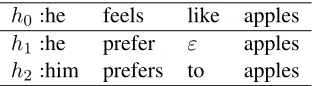
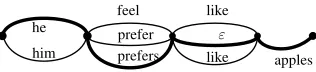
Table 1 shows hypothesesh1 andh2 are aligned to selected backbone h0. When alignment algorithm obtains good enough results, the expected output
“he prefers apples”is included in its corresponding
confusion network in Figure 1. This suggests de-veloping better alignment algorithm may help creat-ing high-quality confusion networks. This also mo-tivates us to use the BLEU of oracle hypotheses to approximately measure the quality of a set of CNs. We hereafter call it an oracle BLEU of a CN. See more in Section 5.1.
h0 :he feels like apples
h1 :he prefer ε apples
h2 :him prefers to apples
Table 1: A toy example of hypothesis alignment, where
h0 is the backbone hypothesis. h1andh2 are aligned to
the backbone separately. The resulting confusion net-work is in Figure 1.
A confusion network G = (V, E) is a directed
b b b b him
he
prefers prefer feel
ε like
like
b
[image:3.612.107.265.56.92.2]apples
Figure 1: A classic confusion network, and the bold path the expected output.
formally a weighted finite state automation (FSA), whereV is the set of nodes andEis the set of edges.
Each edge is restricted to attach to a single word as well as an associated probability. A special markε
is a place-holder denoting no word here.
2.2 IHMM-based Alignment
Indirected Hidden Markov Model (IHMM) was firstly proposed by He et. al (2008). Compared with TER-based alignment performing literal matching, IHMM supports synonym comparison in redefining emission probabilities in an IHMM model.
LetfI = (f1, . . . fI) be a backbone hypothesis,
andeJ = (e1, . . . eJ)be a hypothesis aligned to the
backbone, both being English sentences in our ex-periments. Let aJ = {a1, . . . aj} be an alignment.
Suppose theajth word infI is aligned tojth word
in eJ, and the conditional probability that the
hy-pothesis is generated by the backbone, shown in the upper graph of Figure 3, is given by
p(fI,eJ) =X
aJ J Y
j=1 {pt(a
j|aj−1, I)po(ej|faj)}
(1) Thedistortion probabilitypt(a
j|aj−1, I)from po-sition aj−1 toaj, relies on jumped distance, which
is computed as follows:
pt(i0|i, I) = c(i 0
−i)
PI
t=1c(t−i)
(2)
The distortion parameters c(d) are grouped into 11 buckets, c(≤ −4),c(−3),c(−2). . .c(5),c(≥ 6).
Because all the hypotheses in system combina-tion are in the same language, the IHMM model would support more monotonic alignments, and non-monotonic alignments will be penalized.
c(d) = (1 +|d−1|)−K, d=−4. . .6 (3)
whereKis tuned on held-out data.
Let p0 be the probability of jumping to a null word state, which is also tuned on held-out data, and the accurate transition probability becomes:
pt(i0|i, I) =
(
p0 ifi
0
=null (1−p0)pt(i
0
|i, I) otherwise
(4) The output probability po(e|f) from the state
wordf to the observation worde, also called
trans-lation probability, is a linear interpotrans-lation of se-mantic similarity psem(e|f) and surface similarity
psur(e|f), andαis the interpolation factor:
po(e|f) =αpsem(e|f) + (1−α)psur(e|f) (5)
When calculating semantic similaritypsem(e|f),
source sentencesrcis needed, and a bilingual
prob-abilistic dictionarypdic(w
1|w2)is necessary.
psem(e|f)≈ X c∈src
pdic(c|f)·pdic(e|c) (6)
Note thatpsem(e|f)has been updated with
differ-ent source sdiffer-entences.
The surface similarity psur(e|f) is measured by
the literal matching rate:
psur(e, f) = exp{ρ[ LMP(f, e)
max(|f|,|e|) −1]} (7)
where LMP(f, e) is the length of the longest
matched prefix, andρis a smoothing parameter.
3 Multi-objective Optimization
Many decision making problems in the real world consider more than one objective. One natural way is to scalarize multiple objectives into one by assign-ing it with a weight vector. This method allows a simple optimization algorithm in many cases, while in system combination, it would cause problems.
the alignment objectives in this work. More, the pa-rameter training in the third module relies on the CNs constructed from the output of the first mod-ule, which increases the instability of the whole sys-tem. Therefore, an unsupervised multi-objective al-gorithm may be a good choice allowing for more alignment information.
There exist other alternative optimization algo-rithms in the multi-objective optimization frame-work, though the evolutionary algorithm is adopted here, we only introduce some general concepts.
3.1 Pareto Optimal Solutions
A general multi-objective optimization problem consists of a number of objectives and is associated with a number of constraints. Mathematically, the problem can be written as follows (Deb, 2001)
Maximize fi(x) i= 1. . . M
s.t. gj(x)≤0 j= 1. . . N
hk(x) = 0 k= 1. . . K
wherexdenotes a potential solution, its structure
re-lying on different problems, and the number of con-straintsM, N, Kdepend on different problems. All
the functionsfi, gj, hkmap a solutionxinto a scalar.
We will explain them in terms of system combina-tion.
In this work, we refer tox ={xi,j|xi,j ∈ {0,1}}
as a potential alignment of a pair of hypotheses, wherexi,j is a boolean value to denotewhether the
ith word in the first hypothesis is aligned to thejth word in the second hypothesis. Here the definition of
xseems different from that ofain Formula 1, and
they could convert to each other. Using a line-based access style, a matrix can be unfolded as a vector. We refer tofas IHMM alignment probability (He et
al., 2008) and GIZA++ alignment probability (Chen et al., 2009), total four objectives from two direc-tions, and the larger the objectives, the better. The
gjs andhks serve as the role of checking ifx
repre-sents a legal alignment. For instance, the subscripts ofxi,j are not in bounds.
Definition 1. Let x, x0 be two potential align-ments. If fi(x) ≥ fi(x0) holds for all i, we call
the alignmentxdominates the alignmentx0. If there
0 1 2 3 4 5
0 1 2 3 4 5
b
p3
b
p5
b
p7
b
p1
⊕
p2
⊕
p6 ⊕
p4
X: Reversed IHMM Probability (1e-8)
Y
:D
ire
ct
IH
M
M
Pr
ob
ab
ili
ty
(1
[image:4.612.363.490.54.182.2]
e-8)
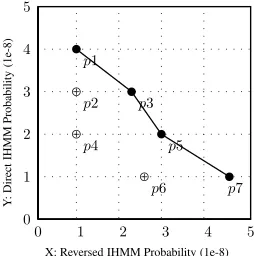
Figure 2: Sample solutions with only two objectives. Pareto Optimal Solutions p1, p3, p5, p7. Other points
p2, p4, p6are dominated by at least one point in the Pareto
optimal solutions.
does not exist any alignmentx00to dominatex, we call the alignmentxto be non-dominated.
Definition 2. A alignmentx is said to be Pareto optimal if there is no other alignment x0 found to dominatex.
In Figure 2, p1 dominates p2, and p2 dominates
p4. To summarize, a point is dominated by the ones on its upper and right side with ties. In this example,
p1,p3,p5,p7are Pareto optimal.
In some cases, Pareto optimal solutions can be used for good candidate solutions. Considering the IHMM model, maximizing Y axis, the top-4 best alignments are p1, p2, p3, p4. But from the view of Pareto optimal, the top-4 alignments would be p1, p3, p5, p7 without order, which considers a greater range than a single optimization model. In our method, we just combine these Pareto optimal solutions equally into a unique alignment (Section 3.3).
Our adopted multi-objective optimization search-ing algorithm is the non-dominated sortsearch-ing ge-netic algorithm II (NSGA-II) (Deb et al., 2000; Deb et al., 2002) with an open source software (http://www.iitk.ac.in/kangal/codes.shtml). NSGA-II has a complexity ofO(mn2), wheremis the num-ber of objectives andnis the population size in an evolutionary algorithm.
b b b
b b b
O:
S: f1 f2 f3
e1 e2 e3
b b b
b b b
S:
O:
e1 e2 e3
f1 f2 f3
Backbone
[image:5.612.115.256.55.150.2]Backbone
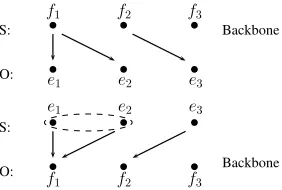
Figure 3: The same alignment(f1, e1)(f1, e2)(f2, e3)in
two IHMM models. The upper one is a typical example in IHMM, and in the bottom one, because any word in the observation is required not to correspond to two statuses, it has a minor trouble. S: status sequence, O: observation sequence.
(Chen et al., 2009), total four from two directions.
3.2.1 IHMM Probability
A typical IHMM alignment is demonstrated in the upper graph of Figure 3, where a backbone is acting the role of a status se-quence. The unnormalized conditional align-ment probability is [pt(1|null)]·[pt(1|1)pt(2|1)] ·
[po(e
1|f1)po(e2|f1)po(e3|f2)]. However, the same alignment (f1, e1)(f1, e2)(f2, e3), if we change the alignment direction, the backbone being observa-tions, would be a bit different. We offer a minor modification to Formula 1.
Look at the bottom graph of Figure 3, the obser-vation f1 has two statuses, e1 and e2 at the same time, it becomes ambiguous to compute the tran-sitional probability between pt(3|1) and pt(3|2).
This is because IHMM algorithm deals with one-to-many alignments, and MOEA permits many-to-many alignments.
We hence empirically modify the IHMM model to support many-to-many alignments. A new status is defined, rather than a single positionpt(j|i), but
as a set of positionspt({j}|{i}). The positions in
one status need not to be adjacent to each other. The redefinedtransitional probability
pt({j}|{i}) = 1 |{j}| · |{i}|
X
i,j pt(j|i)
The redefinedemission probability
po(j|{i}) =Y
i po(j|i)
We need to note that there is no guarantee on
the closed property of probabilities, though these approximations prove to be effective in a practical sense. Straightforwardly, when there is only one po-sition in a new status, the expanded IHMM degener-ates to the standard IHMM.
Let us return to the second IHMM ex-ample. The new probability becomes
[pt(1|null)pt(2|null)]·[1
2pt(3|1)pt(3|2)·pt(null|3)]·
[po(f
1|e1)po(f1|e2)po(f2|e3)po(f3|null)].
3.2.2 Alignment Probability
GIZA++ considers very different and more in-formation in alignment, we attempt to utilize them. All probabilities appearing in below formulas can be looked up in GIZA++.
Given a pair of hypotheses fI = (f1, . . . fI), eJ = (e1, . . . eJ), and their alignmenta, the
align-ment probability could be calculated as follows
pGiza(eJ|fI,a) =Y
ei
T(ei|fI,a)
T(ei|fI,a) =
(
n(φi|ei)P(j,i)∈at(ei|fj)a(j|i)/φi ifφi6= 0 n(0|ei)t(ei|null)a(0|i) otherwise
φi=|{j|(i, j)∈a}|
whereφi is the fertility number, t(e|c)the
transla-tion probabilityfor the word pair,z(j|i) alignment probabilityto show how likely a target word at
posi-tionicould be translated into a source word at
posi-tionj, andn(φ|e)is thefertility probabilityto show
how likely a given target wordeis translated intoφ
source words.
3.3 Configuration of Evolutionary Algorithm
3.3.1 Encoding
Given a sentence pair <fI,eJ>, we define a
two-dimensional matrixx = {zi,j|zij ∈ {0,1}}to
en-code a set of possible alignments. Using a line-based access style, the matrix could be unfolded as a vector with|I| · |J|bits of length.
3.3.2 Initialization
Because in NSGA-II software the initial popu-lation are generated at random. In order to make NSGA-II more consistent and flexible, better initial seeds should be fed with, thus we combine an ex-isting word alignment results as input. Here we use together two N-best lists generated from directional HMM and reversed HMM respectively for initializa-tion.
3.3.3 Normalization of Pareto Optimal Solutions
Multi-objective optimization algorithms do not pose weights on objectives, thus they output a set of so-called Pareto optimal solutions, each of which is a many-to-many alignment. We can understand them as an N-best alignment list without explicit preferences. We also empirically compare it with the idea that directly cuts an N-best list from the IHMM based alignment.
We describe a two-stage strategy for normaliza-tion. Firstly, we use a simple and effective voting strategy to combine a set of many-to-many align-ments into a single many-to-many alignment, and Secondly we normalize it into a one-to-one align-ment for confusion network construction. In the first stage, we count the number of word-to-word align-ments on each position pair(i, j). If there is more
than a half number of alignments, then we output 1, otherwise 0. In the second stage, if any word relates to more than one word alignment, the one with the highest posterior probability is selected (He et al., 2008; Feng et al., 2009). The posterior probabili-ties can be computed in a classic forward-backward procedure in IHMM (He et al., 2008).
4 Training and Decoding
Our work does not change the classic pipeline, thus the model and features are nearly identical to the
ones in (Rosti et al., 2007b; He et al., 2008), which are modeled in a log-linear fashion in Eq. 8. Trans-lation on a CN is just a concatenation of edges tra-versed, on which 4 categories of features are defined.
1. word posterior probabilities. In Eq. 8, p(w|sys, span)are word confidence scores. If
the word wcomes from the kth hypothesis of thesys-th system, the raw score should be k+11 ,
and then it would be normalized by the same
sys and span. The same word coming from different systems owns a different score, so there aresyssystem weightsλsys.
2. logarithm of language model score,L(h).
3. number ofnulledge,N umnull.
4. number of words,N umw.
log(h) = P
spanlog( P
sysλsysp(w|sys, span))
+ w0L(h) +w1N umnull+w2N umw
(8) Decoding a confusion network is straightforward, traversing each node from left to right, and the beam search algorithm will retain for each node an N-best list. The final N-N-best can be acquired following (Huang and Chiang, 2005).
The training process follows minimum error rate training (MERT) described in (Och, 2003; Koehn et al., 2003). In each iteration, the Powell algorithm would attempt to predict the optimal parameters on the cumulative N-best list.
5 Experiments
We evaluate our method in two datasets in the Chinese-to-English task. In the first one, NIST MT 2002 and 2005 are used for tuning and testing re-spectively, and in the second, the newswire part of MT 2006 and 2008 are for tuning and testing. A 5-gram language model is trained on the Xinhua por-tion of the Gigaword corpus. We report the case-sensitive NIST-BLEU score.
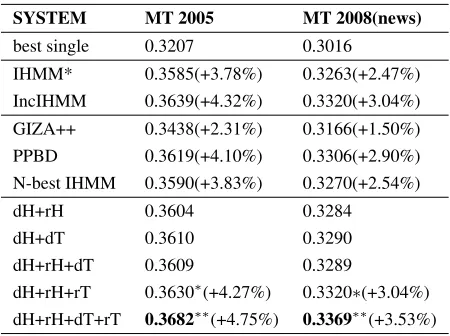
SYSTEM MT 2005 MT 2008(news)
best single 0.3207 0.3016
IHMM* 0.3585(+3.78%) 0.3263(+2.47%) IncIHMM 0.3639(+4.32%) 0.3320(+3.04%) GIZA++ 0.3438(+2.31%) 0.3166(+1.50%) PPBD 0.3619(+4.10%) 0.3306(+2.90%) N-best IHMM 0.3590(+3.83%) 0.3270(+2.54%)
dH+rH 0.3604 0.3284
dH+dT 0.3610 0.3290
dH+rH+dT 0.3609 0.3289
dH+rH+rT 0.3630∗(+4.27%) 0.3320∗(+3.04%)
[image:7.612.73.298.53.221.2]dH+rH+dT+rT 0.3682∗∗(+4.75%) 0.3369∗∗(+3.53%)
Table 2: PPBD is a posterior probabilistic-based decod-ing (section 5.3). N-best IHMM simulates the Pareto op-timal solutions in our method (section 5.3). The last five systems adopt different objective combinations. The im-provement percents in parentheses are compared to the best single. dH: directed IHMM, rH: reversed IHMM, dT: directed translation probability, rT: reversed transla-tion probability. ∗∗ significance at 0.01 level, and∗
sig-nificance at 0.05 level over the IHMM model.
and test sets are collected as the input of the system combination.
Our baseline systems are described as follows. Two main baseline systems are IHMM based and in-cremental IHMM (Li et al., 2009). The first system differs from our method just in hypothesis alignment algorithm, and the second combines the first and sec-ond module of the system combination pipeline.
Because our method utilizes bidirectional infor-mation, we also provide another two alternative systems for comparison, which are GIZA++ based alignment and the posterior probability based align-ment (Liang et al., 2006). Finally, we also provide an N-best alignment IHMM system, which com-bines an N-best alignment list to simulate the Pareto optimal solutions in our method.
The method that linearly combines all objectives is not listed as our baseline like (Duh et al., 2012) does, because their algorithm finds the best weighted solution in a fixed and small solution set, while in our problem, the solution space is a trellis-style structure consisting of an exponential number of so-lutions, and no efficient algorithms apply here.
The IHMM based alignment utilizes typical set-tings (He et al., 2008; Feng et al., 2009). The
smoothing factor for the surface similarity model, and ρ = 3 the controlling factor for the
distor-tion model, K = 2. The bilingual probabilistic
dictionary is trained in the FBIS corpus which in-cludes about 230k parallel sentence pairs. GIZA++ based system is to run GIZA++ from two directions to align all the hypotheses, and make the intersec-tion using grow-diag-final heuristics (Koehn et al., 2003). The many-to-many alignments are normal-ized with the same method with ours. Our system employs NSGA-II software to realize the MOEA al-gorithm. The main parameters, generation number, cross probability and mutation probability, and pop-ulation size, are empirically set as 100, 0.9, 0.001 and 40, and we examine the influence of difference populations sizes in the full system combination.
5.1 The Quality of Confusion Networks
This experiment shows the relationship between hy-pothesis alignment and confusion network. Intu-itively, we expect a better hypothesis alignment would reduce the error in constructing confusion networks, and then improve the final translation quality.
We first use thealignment error rate(AER) (Och
and Ney, 2000), which is widely used to measure the quality of hypothesis alignment. The smaller, the better. For convenience, we only examine exact literal matching. IHMM based alignment reaches around 0.15 in AER, and our method 0.145.
As the AER may not vividly reflect the relations between alignment and the final BLEU of systems, and the quality of confusion network is hard to mea-sure directly, we assume that the quality of confu-sion networks could be measured by the oracle hy-potheses that could be generated from them. We test the BLEU of the oracle hypotheses.
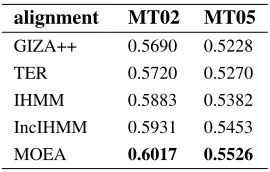
From this angle, we demonstrate several oracle BLEU of CNs generated from some conventional alignment algorithms. The results are shown in Ta-ble 3.
alignment MT02 MT05
GIZA++ 0.5690 0.5228
TER 0.5720 0.5270
IHMM 0.5883 0.5382
IncIHMM 0.5931 0.5453
[image:8.612.118.253.53.139.2]MOEA 0.6017 0.5526
Table 3: Oracle BLEUs of CNs. GIZA++: invoking GIZA++ software. TER: minimum translation edit rate. IHMM: indirect hidden markov model. IncIHMM: in-cremental indirect hidden markov model. MOEA: multi-objective evolution algorithm.
that from IHMM based in the oracle BLEU, we ex-pect our final translation quality would be improved. In Table 3, GIZA++ and TER perform simi-larly, because the former is more capable of tackling many-to-many alignments over the latter, while lat-ter based might obtain relatively more precise align-ment information. Both of the two do not consider synonym matching compared to IHMM.
Our method and IncIHMM overpass IHMM on this metric due to different strategies. Obtaining bet-ter hypothesis alignment or betbet-ter construction of confusion networks benefit the quality of CNs.
5.2 Different Objective Combinations
As our framework is convenient to support different alignment information, we test the influence of dif-ferent objective combinations to the final translation quality. We adopt four objectives to depict the can-didate alignment, directed IHMM probability (dH), reversed IHMM probability (rH), directed alignment probability (dT), and reversed alignment probability (rT). Table 2 demonstrates all the results.
We can see that the IHMM based system out-performs the GIZA++ based system by about 1-1.5 points in BLEU, which agrees with the difference of oracle BLEU in Table 1. From (He et al., 2008), the IHMM based system outperforms the TER based by 1 point, which also agrees with our results in Table 1. Our system, using dH + rH + dT + rT, improves BLEU score by about 1 points over the IHMM based system. This comparison verifies our assumption, improving the quality of the confusion network does improve system performance.
The different feature combinations exhibit inter-esting results. The system with dH + rH + dT is
0.05 point better than the system with dH + rH, and the system dH + rH + rT is 0.3 point better than sys-tem with dH + rH, so the contributions of feature dT and rT are 0.05 and 0.3 respectively. While the two features are used together in the fourth system, the contribution is about 0.8 point, rather than 0.35. This phenomenon also proves the correlations be-tween different features.
Our method explores a way to integrate GIZA++ and IHMM, and is supportive of useful features. Compared to the classic and powerful IHMM based system, we obtained an improvement of 0.97 points on MT 05 and 1.06 points on news of MT 2008, and equivalently over the best single system by 4.75 points and 3.53 points respectively. More, compared with the incremental IHMM, our system also shows moderate improvement, though not much. We hope these two ideas could be effectively combined in the future work.
5.3 Comparison with Other Bi-directional Alignment Methods
Our method introduces multiple alignment infor-mation into system combination to obtain improve-ments, thus it would be interesting to explore other alternative methods for utilizing this information. We provide three alternative methods similar to our motivations, and they fall into two categories.
The first category is from the angle of bi-directional alignment. We use GiZA++ alignment and the posterior probability decoding-based align-ment for comparison. The basic idea for the lat-ter is setting a word-to-word alignment xi,j as 1,
if its approximate posterior marginal probability
q(xi,j, x) = pd(xi,j|x, θd)·pr(xi,j|x, θr)is greater
than a threshold δ, where pd and pr are posterior
marginal probabilities from directed and reversed IHMM models, which could be conveniently com-puted with a forward-backward algorithm, and theδ
is tuned on a validation-set optimized data. We just list someδ values to examine its best performance
shown in Table 4.
The second class is because our method combines the Pareto optimal solutions that consist of several candidate alignments, thus for fairness we also use a 100-best outputs from the directed IHMM model and conduct the same normalization technique.
δ MT 2005 MT 2008
IHMM 0.3585 0.3263 0.15 0.3556 0.3391
0.2 0.3619 0.3306
[image:9.612.120.251.52.138.2]0.25 0.3575 0.3278 0.3 0.3608 0.3259
Table 4: Posterior decoding. When thresholdδ are set to suitable values, simple bi-directional alignment could overpass the baseline.
see that, GIZA++ leads to the worst performance, which can be explained as GIZA++ does not support synonym matching like IHMM. The N-best IHMM has a minor improvement over the IHMM method. We found differences in the N-best list are not obvi-ous enough. In comparison, the posterior decoding method brings relatively significant improvements on both datasets. However, the threshold δ must
be selected suitably. Table 4 lists the ideal results, which will be hampered when tuning on a validation set.
All of the three candidate methods can not conve-niently support extra alignment information, and a linear model poses restrictions on features to get an efficient decoding, the multi-objective optimization may be a good selection as an inference algorithm in many circumstances.
5.4 Population Size
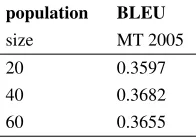
We test the influence of final translation quality and time consumed by different population size.
population BLEU
size MT 2005
20 0.3597
40 0.3682
60 0.3655
Table 5: Big population size consumes more CPU time. In our experiments, we use a multi-thread technique to speed up the alignment, and choose 40 as the parameter to leverage the time and BLEU.
We expect enlarging the population size would improve the translation quality, but the BLEU in population size set as 60 does not overpass when set as 40. We conjecture that, in our code, if the N-best size from IHMM (we set as 50-best) does not reach
the population size, we would use randomly gener-ated seeds, which may hamper the performance of MOEA. We also tried a larger population in MOEA, but did not receive obvious improvement on perfor-mance.
We exerted a hard restriction on the genes in evo-lutionary algorithm, that is many-to-many discon-tiguous alignment is forbidden. This trick speeds up running by about 20 times, and does not harm sys-tem performance. Now our method runs about 0.9 seconds to align a pair of hypotheses. In practice, we utilize multi-thread to speed up.
6 Conclusion
In this paper, we explore a multi-objective frame-work to conveniently support more useful alignment objectives to improve the hypothesis alignment. By a minor modification of the first module in the classic pipeline, we successfully combine GIZA++ and IHMM to obtain significant improvement over a powerful and state-of-the-art IHMM based sys-tem. In comparison with another genre of improving system combination by combing adjacent modules of the pipeline, more powerful incremental IHMM here, our system also show moderate improvement. Though, our best system may not overpass He and Toutanova (2009) who combine all the modules into a unified training procedure, we believe our method could boost many work on the higher modules of the pipeline to obtain a further improvement to match their work.
7 Acknowledgement
This research is partially supported by Air Force Office of Scientific Research under grant FA9550-10-1-0335, the National Science Foundation under grant IIS RI-small 1218863 and a Google research award. We thank the anonymous reviewers for their insightful comments.
References
B Bangalore, German Bordel, and Giuseppe Riccardi. 2001. Computing consensus translation from multi-ple machine translation systems. InAutomatic Speech Recognition and Understanding.
[image:9.612.138.236.501.570.2]model based on multiobjective evolutionary algo-rithms. Computers and Mathematics with Applica-tions, 57.
Kalyanmoy Deb, Samir Agrawal, Amrit Pratap, and Tanaka Meyarivan. 2000. A fast elitist non-dominated sorting genetic algorithm for multi-objective optimiza-tion: Nsga-ii. Lecture notes in computer science,
1917:849–858.
Kalyanmoy Deb, Amrit Pratap, Sameer Agarwal, and TAMT Meyarivan. 2002. A fast and elitist multiob-jective genetic algorithm: Nsga-ii.Evolutionary Com-putation, IEEE Transactions on, 6(2):182–197.
Kalyanmoy Deb. 2001. Multi-objective optimization.
Multi-objective optimization using evolutionary algo-rithms, pages 13–46.
John DeNero, Shankar Kumar, Ciprian Chelba, and Franz Och. 2010. Model combination for machine transla-tion. InProc. of NAACL, pages 975–983.
Kevin Duh, Katsuhito Sudoh, Xianchao Wu, Hajime Tsukada, and Masaaki Nagata. 2012. Learning to translate with multiple objectives. In Proc. of ACL,
pages 1–10.
Andries P Engelbrecht. 2005. Fundamentals of compu-tational swarm intelligence, volume 1. Wiley
Chich-ester.
Yang Feng, Yang Liu, Haitao Mi, Qun Liu, and Ya-juan Lü. 2009. Lattice-based system combination for statistical machine translation. In Proc. of EMNLP,
EMNLP ’09.
G David Forney Jr. 1973. The viterbi algorithm. Proc. of the IEEE, 61(3):268–278.
Michael Pilegaard Hansen. 1997. Tabu search for mul-tiobjective optimization: Mots. In Proc. of Multiple Criteria Decision Making, pages 574–586.
Xiaodong He and Kristina Toutanova. 2009. Joint opti-mization for machine translation system combination. InProc. of EMNLP.
Xiaodong He, Mei Yang, Jianfeng Gao, Patrick Nguyen, and Robert Moore. 2008. Indirect-hmm-based hy-pothesis alignment for combining outputs from ma-chine translation systems. InProc. of EMNLP.
Liang Huang and David Chiang. 2005. Better k-best parsing. InProc. of IWPT.
Fei Huang and Kishore Papineni. 2007. Hierarchical system combination for machine translation. InProc. of EMNLP-CoNLL.
Philipp Koehn, Franz Josef Och, and Daniel Marcu. 2003. Statistical phrase-based translation. In Proc. of NAACL.
Philipp Koehn, Hieu Hoang, Alexandra Birch, Chris Callison-Burch, Marcello Federico, Nicola Bertoldi, Brooke Cowan, Wade Shen, Christine Moran, Richard
Zens, et al. 2007. Moses: Open source toolkit for sta-tistical machine translation. InProc. of ACL: Poster,
pages 177–180.
Shankar Kumar, Wolfgang Macherey, Chris Dyer, and Franz Och. 2009. Efficient minimum error rate train-ing and minimum bayes-risk decodtrain-ing for translation hypergraphs and lattices. InProc. of Joint ACL and AFNLP.
Zhifei Li and Sanjeev Khudanpur. 2009. Forest rerank-ing for machine translation with the perceptron algo-rithm. GALE book chapter on MT From Text.
Chi-Ho Li, Xiaodong He, Yupeng Liu, and Ning Xi. 2009. Incremental hmm alignment for mt system com-bination. InProc. of Joint ACL and AFNLP.
Percy Liang, Ben Taskar, and Dan Klein. 2006. Align-ment by agreeAlign-ment. InProc. of NAACL.
Evgeny Matusov, Nicola Ueffing, and Hermann Ney. 2006. Computing consensus translation from multiple machine translation systems using enhanced hypothe-ses alignment. InProc. of EACL.
Haitao Mi, Liang Huang, and Qun Liu. 2008. Forest-based translation. Proc. of ACL-08: HLT, pages 192–
199.
F. J. Och and H. Ney. 2000. Improved statistical align-ment models. pages 440–447, October.
Franz Josef Och. 2003. Minimum error rate training in statistical machine translation. InProc. of ACL, pages
160–167.
Adam Pauls, John DeNero, and Dan Klein. 2009. Con-sensus training for conCon-sensus decoding in machine translation. InProc. of EMNLP.
Antti-Veikko I Rosti, Necip Fazil Ayan, Bing Xiang, Spy-ros Matsoukas, Richard Schwartz, and Bonnie Dorr. 2007a. Combining outputs from multiple machine translation systems. InProc. of NAACL-HLT.
Antti-Veikko I Rosti, Spyros Matsoukas, and Richard Schwartz. 2007b. Improved word-level system com-bination for machine translation. InProc. of ACL,
vol-ume 45.
Antti-Veikko I Rosti, Bing Zhang, Spyros Matsoukas, and Richard Schwartz. 2008. Incremental hypothesis alignment for building confusion networks with appli-cation to machine translation system combination. In
Proc. of WSMT.
Paolo Serafini. 1994. Simulated annealing for multi ob-jective optimization problems. In Proc. of Multiple Criteria Decision Making, pages 283–292. Springer.
Khe Chai Sim, William J Byrne, Mark JF Gales, Hichem Sahbi, and Phil C Woodland. 2007. Consensus net-work decoding for statistical machine translation sys-tem combination. InProc. of ICASSP, volume 4.