Decrease in eccentric quadriceps and
hamstring strength in recreational
alpine skiers after prolonged skiing
Arnold Koller, Birgit Fuchs, Veronika Leichtfried, Wolfgang Schobersberger
To cite:Koller A, Fuchs B, Leichtfried V,et al. Decrease in eccentric quadriceps and hamstring strength in recreational alpine skiers after prolonged skiing.BMJ Open Sport Exerc Med2015;0: e000028. doi:10.1136/ bmjsem-2015-000028
▸ Prepublication history for this paper is available online. To view these files please visit the journal online (http://dx.doi.org/10.1136/ bmjsem-2015-000028).
Accepted 23 July 2015
Institute for Sports Medicine, Alpine Medicine & Health Tourism, tirol kliniken and Private University for Health Sciences, Medical Informatics and Technology, Hall, Austria
Correspondence to Dr Arnold Koller;
ABSTRACT
Background:To effectively prevent injury in recreational alpine skiing, it is important to identify modifiable risk factors that can be targeted through exercise and training. Fatigue is a potential risk factor in recreational skiing, but no investigations have evaluated concentric/eccentric quadriceps and hamstring fatigue in recreational skiers. We tested the hypothesis that recreational skiing is associated with more pronounced eccentric as compared with concentric muscle fatigue.
Methods:Twenty-four healthy and fit recreational skiers (14 male and 10 female) performed an isokinetic muscle test 1 day before, 1 h after, and 24 h after a 4 h skiing session. The testing protocol consisted of concentric and eccentric quadriceps and hamstring contractions for both legs.
Results:Eccentric peak hamstring torque (both thighs) and eccentric peak quadriceps torque (left thigh) were reduced in male and female participants ( p<0.05). Reduced peak torques were still present 24 h after the skiing session. There were no other significant findings.
Summary:Recreational skiing is associated with prolonged (at least 24 h) eccentric quadriceps (left thigh) and hamstring (both thighs) fatigue in men and women. Eccentric quadriceps and hamstring fatigue may be a potential injury risk factor in male and female recreational skiers. This provides some justification for judicious use of additional eccentric training modalities for alpine skiing.
Changes in modern ski equipment and improvements in slope design and mainten-ance have contributed to a decline in
injur-ies, yet there is still a significant number of
skiing injuries.1 Previously, fractures were
more common, but since these technical changes, injuries of the ligaments of the
knee have increased.2
To prevent injury effectively, we should
identify modifiable risk factors that can be
targeted through exercise and training.3
According to expert stakeholders in the World Cup ski racing community, a superior
fitness level is one of the most important
perceived factors for injury prevention.4
Although the importance of a high-fitness
level for injury prevention is widely accepted
in practice, this is not supported by scientifi
c-ally validated recommendations.3
Fatigue is known to have a negative impact
on balance control, and physicalfitness has a
positive effect on reaction time during
exer-cise.5 6Therefore, it seems reasonable that a
lack of fitness and early fatigue could both
be independent risk factors for injuries in
alpine skiers.7 Surprisingly, perceived fatigue
does not seem to be a major risk factor for anterior cruciate ligament (ACL) injury in
recreational skiers.8 Moreover, eccentric
knee extensor muscle activity is considered a particular feature of alpine skiing and the preventive exercises deemed most important for preventing injuries in alpine skiing are eccentric exercises (eg, eccentric training to shift the optimal muscle length of hamstring
muscles).9 In contrast to competitive alpine
skiing, a significantly higher risk of injury has
been reported in women than men in
recre-ational skiing.10 During turns in alpine
skiing, eccentric knee extensor muscle activ-ity is dominant and is higher in magnitude and up to twice as long in duration
com-pared with concentric activity.9
Unexpectedly, mitochondrial protein con-centration does not increase in the vastus lateralis muscle after 28.5 days of alpine
skiing over 3 months.11 In contrast, an
Summary box
▪ This study is the first to show that recreational skiing is associated with prolonged eccentric quadriceps and hamstring fatigue.
▪ Presumably, concentric types of endurance train-ing (eg, biktrain-ing, walktrain-ing) do not prevent fatigue during eccentric (ie, skiing) types of endurance exercise.
▪ Judicious use of eccentric types of endurance training may be warranted in recreational skiers.
copyright.
on May 7, 2020 by guest. Protected by
increased capillary-to-fibre ratio and capillary density
reflects a net increase in capillary supply to knee
exten-sor muscles after ski training, and adaptations of muscle energy supply lines with recreational skiing differ from
the effects of concentric types of endurance training.11
This finding is consistent with a specific increase in
capillarity with eccentric types as opposed to concentric
types of endurance exercise,12 suggesting that modifi
ca-tions in capillarity with skiing are driven by mechanical
rather than metabolic factors.11 Moreover, eccentric
hamstring fatigue occurs in response to football-specific
exercise and marathon running.13 14 However, to the
best of our knowledge, no investigations have aimed at evaluating concentric/eccentric quadriceps and ham-string fatigue in alpine skiing. Thus, we aimed to test the hypothesis that recreational alpine skiing is associated with pronounced eccentric muscle fatigue.
METHODS Study design
The recruitment process for this study involved broad-casting via local radio stations. To obtain a homogeneous sample, middle-aged participants were selected according to their skiing ability and physical activity. All participants were at an intermediate level based on the Austrian Ski
Teaching Concept.15Intermediate-level skiers are able to
perform short-radii and long-radii turns on prepared
ter-rains. Onflat terrain, intermediate-level skiers are able to
execute carved turns but perform mostly skid turns on steep terrain. Physical activity in leisure time was graded as one of four levels using the Copenhagen City Heart
Study Leisure Time Physical Activity Questionnaire.16
Participants belonged to group III: light physical activity for more than 4 h per week or more vigorous activity for
2–4 h per week (eg, brisk walking, fast biking, sports that
cause perspiration or exhaustion).16 The activity
ques-tionnaire has been shown to discriminate between seden-tary people and their more active counterparts with
respect to maximal oxygen uptake.16 No systematic
eccentric-based training protocols were implemented in the training programmes. Thirty skiers volunteered to participate in this study.
All participants underwent the following screening protocol. First, after obtaining the medical history and conducting a physical examination, a 12-lead electrocar-diogram at rest and spirometry were performed. In add-ition, blood was collected, and standard laboratory parameters (including red and white cell counts and C reactive protein levels) were measured. Participants were excluded if they suffered from major chronic illnesses such as hypertension, diabetes, chronic obstructive pul-monary disease, coronary artery disease requiring treat-ment or had a history of knee joint ligatreat-mentous trauma. An incremental standard cycle protocol was used to determine peak exercise capacity.
One day before the skiing session, 24 participants (14 male and 10 female skiers) performed an isokinetic
muscle test. The test was repeated 1 h and 1 day after the skiing session. The dominant leg was determined by asking skiers which leg they prefer to kick a ball with, as
described by another study.17 Written informed consent
was given by all participants. The study protocol was approved by the ethics committee of the Medical University of Innsbruck (AN-2013-0028).
Cycle ergometry
Participants’ performance capacity was assessed by
maximal exercise testing on the Excalibur Sport cycle ergometer (Lode B.V., Groningen, the Netherlands). Male participants started at 70 W, with stepwise increases of 30 W every 2 min until exhaustion. Female partici-pants started at 50 W, with stepwise increases of 25 W every 90 s. Capillary blood samples were taken from the ear lobe immediately after each workload to determine lactate concentration (lactateanalyser Biosen C_line, EKF Diagnostic, Barleben, Germany). Values of maximal power output during cycle ergometry corrected for body
mass were used to assess aerobic power.18
Isokinetic dynamometry
An isokinetic dynamometer (CON-TREX MJ; CMV AG, Zürich, Switzerland) was used to generate angle-torque curves. An angle-torque curve is a measure of torque as a function of knee angle produced when the muscle is maximally activated during isovelocity shortening or stretching. After warming up for 10 min on a bicycle, participants sat on the dynamometer with their hip
flexed to approximately 90° and their trunk secured
with dual cross-over straps and a waist strap. The range
of motion at the knee was set at 110° and was modified
according to the available passive motion and the
parti-cipant’s tolerance. The angle was 0° when the leg was
fully extended at the knee and 110° when it wasflexed.
A thigh strap on the test leg was used to restrict any
lateral movement at the knee, allowing only flexion and
extension. Both legs were tested, and the testing proto-col consisted of concentric and eccentric quadriceps and hamstring contractions (ie, four repetitions each at an angular velocity of 60°/s) after familiarisation with the equipment (2 min; submaximal trials at an angular velocity of 60°/s). Torque and angle signals were trans-ferred from the dynamometer to a computer and
ana-lysed. Optimum peak torque was recorded for
hamstrings and quadriceps of both legs and used for statistical analyses. In addition, optimum peak torque was corrected for body mass.
Skiing
The prolonged skiing session took place at the Patscherkofel Ski Area in Innsbruck, Austria. The testing period was in March 2014. Participants were requested to ski at their habitual speed using their preferred tech-nique; thus, they skied at their own self-selected pace. Weather conditions were similar for all participants (ie, no snowfall). The skiing session started at about 9:00.
copyright.
on May 7, 2020 by guest. Protected by
After a 60 min break following 2 h of skiing, participants skied for an additional 2 h. With GPS tracking (iSki Tracker, Feratel Media Technologies AG, Innsbruck, Austria), slope kilometres, vertical distance (ie, metres of altitude) and speed were recorded. Heart rate was mea-sured continuously via the Polar RS 400 (Polar Electro Oy, Kempele, Finland) during the entire skiing session.
Statistical analysis
SPSS V.20.0 (Statistical Package for Social Sciences, Chicago, Illinois, USA) was used to perform all statistical analyses. The distribution of data was evaluated using box plots. All parameters were normally distributed.
Following significant effects in repeated measures
ana-lysis of variance, Student’s t tests were used to identify
significant changes in parameters between each time
point and baseline values. Student’s t tests were also
used to analyse group differences. Categorical variables are reported as proportions, and numerical data are reported as mean± SD. A p value of <0.05 was
consid-ered statistically significant.
RESULTS
After physical examination and ergometry, six partici-pants were excluded (two men and four women). Therefore, 24 participants (14 males and 10 females) underwent further testing. Age, height and weight of the remaining 24 participants were 49.0±6.7 years, 172.3 ±10.1 cm and 73.3±12.5 kg, respectively. All participants
finished the skiing session. Maximum heart rate (141.2
±13.4 bpm) during skiing was 77.4% of the maximum heart rate measured during the incremental cycle test
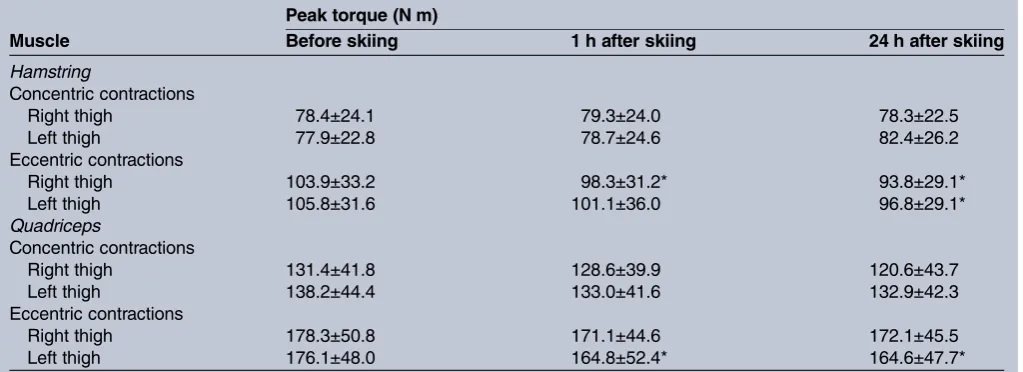
(182.4±9.8 bpm). Interestingly, there were no significant
differences in peak torque before and after skiing, except for eccentric peak hamstring torque (both
thighs) and eccentric peak quadriceps torque (left
thigh) (table 1).
Additional evaluation of sex differences showed that the right leg was the most preferred kicking leg in 86% of men and 80% of women. Values of maximal power
output corrected for body mass were significantly
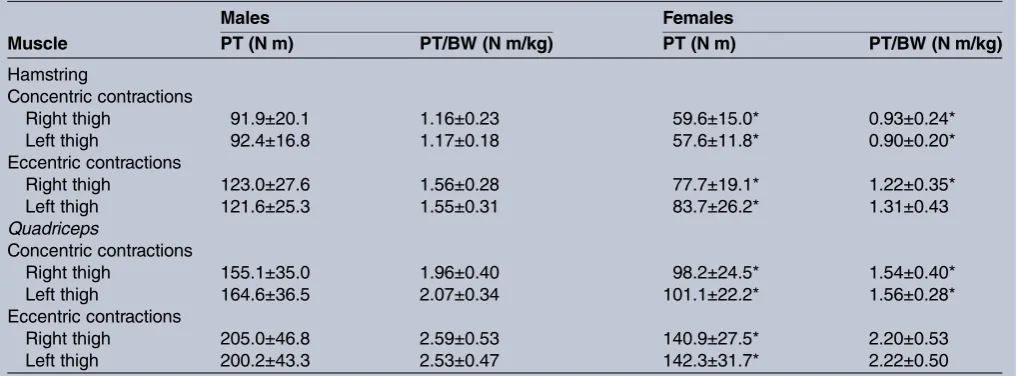
differ-ent between women (2.92±0.39 W/kg) and men (3.3 ±0.59 W/kg) ( p=0.003). Baseline absolute peak torque values (concentric and eccentric) and baseline concen-tric peak torque values corrected for body mass were
also significantly different between female and male
skiers (table 2).
In contrast, female and male skiers did not display
sig-nificant differences in eccentric peak torque corrected
for body mass, except that eccentric peak hamstring torque corrected for body mass was reduced in the right
thigh of females (table 2). Moreover, male and female
skiers did not display significant bilateral limb differences
in thigh muscle strength for any of the strength variables (table 2). No significant differences were observed in slope kilometres between females (31.1±4.8 km) and males (30.3±5.8 km). Maximal speed during skiing was
significantly higher in male skiers (77.5±17.4 km/h) than
in female skiers (63.4±7.05 km/h). Only eccentric peak hamstring torque (both thighs) and peak quadriceps
torque (left thigh) were significantly reduced in females
and males after 4 h of skiing. In addition, women and
men did not display significant differences in change in
peak torques (ΔPT) for any of the strength variables
( ps>0.05), except for eccentric peak hamstring torque
(ΔPTHecc) (left thigh) 1 day after the ski session (males:
ΔPTHecc=1.2 N m (1% decline); females: ΔPTHecc=9.7
N m (11.6% decline); p=0.013). No significant
differ-ences in change in eccentric peak quadriceps torque
cor-rected for body mass (ΔPTQ(BW)ecc) (left thigh) were
[image:3.595.44.556.521.707.2]observed in either women (ΔPTQ(BW)ecc=0.19±0.34 (1 h
Table 1 Peak hamstring and quadriceps torque in recreational skiers after 4 h of skiing Peak torque (N m)
Muscle Before skiing 1 h after skiing 24 h after skiing
Hamstring
Concentric contractions
Right thigh 78.4±24.1 79.3±24.0 78.3±22.5
Left thigh 77.9±22.8 78.7±24.6 82.4±26.2
Eccentric contractions
Right thigh 103.9±33.2 98.3±31.2* 93.8±29.1*
Left thigh 105.8±31.6 101.1±36.0 96.8±29.1*
Quadriceps
Concentric contractions
Right thigh 131.4±41.8 128.6±39.9 120.6±43.7
Left thigh 138.2±44.4 133.0±41.6 132.9±42.3
Eccentric contractions
Right thigh 178.3±50.8 171.1±44.6 172.1±45.5
Left thigh 176.1±48.0 164.8±52.4* 164.6±47.7*
Twenty-four recreational alpine skiers (14 males and 10 females) performed an isokinetic muscle test 1 day before, 1 h after, and 24 h after a 4 h skiing session.
*Significant difference before and after skiing (p<0.05) Values are shown as mean±SD.
copyright.
on May 7, 2020 by guest. Protected by
after skiing) and 0.14±0.21 (24 h after skiing)) or men
(ΔPTQ(BW)ecc=0.13±0.29 (1 h after skiing) and 0.13
±0.31 (24 h after skiing)) ( p=0.65 (1 h after skiing); p=0.92 (24 h after skiing)).
DISCUSSION
Different methodological approaches in recent years have increased our understanding of why and how injuries
occur in alpine skiing.19However, there is a paucity of
sci-entific literature on modifiable (ie, trainable) risk factors
for injury prevention in recreational skiers.3 In
non-professional skiing, female skiers have twice the risk of
serious knee injuries as male skiers.2 Environmental
factors, such as cold temperature and snowfall, as well as personal factors, such as leg dominance, could potentially
have a greater impact on injury risk among women.17 20
Limb strength after prolonged skiing
The current study did not involve an extreme skiing load. The participants performed at an intensity that is
consistent with recreational skiing.21 We found
pro-longed (ie, at least 1 day) eccentric hamstring fatigue in thighs and eccentric quadriceps fatigue in the left thigh in recreational endurance-trained (ie, concentric type of
endurance exercise11) alpine skiers even at the end of
the winter season, when participants may be conditioned
to eccentric loading during skiing.9 Consequently, one
might expect a more pronounced decline in eccentric strength at the start of the winter season. This suggests eccentric training as a training adjunct in strength and conditioning programmes for recreational alpine skiers.
Eccentric fatigue and perceived exertion
A recent study reported that ACL-injured recreational
skiers perceive significantly less local and overall fatigue
than uninjured controls,8although there were some
lim-itations of the interview approach used in this study.
Perceived exertion is reported to be ‘fairly light’ during
eccentric exercise.22 23 Consequently, perceived fatigue
may not reflect true fatigue (ie, decline in eccentric
muscle strength) during eccentric exercises, challenging the notion that ACL injuries may not be related to
fatigue.8
Comparison of limb strength between male and female skiers
Baseline values of absolute strength were lower in female skiers than in male skiers. The use of absolute strength values, however, may not be appropriate when comparing men and women. Instead, body mass
normal-isation is recommended.24 25Despite there being no
sig-nificant difference in concentric peak torque before
and after skiing, and no difference in slope kilometres skied between men and women, concentric peak torque values corrected for body mass and body weight-normalised maximal power output during cycle
ergome-try were significantly lower in female skiers than in male
skiers. This suggests that concentric muscle action may not be a performance-limiting factor in prolonged recre-ational skiing. This is hardly surprising, because during recreational skiing an eccentric type as opposed to a
concentric type of endurance exercise is dominant.11
Interestingly, previous work shows no correlation
between racing performance and concentric peak
torque and work for knee extension and flexion in
either sex of elite skiers.26 Thus, one may speculate that
concentric muscle action may also not be a
performance-limiting factor in ski racing.27
[image:4.595.45.554.75.263.2]Strikingly, there was no sex difference in baseline body weight-normalised eccentric peak quadriceps torque. Although female skiers showed lower eccentric peak
Table 2 Comparison of absolute (PT) and body weight-normalised (PT/BW) baseline peak torque between male and female skiers
Males Females
Muscle PT (N m) PT/BW (N m/kg) PT (N m) PT/BW (N m/kg)
Hamstring
Concentric contractions
Right thigh 91.9±20.1 1.16±0.23 59.6±15.0* 0.93±0.24*
Left thigh 92.4±16.8 1.17±0.18 57.6±11.8* 0.90±0.20*
Eccentric contractions
Right thigh 123.0±27.6 1.56±0.28 77.7±19.1* 1.22±0.35*
Left thigh 121.6±25.3 1.55±0.31 83.7±26.2* 1.31±0.43
Quadriceps
Concentric contractions
Right thigh 155.1±35.0 1.96±0.40 98.2±24.5* 1.54±0.40*
Left thigh 164.6±36.5 2.07±0.34 101.1±22.2* 1.56±0.28*
Eccentric contractions
Right thigh 205.0±46.8 2.59±0.53 140.9±27.5* 2.20±0.53
Left thigh 200.2±43.3 2.53±0.47 142.3±31.7* 2.22±0.50
Absolute (PT) and body weight-normalised (PT/BW) baseline peak torque in male and female skiers assessed with isokinetic dynamometry. *Significant difference between male and female skiers (p<0.05). Values are shown as mean±SD.
copyright.
on May 7, 2020 by guest. Protected by
hamstring torque corrected for body mass (right thigh) compared with male skiers, both sexes displayed reduced eccentric hamstring strength in both thighs
after skiing. Interestingly, a recent study by Jordanet al25
reports no sex differences in hamstring or quadriceps strength measured using isometric dynamometry when corrected for body mass in ski racers. In addition, no bilateral limb difference in thigh muscle strength was detected between male and female skiers. For knee/ ACL injuries, leg dominance could potentially have a
higher impact on injury risk in women than in men.17
This study shows that eccentric quadriceps fatigue occurs in the left (ie, non-dominant) leg in male and female skiers. This decline in eccentric quadriceps strength in the non-dominant thigh may thus have the same impact on injury risk in both sexes.
Eccentric hamstring fatigue and alpine skiing
In a recent study, the effect of prolonged skiing on the recruitment and coordination of muscle activity was investigated in recreational skiers using
electromyogra-phy (EMG).21 Interestingly, functional demand for the
rectus femoris (RF) muscle during skiing, assessed by a
wavelet analysis of EMG, is very high.21 28The decline of
eccentric hamstring strength measured in this study is consistent with this high functional demand for the RF
during prolonged skiing.21Moreover, this decline is
con-sistent with the reduced eccentric hamstring force found
in response to football-specific exercise and marathon
running.13 14 However, despite the considerable
import-ance placed on hamstring eccentric exercises in premier
league football teams,29the amount of scientific evidence
for this being an independent risk factor is low.30 This
does not imply that this perception and practice is not
valid or important; rather, there may simply not be a suffi
-cient number of studies to validate or refute this
prac-tice.30 The hamstring muscles act as an ACL agonist to
resist anterior translation of the tibia relative to the
femur,31 32which is relevant for ACL injury prevention in
alpine skiing. Moreover, the hamstring and quadriceps muscles act in a coordinated manner for knee
stabilisa-tion and ACL protecstabilisa-tion.31–33Therefore, it seems
reason-able that the decline in eccentric hamstring strength could be a risk factor for injuries in alpine skiing.
However, as for football,30there is currently no scientific
evidence for this possibility.3Nevertheless, the judicious
use of hamstring eccentric training modalities may be
warranted in the preparation of recreational skiers.9
Limitations
Some limitations of the present investigation include its relatively small sample size. Also, future studies should
be undertaken to confirm the present results in younger
and older skiers and to test whether eccentric fatigue
lasts more than 1 day. Considering the current findings
and the importance that sports medicine and sports science practitioners place on eccentric exercise in the
preparation of alpine skiers,9 future research should
determine the contribution of eccentric exercises to pre-venting injuries in this setting.
Contributors This study was conceived and designed by AK, BF and WS. Literature search was performed by AK. Acquisition of data and statistical analysis were carried out by AK, BF and VL, respectively. All authors have significantly contributed to this work. All authors contributed to the interpretation and discussion of the findings and participated in editing or rewriting of the article.
Competing interests None declared.
Ethics approval Ethics committee of the Medical University of Innsbruck.
Provenance and peer review Not commissioned; internally peer reviewed.
Open Access This is an Open Access article distributed in accordance with the Creative Commons Attribution Non Commercial (CC BY-NC 4.0) license, which permits others to distribute, remix, adapt, build upon this work non-commercially, and license their derivative works on different terms, provided the original work is properly cited and the use is non-commercial. See: http:// creativecommons.org/licenses/by-nc/4.0/
REFERENCES
1. Ruedl G, Philippe M, Sommersacher R,et al. Current incidence of accidents on Austrian ski slopes.Sportverl Sportschad
2014;28:183–7.
2. Palmer-Green D, Elliott N. Sports injury and illness epidemiology: Great Britain Olympic Team (TeamGB) surveillance during Sochi 2014 Winter Olympic Games.Br J Sports Med2015;49:25–9. 3. Hébert-Losier K, Holmer H-C. What are the exercise-based injury
prevention recommendations for recreational alpine skiing and snowboarding? A systematic review.Sports Med2013;43:355–66. 4. Spörri J, Kröll J, Amesberger G,et al. Perceived key injury risk
factors in World Cup alpine ski racing—an explorative qualitative study with expert stakeholders.Br J Sports Med2012;46:1059–64. 5. Spörri J, Kröll J, Schwameder H,et al. Course setting and selected biomechanical variables related to injury risk in alpine ski racing: an explorative case study.Br J Sports Med2012;46:1072–7. 6. Brisswalter J, Arcelin R, Audiffren M,et al. Influence of physical
exercise on simple reaction time: effect of physical fitness.Percept Mot Skills1997;85:1019–27.
7. Gilgien M, Spörri J, Kröll J,et al. Mechanics of turning and jumping and skier speed are associated with injury risk in men’s World Cup alpine skiing: a comparison between the competition disciplines.Br J Sports Med2014;48:724–7.
8. Ruedl G, Schranz A, Fink C,et al. Are ACL injuries related to perceived fatigue in female skiers?JAI2010;7.
9. Vogt M, Hoppeler HH. Eccentric exercise: mechanisms and effects when used as training regime or training adjunct.J Appl Physiol
2014;116:1446–54.
10. Bere T, Flørenes TW, Nordsletten L,et al. Sex differences in the risk of injury in World Cup alpine skiers: a 6-year cohort study.Br J Sports Med2014;48:36–40.
11. Van Ginkel S, Amami M, Dela F,et al. Adjustments of muscle capillarity but not mitochondrial protein with skiing in the elderly.
Scand J Med Sci SportsPublished Online First: 28 September 2014. 12. LaStayo PC, Pierotti DJ, Pifer J,et al. Eccentric ergometry: increases in locomotor muscle size and strength at low training intensities.Am J Physiol Regul Integr Comp Physiol2000;278:R1282–8.
13. Greig M. The influence of soccer-specific fatigue on peak isokinetic torque production of the knee flexors and extensors.Am J Sports Med2008;36:1403–9.
14. Koller A, Sumann G, Schobersberger W,et al. Decrease in eccentric hamstring strength in runners in the Tirol Speed Marathon.Br J Sports Med2006;40:850–2.
15. Wörndle W. Alpiner Skilauf. In: Österreichischer Skischulverband, ed.Snowsport Austria—Die österreichischen Skischulen. Purkersdorf, Austria: Verlag Brüder Hollinek, 2011:33–138. 16. Schnohr P, O’Keefe JH, Marott JL. Dose of jogging and long-term
mortality.J Am Coll Cardiol2015;65:411–19.
17. Ruedl G, Webhofer M, Helle K,et al. Leg dominance is a risk factor for noncontact anterior cruciate ligament injuries in female recreational skiers.Am J Sports Med2012;40:1269–73. 18. Bovens AMPM, van Baak MA, Vrencken JGPM,et al. Maximal
aerobic power in cycle ergometry in middle-aged men and women, active in sports, in relation to age and physical activity.Int J Sports Med1993;14:66–71.
copyright.
on May 7, 2020 by guest. Protected by
19. Bere T, Bahr R. Injury prevention advances in alpine ski racing: harnessing collaboration with the International Ski Federation (FIS), long-term surveillance and digital technology to benefit athletes.Br J Sports Med2014;48:738.
20. Ruedl G, Fink C, Schranz A,et al. Impact of environmental factors on knee injuries in male and female recreational skiers.Scand J Med Sci Sports2012;22:185–9.
21. Kröll J, Müller E, Seifert JG,et al. Changes in quadriceps muscle activity during sustained recreational alpine skiing.J Sports Sci Med 2011;10:81–92.
22. Hollander DB, Durand RJ, Trynicki JL,et al. RPE, pain, and physiological adjustment to concentric and eccentric contractions.
Med Sci Sports Exerc2003;35:1017–25.
23. Meyer K, Steiner R, Lastayo P,et al. Eccentric exercise in coronary patients: central hemodynamic and metabolic responses.Med Sci Sports Exerc2003;35:1076–82.
24. Hiemstra LA, Webber S, McDonald PB,et al. Knee strength deficits after hamstring tendon and patellar tendon anterior cruciate ligament reconstruction.Med Sci Sports Exerc2000;32:1472–9.
25. Jordan MJ, Aagaard P, Herzog W. Rapid hamstrings/quadriceps strength in ACL-reconstructed elite alpine ski racers.Med Sci Sports Exerc2015;47:109–19.
26. Neumayr G, Hoertnagl H, Pfister R,et al. Physical and physiological factors associated with success in professional alpine skiing.Int J Sports Med2003;24:571–5.
27. Maffiuletti NA, Impellizzeri F, Rampinini E,et al. Letter to the editor
—is aerobic power really critical for success in alpine skiing?Int J Sports Med2006;27:166–7.
28. Kröll J, Wakeling JM, Seifert JG,et al. Quadriceps muscle function during recreational alpine skiing.Med Sci Sports Exerc
2010;42:1545–56.
29. McCall A, Carling C, Nedelec M,et al. Risk factors, testing and preventive strategies for non-contact injuries in professional football: current perceptions and practices of 44 teams from various premier leagues.Br J Sports Med2014;48:1352–7.
30. McCall A, Carling C, Davison M,et al. Injury risk factors, screening tests and preventative strategies: a systematic review of evidence that underpins the perceptions and practices of 44 football (soccer) teams from various premier leagues.Br J Sports Med2015;49:583–9. 31. Barrata R, Solomonow M, Zhou BH,et al. Muscular co-activation.
The role of the antagonist musculature in maintaining knee stability.
Am J Sports Med1988;16:113–22.
32. McWilliams BA, Wilson DR, DesJardins JD,et al. Hamstring co-contraction reduces internal rotation, anterior translation, and anterior cruciate ligament load in weight-bearing flexion.J Orthop Res1999;17:817–22.
33. Thorlund JB, Michalsik LB, Madsen K,et al. Acute fatigue-induced changes in muscle mechanical properties and neuromuscular activity in elite handball players following a handball match.Scand J Med Sci Sports2008;18:462–72.
copyright.
on May 7, 2020 by guest. Protected by