Algorithms, Key Sizes and
Parameters Report
2013 recommendations
Contributors to this report:
This work was commissioned by ENISA under contract P/18/12/TCD Lot 2 to the consortium formed for this work by K.U.Leuven (BE) and University of Bristol (UK).
• Contributors: Nigel P. Smart (University of Bristol), Vincent Rijmen (K.U. Leuven), Bogdan Warinschi (University of Bristol), Gaven Watson (University of Bristol).
• Editor: Nigel P. Smart (University of Bristol), • ENISA Project Manager: Rodica Tirtea
Agreements of Acknowledgements
We would like to extend our gratitude to:
• External Reviewers: Arjen Lenstra (EPFL), Christof Paar (Ruhr-Universit¨at Bochum), Ken-neth G. Paterson (Royal Holloway, University of London), Michael Ward (Mastercard) for their comments suggestions and feedback.
About ENISA
The European Union Agency for Network and Information Security Agency is a centre of network and information security expertise for the EU, its member states, the private sector and Europe’s citizens. ENISA works with these groups to develop advice and recommendations on good practice in information security. It assists EU member states in implementing relevant EU legislation and works to improve the resilience of Europe’s critical information infrastructure and networks. ENISA seeks to enhance existing expertise in EU member states by supporting the development of cross-border communities committed to improving network and information security throughout the EU. More information about ENISA and its work can be found at www.enisa.europa.eu.
Contact details
For contacting ENISA or for general enquiries on cryptography, please use the following details: • E-mail: [email protected].
• Internet: http://www.enisa.europa.eu.
For questions related to current report, please use the following details: • E-mail: [email protected]
Legal Notice
Notice must be taken that this publication represents the views and interpretations of the authors and editors, unless stated otherwise. This publication should not be construed to be a legal ac-tion of ENISA or the ENISA bodies unless adopted pursuant to the ENISA Regulaac-tion (EU) No 526/2013. This publication does not necessarily represent state-of the-art and ENISA may update it from time to time.
Third-party sources are quoted as appropriate. ENISA is not responsible for the content of the external sources including external websites referenced in this publication.
This publication is intended for information purposes only. It must be accessible free of charge. Neither ENISA nor any person acting on its behalf is responsible for the use that might be made of the information contained in this publication.
Reproduction is authorised provided the source is acknowledged. cEuropean Union Agency for Network and Information Security (ENISA), 2013
Contents
1 Executive Summary 9
2 How to Read this Document 11
2.1 Division into Chapters and Sections . . . 13
2.2 Making a Decision . . . 14
2.2.1 Public key signatures . . . 15
2.2.2 Public key encryption . . . 15
2.3 Comparison to Other Documents . . . 16
2.4 Open Issues and Areas Not Covered . . . 17
3 Primitives 20 3.1 Comparison . . . 20
3.2 Block Ciphers . . . 22
3.2.1 Recommended Block Ciphers . . . 23
3.2.2 Legacy Block Ciphers . . . 24
3.2.3 Historical (not-recommended) Block Ciphers . . . 25
3.3 Hash Functions . . . 25
3.3.1 Recommended Hash Functions . . . 26
3.3.2 Legacy Hash Functions . . . 26
3.3.3 Historical (not recommended) Hash Functions . . . 27
3.4 Stream Ciphers . . . 27
3.4.1 Recommended Stream Ciphers . . . 27
3.4.2 Legacy Stream Ciphers . . . 28
3.4.3 Historical (non recommended) Stream Ciphers . . . 29
3.5 Public Key Primitives . . . 30
3.5.1 Factoring . . . 30
3.5.2 Discrete Logarithms . . . 31
3.5.3 Pairings . . . 33
4 Schemes 36
4.1 Block Cipher Basic Modes of Operation . . . 37
4.1.1 ECB . . . 37 4.1.2 CBC . . . 37 4.1.3 OFB . . . 39 4.1.4 CFB . . . 39 4.1.5 CTR . . . 39 4.1.6 XTS . . . 40 4.1.7 EME . . . 41
4.2 Message Authentication Codes . . . 41
4.2.1 Block Cipher Based MACs . . . 41
4.2.2 GMAC . . . 43
4.2.3 Hash Function Based MACs . . . 43
4.3 Authenticated Encryption . . . 43
4.3.1 Encrypt-then-MAC (and variants) . . . 44
4.3.2 OCB . . . 44
4.3.3 CCM . . . 44
4.3.4 EAX . . . 45
4.3.5 CWC . . . 45
4.3.6 GCM . . . 45
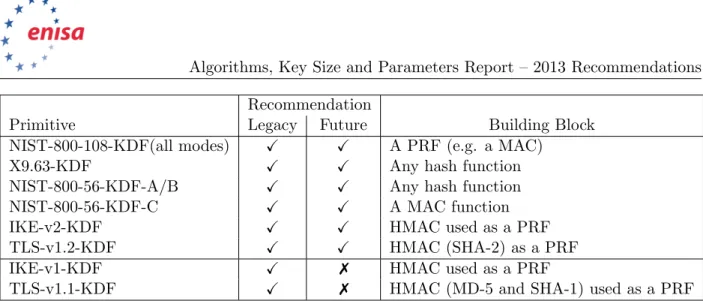
4.4 Key Derivation Functions . . . 45
4.4.1 NIST-800-108-KDF . . . 46
4.4.2 X9.63-KDF . . . 46
4.4.3 NIST-800-56-KDFs . . . 46
4.4.4 IKE-v1-KDF and IKE-v2-KDF . . . 47
4.4.5 TLS-KDF . . . 47
4.5 Generalities on Public Key Schemes . . . 47
4.6 Public Key Encryption . . . 48
4.6.1 RSA-PKCS# 1 v1.5 . . . 48 4.6.2 RSA-OAEP . . . 48 4.7 Hybrid Encryption . . . 48 4.7.1 RSA-KEM . . . 49 4.7.2 PSEC-KEM . . . 49 4.7.3 ECIES-KEM . . . 49
4.8 Public Key Signatures . . . 49
4.8.1 RSA-PKCS# 1 v1.5 . . . 49
4.8.2 RSA-PSS . . . 49
4.8.3 RSA-FDH . . . 50
4.8.4 ISO 9796-2 RSA Based Mechanisms . . . 50
4.8.6 PV Signatures . . . 51
4.8.7 (EC)Schnorr . . . 51
4.9 Identity Based Encryption/KEMs . . . 51
4.9.1 BF . . . 51 4.9.2 BB . . . 52 4.9.3 SK . . . 52 5 Protocols 53 5.1 General Protocols . . . 53 5.1.1 Key Agreement . . . 53 5.1.2 TLS . . . 54 5.1.3 IPsec . . . 56 5.1.4 SSH . . . 58 5.1.5 Kerberos . . . 60
5.2 Application Specific Protocols . . . 61
5.2.1 WEP/WPA . . . 61 5.2.2 UMTS/LTE . . . 61 5.2.3 Bluetooth . . . 62 5.2.4 ZigBee . . . 63 5.2.5 EMV . . . 63 Bibliography 64
Acronyms
3DES Triple DES
3GPP 3rd Generation Partnership Project (mobile phone system) A5/X Stream ciphers used in mobile phone protocols
AES Advanced Encryption Standard AMAC Ansi Retail MAC
BB Boneh–Boyen (ID based encryption) BF Boneh–Franklin (ID based encryption) CBC Cipher Block Chaining (mode)
CCA Chosen Ciphertext Attack CCM Counter with CBC-MAC (mode) CFB Cipher Feedback
CMA Chosen Message Attack CMAC Cipher-based MAC CPA Chosen Plaintext Attack
CTR Counter (mode)
CVA Ciphertext Validity Attack CWC Carter–Wegman + Counter DEM Data Encapsulation Mechanism DES Data Encryption Standard DLP Discrete Logarithm Problem DSA Digital Signature Algorithm E0 A stream cipher used in Bluetooth EAX Actually stands for nothing (mode) ECB Electronic Code Book (mode) ECC Elliptic Curve Cryptography
ECDLP Elliptic Curve Discrete Logarithm Problem ECIES Elliptic Curve Integrated Encryption Scheme EEA EPS Encryption Algorithm
EIA EPS Integrity Algorithm
EME ECB-mask-ECB (mode)
EMV Europay–Mastercard–Visa (chip-and-pin system) ENISA European Network and Information Security Agency
FDH Full Domain Hash
GCM Galois Counter Mode
GDSA German Digital Signature Algorithm
GSM Groupe Sp´ecial Mobile (mobile phone system) HMAC A hash based MAC algorithm
IAPM Integrity Aware Parallelizable Mode IEC International Electrotechnical Commission IEEE Institute of Electrical and Electronics Engineers IETF Internet Engineering Task Force
IKE Internet Key Exchange
IND Indistinguishability of Encryptions INT-CTXT Integrity of Ciphertexts
IPsec Internet Protocol Security
ISO International Standards Organization IV Initialisation Vector (or Value) KDSA Korean Digital Signature Algorithm KDF Key Derivation Function
KEM Key Encapsulation Mechanism
LTE Long Term Evolution (mobile phone system) MAC Message Authentication Code
MOV Menezes–Okamoto–Vanstone (attack) MQV Menezes–Qu–Vanstone (protocol)
NIST National Institute of Standards and Technology (US)
NMAC Nested MAC
OAEP Optimal Asymmetric Encryption Padding
OCB Offset Code Book (mode)
PKCS Public Key Cryptography Standards PRF Pseudo Random Function
PRP Pseudo Random Permutation
PSEC Provable Secure Elliptic Curve (encryption) PSS Probabilistic Signature Scheme
PV Pointcheval–Vaudenay (signatures) RC4 Ron’s Cipher Four (a stream cipher) RDSA Russian Digital Signature Algorithm RSA Rivest–Shamir–Adleman
SHA Secure Hash Algorithm
SK Sakai–Kasahara (ID-based encryption) SSH Secure Shell
SSL Secure Sockets Layer
UEA UMTS Encryption Algorithm UF Universally Unforgeable UIA UMTS Integrity Algorithm UMAC Universal hashing based MAC
UMTS Universal Mobile Telecommunications System WEP Wired Equivalent Privacy
WPA Wi-Fi Protected Access
Chapter 1
Executive Summary
Recently published EC Regulations on the measures applicable to the notification of personal data breaches [119] make reference to ENISA, as a consultative body, in the process of establishing a list of appropriate cryptographic protective measures. Furthermore, in a previous study of ENISA [113], addressing the use of cryptographic techniques in the EU, published in 2011 it had been noticed that a large number of national bodies were referring to the ECRYPT and ECRYPT II “Yearly Report on Algorithms and Key Lengths” [104–111]. As the ECRYPT Network of Excellence (NoE) published the last report at the end of 2012, the need for continuation of this activity has been acknowledged by ENISA in its work programme for 2013 [115].
This document collates a series of recommendations for algorithms, keysizes, and parameter recommendations. It addresses the need for a minimum level of requirements for cryptography across European Union (EU) Member States (MSs) in their effort to protect personal and sensitive data of the citizens. The document tries to address the need for continuation of the reports published by ECRYPT NoE and also the requirements for cryptographic protective measures applicable to the notification of personal data breaches by providing a focused set of recommendations in an easy to use form. This is the first report consisting of recomendations addressing cryptographic algorithms, sizes and paramenters published by ENISA. The intention is to continue and extend this activity in the following years.
It should be noted that this is a technical document addressed to decision makers, specialists designing and implementing cryptographic solutions. This set of recommendations is complement-ing another study [114] published by ENISA that provides an easy to read and understand context for non-speciallized parties and which places the notions of information security in the context of personal data protection framework.
In this document we focus on just two decisions which we feel are more crucial to users of cryptography.
Firstly, whether a given primitive, scheme or protocol can be considered for use today if it is already deployed. We refer to such use as legacy use within our document. Our first
recommen-dation is that if a scheme is not considered suitable for legacy use, or is only considered for such use with certain caveats, then this should be taken as a strong recommendation that the primitive, scheme or protocol be replaced as a matter of urgency.
Secondly, we consider the issue of whether a primitive, scheme, or protocol is suitable for deployment in new or future systems. In some sense mechanisms which we consider useable for new and future systems meet cryptographic requirements described in this document; they generally will have proofs of security, will have key sizes equivalent to 128-bit symmetric security or more1, will have no structural weaknesses, will have been well studied, will have been been standardized, and will have a reasonably-sized existing user base. Thus the second recommendation is that decision makers now make plans and preparations for the phasing out of what we term legacy mechanisms over a period of say 5-10 years, and replacing them with systems we deem secure for future use.
The document also details a summary of some of the many cryptographic protocols in use. This section is deliberately brief as there has been very little scientific analysis of cryptographic protocols in the literature. It is hoped that by detailing some protocols in need of analysis the research community will start to consider examining these in more detail.
This document does not consider any mechanisms which are currently only of academic interest. In particular all the mechanisms we discuss have been standardized to some extent, and have either been deployed, or are slated to be deployed, in real systems. This selection is a means of focusing the document on mechanisms which will be of interest to decision makers in industry and government. As another restriction of scope, we do not consider issues related to implementation (e.g. side channels resulting from timing, power, cache analysis, etc), nor issues arising from poor randomness generation.
Further limitations of scope are mentioned in the introductory chapter which follows. Further restrictions are mentined in Chapter 2 “How to Read this Document”. Such topics, which are not explored by this document, could however be covered in the future.
1
Chapter 2
How to Read this Document
This document collates a series of recommendations for algorithm, keysize and protocol recommen-dations. In some sense the current document supersedes the ECRYPT and ECRYPT2 “Yearly Report on Algorithms and Key Lengths” published between 2004 and 2012 [104–111]. However, it should be considered as completely distinct. The current document tries to provide a focused set of recommendations in an easy to use form, the prior ECRYPT documents provided more general background information and discussions on general concepts re key size choice, and tried to predict the future ability of cryptanalytic attacks via hardware and software.
In this document we focus on just two decisions which we feel are more crucial to users of cryptography. Firstly, whether a given primitive, scheme, protocol or keysize can be considered for use today if it is already deployed. We refer to such use as legacy use within our document. If a scheme is not considered suitable for legacy use, or is only considered for such use with certain caveats, then this should be taken as a strong recommendation that the primitive, scheme or protocol be possiblyreplaced as a matter of urgency (or even that an attack exists). Some of the caveats which may mean a system which it not considered suitable for legacy use may still be secure could be use of limited key lifetimes within a system, mitigating controls, or (in the case of hash functions) relieing on non-collision resistance properties.
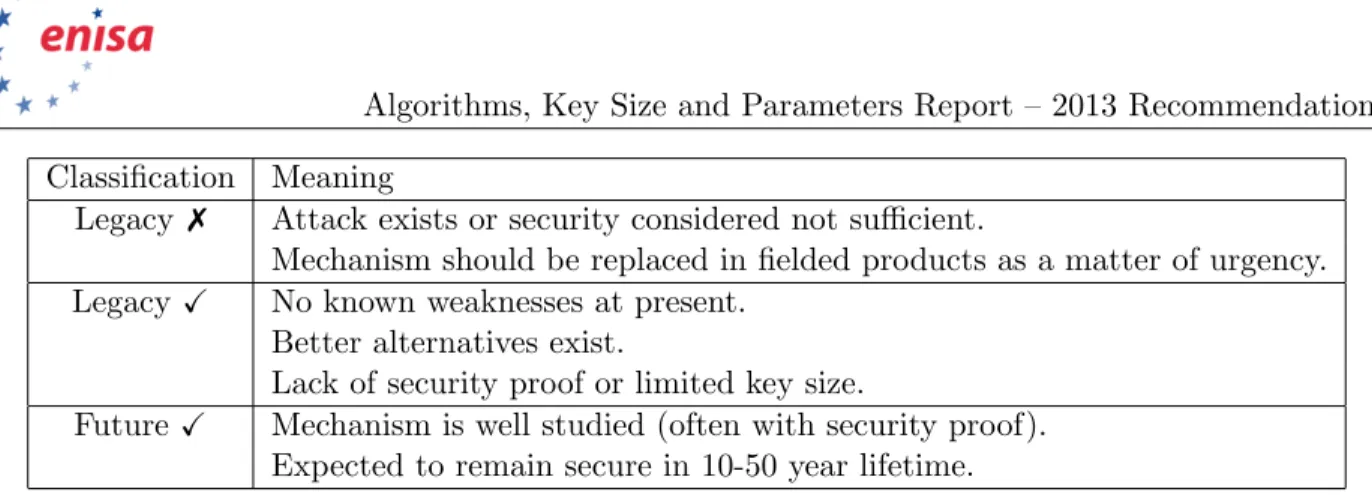
In particular, we stress, that schemes deemed to be legacy are considered to be secure currently. But, that for future systems there are better choices available which means that retaining systems which we deem to be legacy in future systems is not best practice. We summarize this distinction in Table 2.1.
Secondly, we consider the issue of whether a primitive, scheme, protocol, or key size is suitable for deployment in new or future systems. In some sense mechanisms which we consider usable for new and future systems meet a gold standard of cryptographic strength; they generally will have proofs of security, will have key sizes equivalent to 128-bits symmetric security or more, will have no structural weaknesses, will have been well studied, been standardized and would have a reasonable existing install base.
Classification Meaning
Legacy 7 Attack exists or security considered not sufficient.
Mechanism should be replaced in fielded products as a matter of urgency. Legacy X No known weaknesses at present.
Better alternatives exist.
Lack of security proof or limited key size.
FutureX Mechanism is well studied (often with security proof). Expected to remain secure in 10-50 year lifetime.
Table 2.1: Summary of distinction between legacy and future use
As a general rule of thumb we consider symmetric 80-bit security levels to be sufficient for legacy applications for the coming years, but consider 128-bit security levels to be the minimum requirement for new systems being deployed. Thus the key recommendation is that decision makers now make plans and preparations for the phasing out of what we term legacy mechanisms over a period of say 5-10 years. In selecting key sizes for future applications we consider 128-bit to be sufficient for all but the most sensitive applications. Thus we make no distinction between high-grade security and low-high-grade security, since 128-bit encryption is probably secure enough in the near term.
However, one needs to also take into account the length of time data needs to be kept secure for. For example it may well be appropriate to use 80-bit encryption into the near future for transactional data, i.e. data which only needs to be kept secret for a very short space of time; but to insist on 128-bit encryption for long lived data. All recommendations in this document need to be read with this in mind. We concentrate on recommendations which imply a minimal security level across all applications; i.e. the most conservative approach. Thus this does not imply that a specific application may enable lower security levels than that considered here.
The document does not consider any mechanisms which are currently only ofacademic interest. In particular all the mechanisms we discuss have been standardized to some extent, and have either been deployed or are due to be deployed in real world systems. This is not a critique of academic research, but purely a means of focusing the document on mechanisms which will be of interest to decision makers in industry and government.
As another restriction of scope we do not consider issues related to implementation (e.g. side channels resulting from timing, power, cache analysis etc), nor insufficient randomness generation [215]. However, we do consider implementation issues related to the mathematical instantiation of the scheme, such as padding oracle attacks etc. If a particular mechanism option provides a defense against side channel attacks (for example) we may mention it, but implementers are
strongly recommended to use all the standard implementation techniques to defend against such attacks. In terms of randomness generation, almost all cryptographic mechanisms require access to a sufficient entropy source. Whilst out of scope of this document, implementors are again strongly
recommended to ensure appropriate steps are taken to provide sufficient entropy to the mechanism. As another restriction of scope, which we alluded to above, we do not make a comprehensive discussion on how key size equivalents are decided upon (e.g. what RSA key size corresponds to what AES key size). We refer to other comparisons in the literature in Section 3.1, but we feel repeating much of this analysis would detract from the focus of this document.
2.1
Division into Chapters and Sections
The document divides cryptographic mechanisms into primitives (such as block ciphers, public key primitive and hash functions), schemes (such as symmetric and public key encryption schemes, signature schemes etc), and protocols (such as key agreement, TLS, IPsec etc). Protocols are built out of schemes, and schemes are themselves built out of primitives. At each stage of this process security needs to be defined, and the protocol or scheme needs to be proven to meet this definition, given the components it uses. So for example, just because a scheme makes use of a secure primitive does not imply the scheme is secure; this needs to be demonstrated by a proof. Luckily for most schemes such proofs do exist. However, in the case of protocols very little work has been performed in proving that deployed protocols meet a well defined security definition even when they are built out of secure component primitives and schemes.
Primitive - Scheme - Protocol
Cryptographic primtives are considered the basic building blocks upon which one needs to make someassumption. This assumption is the level of difficulty of breaking this precise building block; this assumption is always the communities current “best guess”. We discuss primitives in detail in Chapter 3.
In Chapter 4 we then go onto discuss schemes. By a scheme we mean some method for taking a primitive, or set of primitives, and constructing a cryptographic service out of the primitive. Hence, a scheme could refer to a digital signature scheme or a mode of operation of a block cipher. It is considered good cryptographic practice to only use schemes for which there is a well defined security proofwhich reduces the security of the scheme to that of the primitive. So for example an attack against CBC mode using AES should result in an attack against the AES primitive itself.
Making the distinction between schemes and primitives also means we can present schemes as general as possible and then allow users to instantiate them with secure primitives. However, this leads to the question of what generally should the key size be for a primitive given, if is to be used within a scheme? This might seem a simple question, but it is one which divides the cryptographic community. There are two approaches to this problem:
introduce asecurity loss, some cryptographers state that the key size of the primitive should be chosen with respect to this loss. With such a decision, unless proofs are tight1, the key sizes used in practice will be larger than one would normally expect. The best one can hope for is that the key size for the scheme matches that of the underlying primitive.
2. Another school of thought says that a proof is just a design validation, and the fact a tight proof does not exist may not be for fundamental reasons but could be because our proof techniques are not sufficiently advanced. They therefore suggest picking key sizes to just ensure the underlying primitive is secure.
It is this second, pragmatic, approach which we adopt in this document. It is also the approach commonly taken in industry.
The third type of cryptographic construction we examine is that of protocols (Chapter 5). Whilst the design of primitives, and the analysis of schemes via provable security, has reached a high level of sophistication; the analysis of protocols lags far behind. The academic literature does contain analysis of quite complex protocols, but often these are designed from scratch to enable efficient analysis. There is little analysis of existing protocols, in which a cryptographic analysis needs to be performed after the design has been deployed or fixed. Indeed, many real world protocols do not withstand such rigorous analysis and numerous weaknesses have been discovered in real world protocols due to a lack of rigorous analysis before they were deployed. In an ideal world design and analysis should be completed before deployment. However, in recent years a number of researchers have started to examine how to do a post-hoc security analysis on already defined protocols.
In the chapter on protocols we present, for a number of existing well known protocols, the level of cryptographic security analysis which is known to have been performed. We restrict in this section, purely for reasons of space, to those results of a cryptographic nature; for example padding/error oracle attacks which we consider to be cryptographic design problems.
2.2
Making a Decision
The question then arises as to how to read this document? Whilst the order of the document is one of going from the ground up, the actual order of making a decision should be from the top down. We consider two hypothetical situations. One in which a user wishes to select a public key signature algorithm and another in which he wishes to select a public key encryption algorithm for use in a specific protocol. Let us not worry too much about which protocol is being used, but assume that the protocol says that one can select either RSA-PSS or EC-Schnorr as the public key signature algorithm, and either RSA-OAEP or ECIES as the public key encryption algorithm.
2.2.1 Public key signatures
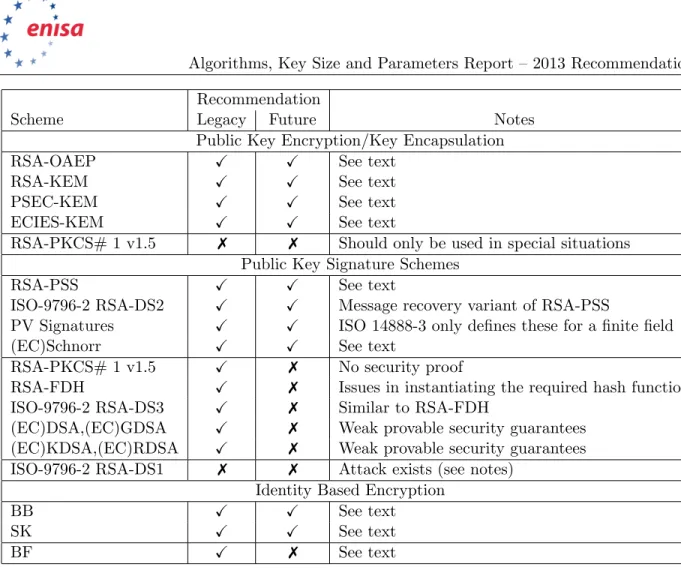
We first examine the signature algorithm case. The reader should first turn to the section on signature schemes in Section 4.8. The reader should examine the discussion of both RSA-PSS and EC-Schnorr in Sections 4.8.2 and 4.8.7 respectively. One finds that both signature schemes are considered suitable for legacy applications and future applications. However, for “systems” reasons (probably the prevalence of RSA based digital certificates) the user decides to go for RSA-PSS. The RSA-PSS scheme is actually made up of two primitives; firstly the RSA primitive (discussed in Section 3.5.1) and secondly a hash function primitive (discussed in Section 3.3). Thus the user now needs to consider “which” RSA primitive to use (i.e. the underlying RSA key size) and which hash function to use. The scheme itself will impose some conditions on the relevant sizes so they match up, but this need not concern a reader of this document in most cases. Returning to RSA-PSS we see that the user should use 1024-bit RSA moduli only for legacy applications and SHA-1 as a hash function only for legacy applications. If that is all the user requires then this document would support the user’s decision. However, if the user is looking at creating a new system without any legacy concerns then this document cannot be used as a justification for using RSA moduli of 1024 bits and SHA-1 as the hash function. The user would instead be forced to consider RSA moduli of 3024 bits (or more) and a hash function such as the 256-bit variant of SHA-2.
2.2.2 Public key encryption
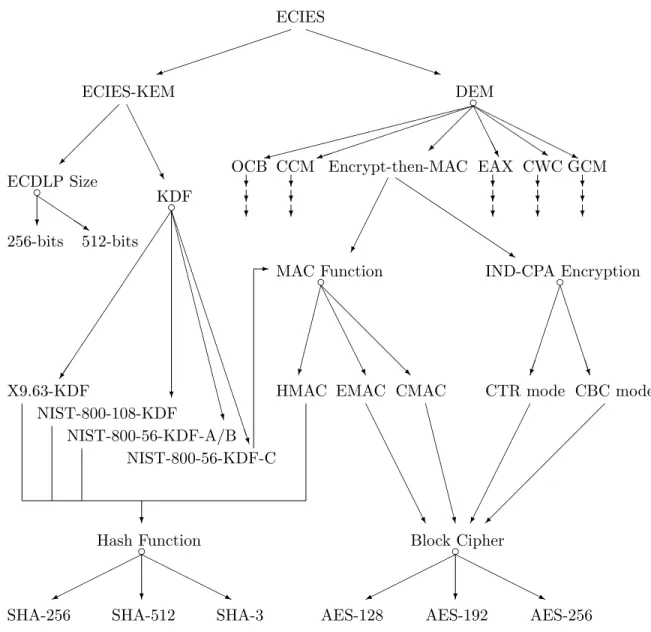
We now turn to comparing the choice of RSA-OAEP and the ECIES hybrid cipher. By examining Chapter 4 on schemes (in particular Section 4.6.2 for RSA-OAEP and Section 4.7 for ECIES) the user sees that whilst both schemes have security proofs and so can be used for future applications, ECIES is better suited to long messages. They therefore decide to proceed with ECIES, which means certain choices need to be made with respect to the various components. The ECIES public key encryption scheme, being a hybrid cipher, is made from the ECIES-KEM scheme (see Section 4.7.3), which itself makes use of a key derivation method (see Section 4.4 for various choices of key derivation methods) and a Data Encapsulation Method, or DEM. A DEM is a form of one-time authenticated symmetric encryption, see Section 4.3 for various possible instantiations. This creates a huge range of possible instantiations, for which we now outline a possible decision process and which we illustrate graphically in Figure 2.1. From examining Section 4.7.3 on ECIES-KEM and Section 4.3 on authenticated symmetric encryption the user sees that ECIES-KEM is supported for legacy and future use, and that so is Encrypt-Then-MAC as a DEM. Given these choices for the components the user then needs to instantiate Encrypt-Then-MAC, which requires the choice of an IND-CPA symmetric encryption scheme (i.e. a block cipher mode of operation from Section 4.1) and a MAC algorithm from Section 4.2. Looking at these sections the user then selects CTR mode (for use with some block cipher), and CMAC (again for use with some block cipher). The KEM also requires use of a key derivation function from Section 4.4, which will output a key for the block cipher in CTR mode and a separate key for the CMAC algorithm. The user at this
point could select the key derivation function that we denote X9.63-KDF, which itself requires the use of a hash function. Only at this point does the user of this document examine Chapter 3 on primitives so as to instantiate the precise elliptic curve group, the precise hash function for use in the key derivation function and the block ciphers to be used in the CTR mode encryption and the CMAC function. At this point a valid choice (for future applications) could be a 256-bit elliptic curve group, the SHA-2 key derivation function, and the AES block cipher at 128-bit key-length.
We stress that the above decision, on how to instantiate ECIES, is just one possible amongst all the various methods which this document supports.
2.3
Comparison to Other Documents
This document is one of many which presents recommendations for cryptographic primitives, key sizes and schemes. Each of these documents has a different audience and purpose; our goal has been to present an analysis of algorithms commonly used in current practice as well as providing state-of-the-art advice as to adoption of algorithms in future systems. Our recommendations are often rather conservative since we aim to give recommendations for the constructions of systems with a long live cycle.
As already remarked there is a strong relationship between this document and the ECRYPT and ECRYPT2 reports [104–111]. As mentioned earlier the current document is focused on making explicit recommendations as opposed to providing a general framework and summary as the original ECRYPT documents did.
Various government organizations provide advice, see annex A of [113], or mandates, in relation to key size and algorithm choice for their own internal purposes. In these documents, the choice of algorithms and key sizes is often done with an eye to internal systems and processes. The current document extends the scope to a wider area, e.g., internet communication and hence in addition considers algorithms deployed in various internet protocols.
Among the EU member states, there are a number of such documents including [21] published by France, and [66, 67] published by Germany. The key size recommendations of these three documents are in almost all cases consistent with our own recommendations for symmetric key sizes, hash function sizes and elliptic curve key sizes. The documents [66] and [21] also mention integer factorization based primitives; the recommendations in [21] are consistent with our own, whilst we are more conservative than [66] in this respect. Along with [21] we place a strong emphasis on using schemes with modern security proofs.
Further afield the US government maintains a similar document called Suite B [251], which presents recommended algorithms and key sizes for various govenmental uses. Again our recom-mendations are broadly consistent in terms of key sizes with this document.
All of these documents [21, 66, 67, 251] also detail a number of concrete cryptographic schemes. In this aspect our coverage is much wider due to our wider audience. For example all documents recommend the use of AES, SHA-2 and elliptic curve based primitves, and some integer
factor-ization based primitives. As well as these basic primitives we also mention a number of other primitives which are used in various deployed protocols, for example Camellia (in TLS), SNOW 3G (in GSM/LTE), as well as primitives used in what we term legacy systems (e.g. MD5, SHA-1, DES etc).
In terms of cryptographic schemes our coverage is much wider than that of [66, 67, 251]; this is only to be expected as per our different audiences. As an example of this we cover a significant number of MAC functions, authenticated encryption modes, and key derivation functions compared to the other documents. In one aspect we diverge from [66,67,251] in that we recommend variants of the DSA algorithm for use in legacy systems only. This is because DSA only has a security proof in a relatively weak computational model [63]. For discrete logarithm based signatures we recommend Schnorr signatures [313], which have stronger provable security properties than DSA [254, 283].
Another form of comparison can be made with the documents of various standards organizations. The ones which have been most referred to in this report are those of IETF, ISO and NIST. Divergences from the recommendations (if any) in these standards are again due to the distinct audiences. The IETF standardizes the protocols which keeps the internet running, their main concern is hence interoperability. As we have seen in recent months, with attacks on TLS and IPSec, this often leads to compromises in algorithm selection and choice. The ISO takes a very liberal approach to standardizing cryptographic algorithms, with far more algorithms standardized than a report like this could reasonably cover. We have selected algorithms from ISO (and dubbed them suitable/unsuitable for legacy and future use) due to our perception of their importance in other applications. Finally the NIST documents are more focused, with only a small subset of schemes being standardized. A major benefit in the NIST standardization is that when security proofs are available they are alluded to, and so one can judge the scientific basis of the recommendations.
2.4
Open Issues and Areas Not Covered
Whilst the area of primitives and schemes has attracted considerable academic attention in the last three decades, the same cannot be said of high level protocols. Whilst there are some academic treatments of protocols (e.g. extensive work on key agreement), very few of the actual deployed protocols make use of the design methodology introduced in the academic treatments. Thus for protocols there is a wide divergence between cryptographic theory and cryptographic practice. We give an overview of some (well used) protocols in this document which have had some limited analysis. A number of researchers are now trying to bridge this divide with considerable progress having been made in the last few years; but more work needs to be urgently done in this area.
Mainy of the recommendations in this document are focused on long term data retention issues (e.g. encrypted stored data, or long term signatures). Many cryptographic systems only need to protect transient data (i.e. transactional data) which has no long term value. In such situations some of the recommendations with respect to key size etc may need to be changed.
this document. In terms of cryptographic schemes these contain, but are not limited to: • Currently practical Post-Quantum Systems.
• Random number generation (e.g. physical generation) and extraction (via pseudo-random number generators), e.g. as in FIPS 140-2 or NIST SP 800-90.
• Idenfitication and User Authentication Protocols, e.g. as in the various ISO 9798 standards. • Key-wrap algorithms, e.g. as in ANSI X9.102 or NIST SP 800-38F.
• Key life cycle management, e.g. as in NIST SP 800-130 and 800-132, • Password based key derivation, e.g. as in NIST SP 800-132.
• Password based key agreement protocols, e.g. EKE, PAK, SPEKE and J-PAKE.
It is hoped that if this document were to be revised in future years that the opportunity would be taken to also include the afore mentioned mechanisms.
ECIES P P P P P P P P P q ) ECIES-KEM A A A A A U DEMc 9 ) A A A A U Q Q Q Q Q s H H H H H H H j ECDLP Sizec ? Q Q Q Q s 256-bits 512-bits KDFc ? C C C C C C C C C C C C C CW B B B B B B B B B B B B B B B B N OCB ? ? ? CCM ? ? ? Encrypt-then-MAC Q Q Q Q Q Q Q Q s EAX ? ? ? CWC ? ? ? GCM ? ? ? MAC Functionc A A A A A A U @ @ @ @ @ @ R IND-CPA Encryptionc B B B B B B B N HMAC ? EMAC A A A A A A A A U CMAC C C C C C C C CW CTR mode CBC mode X9.63-KDF NIST-800-108-KDF NIST-800-56-KDF-A/B NIST-800-56-KDF-C -Hash Functionc ? H H H H H H j
SHA-256 SHA-512 SHA-3
Block Cipherc ? H H H H H H j
AES-128 AES-192 AES-256
Figure 2.1: Just some of the design space for instantiating the ECIES public key encryption algorithm. Note, that not all standards documents will support all of these options. To read this diagram: A group of arrows starting with a circle implies the implementer needs to choose one of the resulting paths. A set of three arrows implies a part of the decision tree which we have removed due to space. In addition (again for reasons of space) we do not list all possible choices. Even with these restrictions one can see the design space for a cipher as well studied and understood as ECIES can be quite complex.
Chapter 3
Primitives
This chapter is about basic cryptographic building blocks, the atoms out of which all other crypto-graphic constructions are produced. In this section we include basic symmetric key building blocks, such as block ciphers, hash functions and stream ciphers; as well as basic public key building blocks such as factoring, discrete logarithms and pairings. With each of these building blocks there is some mathematical hard problem underlying the primitive. For example the RSA primitive is based on the difficulty of factoring, the AES primitive is (usually) based on it representing a keyed pseudo-random permutation. That these problems are hard, or equivalently, the primitives are secure is an assumption which needs to be made. This assumption is often based on the specific parameters, or key lengths, used to instantiate the primitives.
Modern cryptography then takes these building blocks/primitives and produces cryptographic schemes out of them. The defacto methodology, in modern work, is to then show that the result-ing scheme, when attacked in a specific cryptographic model, is secure assumresult-ing the underlyresult-ing assumption on the primitive holds. So another way of looking at this chapter and the next, is that this chapter presents the constructions for which we cannot prove anything rigorously, whereas the next chapter presents the schemes which should have proofs relative to the primitives in this chapter actually being secure.
In each section we use the termobservation to point out something which may point to a longer term weakness, or is purely of academic interest, but which is not a practical attack at the time of writing. In each section we also give a table, and group the schemes within the table in order of security recommendations (usually).
3.1
Comparison
In making a decision as to which cryptographic mechanism to employ, one first needs to decide the mechanism and then decide the key length to be used. In later sections and chapters we focus on the mechanism choice, whereas in this section we focus just on the key size. In some schemes the
effective key length is hardwired into the mechanism, in others it is a parameter to be chosen, in some there are multiple parameters which affect the effective key length.
There is common understanding that what we mean by an effective key length is that an attack should take 2k operations for an effective key length ofk. Of course this understanding is itself not well defined as we have not defined what an operation is; but as a rule of thumb it should be the “basic” operation of the mechanism. This lack of definition of what is meant by an operation means that it is hard to compare one mechanism against another. For example the best attack against a block cipher of key lengthkb should be equivalent to 2kb block cipher invocations, whereas the best known attack against an elliptic curve system with group order of ke bits should be 2ke/2 elliptic curve group operations. This often leads one to conclude that one should take ke= 2·kb, but this assumes that a block cipher call is about the same cost as an elliptic curve group operation (which may be true on one machine, but not true on another).
This has led authors and standards bodies to conduct a series of studies as to how key sizes should be compared across various mechanisms. The “standard” method is to equate an effective key size with a specific block cipher, (say 112 corresponds to two or three key Triple-DES, 128 corresponds to AES-128, 192 corresponds to AES-192, and 256 corresponds to AES-256), and then try to establish an estimate for another mechanisms key size which equates to this specific quanta of effective key size.
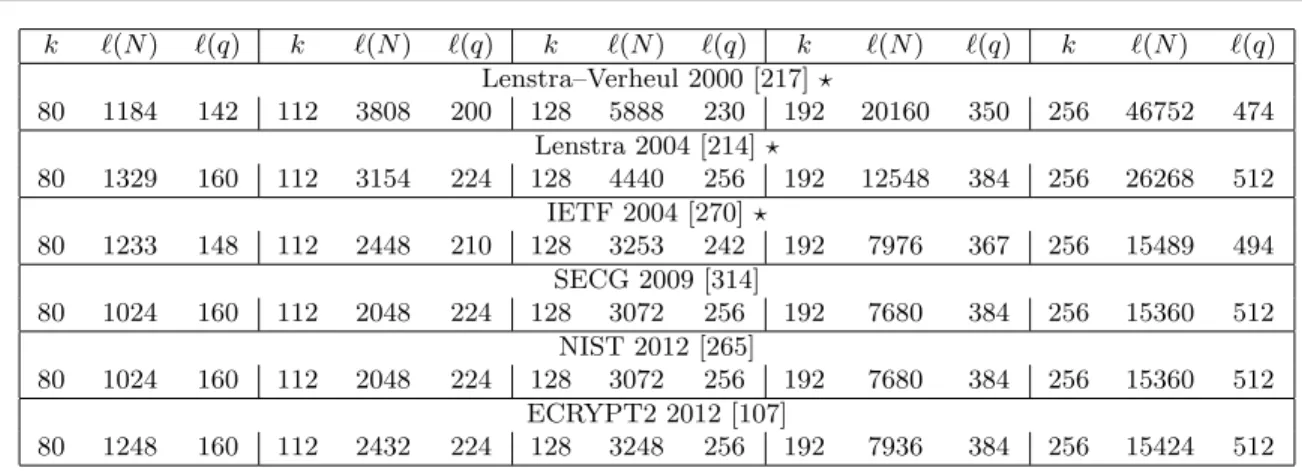
In comparing the different literature one meets a major problem in that not all studies compare the same base symmetric key sizes; or even do an explicit comparison. The website http:// www.keylength.com takes the various proposed models from the the literature and presents a mechanism to produce such a concrete comparison. In Table 3.1 we present either the concrete recommendations to be found in the literature, or the inferred recommendations presented on the web sitehttp://www.keylength.com.
We focus on the symmetric key size k, the RSA modulus size `(N) (which is also the size of a finite field for DLP systems) and the discrete logarithm subgroup size `(q); all of which are measured in bits. Of course these are just crude approximations and hide many relationships between parameters which we discuss in future sections below. As one can see from the table the main divergence in estimates is in the selection of the size`(N) of the RSA modulus.
As one can see, as the symmetric key size increases the size of the associated RSA moduli needs to become prohibitively large. Ignoring such large value RSA moduli we see that there is surprising agreement in the associated size of the discrete logarithm subgroup q, which we assume to be an elliptic curve group order.
Our implicit assumption is that the above key sizes are for (essentially) single use applications. As a key is used over and over again its security degrades, due to various time-memory tradeoffs. There are often protocol and scheme level procedures to address this issue; for example salting in password hashing. The same holds true in other situations, for example in [46], it is shown that AES-128 has only 85-bit security if 243 encryptions of an arbitrary fixed text under different keys are available to the attacker.
k `(N) `(q) k `(N) `(q) k `(N) `(q) k `(N) `(q) k `(N) `(q) Lenstra–Verheul 2000 [217]? 80 1184 142 112 3808 200 128 5888 230 192 20160 350 256 46752 474 Lenstra 2004 [214]? 80 1329 160 112 3154 224 128 4440 256 192 12548 384 256 26268 512 IETF 2004 [270]? 80 1233 148 112 2448 210 128 3253 242 192 7976 367 256 15489 494 SECG 2009 [314] 80 1024 160 112 2048 224 128 3072 256 192 7680 384 256 15360 512 NIST 2012 [265] 80 1024 160 112 2048 224 128 3072 256 192 7680 384 256 15360 512 ECRYPT2 2012 [107] 80 1248 160 112 2432 224 128 3248 256 192 7936 384 256 15424 512
Table 3.1: Key Size Comparisons in Literature. An entry marked with a ? indicates an inferred comparison induced from the web sitehttp://www.keylength.com. Where a range is given by the source we present the minimum values. In the columns k is the symmetric key size, `(N) is the RSA modulus size (or finite field size for finite field discrete logarithms) and `(q) is the subgroup size for finite field and elliptic curve discrete logarithms.
of hash functions or MAC functions; since this is very much scheme/protocol specific. A good rule of thumb for hash function outputs is that they should correspond in length to 2·k, since often hash functions need to be collision resistant. However, if only preimage or second-preimage resistance is needed then output sizes of kcan be tolerated.
The standard [262] implicitly recommends that the MAC key and and MAC output size should be equal to the underlying symmetric key size k. However, the work of Preneel and van Oorschot [287, 288], implies attacks on MAC functions requiring 2n/2 operations, where nis the key size, or the size of the MAC functions internal memory. These recommendations can be problematic with some MAC function constructions based on block ciphers at high security levels, as no major block cipher has block length of 256 bits. In addition one needs to distinguish between off-line attacks, in which a large MAC output size is probably justified, and an on-line attack, where smaller MAC output sizes can be tolerated. Thus choice of the MAC output size can be very much scheme, protocol, or even system, dependent.
3.2
Block Ciphers
By a block cipher we mean (essentially) a keyed pseudo-random permutation on a block of data of a given length. A block cipher isnot an encryption scheme, it is a component (in our terminology
primitive) which goes into making such a scheme; often this is done via a mode of operation. In this section we consider whether a given block cipher construction is secure, in the sense that it seems to act like a pseudo-random permutation. Such a security consideration can never be proven, it
is a mathematical assumption, akin to the statement that factoring 3024-bit moduli is hard. The schemes we present in Chapter 4, that use block ciphers, are often built on the assumption that the block cipher is secure in the above sense.
Generally speaking we feel the minimum key size for a block cipher should be 128 bits; the minimum for the block size depends on the precise application but in many applications (for example construction of MAC functions) a 128-bit block size should now be considered the minimum in many application. We also consider that the maximum amount of data which should be encrypted under the same key should be bounded by 2n/2, where nis the block size in bits. However, as indicated before some short lived cryptograms may warrant smaller block and key sizes in their constructions; but for general applications we recommend a minimum of 128 bits.
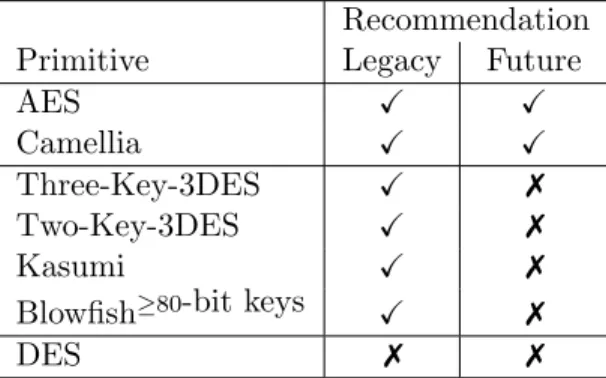
Again, for each primitive we give a short description of state of the art with respect to known attacks, we then give recommendations for minimum parameter sizes for future and legacy use. For convenience these recommendations are summarized in Table 3.2.
Recommendation
Primitive Legacy Future
AES X X
Camellia X X
Three-Key-3DES X 7
Two-Key-3DES X 7
Kasumi X 7
Blowfish≥80-bit keys X 7
DES 7 7
Table 3.2: Block Cipher Summary
3.2.1 Recommended Block Ciphers
AES
The Advanced Encryption Standard, or AES, is the block cipher of choice for future applications [88, 120]. AES is called 128-EIA 2 in LTE. The AES has a block length of 128 bits and supports 3 key lengths: 128, 192 and 256 bits. The versions with longer key lengths use more rounds and are hence slower (by 20, respectively 40%).
Observation:The strong algebraic structure of the AES cipher has led some researchers to suggest that it might be susceptible to algebraic attacks [86, 249]. However, such attacks have not been shown to be effective [76, 220].
For the 192- and 256-bit key versions there are related key attacks [44, 45]. For AES-256 this attack, using four related keys, requires time 299.5 and data complexity 299.5. The attack works
due to the way the key schedule is implemented for the 192- and 256-bit keys (due to the mismatch in block and key size), and does not affect the security of the 128-bit variant. Related key attacks can clearly be avoided by always selecting cryptographic keys independently at random.
A bi-clique technique can be applied to the cipher to reduce the complexity of exhaustive key search. For example in [53] it is shown that one can break AES-128 with 2126.2 encryption operations and 288 chosen plaintexts. For AES-192 and AES-256 these numbers become 2189.7/240 and 2254.4/280 respectively.
Camellia
The Camellia block cipher is used as one of the possible cipher suites in TLS, and unlike AES is of a Feistel cipher design. Camellia has a block length of 128 bits and supports 3 key lengths: 128, 192 and 256 bits [228]. The versions with a 192- or a 256-bit key are 33% slower than the versions with a 128-bit key.
Observation: Just as for AES there is a relatively simple set of algebraic equations which define the Camellia transform; this might leave it open to algebraic attacks. However, just like AES such attacks have not been shown to be effective.
3.2.2 Legacy Block Ciphers
3DES
Comes in two variants; a two key version with a 112-bit key and a three key version with a 168-bit key [266]. The effective key length of three key 3DES is 112 bits and not 168 bits as one would expect. The small block length (64-bits) is a problem in some applications. The two key variant suffers from a (theoretical) related key attack, however if the two keys are selected uniformly at random this is not a problem in practice.
Observation: Due to the iterated nature of the cipher the security is not as strong as the key length would suggest. For the two key variant the security is 2120−t where 2t plaintext/ciphertext pairs are obtained; for the three key variant the security is reduced to 2112.
Kasumi
This cipher [118], used in 3GPP, has a 128-bit key and 64-bit block size is a variant of MIST-1. Kasumi is called UIA1 in UMTS and is called A5/3 in GSM
Observation:Whilst some provable security against linear and differential cryptanalysis has been established [188], the cipher suffers from a number of problems. A related key attack [41] requiring 276operations and 254plaintext/ciphertext pairs has been presented. In [98] a more efficient related key attack is given which requires 232 time and 226 plaintext/ciphertext pairs. These attacks do not affect the practical use of Kasumi in applications such as 3GPP, however given them we do not recommend Kasumi for use in further applications.
Blowfish
This cipher [312] has a 64-bit block size, which is too small for some applications and the reason we only recommend it for legacy use. It also has a key size ranging from 32- to 448-bits, which we clearly only recommend using at 80-bits and above for legacy applications. The Blowfish block cipher and is used in some IPsec configurations.
Observation: There have been a number of attacks on reduced round versions [189, 293, 334] but no attacks on the full cipher.
3.2.3 Historical (not-recommended) Block Ciphers
DES
DES has a 56-bit key and 64-bit block size and so is not considered secure by today’s standards. It is susceptible to linear [42] and differential cryptanalysis [229].
3.3
Hash Functions
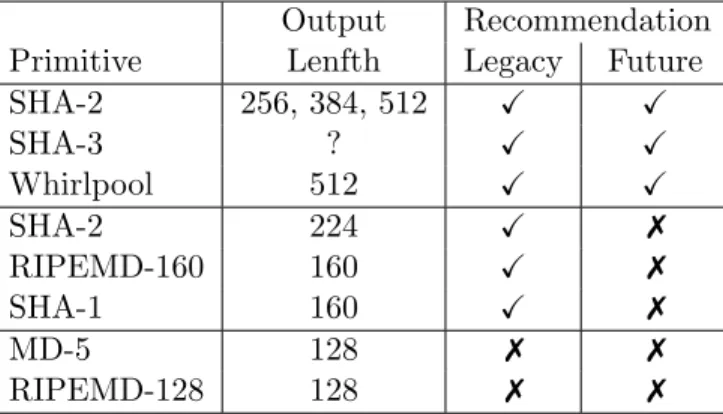
Hash function outputs should be, in our opinion, a minimum of 160 bits in length for legacy applications and 256 bits in length for all new applications. Hash functions are probably the area of cryptography which has had the most attention in the past decade. This is due to the spectacular improvements in the cryptanalysis of hash functions, as well as the subsequent SHA-3 competition to design a replacement for our existing set of functions. Most existing hash functions are in the Merkle–Damg˚ard family, and derive much of their design philosophy from the MD-4 hash function; such hash fucntions are said to be in the MD-X family. This family includes MD-4, MD-5, RIPEMD-128, RIPEMD-160, SHA-1 and SHA-2.
Output Recommendation
Primitive Lenfth Legacy Future
SHA-2 256, 384, 512 X X SHA-3 ? X X Whirlpool 512 X X SHA-2 224 X 7 RIPEMD-160 160 X 7 SHA-1 160 X 7 MD-5 128 7 7 RIPEMD-128 128 7 7
3.3.1 Recommended Hash Functions
SHA-2
2 is actually a family of four algorithms, 224, 256, 384 and 512. SHA-224 (resp. SHA-384) is a variant itself of SHA-256 (resp. SHA-512), but just uses a different IV and then truncates the output. Due to our decision of symmetric security lengths of less than 128 being only suitable for legacy applications we denote SHA-224 as in the legacy only division of our analysis.
Observation: For SHA-224/SHA-256 (resp. SHA-384/SHA-512) reduced round collision attacks 31 out of 64 (resp. 24 out of 80) have been reported [162, 239, 306]. In addition reduced round variants 43 (resp. 46) have also been attacked for preimage resistance [22, 138].
SHA-3
The competition organized by NIST to find an algorithm for SHA-3 ended on October 2nd, 2012, with the selection of Keccak [131]. Currently, NIST is drafting a FIPS describing SHA-3.
Observation: Reduced round collision attacks (8 out of 24) have been reported [96]. Whirlpool
Whirlpool produces a 512-bit hash output and is not in the MD-X family; being built from AES style methods, thus it is a good alternative to use to ensure algorithm diversity.
Observation:Preimage attacks on 5 (out of 10) rounds have been given [307], as well as collisions on 5.5 rounds [210], with complexity 2120.
3.3.2 Legacy Hash Functions
RIPEMD-160
It is anticipated that collision attacks on RIPEMD-160 are likely to be found on reduced round versions in the near future [240]. Collision attacks on 36 rounds (out of 80) have already been found [238].
SHA-1
SHA-1 is in widespread use and was designed to provide protection against collision finding of 280. However, the analysis of MD-5 has been extended to SHA-1 (which is in the same family), resulting in collisions being found in 269operations [341], and even lower complexity [241, 340]. The current best analysis is that of 257.5 operations, reported in [324]. On the other hand explicit collisions for the full SHA-1 have not yet been found, despite collisions for a reduced round variant (73 rounds
out of 80) being found [102]. An extension of Stevens’ analysis from [324] is expected to yield a full collision in 261 operations.
Observation:The literature also contains preimage attacks on a variant reduced to 45-48 rounds [23, 69].
3.3.3 Historical (not recommended) Hash Functions
MD-5
Despite being widely deployed the MD-5 hash function should not be considered secure. Collisions can be found within seconds on a modern desktop computer. The literature on the collision weakness of MD-5 and its impact in various scenarios is wide [219, 309, 325–327]. Preimage resistance can also be broken in time 2124.4 [308].
RIPEMD-128
Given an output size of 128-bits, collisions can be found in RIPEMD-128 in time 264using generic attacks, thus RIPEMD-128 can no longer be considered secure in a modern environment irrespective of any cryptanalysis which reduces the overall complexity. Practical collisions for a 3-round variant were reported in 2006, [240]. In [211] futher cryptanalytic results were presented which lead one to conclude that RIPEMD-128 is not to be considered secure.
3.4
Stream Ciphers
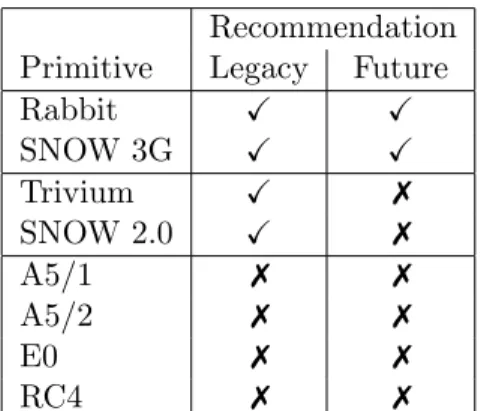
Generally speaking stream ciphers should be used with a distinct IV for each message, unless the key is used in a one-time manner (as for example in a DEM construction). Again, for each cipher we give a short description of state of the art with respect to known attacks, we then give recommendations for minimum parameter sizes for future and legacy use. For convenience these recommendations are summarized in Table 3.4. Where possible, it is probably better to use a block cipher in mode such as CTR mode than a dedicated stream cipher. Dedicated stream ciphers offer performance advantages over AES in CTR mode, but historically the science of stream cipher design lags that of block cipher and mode of operation design.
3.4.1 Recommended Stream Ciphers
Rabbit
Rabbit was an entrant to the eSTREAM competition and included in the final eSTREAM portfolio as promising for software implementations. Rabbit uses a 128-bit key together with a 64-bit IV. Rabbit is described in RFC 4503 and is included in ISO/IEC 18033-4 [167].
Recommendation Primitive Legacy Future
Rabbit X X SNOW 3G X X Trivium X 7 SNOW 2.0 X 7 A5/1 7 7 A5/2 7 7 E0 7 7 RC4 7 7
Table 3.4: Stream Cipher Summary
SNOW 3G
SNOW 3G is an enhanced version of SNOW 2.0, the main change being the addition of a second S-Box as a protection against future advances in algebraic cryptanalysis. It uses a 128-bit key and a 128-bit IV. The cipher is the core of the algorithms UEA2 and UIA2 of the 3GPP UMTS system, which are identical to the algorithms 128-EIA1 and 128-EEA1 in LTE.
3.4.2 Legacy Stream Ciphers
Trivium
Trivium was an entrant to the eSTREAM competition and included in the final eSTREAM portfolio as promising for hardware implementations. It has been included in ISO/IEC 29192-3 on lightweight stream ciphers [169]. Trivium uses an 80-bit key together with an 80-bit IV.
Observation: There has been a number of papers on the cryptanalysis of Trivium and there currently exists no attack against full Trivium. Aumasson et al. [25] present a distinguishing attack with complexity 230 on a variant of Trivium with the initialization phase reduced to 790 rounds (out of 1152). Maximov and Biryukov [232] present a state recovery attack with time complexity around 283.5. This attack shows that Trivium with keys longer than 80 bits provides no more security than Trivium with an 80-bit key. It is an open problem to modify Trivium so as to obtain 128-bit security in the light of this attack.
SNOW 2.0
SNOW 2.0 comes in a 128 and 256-bit key variants. A distinguishing attack against SNOW 2.0 is theoretically possible [268], but it requires 2174bits of key-stream and work. Given the introduction
of SNOW 3G we only see a legacy application for SNOW 2.0, and recommend all new systems wishing to use a SNOW-like cipher to use SNOW 3G.
3.4.3 Historical (non recommended) Stream Ciphers
A5/1
A5/1 was originally designed for use in the GSM protocol. It is initialized using a 64-bit key and a publicly known 22-bit frame number. The design of A5/1 was initially kept secret until 1994 when the general design was leaked and has since been fully reverse engineered. The cipher has been subject to a number of attacks. The best attack was shown to allow for real-time decryption of GSM mobile phone conversations [27]. As result this cipher is not considered to be secure.
A5/2
A5/2 is a weakened version of A5/1 to allow for (historic) export restrictions to certain countries. It is therefore not considered to be secure.
E0
The E0 stream cipher is used to encrypt data in Bluetooth systems. It uses a 128-bit key and no IV. The best attack recovers the key using the first 24 bits of 224frames and 238computations [223]. This cipher is therefore not considered to be secure.
RC4
RC4 comes in various key sizes. Despite widespread deployment the RC4 cipher has for many years been known to suffer from a number of weaknesses. There are various distinguishing attacks [226], and state recovery attacks [233]. (An efficient technique to recover the secret key from an internal state is described in [40].)
An important shortcoming of RC4 is that it was designed without an IV input. Some ap-plications, notably WEP and WPA “fix” this by declaring some bytes of the key as IV, thereby effectively enabling related-key attacks. This has led to key-recovery attacks on RC4 in WEP [337]. When initialized the first 512 output bytes of the cipher should be discarded due to statistical biases. If this step is omitted, then key-recovery attacks can be accelerated, e.g. those on WEP and WPA [317].
Despite statistical biases being known since 1995, SSL/TLS does not discard any of the output bytes of RC4; this results in a recent attacks by AlFardan et al. [12] and Isobe et al. [163].
3.5
Public Key Primitives
For each primitive we give a short description of state of the art with respect to known attacks, we then give recommendations for minimum parameter sizes for future and legacy use. For convenience these recommendations are summarized in Table 3.5. In the table we let`(·) to denote the logarithm to base two of a number; a ? denotes some conditions which also need to be tested which are explained in the text.
Primitive Parameters Legacy System Minimum Future System Minimum
RSA Problem N, e, d `(n)≥1024, `(n)≥3072 e≥3 or 65537, d≥N1/2 e≥3 or 65537,d≥N1/2 Finite Field DLP p, q, n `(pn)≥1024 `(pn)≥3072 `(p), `(q)>160 `(p), `(q)>256 ECDLP p, q, n `(q)≥160,? `(q)>256,? Pairing p, q, n, d, k `(pk·n)≥1024 `(pk·n)≥3072 `(p), `(q)>160 `(p), `(q)>256 Table 3.5: Public Key Summary
3.5.1 Factoring
Factoring is the underlying hard problem behind allschemesin the RSA family. In this section we discuss what is known about themathematicalproblem of factoring, we then specialize to the math-ematical understanding of the RSA Problem. The RSA Problem is the underlying cryptographic primitive, we are not considering the RSA encryption or signature algorithm at this point. In fact vanilla RSA shouldneverbe used as an encryption or signature algorithm, the RSA primitive (i.e. the RSA Problem) should only be used in combination with one of the well defined schemes from Chapter 4.
Since the mid-1990s the state of the art in factoring numbers of general form has been determined by the factorization of the RSA-challenge numbers. In the last decade this has progressed at the following rate RSA-576 (2003) [124], RSA-640 (2005) [125], RSA-768 (2009) [202]. These records have all been set with the Number Field Sieve algorithm [216]. It would seem prudent that only legacy applications should use 1024 bit RSA modulus going forward, and that future systems should use RSA keys with a minimum size of 3072 bits.
Since composite moduli for cryptography are usually chosen to be the product of two large primes N =p·q, to ensure they are hard to factor it is important that p and q are chosen of the same bit-length, but not too close together. In particular
• If`(p)`(q) then factoring can be made easier by using the small value ofp (via the ECM method [186]). Thus selectingp and q such that 0.1<|`(p)−`(q)| ≤20, is a good choice.
• On the other hand if |p−q| is less than N1/4 then factoring can be accomplished by the Coppersmith’s method [79].
Selecting p and q to be random primes of bit length `(N)/2 will, with overwhelming probably, ensure that N is hard to factor with both these techniques.
RSA Problem
Cryptosystems based on factoring are actually usually based not on the difficulty of factoring but on the difficulty of solving the RSA problem. The RSA Problem is defined to be that of given an RSA modulus N = p·q, an integer value e such that gcd(e,(p−1)·(q−1)) = 1, and a value y∈Z/NZfind the valuex∈Z/NZsuch thatxe=y (modN).
If e is too small such a problem can be easily solved, assuming some side information, using Coppersmith’s lattice based techniques [77, 78, 80]. Thus for RSA based encryption schemes it is common to select e≥65537. For RSA based signature schemes such low values of e do not seem to be a problem, thus it is common to selecte≥3. For efficiency one often takes eto be as small a prime as the above results would imply; thus it is very common to find choices of e= 65537 for encryption ande= 3 for signatures in use.
The RSA private key is given by d= 1/e (mod (p−1)·(q−1)). Some implementers may be tempted to choosed“small” and then selecteso as to optimize the private key operations. Clearly, just from naive analysis d cannot be too small. However, lattice attacks can also be applied to choices of dless than N0.292 [57, 343]. Lattice attacks in this area have also looked at situations in which some of the secret key leaks in some way, see for example [116,150]. We therefore recommend that d is chosen such that d > N1/2, this will happen with overwhelming probability if the user selectsefirst and then findsd.
3.5.2 Discrete Logarithms
The discrete logarithm problem can be defined in any finite abelian group. The basic construction is to take a finite abelian group of large prime order q generated by an element g. The discrete logarithm problem is to recover x ∈ Z/qZ from the value h = gx. It is common for the group and generator to be used by a set of users; in this case the tuple{hgi, q} is called a set ofDomain Parameters.
Whilst the DLP is the underlying number theoretic problem in schemes based on the discrete logarithm problem, actual cryptographic schemes base their security on (usually) one of three related problems; this is similar to how factoring based schemes are usually based on the RSA problem and not factoring per se. The three related problems are:
• Computational Diffie–Hellman problem: Givengx and gy for hidden x andy compute gx·y.
• Gap Diffie–Hellman problem: Given gx and gy for hidden x and y compute gx·y, given an oracle which allows solution of the Decision Diffie–Hellman problem.
Clearly the ability to solve the DLP will also give one the ability to solve the above three problems, but the converse is not known to hold in general (although it is in many systems widely believed to be the case).
Finite Field DLP
The discrete logarithm problem in finite fields (which we shall refer to simply as DLP), and hence the Diffie–Hellman problem, Decision Diffie–Hellman problem and gap Diffie–Hellman problem, is parametrized by the finite fieldFpn and the subgroup sizeq, which should be prime. In particular this means thatq dividespn−1. To avoid “generic attacks” the valueq should be at least 160 bits in length for legacy applications and at least 256 bits in length for new deployments.
For the case of small prime characteristic, i.e. p = 2,3 there is new algorithm was presented in early 2013 by Joux [184] which runs in time L(1/4 +o(1)), for when the extension degree n is composite (which are of relevance to pairing based cryptography). This algorithm was quickly supplanted by an algorithm which runs in quasi-polynomial time by Barbulescu and others [26]. Also in 2013 a series of record breaking calculations were performed by a French team and a Irish team for characteristic two fields, resulting in the records of F26120 [137] and F26168 [182]. For characteristic three the record is F3582 [332]. For prime values of n the best result is a discrete logarithm calculation in the fieldF2809 [61]. All of these results make use of special modification to the function field sieve algorithm [9]. In light of these results no system should be deployed relying on the hardness of the DLP in small characteristic fields.
For large prime fields, i.e. n = 1, the algorithm of choice is a variant of the Number Field Sieve [135]. The record here is for a finite fieldFp withpa 530 bit prime [201] set in 2007. In light of the “equivalence” between the number field sieve for factoring and that for discrete logarithms our recommendation is in this case that legacy applications should use 1024 bitp, and new systems should use a minimump of 3072 bits.
There has been some work on the case of so called medium prime fields; fields withplarger than 100 and 1< n <100, see for example [183, 185]. Currently these algorithms have no cryptographic impact; although this might change if the fields being considered have impact on pairing based cryptography (see Section 3.5.3). This is because all pairing based applications have log2(p)≥160. ECDLP
Standard elliptic curve cryptography (i.e. ECC not using pairings) comes in two flavors, either systems are based on elliptic curves over a large prime field E(Fp), or they are based on elliptic curves over a field of characteristic twoE(F2n). We denote the field size by pn in what follows, so when writing pn we implicitly assume either p = 2 or n = 1. We let q denote the largest prime
factor of the group order and let h denote the “cofactor”, so h·q = #E(Fpn). To avoid known attacks one selects these parameters so that
• The smallest t such that q dividespt·n−1 is such that extracting discrete logarithms in the finite field of size pt·n is hard. This is the so called MOV condition [242].
• Ifn= 1 then we should not have p=q. These are the so-called anomalous curves for which there is a polynomial time attack [310, 316, 321].
• Ifp= 2 thenn should be prime. This is to avoid so-called Weil descent attacks [132]. It is common, to avoid small subgroup attacks, for the curve to be chosen such that h = 1 in the case of n = 1 and h = 2 or 4 in the case of p = 2. There are a subclass of curves called Koblitz curves in the case of p= 2 which offer some performance advantages, but we do not consider the benefit to outweigh the cost for modern processors thus our discussion focuses on general curves only. Some standards, e.g. [117] stipulate that the class number of the associated endomorphism ring must be larger than some constant (e.g. 200). We see no cryptographic reason for making this recommendation; since by choosing random curves it is over whelmingly likely to occur in any case and no weakness is known for such curves.
The largest ECDLP records have been set for the case of n= 1 with a p of size 109-bits [60], and for p = 2 with n = 109 [72]. These record setting achievements are all performed with the method of distinguished points [333], which is itself based on Pollard’s rho method [285]. To avoid such “generic attacks” the valueq should be at least 160 bits in length for legacy applications and at least 256 bits in length for new deployments.
Various standards, e.g. [19, 20, 315] specify a set of recommended curves; many of which also occur in other standards and specifications, e.g. in TLS [50]. Due to issues of interoperability the authors feel that using a curve specified in a standard is best practice. Thus the main choice for an implementer is between curves in characteristic two and large prime characteristic.
3.5.3 Pairings
Pairing based systems take two elliptic curvesE(Fpn) and ˆE(Fpn·d), each containing a subgroup of order q. We denote the subgroup of order q in each of these elliptic curves byG1 and G2. Pairing based systems also utilize a finite field Fpk·n, where q divides pk·n−1. These three structures are
linked via a bilinear mapping ˆt:G1×G2 −→GT, where GT is the multiplicative subgroup of Fpk·n of orderq. The valuekis called the embedding degree, and we always have 1≤d≤k. Whilst there are many hard problems on which pairing based cryptography is based, the most efficient attack is almost always the extraction of discrete logarithms in either one of the elliptic curves or the finite field (although care needs to be taken with some schemes due to the additional information the scheme makes available). Given our previous discussion on the finite field DLP and the ECDLP the parameter choices for legacy and new systems are immediate. Note: This immediately implies that log2(p)>160, so as to avoid attacks based on the low characteristic discrete logarithm algorithms
in finite fields. In addition, note that the conditions in Table 3.5 immediately imply all the special conditions for elliptic curve based systems indicated by a? in the ECDLP row.
3.6
Recommendations
Recommending key sizes for long term use is somewhat of a hit-and-miss affair, for a start it assumes that the algorithm you are selecting a key size for is not broken in the mean time. So in recommending key sizes for specific application domains we make an implicit assumption that the primitive, scheme or protocol which utilizes this key size is not broken in the near future. All primitives, protocols and schemes marked as suitable for future use in this document we have confidence will remain secure for a significant period of time.
Making this assumption still implies a degree of choice as to key size however. The AES block cipher may remain secure for the next fifty years, but one is likely to want to use a larger key size for data which one wishes to secure for fifty years as opposed to, say, five years. Thus in recommending key sizes we make two distinct cases for schemes relevant for future use. The first cases is for security which you want to ensure forat leastten years (which we call near term), and secondly for security for thirty to fifty years (which we call long term). Again we reiterate these are purely key size recommendations and they do not guarantee security, nor do they guarantee against attacks on the underlying mathematical primitives.
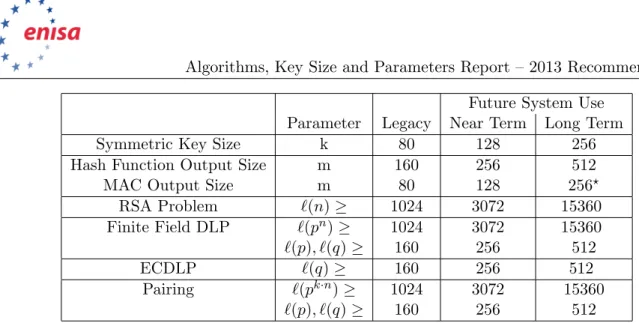
In Table 3.6 we present our explicit key size recommendations. The reader will see that we have essentially followed the NIST equivalence [265] between the different key sizes. However, these key sizes equivalences need to be understood to apply only to the “best in class” algorithm for block ciphers, hash function, RSA parameters, etc etc. It is clearly possible for a block cipher of 128-bits security to not offer 128-bit security due to cryptanalytic attacks.
We have focused on 128 bit security in this document for future use recommendations; clearly this offers a good long term security gaurantee. It is plausible that a similar recommendation could be made at (say) the 112 bit security level (which would correspond to roughly 2048 bit RSA keys). The line has to be drawn somewhere and there is general agreement this should be above the 100-bit level; whether one selects 112 bits or 128 bits as the correct level is a matter of taste. Due to the need to protect long term data we have taken the conservative choice and settled on 128 bits; with a higher level for very long term use.
Due to the problem of key sizes not being a good measure of security on their own, and also due to considerations of underlying performance costs, at the time of writing the recommendation for future use can be summarized in the following simple choices:
1. Block Ciphers: For near term use we recommend AES-128 and for long term use AES-256. 2. Hash Functions: For near term use we recommend SHA-256 and for long term use SHA-512. 3. Public Key Primitive: For near term use we recommend 256 bit elliptic curves, and for long
Future System Use Parameter Legacy Near Term Long Term
Symmetric Key Size k 80 128 256
Hash Function Output Size m 160 256 512
MAC Output Size m 80 128 256?
RSA Problem `(n)≥ 1024 3072 15360 Finite Field DLP `(pn)≥ 1024 3072 15360 `(p), `(q)≥ 160 256 512 ECDLP `(q)≥ 160 256 512 Pairing `(pk·n)≥ 1024 3072 15360 `(p), `(q)≥ 160 256 512
Table 3.6: Key Size Recommendations. A? notes the value could be smaller due to specific protocol or system reasons, the value given is for general purposes.
Finally, we note that the recommendations above, and indeed all analysis in this document, is on the basis that there is no breakthrough in the construction of quantum computers.