POUR L'OBTENTION DU GRADE DE DOCTEUR ÈS SCIENCES
acceptée sur proposition du jury: Prof. G. Candea, président du jury Prof. R. Guerraoui, directeur de thèse
Dr M. Aguilera, rapporteur Prof. P. Felber, rapporteur Prof. W. Zwaenepoel, rapporteur
Universally Scalable Concurrent Data Structures
THÈSE N
O7993 (2017)
ÉCOLE POLYTECHNIQUE FÉDÉRALE DE LAUSANNE
PRÉSENTÉE LE 29 SEPTEMBRE 2017À LA FACULTÉ INFORMATIQUE ET COMMUNICATIONS LABORATOIRE DE PROGRAMMATION DISTRIBUÉE
PROGRAMME DOCTORAL EN INFORMATIQUE ET COMMUNICATIONS
Suisse 2017 PAR
“Because it’s there.” — George Mallory, 1923, when asked why he wants to climb Mount Everest
Acknowledgements
Pursuing a PhD has been a tremendously enriching and enjoyable experience. Yet, looking back on the years of work which amounted to this dissertation, I am realizing that in many ways, this is the first difficult thing that I have ever done, and that I cannot imagine having been able to do it on my own. I therefore have a long list of “thank you”s. I have done my best to make it as complete as possible, but, since as is often the case in academia, writing this page was done under a tight deadline, I am certain I have omitted some names. For that, I apologize.
I would like to start by thanking my advisor, Prof. Rachid Guerraoui. I have learned a lot from Rachid, both as a researcher, and as a person. In particular, Rachid taught me how to truly get to the heart of the problem I’m working on, to always mind the difference between good research and good engineering, and how in an academic career, you can be very productive without having to sacrifice the things you like outside of work.
During my PhD, I had the opportunity of spending two summers in the research groups of VMware and Microsoft, where I started collaborations with Marcos Aguilera and Dahlia Malkhi (at VMware Research), and Aleksandar Dragojevic (at Microsoft Research). Each of them has taught me a lot and has shaped my perspective on research. The results of our productive collaborations are included in this dissertation. For all that, a big “thank you”!
I also want to thank the colleagues with which I collaborated during these years. I owe much of the quality of this dissertation to them as well. In particular, I want to thank Vasileios Trigonakis, with whom I had a very fruitful collaboration during the first couple of years of the PhD. I also want to thank Maysam Yabandeh, with whom I worked when I first joined the lab as a Master student, as well as Igor Zablotchi, with whom I collaborated on my last paper. I would then like to acknowledge the members of the jury that accepted my PhD thesis: Dr. Marcos Aguilera, Prof. George Candea, Prof. Pascal Felber, and Prof. Willy Zwaenepoel. Many thanks for reading my dissertation, and for the insightful questions and comments. In particular, I am grateful to Marcos for traveling all the way from California to participate in my private defense.
I want to thank EPFL, VMware, the Swiss National Science Foundation, and the European Research Council for financially supporting my research.
Acknowledgements
Dealing with administrative tasks would would have been much more difficult without the help of Kristine Verhamme and France Faille, and my practical experiments less successful without the help of our system administrator, Fabien Salvi.
Also, many thanks to all my colleagues in the Distributed Programming Laboratory, which have contributed to a great working environment. I consider myself particularly lucky to be able to call several current and former members of LPD not just colleagues, but close friends. Without Vasilis, David, George, Adi, Matej, Mihai, Oana, these 5 years of PhD would not have been nearly as fun as they were.
Fortunately, during these years, I also got to (sometimes) go outside the research lab. I am thankful to Ioana, Cristina, Jean-Noel, Radu, Flaviu, Sonia, Tudor, Virgil, Razvan, Vlad for the good conversations, the drinks, the parties, the hikes, but especially for reminding me that at times it’s worth putting work aside.
Last, but not least, I would like to thank my parents, Elena and Ioan, and my sister, Adina. This dissertation would not have happened without their unconditional love and support. I am deeply grateful.
Lausanne, September 7, 2017 Tudor David
Preface
This thesis was conducted in the Distributed Programming Laboratory at EPFL, under the supervision of Prof. Rachid Guerraoui, between 2012 and 2017.
The main results presented in this dissertation were first introduced in the following publica-tions:
1. Tudor David, Rachid Guerraoui, and Vasileios Trigonakis.Asynchronized Concurrency: The Secret to Scaling Concurrent Search Data Structures, 20th International Conference on Architectural Support for Programming Languages and Operating Systems (ASPLOS), Istanbul, Turkey, 2015.
2. Tudor David and Rachid Guerraoui.Concurrent Search Data Structures Can Be Blocking and Practically Wait-Free, 28th Symposium on Parallelism in Algorithms and Architec-tures (SPAA), Monterey, CA, 2016.
3. Marcos K. Aguilera, Tudor David, and Rachid Guerraoui.Locking Timestamps Versus Locking Objects.Technical report (EPFL-REPORT-229425), 2017.
4. Tudor David, Aleksandar Dragojevic, Rachid Guerraoui, and Igor Zablotchi.Log-free Concurrent Data Structures.Under submission, 2017.
Besides the aforementioned publications, which constitute the bulk of this dissertation, I was involved in the following papers:
1. Tudor David, Rachid Guerraoui and Vasileios Trigonakis.Everything You Always Wanted to Know about Synchronization but Were Afraid to Ask, Symposium on Operating Systems Principles (SOSP), Farmington, PA, 2013.
2. Tudor David, Rachid Guerraoui and Maysam Yabandeh.Consensus Inside, 15th Inter-national Middleware Conference (Middleware), Bordeaux, France, 2014. Best Paper Award.
Abstract
The increase in the number of cores in processors has been an important trend over the past decade. In order to be able to efficiently use such architectures, modern software must be scalable: performance should increase proportionally to the number of allotted cores.While some software is inherently parallel, with threads seldom having to coordinate, a large fraction of software systems are based on shared state, to which access must be coordinated. This shared state generally comes in the form of a concurrent data structure. It is thus essential for these concurrent data structures to be correct, fast and scalable, regardless of the scenario (i.e., different workloads, processors, memory units, programming abstractions). Nevertheless, few or no generic approaches exist that result in concurrent data structures which scale in a large spectrum of environments.
This dissertation introduces a set of generic methods that allows to build - irrespective of the deployment environment - fast and scalable concurrent data structures.
We start by identifying a set of sufficient conditions for concurrent search data structures to scale and perform well regardless of the workloads and processors they are running on. We introduce “asynchronized concurrency”, a paradigm consisting of four complementary programming patterns, which calls for the design of concurrent search data structures to resemble that of their sequential counterparts. Next, we show that there is virtually no practical situation in which one should seek a “theoretically wait-free” algorithm at the expense of a state-of-the-art blocking algorithm in the case of search data structures: blocking algorithms are simple, fast, and can be made "practically wait-free".
We then focus on the memory unit, and provide a method yielding fast concurrent data structures even when the memory is non-volatile, and structures must be recoverable in case of a transient failure. We start by introducing a generic technique that allows us to avoid doing expensive writes to non-volatile memory by using a fast software cache. We also study memory management, and propose a solution tailored to concurrent data structures that uses coarse-grained memory management in order to avoid logging. Moreover, we argue for the use of lock-free algorithms in this non-volatile context, and show how by optimizing them we can avoid expensive logging operations. Together, the techniques we propose enable us to avoid any form of logging in the common case, thus significantly improving concurrent data structure performance when using non-volatile RAM.
Finally, we go beyond basic interfaces, and look at scalable partitioned data structures imple-mented through a transactional interface. We present multiversion timestamp locking (MVTL), a new genre of multiversion concurrency control algorithms for serializable transactions. The
Preface
key idea behind MVTL is simple and novel: lock individual time points instead of locking objects or versions. We provide several MVTL-based algorithms, that address limitations of current concurrency-control schemes.
In short, by spanning workloads, processors, storage abstractions, and system sizes, this dissertation takes a step towards concurrent data structures that areuniversally scalable. Key words: Concurrent data structures, multi-core, transactions, scalability, performance, non-volatile RAM;
Résumé
Les dix dernières années ont vu croître le nombre de coeurs au sein des processeurs. Afin de profiter au mieux de ces nouvelles architectures, les algorithmes actuels doivent être scalables : leur performance doit croître proportionnellement avec le nombre de coeurs.
Bien que certains algorithmes sont intrinsèquement parallèles (les différents fils d’exécution n’ayant presque pas besoin de se coordonner entre eux), la plupart des systèmes logiciels ont un état partagé, les accès auquel devant être coordonnés. Cet état partagé se présente communément sous la forme d’une structure de données partagée. Il est donc essentiel que ces structures de données soient, non seulement correctes, mais également rapides et scalables, et ce, quel que soit le scénario. Pourtant, il existe très peu, et dans certains cas il n’existe aucune, méthode générique permettant de produire des structures de données qui soient scalables sur un large éventail d’architectures.
Dans ce document, nous présentons un ensemble de telles méthodes génériques : des mé-thodes de conception de structures de données rapides et scalables, indépendemment de l’environnement où elles sont déployées.
D’abord, nous identifions les conditions nécessaires sous lesquelles des structures de données concurrentes peuvent être rendues scalables et efficaces indépendemment de la charge du sys-tème et de la plateforme d’exécution. Nous définissons la notion de “concurrence asynchronisé (ASCY)”, un paradigme comprenant quatre motifs complémentaires de programmation de structures de recherche concurrente de données (Concurrent Search Data Structures, CSDS), et dont l’objectif est de rapprocher au mieux l’implémentation de la structure de donnée concurrente d’une implémentation séquentielle. Nous montrons ensuite qu’il n’existe aucune situation concrète où un algorithme wait-free en théorie surpasse les meilleurs algorithmes bloquants vis-à-vis des CSDS : les algorithmes bloquants sont simples, rapides, et wait-free “en pratique”.
Nous nous concentrons ensuite sur la mémoire. Nous proposons une méthode donnant lieu à des structures de données rapides même quand la mémoire n’est pas volatile, et que les struc-tures de données doivent être réparables en cas de fautes transitoires. Nous recommandons, arguments à l’appui, l’usage d’algorithmes lock-free, et montrons comment l’optimisation de ces derniers permet d’éviter des opérations coûteuse de logging. Nous étudions aussi la gestion de la mémoire, et proposons une solution adaptée aux structures de données qui évite une large partie des opérations de logging. Prises ensembles, les techniques que nous proposons permettent de conserver les performances des structures de données concurrentes lorsque la mémoire utilisée est une NVRAM.
Preface
Enfin, au-delà des structures de données en mémoire partagée, nous portons notre attention aux structures de données partitionnées implémentées à travers une interface de type tran-sactionnelle. Nous proposons un système de verrou à base d’estampillage multi-versionnelle (multiversion timestamp locking, MVTL), un nouveau type d’algorithmes de contrôle de concurrence pour les transactions sérialisables. L’idée-clé derrière MVTL est simple et inédite : verrouiller des points temporels isolés au lieu de verrouiller des objets ou des versions. Nous proposons plusieurs algorithmes fondées sur MVTL qui outrepassent les limites des schémas de contrôle de concurrence actuels.
Par l’étude des charges de travail, des processeurs, des abstractions de stockage de données et de tailles de système, cette thèse établit un pas vers des structures de données concurrentes qui soientuniversellement scalables.
Mots clefs : structures de données concurrentes, multi-coeur, transactions, scalabilité, perfor-mance, NVRAM
Contents
Acknowledgements i
Preface iii
Abstract (English/Français) v
List of figures xiii
List of tables xv
1 Introduction 1
1.1 Fast and Scalable Concurrent Data Structures . . . 2
1.2 Fast and Scalable Durable Data Structures . . . 4
1.3 Fast and Scalable Transactional Data Structures . . . 5
1.4 Contributions . . . 6
1.5 Roadmap . . . 6
I Preliminaries 7 2 Background 9 2.1 Modern multi-cores. . . 9
2.2 Search data structures. . . 10
2.3 Concurrent search data structures. . . 11
2.4 Memory reclamation. . . 12
2.5 Fast non-volatile memory. . . 12
2.6 Concurrency control protocols. . . 14
3 Related Work 17 3.1 Concurrent data structures . . . 17
3.2 Software for fast persistent memory. . . 20
Contents
II Scalable Concurrent Search Data Structures 25
4 Asynchronized Concurrency:
The Secret to Scaling Concurrent Search Data Structures 27
4.1 Introduction . . . 27
4.2 TheASCYLIBLibrary . . . 30
4.3 Evaluating the State of the Art CSDSs . . . 32
4.4 The ASCY Patterns . . . 38
4.5 Designing with ASCY from Scratch . . . 44
4.5.1 Cache-Line Hash Table (CLHT) . . . 44
4.5.2 BST Ticket (BST-TK) . . . 45
4.6 Concluding Remarks . . . 46
5 Blocking concurrent search data structures can be practically wait-free 49 5.1 Introduction . . . 49
5.2 Concurrent Search Data Structures: From Theory to Practice . . . 52
5.2.1 Performance and progress . . . 52
5.2.2 A closer look at wait-free CSDS algorithms . . . 53
5.2.3 Practical wait-freedom . . . 56
5.3 Experimental Setting . . . 57
5.3.1 State-of-the art algorithms . . . 57
5.3.2 Implementation details . . . 58
5.3.3 Methodology . . . 59
5.4 Coarse-Grained Metrics . . . 59
5.5 Practical Wait-Freedom . . . 61
5.5.1 Structure size and update ratio . . . 61
5.5.2 Non-uniform workloads . . . 64
5.5.3 High contention . . . 64
5.5.4 Unresponsive threads . . . 66
5.6 The Birthday Paradox . . . 69
5.6.1 Hash table . . . 70
5.6.2 Linked list . . . 70
5.6.3 Uniform vs. non-uniform workloads . . . 71
5.6.4 TSX-based algorithms . . . 71
5.7 Beyond Search Data Structures . . . 72
5.7.1 Intuition . . . 72
5.7.2 Experimentation . . . 73
5.8 Concluding Remarks . . . 73
III Durable Concurrent Data Structures 75 6 Log-Free Concurrent Data Structures 77 6.1 Introduction . . . 77 x
Contents
6.2 Avoiding frequent write-backs: the link cache . . . 80
6.2.1 Link cache overview . . . 80
6.2.2 Link cache implementation . . . 81
6.2.3 Illustration of the link cache’s effectiveness . . . 84
6.3 Memory Management with NV-Epochs . . . 84
6.3.1 Overview . . . 84
6.3.2 Epoch-based memory reclamation . . . 85
6.3.3 Interface with NVRAM allocators . . . 86
6.3.4 Maintaining the set of active NVRAM memory areas . . . 86
6.3.5 Recovery after transient failures . . . 87
6.4 Log-Free Durable Data Structures . . . 88
6.4.1 The Case for Lock-free Algorithms . . . 88
6.4.2 Durable Data Structure Implementations . . . 89
6.5 Evaluation . . . 91
6.5.1 Experimental setup . . . 91
6.5.2 Data structure performance . . . 91
6.5.3 Link cache efficiency . . . 93
6.5.4 Active page table efficiency . . . 94
6.5.5 Recovery . . . 95
6.5.6 NV-Memcached . . . 95
6.6 Concluding Remarks . . . 97
IV Scalable Concurrency Control 99 7 Locking timestamps versus locking versions 101 7.1 Introduction . . . 101 7.2 Model . . . 103 7.3 Overview . . . 104 7.4 Generic MVTL Algorithm . . . 106 7.4.1 Preamble . . . 106 7.4.2 Freezable locks . . . 106 7.4.3 Algorithm . . . 107 7.5 Simple MVTL Algorithms . . . 110
7.5.1 The preferential algorithm . . . 110
7.5.2 The prioritizer algorithm . . . 113
7.5.3 The-clock algorithm . . . 115
7.5.4 Existing algorithms as special cases . . . 117
7.5.5 The ghostbuster algorithm . . . 120
7.6 Extending MVTL to distributed systems . . . 122
7.6.1 Commitment object implementations . . . 125
7.6.2 Correctness . . . 126
Contents
7.8 Conclusion . . . 130
V Concluding Remarks 131
8 Conclusions and Future Work 133
8.1 Summary and Implications . . . 133 8.2 Future Work . . . 134
Bibliography 148
Curriculum Vitae 149
List of Figures
4.1 Search data structure interface. Updates have two phases: a parse phase,
fol-lowed by a modification phase. . . 28
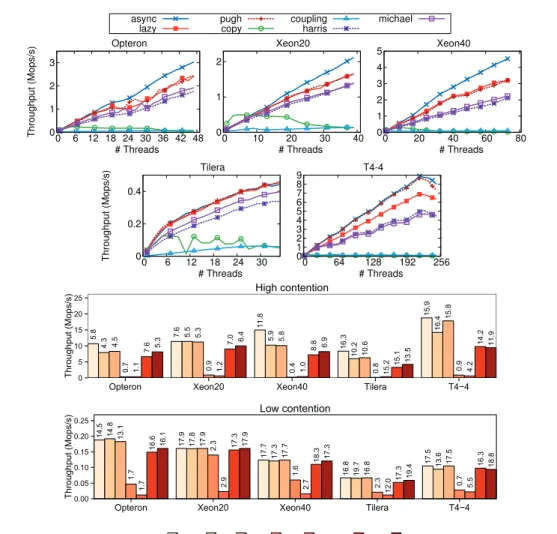
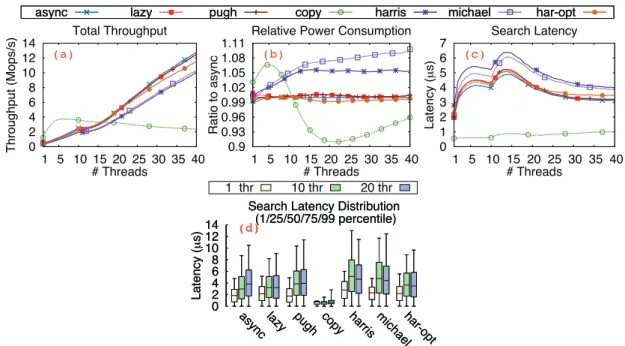
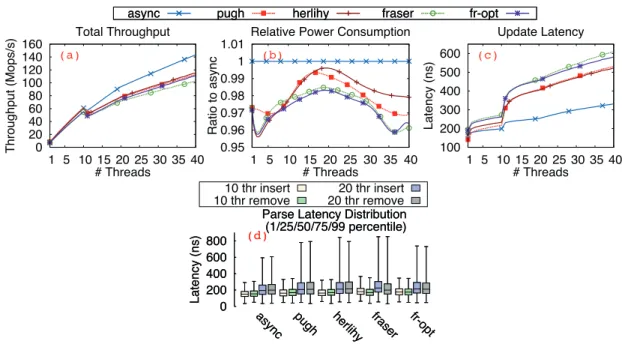
4.2 Linked lists: cross-platform results on average (top graphs – 4096 elements, 10% updates), high (20 threads, 512 elements, 25% updates), and low contention (20 threads, 16384 elements, 10% updates). . . 34
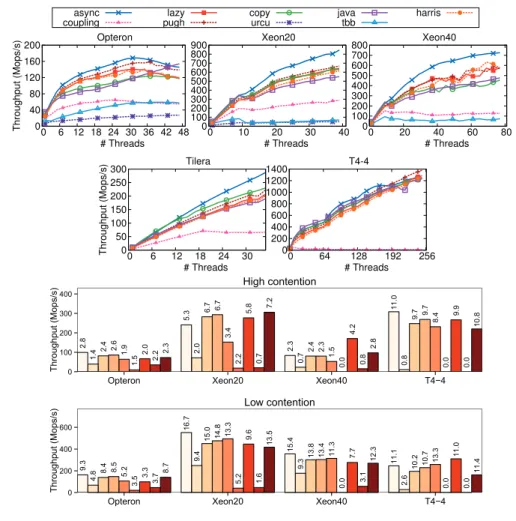
4.3 Hash tables: cross-platform results on average (top graphs – 4096 elements, 10% updates), high (20 threads, 512 elements, 25% updates), and low contention (20 threads, 16384 elements, 10% updates). . . 35
4.4 Skip lists: cross-platform results on average (top graphs – 4096 elements, 10% updates), high (20 threads, 512 elements, 25% updates), and low contention (20 threads, 16384 elements, 10% updates). . . 36
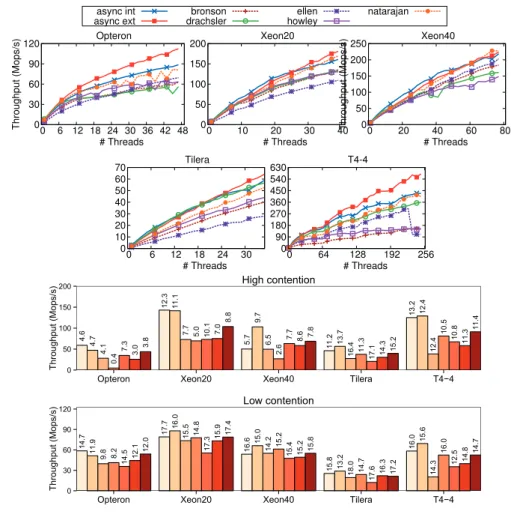
4.5 BSTs: cross-platform results on average (top graphs – 4096 elements, 10% up-dates), high (20 threads, 512 elements, 25% upup-dates), and low contention (20 threads, 16384 elements, 10% updates). . . 37
4.6 Cache misses per operation and scalability for various linked-list algorithms. . 37
4.7 Linked list with 1024 elements and 5% updates (2.5% successful). . . 39
4.8 Skip list with 1024 elements and 20% updates (10% successful). . . 41
4.9 Hash table with 8192 elements, 8192 (initial) buckets, and 10% updates (5% successful). . . 42
4.10 BST with 2048 elements and 20% updates (10% successful). . . 44
4.11CLHTwith 4096 elements on 20 threads for various update rates. . . 45
4.12BST-TKwith 4096 elements on 20 threads for various update rates. . . 46
5.1 The throughput of blocking, lock-free and wait-free linked lists of size 1024, with 10% of the operations being updates. . . 54
5.2 CSDS traversals. . . 55
5.3 Throughput scalability of blocking implementations. . . 58
5.4 Per-thread throughput (and standard deviation). . . 60
5.5 Fraction of time threads spend waiting for locks (and standard deviation). . . . 62
5.6 Fraction of requests that are restarted. . . 63
5.7 Percentage of time spent waiting for locks and percentage of requests restarted for blocking search data structures on a workload with a Zipfian request distri-bution. . . 64
List of Figures
5.8 Delayed requests and time spent waiting for locks as a function of structure size. 65 5.9 Percentage of time spent waiting for locks and percentage of requests restarted
for blocking search data structures when a thread repeatedly suffers delays. . . 66 5.10 Percentage of time threads spend waiting in blocking queue and stack
imple-mentations. . . 73 6.1 A bucket in the link cache. . . 81 6.2 Example of how the link cache is constructed. . . 83 6.3 Update throughput improvements compared to redo log based implementations. 92 6.4 Throughput when using the link cache normalized to throughput when not
using link cache, for a 1024-element hash table, with all operations being updates. 93 6.5 Active page table hit rates. . . 94 6.6 Data structure recovery times. . . 96 6.7 Performance and warm-up time comparison of Memcached and NV-Memcached. 96
List of Tables
2.1 Caches, DRAM, and NVRAM (projected) latencies (ns). . . 13 4.1 A short description of the existing CSDS algorithms we consider. “seq” stands
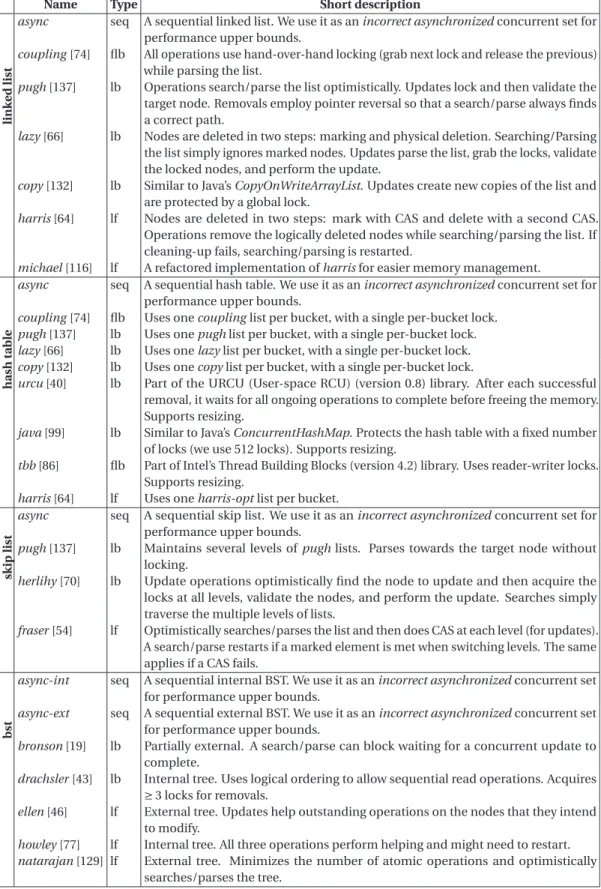
for sequential, “flb” for fully lock-based, “lb” for (hybrid) lock-based, and “lf” for lock-free. . . 31 5.1 Blocking search data structure algorithms considered in our evaluation. . . 55 5.2 Fraction of critical sections falling back to acquiring locks using 8
threads/physi-cal core (32 threads in total) with data structures of size 1024. . . 68 5.3 Throughput improvements of TSX-enabled versions vs. default implementations
1
Introduction
Data structures represent one of the main concerns of Computer Science. They are studied from the very first CS courses, and are at the core of virtually every modern software system. Linked lists, queues, stacks, search trees, hash tables, and skip lists are concepts that are familiar to every computer scientist.
Traditionally, we study sequential algorithms for such data structures: these algorithms assume a single thread of execution, and have little or no concern for storage. Data structures as means of organizing data are only useful if they are efficient for the user’s goals. Thus, an important amount of time is dedicated to studying and optimizing the performance of their operations in terms of sequential complexity. However, the ultimate purpose of any computer science abstraction is to be useful in practice. In particular, this means that any practical algorithm for a data structure needs to be adapted to the hardware on which it is running.
If we look at the simplest blueprint of modern computers, that is, the von Neumann archi-tecture [160], we note that there are two main components: the processor, and the memory unit. Therefore, any data structure deployed in practice needs to at the very least be adapted to these two components. The model of a single processing unit largely reflected the state of affairs in practice for more than half a century, until the advent of multi-cores in the early 2000s. Nowadays, a processor invariably has several cores, i.e., it is a machine that is able to run several threads of execution at the same time. For a data structure running on such a machine, it is important to be able to efficiently use all these concurrent threads at its disposal. Moreover, even more recently, memory units that are able to maintain their contents across transient failures have been introduced, potentially making application durability less costly. To take advantage of this capability, a data structure algorithm should store its state in a way that allows recovery, while maintaining as much of the performance of its volatile counterparts as possible.
Nevertheless, while a large amount of work has been dedicated to specialized and intricate data structure algorithms, there are few or nogenericapproaches that help us design data structures that are adapted to modern hardware (processors, storage techniques, or system
Chapter 1. Introduction
structures) in such a way as to maximize performance. Hence, a developer trying to design a data structure for her system from scratch has little guidance on how the algorithm should look like in order to perform as she expects. One of the aims of this dissertation is to take a step towards solving this problem.
Additionally, when concurrency is an issue and more complex computations need to be performed on a data structure, whether in a multi-core or a distributed system, it is extremely convenient to provide the user with a mechanism that allows one to access the structure not only through its basic interface, but rather through an abstraction that groups several operations and executes them in an atomic, all-or-nothing manner. This abstraction is referred to as a transaction. Beyond its convenience for the user, a transactional system must of course provide performance by allowing the maximum number of concurrent transactions to proceed.
This thesis aims to provide generic approaches for fast and scalable data structures in all these environments and programming models. In the following, we provide a brief overview of the approaches we propose for each of them.
1.1 Fast and Scalable Concurrent Data Structures
We first concern ourselves with adapting data structures to modern processors. Tradition-ally, processors only had a single processing unit (core), to which sequential data structure algorithms were well suited. However, for more than a decade now, Dennard scaling [38], which allowed core frequency to increase from generation to generation, has stalled. With Moore’s law [124], which predicts that the number of transistors per die doubles roughly every two years, still applying, computer architects have used these additional transistors that were becoming available with each CPU generation to place several cores on the same die. Such processors are known asmulti-cores.
Software systems, which relied on continuous increases in frequency to become faster with each CPU generation essentially for free, now need to harness the power of all the cores on a processor in order to achieve this. In some cases this is trivial: execution can simply be split in several independent instances that never or only rarely need to communicate with each other. Such workloads are called “embarrassingly parallel”. However, such cases are not very common: an important number of widely-used systems have some shared state at their core (e.g. [47, 59, 114, 122, 123]), state that is frequently accessed by a significant fraction of the execution threads in the system. Most often, this state is in the form of a data structure. We refer to data structures that must support access from multiple execution threads asconcurrent data structures.
Of course, when multiple threads are accessing a concurrent data structure and potentially modifying its state at the same time, their access to the structure needs to be coordinated in such a way as to ensure correctness. Essentially, operations should appear to execute as if they
1.1. Fast and Scalable Concurrent Data Structures
were run in some sequential order, and the effects of each operation need to become visible at some instant between its invocation and its return, a property known aslinearizability[75]. However, guaranteeing such correctness properties comes at a price: due to the need to coordinate between threads, total output is not always proportional to the number of threads concurrently running the data structure algorithm. The evolution of a concurrent data struc-ture’s performance as the number of cores dedicated to its execution (i.e., the number of concurrent execution threads accessing it) increases is calledscalability.
Ideally, a concurrent data structure should exhibit good base performance, andlinear scala-bility: performance that increases proportionally to the number of allotted cores. However, designing correct, fast, and scalable concurrent algorithms is a notoriously difficult and error-prone task. A large amount of work has been dedicated to the design of highly-tuned al-gorithms for such data structures [19,35,40,43,46,54,64,66,70,77,94,99,116,129,137,150,151]. Such algorithms might scale only under certain conditions and workloads, and when they do scale, it is not exactly clear what precisely it is that enables them to do so. Thus, no clear picture exists on how an algorithm that is fast and scalable regardless of the situation should look like. Even though sometimes, data structure implementations directly provided by a library are indeed sufficient, more often than not, when the goal is a high-performance sys-tem, concurrent data structures customized to the need of the particular system need to be designed and implemented from scratch. In Chapter 4 we take a step towards simplifying this task for an important class of data structures: search data structures. We identify and propose Asynchronized concurrency: a set of general patterns that when applied result in highly scalable implementations of concurrent search data structures. Moreover, these implementations are portably scalable: they scale under a wide variety of workloads and platforms. Intuitively, the idea is to design search data structures that resemble their sequential counterparts as much as possible, with stores only to cache lines semantically associated with updated nodes. Reads should not do any stores, nor should updates while traversing the data structure to reach the point where the change should be made. Only a small neighborhood of the data structure, containing the node to which the update actually refers to should be modified. We show that it is possible to apply all these patterns to a variety of existing state-of-the-art algorithms, both lock-based and lock-free, and that by applying them we improve the algorithms’ performance. In addition, we showcase how new algorithms can be designed starting from these principles. Thus, Asynchronized concurrency offers the programmer both a way to optimize existing concurrent search data structures, and simplifies the task of designing new ones.
An important characteristic of concurrent algorithms is the theoreticalprogress guarantee that they provide. The progress guarantee tells us what we can expect from the behavior of individual threads under concurrency. An open question in the context of concurrent data structures is the extent to which the theoretical progress guarantee provided by the algorithm matters in practical situations. The stronger the progress guarantee, the more complicated an algorithm is to design. In addition, wait-free algorithms (i.e., the algorithms providing the strongest progress guarantee) usually suffer in terms of throughput in the common case. It has
Chapter 1. Introduction
previously been shown that a large class of lock-free algorithms actually behave like wait-free algorithms in practice [3]. The question we raise is whether blocking implementations can also behave in a practically wait-free manner. One would expect a negative answer given the frequent use of mutual exclusion and the varied conditions under which these algorithms must run. As we show in Chapter 5, the answer is howeveryesfor search data structures. To be able to obtain this answer, we first introduce a set of performance metrics capable of capturing wait-free behavior in practice: the absence of significant delays due to concurrency. We then look at state-of-the-art implementations of concurrent data structures under a large variety of workloads and conditions. The conclusion we draw is that blocking search data structures exhibit virtually no significantly delayed requests. We also give a theoretical intuition for the result, through an analogy with the birthday paradox. The most problematic case for blocking algorithms can be frequent interrupts, in particular context switches. We show how best-effort Hardware Transactional Memory (HTM) can be leveraged to allow blocking algorithms to maintain practically wait-free behavior in this case. By changing only the locking code to use HTM, and by taking advantage of the seeming inconvenience of hardware transactions aborting upon interrupts, threads virtually never hold locks while preempted. In summary, our work helps programmers to better determine when a blocking implementation is sufficient for their needs, thus potentially simplifying the task of implementing a concurrent data structure to a substantial degree.
1.2 Fast and Scalable Durable Data Structures
Our second concern is adapting data structures to current memory units. Traditionally main memory used DRAM, and was volatile: its contents would have been lost in case of a power failure. However, non-volatile RAM (NVRAM), an emerging technology, promises latencies and a programming model similar to DRAM, while also ensuring durability. One of the main challenges when working with NVRAM is ensuring the complete recoverability of a system in case of a restart, while not significantly degrading performance at runtime when compared to structures running on DRAM. Intuitively, the challenge comes from the fact that by default, we do not have control over the order in which data is evicted from the write-back caches, and thus this has to be handled explicitly trough costly write-back instructions. Often, in order to ensure the correctness of durable state, we have to make sure stores are reliably written to NVRAM before proceeding in our application. Such operations are extremely expensive. Logging, which was extensively used in previous work [23, 25, 29, 78, 88, 92, 96, 105, 113, 159], is particularly problematic from this point of view.
As a solution in the context of (concurrent) data structures, if these have to be durable, in Chapter 6 we propose using lock-free data structures. The theoretical property of lock-freedom states that at least one process in a system should be able to make progress regardless of the current state. In particular, this means that processes should never leave the system in an inconsistent state. This allows us to avoid expensive logging in the data structure algorithm. We show how data structures for NVRAM can be efficiently implemented, and propose generic 4
1.3. Fast and Scalable Transactional Data Structures
techniques to optimize them further and to minimize the time spent waiting for stores to be persisted. In addition, we also look at the problem of memory management. Because of frequent logging operations, this is a particularly thorny issue from a performance standpoint when working with NVRAM. We propose a solution tailored to concurrent data structures, which by keeping track of memory at a coarser granularity avoids overheads at runtime. This does mean that upon a restart after a failure has occurred, some work will have to be performed to avoid persistent memory leaks. Nevertheless, by taking advantage of our knowledge of the concurrent data structure algorithms, we are able to keep this recovery time manageable. Our work thus presents the first methodology for designing durable concurrent data struc-tures that avoids logging in the common case, and therefore brings overall data structure performance closer to that of volatile memory counterparts.
1.3 Fast and Scalable Transactional Data Structures
We also look at the programming abstractions through which data structures are manipulated. Ideally, a user can express her computations using individual reads and writes. However, it is at times significantly more convenient to treat entire portions of code accessing a structure as a single atomic unit of sequential code. This abstraction is called atransaction. It is then the job of the underlying system to execute the transaction in an all-or-nothing manner, and in isolation from any concurrency (that is, all the operations in the transactions should appear to execute at the same point in time relative to operations of other transactions). The correct execution of such transactions is ensured through a concurrency control protocol. Aside from correctness, the performance of such transactional systems is of course essential. In general, concurrency control protocols are either pessimistic (they lock the required objects before doing any computations), or optimistic (they perform work speculatively, and then try to commit it). While pessimistic concurrency control protocols may limit parallelism, optimistic protocols may result in large numbers of aborts.
To mediate these downsides, in Chapter 7 we introduce a new paradigm for concurrency control:Multiversion Timestamp Locking (MVTL). Unlike previous approaches, MVTL works not with objects or versions of objects, but at a much finer granularity - namely individual points of logical time. Along with the increased concurrency that comes with this finer-grain locking, MVTL transactions are able to explore several serialization points at the same time. We first prove the correctness of the generic MVTL framework, and then propose several MVTL-based algorithms, that circumvent some of the issues inherent in previous protocols. In particular, we provide an MVTL algorithm that, as we show, commits more workloads than previous related algorithms. We also propose algorithms that provide prioritized transactions, and avoid ghost and serial aborts. In addition, we provide an MVTL algorithm aimed at a distributed setting. While here we merely develop the theoretical foundations of MVTL, we believe it is in this environment that MVTL would shine in practice. These algorithms represent but a starting point: MVTL can be the basis of a large spectrum of new algorithms.
Chapter 1. Introduction
1.4 Contributions
The main aim of this thesis is to make the design of fast and scalable data structures a some-what less onerous task for the programmer. To this end, we focus on methods that are generic in the sense that they can be applied to a large spectrum of data structures and concurrent objects, and we target environments that are both varied and relevant in today’s technology landscape. In particular, we focus on modern processors and system structures, on next-generation memory units, as well as on programming models that go beyond individual operations. In this sense, we seekuniversality. More concretely, this dissertation makes the following intellectual contributions:
• Asynchronized concurrency: a set of general patterns that facilitate the design an imple-mentation of portably scalable concurrent search data structures;
• A better understanding of the precise scenarios under which blocking concurrent data structures should be used;
• A generic methodology for the design of efficient lock-free concurrent data structures and memory management for the NVRAM environment;
• Multiversion Timestamp Locking, a family of concurrency control algorithms that ad-dress several shortcomings of previous approaches.
1.5 Roadmap
The rest of this dissertation is organized as follows:
• Part I provides some background (Chapter 2), and discusses published work related to the topics covered in this thesis (Chapter 3);
• Part II presents Asynchronized concurrency, showing how to design portably scalable CSDSs (Chapter 4), and argues that in the case of CSDSs, blocking algorithms may behave practically wait-free (Chapter 5);
• Part III shows how concurrent data structures for non-volatile RAM can be efficiently designed;
• Part IV discusses Multiversion Timestamp Locking, a new paradigm for concurrency control;
• Part V presents potential future work and concludes the dissertation.
Part I
Preliminaries
2
Background
In this section, we present some background related to the topics which will be discussed in later chapters. We start with a discussion of modern architectures and the need for scalable concurrent software. We continue by discussing search data structures, and then go into more details into the design of concurrent algorithms for such structures. We present new fast non-volatile storage technologies, and we end with a discussion of concurrency control for transactions.
2.1 Modern multi-cores.
For more than a decade, Dennard scaling [38] has ground to a halt, thus preventing computer architects from further increasing core frequency. However, Moore’s law [124] has still been in effect. As a result, computer architects have been using the additional transistors that were becoming available with each CPU generation to increase the number of cores placed on a single processor. This fundamentally changed the way software is designed. Before hitting the frequency wall, software was simply becoming faster with each CPU generation simply because of the increase in the clock frequency. Since then, software has mainly achieved better performance through scalability: the ability of efficiently using the available cores. A multi-core software system is said to be scalable if its output is proportional to the number of cores running that system. In particular, communication between cores must not hamper scalability.
The standard means of communication between the different cores is through shared main memory. As there are two orders of magnitude difference between the operating speed of a core and DRAM, traditionally several layers (generally 3) of caches are present between main memory and a core. The closer a cache is to the core, the smaller its capacity, and the lower its latency. Two levels of cache are generally private to each core, while the third, larger cache is shared among the cores of a processor. The granularity at which the memory system operates is the cache line, which on modern architectures is generally 64 bytes in size.
Chapter 2. Background
When multiple cores are working with the same cache line, correctness is ensured by the cache coherence mechanism, which ensures that everyone sees the same value for a particular cache line. Most modern processors use variants of the MESI cache coherence protocol to this effect. Briefly, a cache line can be in one out of several states:
• Modified.This is the only correct copy of the data. Every other copy is stale. • Exclusive.This is the only copy of the data (except for main memory). • Shared.This is one out of several correct copies of the data in the system. • Invalid.The data held in this copy of the cache line is not usable.
When a core performs a load or store on a particular piece of data, the corresponding cache lines must be brought in the core’s private caches in a state that allows the operation.
The time it takes a core to fetch a cache line depends on where the current valid copies are found. Typical values (in cycles) are 5 for the first-level cache, 10-15 for the second-level cache, 40 for the last-level cache, and more than 100 for RAM [36]. Modern servers often comprise more than one processor. If the latest copy of a piece data is currently in the memory of another processor, the latency to read or write it can be several hundred cycles.
Given the large latency differences depending on the state and location of data it is essential for scalable concurrent software keep data as much as possible in shared state, and avoid expensive data accesses whenever possible.
In general, modern architectures provide atomic Compare-and-Swap (CAS), as well as atomic Fetch-and-OP (where OP is an arithmetic or logical operation) instructions. These instructions usually operate at word-size granularity, and are the building blocks for higher-level software synchronization mechanisms and concurrent objects. As CAS has consensus numbern[69], it is sufficient to implement any concurrent object.
Several newer architectures also provide best-effort hardware transactional memory(HTM). The user may specify a region of code which should be executed atomically, and the hardware then detects if any other core reads or writes the transaction’s data while it is executing. Hard-ware transactions may however abort for several reasons, including data conflicts, capacity limits (the write-set of a transaction must be in the L1 cache of the core executing the transac-tion), interrupts (including context switches). Therefore, there is a non-negligible possibility of starvation. Thus, to prevent this, one must have to provide a non-transactional fall-back path, which is taken if the transaction fails a specified number of times.
2.2 Search data structures.
In this dissertation, while we will discuss a large variety of data structures, we place a particular emphasis onsearch data structures.
2.3. Concurrent search data structures.
A search data structure consists of a set of elements and three main operations:search,insert, andremove. An element consists of akeyand avalue. The key uniquely identifies the element in the set. The value is often a pointer to a structure that contains the actual data.
The three main operations have the following semantics:
• search(key)looks for an element with the given key; if it is found, returns the value of the element, otherwise returnsNULL.
• insert(key, val)attempts to insert a new element in the data structure; the insertion is successful iff there is no other element with the same key.
• remove(key)attempts to remove the element with the given key; it is successful iff such an element exists.
A common attribute of search data structures is that the updates (insertions and removals) comprise two distinct phases. First, theyparsethe structure until the update point is reached. Then the actual modification is attempted.
2.3 Concurrent search data structures.
We study the most basic and commonly-used CSDSs:linked lists, hash tables, skip lists, and binary search trees (BSTs). We are interested inlinearizable[75] implementations of the aforementioned data structures.
Linearizability significantly simplifies the task of the programmer for it requires every op-eration on the search to appear to execute in a single point in time, despite concurrency. To ensure linearizability, concurrent operations on the same data structure from different threads need to besynchronized: this is achieved using low-level operations provided by the underlying hardware.
It is common to classify linearizable implementations based on whether and how they make use of locks [74]. One can distinguishfully lock-based, hybrid lock-based, andlock-free[54] algorithms. Fully lock-based algorithms use locks to protect all three operations and are blocking[74], in the sense that a thread might have to wait for a lock to be released. Hybrid lock-based (henceforth called “lock-based”) algorithms use locks to protect the actual updates to the structure. They are otherwise lock-free. For instance, a removal might parse the list (in a lock-free manner) until the target node is found, get the lock, and then do the actual deletion. Hybrid algorithms are also blocking. Finally, lock-free algorithms do not use locks and arenon-blocking[54, 71]. They typically use the underlying atomic operations, such as compare-and-swap (CAS), provided by the hardware.
Chapter 2. Background
2.4 Memory reclamation.
The problem of memory reclamation is inherent when working with concurrent linked data structures in an unmanaged language, such as C. Essentially, when a node is removed from a data structure, it cannot be freed immediately, as other concurrent operations might still have references to it. Thus, a mechanism is needed in order to be able to safely determine when a certain data structure node can be freed. Ideally, this should be achieved without incurring significant time or space overheads. Additionally, memory should be freed as soon as possible. In practice, the most common solutions to this problem are hazard pointers [117], and epoch or quiescence based memory reclamation [54].
Briefly, when using hazard pointers, each thread holds a small number of pointers to nodes it may currently have references to (the thread’shazard pointers). Only a thread can write its own hazard pointers, but any thread can read them. When a node is unlinked and its memory should be reclaimed, one must first ensure that no hazard pointers concerning that particular node exist. An advantage of hazard pointers is the fact that the method provides lock-freedom. However, it is known to exhibit scalability issues, as the hazard pointers of all threads need to be collected.
In epoch-based memory reclamation, each thread is assigned an epoch number. In the most common implementation, threads increment their epoch numbers at the very beginning of an operation, as well as at the end. When a node is unlinked from the data structure, it is not immediately freed, but rather handed over to the memory reclamation mechanism, which also stores the epochs each thread was in at the moment the node was unlinked. When the epochs of all the threads that had operations in progress at the moment the node was unlinked have advanced, (thus guaranteeing they have finished any operations in which they might have had references to the unlinked node), the memory of the node can be safely reclaimed. While scalable, this method is not lock-free: a single thread that does not may progress in its execution can prevent memory from being freed.
In this work, we will use epoch-based memory reclamation, as in the case of the structures we consider, this technique tends to incur a smaller run time penalty.
2.5 Fast non-volatile memory.
Traditionally, storage has either been fast, but volatile (i.e., the data stored is lost in case of a power failure), such as is the case with DRAM, or non-volatile, but slow, such as is the case with flash storage for instance.
However, more recently, a new class of storage that promises both low latency and non-volatility is becoming available. Candidate technologies include Memristors [147], Phase Change Memory [100, 138], and 3D XPoint [120]. Latencies are expected to be somewhat larger than those of DRAM, with writes being somewhat more expensive than reads. Table 2.1
2.5. Fast non-volatile memory.
L1 L2 LLC DRAM PCM Memristor
Read 2 6 15 50 50-70 100
Write 2 6 15 50 150 100
Table 2.1 – Caches, DRAM, and NVRAM (projected) latencies (ns).
provides a comparison of expected PCM and Memristor latencies [143, 157, 170] with those of DRAM and caches.
As opposed to other forms of non-volatile storage, these new technologies will be byte-addressable, and from a programming model standpoint will be mappable to a region of virtual memory. Therefore, accessing it would then essentially be no different than access-ing DRAM. In the rest of this dissertation, we refer to such fast, byte-addressable memory that maintains its contents across power failures asnon-volatile RAM (NVRAM)orpersistent memory.
From a programming perspective, one of the main difficulties when working with NVRAM stems from the fact that by default, we do not control the order in which cache lines are evicted from the write-back caches, and actually written to NVRAM. Thus, when performing several stores, even when we ensure that they appear in the proper order in the caches (for which we just need to mind the memory consistency model of our processor), it may still be the case that they appear in a different order from the point of view of the persistent memory. If a restart occurs before all the stores are persisted, we might end up with incorrect state (such as, for example, pointers to uninitialized memory). The only way to ensure that stores appear when we want them to and in the order we want them to in persistent memory is by using special instructions that force data to be written back to NVRAM.
On current Intel processors, one can ensure that a cache line is written to memory by using
theclflushinstruction. This instruction invalidates the cache line. In addition, such flushes
are ordered with respect to one another: if we issue two flushes, the second one will only start executing once the first one has completed. On upcoming processors, Intel is introducing two new instructions targeted at non-volatile RAM [80, 82]. The first one isclflushopt. This instruction is not strongly ordered. Therefore, we can issue aclflushoptbefore the previous one has finished; thus, multiple such instructions can proceed in parallel.clflushoptis only ordered with respect to store fences. The second new instruction isclwb, which only does a write-back to memory, without invalidating the cache line from the cache hierarchy. Like
clflushopt, it is only ordered with respect to store fences (or to instructions that have an
implied store fence, such as, for example, Compare-and-Swap).
In the rest of this dissertation, when working with NVRAM, we will use theclwbinstruction to ensure that cache lines are written to memory. An important observation is the fact that
Chapter 2. Background
since these instructions are unordered with respect to one another, when the relative order in which they are written to persistent memory is not particularly important, batching several write-back instructions is beneficial for performance [81]. We refer to one or more write-back instructions followed by a store fence as asyncoperation.
When working with durable memory, we assume a model transient failures may occur: a machine may fail at any point in time (due to, for example, a power failure), but can be expected to be restarted and resume normal operation.
We require, as is commonly the case in practice, that only the data stored in durable main memory is still available after a crash. The data that was in a processor’s registers or in the write-back caches at the moment of the crash is not available after a restart. Nevertheless, our approach of using lock-free algorithms would be highly beneficial on an architecture that maintains enough residual energy to flush the register and the caches in case of a power failure as well.
Moreover, similar to related work [16], we assume that a region of non-volatile RAM can be mapped to the same region of virtual memory across restarts. Alternatively, if this is not the case, we can update persistent pointers at recovery time.
In the context of concurrent software, it is important to define correctness conditions in the face of restarts. In particular, we require a framework that allows us to reason about the state that is stored in NVRAM after a crash. For this purpose, we use the concept ofdurable lineariz-abilityintroduced by Izraelevitz et al. [89]. Essentially, a durably linearizable implementation guarantees that the state of the data structure after a restart reflects a consistent operation subhistory that includes all the completed operations at the moment of the crash.
2.6 Concurrency control protocols.
A large number of applications express sections of code that need to be executed atomically astransactions. This is true in databases, in distributed data stores, as well as in concurrent software, such as software transactional memory (STM). Transactions represent a particularly convenient abstraction for application users, which do not need to concern themselves with concurrency and potential interleaving of operations. The user merely has to specify a portion of code that is to be executed in an atomic manner, and the underlying system ensures the transaction is correctly executed.
In terms of isolation, transactional systems may offer one out of several guarantees. Popular alternatives includesnapshot isolation,serializability, andstrict serializability. Snapshot isola-tion guarantees that the read set of a transacisola-tion reflects a consistent view of the objects in the system at a certain point in time. While systems providing snapshot isolation can be efficiently implemented, they are prone to anomalies, such as the write skew anomaly [15]. Serializability guarantees that the effect of the execution of transactions is as if they were executed one a
2.6. Concurrency control protocols.
time, in some particular order. Strict serializability requires that the serialization order of transactions reflect their execution order.
In the rest of this dissertation, we concern ourselves with providing serializable transactions. Where appropriate, we also discuss the necessary changes for strict serializability.
The way in which potential conflicts between concurrent transactions are handled is deter-mined by theconcurrency control protocol. Broadly speaking, there are two types of concur-rency control protocols: pessimistic and optimistic protocols. Pessimistic protocols acquire locks on the items transactions before executing them. Thus, when the transaction is executed, it is certain to succeed. Such protocols are pessimistic in the sense that they assume that conflicts will occur, and thus acquire locks in the first phase in order to be sure of the success of the transaction. One example of such protocol is two-phase-locking (2PL) [15].
Optimistic concurrency control protocols on the other hand generally execute a transaction in a speculative manner, and only when actually trying to commit the results verify whether the transaction can be successfully committed, or if some other concurrent transaction has modified the concerned state in the meanwhile. These protocols are optimistic in the sense that they assume that conflicts will not generally happen, and thus most transactions will be successful.
In terms of performance, optimistic protocols are more appropriate when conflicts are rare, while pessimistic protocols shine in the face of frequent conflicts.
Concurrency control protocols may work with one or several versions, indexed by the (logical) time when they were created. The precise version a transaction accesses is determined by its rank in the serialization order. In general, working with several versions of the same object enables more concurrency, but incurs storage overheads. We discuss multiversion concurrency control in more detail in Chapter 7.
3
Related Work
In this chapter, we discuss published work that is related to the ideas introduced in this dissertation. We start by presenting work that focuses on various aspects of the design of concurrent data structures, as well as their use in systems (Section 3.1). We then discuss previous work focusing on the design of software for fast, persistent memory, as well as other software constructs that are similar to our link cache (Section 3.2). We finish by presenting work on concurrency control, both in the context of distributed transactions, as well as in the context of software transactional memory (Section 3.3).
3.1 Concurrent data structures
CSDS design. A large body of work has been dedicated to the design of efficient CSDSs [19,43, 46,54,66,74,77,112,115,116,129,137,148,153,155,162]. These efforts usually aim at optimizing a specific CSDS (e.g., BST) in terms of throughput, for a specific set of workloads and platforms. In contrast, ASCY is a paradigm that targets the scalability of various CSDSs across different platforms, for various workloads, and according to several performance metrics.
Memory reclamation is of key importance in CSDSs [18,41,44,72,117]. Various techniques have been proposed, such asquiescent state[40, 64, 65],epochs[54],reference counters[41, 58, 155], pointers[18, 72, 117], and, recently, hardware transactional memory [4, 44].ASCYLIBuses an epoch-based allocator that reduces the performance overheads.
Read-copy update (RCU) [112] is a concurrent programming technique that is heavily used in the Linux Kernel [9]. In short, RCU guarantees that readers always find a consistent view of the data structure. Writers perform atomic updates, after which, in the case of removals, they wait for all concurrent readers to finish in order to perform memory reclamation. Relativistic programming [153] is a technique that is related to RCU and maintains efficient reads even with large updates to the data structure (e.g., a resize).
Recently, a significant amount of work has been dedicated to improving the ease of use and concurrency of the RCU pattern. Arbel and Attiya [7] present an RCU-like search tree which
Chapter 3. Related Work
allows concurrent updates. While out-performing classic RCU-based structures, the design is still shown to lag behind other state-of-the-art CSDSs that are closer to ASCY, in particular in write-intensive scenarios. Arbel et al. [8] propose predicate RCU, which reduces the waiting time writers have to wait for readers. Matveev et al. [110] introduce Read-Log-Update, a version of RCU that is enhanced with techniques inspired from software transactional mem-ory, simplifying its usage, and allowing more concurrency with writers. Nevertheless, while improving on RCU, these approaches still do not match the performance and scalability of tailor-made, high-performance concurrent data structures. In general, RCU-like approaches purposefully optimize the performance of search operations at the possible expense of up-dates. Our ASCY1pattern is similar in the sense that it dictates that readers must be unaware
of concurrency. However, our three remaining patterns achieve the benefits of sequential reads without sacrificing the performance of updates.
Hunt et al. [79] study the energy efficiency of lock-free and lock-based concurrent data struc-tures (queues and linked lists). They find that lock-free algorithms tend to be more energy efficient than their lock-based counterparts. We observe that in the context of CSDSs, as long as the algorithms apply ASCY, there is no inherent difference between lock-free and lock-based algorithms. Essentially, this is because the ASCY patterns help reduce the number and the granularity of locks.
Gramoli [61] performs a study synchronization techniques. He observes that while generally offering good performance, the validate-lock-validate technique advocated by ASCY3in the
context of blocking algorithms at times results in high performance variability.
More recently, Trigonakis and Guerraoui [63] generalize the method used in BST-TK, and propose Optik, a design pattern for CSDSs that uses trylocks based on version numbers, which allow the merging of locking and conflict detection. Based on ASCY, Antoniadis et al. [6] introduce sequential proximity, a theoretical approach that allows one to determine if a CSDS algorithm is close to its sequential counterpart, and thus scalable. Similar to what we proposed through out ASCY patterns, Gibson and Gramoli [57] theoretically show that excessive helping can be detrimental to performance.
Calciu et al. [22] propose Node Replication, a method that automatically transforms a se-quential data structure algorithm into a concurrent one. Node Replication maintains several replicas of the data structure in a NUMA-aware fashion, and ensures consistency of the repli-cas though a shared log. Node Replication is shown to perform well in scenarios with very high contention, but in the case of search data structures, it is out-performed by state-of-the-art algorithms (such as those applying our ASCY patterns) in other scenarios. Moreover, Node Replication incurs significant space overhead, as the data structure is replicated in several times, and is blocking.
Scalability. Our work [36] has argued that scalability of synchronization is mainly a property of the hardware. In particular, synchronization primitives are shown to be inherently non-18
3.1. Concurrent data structures
scalable on NUMA architectures due to expensive cache-line transfers. To bypass these problems, ASCY reduces the amount of synchronization on CSDSs, leading to designs that scale even in the presence of non-uniformity.
Clements et al. [28] show that as long as interfaces are commutative, a scalable implementation of an object must exists. Essentially, they make the case that if two operations commute, there must be an implementation where executing these operations results in no cache conflicts. Thus, from the point of view of the memory system, executing the two operations does not cause any scalability issues. Although basic CSDS interfaces commute, as defined by Clements et al., certain structures such as lists and trees do not allow for conflict-free implementations. We show, however, that even in these cases, scalable algorithms can be devised following ASCY.
Data structures in systems. Boyd-Wickizer et al. [17] performed a scalability study of the Linux kernel. They identify several bottlenecks, among which, one in the directory entry lookup operation (even though it is optimized using RCU). In general, many systems, such as Memcached [114], SILT [103], LevelDB [59], RocksDB [47], or Masstree [108] have a CSDS at their core. In several cases, these structures have been found to cause scalability problems. A well known instance is that of Memcached [17,49,131]. Fan et al. [49] increase the performance of Memcached by a factor of three, largely due to changes in the hash table algorithm. ASCY can be used to recognize possible optimizations in systems such as Memcached and develop scalable CSDS implementations.
Baumann et al. [12] argue that in principle, non-portable, hardware-specific optimizations in the OS kernel should be removed. They attribute the existence of such optimizations to “the basic structure of a shared-memory kernel with data structures protected by locks” and propose to rethink the OS structure. We show that, by applying ASCY, we reach portably-scalable implementations. We believe that ASCY can help alleviate the difficult problem of CSDSs in OSes.
Progress guarantees Gramoli [61] studies different classes of concurrent data structures, and observes no inherent difference in aggregate throughput between free and lock-based search data structures. In this dissertation, we look at CSDSs through the perspective of a different criterion: practical wait-freedom.
We are not the first to ask whether algorithms with weaker progress guarantees do not actually provide wait-freedom, given some assumptions about the execution environment. We are however the first to look at blocking algorithms. In doing so, we also provide the first practical quantification of the effects of progress guarantees on CSDSs. Ellen et al. [53] show that under an unknown-bound synchronous model, obstruction-free algorithms can behave practically wait-free. Herlihy and Shavit [73] suggest that on realistic schedulers, lock-free algorithms behave in a wait-free manner. Alistarh et al. [3] prove that assuming a stochastic scheduler which determines the ordering of accesses to a memory location, lock-free algorithms behave
Chapter 3. Related Work
practically wait-free. Our work suggests that in the case of CSDSs, given the fact that the probability of contention for any memory location is low, the characteristics of the scheduler governing the order of memory accesses might not be a determining factor.
Michael [118] also studies the practical trade-offs between different progress guarantees. However, his analysis only discusses non-blocking algorithms, and does not focus on CSDSs, but mostly on objects where a single point of contention is likely, such as counters and queues. As we show in this dissertation, the properties of state-of-the-art concurrent algorithms for search data structures are significantly different from other concurrent structures.
Rajwar and Goodman [139] propose a hardware mechanism for transactions and identify it as conductive to non-blocking behavior in lock-based programs. However, the transactional support they propose provides starvation freedom, which is not the case in practical imple-mentations such as Intel TSX. In the context of blocking CSDSs, we show that HTM support is needed for wait-free behavior in a particular set of circumstances only. This observation is, we believe, interesting in its own right. We also show that wait-free behavior is possible even with best-effort transactional memory which may revert to locking, and explain why this conclusion does not extend to other concurrent structures beyond CSDSs.
3.2 Software for fast persistent memory.
Durable data structures. Several approaches have used transactions as means of interacting with NVRAM [23, 29, 39, 60, 88, 92, 96, 105, 113, 159]. Yet, the significant overhead associated with transactional logging, inherent to such methods, has been recently highlighted (e.g., [144]), and several attempts to alleviate the problem have been proposed. Izraelevitz et al. [88] introduce an approach in which if failures occur within a critical section, upon recovery the critical section can simply be run to completion instead of reverting to previous state. To achieve this, one simply needs to reliably keep track of the last store instruction performed by each thread. While efficient in a scenario where write-back caches can be assumed to be persistent as well, the approach essentially requires a write to the log for each store instruction in a critical section. Kolli et al. [96] focus on static transactions in lock-based applications, and attempt to minimize persist dependencies in order limit waiting time. The authors also show how the commit stage of transactions can be performed while not holding any locks. In the same vein, Kamino-Tx [113] uses a copy-on-write technique, and avoids logging in critical sections. DudeTM [105] optimizes redo logging by first executing the transaction and obtaining a redo log in volatile memory, then atomically flushing the redo log to persistent memory, and only then modifying the original data.
In this paper, we go beyond optimizations to logging: we provide a method that in the com-mon case allows us to circumvent such logging altogether in the context of concurrent data structures.
Several efforts [23,25,78] have been dedicated to the generation of correct durable applications