Prevalence of Depression among Iranian Elderly:
Systematic Review and Meta-Analysis
Diana Sarokhani1, Masoumeh Parvareh1, Ali Hasanpour Dehkordi2,3, Kourosh Sayehmiri4, Abbas Moghimbeigi5*
Abstract
Objective: depression is one of the most serious and prevalent mood disorders. Aging population is an important economic, social, and health challenge of the 21st century. The present study aimed at estimating the prevalence of depression among the Iranian elderly through meta-analysis method.
Method: Studies were searched in ISI, Scopus, Pub Med, Google Scholar, and in Iranian databases including Iran Medex, Magiran, SID, and Med Lib using the following keywords: “depression”, “prevalence”, and “elderly”. Data were analyzed using meta-analysis (random effects model). Heterogeneity among the results of the studies was examined by “I2” index. Beck, DASS-21, GHQ-28, and G DS questionnaires were used in this study, and analyses were performed using STATA Ver.11.
Results: A total of 26 studies in Iran with a sample size of 5781 individuals had been found during 2001 and 2015. Prevalence of depression among Iranian elderly was estimated to be 43% (95% confidence interval (CI):30% - 55%). The findings showed that the prevalence of depression among Iranians were49% in women, 48% in men, 37% in unmarried, and 45%in the married. In addition, the prevalence of very severe, severe, moderate, and mild depression levels were estimated to be 5%, 19%, 33%, and 38% of the participants, respectively. No significant difference was observed between married and unmarried individuals. Most of Iranian elderly suffered from mild depression.
Conclusion: There was high level of depression prevalence among Iranian elderly, and women were more depressed than men. So, policy makers must design and run mental health programs to decrease the prevalence of depression among Iranian elderly.
Key words: Depression, Elderly, Iran, Prevalence
D
epression has been one of the most commondisorders in Iran, the world's fourth costly impairment, and undoubtedly the second costliest disorder until 2015. Some of the demographic and social characteristics among the elderly reduce or increase their depression (1). Depression is a public issue and constitutes 35% to 45%of mental illnesses in Iran (2) and generally covers about 8% to 20% of the population (3).
The chronic nature of some diseases has many consequences on patients' lives especially the quality of
their lives, duration of treatment, mortality, new admissions, and the cost of hospital readmissions (4-9). Aging is a stage of life that is naturally associated with reduced physical and mental abilities (10-12).
So, it will be one of the most important health problems of societies in the future. Psychological problems, particularly depression, are the most common problems in this age group (13).
Systematic Review
1. Psychosocial Injuries Research Center, Ilam University of Medical Sciences, Ilam, Iran.
2. Social Determinants of Health Research Center, Shahrekord University of Medical Sciences, Shahrekord, Iran.
3. Department of Medical-Surgical, Faculty of Nursing and Midwifery, Shahrekord University of Medical Sciences, Shahrekord, Iran.
4. Department of Biostatistics, Psychosocial Injuries Research Center, Ilam University of Medical Sciences, Ilam, Iran.
5. Modeling of Noncommunicable Diseases Research Center, Department of Biostatistics, School of Public Health, Hamadan University
of Medical Sciences, Hamadan, Iran.
*Corresponding Author:
Address: Modeling of Noncommunicable Diseases Research Center, Department of Biostatistics, Faculty of Public Health, Hamadan University of Medical Sciences, Hamadan, Iran.
Tel: 98-813839091, Fax: 98-813839091, Email: [email protected]
In addition, aging is a term used for lack of ability to effectively reduce biological life along with aging (14). Along with aging, problems and depression in the elderly have increased, making aging the most common mental disorder (15).
Mental health is one of the key areas of elderly individuals’ health aspects and requires particular attention to prevent such disorders as depression and anxiety. For several reasons, elderly people are much vulnerable considering mental health, and about 15% to 25%of the elderly have serious mental health problems, so that depressive disorders increase with each decade of age increase (16). Depression and cognitive impairment are common problems in the elderly that reduce performance, quality of life, and increase mortality (17). Depressive disorders are one of the most common psychiatric disorders of the 20th century, particularly in nursing homes with a prevalence of 43% to 86%. The disease increases the risk of suicide and health care costs (18). Depression can be prevented and treated in the elderly, and eliminating it improves quality of life (19). The most common symptoms of depression in the elderly occur in the form of lethargy, fatigue, lack of concentration, irritability, lack of hearts and minds, frequent waking from sleep, loss of appetite, and physical pain (20). Loneliness has been noted as a sign of depression and an independent risk factor in psychological damages of aging, and the elderly experience it for various reasons such as physical defects, loss of relatives, and reduced communication (21). Social isolation and loneliness are among the factors affecting the incidence of depression and dementia in the elderly (22). Also, moderate and severe hearing loss in the elderly can affect their physical and mental-social health. These people may suffer from poor self-esteem, irritability, isolation, frustration, depression, and probably amnesia (23). The rate of depression in elderly men has been mostly affected by their physical health and mobility problems. Also, elderly women show more symptoms of depression and anxiety due to receiving less social and family support (24).
Considering numerous studies done on the prevalence of depression among the elderly in Iran, conducting a meta-analysis study is necessary to validate the results of these studies, so that a precise and valid rate is provided for planners and researchers in the field. Thus, this study aimed at estimating the prevalence of depression in the elderly in Iran using systematic review and meta-analysis. This study conducted a systematic review of previous studies, performed meta-analysis of the final data, and finally assessed the prevalence of depression in the elderly in Iran.
Materials and Methods
Search StrategyThe reviewed articles were collected through searches in the internet and manual search. Databases including Iran Medex, SID, Magiran, Irandoc, Medlib, IranPsych, Science Direct, ISI, PubMed, and Scopus were searched.
All articles, theses, national and international scientific
journals, papers presented at congresses and
organizational reports were searched up to December 2015.
To gain high sensitivity, search was done in Iranian databases only through keywords of “Prevalence”, “Depression”, “Elders”, and “Iran” because some websites did not show sensitivity to the search operators (OR, AND, NOT). However, international databases were searched through the keywords of "Iran", "Elders", "Prevalence", and" Depression". The keywords were standard in MeSH and eventually “Depression AND Elders” strategy was used to search. In addition, reference lists of the selected articles were evaluated for finding relevant studies.
Study Selection
First, a list of titles and abstracts of all searched papers in national databases was prepared by 2 researchers independently. Then, duplicated article titles were excluded. Next, articles’ abstracts were reviewed to find appropriate studies. Study selection in international databases was similar to that of national databases. Study inclusion criteria were as follow: (1) elderly population, (2) referring to prevalence of depression in the elderly in Iran, (3) and studies conducted in the last 14 years. Minimum entry criteria were used to increase the sensitivity of article selection. However, to find the most relevant and highest quality studies, exclusion criteria were as follows: (1) non-related studies in study method and research topic, and (2) studies which did not have enough information. The low quality of studies was assessed through the STROBE checklist (Strengthening the reporting of observational studies in epidemiology) (25).
Data Extraction
To reduce bias in reporting and error in data collection, 2 researchers independently extracted data using a standardized data collection form that had already been prepared. The form was first designed by the study team and included the following items: author’s name, title of study, year of publication, journal name, study design, sample size, city, questionnaire type, and prevalence of depression.
This study included 3 questionnaires. The first was the Geriatric Depression Scale (GDS) Questionnaire, which was designed and certified to evaluate depression in the elderly (26). This questionnaire is simple and easy and is used to rank the elderly in three levels of severe, moderate, and mild depression (27). All the questions are yes-no. The questionnaire is an appropriate scale to assess symptoms of depression in the elderly and has been validated in multiple clinical and non-clinical environments (21).
The questionnaire covers various aspects of depression and its purpose is to measure depression (28).
The third questionnaire was Kessler test which measures anxiety and depressive disorders. The questionnaire assesses signs and symptoms of anxiety and depression in the 4 weeks prior to questioning, and it covers the
feelings of sadness, nervousness, restlessness,
hopelessness, effort, and worthlessness (29).
Goldberg Health Questionnaire (GHQ) was the last questionnaire in the study, which is used in many studies, and its validity and reliability has been confirmed (20). The 28-item version of Goldberg’s Questionnaire has domains for psychopathology subscales. In addition to total score, it has scores for the 4 scales of somatization of symptoms, anxiety, social dysfunction disorder, and depression, each having 7 questions (30).
Statistical Analysis
Distribution of prevalence of depression was binomial, so its variance was computed using binomial distribution. The effect size (ES) in this study was defined as prevalence of depression. Due to significant heterogeneity between studies (P=0.000), random-effects model in meta-analysis was used to combine the results of studies. Meta-regression was used to find a relationship among prevalence of depression among the elderly and sample size and year of study. Sensitivity analysis was used to evaluate the effect of each study on pooled analysis. Funnel plot and Beggs test were used to assess publication bias. Data were analyzed using STATA Ver. 11 software.
Results
Inclusion Method Summary of Studies to the Meta-analysis
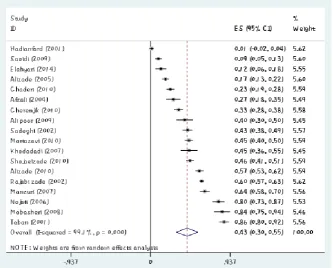
In the first phase of the search, 38 articles were selected and after reviewing the titles, 3 duplicates and overlapping articles were excluded. Abstracts of 35 possibly relevant articles were reviewed and 5 other irrelevant articles were identified and excluded. The full-texts of the remaining 30 articles were reviewed. Moreover, 4studies were deleted because of lack of sample size for depression, and finally, 26 articles were accepted for inclusion in the meta-analysis (Chart 1). In 26 studies with a sample of 5781 individuals, 18 articles reported the prevalence of depression among the elderly in Iran. Prevalence of depression among the elderly in Iran was estimated to be 43% (95% CI, 30%-56%). In this study, the lowest prevalence of depression in Iranian elderly was 1% in the study of Hadianfard et al. in 2001 (95% CI, - 2%-4%) and the highest prevalence of depression among Iranian elderly was 86% in the study of Taban et al. in 2001 (95% CI, 80%-92%) (Table 1). Due to the heterogeneity among studies, random-effects model was used to compute pooled estimate of prevalence of depression in the elderly (Figure 1).
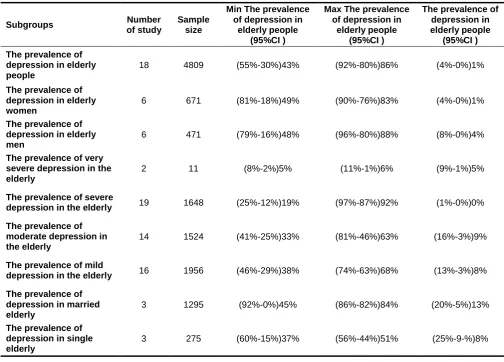
Prevalence of depression was estimated to be 49% (95% CI, 18%-81%) in elderly women, 48% (95% CI, 16%-79%) in elderly men, 37%(95% CI, 15%-60%) in single elderly people, and 45%(95% CI, -1%-92%) in married elderly. Also, the prevalence of very severe depression was 5% (95% CI, 2%-8%) in the elderly, severe depression 19% (95% CI, 12%-25%), moderate depression 33% (95% CI, 25%-41%), and mild depression 38% (95% CI, 29%-46%) (Table 2).
In an analysis done on 9 studies conducted on the elderly population in the northern Iran, prevalence of depression in the elderly was estimated to be 42% (CI 95%, 30%-55%),and it was found to be 35%(95% CI, 15%-84%) in 2 studies conducted in southern Iran. The prevalence was 51 %( 95% CI, 19%-83%) in 6 studies in central Iran. There was only 1 study in other regions of Iran. In the analysis that was done by the type of questionnaire, the prevalence of depression in Iranian elderly, using Beck questionnaire, was 49%(95% CI, 21%-77%) in 4 studies, 48%(95% CI, 28%-68%) for GDS Questionnaire in 8 studies, 40%(95% CI, 16%-64%) for Kessler questionnaire in 3 studies, and there was only 1 study from other questionnaires.
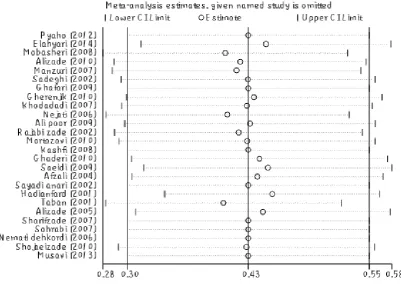
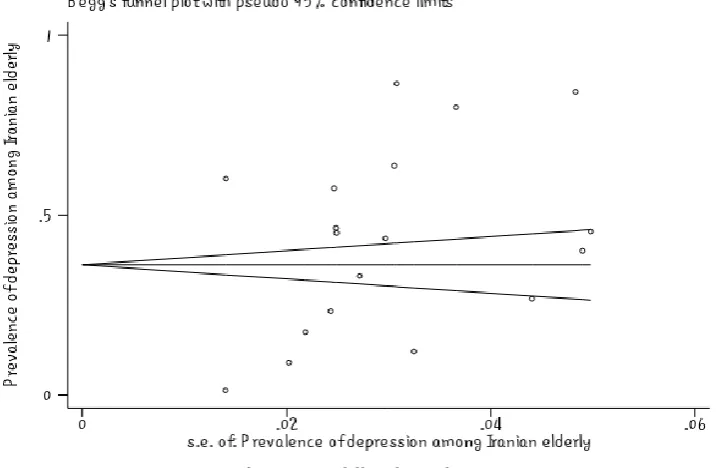
The meta-regression showed no significant relationship between the prevalence of depression in Iranian elderly and the sample size (P =0.447) (Figure 2). Also, there was no significant relationship between the prevalence of depression in Iranian elderly and the year of study (P =0.596) (Figure 3). Sensitivity analysis was used to assess the effect of each study on the final result (Figure 4). Funnel figure of Beggs test showed that the effect of publication bias was not significant (P=0.430) (Figure 5).
The midpoint of each segment showed the prevalence of depression in elderly in each study. Rhombus shape indicated the prevalence of depression in elderly in Iran in all studies.
Discussion
A total of 26 articles were reviewed with a sample size of 5781 individuals, and 18 articles reported the prevalence of depression in Iranian elderlies. The prevalence of depression among the elderly in Iran was estimated to be 43% (95% CI, 30%-56%). In this study, the lowest prevalence of depression in Iranian elderly was 1% in the study of Hadianfard and the highest prevalence of depression among Iranian elderly was 86% in the study of Taban et al.
Also, the prevalence of very severe depression was 5% in the elderly, severe depression 19%, moderate depression 33%, and mild depression 38%. Hence, most of the Iranian elderly suffer from mild depression. A study reported 64.6% prevalence for depression in the elderly; moreover, 51.5% of the participants had moderate depression and 13.1% had severe depression (32). In another study, the prevalence of mild depression in the elderly was 16.8% and major depression was 14.7% (33). Qaranjik studied elderly Turkmens in 2010 and reported the prevalence of moderate depression to be 10% and severe depression to be 3% (34), and these results are consistent with our study.
In the analysis done by the type of questionnaire, the prevalence of depression in Iranian elderly using Beck questionnaire was 49%; it was 48% for GDS questionnaire, and 40% for Kessler questionnaire. So, studies that used Beck questionnaires had the highest of depression prevalence. In the analysis done based on Iran’s regions, the prevalence of depression in the elderly people in northern Iran was 42%, it was 35% in southern Iran, and 51% in central Iran. The results of these studies revealed that the elderly in central Iran had the highest prevalence of depression.
Based on the meta-regression figure, there was no significant relationship between the prevalence of depression in Iranian elderly and the sample size which meant that prevalence of depression in Iranian elderly did not increase by increase in sample size. In Figure 2, the size of the circle shows the largeness of sample size (P =0.447). The meta-regression revealed no significant relationship between the prevalence of depression in Iranian elderly and year of study (P =0.596); moreover, prevalence of depression in Iranian elderly did not increase during 2001 to 2015, the years reviewed in this study (Figure 3).
Circles show relative risk (RR) by removing studies, and segments show 95% CI for RR. This figure shows the effect of the removal of any study on the final outcome of this study. Based on the above figure, prevalence of depression in Iranian elderly increases to 47% by removing the study of Taban in 2011 (95% CI, 35%-50%) and prevalence of depression in Iranian elderly decreases to 28% by removing the study of Mobasheri in 2008 (95% CI, 28%-52%). These two were the most weighted studies in the final result of this research. Funnel plot of Beggs test showed that the effect of publication bias was not significant (P=0.430). It is better if the figure is not significant because it shows that the studies that have been done in this area had a chance of being published and have been usually published (Figure 5).
Epidemiological studies conducted in this field in Iran are limited. Taban (2002) reported the prevalence of depression in the elderly in nursing homes in Isfahan to be 86% (35). In another study, the prevalence of 22.4% has been reported for depression and loneliness in the elderly across the country (36). According to the study
of Baaseri et al. on 110 nursing home residents in Mashhad, 23.9% of the elderly had a depression score of 5 or more (37). Alahyari et al. performed a study and reported the depression prevalence of 12% for the elderly (38). The prevalence of depression in the elderly in Tehran was 79.8% in the study of Nejati (39). Due to obtaining different results from previous studies, performing a meta-analysis study is necessary.
The results of a study in Greece showed the prevalence of 27% for mild to moderate depression and 12% for moderate to severe depression (40). In another study in China's rural elderly, 26.5 of them had mild depression and 4.3% had severe depression (41). William (1980) reported the depression prevalence of 2% to 4% in American people over 65 years and the prevalence of 5% to 44% for milder depression (42). In another study on Chinese elderly living in Hong Kong, the prevalence of depression was 11% in men and 14% in women (43).
Limitation
Due to the different types of questionnaires used in the reviewed articles, the difference in scoring the questions of the respective questionnaires and the difference in the number of questions in questionnaires, we could not combine the results of different questionnaires and report accurate statistics on the prevalence of depression among elderly in general and for various dimensions. Because of the variety of questionnaires, we did not manage to estimate the average score of the prevalence of depression among elderly in terms of age and place of research.
Conclusion
Given the high prevalence of depression in the elderly and, in particular, the high prevalence of depression in elderly women, the use of interventions including education about symptoms of depression for early diagnosis and timely reference elderly patients are highly essential. Also, due to the high prevalence of mild depression, critical planning is necessary for timely diagnosis and treatment.
Study limitation: The present study had some limitations including lack of access to full-text articles, different measurement tools, and lack of uniform distribution of studies between different regions of the country.
Different measurement tools to estimate prevalence of depression were another limitation of the study. For example, BDI is not a diagnostic test, but a test to evaluate the severity of depression. So, combination of prevalence of these tools must be considered in interpretation of the results.
Acknowledgment
This study has been conducted under the financial support of the Research Center for the Prevention of Psychosocial Disorders at Ilam University of Medical
Sciences and the Hamadan University of Medical Sciences. Hence, we extend our sincere gratitude to the authorities of these two organizations.
Figure1. Prevalence of Depression in Iranian Elderly and its 95% CI in Iran Based on Author’s Name and Year of Study According to Random Effects Model
Figure 3. The Relationship between Prevalence of Depression in Iranian Elderly and Year of Study Using Meta-regression
Figure5. Publication Bias
Table 1. Specifications of Articles under Review for Prevalence of Depression among Iranian Elderly
Table 2. The Prevalence of Depression in the Elderly in the Groups Studied in Iran
The prevalence of depression in elderly people
(95%CI ) Max The prevalence
of depression in elderly people
(95%CI ) Min The prevalence
of depression in elderly people
(95%CI ) Sample
size Number
of study Subgroups
(4%-0%)1% (92%-80%)86%
(55%-30%)43% 4809
18
The prevalence of depression in elderly people
(4%-0%)1% (90%-76%)83%
(81%-18%)49% 671
6
The prevalence of depression in elderly women
(8%-0%)4% (96%-80%)88%
(79%-16%)48% 471
6
The prevalence of depression in elderly men
(9%-1%)5% (11%-1%)6%
(8%-2%)5% 11
2
The prevalence of very severe depression in the elderly
(1%-0%)0% (97%-87%)92%
(25%-12%)19% 1648
19
The prevalence of severe depression in the elderly
(16%-3%)9% (81%-46%)63%
(41%-25%)33% 1524
14
The prevalence of moderate depression in the elderly
(13%-3%)8% (74%-63%)68%
(46%-29%)38% 1956
16
The prevalence of mild depression in the elderly
(20%-5%)13% (86%-82%)84%
(92%-0%)45% 1295
3
The prevalence of depression in married elderly
(25%-9-%)8% (56%-44%)51%
(60%-15%)37% 275
3
The prevalence of depression in single elderly
Conflict of Interest
There are no conflicts of interest.
References
1. Kashfi M, Khani Jeihooni A, Farhadi S. [The relationship between social and demographic factors and prevalence of depression among over 60 years old individuals, Shiraz, Iran (Persian)]. Medical Journal of Hormozgan University 2011; 14: 319-325.
2. Saeedi S, Foroughan M, Akbari Kamrani A, GHaem magham farahani Z, Delbari A. [Clinical Features of Elderly Patients Admitted to Ahvaz Petroleum Hospital, 2010 (Persian)]. Quarterly Journal of Sabzevar University of Medical Sciences 2012; 19: 85-95.
3. Rajabizadeh G, Ramazani A. [Prevalence of Depression in Kermanian Geriatrics (2002) (Persian)]. Journal of Rafsanjan University of Medical Sciences 2003; 3: 58-66.
4. Hasanpour-Dehkordi A, Far A, Khaledi-Far B, Salehi-Tali S. The effect of family training and support on the quality of life and cost of hospital readmissions in congestive heart failure patients in Iran. Applied Nursing Research. 2016; 31: 165-169.
5. HassanpourDehkordi A, Mohammadi N, NikbakhatNasrabadi A. Hepatitis-related stigma in chronic patients: A qualitative study. Appl Nurs Res 2016; 29: 206-210.
6. Mohammadi N, Hassanpour Dehkordi A, NikbakhatNasrabadi A. Iranian patients with chronic hepatitis struggle to do self-care. Life Sci J 2013; 10: 457-462.
7. Hasanpour Dehkordi A. Influence of yoga and aerobics exercise on fatigue, pain and psychosocial status in patients with multiple sclerosis: A Randomized Trial. J Sports Med Phys Fitness 2016; 56: 1417-1422.
8. Hasanpour-Dehkordi A. Self-care concept analysis in cancer patients: An evolutionary concept analysis. Indian J Palliat Care 2016; 22: 388-394.
9. Noghabi A, Zandi M, Mehran A, Alavian S, Dehkordi A. The effect of education on quality of life in patients under interferon therapy. Hepat Mon 2010 Summer; 10: 218-222.
10. Heydarnejad S, Dehkordi AH. The effect of an exercise program on the health-quality of life in older adults. Dan Med Bull 2010; 57: A4113. 11. Hassanpour-Dehkordi A, Jalali A. Effect of
Progressive Muscle Relaxation on the Fatigue and Quality of Life Among Iranian Aging Persons. Acta Med Iran 2016; 54: 430-436. 12. Southham M, Agras W, Taylor B, Kraemer H.
Stress management at the work for elderly people compliance, cost benefits. health care and hypertension - related variable Psychosom Med 2001; 46: 387-97.
13. Ghaderi S, Sahaf R, Mohammadi Shahbalaghi F, Ansari G, Gharanjic A, Ashrafi K, et al. [Prevalence of Depression in Elderly Kurdish
Community Residing in Boukan, Iran (Persian)]. Sija 2012; 7: 57-66.
14. khodadady N, sheikholeslami F, rezamasuoleh S, yazdani M. "Rate of depression in late-life in superannuated government employed center of Guilan University of medical sciences"Persian. J Holist Nurs Midwifery 2007; 17: 16-22.
15. HekmatiPour N, Hojjati H, Sharif Nia H, Akhondzade G, Nikjou A, MirAbolhasani M. [Impact of Routine Exercises on Elderly’s Depression Rate (Persian)]. Health Education and Health Promotion 2013; 1: 23-32.
16. Alipour F, Sajadi H, Forouzan A, Nabavi H, Khedmati E. [The Role of Social Support in the Anxiety and Depression of Elderly( Persian)]. Sija 2009; 4: 53-61.
17. Ingersoll B, Silverman A. Cooperative group psychotherapy for the aged. Gerontologist 1978; 18: 201-206.
18. Vakylabad M, Fallahi Khoshknab M, Maddah S, Hosaini M. [The effect of mind education by imagery on depression of elders (Persian)]. Iranian Journal of Nursing Research (IJNR). 2012; 7: 10-7.
19. Comer R. Abnormal Psychology. Thired Edition. Francisco: Freeman; 1998.
20. Sohrabi M, Zolfaghari P, Mahdizade F, Aghayan S, Ghasemian- Aghmashhadi M, Shariati Z, et al. [Evaluation and Comparison of Cognitive State and Depression in Elderly Admitted in Sanitarium with Elderly Sited in Personal Home (Persian)]. Knowledge & Health 2008; 3: 27-31. 21. Sheibani Tazraji F, Pakdaman S, Dadkhah A,
Hasanzadeh Tavakoli M. [The Effect of Music Therapy on Depression and Loneliness in Old People (Persian)]. Sija 2010; 5: 54-60.
22. Hendeson J. In-home preventive health assessment and telephone case management for over 75s living alone in independent living units: A cluster randomised controlled trial [PhD thesis]. 2005.
23. Hosienabadi R, Goorabi K, Shareh H. [Hearing Aid Effect on Elderly's Depression in Tehran's Nursing Homes (Persian)]. Sija 2007; 2: 205-209.
24. Alizadeh-Khoei M, Khosbin S, Khavarpour F. [Assessing Quality of Life, Well Being and Depression Among Iranian Ederly in Australia (Persian)]. Sija 2010; 4: 15-26.
25. von Elm E, Altman D, Egger M, Pocock S, Gøtzsche P, Vandenbroucke J, et al. Strengthening the Reporting of Observational Studies in Epidemiology (STROBE) statement: guidelines for reporting observational studies. BMJ 2007; 335: 806-808.
26. Manzouri L, Babak A, Merasi M. [The Depression Status of the Elderly and It's Related Factors in Isfahan in 2007 (Persian)]. Sija 2010; 4.
of Medical Sciences and Health Services 2013; 35: 20-25.
28. Malekshahi F, Dadkhah A. "The Psycho-Rehabilitative Effect of Japanese Dohsa-Hou on the Depression of the Aged People "Persian. Journal of Sabzevar University Of Medical Sciences 2001; 8: 4-11.
29. Alizadeh M, Hoseini M, Shojaeizadeh D, Rahimi A, Arshinchi M, Rohani H. [Assessing Anxiety, Depression and Psychological Wellbeing Status of Urban Elderly Under Represent of Tehran Metropolitan City (Persian)]. Sija 2012; 7: 66-73. 30. Mortazavi S, Eftekhar Ardebili H, Mohammad K, Dar ali bani R. [Mental health of elderly people in Shahrekord and its association with demographic and social factors (Persian)]. journal of the Iranian Institute for Health Sciences Research (IHSR) 2011; 10: 485-492. 31. Mobasheri M, Moezy M. [The prevalence of
depression among the elderly population of Shaystegan and Jahandidegan nursing homes in Shahrekord (Persian)]. J Shahrekord Univ Med Sci 2010; 12: 89-94.
32. Eshaghi R, Shafiei N. The prevalence of depression in Isfahan elderly Proceedings of the National Conference on Aging and Medical. 2004; 323.
33. Mahdizadeh F. [Comparative study of cognitional situation and depression among elderly of nursing homes of Shahrood and elderly living at home in 2007 (Persian)]. Book of abstract of the third congress on elderly in Iran and the world 2007.
34. Gharanjik A, Mohammadi Shahbolaghi F, Ansari G, Najafi F, Ghaderi S, Ashrafi K, et al. [The Prevalence of Depression in Older Turkmen Adults in 1389 (Persian)]. Sija 2011; 6: 34-39. 35. Taban H, Ahmadzadeh G, Ghasemi G,
Farzaneh A, Kazemi M. [Comparison of the prevalence of depression in residents of Sadeghieh nursing home and the elderly living in Isfahan (Persian)]. Journal of Isfahan Medical School 2005; 77: 55.
36. Rahgozar M, Mohammad NasrAbadi M. [The feeling of depression and stress among elderly (Persian)]. J Hakim 2008; 2.
37. Baaseri V. The study of mental health and the level of depression among elderly of Mashhad nursing homes in 2006. Book of abstract of the third congress on elderly in Iran and the world. 2007.
38. Alahyari T, Mirgholikhani _Tehrani N. [A study of social factors affecting depression among elderly women living in Kahrizak sanatorium (Persian)]. Social sciences 2014; 74.
39. Nejati V, Ashayeri H. [Evaluation of Relationship Between Depression and Cognitive Impairment in Elderly (Persian)]. Sija 2007; 1: 112-118. 40. Papadopoulos F, Petridou E, Argyropoulou S,
Kontaxakis V, Dessypris N, Anastasiou A, et al. Prevalence and correlates of depression in late life: a population based study from a rural Greek town. Int J Geriatr Psychiatry 2005; 20: 350-357.
41. Gao S, Jin Y, Unverzagt F, Liang C, Hall K, Ma F, et al. Correlates of depressive symptoms in rural elderly Chinese. Int J Geriatr Psychiatry 2009; 24: 1358-1366.
42. Blazer D, Williams C. Epidemiology of dysphoria and depression in an elderly population. Am J Psychiatry 1980; 137: 439-444.
43. Chi I, Yip P, Chiu H, Chou K, Chan K, Kwan C, et al. Prevalence of depression and its correlates in Hong Kong's Chinese older adults. Am J Geriatr Psychiatry 2005; 13: 409-416. 44. Sadeghi M, Kazemi H. [Prevalence of Dementia
and Depression among Residents of Elderly Nursing Homes in Tehran Province (Persian)]. IJPCP 2004; 9: 49-55.
45. Ghafari M, Sharifirad G, Zanjani S, Hassanzadeh A. [Stress, Anxiety and Depression Levels Among Elderly Referrals to Tehran Elderly Club (Persian)]. Sija 2012; 7: 53-59.
46. Afzalei S.M, Etemadifar Sh, Aslani Y, Hasan Pour A, Keirani Z. [Assessment of Psychosomatic Health status in Elderly Population That Coverage by Shahre - Kord Behzisty Center(Persian)]. Sci J Hamadan Nurs Midwifery Fac. 2007; 15:38-48
47. Sayadi anari A, Ansari jaberi A, Khaleghi E, Nazer M. [The effect of movement therapy on depression in elderly women (Persian)]. Journal of Rafsanjan University of Medical Sciences 2002; 1: 157-62.
48. Hadianfard M, Hadianfard H. [Mental Status of Geriatric Patients with Chronic Locomotor Diseases (Persian)]. IJPCP 2004; 9: 75-83. 49. Sharifzadeh G, Moodi M, Akhbari H.
[Investigating Health Status of Older People Supported by Imam (Persian)]. Sija 2010; 5: 52-59.
50. Nemati Dehkordi S, Nemati Dehkordi M, Nekuee A, Fruzande R. [The Effect of Group Reminiscence Therapy on Depression of Elderly (Persian)]. Armaghane danesh Journal 2008; 13: 57-64.
51. Shojaeizadeh D, Alizadeh M.[A comparative study on the health status (physical and mental) of elderly based on age groups of 60 years and above in the population covered by the affiliated centers of Tehran University of Medical Sciences (Persian)].