Prof. K. P. R. Chowdary Mobile: 9866283578
E-mail: [email protected] Address for correspondence
OPTIMIZATION OF VALSARTAN TABLET FORMULATION BY 23 FACTORIAL DESIGN
INTRODUCTION
About 95% of all new potential therapeutic drugs (APIs) exhibit low and variable oral bioavailability due to their poor aqueous solubility at physiological pH and consequent low dissolution rate. These drugs are classified as class II drugs under BCS with low solubility and high permeability characters and pose challenging problems in their pharmaceutical product development process.
Valsartan, a widely prescribed anti-hypertensive drug belongs to class II under BCS
classification and exhibit low and variable oral bioavailability due to its poor aqueous solubility. Because of poor aqueous solubility in dissolution rate it poses challenging problems in its tablet formulation development. Tablet formulation requires a careful selection of excipients to serve various pharmaceutical purposes. Among the various excipients (additives) added in tablet formulation, the diluent, binder and disintegrant play a critical role in influencing the dissolution rate and bioavailability of drugs administered as tablet dosage form1. In the case of poorly soluble drugs these excipients in tablet formulation significantly influence dissolution rate2-7 and consequently bioavailability of the drug requiring a rational selection of diluents, binder
Valsartan, a widely prescribed anti-hypertensive drug belongs to class II under BCS classification and exhibit low and variable oral bioavailability due to its poor aqueous solubility. Because of poor aqueous solubility in dissolution rate it poses challenging problems in its tablet formulation development. In the case of poorly soluble drugs these excipients in tablet formulation significantly influence dissolution rate and consequently bioavailability of the drug requiring a rational selection of diluents, binder and disintegrant combination. The objective of the study is to optimize valsartan tablet formulation by 23factorial design for selecting the best combinations of diluent, binder
and disintegrant giving fast dissolution of the drug, valsartan.
Much variations were observed in the disintegration and dissolution characteristics of the valsartan tablets prepared employing various combinations of binder (factor A), disintegrant (factor B) and diluent (factor C) as per 23 factorial design. ANOVA of K
1and
DE30 values indicated that the individual and combined effects of the three factors in
influencing the dissolution rate of tablets are highly significant (P < 0.05) except AC (PVP – DCP) and BC (Primogel – DCP) combinations. Valsartan tablets formulated employing lactose as diluent (F1, Fa, Fb, Fab) disintegrated rapidly within 1 min whereas
tablets formulated with DCP disintegrated relatively slowly in 3 – 5 min. Tablets formulated employing lactose as diluent gave higher dissolution rates (K1) and DE30
values when compared to the tablets formulated employing DCP. Formulation Fab(tablets
prepared employing lactose, PVP and Primogel), F1(tablets prepared employing lactose,
acacia and potato starch) and Fabc (tablets prepared employing DCP, PVP and Primogel)
gave higher dissolution rates and DE30 values and fulfilled the official (I.P 2010 )
dissolution rate test specification of valsartan tablets. The increasing order of dissolution rate (K1) observed with various formulations was Fab> Fabc > F1> Fb> Fbc> Fa> Fc > Fac.
Hence combinations of (i) lactose, PVP , Primogel, (ii) lactose, acacia, potato starch and (iii) DCP, PVP, Primogel are the best combinations of diluent, binder and disintegrant are recommended for formulation of valsartan tablets giving rapid and higher dissolution of valsartan, a BCS class II drug.
Keywords: Formulation development, Optimization, Valsartan, Diluent, Binder, Disintegrant, Factorial design.
ABSTRACT K. P. R. Chowdary*,
K. Ravi Shankar P. Ravi Sankar
Vikas Institute of Pharmaceutical Sciences, Nidigatla Road,
Rajahmundry- 533103
Journal of Global Trends in Pharmaceutical Sciences
Available online at www.JGTPS.com
ISSN: 2230-7346 Journal of Global Trends in Pharmaceutical Sciences Volume 5, Issue 1, pp -1374-1379, January-March 2014
and disintegrant combination. The objective of the study is to optimize valsartan tablet formulation by 23 factorial design for selecting the best combinations of diluent, binder and disintegrant giving fast dissolution of the drug, valsartan.
EXPERIMENTAL
Materials:
Valsartan was a gift sample from M/s Hetero Drugs Ltd., Hyderabad. Lactose, dicalcium phosphate (DCP), polyvinyl pyrrolidone (PVP), potato starch, Primogel, acacia, talc, magnesium stearate were procured from commercial sources. All other materials used were of pharmacopoeial grade.
Methods:
Estimation of Valsartan:
An UV Spectrophotometric method based on the measurement of absorbance at 250 nm in phosphate buffer of pH 6.8 was used for the estimation of valsartan. The method was validated for linearity, accuracy, precision and interference. The method obeyed Beer’s law in the concentration range of 1 – 10 µg/ ml. When a standard drug solution was repeatedly assayed (n=6), the relative error and coefficient of variance were found to be 0.8% and 1.45% respectively. No interference by the excipients used in the study was observed.
Formulation of Valsartan Tablets:
For formulation of valsartan tablets as per 23 factorial design the binder, diluent and disintegrant are considered as the three factors. The two levels of the factor A (binder) are acacia and PVP at 2% concentration each and the two levels of the factor B (disintegrant) are potato starch (15%) and Primogel (5%). The two levels of the factor C (diluent) are lactose and DCP. Eight valsartan tablet formulations employing selected combinations of the three factors i.e., binder, disintegrant and diluent as per 23 factorial design were formulated and prepared by wet granulation method and evaluated to find out the significance of individual and combined effects of the binder, disintegrant and diluent and to select the best combinations for formulation of tablets giving fast dissolution of valsartan.
Preparation of Valsartan Tablets:
Valsartan (50 mg) tablets were prepared by wet granulation method as per the formula given in Table 1.The required quantities of valsartan, lactose, dicalcium phosphate, acacia, PVP, potato starch as per the formula in each case were blended thoroughly in a dry mortor and granulated with water (q.s) as granulating fluid. The wet mass formed was pressed through mesh no.12 to obtain wet granules. The wet granules were dried at 600 C for 1hour. The dried granules were passed through mesh no.14 to break the aggregates formed and to obtain discrete granules. Super disintegrant Primogel, talc and magnesium stearate were passed through mesh no.80 and collected on to the bed of tablet granulations prepared and mixed. The tablet granules were blended thoroughly in a closed polyethene bag and compressed in to 250 mg tablets using an 8- station RIMEK tablet punching machine employing 9mm flat punches.
Evaluation of Tablets:
Valsartan tablets prepared were evaluated for drug content, hardness, friability, disintegration time and dissolution rate as per official methods.
Hardness:
The hardness of prepared tablets was determined by using Monsanto hardness tester and measured in terms of kg/cm2.
Friability:
The friability of the tablets was measured in a Roche friabilator using the formula
Friability (%) = [(Initial weight- Final weight) / (Initial weight)] x 100
Drug Content:
Disintegration time:
Disintegration time of the tablets was determined using single unit disintegration test apparatus (Make: Paramount) employing water as test fluid.
Dissolution Rate Study:
Dissolution rate of valsartan tablets prepared was studied in phosphate buffer of pH 6.8 (900 ml) employing eight station dissolution rate test apparatus (LABINDIA, DS 8000) using paddle stirrer at 50 rpm and at a temperature of 37°C ± 1°C. One tablet was used in each test. Samples of dissolution fluid (5 ml) were withdrawn through a filter at different time intervals and assayed for valsartan at 250 nm. The sample of dissolution fluid withdrawn at each time was replaced with fresh drug free dissolution fluid and a suitable correction was made for the amount of drug present in the samples withdrawn. Each dissolution experiment was run in triplicate (n=3).
Analysis of Data:
The dissolution data were analysed as per zero order and first order kinetic models. Dissolution efficiency (DE 30) values were estimated as suggested by Khan8. Dissolution rate (K1) and dissolution efficiency (DE30) values were analysed as per ANOVA of 23 factorial experiments.
RESULTS AND DISCUSSION
Valsartan tablet formulation was optimized by 23 factorial design for selecting the best combinations of diluent, binder and disintegrant giving fast dissolution of the drug. For formulation of valsartan tablets as per 23 factorial design the three factors involved are binder, diluent and disintegrant. The two levels of the factor A (binder) are acacia and PVP at 2% concentration each and the two levels of the factor B (disintegrant) are potato starch (15%) and Primogel (5%). The two levels of the factor C (diluent) are lactose and DCP. Eight valsartan tablet formulations each containing 50 mg of valsaratan were prepared employing selected combinations of the three factors i.e., binder, disintegrant and diluent as per 23 factorial design. The tablets were prepared by wet granulation method as per the formulae given in Table 1.
All the tablets prepared were evaluated for drug content, hardness, friability, disintegration time and dissolution rate as per official methods.
The physical parameters of the valsartan tablets prepared are given in Table 2. The hardness of the tablets was in the range 4.5-5.5 kg/cm2. Weight loss in the friability test was less than 0.95 % in all the cases. Valsartan content of the tablets prepared was within 100±3 %. Many variations were observed in the disintegration and dissolution characteristics of the valsartan tablets prepared. The disintegration times were in the range 11 sec to 4 min 28 sec. Valsartan tablets formulated employing lactose as diluent (F1, Fa, Fb, Fab) disintegrated rapidly within 1 min. Tablets formulated with DCP disintegrated relatively slowly in 3 – 5 min. Tablet formulation Fabcalso disintegrated rapidly within 40 sec.
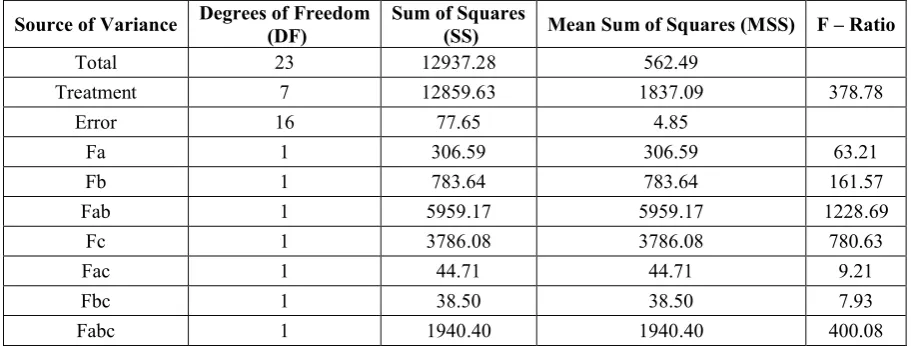
Dissolution rate of valsartan tablets prepared was studied in phosphate buffer pH 6.8. The dissolution profiles of the tablets are shown in Fig.1 and the dissolution parameters are given in Table 3. Dissolution of valsartan from all the tablets prepared followed first order kinetics with coefficient of determination (R2) values above 0.921. The first dissolution rate constant (K1) values were estimated from the slope of the first order linear plots. Much variation were observed in the dissolution rate (K1) and DE30 values of the tablets prepared due to formulation variables. The results of ANOVA of K1 and DE30 values indicated that the individual and combined effects of the three factors in influencing the dissolution rate of tablets are highly significant (P < 0.05) except AC (PVP – DCP) and BC (Primogel – DCP) combinations.
Tablets formulated employing lactose as diluent gave higher dissolution rates (K1) and DE30 values when compared to the tablets formulated employing DCP. Among all, formulation Fab (tablets prepared employing lactose, PVP and Primogel), F1(tablets prepared employing lactose, acacia and potato starch) and Fabc (tablets prepared employing DCP, PVP and Primogel) gave higher dissolution rates and DE30 values .The increasing order of dissolution rate (K1) observed with various formulations was as follows:
IP 2010 prescribed a dissolution rate test specification of NLT 70% in 45 min for valsartan tablets. Formulations F1, Fab, Fabcgave more than 70% dissolution in 45 min and fulfilled the official dissolution rate test specification.
CONCLUSIONS
1. Much variations were observed in the disintegration and dissolution characteristics of the valsartan tablets prepared employing various combinations of binder ( factor A), disintegrant (factor B) and diluent (factor C) as per 23 factorial design. ANOVA of K1 and DE30 values indicated that the individual and combined effects of the three factors in influencing the dissolution rate of tablets are highly significant (P < 0.05) except AC (PVP – DCP) and BC (Primogel – DCP) combinations.
2. Valsartan tablets formulated employing lactose as diluent (F1, Fa, Fb, Fab) disintegrated rapidly within 1 min whereas tablets formulated with DCP disintegrated relatively slowly in 3 – 5 min.
3. Tablets formulated employing lactose as diluent gave higher dissolution rates (K1) and DE30 values when compared to the tablets formulated employing DCP.
4. Formulation Fab (tablets prepared employing lactose, PVP and Primogel), F1 (tablets prepared employing lactose, acacia and potato starch) and Fabc (tablets prepared employing DCP, PVP and Primogel) gave higher dissolution rates and DE30 values and fulfilled the official (I.P 2010 ) dissolution rate test specification of valsartan tablets.
5. The increasing order of dissolution rate (K1) observed with various formulations was Fab > Fabc > F1 > Fb > Fbc > Fa > Fc > Fac.
6. Hence combinations of (i) lactose, PVP , Primogel, (ii) lactose, acacia, potato starch and (iii) DCP, PVP, Primogel are the best combinations of diluent, binder and disintegrant are recommended for formulation of valsartan tablets giving rapid and higher dissolution of valsartan, a BCS class II drug.
Table 1:Formulae of Valsartan Tablets Prepared as Per 23Factorial design
Ingredient (mg/tablet) F1 F a F b F ab F c F ac F bc F abc
Valsartan 50 50 50 50 50 50 50 50
Acacia 5 - 5 - 5 - 5
-PVP - 5 - 5 - 5 - 5
Potato starch 37.5 37.5 - - 37.5 37.5 -
-Primogel - - 12.5 12.5 - - 12.5 12.5
Lactose 147.5 147.5 172.5 172.5 - - -
-DCP - - - - 147.5 147.5 172.5 172.5
Talc 5 5 5 5 5 5 5 5
Magnesium stearate 5 5 5 5 5 5 5 5
Total weight (mg) 250 250 250 250 250 250 250 250
Table 2: Physical Parameters of Valsartan Tablets Prepared as per 23Factorial Designs
Formulation Hardness(Kg/cm2) (% Wt loss)Friability
Disintegration Time (min-sec)
Drug Content (mg/tablet)
F 1 5.0 0.66 0 -20 49.2
F a 4.5 0.64 0-11 48.9
F b 4.7 0.71 1-07 50.1
F ab 5.0 0.75 0-20 50.4
F c 5.0 0.69 4 – 48 49.6
F ac 4.5 0.87 4 -13 50.5
F bc 5.5 0.79 3- 49 51.2
Table 3: Dissolution Parameters of Valsartan Tablets Prepared as per 23Factorial Design
Formulation PD45
(%) (min)T50 DE(%)30 K1X 10
2
(min-1) Official Dissolution Rate Test
F1 85.62 6 61.68 2.972
NLT 70% in 45min. (IP 2010)
F a 34.85 > 60 16.60 0.851
F b 45.35 58 21.33 1.130
F ab 95.25 4 75.00 6.751
F c 26.06 >60 13.31 0.534
F ac 17.94 >60 9.66 0.328
F bc 32.95 >60 13.74 0.906
F abc 71.15 18 37.15 3.206
Table 4:ANOVA of Dissolution Rates (K1) of Valsartan Tablets Prepared as per 23Factorial Design
Source of Variance Degrees of Freedom (DF) Sum of Squares (SS) Mean Sum of Squares (MSS) F- Ratio
Total 23 162.40 7.04
Treatment 7 155.71 22.24 55.24
Error 16 6.69 0.14
F a 1 10.14 10.14 24.73
F b 1 19.44 19.44 47.41
F ab 1 64.02 64.02 156.14
F c 1 38.00 38.00 92.61
Fac 1 0.37 0.37 0.90
Fbc 1 0.13 0.13 0.31
Fabc 1 23.60 23.60 57.56
F 0.05(1,16) = 4.49 ; F0.05 (7,16) = 2.66
Table 5:ANOVA of DE30 Values of Valsartan Tablets Prepared as per 23Factorial Design
Source of Variance Degrees of Freedom(DF) Sum of Squares(SS) Mean Sum of Squares (MSS) F – Ratio
Total 23 12937.28 562.49
Treatment 7 12859.63 1837.09 378.78
Error 16 77.65 4.85
Fa 1 306.59 306.59 63.21
Fb 1 783.64 783.64 161.57
Fab 1 5959.17 5959.17 1228.69
Fc 1 3786.08 3786.08 780.63
Fac 1 44.71 44.71 9.21
Fbc 1 38.50 38.50 7.93
Fig.1:Dissolution Profiles of Valsartan Tablets Prepared as per 23Factorial Design
REFERENCES
1. Lachman. L., Liberman, M.A. and Kanig, J.L., Eds., in: The Theory and Practice of Industrial Pharmacy, 2nd
Edn. Lea and Febiger,
Philadelphia,1978; 328.
2. Chowdary, K.P.R., and Aparajitha, N., The Eastern Pharmacist., 1989; 32:121. 3. Chowdary, K.P.R., and Manjula, T.,
Indian J. Pharm. Sci., 2000; 62: 224. 4. S. Jaya1, K.P.R. Chowdary , P.
Rajeswara Rao., Int. Res J Pharm. App Sci., 2012; 2(4): 109 - 113.
5. Chowdary, K. P. R., Lingaraju S Danki and Hiremath, S. N., Der Pharmacia Lettre., 2010;2(2 (: 221-236.
6. Michael .U. Uhumwangho and Roland. S. Okor , Acta Poloniae Pharmaceutica – Drug Research, 2007,64(1) , 73-79.
7. Hari Har Prasad .M and Duraivel .S , IJPCR, 2012, 4(4) , 44-47.