http://mojem.um.edu.my
1
[1] The Education Department, Ministry of Education,
Isfahan Province Branch, Iran
[2] Faculty of Education, University of Malaya, Malaysia
Corresponding Author: The Education Department, Ministry of Education, Isfahan Province Branch, IRAN Email: [email protected]
ABSTRACT
This study attempted to investigate the mediating effect of parental involvement on the relationship between school climate and continuous improvement. To achieve this aim, the researchers conducted a descriptive research with quantitative approach to explore this mediating effect. The population of this study was 42870 Grade 1 and 2 high school students in Lorestan state, Iran. With applied simple and stratified random sampling, a total of 400 students were chosen as the participants in this study. The researchers used questionnaire as an instrument to collect the data. The results of this study illustrated the medium level for parental involvement, school climate and continuous improvement, based on students’ perception. In addition, the findings show the mediating effect of parental involvement on the relationship between school climate and continuous improvement. These results have suggested that if school climate and parental involvement are improved, it could be an effective strategy to increase continuous school improvement. The results of this research proposed more comprehensive empirical view on how parental involvement can improve the relationship between school climate and continuous improvement in Iranian education system.
Keywords: School Climate, Parental Involvement, Continuous Improvement, Student Learning, School Performance.
October 2018, VOLUME 6, ISSUE 4, 1 - 14
E-ISSN NO: 2289 – 4489
https://doi.org/10.22452/mojem.vol6no4.1
THE MEDIATING EFFECT OF PARENTAL INVOLVEMENT ON
SCHOOL CLIMATE AND CONTINUOUS IMPROVEMENT
Masoumeh Pourrajab1 (PhD), Muhammad Faizal Bin Ghani2 (PhD) &
http://mojem.um.edu.my
2
INTRODUCTIONContinuous improvement in schools and the education system has become an interesting challenge for educational scholars. The aim of continuous improvement is collaboration between teachers, principals and parents as a team to improve the process of student learning (Weller, 2000). On the other hand, this kind of collaboration requires a positive climate in schools. Currently, a series of school reforms have been implemented in education systems around the world (Thapa, Cohen, Guffey, & Higgins-D' Alessandro, 2013) in order to improve student learning. Unfortunately, in most schools, the results of innovation tend to appear and disappear during the reform phase. In fact, few reforms have been implemented systematically, resulting in short-run gains rather than building capacity for continuous improvement (Hawley, 2007).
School climate is a general term which is related to the quality of school environment that are observed by the parents, students, and school’s staff (Hoy, Miskel, & Tarter, 2013). This variable affects the students’ learning. This imply that in a positive school climate, the students’ academic achievement will be improved (Wang et al., 2014). On the other hand, parental involvement has become an important factor in educational effectiveness (Hornby & Lafaele, 2011). The importance of involving parents in schooling and student learning process have been considered by principals, teachers, and educational policy makers (Wilder, 2014). LaRocque, Kleiman, and Darling (2011) believed that parental involvement can be defined as a family investment for their children.
The basic element of continuous school improvement is student learning, and various variables have an effect on student learning, such as school climate and parental involvement (Gage, Larson, Sugai, & Chafouleas, 2016). Thapa et al. (2013) have shown the positive effect of school climate on student learning. The term ‘school climate’ has been used to describe the general environment existing in each school (Hoy et al., 2013). In a study investigating school climate and parental involvement, it was reported that there is positive correlation between the two variables (Pourrajab, Roustaee, Talebloo, Kasmaienezhadfard, & Ghani, 2015). In developed societies, schools have an important role in educating people and completing the role of the parents in their children’s education (Hornby & Lafaele, 2011), and these two groups (schools and parents) work together based on a systematic structure to improve students’ learning and academic achievement.
However, in some developing nation such as Iran, the role of parents in the school process is not as strong as developed countries and the parents themselves does not have the desire to be involved in the school process (Mirkamali, 2015). On the other hand, having checked with various, different academic databases, the researchers found very little literature focusing on the effect of parental involvement on the relationship between school climate and continuous improvement, especially in Iran. Therefore, this area of research is still open for more investigation. In other words, the need for continuous improvement in school and the effect of school climate and parental involvement can be attributed to something unique in the school and the education system. This need forms the foundation for this research. Therefore, the specific objective of this research paper is to investigate the mediation effect of parents’ involvement on the relationship between school climate and continuous improvement. Thus, the research objectives in this study are to:
1. Determine the relationship between school climate and continuous improvement in Iranian schools.
2. Investigate the mediation effect of parents’ involvement on the relationship between continuous
http://mojem.um.edu.my
3
LITERATURE REVIEWContinuous Improvement
One of the principles of the Total Quality Management (TQM) model is continuous improvement (Deming, 1986), which purpose to increase the continual performance of an organization through learning and adaptation (Temponi, 2005). The main idea of continuous improvement comes from the Japanese word, Kaizen, and focuses on the on-going improvement processes (Temponi, 2005). In education, new methods and technology in teaching and learning process are developed every day and in order to achieve a high level of quality in education, it is necessary to keep up with changes through continuous improvement (Rampa, 2010).
The findings of educational research have shown that the organizational structures, culture and climate of schools can either enhance or hinder schools’ effectiveness. The quality of teaching and conditions that support it are necessary foundations for continuous school improvement (Hawley, 2007). Starratt (2003) highlighted that schools have been attempting to increase the level of quality in teaching and learning (T&L) process for all students in order to improve student performance.
School Climate
Gálvez, Cruz, Díaz, and Roberts (2016) concluded that school climate is a multidimensional concept and it has become important in education for the past three decades. Thapa et al. (2013) reviewed more than 200 research studies on this term and recognized that this item is important for the education system. They classified this factor into five dimensions as follows:
Safety: A basic human need is to feel safe (Maslow, 1973). Schools are responsible to provide a safe and healthy environment (Epstein, Atkins, Cullinan, Kutash, & Weaver, 2008). Devine and Cohen (2007) found that students who feel safe can learn better, and a safe school environment supports the students’ success (Snyder, Vuchinich, Acock, Washburn, & Flay, 2012).
Relationships: The cooperation among school’s principal, teachers, staff and parents is necessary in each school. This cooperation will prove that this relationship exists between these people in a school. This relationship among people in schools are one of the main factors for positive school climate (Gregory & Cornell, 2009).
Teaching and Learning (T&L): Thapa et al. (2013) suggested that the purposes and principles that make up the T&L environment are one of the responsibilities of the principal and teachers. Team cohesion, cooperative learning, and mutual trust will be encouraged by positive school climate (Finnan, Schnepel, & Anderson, 2003).
School Environment: This factor is divided into school connectedness, physical structures and school surroundings and resources. School connectedness is an influential predictor in student achievement (Ruus et al., 2007). In addition, Astor, Guerra, and Van Acker (2010) mentioned that students will feel unsafe if their school is located in an unsupervised area.
http://mojem.um.edu.my
4
In schools with positive school climate, students can obtain high achievement (Freiberg, 1998; Thapa et al., 2013). Simpson (2014) believed that in each effective educational system, school climate should be considered a critical component in it.Parental Involvement: Epstein Model
Parents become involved in learning process for several reasons, because they believe that they must involve themselves in their children’s learning and education to create a huge and positive difference (Hoover_Dempsey et al., 2005). All the policy makers, principals, school staff, teachers, parents, and each member of school society involved with the students’ learning have accepted this reality that parents have positive effect on students’ academic achievement (Fan & Chen, 2001).
Epstein (1994) offered a model for parental involvement with six types of involvement including: parenting, learning at home, communication, volunteering, decision making and community involvement. Parenting is the parents’ main duty which included taking care of the children’s health and safety alongside developing good parenting skills in training and preparing their children to inter school and providing a quiet situation at home wherein the children can focus in their learning activities and completing their homework. Learning at home is regards to the relationship between teachers and parents to help student to learn better at home. On the other hand, communication is refer to keep contact between parents and school through sending messages or letters, phone calls, visiting school by parents, sending news by teachers and principals is covered by this item to support students learning. The participation of parents in school and classroom’s activities to support student learning is related to the volunteering item. The term decision making involvement is related to parents’ involvement in the school’s decision making and judgment to increase student academic achievement. The parents’ attendance in the Parents Teachers Association (PTA) meeting is one of the examples for this item. The last term is community involvement which refers to the connections and relationships among parents, teachers, school community, administrators, and other groups that share responsibility for student learning. This model has shown that parents, school, and community have overlapping spheres of influence on student learning development.
School Climate and Continuous Improvement
Thapa et al. (2013) claimed that the growing number of investigations have been focused on school climate reforms as an important factor for increased school outcomes and improvement. Therefore, by improving the school climate, it will create school improvement (Anderson-Butcher, Amorose, Iachini, & Ball, 2012), and better students’ academic achievement in elementary, middle and high schools (Guffey et al., 2011; Wang & Degol, 2016). Thapa et al. (2013) declared that in a school with positive climate, students can learn through cooperative learning, team cohesion, and mutual trust.
Parental Involvement and Continuous Improvement
http://mojem.um.edu.my
5
School Climate and Parental Involvement
Principals and teachers can implement some programs and expend effort to increase parental and community involvement, as well as create positive climate in schools (Jones, Fisher, Greene, Hertz, & Pritzl, 2007). Positive school climate will motivate parents to be more involved in the education process (Azzam, 2007). Pourrajab et al. (2015) investigated the relationship between these school climate and parental involvement and discovered a positive and strong correlation between these two variables which indicate that through improving school climate, parents will be more involved in school process.
CONCEPTUAL FRAMEWORK
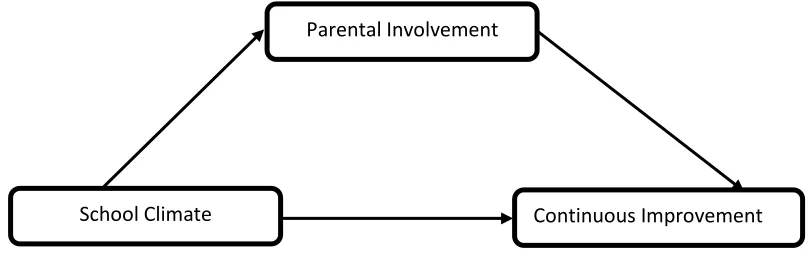
This research attempts to investigate the mediating effect of parental involvement on the relationship between school climate and continuous improvement in Iranian schools. Based on the Epstein model (1994), there are six dimensions considered for parental involvement in school. Meanwhile, in regards to the research by Thapa et al. (2013), there are five dimensions considered for school climate. The continuous improvement is one of the main principles of TQM that was developed by Deming (1986).
An educational system focuses on continuous improvement that can be created by meaningful learning; trust and responsibility; parental involvement; accessible data; multiple measures; community engagement; collaboration and coherence; creativity; and flexibility (Darling-Hammond & Plank, 2015). Scholars and researchers have attempted to identify the importance of parents’ involvement and positive school climate to increase students’ learning and achievement (Velasco, Edmonson, & Slate, 2012). Gálvez et al. (2016) in their paper found the relationship among school climate, students’ outcomes and community’s satisfaction (such as parents).
Based on the previous researches before, Figure 1 shows the conceptual framework designed to illustrate the relationship between variables under this study.
Figure 1: The conceptual Framework in this Study
METHOD
This study is a descriptive research aligned with the quantitative approach. In this research, the researchers described the mediating effect of parental involvement on the relationship between school climate and continuous improvement.
Parental Involvement
http://mojem.um.edu.my
6
Population, Sample Size, and Sampling Procedure
This research was conducted in high schools located at Lorestan state, Iran with a student population of 42870 students (in Grade 1 and 2) from 206 public schools. When considering the Cochran (1977) formula, the sample size was supposed to include only 396 students, however, for ease of calculation, 400 students from 20 schools were considered as participants in this research. We applied simple and stratified random sampling to select participants for this study. The student population for this study included 52.5% female and 47.5% male students. The sample should include the same proportion of each gender in the sample so as to be as close to the target population as possible (Salkind, 2010). Of the initial of 400 students, 210 were female and 190 were male students.
Instrument
The questionnaire used for this study was modified from the questionnaire developed by Rampa (2004). The researchers was granted the permission to use this instrument. Modifications was needed since the questionnaire was developed over a decade ago and some of the items were outdated for the current time alongside there was a need to match the questionnaire’s items with the culture in Iran. The modified questionnaire included four parts.
Part A was related to participants’ biographical information.
Part B refers to school climate with 27 items measuring five dimensions of school climate.
Part C was related to parental involvement with 35 items measuring 6 dimensions of this variable based
on Epstein model.
Part D, was related to continuous improvement and was measured by 25 items.
The items in part B, C, and D utilized a 4-point Likert scale. The original questionnaire was written in English, since all participants are Iranian students and since Persian is the official language used in Iran, the questionnaire was then translated into Persian language. The validity of the questionnaire was obtained by content validity, and two lecturers from University Putra Malaysia (UPM) check the validity of the instrument as an expert panel. The Cronbach’s alpha test was used to check the reliability of the instrument. In this study α= 0.806 which shows that the instrument has a good reliability (George & Mallery, 2001). Table 1 provides the reliability test for each variable in this study.
Table 1
Cronbach's Alpha Values
Variables Cronbach’s Alpha
School climate .8102
Parental involvement .808
Continuous improvement .804
As shown in the table above, all the variables in this study have a Cronbach Alpha greater than 0.80.
Pre-testing the Questionnaire and Data Collection Process
http://mojem.um.edu.my
7
The data were collected by those administrating the questionnaire live to participants group and one of the researchers attended each selected class to clarify, explain, and give more information and details to the students who did not understand the meaning of some items.Data Analysis Process
The Pearson Correlation was applied to identify the relationship between school climate and continuous improvement. In order to investigate the mediating effect of parental improvement on the relationship of those two variables, the Baron and Kenny’s procedure was employed.
FINDINGS
Demographic and General Information
The sample included 400 high school students (210 female and 190 male students) in Grade 1 and 2 in Lorestan state, Iran. The average age of participants was 13.42 years.
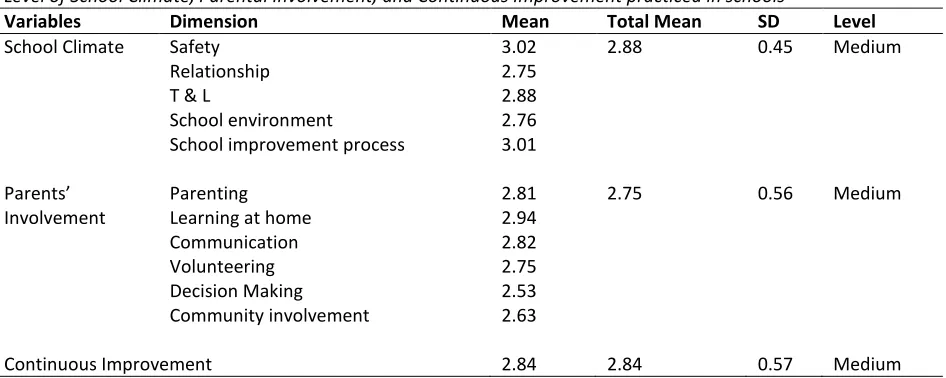
Table 2 provides the current situation of school climate, parental involvement, and continuous improvement practiced in school based on student perception.
Table 2
Level of School Climate, Parental Involvement, and Continuous Improvement practiced in schools
Variables Dimension Mean Total Mean SD Level
School Climate Safety 3.02 2.88 0.45 Medium
Relationship 2.75
T & L 2.88
School environment 2.76
School improvement process 3.01
Parents’ Involvement
Parenting 2.81 2.75 0.56 Medium
Learning at home 2.94
Communication 2.82
Volunteering 2.75
Decision Making 2.53
Community involvement 2.63
Continuous Improvement 2.84 2.84 0.57 Medium
http://mojem.um.edu.my
8
The Relationship between School Climate and Continuous Improvement
The first research objective in this study is to determine the relationship between school climate and continuous improvement in Iranian schools. Table 3 has shown the correlation between the variables in this study. By using the Pearson’s Correlation method, the analysis of the 400 students revealed that there was a significant, positive, and moderately strong relationship (Lodico, Spaulding, & Voegtle, 2006) between the school climate and continuous improvement with correlation coefficient (r) of 0.769, which was significant at the 0.01 level (p=.000).
Table 3
Correlation Results for the variables
Variables 1 2 3
1 School Climate 1 .417** .593**
2 Parental Involvement 1 .379**
3 Continuous Improvement 1
N=400 ** Significant at 0.01 level (2-tailed)
Figure 2 presents the summary of this relationship as follow:
Figure 2: First model with statistical output
It can be concluded that the level of school climate and continuous improvement have a parallel relationship together, which means that an increase in the level of school climate will result in an increase in the level of continuous improvement.
The Mediation Effect of Parents’ Involvement
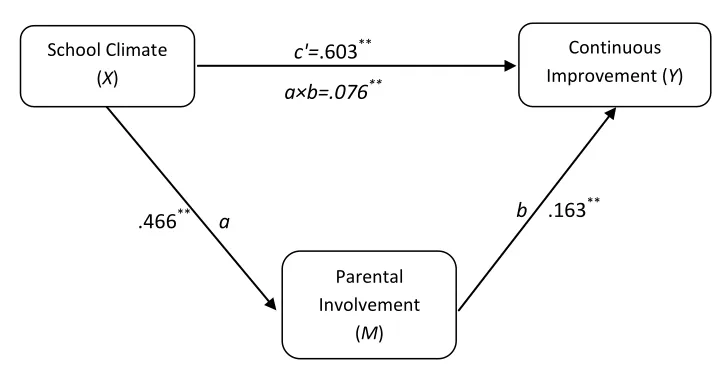
The main purpose of this research (second research objective) was to investigate the mediation effect of parents’ involvement on the relationship between school climate and continuous improvement. The procedure by Baron and Kenny (1986) has been broadly applied to test the mediation effect. The results illustrate that the indirect
effect of school climate was significant (a×b=.076) with p-value of .00076 (Sobel Test). This indirect effect
suggested that mediation is established (Grubb & Flessa, 2006). In the indirect path, school climate increases
parental involvement by a=.466; b=.163, so in maintaining the situation of school climate, an increase of one unit
in parental involvement increased continuous improvement by .163 units. Based on the total effect, school climate
has a significant effect on continuous improvement (c=0.593; p= 0.00) (Figure 2). The type of mediation can be
identified by the signs a*b*c (Grubb & Flessa, 2006). In this study this sign is positive, therefore this is a
complementary mediation, because the mediation effect (a×b) and the direct effect (c ) both exist at the same time and in the same direction. Analysis of 5000 bootstrap samples shows a significant indirect effect of school climate on continuous improvement through parental involvement, with 95% bias corrected and accelerated confidence interval excluding zero (1.286 to 1.655). The results of the mediation analysis are shown in Figure 3.
School Climate (X) Continuous
Improvement (Y)
.593**
http://mojem.um.edu.my
9
Figure 3: Second model; the mediation role of parents’ involvement in the relationship between of school climateand continuous improvement
At the sum, the direct effect of school climate on continuous improvement is 0.593, on the other hand, the indirect effect is 0.603. That means parental involvement can increase the effect of school climate on continuous improvement in school and improve the relationship between these two variables. Overall this result shows that the parental involvement has a mediating effect on the relationship between school climate and continuous improvement.
Implications of the Findings
Various studies and researches have shown the positive relationship between school climate and continuous improvement as well as positive relationship between school climate and parental involvement. In addition, few empirical studies investigated the mediating effect of parental involvement on the relationship between school climate and continuous improvement in the past.
The lack of enough theoretical and empirical research of this mediation effect have caused doubts among educational policy makers and administrators to implement and improve the level of these variables in schools. Moreover, this research develops the body of knowledge on educational administration in educational context.
To the researchers’ knowledge, there have been no researches in Iran so far that explores theoretical and empirical of this mediation effect. This research extends the theoretical and empirical research and propose a more comprehensive empirical view on how parental involvement can improve the relationship between school climate and continuous improvement in Iran. The practical findings of this research afford a firm foundation for further investigation in Iranian educational system.
DISCUSSION AND CONCLUSION
It is obvious that student learning improvement is the ultimate goal of an education system. This goal can be accomplished through sustained planning and continuous improvement to develop the skills and knowledge of teachers, principals, and school staff who provide instructional leadership. Continuous improvement is embedded in school organization and school commitment in order to focus on achieving schools’ goals for school
School Climate (X)
Continuous Improvement (Y)
c'=
.603
**a×b=.076
**b
.163
**.466
**a
Parental Involvement
http://mojem.um.edu.my
10
development and sustainability (Starratt, 2003). In this way, some factors have an effect on continuous improvement in school. This paper highlights the effect of school climate and parental involvement on it.The findings of this research paper highlighted the medium level for continuous improvement, parental involvement and school climate, based on the students’ perception. The aim of education systems and schools is to prepare an appropriate situation for students to obtain academic skills and knowledge. Therefore, it is the responsibility of educational authorities and administrators to create a positive climate in school. A positive climate in school will lead to better student outcomes and achievement (Edmonds, 1979; Lingard, Hayes, Mills, & Christie, 2003; Matthews & Crow, 2010; Murphy, 2000). On the other hand, one of the main element of academic achievement is to involve parents in school process (Hornby & Lafaele, 2011; Sweeney, 1992). However, in this study, the students perceived a medium level for these two variables. This medium level can reduce the effectiveness of continuous school improvement.
The results of this research show that school climate have a positive and significant relationship with continuous improvement. That means, if the climate at school is further improved, the level of school improvement will continuously increase. These findings are similar to the results of the investigation conducted by Velasco et al. (2012), as well as Mastny (2013), who established that continuous improvement is linked with a safe and healthy environment.
Another factor that can increase continuous improvement is parental involvement. This current study also shows that parental involvement has a positive relationship with continuous improvement in school. This means that if parents are more involved in school, continuous school improvement will be obtained. Parents have been considered as the first teacher for children at home (Brannon, 2008), and they have positive impact on their student academic achievement (Sweeney, 1992). Therefore, they are important factors for school effectiveness (Hornby & Lafaele, 2011). This finding is supported by the study of Senge (1990) that showed a positive relationship between parents’ involvement and student academic achievement and continuous school improvement.
The finding of this study also revealed the existing correlation between school climate and parents’ involvement. In schools with a positive climate, parents will be more motivated to be involved in the school process (Cohen, McCabe, Michelli, & Pickeral, 2009; DuFour, 2004). Goldkind and Farmer (2013) found that positive school climate will increase parental participation in school. In the research by Lave and Wenger (1991), they found the direct effect of parents’ involvement on school climate.
An important finding of this research indicates the mediating effect of parents’ involvement on the relationship of school climate and continuous improvement in school. If schools want to continuously improve their performance, they should first improve their school climate and involve students’ parents more than before. As shown in Table 3, the levels of school climate and parental involvement are at the medium level. Therefore, it is necessary for an education system to increase these two levels first in order to improve their performance.
http://mojem.um.edu.my
11
This indicates that continuous school improvement will be greater when school climate improves and parents begin to involve themselves in school process. The study also suggests that school principals should be given more authority since they have the most power and position to influence school improvement process by creating a positive school climate.REFERENCES
Amatea, E., & West-Olatunji, C. (2007). Joining the conversation about educating our poorest children: Emerging
leadership roles for school counselors in high-poverty schools. Professional School Counseling, 11(2),
81-89.
Anderson-Butcher, D., Amorose, A., Iachini, A., & Ball, A. (2012). The Development of the Perceived School Experiences Scale. Research on Social Work Practice, 22(2), 186-194.
Astor, R. A., Guerra, N., & Van Acker, R. (2010). How can we improve school safety research? Educational
Researcher, 39(1), 69-78.
Azzam, A. M. (2007). Why Students Drop Out. Educational Leadership, 64(7), 91-93.
Baron, R. M., & Kenny, D. A. (1986). The moderator-mediator variable distinction in social psychological research: Conceptual, strategic, and statistical considerations. Personality and Social Psychology, 51(6), 1173-1182.
Beets, M. W., Flay, B. R., Vuchinich, S., Acock, A. C., Li, K.-K., & Allred, C. (2008). School climate and teachers' beliefs and attitudes associated with implementation of the positive action program: A diffusion of innovations model. Prevention Science, 9(4), 264-275.
Brannon, D. (2008). Character Education: It's a Joint Responsibility. Kappa Delta Pi Record, 44(2), 62-65.
Cochran, W. G. (1977). Sampling Techniques. New York: John Wiley and Sons.
Cohen, J., McCabe, L., Michelli, N. M., & Pickeral, T. (2009). School climate: Research, policy, practice, and teacher education. The Teachers College Record, 111(1), 180-213.
Darling-Hammond, L., & Plank, D. (2015). Supporting Continuous Improvement in California’s Education System. Stanford University, California: Policy Analysis for California Education.
Deming, E. (1986). Out of the Crisis: Quality, Productivity and Competitive Position. Cambridge: Cambridge
University Press.
Devine, J. F., & Cohen, J. (2007). Making your school safe: Strategies to protect children and promote learning. New York: Teachers College Press.
DuFour, R. (2004). What is a" professional learning community"? Educational Leadership, 61(8), 6-11.
Edmonds, R. (1979). Effective schools for the urban poor. Educational Leadership, 37(1), 15-24.
http://mojem.um.edu.my
12
firing lines (pp. 39-52). Boulder, CO: Westview.Epstein, M., Atkins, M., Cullinan, D., Kutash, K., & Weaver, K. (2008). Reducing Behavior Problems in the Elementary School Classroom. National Center for Education Evaluation and Regional Assistance: Institute of Educational Sciences.
Fan, X., & Chen, M. (2001). Parental involvement and students' academic achievement: A meta-analysis. Educational psychology review, 13(1), 1-22.
Finnan, C., Schnepel, K. C., & Anderson, L. W. (2003). Powerful learning environments: The critical link between school and classroom cultures. Journal of Education for Students Places at Risk, 8(4), 391-418.
Freiberg, H. J. (1998). Measuring School Climate: Let Me Count the Ways. Educational Leadership, 56(1), 22-26.
Gage, N. A., Larson, A., Sugai, G., & Chafouleas, S. M. (2016). Student Perceptions of School Climate as Predictors of Office Discipline Referrals. American Educational Research Journal, 53(3), 1-24.
Gálvez, I., Cruz, F. J. F., Díaz, M. J. F., & Roberts, B. (2016). Evaluation of the impact of quality management systems on school climate. International Journal of Educational Management, 30(4), 474-492.
George, D., & Mallery, P. (2001). SPSS for Windows Step by step: A simple guide and Reference (3rd ed.). United States of America: Allyn & Bacon.
Goldkind, L., & Farmer, G. L. (2013). The Enduring Influence of School Size and School Climate on Parents' Engagement in the School Community. School Community Journal, 23(1), 223-244.
Gregory, A., & Cornell, D. (2009). Tolerating adolescent needs: Moving beyond zero tolerance policies in high school. Theory Into Practice, 48(2), 106-113.
Grubb, W. N., & Flessa, J. J. (2006). “A Job too Big for One”: Multiple Principals and other Non-traditional Approaches to School Leadership. Educational administration quarterly, 42(4), 518-550.
Guffey, S., Higgins-D'Alessandro, A., & Cohen, J. (2011). Year-one implementation of an intervention to reduce
bullying through continuous school climate assessment and improvement. Paper presented at the the biennial meeting of the Society for Research in Child Development, Montreal, Canada.
Hawley, W. D. (2007). The Keys to Effective Schools: Educational Reform as Continuous Improvement. California:
Corwin Press.
Hoover_Dempsey, K. V., Walker, J. M., Sandler, H. M., Whetsel, D., Green, C. L., Wilkins, A. S., & Closson, K. (2005).
Why Do Parents become Involved? Research Findings and Implications. The Elementary School Journal,
106(2), 105-130.
Hornby, G., & Lafaele, R. (2011). Barriers to Parental Involvement in Education: An Explanatory Model. Educational
Review, 63(1), 37-52.
http://mojem.um.edu.my
13
Jones, S. E., Fisher, C. J., Greene, B. Z., Hertz, M. F., & Pritzl, J. (2007). Healthy and Safe School Environment, Part I:Results from the School Health Policies and Programs Study 2006. Journal of School Health, 77(8),
522-543.
LaRocque, M., Kleiman, I., & Darling, S. M. (2011). Parental involvement: The missing link in school achievement. Preventing School Failure, 55(3), 115-122.
Lave, J., & Wenger, E. (1991). Situated learning: Legitimate peripheral participation. Cambridge: Cambridge
University Press.
Lingard, B., Hayes, D., Mills, M., & Christie, P. (2003). Leading learning. Maidenhead: McGraw.
Lodico, M. G., Spaulding, D. T., & Voegtle, K. H. (2006). Methods in Educational Research: from Theory to Practice. San Francisco: Wiley.
Maslow, A. H. (1973). On Dominance, Self-Esteem, and Self-Actualization: Germinal Papers of A.H. Maslow. New
York: Thamson Brooks/Cole.
Mastny, A. (2013). The Perceived Effectiveness of Professional Learning Communities in the Instruction of
Secondary Instrumental Music Ensembles. (Master Thesis), University of Nebraska, Omaha.
Matthews, L. J., & Crow, G. M. (2010). The Principals: New Roles in a Professional Learning Community. Bostan,
MA: Allyn & Bacon.
Mirkamali, M. (2015). Human relations in the school (10th ed.). Tehran: Yastaron.
Murphy, J. (2000). School-based management as school reform. Thousand Oaks, CA: Corwin Press.
O'malley, M., Voight, A., Renshaw, T. L., & Eklund, K. (2015). School climate, family structure, and academic achievement: A study of moderation effects. School Psychology Quarterly, 30(1), 142-157.
Pourrajab, M., Roustaee, R., Talebloo, B., Kasmaienezhadfard, S., & Ghani, M. F. B. (2015). School Climate and
Parental Involvement: The Perception of Iranian Teachers. Global Journal of Commerce& Management
Perspective, 4(1), 11-18.
Rampa, S. (2010). A customised Total Quality Management Framework for schools Africa Education Review, 7(1),
199 - 217.
Rampa, S. H. (2004). The Relationship between Total Quality Management and School Improvement. (Doctoral
thesis), University of Pretoria, South Africa.
Ruus, V.-R., Veisson, M., Leino, M., Ots, L., Pallas, L., Sarv, E.-S., & Veisson, A. (2007). Students' Well-Being, Coping,
Academic Success, and School Climate. Social Behavior and Personality: an international journal, 35(7),
919-936.
Salkind, N. (2010). Encyclopedia of Research Design (Vol. 3). USA: SAGE.
http://mojem.um.edu.my
14
Simpson, A. D. (2014). School climate and building highly effective schools: How student perception of school
structure and supportive learning environments affect their enjoyment of school. (PhD Thesis), University of Missouri-Saint Louis, Missouri, USA.
Snyder, F. J., Vuchinich, S., Acock, A., Washburn, I. J., & Flay, B. R. (2012). Improving Elementary School Quality Through the Use of a Social‐Emotional and Character Development Program: A Matched‐Pair, Cluster‐Randomized, Controlled Trial in Hawaii. Journal of School Health, 82(1), 11-20.
Starratt, R. J. (2003). Centering Educational Administration: Cultivating Meaning, Community, and Responsibility.
Mahwah: Lawrence Erlbaum.
Strahan, D. (2003). Promoting a collaborative professional culture in three elementary schools that have beaten the odds. The Elementary School Journal, 104(2), 127-146.
Sweeney, J. (1992). Research Synthesis on Effective School Leadership. Educational Leadership, 39(5), 346-352.
Temponi, C. (2005). Continuous Improvement Framework: Implications for Academia. Quality Assurance in
Education, 13(1), 17-36.
Thapa, A., Cohen, J., Guffey, S., & Higgins-D' Alessandro, A. (2013). A review of school climate research. Review of
Educational Research, 83(3), 357-385.
Velasco, I., Edmonson, S. L., & Slate, J. R. (2012). Principal Leadership Behaviors and School Climate: A Conceptual Analysis. Journal of Education Research, 6(3), 315-336.
Wang, M.-T., & Degol, J. L. (2016). School climate: A review of the construct, measurement, and impact on student outcomes. Educational psychology review, 28(2), 315-352.
Wang, M. T., & Sheikh_Khalil, S. (2014). Does parental involvement matter for student achievement and mental health in high school? Child Development, 85(2), 610-625.
Wang, W., Vaillancourt, T., Brittain, H. L., McDougall, P., Krygsman, A., Smith, D., . . . Hymel, S. (2014). School
climate, peer victimization, and academic achievement: Results from a multi-informant study. School
Psychology Quarterly, 29(3), 360.
Weller, D. (2000). School Attendance Problems: Using TQM tools to Identify Root Causes. Journal of Educational
Administration, 38(1), 64-82.
Wilder, S. (2014). Effects of parental involvement on academic achievement: a meta-synthesis. Educational