Geschke Center
Master's Theses Theses, Dissertations, Capstones and Projects
Spring 5-19-2017
Competitive Mothers: An Experimental Study of
Female Competitiveness and Polygamy in Togo
(West Africa)
Aminata Cissokho
Follow this and additional works at:http://repository.usfca.edu/thes
Part of theBehavioral Economics Commons, and theGrowth and Development Commons
This Thesis is brought to you for free and open access by the Theses, Dissertations, Capstones and Projects at USF Scholarship: a digital repository @ Gleeson Library | Geschke Center. It has been accepted for inclusion in Master's Theses by an authorized administrator of USF Scholarship: a digital repository @ Gleeson Library | Geschke Center. For more information, please [email protected].
Recommended Citation
Cissokho, Aminata, "Competitive Mothers: An Experimental Study of Female Competitiveness and Polygamy in Togo (West Africa)" (2017).Master's Theses. 234.
Competitive Mothers:
An Experimental Study of Female Competitiveness and Polygamy in Togo (West Africa)
Aminata Cissokho
Advisor Prof.Alessandra Cassar
Department of Economics
University of San Francisco
2130 Fulton St.
San Francisco, CA 94117
Thesis Submission of the Masters of Science Degree
in International and Development Economics
e-mail:
[email protected]
,
[email protected]
April 2017
1. Introduction
It is evident that social differentiation by gender is a fundamental phenomenon that affects every aspect of individuals' daily lives (Bussey K. & Bandura A. 1999). The contemptuous difference between men and women maintains a persistence of disparities between genders, which induces prejudicial attitudes throughout society. However, gender is merely considered constructed cultural construct (see Golombok & Fivush, 1994). Although there may be some inherent biological differences between women and men (Ehrhardt, Meyer-Bahlberg, Feldman, & Ince, 1984; Urdry 1994), how cultures define, classify, and value these differences influence the expressions of the changes in behavior related to gender (Markus & Oyserman, 1989).
Despite efforts of awareness and the promotion of women’s rights to compete at the same tables of educational and professional excellence as men, and despite the improvements recorded in the female education enrollment rate, there is still a consistency in the gaps between the considerations and the treatment attributed to women and men. The gender gap is not only observed in wage payments but also on the prospects for careers advancement (e.g. Gneezy, Leonard & List, 2008). For example, among Fortune 500 companies, women comprise only 4.8 percent of CEOs, 14.6 percent of executive officers, and 16.9 percent of board members (Catalyst 2014). In some societies women are chiefly responsible for child rearing, familial, and domestic tasks regardless of their employment (Chafetz J.S. 1998). Also, in some companies, women face unpaid maternal leave and can even, in some cases, lose their jobs definitively due to pregnancies or family responsibilities.
competition diminish significantly with the incentives given to individuals. Drawing from their work, this study uses the same experimental design to examine the deeply held belief that varies across societies on women’s competitive behavior. In matrilineal societies, the central belief is that women are equally or even more competitive than men. In patriarchal societies, where women appropriate roles are limited within the household, women are less competitive than men. In order to measure the competitive behavior of both genders, this study analyzes the willingness to compete of men and women under monetary and non-monetary incentives. To the understanding of the gender differences in competition, we also present an analysis on the income and the marriage type (polygamy, monogamy) on the attitude of both genders willingness to compete. The goal of this work is to gain a better understanding of the factors that influence the decision making of genders, and therefore help shed light on the disparities in organizational outcomes. Taking into account all these aspects, the findings of this study will also indicate the importance of cultural norms in driving gender disparities, as well as opening the door for policy interventions to address them.
The study is conducted in Togo (West Africa). The demographics of Togo notes two major groups that make up the bulk of its workforce. By groups, we are referring to Togo’s youth and female population. Togolese women have a reputation of great entrepreneurs in the history of the country. They are known for their contributions in the business world of trade. These business women are referred to as the “Nana-Benz” or simply known as the “Nana”. The “Nanas” are women who “degender” themselves from social gender norm attributes to take on masculine roles
for success.
The data collection is done in two-time periods (Summer 2016 & Winter 2017). Together, the experiment is performed with 428 participants: both male and female, parent and non-parent. The results of this experiment reveal some fascinating facts about differences in competition between genders. Although this society is patriarchal, females in both the cash and voucher incentives are as competitive as the males. Female parents are more competitive than the male parents irrespective of the treatment. Moreover, polygamous marriages show to have some impact on competitiveness, where people, especially females in this type of marriage reveal to be most competitive. The results do not provide evidence to conclude a significant effect of income on individual’s willingness to compete.
Located in the west part of Africa, the Togolese are a classic representation of a patriarchal society. According to traditions, the family life has to be organized around the father’s house. A woman is required to leave her household and join the household of her husband’s family. Meanwhile a man never leaves his home to join a woman’s household. A man is considered the head of the family regardless of his financial status. Men have to pay for a woman’s dowry and are also required to be the primary provider for their families. They, take care of all financial decisions. In the absence of her husband, a woman needs to seek permission from an elder male, before she makes any decision.
However, in the same society, there is a group of women, who are known not to follow these patriarchal traditional patterns. These women are called the “Nana Benz”. The term “Nana,” is commonly used in Togo to refer to wealthy female, cloth merchants, and by extension wealthy businesswomen. Their ownership of Mercedes Benz cars, which people could not afford at the time, was evidence of their success stories from the mid-1950’s through1980’s. This is how they acquired the name “Nana Benz”. The government used to hire their Mercedes Benz for important
guests and state functions. Although many were uneducated, the Nana Benz of Togo, made their brand internationally by trading in wax printed cloth starting in the 1930’s, before the independence of the country. They started from nothing and ended up being among the country’s richest citizens. They imported the cloth from Dutch companies in Indonesia. Between 1976 and 1984, at least 40% of the commercial business in Togo which was in the informal sector, was in the hands of the “Nana Benz”. During the 1970’s, the scope of this trade in textile was so important that it exceeded Togo’s phosphate industry, the country’s primary source of revenue (African Queens of Textiles 2012).According to the African Queens of Textiles (2012), it is important to note that a woman did not become a “Nana Benz” through inheritance, or society’s choice, but through ingenuity, and struggle.
of the Amazons of Dahomey: “They thus reject the traditional gender condition, but are proud to be extraordinary women.” The Nana Benz are also attributed the same success criteria as men.
Another masculine attribute associated with these businesswomen is that they finance household expenses and educate their children in the best schools in the country or abroad. It is generally thought that they exercise the real authority at home, a role traditionally rendered to the husband (Toulabor 2012).
Inspired by their mothers, today, the Togolese society is once again faced with a new generation of the “Nanas”, which took over the trade market. This time its majority consists of the daughters from the powerful ladies who have stood for a long time in the Togolese economy. This new generation is no longer referred to as the Nana-Benz, but just “Nana,” due to the fact that Mercedes cars are now affordable for most of the people. Today, due to the competition and the economic situation, the heirs of the “Nana” are not only content from the sale of cloths, but are also starting in the marketing of manufactured goods, vehicles and products of first necessity (Les Nana Benz 2012).
3. Literature Review
A large body of research documents elaborate important gender differences in competition, and most findings suggest that these observed gaps between genders result in the difference in the willingness to compete of men and women (Niderle & Vedsterlund 2007). However, though there are some controversies in the findings, one stylized fact emerging from the literature is that men are more likely to self-select into environments that involve competition than women, as opposed to individualistic incentive schemes (Andersen, Steffen, Ertac, Gneezy, List, and Maximiano 2013). This section of the paper focuses on the different advanced explanations of the persistent gender gap through the channels of evolutionary biology, sociology and experimental economics.
1. Evolutionary biology perspectives
mating systems. Hence, such a choice would fall primarily on the male. On the other hand, because males are observed to have less contribution to their children’s survival chances, they tend to be more selective of their mate and therefore have multiple partners. Females have a lot of responsibilities when it comes to their children’s survival. Intrigued by this observation, in 1972, Trivers through the channel of parental investment in children takes the evolutionary theory a step further, from which he also derived that males are more competitive than females. Females adapt to their greater imposed role in reproduction and parenting by preferring fewer sexual partners, while males attempt to maximize the likelihood of paternity by reproducing with many females (Bussey & Bandural 1999).
2. Sociology perspectives
Unlike to the evolutionary theory, sociologists explain the differences in gender through the endorsement of social behavior attributed to both men and women. It is therefore important to acknowledge that these gender differences in competition are also controlled by contextual factors, such as situations and places in which men and women happen to find themselves. According to the social role theory, prescribed norms for femininity are inconsistent with behaviors, such as a leadership or competitiveness, that are connected with career progression (Heilman 2001). In general, women's traditional domestic and relational roles require collectivist traits and behaviors. By contrast, success in the competitive job market typically requires men to enact individualistic traits (Cuddy, Wolf, Glick, Crotty, Chong, & Norton, 2015). The inconsistency between the prescribed and required roles of women leads to the backlash effect (Rudman 1998), which states that when women show agentic behaviors, they may be seen as socially deficient, liked less, and be discriminated against (Rudman & Glick 2001). Therefore, to abide by the norms of their societies, and in order not to be rejected, typically women decide not to compete.
3. Experimental economics perspectives
Inspired by the theories, numerous studies are now being conducted in the field of economics. To help explain the gender differences in competition, economists analyze various aspects which can potentially trigger or impact such phenomenon.
3.1 Nature or Nurture
time. Gender differences in competitive environments are found to build on earlier evidence suggesting that boys are more familiar to competitive environments than girls. This view is also associated with social learning. Through an experiment with 3 to 8-year-old children in Germany, Sutter and Rutzler (2010) found that gender gap emerges early in life, from the age of 5, but it is not present in younger children. Similarly, but in terms of performance, Gneezy and Rustichini (2004) analyze the response of Israeli fourth-graders to competitive environments. They found that introducing a competitive aspect to running races cause the boys to perform better, but has no effect on the performance of girls.
3.2Effects of tasks in competition
Men and women differ in their approach and completion of different goals. Most findings demonstrate that women underperform in competitive environments or decide not to compete at all. Researches show that the underperformance and reluctance toward competing from women may be the result of the tasks given to them to accomplish. There exist a division in the type of job a woman and a man can perform. In most societies, when a woman is acknowledged to be successful at performing male gender-typed work, she is by definition thought to have the attributes necessary to execute the tasks efficiently. However, these are the same attributes which are perceived as violations of gender norms. This shows that, although there is a good fit between what women are perceived to be like and the requirement of jobs, there is a bad fit for women’s gendered perception and the conception of how they should behave (Heilman, Wallen, Fucshs, & Tamkins, 2004). Studies on competitiveness differences using two tasks with varying gender associations; a “male” oriented task based on mathematical ability and a “female” oriented task
based on verbal ability among adolescents show that although there is no significance difference in the task performance, adolescent boys and girls are equally likely to self-select into competition in a verbal task. However, boys are significantly more likely to choose to compete in a mathematical task (Dreber, Essen & Ranehill 2013; Nosek & Smyth 2011).
3.3Effects of culture in competition
difference accentuation in masculine countries. For example, fathers in masculine cultures are said to deal with facts and, mothers with feelings. Whereas both fathers and mothers deal with feeling in feminine culture (Paul, Costa, Antonio Terracciano & Robert 2001). Indeed, these views are supported by recent empirical studies, where findings show that women are significantly competitive in matrilineal societies, whereas in patriarchal societies women do not self-select in competition (see Gneezy, Kenneth, &List 2008; Gneezy, Leonard, & List 2009; Anderson, Ertac, Gneezy, List, & Maximiano 2013). Likewise, a study by Booth and Nolan (2012), but this time with youths, demonstrate that girls from single-sex schools in the United Kingdom are more prone to compete than girls from co-educational schools.
3.4Effects of risk tolerance in competition
Scholars also examine gender differences in competition by testing both men’s and women’s decision-making behavior when it comes to risks. Previous surveys of economics by Eckel and Grossman (2008c) and psychology by Byrnes, Miller, and Schafer (1999) report the same conclusion: “women are more risk averse than men in the vast majority of environments and tasks. Men and women tend to perceive and attach different meaning to risks”. Croson & Gneezy (2009) argue that men and women differ in their emotional reaction to uncertain situations and this differential emotional reaction results in differences in risk taking. Men are also more confident than women and, as a result, have a different perception of the probability distribution underlying a given risk. Moreover, men tend to view risky situations as challenges as opposed to threats, which lead to increased risk tolerance.
3.5Are women competitive at all?
Although most findings from the literature result in men being more competitive than women, it does not therefore mean that women are not competitive. Navaro & Schwartzberg (2008) argue that women have always been competitive, but the focus of that competition has previously been on getting and keeping a man, being a favored child, or gaining the admiration or approval of others through traditional feminine tasks. Indeed, few studies, however, demonstrate that women perform best when competing in all women teams against all men teams, whereas men perform best in mixed teams (Gneezy, Niderle, & Rustichini 2003: Stenzel & Kubler 2005).
3.6 Effects of size in competition and Individual vs. Team competition
firms; they find that women, relative to men, prefer to enter smaller competition compared with larger competition. In assessing the gender competition gap, some studies use different terms under which competitions are performed. For example, Healy and Pate (2011), attempt to ascertain the effect that team competition has on gender disparities. In their studies, they have an individual- competition sessions and also sessions where individuals compete in two-person teams. Compared to the individual-competition sessions, the findings reveal that the gender competition gap in the team sessions is only one-third as large. Moreover, the findings indicated that relative to men, women preferred to compete more in teams than as individuals.
3.7 Effects of incentives in competition
According to Atkinson (1966) the value of incentive is the relative attractiveness of success on a task given. It represents the relative attractiveness of a particular goal that is offered in a situation. Drawing on the evolutionary theory, Cassar, Wordofa & Zhang (2016) introduce an additional and new incentive, which shows that once the incentive is switched from monetary to a child benefitting reward, gender differences in competition disappear. Women therefore become as competitive as men.
To date, through the various channels of understanding the gender gap, it can be observed that culture attribution of roles and how it defines them play some significant parts in individual life. Thus, inspired by Cassar, Wordofa & Zhang (2016)’s work, in this paper, we will be replicating their experiment but in a different environment, in order to examine if this method of change in incentives hold in the Togolese society. Moreover, we will examine whether women in patriarchal society are less competitive. Another way this research also assesses these continuing disparities is also by examining each genders’ behavior through individual income. Schultz (1980) argues that poor people are no less concerned about improving their lot and of their children than people who have more income. Mullainathann and Shafir (2015) explain this behavior from the poor by advancing the concept that poverty taxes the mind of the disadvantaged. Further, they argue that along the obvious difficulty of not having enough time, money or food to meet goals, the feeling of scarcity drains the mental energy. As a result, the poor’s cognitive capacity is reduced
leaving him/her prone to a host of bad outcomes. Thus, since competition is regarded as the way to success on the labor market, will the poor be willing to compete?
4. Methodology
The primary objective of this study is to determine whether women are as competitive as men and if their competitive participation increases when they are presented with non- monetary rewards. Further, we examine three other factors: whether being a parent, in a polygamous marriage, and having a high income impact individuals’ decision in entering competition. Thus the hypotheses in this paper are the following:
I. Women become competitive as men when the incentive lies with children’s well-being.
II. Female parents are more likely to compete.
III. Individuals in polygamous marriages are more likely to compete. IV. Individuals with high income are more likely to compete.
Competitiveness can be complex to evaluate but there is substantial literature that uses several distinctive approaches to measure the competitive levels of specific sectors and environments. This study utilizes the innovative incentives tracking method postulated by Cassar, Wordofa & Zhang (2016) to measure competition.
6. Data
The data for this study is collected in Togo, West Africa. The data collection is done in two rounds (summer 2016 & winter 2017). It is important to mention that though the data are collected from the same population, the characteristics of the participants in the first data collection differ in terms of cultural values from the participants in the second data collection. The first round of data collection consists of 243 participants, of whom 117 women and 126 men. Regrouping both parents and non-parents, the experiment was divided in 15 sessions. The second round of data collection, which is also from the society, includes 185 -94 females and 89 males’ participants. All of the participants recorded in this data are parents. For both experiments, participants were recruited by means of announcements made on national radios, and in schools.
7. Experimental Design
activities, and a survey, which is filled out by the same participants at the end. After the completion of the survey, participants in each session, were asked to select one individual among themselves to randomly draw which of the six activities they will be paid on, plus the show up fee of 1500 CFA. In addition, an experimental income is selected randomly of 500 CFA(rich), and 100 CFA (poor) are given to participants before the beginning of each section. Participants’ performances determined their payout, therefore they were strongly encouraged to do their best in each activity. Depending on how many people were in a section, and their ability to read and write, the longest section lasted about two and a half hours.
At the beginning of the activities, all participants were asked to randomly pick their experimental income, which determined their financial status. Participants were told that the starting amount was not the same within the group, however every participant’s initial income remained confidential. This was done to avoid the effects of any other factors on income. Thus, this experiment consists of four different participant groups (see Table 1). There are two incentives to the experiment: cash and voucher. In the first four stages, participants are asked to solve some arithmetic questions within three minutes, without using a calculator. The questions involved the additions of three digit numbers, for example: 30+19+45=? There are 25 questions on each sheet. In the fifth stage, participants’ risk behavior is measured on a scale of 1 to 6 (1 being no risky and
6 being very risky). Participants are each given six different tickets, and are asked to make a choice. In the six round, participants’ valuation of the non-monetary reward is measured, through a
question based on the value of the non-monetary goods. This round is to see whether men and women value the voucher equally or not. In the final round, participants are given a list of questions which elicit control for variables such as age, head of household gender, and marital status. The last three rounds do not have any time constraint. And most importantly the order of the activities is kept the same in all the sections. Participants are allowed to only look at their own scores, and are not given the scores of their opponents.
5. Model
In this paper we are using the ordinary least square estimation. The model consists of a binary dependent variable, where I analyze a women’s level of participation in competitive environments under two different treatments (money and voucher incentives treatments). The baseline regression of the experiment is the same in Cassar, Wordofa & Zhang (2016):
Exp.Incomei +β4 Confidence + β5 WTPi+ β6Risk Tolerancei+ β7 X+εi
Equation 1 represents the panel estimation, where the dependent variable Choiceit is a dummy;
representing 0 if a participant chooses not to compete and 1 if he/she chooses to compete under the given treatment. Treatmentt is a dummy variable which is 1 for the voucher-round, and 0 for
the cash-round. Confidence is obtained by subtracting participants’ own score during the compulsory tournament game (Round 2) from the score they guessed their opponents received in the same round. Willingness To Pay (WTPi) is measured from a question based on the use of the
non-monetary goods to each participant; on a scale of 1-4 (1 being very useful, and 4 not useful).
Risk Tolerancei is measured through 6 different tickets given to each participant (1 being not risky
and 6 very risky). These controls are consistent with the factors the literature suggests to affect a person’s decision to enter competition. In addition, the X controls for other variables such as age,
marital status, education level, and parental status.
8. Results
8.1Summary statistics
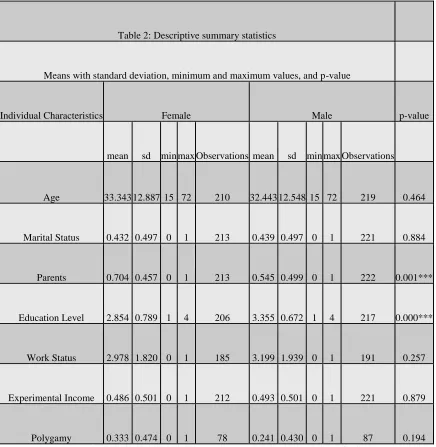
Table 2 presents the summary of the combination of the pooled dataset. I present some information drawn from the survey, which includes queries on gender, age, level of education, marital status, and parental status. For females, the average participant is in the 15 to 72-year-old range, which is similar to the average male participant. 70 percent of females report to be parents compare to 55 percent of males. On average male participants have higher educational attainment relative to the female participants. Although females on average report to have more fulltime jobs compared to males, there is not a significant difference and these same findings are true for the polygamy variable.
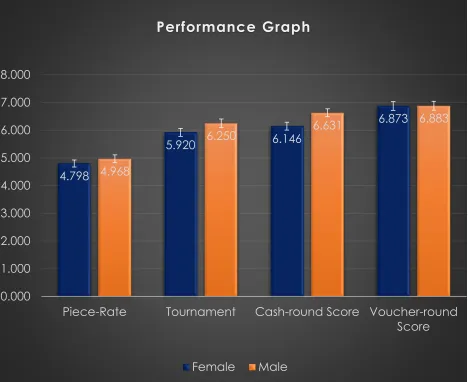
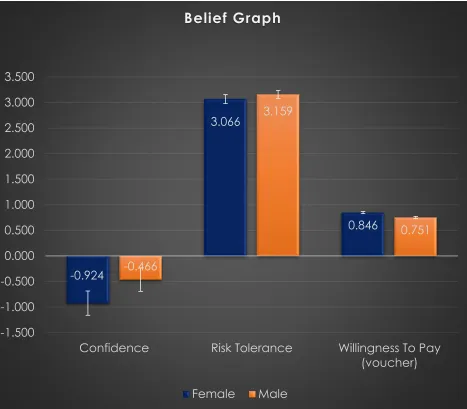
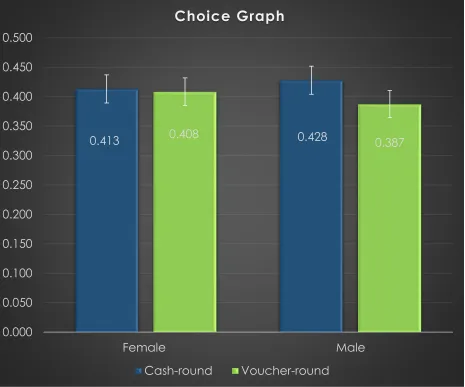
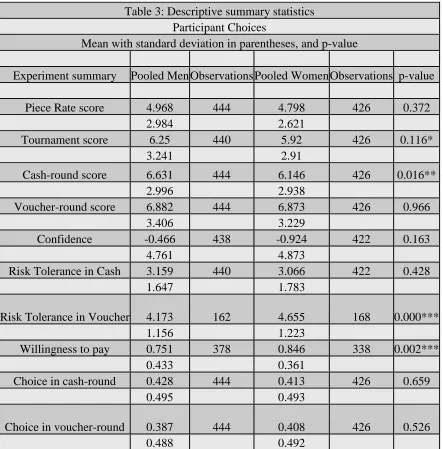
The panel in Table 3 provides summaries of the performances; correct answers found during the activities, the risk tolerance, willingness to pay of the participants, and the choices of the participants. Figure 1 to 4 complement these data summaries with visual depictions of the observed results. In terms of performances both genders’ scores are closer to each other across the various groups, except in the tournament and cash-round activities, where males scores are slightly higher than female scores. The confidence level is negative for both genders, but not significant.
compete slightly decreases to 39%, while the percentage of females remains at 41%. However, the results become more interesting when we observe the data from non-parent and parent views. In the cash-round, female parents reveal to be as competitive as the male parents, where 51% of the mothers chose to compete relative to 46% of fathers. Unlike the cash-round, the percentage of fathers willing to compete in the voucher-round decreases to 40%, while mothers’ percentages stay the same (p-value=0.04). Though we observe the same patterns in the case of the non-parent male and female participants, the percentage of males who chose to compete is still higher than the females who chose to compete.
Observing the participants’ willingness to compete based on their marital union, either in
a polygamous marriage or not, we note that both females and males in polygamous unions are more competitive relative to the ones in monogamous unions. It is important to comment that the percentage of males in polygamous marriages who chose to compete is just slightly higher than the ones’ in monogamous marriages who choose to compete. The dramatic change is observed on the females’ side, where the percentage of females in polygamous marriages who chose to compete
increases by 11% in the cash-round compared to the females in monogamous marriages.
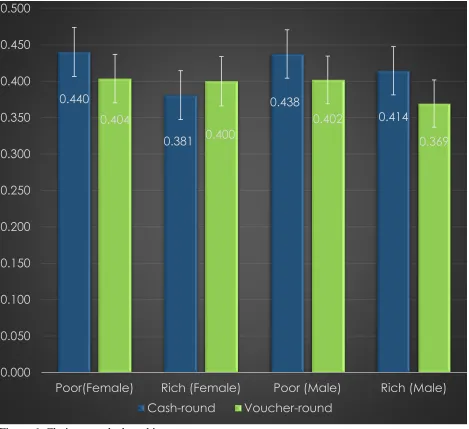
From the income perspective, we see that poor people tend to more competitive compared to rich people. But, these results are not significant.
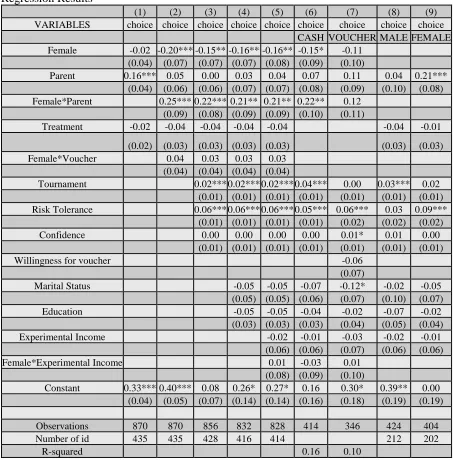
Though the raw data summaries provide some evidence that behavior varies across both gender groups and within the society, there has been no attempt to control for observables, which might influence behavior and performances. To address this issue, we regress the individual participant’s choice to compete on a dummy variable of gender, treatment, their interaction, and
the observables presented in Table 2.
1. Empirical Results
1.1.Whole Dataset results
significant in S (2) to S (6). Under the voucher treatment, the signs of the coefficients become positive, meaning women become competitive when the reward favors their children, the coefficients are not significant. Supporting the previous findings, the regression results show that female parents are most competitive. Both male and female participants in this society are risk tolerant.
8.2Subset Dataset results
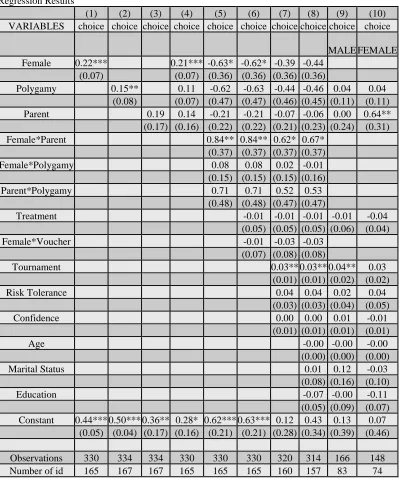
Table 5 displays the specifications on the subset of the data, where we collected information on polygamy. In the second specification, the result shows that females are competitive. However, these results lose the significance when other observables are added to the regression. Results on female parents are significant, showing that they are competitive. Both females and males in polygamy marriages are competitive.
Conclusion
Several recent experimental studies show the link between gender and competition. This study is an extension of a previous work by Cassar, Wordofa and Zhang (2016). This work uses an incentivized experimental task to explore whether there are gender differences in selecting into competitive environments when the incentive changes from cash to voucher. In addition, we also measure the effects of income, marriage type, and being a parent on people’s willingness to compete. This society is unique in the sense that though it is a patriarchal, we find some group of women who “degender” themselves to take on masculine roles in order to be successful. The data show some interesting results. The results show that both men and women have similar performances in the activities. It is important to note that these activities are mathematical activities, which are found in the previous literature to hinder the willingness to compete of women. Furthermore, the findings reveal that female parents are willing to compete regardless of the incentives. These findings are consistent with the study from China by Cassar, Wordofa and Zhang (2016) work, where they find that mothers are competitive when the incentive benefit their children.
important impact on their willingness to compete. Although the Togolese is a patriarchal, both genders have the same level of willingness to compete under both cash and voucher incentives. However, the behavior of the female parents to more competitive can be the result of the “Nanas” in the society, who have and continue to show great success examples. Therefore, a
woman willingness to compete should not just be perceived based on the just the task, but also on the environment and situation this latter happens to find herself. Maybe cultural norms need to be revised in order to examine how with globalization and others, the woman evolve and adapt to situations. In the Togolese society, it can be inferred that the “Nana Benz” are aspiration windows to other women to be competitive.
Some policy implications from this study, are that women parents will be better off and more represented in on the formal labor force if some kind of help to their offspring is provided to them for example children day cares. The findings from this study have also shown that although most of these women are uneducated, they are however competitive. It will be interesting if people without certain education can be given the opportunity to grow, through some special training provided to them by their government. Finally but not last, since mothers seems to be more competitive, other incentives such as flexible working hours and also on maternity leaves could be of good outcomes.
References
Fine, C. (2017). Testosterone rex: myths of sex, science, and society. New York, NY: W.W. Norton & Company, Inc.R. (2015, April 30). 2014
Catalyst Census: Women Board Directors. Retrieved April 10, 2017,
fromhttp://www.catalyst.org/knowledge/2014-catalyst-census-women-board-directors
African Queens of Textiles: the Nana Benz of Togo. (2012, February 23). Retrieved April 10, 2017, from https://afrolegends.com/2012/02/21/african-queens-of-textiles-the-nana-benz-of-togo/
Andersen, S., Ertac, S., Gneezy, U., List, J. A., & Maximiano, S. (2013). Gender,
Competitiveness, and Socialization at a Young Age: Evidence From a Matrilineal and a Patriarchal Society. Review of Economics and Statistics, 95(4), 1438-1443.
Doi:10.1162/rest_a_00312Booth, A. L., & Nolen, P. (2012).
Gender differences in risk behavior: does nurture matter? The Economic Journal, 122(558). Doi:10.1111/j.1468-0297.2011. 02480.x
Bussey, K., & Bandura, A. (1999). Social cognitive theory of gender development and differentiation. Psychological Review, 106(4), 676-713. Doi:10.1037//0033-295x.106.4.676
Byrnes, J. P., Miller, D. C., & Schafer, W. D. (1999). Gender differences in risk taking: A meta-analysis. Psychological Bulletin, 125(3), 367-383. Doi:10.1037//0033-2909.125.3.367 Cassar, A., Wordofa, F., & Zhang, Y. J. (2016). Competing for the benefit of offspring
eliminates the gender gap in competitiveness. Proceedings of the National Academy of Sciences, 113(19), 5201-5205. Doi:10.1073/pnas.1520235113
Chafetz, J. S., & Rhode, D. L. (1991). Theoretical Perspectives on Sexual Difference. Contemporary Sociology, 20(2), 185. Doi:10.2307/2072890
Croson, R., & Gneezy, U. (2009). Gender Differences in Preferences. Journal of Economic Literature, 47(2), 448-474. Doi:10.1257/jel.47.2.448
Cárdenas, J., Dreber, A., Essen, E. V., & Ranehill, E. (2012). Gender differences in
competitiveness and risk taking: Comparing children in Colombia and Sweden. Journal of Economic Behavior & Organization, 83(1), 11-23. Doi:10.1016/j.jebo.2011.06.008 Darwin, C. (1871). The descent of man, and selection in relation to sex. By Charles Darwin ...
doi: 10.5962/bhl.title.24784
Dreber, A., Essen, E. V., & Ranehill, E. (2013). Gender and competition in adolescence: task matters. Experimental Economics, 17(1), 154-172. Doi:10.1007/s10683-013-9361-0Gneezy, U., Niederle, M., & Rustichini, A. (2003). Performance in Competitive Environments: Gender Differences. The Quarterly Journal of Economics, 118(3), 1049-1074. Doi:10.1162/00335530360698496
Gneezy, U., Niederle, M., & Rustichini, A. (2003). Performance in Competitive Environments: Gender Differences. The Quarterly Journal of Economics, 118(3), 1049-1074.
Doi:10.1162/00335530360698496Gneezy, U., & Rustichini, A. (2004). Gender and Competition at a Young Age. American Economic Review, 94(2), 377-381.
Doi:10.1257/0002828041301821
Gneezy, U., Leonard, K., & List, J. (2008). Gender Differences in Competition: Evidence from a Matrilineal and a Patriarchal Society. Doi:10.3386/w13727
Gneezy, U., Leonard, K., & List, J. (2008). Gender Differences in Competition: Evidence from a Matrilineal and a Patriarchal Society. Doi:10.3386/w13727Goerg, O., &
Coquery-Vidrovitch, C. (1994). Histoire des villes d’Afrique noire. Des 17oloniz a la
17olonization. Vingtième Siècle. Revue d’histoire, (42), 131. Doi:10.2307/3771227 Gredler, G. R. (2000). Golombok, S., & Fivush, R. (1994). Gender development. New York:
Cambridge University Press. 275 pp., $22.75. Psychology in the Schools, 37(4), 394-395. Doi:10.1002/1520-6807(200007)37:4<394::aid-pits14>3.0.co;2-9Hamilton, J. O. (1974). Motivation and risk taking behavior: A test of Atkinson’s theory. Journal of Personality and Social Psychology, 29(6), 856-864. Doi:10.1037/h0036463
Hanek, K. J., Garcia, S. M., & Tor, A. (2016). Gender and competitive preferences: The role of competition size. Journal of Applied Psychology, 101(8), 1122-1133.
Doi:10.1037/apl0000112
Heilman, M. E., & Alcott, V. B. (2001). What I think you think of me: Women’s reactions to being viewed as beneficiaries of preferential selection. Journal of Applied Psychology, 86(4), 574-582. Doi:10.1037/0021-9010.86.4.574
Heilman, M. E., Wallen, A. S., Fuchs, D., & Tamkins, M. M. (2004). Penalties for Success: Reactions to Women Who Succeed at Male Gender-Typed Tasks. Journal of Applied Psychology, 89(3), 416-427. Doi:10.1037/0021-9010.89.3.416
Hofstede, G. (1998). Think Locally, Act Globally: Cultural Constraints in Personnel
Management. Management and International Review, 7-26. Doi:10.1007/978-3-322-90989-3_2Ivanova-Stenzel, R., & Kübler, D. (2011). Gender differences in team work and team competition. Journal of Economic Psychology, 32(5), 797-808. Doi:
10.1016/j.joep.2011.05.011
Knight, J. (2002). Sexual stereotypes. Nature, 415(6869), 254-256. Doi:10.1038/415254a Markus, H., & Oyserman, D. (1989). Gender and Thought: The Role of the Self-Concept.
Gender and Thought: Psychological Perspectives, 100-127. Doi:10.1007/978-1-4612-3588-0_6
Martinsson, P., Nordblom, K., Rützler, D., & Sutter, M. (2011). Social preferences during childhood and the role of gender and age — An experiment in Austria and Sweden. Economics Letters, 110(3), 248-251. Doi: 10.1016/j.econlet.2010.11.028
Meyer-Bahlburg, H. F., Feldman, J. F., Ehrhardt, A. A., & Cohen, P. (1984). Effects of prenatal hormone exposure versus pregnancy complications on sex-dimorphic behavior. Archives of Sexual Behavior, 13(5), 479-495. Doi:10.1007/bf01541431
Niederle, M., & Vesterlund, L. (2007). Do Women Shy Away From Competition? Do Men Compete Too Much? The Quarterly Journal of Economics, 122(3), 1067-1101. Doi:10.1162/qjec.122.3.1067
Nosek, B. A., & Smyth, F. L. (2011). Implicit Social Cognitions Predict Sex Differences in Math Engagement and Achievement. American Educational Research Journal, 48(5), 1125-1156. Doi:10.3102/0002831211410683
Rivière, C. 1978. “Rumeur de metamorphose.” Ethnopsychologie 33 (1) (January–March) : 55–
80
Rudman, L. A., & Glick, P. (2001). Prescriptive Gender Stereotypes and Backlash Toward Agentic Women. Journal of Social Issues, 57(4), 743-762. Doi:10.1111/0022-4537.00239 Schultz, T. W. (1980). Nobel Lecture: The Economics of Being Poor. Journal of Political
Economy, 88(4), 639-651. Doi:10.1086/260895Shah, A. K., Shafir, E., & Mullainathan, S. (2015). Scarcity Frames Value. Psychological Science, 26(4), 402-412.
Doi:10.1177/0956797614563958Toulabor, C. (2012). Les Nana Benz de Lomé. Afrique contemporaine, 244(4), 69. Doi:10.3917/afco.244.0069
Tregenza, T., & Wedell, N. (2002). Polyandrous females avoid costs of inbreeding. Nature, 415(6867), 71-73. Doi:10.1038/415071aTrivers, R. L. (n.d.). Foreword by Robert L. Trivers. Sexual Selection in Primates, Ix-Xii. Doi:10.1017/cbo9780511542459.001 Udry, J. R. (1994). The Nature of Gender. Demography, 31(4), 561. Doi:10.2307/2061790Ward,
P. I., Wedell, N., Hosken, D. J., & Tregenza, T. (2002). Measuring the sperm competition successes of field males of the yellow dung fly. Ecological Entomology, 27(6), 763-765. Doi:10.1046/j.1365-2311.2002. 00463.x
Figure 1. Performances graphs
4.798
5.920 6.146
6.873
4.968
6.250 6.631
6.883
0.000 1.000 2.000 3.000 4.000 5.000 6.000 7.000 8.000
Piece-Rate Tournament Cash-round Score Voucher-round
Score
Performance Graph
Figure 2. Beliefs graphs
-0.924
3.066
0.846
-0.466
3.159
0.751
-1.500 -1.000 -0.500 0.000 0.500 1.000 1.500 2.000 2.500 3.000 3.500
Confidence Risk Tolerance Willingness To Pay
(voucher)
Belief Graph
Figure 3. Choices graphs (whole data)
0.413 0.408 0.428 0.387
0.000 0.050 0.100 0.150 0.200 0.250 0.300 0.350 0.400 0.450 0.500
Female Male
Choice Graph
Figure 4. Choices graphs of parents
Figure 5. Choices graphs based om marriage type
0.507
0.190
0.455
0.396 0.493
0.206
0.405
0.366
0.000 0.100 0.200 0.300 0.400 0.500 0.600
Parent (Female) Non-Parent
(Female) Parent (Male) Non-Parent(Male)
Cash-round Voucher-round
0.808
0.593
0.476 0.426
0.769
0.574
0.476 0.412
0.000 0.100 0.200 0.300 0.400 0.500 0.600 0.700 0.800 0.900 1.000
Polygamy
(Female) Monogamy(Female) Polygamy (Male) Monogamy(Male)
Figure 6. Choices graphs based income
0.440
0.381
0.438
0.414 0.404
0.400
0.402
0.369
0.000 0.050 0.100 0.150 0.200 0.250 0.300 0.350 0.400 0.450 0.500
Poor(Female) Rich (Female) Poor (Male) Rich (Male)
Table 2: Descriptive summary statistics
Means with standard deviation, minimum and maximum values, and p-value
Individual Characteristics Female Male p-value
mean sd min max Observations mean sd min max Observations
Age 33.343 12.887 15 72 210 32.443 12.548 15 72 219 0.464
Marital Status 0.432 0.497 0 1 213 0.439 0.497 0 1 221 0.884
Parents 0.704 0.457 0 1 213 0.545 0.499 0 1 222 0.001***
Education Level 2.854 0.789 1 4 206 3.355 0.672 1 4 217 0.000***
Work Status 2.978 1.820 0 1 185 3.199 1.939 0 1 191 0.257
Experimental Income 0.486 0.501 0 1 212 0.493 0.501 0 1 221 0.879
Polygamy 0.333 0.474 0 1 78 0.241 0.430 0 1 87 0.194
Table 3: Descriptive summary statistics Participant Choices
Mean with standard deviation in parentheses, and p-value
Experiment summary Pooled Men Observations Pooled Women Observations p-value
Piece Rate score 4.968 444 4.798 426 0.372
2.984 2.621
Tournament score 6.25 440 5.92 426 0.116*
3.241 2.91
Cash-round score 6.631 444 6.146 426 0.016**
2.996 2.938
Voucher-round score 6.882 444 6.873 426 0.966
3.406 3.229
Confidence -0.466 438 -0.924 422 0.163
4.761 4.873
Risk Tolerance in Cash 3.159 440 3.066 422 0.428
1.647 1.783
Risk Tolerance in Voucher 4.173 162 4.655 168 0.000***
1.156 1.223
Willingness to pay 0.751 378 0.846 338 0.002***
0.433 0.361
Choice in cash-round 0.428 444 0.413 426 0.659
0.495 0.493
Choice in voucher-round 0.387 444 0.408 426 0.526
0.488 0.492
Table 4
Regression Results
(1) (2) (3) (4) (5) (6) (7) (8) (9)
VARIABLES choice choice choice choice choice choice choice choice choice CASH VOUCHER MALE FEMALE Female -0.02 -0.20*** -0.15** -0.16** -0.16** -0.15* -0.11
(0.04) (0.07) (0.07) (0.07) (0.08) (0.09) (0.10)
Parent 0.16*** 0.05 0.00 0.03 0.04 0.07 0.11 0.04 0.21***
(0.04) (0.06) (0.06) (0.07) (0.07) (0.08) (0.09) (0.10) (0.08)
Female*Parent 0.25*** 0.22*** 0.21** 0.21** 0.22** 0.12
(0.09) (0.08) (0.09) (0.09) (0.10) (0.11)
Treatment -0.02 -0.04 -0.04 -0.04 -0.04 -0.04 -0.01
(0.02) (0.03) (0.03) (0.03) (0.03) (0.03) (0.03)
Female*Voucher 0.04 0.03 0.03 0.03
(0.04) (0.04) (0.04) (0.04)
Tournament 0.02*** 0.02*** 0.02*** 0.04*** 0.00 0.03*** 0.02
(0.01) (0.01) (0.01) (0.01) (0.01) (0.01) (0.01)
Risk Tolerance 0.06*** 0.06*** 0.06*** 0.05*** 0.06*** 0.03 0.09***
(0.01) (0.01) (0.01) (0.01) (0.02) (0.02) (0.02)
Confidence 0.00 0.00 0.00 0.00 0.01* 0.01 0.00
(0.01) (0.01) (0.01) (0.01) (0.01) (0.01) (0.01)
Willingness for voucher -0.06
(0.07)
Marital Status -0.05 -0.05 -0.07 -0.12* -0.02 -0.05
(0.05) (0.05) (0.06) (0.07) (0.10) (0.07)
Education -0.05 -0.05 -0.04 -0.02 -0.07 -0.02
(0.03) (0.03) (0.03) (0.04) (0.05) (0.04)
Experimental Income -0.02 -0.01 -0.03 -0.02 -0.01
(0.06) (0.06) (0.07) (0.06) (0.06)
Female*Experimental Income 0.01 -0.03 0.01
(0.08) (0.09) (0.10)
Constant 0.33*** 0.40*** 0.08 0.26* 0.27* 0.16 0.30* 0.39** 0.00
(0.04) (0.05) (0.07) (0.14) (0.14) (0.16) (0.18) (0.19) (0.19)
Observations 870 870 856 832 828 414 346 424 404
Number of id 435 435 428 416 414 212 202
R-squared 0.16 0.10
Table 5
Regression Results
(1) (2) (3) (4) (5) (6) (7) (8) (9) (10)
VARIABLES choice choice choice choice choice choice choice choice choice choice
MALE FEMALE
Female 0.22*** 0.21*** -0.63* -0.62* -0.39 -0.44
(0.07) (0.07) (0.36) (0.36) (0.36) (0.36)
Polygamy 0.15** 0.11 -0.62 -0.63 -0.44 -0.46 0.04 0.04
(0.08) (0.07) (0.47) (0.47) (0.46) (0.45) (0.11) (0.11)
Parent 0.19 0.14 -0.21 -0.21 -0.07 -0.06 0.00 0.64**
(0.17) (0.16) (0.22) (0.22) (0.21) (0.23) (0.24) (0.31)
Female*Parent 0.84** 0.84** 0.62* 0.67*
(0.37) (0.37) (0.37) (0.37)
Female*Polygamy 0.08 0.08 0.02 -0.01
(0.15) (0.15) (0.15) (0.16)
Parent*Polygamy 0.71 0.71 0.52 0.53
(0.48) (0.48) (0.47) (0.47)
Treatment -0.01 -0.01 -0.01 -0.01 -0.04
(0.05) (0.05) (0.05) (0.06) (0.04)
Female*Voucher -0.01 -0.03 -0.03
(0.07) (0.08) (0.08)
Tournament 0.03** 0.03** 0.04** 0.03
(0.01) (0.01) (0.02) (0.02)
Risk Tolerance 0.04 0.04 0.02 0.04
(0.03) (0.03) (0.04) (0.05)
Confidence 0.00 0.00 0.01 -0.01
(0.01) (0.01) (0.01) (0.01)
Age -0.00 -0.00 -0.00
(0.00) (0.00) (0.00)
Marital Status 0.01 0.12 -0.03
(0.08) (0.16) (0.10)
Education -0.07 -0.00 -0.11
(0.05) (0.09) (0.07) Constant 0.44*** 0.50*** 0.36** 0.28* 0.62*** 0.63*** 0.12 0.43 0.13 0.07
(0.05) (0.04) (0.17) (0.16) (0.21) (0.21) (0.28) (0.34) (0.39) (0.46)
Observations 330 334 334 330 330 330 320 314 166 148
Number of id 165 167 167 165 165 165 160 157 83 74
Appendix:
Table 1: Groups of participants
Men Women
rich men rich women rich