Content-Based Image Retrieval
Nádia P. Kozievitch1, Jurandy Almeida1, Ricardo da S. Torres1, Neucimar A. Leite1 Marcos A. Gonçalves2, Uma Murthy3, Edward A. Fox3
1 Institute of Computing, University of Campinas, Campinas, SP, Brazil
{nadiapk,jurandy.almeida,rtorres,neucimar}@ic.unicamp.br
2 Department of Computer Science, Federal University of Minas Gerais, Belo Horizonte, Brazil
3 Department of Computer Science, Virginia Tech University, Blacksburg, VA, USA
{umurthy,fox}@vt.edu
Abstract. Advanced services in digital libraries (DLs) have been developed and are widely used to address the required capabilities of an assortment of systems as DLs expand into diverse application domains. In order to reuse, integrate, unify, manage, and support these heterogeneous resources, the notion ofcomplex objects (COs)has emerged as a means to facilitate aggregation of content and to help developers to manage heterogeneous information resources, and their internal components. In particular, complex image objects (along with the most used service - Content-Based Image Retrieval) have the potential to play a key role in information systems, due to the large availability of images and the need to integrate them with other datasets (and metadata), and image manipulation software. However, the lack of consensus on precise theoretical definitions for these concepts usually leads to ad hoc implementation, duplication of efforts, and interoperability problems. In this article we exploit the 5S Framework to propose a formal description for Complex Objects and Content-Based Image Retrieval, defining their fundamental concepts and relationships from a digital library (DL) perspective. These formalized concepts can be used to classify, compare, and highlight the differences among components, technologies, and applications, impacting digital library researchers, designers, and developers. The theoretical extensions of digital library functionality presented here cover complex image objects, within a practical case study, to exemplify the integrative use of services, thus balancing theory and practice.
Categories and Subject Descriptors: H. Information Systems [H.2 Database Management]: Miscellaneous
Keywords: Content-Based Image Retrieval, Complex Object, Digital Libraries, 5S Framework
1. INTRODUCTION
Advances in data compression, data storage, and data transmission have facilitated the creation, storage, and distribution of digital resources. These advances led to an exponential increase in the volume and assortment of data deployed and used in many applications. In order to deal with those data, it is necessary to develop appropriate information systems to efficiently manage collections of such data.
Users involved in creation, management, and access to heterogeneous resources are often concerned with improving productivity. For this, it is important to provide developers with effective tools to reuse and aggregate content. This has been the goal of a quickly evolving research area, namely Digital Libraries.
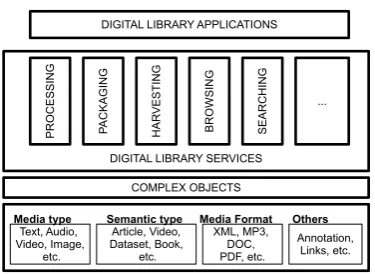
In order to reuse and aggregate different resources, Complex Objects (COs) have been created, motivating solutions for integration and interoperability. Such objects are aggregations of different information combined together into a unique logical object [Nelson and de Sompel 2006; Nelson et al. 2001]. Figure 1 shows the
We thank Rubens Riscala Madi, Marlene Tiduko Ueta and Silmara Marques Allegretti for their collaboration in this work. The authors thank CNPq, HP Technology for Teaching, CAPES, FAPESP, NIJ (National Institute of Justice), and BAE Systems for financial support. Thanks also go to NSF grants IIS-0910183, IIS-0916733, DUE-0840719, and CCF-0722259.
DIGITAL LIBRARY SERVICES Text, Audio, Video, Image, etc. Article, Video, Dataset, Book, etc. XML, MP3, DOC, PDF, etc.
Media type Semantic type Media Format
Annotation, Links, etc. Others COMPLEX OBJECTS ... P R O C E S S IN G
DIGITAL LIBRARY APPLICATIONS
P A C K A G IN G H A R V E S T IN G B R O W S IN G S E A R C H IN G
Fig. 1. Architecture for a CO-Based Digital Library.
architecture for a CO-Based Digital Library. The bottom layer has the data sources, accommodating different media types, with different semantic types and formats. The data sources are aggregated in COs, which are later accessed through different services, such as processing, packaging, harvesting, browsing, and searching. These services are later used by digital library applications. Yet, these applications have faced some issues [Ruijgrok and Slabbertje 2009; Awre 2009b]: (i) inadequate support by available DL software for working with COs; (ii) complicated management of COs arising from specific component particularities (such as documents’ legal rights); and (iii) inadequate support for multimodal search of complex objects and all components.
Most existing solutions to deal with these issues have focused only on textual data. With the growing demand for visual data, due to the Web, new challenges have emerged. In particular, if we consider image data, significant research efforts have been spent by the Content-Based Image Retrieval (CBIR) [Torres et al. 2006] community in the development of appropriate systems to efficiently manage image collections.
In spite of all the advances, there is a lack of consensus on the precise formalization involved in reusing, integrating, unifying, managing, and supporting of diverse application domains for COs and CBIR related tasks. To tackle this issue, we can take advantage of formal concepts to understand clearly and unambigu-ously the characteristics, structure, and behavior of complex information systems. The benefits of adopting a formal model include the abstraction of general characteristics and common features, and the definition of structures for organizing components (e.g., aggregations, collections). A precise specification of requirements also strengthens the correctness of an implementation [Gonçalves et al. 2004]. On the other hand, formalized concepts can be used to classify, compare, and highlight the differences among components, technologies, and applications, impacting digital library researchers, designers, and developers.
In this article, we address the formal definitions and descriptions for COs and CBIR by exploiting concepts of the 5S formal framework [Gonçalves et al. 2004]. Later these definitions are explored in a practical case study, to define the complex image object. Our contribution relies on (i) the formalization of complex objects; (ii) the formalization of content-based image retrieval; and (iii) and the discussion on how to combine them to handle complex image objects in applications.
2. RELATED WORK
2.1 5S Framework
The 5S framework aims to provide an underlying foundation for the definition of digital libraries [Gonçalves et al. 2004]. The unified formal theory first specifies an underlying foundation using key fundamental concepts: Streams, Structures, Spaces, Scenarios, and Societies. In turn, these can be employed to describe other DL concepts, such as digital objects, metadata, collections, and services. Streamsare sequences of elements of particular types (e.g., characters, pixels, bits, etc.). Streams are used to model static and dynamic content, including textual material and multimedia content. Structures specify the way in which parts of DLs are organized. Structures are used to represent hypertexts, system organization, and containment. Spaces are sets of objects and their operations. Spaces define the logical, representational, and presentational views of
many DL components (e.g., probability and vector spaces). Scenarios are sequences of events along with
a number of parameters. Events may represent changes in computational states through specific parameter values. Behaviors of DL services are described using scenarios. Societiesare used to describe entities with their relationships to other entities. Societies may include human users and software entities that play a defined role in the digital library’s operation.
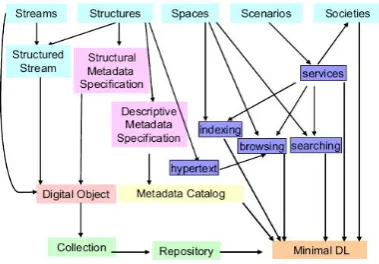
These five abstractions are useful in providing a foundation for defining and relating digital library concepts. As an example, a digital object may be defined in terms of itsstructuredstoragestreamandstructuredmetadata specification. The set of 5S descriptions for a digital library may be encompassed in 5SL representations. The 5SL representations may be used to generate and install an implementation of the described digital library [Gonçalves and Fox 2002].
Initial 5S framework efforts focused on defining the minimal set of features belonging to a digital library. The minimal digital library is defined as a quadruple (Repository, Metadata Catalogue, Services, Society) containing the core digital library components. These features include the basic set of structured content and elementary services provided to end-users. In a minimal digital library, the Structures component is only considered in a few ways; digital objects are represented through one or more structured streams and have an associated metadata record with a simple structure. There are no other structures in the minimal DL. The basic digital library services include indexing, searching, browsing, and visualization [Shen et al. 2006]. Minimal digital libraries have been defined with minor context-specific additions to produce existing libraries such as the archaeological ETANA-DL [Ravindranathan et al. 2004]. Further comparisons between 5S and other digital library models can be found in [Kozievitch et al. 2011].
We chose to work with the 5S framework due to wide flexibility for analyzing the internal structure and components of the CO, the description of services through scenarios, the description and use of components organizations (aggregations, collections); and finally, due to its use for implementing applications [Gonçalves and Fox 2002; Zhu et al. 2003].
2.2 Complex Objects (CO)
Some authors name the integration of resources into a single digital object asAggregation[Brogan 2003], a
Component-Based Object[Santanchè and Medeiros 2007; Santanchè et al. 2007], aComplex Object [Nelson et al. 2001], or aCompound Object[Awre 2009a]. We adopt the same definition of structuring digital objects present in [Awre 2009a]: atomistic, compound, and complex. The atomistic approach is when the user has a single file (whether made up from a single or multiple text files) from a preferred format. The compound approach is made up from multiple content files, which may have different formats. A complex object is described using a network of digital objects within the repository.
complex object is an aggregation of objects, that can be grouped together and manipulated as a single object.
COs also were defined as aggregations of distinct information units that when combined form a logical whole1. Santanchè, on the other hand, used the idea of COs in the field of software reuse and exchange [San-tanchè and Medeiros 2007; San[San-tanchè et al. 2007]. Like the script concept [Schank 1995], or the frame con-cept [Minsky 1974], the components in a CO are supposed to have the same behavior, respect the same rules, or represent the same concept.
Several complex object (CO) formats arise from different communities [Nelson and de Sompel 2006; Nelson et al. 2001; Kozievitch et al. 2011; Lynch et al. 2007] and can be used under different domains [Kozievitch 2009]. In scientific computing, standards arise, such as Network Common Data Form (NetCDF), Hierarchical Data Format (HDF), and Extensible File System (ELFS). HDF and NetCDF, for example, are used in multi-dimensional storage and retrieval, while ELFS is an approach to address the issue of high performance I/O by treating files as typed objects.
COs often are found in persistent database stores. They may be represented using standards from the Mov-ing Picture Experts Group (MPEG) [Burnett et al. 2006] or Metadata EncodMov-ing and Transmission Standard (METS)2. One example, for including digital object formats, is the Moving Picture Experts Group - 21 Digital
Item Declaration Language (MPEG-21 DIDL).
Even though there are a number of standards aiding in the management of COs, there is still incompatibility, motivating solutions for integration and interoperability. As each standard is specialized for a particular domain, it is hard to interoperate across contexts. Yet, it is possible to match some of them, as proposed in [Dourado et al. 2007], in their comparative study of IMS Content Package (IMS CP) and Reusable Asset Specification (RAS).
New standards have emerged, like SQL Multimedia and Application Packages (SQL/MM) [Melton and Eisenberg 2001]. These were defined to describe storage and manipulation support for complex objects. A number of candidate multimedia domains were suggested, including full-text data, spatial data, and image data.
The Open Archival Information System (OAIS) [CCSDS 2002] is an International Organization for Stan-dardization (ISO) reference model, with a particular focus on digital information, both as the primary form of information held and as supporting information for both digitally and physically archived materials. The objects are categorized by their content and function in the operation of an OAIS, into Content Information objects, Preservation Description Information objects, Packaging Information objects, and Descriptive Infor-mation objects.
The Open Archives Initiative (OAI) [Lagoze and de Sompel 2001] is a framework for archives (e.g., insti-tutional repositories) containing digital content (i.e., a type of digital library). The OAI technical infrastruc-ture, specified in the Open Archives Initiative Protocol for Metadata Harvesting (OAI-PMH) [Suleman et al. 2003], defines a mechanism for data providers to expose their metadata. This protocol mandates that individual archives map their metadata to the Dublin Core, a simple and common metadata set for this purpose.
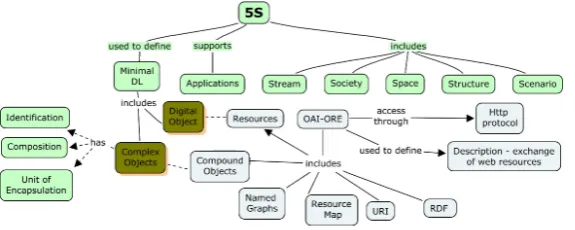
OAI also launched the Object Reuse and Exchange (OAI-ORE) project [Lynch et al. 2007] which defines standards for the description and exchange of aggregations of Web resources, and is developing interoperable, and machine-readable mechanisms to express compound object information on the web. OAI-ORE makes it possible to reconstruct the logical boundaries of compound objects, the relationships among their internal com-ponents, and their relationships to other resources. The information is encapsulated with named graphs: a set of RDF assertions identified by a URI. Figure 2 [Kozievitch and da Silva Torres 2010] highlights some concepts from the 5S framework and OAI-ORE. Note that concepts such as resource - digital object and complex object can be mutually mapped.
1http://www.openarchives.org/ore/(As of Aug. 2011)
Fig. 2. Matching the main concepts of the 5S framework and OAI-ORE.
A named graph can be described by a resource map. OAI-ORE uses the web architecture, essentially con-sisting of:
—URIs for identifying objects;
—resources, which are items of interest;
—standard protocols, such as HTTP, that enable access;
—links via URI references;
—named graphs for encapsulating information into a compound object.
METS addresses packaging to collect digital resource metadata for submission to the repository. It is a Digital Library Federation initiative. A METS document consists of the following sections: header, descriptive metadata, administrative metadata, file section, structural map, structural links, and behavior. METS uses a structural map to outline a hierarchical structure for the digital library object, where file elements may be grouped within fileGrp elements, to provide for subdividing the files by object version. Ahf ileGr pistructure is used to comprise a single electronic version of the digital library object. hFContentiwas created to embed the actual contents of the file within the METS document, but it is rarely used. METS provides an XML Schema designed for the purpose of:
—Creating XML document instances that express the hierarchical structure of digital library objects. —Recording the names and locations of the files that comprise those objects.
—Recording associated metadata.
METS can, therefore, be used as a tool for modeling real world objects, such as particular document types.
SCORM3is a compilation of technical specifications to enable interoperability, accessibility and reusability of web-based learning content. With a Content Aggregation Model, resources described in an XML file named imsmanifest.xml, organized in schema/definition (.xsd and .dtd) files, and placed in a zip file, are used as a con-tent package. SCORM defines a web-based learning Concon-tent Aggregation Model and Run-Time Environment for learning objects. In SCORM, a content object is a web-deliverable learning unit. Often, a content object is just an HTML page or document that can be viewed with a web browser. A content object is the lowest level of granularity of learning resources, and can use all the same technologies a web page can use (e.g., Flash, JavaScript, frames, and images).
MPEG-21 [Burnett et al. 2006] aims to define an open framework for multimedia applications, to support, for example, declaration (and identification), digital rights management, and adaptation. MPEG-21 is based on two essential concepts: the definition of a fundamental unit of distribution and transaction, which is the digital item, and the concept of users interacting with them. Within an item, an anchor binds descriptors to a fragment,
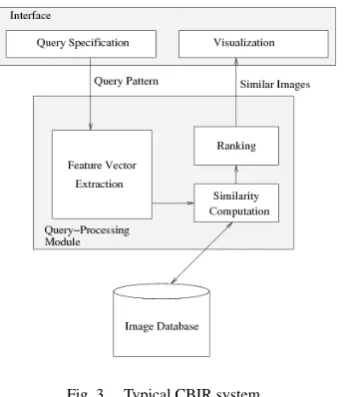
Fig. 3. Typical CBIR system.
which corresponds to a specific location or range within a resource. Items are grouped in a structured container using an XML-based Digital Item Declaration Language (DIDL). In addition, a W3C XML Schema definition of DIDL is provided.
Table I summarizes OAI-ORE, METS, SCORM, and MPEG-21 regarding basic principles available in complex objects: what is the data basic unit, how to relate a part of a document, how to identify it, and how to structure the components.
Name Unit Internal Component Identifier Structure
OAI-ORE Resource Behaves like HTML URI Named Graph
METS Simple object FContent structure OBJID Structural Map
SCORM Asset Sequence rules —— Schema/definition files
MPEG-21 Resource Anchors and fragments URI XML-DIDL
Table I. How standards handle basic CO concepts.
2.3 Content-Based Image Retrieval (CBIR)
A typicalCBIRsolution requires the construction ofimage descriptors, which are characterized by [Torres and Falcão 2006]: (i) anextraction algorithmto encode image features intofeature vectors; and (ii) a similar-ity measureto compare two images based on the distance between their corresponding feature vectors. The similarity measure is amatching function, which gives the degree of similarity for a given pair of images rep-resented by their feature vectors, often defined as a function of the distance (e.g., Euclidean), that is, the larger the distance value, the less similar the images.
Figure 3 shows an overview of a content-based image retrieval system. The interface allows a user to specify a query by means of a query pattern (e.g., a query image) and to visualize the retrieved similar images. The query-processing module extracts a feature vector from a query pattern and applies a distance function (such as the Euclidean distance) to evaluate the similarity between the query image and the images. Next, it ranks the database images according to similarity and forwards the most similar images to the interface module. Note that database images are often indexed according to their feature vectors using structures to speed up retrieval and distance computation.
is the digital museum of butterflies [Hong et al. 2000], aimed at building a digital collection of Taiwanese butterflies. This digital library includes a module responsible for content-based image retrieval based on color, texture, and patterns. In a different image context, Zhuet al.[Zhu et al. 2000] present a content-based image retrieval digital library that supports geographical image retrieval. The system manages air photos which can be retrieved through texture descriptors. Place names associated with retrieved images can be displayed by cross-referencing with a Geographical Name Information System (GNIS) gazetter. In this same domain, Bergman
et al. describe an architecture for storage and retrieval of satellite images and video data from a collection of heterogeneous archives.
There are still other initiatives covering new searching strategies for improving the CBIR systems [French et al. 2003; Wang and Du 2001], and image descriptors [Wang et al. 2004].
Another important initiative for the digital library domain is related to the proposal of the Content-Based Im-age Search Component (CBISC) [Torres et al. 2006]. CBISC is a recently developed component that provides an easy-to-install search engine to query images by content. It can be readily tailored for a particular collection by a domain expert, who carries out a clearly defined set of pilot experiments.
Several researchers have worked to formalize content-based image retrieval systems [Traina Jr. et al. 2005; Atnafu et al. 2004]. However, these formalisms typically describe these kinds of services under the database perspective (in general, based on the relational or object-relational models). To the best of our knowledge this article constitutes the first formal attempt to describe content-based image retrieval services by using digital library concepts described with the 5S framework. One benefit is that the 5S framework is generic enough to formalize these concepts without relying on implementation decisions.
There are several applications which support services based on image content, allowing integration in distinct domains [Murthy et al. 2010; Achananuparp et al. 2007]. The identification of fish species [Murthy et al. 2011] is an example of a desired capability of a biological research system [Lyons et al. 2006]. These applications require the management of images, text, and annotations. Users may search with keyword descriptions or match a query image with images in the collection of fish images. Digital libraries in this context may be required to provide specialized support such as image processing algorithms for fish contours. In a different context, images are also used as the basis to match fingerprints [Kozievitch et al. 2010]. In this case, algorithms used for processing images are not only related to the implementation of CBIR mechanisms, but also to specific software used to properly represent fingerprint details, such as direction, flow, contrast, and curvature. Along with these parameters, specific details (minutiae) are analyzed on the image, to compare if two different images (from the police records and the crime scene, for example) belong to the same person.
3. PROBLEM FORMALIZATION AND OVERALL APPROACH
Formalizing complex objects and content-based image retrieval facilitates the development, comparison, and evaluation of solutions based on distinct information resource integration; makes clear to users what a solution means; indicates how components are related; and helps users evaluate the applicability of a solution. Fur-thermore, it allows us to leverage special-purpose techniques for combining, aggregating, and reference the integration process. In this section, we first introduce the basic notations based on the 5S framework, followed by an overall approach for formalizing complex objects and content-based image retrieval.
3.1 Background on the 5S Framework
Fig. 4. Main concepts of a Minimal Digital Library at the 5S Framework.
3.2 Notations
Notation: LetDL1be a digital library; let{do1,do2, . . . ,don}be the set of digital objectsdopresent inDL1;
let H be a set of universally unique handles (unique identifiers); letSMbe a set of streams; and let setST be a set of structural metadata specifications.
3.3 Complex Objects
From a computational view, a DL, in terms of content, is mainly composed of simple components named digital objects.
Adigital objectis defined as a tupledo= (h,SM,ST,StructuredStreams), where
(1) h∈H, where H is a set of universally unique handles (labels); (2) SM={sm1,sm2, . . . ,smn}is a set of streams;
(3) ST={st1,st2, . . . ,stm}is a set of structural metadata specifications;
(4) StructuredStreams={stsm1,stsm2, . . . ,stsmp} is a set of StructuredStream functions defined from the
streams in theSM set (the second component) of the digital object and from the structures in theST set (the third component).
Streamsare sequences of elements of an arbitrary type (e.g., bits, characters, images, etc.).Structural Meta-data Specificationscorrespond to the relations between the object and its parts (as chapters in a book). Struc-tured Streams define the mapping of a structure to streams (how chapters, sections, introduction, etc. are organized to define a book). More details are available in [Gonçalves et al. 2004].
Definition 3.1. We define a complex objectas a tuplecdo= (h,SCDO,S)where
(1) h∈H, whereHis a set of universally unique handles (labels);
(2) SCDO={DO∪SM}, havingDO={do1,do2, . . . ,don}, anddoiis a digital object or another complex
object; andSM={sma,smb, . . . ,smz}is a set of streams;
(3) Sis a structure that composes the complex objectcdointo its parts inSCDO.
Note that the mentioned definitions consider the object’s metadata in a separate catalog [Gonçalves et al. 2004]. TheDOandSMcomponents are finite sets, therefore theSstructure is also finite, defining what belongs to the CO or not (concept referred to as a boundary).
(a) (b)
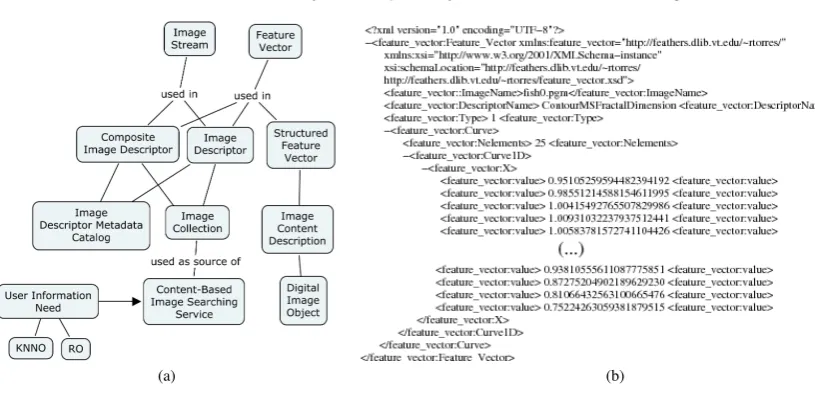
Fig. 5. (a) 5S extensions to support content-based image description and related services. (b) Example of a structured feature vector.
Commons approach [Awre 2009a], where lists represent multiple single files which were packed together, and graphs represent files which are related, creating networks of digital objects. If we consider files arranged in HTML5 [Park et al. 2010], theSstructure can be extended to a cyclic graph. Our focus is not to explore these fine-grained concepts, but to consider a high-level approach: aggregate logically and perhaps physically, distinct objects, so they can be represented as a single unit.
3.4 Content-based Image Retrieval
Figure 5-a presents the proposed concepts based on the 5S framework to handle image content descriptions and related digital library services. These concepts are precisely defined below. Some of these concepts were introduced in [Torres and Falcão 2006]. In this article, we extend them by taking into account digital library aspects.
Definition 3.2. Animagestream(or simplyimage) ˆIis a pair (DI,~I), where:
—DIis a finite set ofpixels(points inN2, that is,DI⊂N2), and
—~I:DI→D0is a function that assigns each pixelpinDIto a vector~I(p)of values in some arbitrary spaceD0
(for example,D0=IR3when a color in the RGB system is assigned to a pixel).
Definition 3.3. Afeature vector ~f vIˆof an image ˆIis a point inRnspace: ~f vIˆ= (f v1,f v2, ...,f vn), where
nis the dimension of the vector.
Examples of possible feature vectors are a color histogram [Swain and Ballard 1991] and a multiscale fractal curve [da S. Torres et al. 2004]. They essentially encode image properties, such as color, shape, and texture. Note that different types of feature vectors may require different similarity functions.
Definition 3.4. Afeature vector digital objectis the digital objectdo= (h,SM,ST,StructuredStreams) which represents the feature vector.
Definition 3.5. Given a structure(G,L,F),G= (V,E)and a feature vector ~f vIˆ, a StructuredFeatureVec-toris a functionV →Rnthat associates each nodevk∈Vwith f vi∈~f vIˆ.
(a) (b)
Fig. 6. (a) The use of a simple descriptorDfor computing the similarity between images. (b) Composite image descriptor.
descriptorContour Multiscale Fractal Dimension[da S. Torres et al. 2004] to the image stream defined by the file “fish0.pgm”.
Definition 3.6. A simple image content descriptor(briefly, image descriptor)D is defined as a tuple (hdesc,εD,δD), where:
—hdesc∈H, whereHis a set of universally unique handles (labels);
—εD:{Iˆ} →Rnis a function, which extracts afeature vector~f vIˆfrom animageIˆ.
—δD:Rn×Rn→R is asimilarity function(e.g., based on a distance metric) that computes the similarity
between two images as a function of the distance between their correspondingfeature vectors.
Figure 6(a) illustrates the use of a simple descriptorDto compute the similarity between two images ˆIAand
ˆ
IB. First, the extraction algorithmεDis used to compute the feature vectors~f vIˆA and
~f v ˆ
IB associated with the
images. Next, the similarity functionδDis used to determine the similarity valuedbetween the images.
Definition 3.7. Acomposite image descriptorDˆ is a tuple(hdesc,D,δD)(see Figure 6(b)), where:
—hdesc∈H, whereHis a set of universally unique handles (labels);
—D={D1,D2, . . . ,Dk}is a set ofkpre-defined simple image descriptors.
—δD is a similarity function which combines the similarity values obtained from each descriptorDi∈D,
i=1,2, . . . ,k.
Definition 3.8. Animage content descriptionICDis a tuple(FV,STFV s,StructuredFV s), where
—FV={f v~1, ~f v2, . . . , ~f vk}is a set of feature vectors;
—STFV s={st f v1,st f v2, . . . ,st f vm}is a set of structural metadata specifications;
—StructuredFV s={str f v1,str f v2, . . . ,str f vm}is a set of StructuredFeatureVector functions defined from the
feature vectorsin theFVset (the first component) of the image content description and from the structures in theSTFV sset (the second component).
Definition 3.9. Adigital image objectidois a digital object with the following extensions and constraints:
—idois adigital object= (h,SM,ST,StrStreams,ICD,StrICDStreams), where (1) h∈H, where H is a set of universally unique handles (labels);
(2) SMsd={smsd[i,j]} ∈SM, wheresmsd[i,j] =
Fig. 7. Digital image object elements.
(3) ST={st1,st2, . . . ,stm}is a set of structural metadata specifications;
(4) StrStreams={stD1,stD2, . . . ,stDm} is a set of StructuredStream functions defined from the image
substreams in theSMset (the second component) of the digital object and from the structures in theST
set (the third component).
(5) ICDis animage content description(Definition 3.8).
(6) StrICDStreams={stimgD1,stimgD2, . . . ,stimgDm}is a set of StructuredStream functions defined from
theimage streamin theSMset (the second component) of the digital image object and from the struc-tures in theSTFV s∈ICD(2)set.
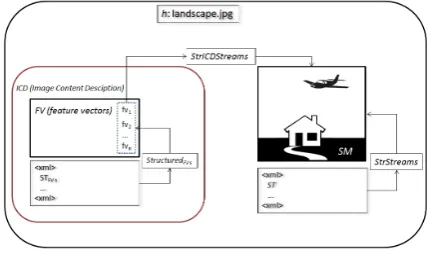
Figure 7 illustrates the relations among the concepts used to define a digital image object. The definition of
StrICDStreamsallows associating feature vectors with parts (objects, regions) of image streams.
Definition 3.10. Animage collectionImgCis a tuple(C,Simgdesc,FVimgdesc), whereCis a collection (see
Def. 17 in [Gonçalves et al. 2004]),Simgdesc is a set of image descriptors, andFVdesc is a functionFVdesc:
{C×Simgdesc} →ICD(1), whereICDisido(5)andido∈C.
FunctionFVdescdefines how a feature vector was obtained, given a digital image objectido∈Cand an image
descriptor ˆD∈Simgdesc.
Definition 3.11. Let Simgdesc be a set of image descriptors with khandles in H. Animage descriptor
metadata catalogDMSimgdescforSimgdescis a set of pairs{(h,{dmdesc1, . . . ,dmdesckh})}, whereh∈Hand the
dmdesciare descriptive metadata specifications for image descriptors.
Descriptive metadata specifications of descriptors could include, for example, data about the author (who implemented the extraction and similarity functions), implementation date, and related publications. Recall that, in general, a metadata catalog is used to assign descriptive metadata specifications to digital image objects (see Def. 18 in [Gonçalves et al. 2004]).
4. CASE STUDY
In this section we exemplify how the 5S extensions for complex objects and content-based image retrieval can be explored to define the complex image object concepts in the SuperIDR and CTRnet projects. The services and digital objects of these tools are not unlike those of a digital library (DL) with extended functionality (such as annotations, and multimodal search).
4.1 Superimposed Image Description and Retrieval Tool - SuperIDR
Fig. 8. SuperIDR Tool: A- Treeview navigation, B- Comparison,
C-Annotation and D - Text search. Fig. 9. The Complex Image Object.
images in situ, where they can select, annotate, and retrieve parts of images in the context of the original image.
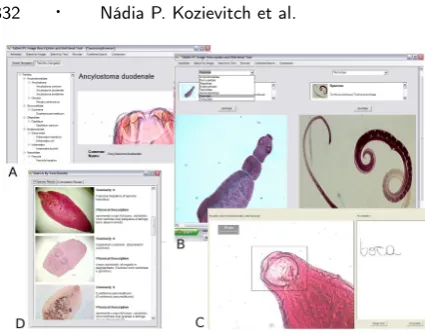
SuperIDR is seeded with details of 13 species and 49 images of parasites, taken from microscope analysis. In addition to making annotations, SuperIDR allows searching and browsing of species descriptions, images, image marks, and annotations. Figure 8 shows screenshots of the tool. We defined that the aggregation would comprise the complex image object, aggregating the image, feature vector, and similarity distances.
For formalization purposes, we will adopt the CO definition for describing an image and its components.
The main difference between acomplex image objectICO and adigital image objectIDO is that the CO
definition considers the image and the feature vector as atomic digital objects, to facilitate object manipulation and related services (such as referencing, harvesting, etc.).
If we consider the CO definition (in section 3.3), the complex image object (ICO) has the structureico= (h,SCDO,S), where:
—h is a unique handle that identifies ico;
—SCDO={DO∪SM}, havingDO={do1,do21...do2k,do31, ...do3k}, wheredo1is animage,kis the number
of descriptors,do21...do2kis a set offeature vector digital objects, anddo31...do3kis a set of Structured-FeatureVectors(with the similarity measures, according to a specific descriptor k); andSM={sm1,sm2, . . . ,smn}
is a set of streams;
—S is a structure that identifies howdo1,do21...do2k, anddo31, ...do3kare composed.
Figure 9 presents the ICO, and its corresponding components: the digital image object, feature vector and similarity scores. Note that each ICO component is adigital object, therefore having also its own handle. This allows users to explore the collection not only by the COs, but also by the individual components (digital objects).
Ancomplex image object collectionImgCOis a tuple(C,Simgdesc), whereCis a collection (see Def. 17
in [Gonçalves et al. 2004]), andSimgdesc is a set of image descriptors. FunctionFVdesc defines how a feature
vector was obtained, given a complex image objectico∈Cand an image descriptor ˆD∈Simgdesc.
In our SuperIDR example, each ICO has the structureico= (h,SCDO,S), where:
—h is a unique handle that identifies ico;
—SCDO={DO∪SM}, having DO={do1,do21,do31}, wheredo1 is a parasite image, k=1 (BIC
de-scriptor [Stehling et al. 2002] ), do21 is a feature vector digital object, and do31 is a StructuredFea-tureVector(another digital object with the similarity measures, according to a specific descriptor k); and
—S is an XML structure that identifies howdo1,do21, anddo31 are composed.
Thecomplex image object collectionrepresented in our SuperIDR example has 43 ICOs and one descrip-tor. FunctionFVdesc classifies image pixels as eitherborderor interior, and then later computes two color
histograms, one for each type of pixels. A pixel is classified as border if at least one of its 4-neighbors has a different color. If its 4-neighbors have the same color, it is classified as interior.
In summary, our case study explored the main concepts for ICOs (such as identification, components, collec-tion, and StructuredFeatureVector) resulting from the CBIR process in SuperIDR. A straightforward benefit of this work is the use of these definitions to construct applications, including requirements gathering, conceptual modeling, prototyping, and code generation, similar to initiatives presented in [Gonçalves and Fox 2002; Zhu et al. 2003; Moreira et al. 2009; Zhu et al. 2003]. As an example, consider the use of 5S formal theory to inte-grate an archaeological digital library, using applications such as 5SGraph [Zhu et al. 2003]. The formalization of the concepts can facilitate the development, comparison, and evaluation of solutions; making it clear to users what a solution means; and helping users evaluate the applicability of a solution.
4.2 Evaluating image descriptors in the CTRnet Project
The Crisis, Tragedy, and Recovery Network (CTRnet) [Kozievitch et al. 2010; Yang et al. 2011] objectives include to develop better approaches toward making technology useful for archiving information about such events, and to support analysis of rescue, relief, and recovery, from a digital library perspective. CTRnet has several modules, including crawling, filtering, a Facebook application, user visualization, metadata search, and Content-Based Image Retrieval. The CBIR module builds upon the EVA tool [Penatti and da S. Torres 2010] for evaluating image descriptors for content-based image retrieval. Eva integrates the most common stages of an image retrieval process and provides functionalities to facilitate the comparison of image descriptors in the context of content-based image retrieval.
Compared to the previous case study, CTRnet images can be evaluated by several descriptors, creating more components. Also, a clear description of ICO concepts can be used as a basis to integrate the CBIR module with other CTRnet modules. We defined that the complex image object would be composed of the image, the feature vectors, and similarity distances from each descriptor. Figure 10 shows the image ranking for Cathedral_P_A_P.jpg, using two different descriptors: BIC [Stehling et al. 2002] and SASI [Çarkacioglu and Yarman-Vural 2003].
The ICO presented in Figure 10 can be defined by the structureico= (h,SCDO,S), where:
—h is a unique handle that identifies ico;
—SCDO={DO∪SM}, havingDO={do1,do21,do22,do31,do32}, wheredo1is animage,k=2 (BIC and
SASI descriptors),do21is afeature vector digital objectusing the BIC descriptor,do22is afeature vector digital objectusing the SASI descriptor,do31is aStructuredFeatureVectorusing the BIC descriptor, and
do32 is aStructuredFeatureVectorusing the SASI descriptor; and SM={sm1,sm2, . . . ,smn} is a set of
streams;
—S is an XML structure that identifies howdo1,do21,do22,do31anddo32are composed.
Thecomplex image object collectionhas 111 ICOs and two descriptors. FunctionFVdesc1(BIC) is based
on the color information. FunctionFVdesc2(SASI) is based on second order statistics of clique autocorrelation
coefficients, which are the autocorrelation coefficients over a set of directional moving windows.
(a) (b)
Fig. 10. Image ranking in CTRnet using BIC (a) and SASI (b) descriptors.
5. CONCLUSIONS AND FUTURE WORK
Many digital library implementations and applications demand additional and advanced services to effectively reuse and aggregate different resources. Examples of commonly required services include those related to the support of newer, more complex media types such as images, multimedia objects, and related information. In this article we address the formal definitions and descriptions for Complex Objects and Content-Based Image Retrieval.
The proposed extensions for digital library functionality take advantage of formalization to understand clearly and unambiguously the characteristics, structure, and behavior of the main concepts related to com-ponents, technologies, and applications. Later these definitions are explored in two case studies, to exemplify how the CO and CBIR concepts can be explored to define the complex image object. Our contribution relies on (i) the formalization of complex objects; (ii) the formalization of content-based image retrieval; and (iii) the discussion on how to combine them to handle complex image objects in applications. These formalized concepts can be used to classify, compare, and highlight the differences among components, technologies, and applications, impacting digital library researchers, designers, and developers. The set of definitions also may impact future development efforts of a wide range of digital library experts since it can guide the design and implementation of new digital library services based on complex objects, and image content.
A straightforward benefit of this work is the use of these definitions to create applications, like those proposed in [Gonçalves and Fox 2002; Zhu et al. 2003], or the formalization of more complex services that can be created by using the proposed constructs. As future work we can mention the analysis of multimodal search services, recommendation systems for complex objects, image browsing services based on image content similarity, and management of complex simulation-based content.
REFERENCES
ACHANANUPARP, P., MCCAIN, K. W.,ANDALLEN, R. B. Supporting student collaboration for image indexing. InProceedigs of International Conference on Asian Digital Libraries. Hanoi, Vietnam, pp. 24–34, 2007.
ATNAFU, S., CHBEIR, R., COQUIL, D.,ANDBRUNIE, L. Integrating similarity-based queries in image dbmss. InProceedings of ACM Symposium on Applied Computing. Nicosia, Cyprus, pp. 735–739, 2004.
AWRE, C. Enhanced E-theses, Managing compound objects within Fedora. Technical report, University of Hull, Hull, 2009a. AWRE, C. Legal issues of compound ETDs. Technical report, Knowledge Exchange Group, University of Utrecht, Utrecht, 2009b. BERGMAN, L. D., CASTELLI, V.,ANDLI, C.-S. Progressive content-based retrieval from satellite image archives. D-Lib
Maga-zine3 (10), 1997.
BROGAN, M. A survey of digital library aggregation services. Technical report, Digital Library Federation Council on Library and Information Resources, Washington, DC, 2003.
ÇARKACIOGLU, A.ANDYARMAN-VURAL, F. T. SASI: a generic texture descriptor for image retrieval. Pattern Recognition36 (11): 2615–2633, 2003.
CCSDS. Legal issues of compound ETDs. Blue book, issue 1, National Aeronautics and Space Administration, Washington, DC, 2002. CHEUNG, K., LASHTABEG, A.,ANDJOHN, D. SCOPE: A Scientific Compound Object Publishing and Editing System.The International
Journal of Digital Curation3 (2): 4–18, 2008.
DAS. TORRES, R., FALCÃO, A. X.,AND DAFONTOURACOSTA, L. A graph-based approach for multiscale shape analysis.Pattern Recognition37 (6): 1163–1174, 2004.
DOURADO, P., FERREIRA, P.,ANDSANTANCHÈ, A. Representação Unificada de Objetos Digitais Complexos: Confrontando o RAS com o IMS CP. InProceedigs of Workshop de Bibliotecas Digitais, XIII Brazilian Symposium on Multimedia and the Web. Gramado, Brazil, 2007.
FRENCH, J. C., CHAPIN, A. C.,ANDMARTIN, W. N. An application of multiple viewpoints to content-based image retrieval. In
Proceedigs of ACM/IEEE Joint Conference on Digital Libraries. Houston, TX, USA, pp. 128–, 2003.
GONÇALVES, M. A.ANDFOX, E. A. 5SL: a language for declarative specification and generation of digital libraries. InProceedigs of ACM/IEEE Joint Conference on Digital Libraries. Portland, Oregon, USA, pp. 263–272, 2002.
GONÇALVES, M. A., FOX, E. A., WATSON, L. T.,ANDKIPP, N. A. Streams, Structures, Spaces, Scenarios, Societies (5S): A Formal Model for Digital Libraries.ACM Transactions on Information Systems22 (2): 1–43, 2004.
HONG, J. S., CHEN, H.,ANDHSIANG, J. A Digital Museum of Taiwanese Butterflies. InProceedigs of ACM Conference on Digital Libraries. San Antonio, TX, United States, pp. 260–261, 2000.
KOZIEVITCH, N. P. Complex Objects in Digital Libraries.Bulletin of IEEE Technical Committee on Digital Libraries5 (3), 2009. KOZIEVITCH, N. P., CODIO, S., FRANCOIS, J. A., FOX, E.,ANDTORRES, R.D. S. Exploring CBIR concepts in the CTRnet Project.
Tech. Rep. IC-10-32, Institute of Computing, University of Campinas. November, 2010.
KOZIEVITCH, N. P.,DAS. TORRES, R., ANDRADE, F., MURTHY, U., FOX, E. A.,ANDHALLERMAN, E. A teaching tool for par-asitology: Enhancing learning with annotation and image retrieval. InProceedings of European Conference Research and Advanced Technology for Digital Libraries. Glasgow, UK, pp. 466–469, 2010.
KOZIEVITCH, N. P.,DAS. TORRES, R., PARK, S. H., FOX, E. A., SHORT, N., ABBOTT, L., MISRA, S.,ANDHSIAO, M. Rethink-ing fRethink-ingerprint evidence through integration of very large digital libraries. InProceedings of Third Workshop on Very Large Digital Libraries, 14th European Conference on Research and Advanced Technologies on Digital Libraries. Glasgow, UK, 2010.
KOZIEVITCH, N. P.AND DASILVATORRES, R. Describing OAI-ORE from the 5S Framework Perspective. InProceedigs of Interna-tional Conference on Asia-Pacific Digital Libraries. Gold Coast, Australia, pp. 260–261, 2010.
KOZIEVITCH, N. P., FOX, E.,ANDTORRES, R.D. S. Analyzing Compound Object Technologies from the 5S Perspective. Tech. Rep. IC-11-01, Institute of Computing, University of Campinas. January, 2011.
KRAFFT, D. B., BIRKLAND, A.,ANDCRAMER, E. J. Ncore: architecture and implementation of a flexible, collaborative digital library. InProceedigs of ACM/IEEE Joint Conference on Digital Libraries. Pittsburgh, PA, USA, pp. 313–322, 2008.
LAGOZE, C.AND DESOMPEL, H. V. The open archives initiative: building a low-barrier interoperability framework. InProceedigs of ACM/IEEE Joint Conference on Digital Libraries. Roanoke, Virginia, USA, pp. 54–62, 2001.
LYNCH, C. A., PARASTATIDIS, S., JACOBS, N.,DESOMPEL, H. V.,ANDLAGOZE, C. The OAI-ORE effort: progress, challenges, synergies. InProceedigs of ACM/IEEE Joint Conference on Digital Libraries. Vancouver, BC, Canada, pp. 80, 2007.
LYONS, J., HANSON, P.,ANDWHITE, E. A photo-based computer system for identifying Wisconsin fishes.Fisheries31 (6): 269–275, 2006.
MELTON, J.ANDEISENBERG, A. SQL Multimedia and Application Packages (SQL/MM).SIGMOD Record30 (4): 97–102, 2001. MINSKY, M. A framework for representing knowledge. Tech. rep., Massachusetts Institute of Technology, Cambridge, MA, USA, 1974. MOREIRA, B. L., GONÇALVES, M. A., LAENDER, A. H. F.,ANDFOX, E. A. Automatic evaluation of digital libraries with 5SQual.J.
Informetrics3 (2): 102–123, 2009.
MURTHY, U.,DAS. TORRES, R.,ANDFOX, E. A. SIERRA - A Superimposed Application for Enhanced Image Description and Retrieval. InProceedings of European Conference Research and Advanced Technology for Digital Libraries. Alicante, Spain, pp. 540–543, 2006.
MURTHY, U., FOX, E. A., CHEN, Y., HALLERMAN, E.,DAS. TORRES, R., RAMOS, E. J.,ANDFALCÃO, T. R. C. Superimposed image description and retrieval for fish species identification. InProceedings of European Conference Research and Advanced Technology for Digital Libraries. Corfu, Greece, pp. 285–296, 2009.
MURTHY, U., KOZIEVITCH, N. P., LEIDIG, J., TORRES, R.D. S., YANG, S., GONCALVES, M., DELCAMBRE, L., ARCHER, D.,AND FOX, E. A. Extending the 5S Framework of Digital Libraries to support Complex Objects, Superimposed Information, and Content-Based Image Retrieval Services. Technical Report TR-10-05, Virginia Tech, Department of Computer Science. April, 2010.
MURTHY, U., LI, L. T., HALLERMAN, E., FOX, E. A., PÉREZ-QUIÑONES, M. A., DELCAMBRE, L. M. L.,AND DAS. TORRES, R. Use of subimages in fish species identification: a qualitative study. InProceedings of Joint International Conference on Digital Libraries. Ottawa, ON, Canada, pp. 185–194, 2011.
NELSON, M. L., ARGUE, B., EFRON, M., DENN, S.,ANDPATTUELLI, M. C. A survey of complex object technologies for digital libraries. Tech. Rep. NASA/TM-2001-211426, Langley Research Center, Hampton, Virginia, 2001.
PARK, S. H., LYNBERG, N., RACER, J., MCELMURRAY, P.,ANDFOX, E. A. HTML5 ETDs. InProceedigs of International Symposium on Electronic Thesis and Dissertations. Austin, TX, USA, 2010.
PENATTI, O. A. B.AND DAS. TORRES, R. User-oriented evaluation of color descriptors for web image retrieval. InProceedings of European Conference Research and Advanced Technology for Digital Libraries. Glasgow, UK, pp. 486–489, 2010.
RAVINDRANATHAN, U., SHEN, R., GONÇALVES, M. A., FAN, W., FOX, E. A.,ANDFLANAGAN, J. W. ETANA-DL: managing complex information applications – an archaeology digital library. InProceedigs of ACM/IEEE Joint Conference on Digital Libraries. Tucson, AZ, USA, pp. 414, 2004.
RUIJGROK, P.ANDSLABBERTJE, M. Requirements for Management & Storage to support complex objects & ORE in DSpace . Technical report, Knowledge Exchange Group, University of Utrecht, Utrecht, 2009.
SANTANCHÈ, A.ANDMEDEIROS, C. B. A Component Model and Infrastructure for a Fluid Web. IEEE Transactions on Knowledge and Data Engineering19 (2): 324–341, 2007.
SANTANCHÈ, A., MEDEIROS, C. B.,ANDPASTORELLOJR, G. Z. User-author centered multimedia building blocks. Multimedia Systems12 (4): 403–421, 2007.
SCHANK, R. C.Tell Me a Story: Narrative and Intelligence. Northwestern University Press, Evanston, IL, 1995.
SHEN, R., VEMURI, N. S., FAN, W.,DAS. TORRES, R.,ANDFOX, E. A. Exploring digital libraries: integrating browsing, searching, and visualization. InProceedigs of ACM/IEEE Joint Conference on Digital Libraries. Chapel Hill, NC, USA, pp. 1–10, 2006. STEHLING, R. O., NASCIMENTO, M. A.,ANDFALCÃO, A. X. A compact and efficient image retrieval approach based on border/interior
pixel classification. InProceedigs of International Conference on Information and Knowledge Management. McLean, VA, USA, pp. 102–109, 2002.
SULEMAN, H., FOX, E. A., KELAPURE, R., KROWNE, A.,ANDLUO, M. Building digital libraries from simple building blocks.Online Information Review27 (5): 301–310, 2003.
SWAIN, M.ANDBALLARD, D. Color Indexing.International Journal of Computer Vision7 (1): 11–32, 1991.
TORRES, R. D. S.ANDFALCÃO, A. X. Content-based image retrieval: Theory and applications. Revista de Informática Teórica e Aplicada13 (2): 161–185, 2006.
TORRES, R.D. S., MEDEIROS, C. B., GONÇALVES, M.,ANDFOX, E. A. A Digital Library Framework for Biodiversity Information Systems.International Journal on Digital Libraries6 (1): 3–17, 2006.
TRAINAJR., C.,DEFIGUEIREDO, J. M.,ANDTRAINA, A. J. M. Image domain formalization for content-based image retrieval. In
Proceedings of ACM Symposium on Applied Computing. Santa Fe, New Mexico, USA, pp. 604–609, 2005.
WANG, J. Z.ANDDU, Y. Scalable integrated region-based image retrieval using irm and statistical clustering. InProceedigs of ACM/IEEE Joint Conference on Digital Libraries. Roanoke, Virginia, USA, pp. 268–277, 2001.
WANG, Y., MAKEDON, F., FORD, J., SHEN, L.,ANDGOLDIN, D. Q. Generating fuzzy semantic metadata describing spatial relations from images using the R-histogram. InProceedigs of ACM/IEEE Joint Conference on Digital Libraries. Tucson, AZ, USA, pp. 202– 211, 2004.
YANG, S., KAVANAUGH, A. L., KOZIEVITCH, N. P., LI, L. T., SRINIVASAN, V., SHEETZ, S. D., WHALEN, T., SHOEMAKER, D., DAS. TORRES, R.,ANDFOX, E. A. CTRnet DL for disaster information services. InProceedings of Joint International Conference on Digital Libraries. Ottawa, ON, Canada, pp. 437–438, 2011.
ZHU, B., RAMSEY, M.,ANDCHEN, H. Creating a Large-Scale Content-Based Airphoto Image Digital Library.IEEE Transactions on Image Processing9 (1): 163–167, 2000.