DOI: 10.7324/JAPS.2018.8508 ISSN 2231-3354
© 2018 Lesia P. Savchenko et al. This is an open access article distributed under the terms of the Creative Commons Attribution License -NonCommercial- ShareAlikeUnported License (http://creativecommons.org/licenses/by-nc-sa/3.0/).
*Corresponding Author
Lesia Savchenko, Department of Quality, Standardization and
Certification of Medicines Institute of Pharmacy Professionals Qualification Improvement, National University of Pharmacy, Kharkiv, Ukraine. E-mail: savchenkolesia @ gmail.com
Development and Validation of the UPLC Method for the
Simultaneous Assay of the Compounding Ointment Components
Lesia P. Savchenko1*, Liudas Ivanauskas2, Victoriya A. Georgiyants3
1Department of Quality, Standardization and Certification of Medicines Institute of Pharmacy Professionals Qualification Improvement, National University
of Pharmacy, Kharkiv, Ukraine.
2Department of Analytical and Toxicological Chemistry, Lithuanian University of Health Sciences, Kaunas, Lithuania. 3Department of Pharmaceutical Chemistry, National University of Pharmacy, Kharkiv, Ukraine.
ARTICLE INFO ABSTRACT
Article history: Received on: 11/02/2018 Accepted on: 28/03/2018 Available online: 30/05/2018
Semi-solid compounding dosage forms always were popular in the treatment of dermatological diseases all over the world. These medicines are often prepared using industrial production ointments. One of them is the tetracycline hydrochloride ointment with the addition of procaine hydrochloride, sulfanilamide, and sulphur for external use. Since the literature data contains a small amount of information on the methods of quantitative analysis of compounding medicines, the aim of our study was the development of the chromatographic method for the ointment components assay. During the research, HPLC method was developed for the simultaneous assay of studied ointment active ingredients. The procedure was tested on the UPLC due to its advantages. Good separation of sulfanilamide (tR =
0.53 min), procaine hydrochloride (tR = 2.76 min) and tetracycline hydrochloride (tR = 6.50 min) was obtained. Total uncertainty value of the method doesn’t exceed its maximum. The study of the method linearity in the concentration range from 2.34 × 10⁻⁶ g/ml to 3.00 × 10⁻⁴ g/ml for each component showed good results. Parameters of precision and accuracy of the method meet the established criteria. The obtained RSD values were quite low and indicate good reproducibility of the method. Thus the developed method can be used for the ointment analysis and its chemical stability studies.
Key words:
Simultaneous determination, sulfanilamide, procaine hydrochloride, tetracycline hydrochloride, compounding ointment, UPLC.
INTRODUCTION
Semi-solid dosage forms (SSDF) have always occupied a significant part in the entire volume of extemporal medicines production. Despite the rapidly developing market of finished medicines in foreign countries, extemporal dosage forms (EDF) have not lost their significance. Analysis of their assortment
had shown that the most popular compounding preparations are
used to treat different dermatological diseases (Masupye et al., 2015; Kristina et al., 2017; Buurma et al., 2003). Dermatological
preparations hold the main part of EDF in Sweden, Palestine, the United States, the Netherlands (Kristina et al., 2017), Bulgaria and
Greece (Dimitrov et al., 2015). They occupied the second place
in the tertiary hospital complex in the Limpopo Province, South
Africa (Masupye et al., 2015). Indispensable are compounding ointments in the treatment of dermatological diseases in Spain
(Sanchez-Regana et al., 2013) and in the Dutch community
pharmacies (Buurma et al., 2003).
In Ukraine, SSDF occupies up to 10% of total volume of compounding medicines production. Most of them (up to 60%) include ointments of industrial production (Korytnyuk et al., 2007).
The fundamental question in the possibility of further compounding medicines preparation is their compliance with modern quality requirements. The occurrence of unwanted or
toxic side effects on the body arises due to the lack of standard
protocols for their preparation, and the presence of a minimum amount of information on their stability and storage conditions
(Masupye et al., 2015; Kristina et al., 2017; Buurma et al., 2003). Requirements for the quality of compounding ointments
Pharmacopoeia of Ukraine, Vol. 1, 2015) and “Non-sterile drugs, prepared in pharmacies”, as well as a private article “Semi-solid compounding medicines” (State Pharmacopoeia of Ukraine, Vol. 3, 2014) of the SPhU. In accordance with its requirements SSDF controlled by the following parameters: definition, total mass or
volume, uniformity, assay. The storage conditions and the shelf
life of the medicines should be justified by the results of the conducted scientific research or literature data.
To date, the literature contains a limited amount of information on quality control and stability estimation methods for compounding ointments. This problem causes the need for
their development. Special difficulties, in this case, represent
multicomponent dosage forms when the analysis in one sample by spectrophotometry or titration methods often is not possible due to the similar properties of active ingredients. Based on this, the aim of our research was to develop the method for simultaneous assay of the active ingredients of compounding ointment prepared using
3% tetracycline ointment of industrial production for external use
with the addition of procaine hydrochloride, sulfanilamide, and sulphur for external use. This ointment is often found in pharmacy practice and used for the treatment of many dermatological diseases and the optimal combination of its components allows to expand the spectrum of tetracycline ointment action.
MATERIALS AND METHODS
Class A glassware, tetracycline hydrochloride
substance (series 20131211, manufactured by Farmak, Ukraine), sulfanilamide substance (series 310416, manufactured by Jinan Jinda Pharmaceutical Chemistry Co., Ltd, China), procaine hydrochloride substance (series 140716, manufactured by Guanxi
Shengtai Chemical Co., Ltd, China), tetracycline ointment
3% (series 80615, manufactured by Nizhpharm, Russia) and
extemporal ointment: sulfanilamide 1,0; procaine hydrochloride
0,5; sulphur for external use 0,5, tetracycline ointment 3%-10,0
were used for the work.
Methanol and acetonitrile were of HPLC-grade (Sigma Aldrich, USA). Trifluoroacetic acid (Sigma Aldrich, USA) was of analytical grade. Water was purified before use in a Milli-Q system (Millipore, Bedford, USA). Ultrasonic Cleaner Set (Wise Clean WUC-A06H) was used for the sample preparation. For the
quantitative determination, the external standard method was used.
HPLC
The studies were conducted using HPLC Waters e 2695 Separation Module equipped with a PDA detector. The analytical column was ACE 5 C18 (250 × 4,6 mm) with precolumn ACE 5 C18 (10 × 4,6 mm).
The mobile phase A: 0,1% solution of trifluoroacetic acid in water; B: acetonitrile. The gradient elution (min/% A) was as follows: 0/95; 20/50; 21/95.
The flow rate of mobile phase was 1 ml/min. Injection volume was 10 μl. Absorbance measurements were held on the
range from 210 to 400 nm. The column temperature was 25°C.
The sample tray temperature was set at 4°С. UPLC
UPLC Waters Acquity H equipped with column Acquity UPLC BEH C18 1,7 μm (2,1 × 50 mm) was used for the analysis.
The mobile phase A: 0,1% solution of trifluoroacetic acid; B: acetonitrile. The gradient elution (min/%A) was as follows: 0/98; 1/98; 5/50; 6/20; 7/10; 8/98.
The flow rate of mobile phase was 0,5 ml/min. Injection volume was 1 μl. Absorbance measurements were held on the
range from 210 to 400 nm. The column temperature was 25°C, the sample tray temperature was 4°C.
The wavelength for the sulfanilamide determination was 258 nm, tetracycline hydrochloride –270 nm, procaine hydrochloride –282 nm.
Reference solution preparation. Standard solutions of each compound were prepared by dissolving 0.010 g of the compound in of methanol and dilution to the mark 10.0 ml in
the volumetric flask to obtain a final concentration of 1 × 10⁻³
g/ml. A mix of standard solutions of tetracycline hydrochloride, sulfanilamide and procaine hydrochloride for the calibration was prepared by mixing 1.50 ml of each standard solution and dilution
to the mark 5.0 ml in the volumetric flask with methanol to obtain a final concentration of 3 × 10⁻⁴ g/ml for each component.
Method for extraction of ointment components. 0.500 g of the ointment was weighed into a measuring beaker; 20 ml of methanol was added and extracted for 10 minutes in a water bath with ultrasound at 30°C. The methanol extract was transferred
to the 100.0 ml volumetric flask. The procedure was repeated
three more times, adjusted to the mark 100.0 ml with methanol. The solution was cooled and placed for 1 hour in a refrigerator for precipitation of ointment base components. The extract was
filtered through a filter Q-MAX RR Syringe Filters (filter diameter 25 mm, membrane 0,22 μm PTFE Hydrophobic). 2.00 ml of final
methanol extract was mixed with 2.00 ml of methanol.
RESULTS AND DISCUSSION
Method development
For the analysis of tetracycline hydrochloride, SPhU suggests using the HPLC method with an isocratic regime and a
mixture of 2-methyl-2-propanol, dipotassium hydrogen phosphate,
tetrabutylamonium hydrogen sulfate and sodium edetate (pH 9.0) as the mobile phase (State Pharmacopoeia of Ukraine, Vol. 2, 2014). Procaine hydrochloride and sulfanilamide are determined
by nitrogen in the amino group (State Pharmacopoeia of Ukraine, Vol. 2, 2014).
HPLC with UV-detectors the most commonly used for
the determination of tetracycline hydrochloride residue in food. In this case, both isocratic and gradient elution is used. The combinations of mobile phases used for analysis are characterized
by a wide variety (e.g., oxalic acid or oxalate buffers at acid pH, citrate buffers and phosphate buffer, sodium acetate buffer, acetonitrile, methanol and their combinations, 0.1% formic acid in water and 0.1% formic acid in methanol) (Shama et al., 2016;
Abbasi et al., 2011; Patyra et al., 2015; Roy and Gogoi, 2014;
Taokaenchan and Sangsrichan, 2010; Singh et al., 2015).
The assay of tetracycline in single and multicomponent
dihydrogen orthophosphate (pH 2.2) as a mobile phase (Pelia, 2012). For the determination of tetracycline impurity in semisolid medicinal forms, the HPLC method with isocratic elution and
a mobile phase consisting of acetonitrile-methanol-80 mM dipotassium phosphate (pH 7.5) was proposed (Giugiu, 2013).
Fig. 1: Chromatogram of the ointment methanol extract HPLC analysis.
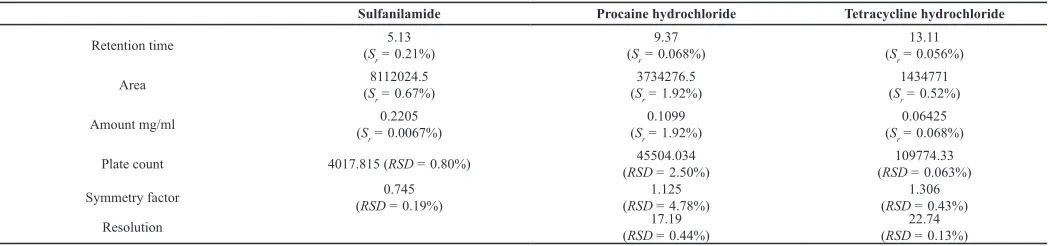
Table 1: The suitability parameters of the ointment assay procedure by HPLC.
Sulfanilamide Procaine hydrochloride Tetracycline hydrochloride
Retention time (S 5.13
r = 0.21%)
9.37 (Sr = 0.068%)
13.11
(Sr = 0.056%)
Area (S8112024.5
r = 0.67%)
3734276.5
(Sr = 1.92%)
1434771
(Sr = 0.52%)
Amount mg/ml (S 0.2205
r = 0.0067%)
0.1099 (Sr = 1.92%)
0.06425
(Sr = 0.068%)
Plate count 4017.815 (RSD = 0.80%) (RSD = 45504.0342.50%) (RSD = 109774.330.063%)
Symmetry factor (RSD = 0.7450.19%) (RSD = 1.1254.78%) (RSD = 1.3060.43%)
Resolution (RSD = 17.190.44%) (RSD = 22.740.13%)
* Each number is the average result of four measurements.
HPLC method with gradient elution and 20 mM
ammonium acetate/methanol as a mobile phase was developed for the simultaneous determination of procainamide and
sulfanilamide in human plasma (MacRitchie, 2011). For the assay of sulfanilamide by HPLC, 0.1% formic acid in water and 0.1% formic acid in acetonitrile (pH 2.7) most often use as a mobile phase with gradient elution (Lake and Kahler, 2012; Long and Henderson, 2012; Hug and Kallury, 2006). For the sulfanilamide residues assay in honey was proposed HPLC method with a gradient mode and a mobile phase 0.02 M H3PO4 (eluent A) and methanol: acetonitrile (1:1) (eluent B) (Szczesna, 2009).
Based on the analysis of conducted research and the properties of the substances, the study was carried out using
gradient elution. The mixture of 0.1% solution of trifluoroacetic
acid and acetonitrile was chosen as a mobile phase.
The mixed standard solution with concentration 3 × 10⁻⁴ g/ml of each component was prepared for simultaneously
calibrating and calculating of substances content in ointment which
will significantly reduce the analysis time. During the research was
found that at a sample temperature of 25°C, the mixture remains stable for only an hour, so it was recommended that the sample temperature for research must be 4°C. Obtained results indicated a good separation of substances and allow recommend this method for the quantitative determination of the ointment components. After preparation of the ointment methanol extract, its analysis
was carried out by the developed method. Results (Figure 1)
indicate a good separation of substances within 15 minutes. To establish the possibility of this technique using for the quantitative analysis of the ointment, the acceptance, and the system
suitability criteria were studied. The parameters characterizing the possibility of components separation plate count, symmetry factor and resolution were calculated using the software. Repeatability of the response was expressed as an estimated percentage relative
standard deviation (Sr, %) for the parameters of retention time,
area, height and amount. It was evaluated by four consecutive series of injections of ointment methanol extract.
Maximum allowable value for four parallel injections is 1.92%. The obtained data indicate the possibility of this technique using for assay of ointment active ingredients (Table 1).
The most promising method of analysis today is UPLC
due to the particle chemistry design, system optimization, detector
design, data processing, and control. This significantly increases substances resolution that defines as a peak shape, method sensitivity, and rate. UPLC allows conducting more difficult separations of complex mixtures, a significant reduction in solvent use and time of the analysis (Swartz, 2005).
Therefore, our further goal was testing the proposed
analysis technique on the UPLC. The resulting chromatogram of the reference solution analysis (Figure 2) indicates a good
separation of substances within four minutes and allows recommend this method for analysis of the studied ointment.
Method validation
To prove the possibility of this method using for the assay of the ointment components, its validation was carried out
Ukraine, Vol. 1, 2015) and EurPh (European Pharmacopoeia,
2013). We used the concentration of 6.25 × 10⁻⁵ g/ml for tetracycline hydrochloride, 1.04 × 10
−4 g/ml for procaine hydrochloride and
2.08 × 10⁻⁴ g/ml for sulfanilamide for the ointment analysis.
Fig. 2: Chromatogram of the reference solution UPLC analysis.
Table 2: Results of the linearity study of the UPLC method.
Component Linear equation r2
Sulfanilamide y = 0.97x + 2.15 0.999957
Procaine hydrochloride y = 0.98x + 0.52 0.999964
Tetracycline hydrochloride y = 0.98x + 0.52 0.999945
The maximum permissible uncertainty of the analysis results was calculated taking into account the allowable deviation in the components quantitative content in the
compounding ointments according to the SPhU requirements (±10%): max ∆As = 10 × 0.32 = 3.2%. During the uncertainty of sample preparation calculating (ΔSP,r), all weighing and dilution
preparation stages of the reference and the test solutions were taken into account.
The total uncertainty of sample preparation is ∆SP,r=
1.63%. It slightly exceeds the recommended framework (the
relation ∆SP ≤ 0.32 × ∆As = 1.024% is not satisfied). Thus,
the requirements for the uncertainty of the final analytical
operation are increased (∆FAO,r). Its calculation was performed
using the combined standard deviation for each substance
(∆FAO,r = 0.64%).
The total uncertainty of the analysis will be: √
.
Its value does not exceed max ∆As. It testifies that the
method will give correct results during the ointment analysis in other laboratories.
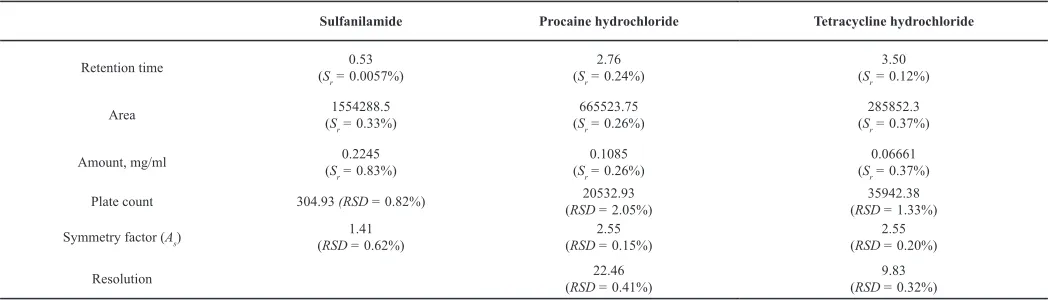
In addition, the system suitability parameters were
determined (Table 2). Repeatability of the method (Sr) was
calculated. Due to the requirements of the SPhU and EurPh for the components content deviation in the finished drug ± 10%,
its maximum allowable value for four parallel injections is
1.92%. Obtained results (Table 2) indicate the conformity of the
reproducibility results since the calculated values of Sr for all
components don’t exceed 1.00%. The peak separation coefficient
is much larger than one, which indicates the reliability of the analysis.
Table 3: The suitability parameters of the ointment assay procedure by UPLC.
Sulfanilamide Procaine hydrochloride Tetracycline hydrochloride
Retention time (S 0.53
r = 0.0057%)
2.76
(Sr = 0.24%)
3.50
(Sr = 0.12%)
Area (S1554288.5
r = 0.33%)
665523.75
(Sr = 0.26%)
285852.3
(Sr = 0.37%)
Amount, mg/ml (S0.2245
r = 0.83%)
0.1085
(Sr = 0.26%)
0.06661
(Sr = 0.37%)
Plate count 304.93 (RSD = 0.82%) (RSD = 20532.932.05%) (RSD = 35942.381.33%)
Symmetry factor (As) (RSD = 1.410.62%) (RSD = 2.550.15%) (RSD = 2.550.20%)
Resolution (RSD = 22.460.41%) (RSD = 9.830.32%)
Method linearity was evaluated by the construction of
calibration curve in the range from 2.344 × 10⁻⁶ g/ml to 3 × 10⁻⁴
g/ml for each component at eight points with triplicate analysis
(Table 3). Results show that the response was linear and correlated
with the amount of compounds mix solution injected as indicated
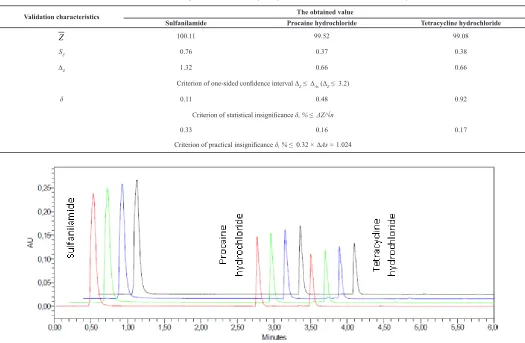
During the analysis, the accuracy and the precision of
the method were determined (Table 4). Quantitation was made
based on the linear calibration curves between the concentrations
and peak area of standard solution. The resulting values do not exceed the allowable criteria.
Table 4: Results of the precision and accuracy study of UPLC method for the ointment assay.
Validation characteristics The obtained value
Sulfanilamide Procaine hydrochloride Tetracycline hydrochloride
Z 100.11 99.52 99.08
SZ 0.76 0.37 0.38
∆Z 1.32 0.66 0.66
Criterion of one-sided confidence interval ∆Z ≤ ∆As (∆Z ≤ 3.2)
δ 0.11 0.48 0.92
Criterion of statistical insignificance δ, % ≤ ΔZ/√n
0.33 0.16 0.17
Criterion of practical insignificance δ, % ≤ 0.32 × ∆As = 1.024
Fig. 3: Two-dimensional chromatogram of the ointment methanol extracts UPLC analysis.
Table 5: Results of method repeatability estimation.
Compound quantity, gNominal amount, gFound percentage, %Recovery recovery, %Average
Sulfanil-amide 1.0000
1.0752 107.52
107.76 1.0757 107.57
1.0829 108.29
1.0766 107.66
RSD, % = 0.33
Procaine
hydrochlo-ride 0.5000
0.5227 104.54
104.14 0.5203 104.06
0.5194 103.88
0.5203 104.06
RSD, % = 0.27
Tetracycline
hydrochlo-ride 0.3000
0.3215 107.17
106.57
0.3190 106.33
0.3191 106.37
0.3192 106.40
RSD, % = 0.38
The reproducibility of the method was evaluated by four consecutive injections of the test ointment methanol extract
(Figure 3). The quantity of each component was evaluated and
compared with the prescribed amount for the repeatability
estimation of the method (Table 5). The obtained RSD values
indicate good reproducibility of the results. It was determined from
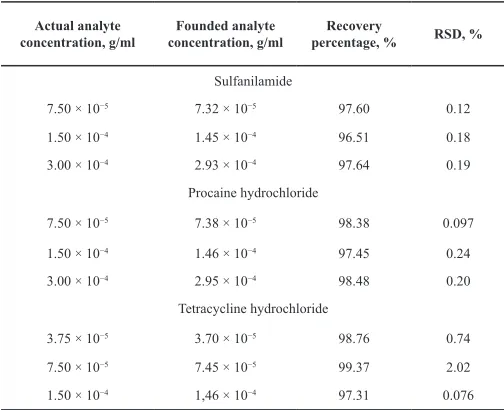
the results of the ointment test solution analysis. For the additional recovery study was evaluated three different concentrations of each substance on the LOQ studies (Table 6, Figure 4). They were
chosen based on the test solution concentration of each substance. The results obtained indicate good recovery of the method.
For each substance limit of detection (LOD) and limit of quantification (LOQ) were calculated. For the sulfanilamide,
LOD was 0.35 mg/ml and LOQ was 1.05 mg/ml; for the procaine hydrochloride LOD was 0.047 mg/ml and LOQ was 0.14 mg/ ml; for the tetracycline hydrochloride LOD was 0.28 mg/ml and LOQ was 0.86 mg/ml. All values demonstrate that the method
characterized by sufficient sensitivity to determine all components
quantitative content.
To test the specificity of the assay procedure, the ointment
base was prepared without adding sulfanilamide, procaine
hydrochloride and tetracycline hydrochloride (placebo solution).
paraffin substances in a ratio of 4 : 6, with ceresin adding (20%
of the total weight of the mixture of petrolatum and lanolin). On
the obtained chromatogram (Figure 5) clearly seen the absence of
peaks in the places of sulfanilamide, procaine hydrochloride, and
tetracycline hydrochloride detection. It testifies high specificity of the UPLC method for ointment analysis and the possibility of its
use for chemical stability analysis of the ointment.
Fig. 4: Chromatogram of the standard solutions analysis by UPLC for the recovery study.
Fig. 5: Chromatogram of the placebo solution analysis by UPLC.
Table 6: The recovery study of the method.
Actual analyte
concentration, g/ml concentration, g/mlFounded analyte percentage, %Recovery RSD, %
Sulfanilamide
7.50 × 10⁻⁵ 7.32 × 10⁻⁵ 97.60 0.12
1.50 × 10⁻⁴ 1.45 × 10⁻⁴ 96.51 0.18
3.00 × 10⁻⁴ 2.93 × 10⁻⁴ 97.64 0.19
Procaine hydrochloride
7.50 × 10⁻⁵ 7.38 × 10⁻⁵ 98.38 0.097
1.50 × 10⁻⁴ 1.46 × 10⁻⁴ 97.45 0.24
3.00 × 10⁻⁴ 2.95 × 10⁻⁴ 98.48 0.20
Tetracycline hydrochloride
3.75 × 10⁻⁵ 3.70 × 10⁻⁵ 98.76 0.74
7.50 × 10⁻⁵ 7.45 × 10⁻⁵ 99.37 2.02
1.50 × 10⁻⁴ 1,46 × 10⁻⁴ 97.31 0.076
CONCLUSIONS
1. HPLC method for the simultaneous determination
of sulfanilamide, procaine hydrochloride and tetracycline hydrochloride in compounding ointment was developed.
2. The developed method was tested on UPLC. The
method was validated to prove the possibility of its using in the ointment analysis. The study of the system suitability parameters showed the possibility of this method using in the ointment analysis. The results of the validation parameters studying indicate
the good parameters of method linearity, its high specificity,
reproducibility, and accuracy.
3. The obtained results allow recommending the developed method for the ointment chemical stability analysis.
REFERENCES
Abdulghani AJ, Jasim HH, Hassan AS. Determination of tetracycline in pharmaceutical preparation by molecular and atomic absorption spectrophotometry and high performance liquid chromatography via complex formation with Au (III) and Hg (II) ions in solutions. Int J Anal Chem. 2013; ID 305124:11 p.
Buurma H, De Smet AGM Peter, Van den Hoff OP, Sysling H, Storimans M, Egberts CG. Frequency, nature and determinants of pharmacy compounded medicines in Dutch community pharmacies. Pharm World Sci. 2003; 25(6):280-287.
Dimitrov M, Petkova V, Husain Sh, Lambov N, Kourtidou L. Extemporaneous dispensing – comparative analysis between Greece and Bulgaria. WJPPS. 2015; 4(03):01-09.
European Pharmacopoeia. 2013. Strasbourg: European Directorate for the Quality of Medicines & HealthCare of the Council of Europe, 8-th ed., Vol. 1, 1456 p.
Giugiu V. Simultaneous determination of related substances of oxytetracycline in pharmaceutical semi solid form by Hight Performance Liquid Chromatography. Vet Drug. 2013; 7(1):67-73.
Hug S, Kallury K. 2006. Extraction and analysis of sulfonamides from honey by LC/MS/MS using strataTMX-C polymeric SPE sorbent and geminiTM C18 HPLC column Phenomenex Inc. CA, USA, 2 p.
Hussien EM. Development and validation of an HPLC method for tetracycline-related USP monographs. Biomed Chromatogr. 2014; 28(9):1278-1283.
Korytnyuk RS, Vlasenko II, Rudenko VV. Ways of improvement of drug manufacturing in conditions of drugstores. Pharm review. 2007; 1:44-48.
Kristina SA, Wiedyaningsih C, Widyakusuma NN, Aditama H. Extemporaneous compounding practice by pharmacists: a systematic review. Int J Pharm Pharm Sci. 2017; 9(2):42-46.
Lake R, Kahler T. 2012. Increase data quality for sulfonamide residue analysis by HPLC and UPLC using unique biphenyl column selectivity. Food safety applications, USA: RESTEK, 3 p.
Long WJ, Henderson JW. 2012. Analysis of sulfa drugs on Eclipse Plus C 18. Application brief, USA: Agilent technologies, 2 p.
MacRitchie E. 2011. HPLC-UV Method for the determination of procainamide from human plasma using SOLA CX. UK: Thermo Fisher Scientific, 2 p.
Masupye EM, Suleman F, Govender T. Investigation extemporaneous compounding practices in the Polokwane tertiary hospital pharmacies in South Africa – a pilot study. Afr J Pharm Pharmacol. 2015; 9(48):1099-1105.
Patyra E, Kowalczyk E, Grelik A, Przenioslo-Siwczynska M, Kwiatek K. Screening method for the determination of tetracyclines and
fluoroquinolones in animal drinking water by liquid chromatography with diode array detector. Pol J Vet Sci. 2015; 18(2):283-289.
Pelia S. 2012. Pharmaceutical Applications Notebook. Antibiotics. New HPLC & UHPLC assay methods for tetracycline hydrochloride and 4-epianhydrotetracycline hydrochloride impurity in tetracycline drug products. Thermo scientific: Application note 288, p. 119-125.
Roy DC, Gogoi R. HPLC and spectrophotometric analysis of tetracycline residues in marketed pork of Assam. TNJVAS. 2014; 43(2):98-103.
Sanchez-Regana M, Llambi-Mateos F, Salleras-Redonnet M, Iglesias Sancho M, Collgros Totosaus H, Umbert-Millet P. Compounding as a current therapeutic option in dermatology. Actas Dermosifiliogr. 2013; 104(9):738–756.
Shama SA, El Sharkawy S, Mahmoud AH, Hassan HM, Nassar SH. Validation of modified HPLC method for determination of oxytetracycline, tetracycline and doxycycline in chicken meat and liver. N Y Sci J. 2016; 9(5):68-74.
Singh SP, Pundhir A, Ghosh S. Validation of an analytical methodology for determination of tetracyclines residues in honey by UPLC-MS/MS detection. IJNPR. 2015; 6(4):293-298.
State Pharmacopoeia of Ukraine: at 3 volumes. 2014. Kharkiv: State enterprise “Ukrainian scientific pharmacopoeial center of medicines quality”, 2-nd ed., Vol. 2, 724 p.
State Pharmacopoeia of Ukraine: at 3 volumes. 2014. Kharkiv: State enterprise “Ukrainian scientific pharmacopoeial center of medicines quality”, 2-nd ed., Vol. 3, 732 p.
State Pharmacopoeia of Ukraine: at 3 volumes. 2015. Kharkiv: State enterprise “Ukrainian scientific pharmacopoeial center of medicines quality”, 2-nd ed., Vol. 1, 1128 p.
Swartz ME. UPLCTM: An Introduction and Review. J Liq Chrom Rel Technol. 2005; 28:1253-1263.
Szczesna T, Rybak-Chmielewska H, Was E, Pohorecka K. Study on sulfonamide residues in honey. JAS. 2009; 53(2):39-47.
Taokaenchan N, Sangsrichan S. HPLC-fluorescence detection method for quantitative determination of tetracycline antibiotic residues in honey. NU Int J Sci. 2010; 6(2):147-155.
How to cite this article:
Savchenko LP, Ivanauskas L, Georgiyants VA. Development