GJMB
Role of Saving and Credit Cooperatives in Improving Socio
Economic Development in Rural Areas. Case Study Imboni
Sacco Kageyo Sector
MBABAZI Jonathan
1*, UWINGENZI Marthe
21,2Department of Management and Development, Faculty of Social Sciences Management and Development Studies,
University of Technology and Arts of Byumba (UTAB), P.O. Box 25 Byumba – Gicumbi – Rwanda.
This research highlights the role of UMURENGE SACCO Kageyo in improving the socio economic development in rural areas. The objective of the study was to find out the impact of this cooperative named “UMURENGE SACCO” in the socio economic development of shareholders in Kageyo Sector. This research was conducted through a research design to present oriented methodology used to investigate population by selecting sample to analyze and discover occurrences. It used primary and secondary data, with documentary, interview and questionnaires, to provide numeric description of some part of population, and describe events. This research enabled the researchers to consider issues such as economy, rapid data collection and ability to understand a population from a part. The research findings approved that all respondents agreed the positive impact of UMURENGE SACCO in the socio economic development in rural area and the most impact such as to increase financial performance in rural areas. 43.3% of respondents said that the relationship between IMBONI SACCO and Social Development in Rural Area is to plays an important role as financial services providers. Therefore, they inaugurated that the Capability of IMBONI SACCO to attract savings as source of social development in Rural Areas is that IMBONI SACCO is financial institution situated around rural areas. The researchers recommended that IMBONI SACCO’s Management should prepare the periodically relevant meetings, training programs for improving the knowledge and analytical skills about social development of their employees and clients and also IMBONI SACCO should recruit employees which they have profession competence for allowing customers to understand the features of product or service and explain the importance of social development in rural areas.
Key words: Role, Socio economic development, IMBONI SACCO, Kageyo Sector
INTRODUCTION
Today’s, the government of Rwanda has put in place more strategies to fight poverty that are striking a considerably bigger part of Rwandan population. Among these strategies there is sensitizing people and mobilizing them to save and using these savings to start up their own self-help projects that would finally self-help them come out of this poverty. Different savings and credit cooperatives including UMURENGE SACCOs have been set up to provide the population with cheap and easy means to access themselves to micro credit facilities that may help them to become small village based entrepreneurs. All this is done through the development of entrepreneurial spirit
many will come out of the miserable life they are living which is characterized by poverty. They may help themselves if they have access to the means to start up home based projects with the help of saving and credit cooperatives (MINECOFIN, 2007).
*Corresponding Author: MBABAZI Jonathan, Department of Management and Development, Faculty of Social Sciences Management and Development Studies, University of Technology and Arts of Byumba (UTAB), P.O. Box 25, Byumba, Gicumbi – Rwanda. E-mail: [email protected]; Tel.: +250788620288
Global Journal of Management and Business
Vol. 5(2), pp. 080-086, September, 2018. © www.premierpublishers.org, ISSN: 8018-0934
Research Article
UMURENGE SACCOs need to be strongly supported in political terms by secondary structures such as the Ministry of Commerce and the Ministry of Local Government. In addition, government need to facilitate alliance formation between SACCOs and MFIs so SACCOs are able to delegate functions to their respective secondary structures in order to benefit from economies of scale and scope and also provide their clients with the opportunity to upgrade in order to access larger loans. UMURENGE SACCOs are characterized by different aspects including savings, ease, reach, stability and low overhead which are detailed below (MINECOFIN, 2007). In a competitive business environment SACCOs must follow sound business practices to survive and progress while following cooperative principles. On the other hand, entrepreneurship is a process of creating ideas and quickly seizing opportunities in the business world. The challenge is however, to see and anticipate ideas and opportunities before others see them and act. (Robert, 2007)
In recent years there has been a rapid increase in the number of UMRURENGE SACCOs in Rwanda. This is in line with the national policy of promoting the spirit of saving and attracting the population to get loans to finance their personal income generating activities. It is long since the formal banking system was introduced in Rwanda. Despite this, poverty and unemployment have remained as alarming threats to the development of the large population of the Rwandans. The composition of the development started up in the economy is majority personal small and in in most cases micro. Great concern should therefore be put in this field to promote the personal initiatives to start up their own projects as this is the main employer and income earner to the majority of the people (True, 1987). The creation of cooperatives is being promoted in urban and rural areas in order to improve the socio-economic development of communities (MINICOM, 2006). This development is sustainable if members of these cooperatives get access to financial services in general; however, there is still a knowledge gap and missing data on the contribution of these financial institutions to the improvement of communities’ livelihood and economy.
It is against this agreement that the researcher will be studying the UMRURENGE SACCOs as an alternative or one of the solutions to meet the requirements of the vulnerable layer of the Rwandan society that cannot easily get access to the credit allocation of the formal financial systems in the economy. In Kageyo sector, for a period of about six months, the researcher observedhouseholds who met quickly qualitative changes; they interact with their neighbors’ and society in general, there is a motive that drives the social change and essential living conditions on socio economic development of people through Imboni SACCO Kageyo. It is on this scenario the research study was set out to analyze the role of UMURENGE SACCO in improving the social development in rural area in Rwanda especially in IMBONI SACCO/Kageyo.
METHODOLOGY
Description of the Area of the Study
As it have been said above when the of creation of SACCO in each UMURENGE all over the country; at that time in KAGEYO Sector they elected three committees to conduct those activities those committees were: Administrative committee, Auditing committee and the Credit committee. And they were only one employee to carry out all activities of SACCO; how the task was very difficult and tiredness! But even though those committees were elected and one employee established, SACCO were not yet started because: apart from having nothing like deposits, savings, office and office materials (pens, papers, stamp, stapler, calculators, …) at that time the RCA’s requirements for conducting an institution as Microfinance were: minimum of at least 1,500 members and 10,000,000 Rwf (Ten million Rwandan francs) of savings. Those conditions were not yet fulfilled by SACCO Kageyo and at that time the name “SACCO Kageyo” was like an idea. The one employee was who had now the hard work of searching for the fulfillment of those requirements through heightening public awareness of that idea (MINECOFIN, 2007).
Finally, on January 7, 2011 SACCO Kageyo opens its doors at the name of SACCO Kageyo with one employee as manager. Its office was in Kageyo at ex-Umurenge office. In the same period Imboni SACCO got a temporal authorization of exercising microfinance activities in Rwanda and granting a credit of 20% on its savings. July 2011 the first round of credit was granted for 11 persons. July14, 2011 IMBONI retired from Umurenge office to Kageyo centre a well-known area in order to facilitate its customers. Till now it works in that centre in a rental house. Finally, on April 17, 2012 IMBONI got a final authorization of exercising its microfinance activities and granting a credit of 40% of its savings.
Location
SACCO IMBONI is working on this address:
IMBONI SACCO Northern Province, Gicumbi District, Kageyo Sector
Population and Sample Size
The entire population of the study was made up 1214 shareholders of IMBONI SACCO KAGEYO. As the entire population of the study was almost always large to work with, a sample was a best way to enable the success of this research under such hindrances. Various methods and instruments enable the researchers to collect significant data of the study. Two main methods namely interview and documents studies were used to gather necessary data for the research and data were collected on basis of the purposive sampling technique.
pick respondents who meet the purpose of the study. The purposive sampling as method of sampling whereby the researcher uses his/her own judgment about those who met best the purpose of the study. Sample size was calculated by using the Yamane formula (1973) as stated below:
Sampling technique
Sampling is the selection of a small number of respondents to represent the survey population (Kenneth D. B., 1978). As the entire population of the study was almost always large to work with mainly due to factors such as time limit and financial constraints, a sample was a best way to enable the success of a research study under such hindrances. As mentioned above, data were collected on basis of the purposive sampling technique.
Concerning the sample selection, the researcher used purposive sampling technique and this enables her to pick respondents who meet the purpose of the study. Kenneth D. B. (1978) explains purposive sampling as method of sampling whereby the researcher uses his/her own judgment about those who met best the purpose of the study.
Sample size
Basing on purposive sampling technique, 49 respondents were selected as they made the management staff and stakeholders of IMBONI SACCO. Data will be collected with the interview from the total respondents.
Formula of sample size: n= 𝑵
𝟏+𝑵𝒆𝟐=
𝟏𝟐𝟏𝟒
𝟏+𝟏𝟐𝟏𝟒(𝟎.𝟎𝟓)𝟐= 48.56≈49 respondents n=Sample size
N= Number of population e=Deviation of sampling (0.05)
Research Instruments
Various methods and instruments enable the researcher to collect significant data of the study. Two main methods namely interview and documents studies were used to gather necessary data for the research.
Primary Data
Interview schedules
An interview schedule is a data collection method, which involves a conversation between the researcher and interviewee. Interviews are of two types namely structured interview, which is similar to a questionnaire where respondents must be asked some questions; and an unstructured interview, which may provide only a framework of key points on the topic.
According to Andrey J.R. (1989), the most useful kind of interview for the research may be an expert in the one the researcher sets up himself-in person or over the telephone-but a face-to face interview excludes the use of telephone. The person to be interviewed may be expert in the field, or you may simply need some kind of personal response from individuals, you can get that by setting up one or more interviews.
Questionnaires
Questionnaire is a list of questions, usually printed, submitted for replies that can be analyzed for usable information. These were made up of both open and closed ended questions (Sawer B J., (1984).
The questionnaires were used to collect data from the field by management staff of IMBONI SACCO. The purpose of using this instrument was to give them time to answer the questions given the busy schedule of their official duties.
Observation
This method also was used to validate and compare information collected from both interview schedules and questionnaires. This involved accurate watching of the reaction of the respondents and critical observation of the extent of the problem.
Secondary Data
Documentation
According to Paige W. (1989), documentation includes all references to sources within the text of your paper and to the full biographical entries at the end of the paper. It offers the reader away to retrace the steps as researcher and writer of a researcher took.
Bernard P. (1996) argues that documents refer to any written materials that may be used as a source of information about the subject. The document study involves reading and understanding the information contained in the documents. Various documents were used in this research among which texts books, financial statements and financial reports. However, the major emphasis was given on financial statements of IMBONI SACCO which is linked to researcher’s study.
DATA ANALYSIS
RESULTS AND DISCUSSIONS
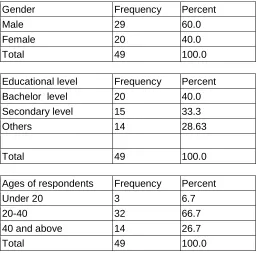
Findings on the role of UMURENGE SACCO in improving socio economic development in rural area as case study of IMBONI SACCO/Kageyo (2012-2016). Accordance with the objectives of this study, the data was collected through the response of employees and clients. It gives the details on the findings by using tables, frequencies and percentages.
Table 1: Socio economic characteristic of respondents
Gender Frequency Percent
Male 29 60.0
Female 20 40.0
Total 49 100.0
Educational level Frequency Percent
Bachelor level 20 40.0
Secondary level 15 33.3
Others 14 28.63
Total 49 100.0
Ages of respondents Frequency Percent
Under 20 3 6.7
20-40 32 66.7
40 and above 14 26.7
Total 49 100.0
Table 1 shows the gender, educational level and the age of respondents
The gender of respondents
The number of respondents included 60% of respondents were male and 40% of respondents were Female. The high percentage of participation in this study was male with 60%.
Educational level
The most of employees, accountants and clients of IMBONI SACCO/Kageyo have attained university degree education and this constitutes 40% of total respondents. 33% attained secondary level while remaining 13% of respondents attend masters’ degree and others level of education.
Age of respondents
From the results: 6.7% of respondents is under of 20 age, 66.7% of respondents had the range of age between 20-40 and 26.7% of respondents were 20-40 and above. This indicates that the majority of respondents were between 20-40 ranges of age.
Table 2: Main function
Function of respondents Frequency Percent
Employee 3 10.0
Accountant 1 10.0
Manager 1 3.3
Clients 44 76.7
Total 49 100.0
Table 3: Positive impact of socio economic development in rural area
Views of respondents Frequency Percent
Yes 49 100.0
No 0 0
Total 49 100
Table 4: the performance of IMBONI SACCO on socio economic development
Frequency Percent
Good (0-50%) 8 16.7
Very good(50-70) 28 56.7
Excellent (70-100) 13 26.7
Total 49
Frequency 100.0 Percent
Social performance 6 13.3
Financial performance 20 40.0
Institutional performance 16 33.3
Others 7 13.3
Total 49 100.0
Frequency Percent
21 43.3
13 26.7
11 23.3
4 6.7
49 100.0
Capability of IMBONI SACCO to attract savings as source of social
development in Rural Areas Frequency Percent Rural areas are often lack financial
services providers 15 30
Financial institution situated around whole rural population
Umurenge Sacco is boosting village businesses
All above
16
6 12
33.4
13.3 23.3
possible the strategies to increase the contribution of IMBONI SACCO in improving the social development in rural area
Frequency Percent
Increase sensitization around all
rural areas 5 10.0
Increasing investment capital of
IMBONI SACCO 24 50.0
Improving professional and skilled
labor in this institutions 7 13.4
Introduce computerized system 3 6.6
All above is correct 10 20.0
Total 49 100.0
The main position of respondents
Table 2 shows that, the majority of respondents (76.7%) points that were clients, 10% of respondents were employees of IMBONI SACCO/Kageyo, 10.0% of respondents were accountant and 3.3% of respondents were the manager of this financial institution.
Table 4 shows that there is a positive impact of IMBONI SACCO on social development in rural area. All respondents (100%) agreed that IMBONI SACCO has positively social impact in rural areas.
The 56.7% of the total number of respondents said that the positive impact of IMBONI SACCO on social development in rural area is very good, and 26.7% of respondents said that the positive impact of IMBONI SACCO on social development in rural area is excellent While 16.7% of respondents showed that the positive impact of IMBONI SACCO on social development in rural area is good. This implies that the respondents expressed their opinion based on how they get information from IMBONI SACCO.
The most of performance of IMBONI SACCO in social development is financial performance with 40%, Institutional performance came on the second place with 33.3% and the last one is social performance and others with 13%. This means that the financial performance is very important in IMBONI SACCO because refers to the degree to which financial Objective is being or has been accomplished. Also it measures the Results of a firm's policies and operations in monetary terms. It is used to Measure overall financial health over a given period of time and can also be used to compare similar institution across the same industry or to compare industries or sectors in aggregation. IMBONI SACCO also provide training and skills development to enable the clients to plan, manage and evaluate the investment, keep the record of all activities of the investment and also to utilize the loan more effectively. The clients are also trained on how to analyze the income generating activities and investment opportunities. The training takes place before the clients receive the loan, after they have got the loan and at the
end of the loan period. These training encounters assist the clients to share their experiences and challenges with the service providers whose strategies how to improve and adjust their programs and policies to suit their customers/clients accordingly.
Table 4 shows the relationship between IMBONI SACCO and Social Development in Rural Area
Result indicates that the majority of respondents (43.3%) agreed that the Relationship between IMBONI SACCO and Social Development in Rural Area is plays an important role as financial services providers and it is the most favorable for this institution. 26.7% of respondents showed that Giving rural population chances of accessing financial services, 23.3% of respondents approved that Umurenge Sacco increases credit and savings to rural businesses for objective of increase of relationship between IMBONI SACCO and Social Development in rural areas, and 6.7% of respondents agreed that all subjects are related to this relationship.
The Capability of IMBONI SACCO to attract savings as source of social development in Rural Areas.
The results showed that the respondents which are equal 33.4%, they agreed that the micro finance institution situated around whole rural population and 30% of respondents agreed that rural areas are often lack financial services providers. This implies that majority of respondents know that the Capability of IMBONI SACCO to attract savings as source of social development in Rural Areas is financial institution located around homeland of population.
The possible strategies to increase the contribution of IMBONI SACCO in improving the social development in rural area
The results shows that 50% of the total number of respondents selected that the most strategy to increase the contribution of IMBONI SACCO in improving the social development in rural area is to increase investment capital of IMBONI SACCO, the second confirmed that all above strategies (Increase sensitization around all rural areas, Increasing investment capital of IMBONI SACCO, Improving professional and skilled labor in this institutions and Introduce computerized system) can implement to increase the contribution of IMBONI SACCO in improving the social development in rural area.
CONCLUSION AND RECOMMENDATION
be the same in other micro finance institutions. The research examined a number of objectives which included: To assess the impact of UMURENGE SACCO in the social development in rural area at IMBONI SACCO/Kageyo, to suggest possible the strategies to increase the contribution of Umurenge SACCO in improving the social development in rural area.
The research was concluded in the following results: The majority of respondents (43.3%) agreed that there is Relationship between IMBONI SACCO and Social Development in Rural Area because IMBONI SACCO plays great important role as financial services providers and it is the most favorable for this institution. At the end, suggested the possible the strategies that IMBONI SACCO’s can use in improving the social development in rural area. The total number of respondents selected that the most strategy to increase the contribution of IMBONI SACCO in improving the social development in rural area is to increase investment capital of IMBONI SACCO.
Different authors discussed that Sectors’ SACCOs have played an important role as financial services providers in rural area in Rwanda, giving the low income population the chance of accessing financial services (Wolff, et.al: 2011). The research found that there is positively impact of IMBONI SACCO on social development in rural area. This confirmed by all respondents (100%) of this research. The results indicated the correspondent’s rate of positively impact of IMBONI SACCO on social development in rural area. This argued by 56.7% of the total number of respondents. Financial performance confirmed with 40% as respondents the most favorable for IMBONI SACCO’s institution
Recommendations to IMBONI SACCO KAGEYO
The respondents recommended that IMBONI SACCO KAGEYO could reduce the interest rates, increase on the amount given as loans and assess repayment capabilities before loan provision.
IMBONI SACCO KAGEYO is urged to establish loan products like the school fees and asset loans and they should not ask for group security where groups are just formed for loan purposes.
Further requests are made to IMBONI SACCO KAGEYO to continuously supervise, monitor and follow up clients adequately and closely to avoid diversion of funds, to network and collaborate with other MFIs in the area, to improve on customer care and not to rely on groups only but also consider individuals on merit as well.
REFERENCES
BOOKS
Cleveland, Harlan and Jacobs, Garry (1999:7), The Genetic Code for Social Development". In: Human Choice, World Academy of Art & Science, USA. Cleveland, Harlan and Jacobs, Garry (1999:964). "Human
Choice: The Genetic Code for Social Development". In: Futures Research Quarterly, Vol. 31.
Cox, D. and Pawar, M.(2006): International social work: Issues, strategies, and programs. Thousand Oaks, CA: Sage.
Davis, Gloria. (2004). A History of the Social Development Network in the World Bank. Washington D.C.: The World Bank, Social Development, Paper No.56, DFID, 2010. Macroeconomic Variables Public Dataset. International Commission on Peace and Food, Uncommon
Opportunities: An Agenda for Peace and Equitable Development, Zed Books, UK, 1994, p. 162
International Commission on Peace and Food, Uncommon Opportunities: An Agenda for Peace and Equitable Development, Zed Books, UK, 1994, p. 158.
International Commission on Peace and Food, Uncommon Opportunities: An Agenda for Peace and Equitable Development, Zed Books, UK, 1994, pp 27, 174 Jacobs, Garry and Asokan N., "Towards a Comprehensive
Theory of Social Development". In: Human Choice,
World Academy of Art & Science, USA, 1999, p. 152.
Jacobs, Garry et al.. Kamadhenu: The Prosperity Movement, Southern Publications, India, 1988.
Jerry Voorhis, (1975). Cooperatives enterprise, interstate Publishers House
Kantengwa, 2009. PBF in Rwanda: what happened after the BTC-experience?
Kish, L. 1965. Introduction to survey sampling and analysis procedures.
Kothari, C.R., 1985. Research Methodology- Methods and Techniques, New Delhi, Wiley Eastern Limited.
Macfarlane, Robert and Van Harten, Robert. "Engines of Development". In: Human Choice, World Academy of
Art & Science, USA, 1999, p. 47
Maslennikoou,. V.,(1983). The Cooperative Movement in Asia and Africa. Moscow. Progress Publishers.
Midgley, J. (1995): Social development: The developmental perspective in social welfare. Thousand Oaks, CA: Sage.
Poduri S. R. S. Rao. 2000. Sampling Methodologies with Applications. Chapman and Hall/CRC Press, London and New York.
Loy Ewell Paul, (1979), Cooperative Development Principles Management 3th Edition. Danville Illinois
Interstate Printers and Publishers.
Reutlinger, C. and Zychlinski, J. (2006): Social space projects in Eastern German flood areas, in: Heimgartner, A. (ed.): Face of research in European social development: Aims, results, impact. Vienna: LIT-Verlag: pp. 95-106.
Robert Killy, (1971). Entrepreneurship and development, the Free Press. New York
Robert W. Price, (2007). Entrepreneurship and Business, the Free Press. New York
Rwanda Cooperative Agency report (2005)
Sen, A. and Jean Drèze.(1989). Hunger and Public Action. Oxford: Clarendon Press.
Sen, A.(1999). Development as Freedom, Oxford, Oxford University Press
Thomas C. Ricketts, Karen D. Johnson-Webb, Patricia Taylor (1998). Chapel Hill: North Carolina Rural Health Research Program, Cecil G. Sheps Center for Health Services Research, University of North Carolina. True, (1987), Macroeconomics, Mosby College
Publishing, The University of Tex is at San Antonio. Victor Fic (1970), "Kerala: Yenan of India The Rise of
Communist Power 1937 -1969" (Nachiketa Publishing Bombay)
Wolff, et.al (2011) “Assessing the sustainability of Savings and Credit Cooperatives”, German Development Institute, Bonn.
Yamane, T. (1967). Statistics: An Introductory Analysis, 2nd Ed.
MINICOFIN, 2007. The development indicator edition 5. Kigali, Rwanda
MINICOM, 2006. New National Strategy to enhance Cross border Trade. Kigali, Rwanda
Emirbayer, M. and Mische, A. 1998: What is agency? in: American Journal of Sociology, 4, pp. 962–1023. JOURNAL and REPORTS REFERENCES
ACOSCA 2014, operations of credit and savings co-operatives
ADB, African Development Bank (2008). Rwanda Country Strategy Paper, 2008-2011.
Asokan. N. History of USA, The Mother's Service Society, 2006.
Household Living Conditions Survey (2012)
International Commission on Peace and Food, Uncommon Opportunities: An Agenda for Peace and Equitable Development, Zed Books, UK, 1994, p. 163.
International Commission on Peace and Food, Uncommon Opportunities: An Agenda for Peace and Equitable Development, Zed Books , UK, 1994, p. 168.
Accepted 10 September 2018
Citation: Mbabazi J, Uwingenzi M (2018). Role of Saving and Credit Cooperatives in Improving Socio Economic Development in Rural Areas. Case Study Imboni Sacco Kageyo Sector. Global Journal of Management and Business, 5(2): 080-086.