1
PROSPECTS AND PROBLEMS OF MSMES IN
INDIA- A STUDY
Dr. A. S. Shiralashetti
1Introduction
Micro, Small and Medium Enterprises (MSMEs) play a vital role for the growth of Indian economy by contributing 45% of industrial output, 40% of exports, employing 60 million people, create 1.3 million jobs every year and produce more than 8000 quality products for the Indian and international markets. MSME’s Contribution towards GDP in 2011 was 17% which is expected to increase to 22% by 2012. There are approximately 30 million MSME Units in India and 12 million persons are expected to join the workforce in the next 3 years. MSMEs are the
1
Faculty, P. G. Dept of Commerce, Karnatak University, Dharwad-3 SHIV SHAKTI
International Journal of in Multidisciplinary and Academic Research (SSIJMAR) Vol. 1, No. 2, July-August (ISSN 2278 – 5973)
Abstract
Worldwide, the micro, Small and Medium enterprises (MSMEs) play a leading role in
propelling economic growth sustaining livelihood and in promoting equitable regional
development. The MSMEs constitute over 90% of total enterprises in most of the developing
economies and credited with generating the highest rate of employment growth and
accounting for a major share of industrial production and exports. In India too, the MSMEs
play a pivotal role in the overall industrial economy of the country. It is estimated that in
terms of value, the sector accounts for about 39% of the Manufacturing output and around
33% of the total export of the country. Further, in recent years the MSME sector has
2
fountain head of several innovations in manufacturing and service sectors, the major link in the supply chain to corporate and the PSUs. By promoting MSMEs, the rural areas of India will be developed.
MSMEs are now exposed to greater opportunities than ever for expansion and diversification across the sectors. Indian market is growing rapidly and Indian entrepreneurs are making remarkable progress in various Industries like Manufacturing, Precision Engineering Design, Food Processing, Pharmaceutical, Textile & Garments, Retail, IT and ITES, Agro and Service sector.
Definitions of MSMEs
The MSMEs of manufacturing enterprises have been classified into micro, small and medium enterprises based on the amount of investment in plant and machinery as follows;
Manufacturing Enterprises – Investment in Plant & Machinery
Description INR USD($)
Micro Enterprises Up to Rs. 25Lakhs Up to $ 62,500
Small Enterprises above Rs. 25 Lakhs & up to Rs. 5 Crores
above $ 62,500 & up to $ 1.25 million
Medium Enterprises above Rs. 5 Crores & up to Rs. 10 Crores
above $ 1.25 million & up to $ 2.5 million
The MSMEs of service enterprises have been classified into micro, small and medium enterprises based on the amount of investment in equipments as follows
Service Enterprises – Investment in Equipments
Description INR USD($)
Micro Enterprises Up to Rs. 10Lakhs Up to $ 25,000
Small Enterprises above Rs. 10 Lakhs & up to Rs. 2 Crores
above $ 25,000 & up to $ 0.5 million
Medium Enterprises above Rs. 2 Crores & up to Rs. 5 Crores
3
ObjectivesThe main objectives of the present study are:
To examine the growth and performance MSMEs,
To reveal the contribution of MSMEs to the growth of the GDP and To analyse the problems of MSMEs.
Methodology
The present study has based on both primary and secondary data. The secondary data are collected from the website of the Ministry of Small and Medium Enterprises, the government of India. The primary data are collected through the personal discussion with entrepreneurs of these industries located in Dharwad district.
Analysis of prospects and problems of MSMEs
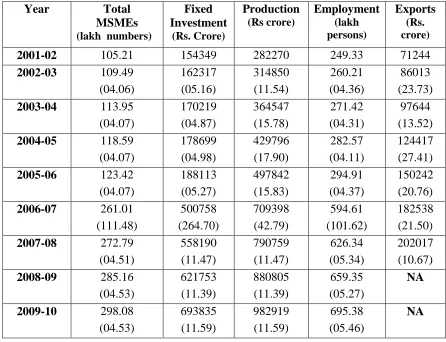
It is clear from table 1 that the total numbers of MSMEs have increased from 105.21 lakhs in 2001-02 to 298.08 lakhs in 2009-10. The MSMEs have grown around three times in a span of ten years. However, they grow consistently till 2005-06 but in 2006-07 growth rate was unimaginable (i.e. 111.18 per cent) and thereafter the growth rate has been around 4.5 per cent till 2009-10 as compared to their respective previous years.. The fixed investments in these
industries have gone up from Rs.154349 crores in 2001-02 to Rs.693835 crores in 2009-10. The fixed investments in these industries have increased by more than four times in 10 years. Like
4
contributed lot in earning foreign exchange to India. The exports from these industries have increased from Rs.71244 crores in 2001-02 to Rs.2022017 crores in 2007-08. This also signifies that there has an around three time increase in exports in a span of seven years.
Table 1; Growth and Performance of MSMEs in India
Year Total
MSMEs
(lakh numbers)
Fixed Investment (Rs. Crore) Production (Rs crore) Employment (lakh persons) Exports (Rs. crore)
2001-02 105.21 154349 282270 249.33 71244
2002-03 109.49
(04.06) 162317 (05.16) 314850 (11.54) 260.21 (04.36) 86013 (23.73)
2003-04 113.95
(04.07) 170219 (04.87) 364547 (15.78) 271.42 (04.31) 97644 (13.52)
2004-05 118.59
(04.07) 178699 (04.98) 429796 (17.90) 282.57 (04.11) 124417 (27.41)
2005-06 123.42
(04.07) 188113 (05.27) 497842 (15.83) 294.91 (04.37) 150242 (20.76)
2006-07 261.01
(111.48) 500758 (264.70) 709398 (42.79) 594.61 (101.62) 182538 (21.50)
2007-08 272.79
(04.51) 558190 (11.47) 790759 (11.47) 626.34 (05.34) 202017 (10.67)
2008-09 285.16
(04.53) 621753 (11.39) 880805 (11.39) 659.35 (05.27) NA
2009-10 298.08
(04.53) 693835 (11.59) 982919 (11.59) 695.38 (05.46) NA
Source; Annual Reports of Ministry of Small and Medium Enterprises
5
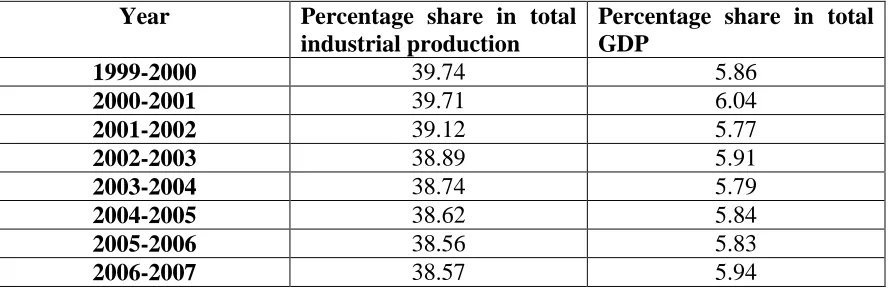
Table 2; Contribution of MSE (%) at 1999-2000 prices in total industrial Production and GDP
Year Percentage share in total industrial production
Percentage share in total GDP
1999-2000 39.74 5.86
2000-2001 39.71 6.04
2001-2002 39.12 5.77
2002-2003 38.89 5.91
2003-2004 38.74 5.79
2004-2005 38.62 5.84
2005-2006 38.56 5.83
2006-2007 38.57 5.94
Source: Annual Report, 2008-09. Ministry of Micro, Small and Medium Enterprises,
It can be witnessed from table 2 that the contribution of the MSME sector to overall industrial production has declined marginally from 39.74 per cent in 1999-2000 to 38.57 per cent in 2006-07. The contribution of the MSME sector to the Gross Domestic Product (GDP) has increased from 5.86 per cent in 1999-2000 to 5.94 per cent in 2006-07. This signifies that the need of MSMEs in the growth and development of Indian economy.
Table 3;Comparative Growth Rates
Year Growth rate of MSMEs
(%)
Overall Industrial sector
(%)
2002-2003 8.68 5.70
2003-2004 9.64 6.90
2004-2005 10.88 8.40
2005-2006 12.32 8.10
2006-2007 12.60 11.5
2007-2008* 13.00* 8.0
*Projected
6
The MSME sector has maintained a higher rate of growth vis-à-vis the overall industrial sector. It is clear from the data of table 3 that the growth rate of MSMEs has increased from 8.68 per cent in 2002-03 to 13.00 per cent in 2007-08 where as the growth rate in overall industrial sector has increased from 5.70 per cent to 8.00 per cent during the same period with increasing trend till 2006-07 but declined in 2007-08. This indicates that the contribution of MSMEs has been much higher as compared to over industrial sector in India. The father of nation, Mahatma Gandhiji said that the small and micro enterprises are the backbone of Indian industrial sector. The sayings of father of nation has been holding true in Indian economy. Therefore, the central as well as
state governments should give priority in the development of this sector by making them more competitive.
Problems of MSMEs
Despite of commendable contribution to the nation's economy, the MSME sector does not get the required support from the concerned Government Departments, Banks, Financial Institutions and Corporate, which become a handicap for more competitive in the National and International Markets. The MSMEs faces a number of problems. The main problems of MSMEs in India are:
Absence of adequate and timely supply of bank finance, Limited capital and knowledge,
Lack of power, Low quality inputs, Low return,
Non-availability of suitable technology, Low production capacity,
Ineffective marketing strategies, Identification of new markets,
Constraints in modernisation and expansions, Transportation problems,
7
Lack of training, High competition,
Non availability of highly skilled labour at affordable cost.
Conclusion
To empower the MSME sector to take its rightful place as the growth engine of Indian economy, it is necessary to support the MSMEs, educate and empower them to make optimum utilization of the resources, both human and economic, to achieve success. The MSMEs need to be educated and informed of the latest developments taking place globally and helped to acquire skills necessary to keep pace with the global developments.
References
www.smechamberofindia.com and www.indiabudget.nic.in
www.rbi.org.
www.msme.gov.in
www.eria.org
www.disr.gov.in
www.wikepedia.org