Volume 2006, Article ID 45412, Pages1–11 DOI 10.1155/ASP/2006/45412
Error-Resilient Unequal Error Protection of Fine
Granularity Scalable Video Bitstreams
Hua Cai,1Bing Zeng,2Guobin Shen,1Zixiang Xiong,3and Shipeng Li1
1Microsoft Research Asia, Haidian District, Beijing 100080, China
2Department of Electrical and Electronic Engineering, The Hong Kong University of Science and Technology, Clear Water Bay, Kowloon, HKSAR, China
3Department of Electrical Engineering, Texas A&M University, College Station, TX 77843, USA
Received 12 August 2005; Revised 9 March 2006; Accepted 30 April 2006
This paper deals with the optimal packet loss protection issue for streaming the fine granularity scalable (FGS) video bitstreams over IP networks. Unlike many other existing protection schemes, we develop an error-resilient unequal error protection (ER-UEP) method that adds redundant information optimally for loss protection and, at the same time, cancels completely the dependency among bitstream after loss recovery. In our ER-UEP method, the FGS enhancement-layer bitstream is first packetized into a group of independent and scalable data packets. Parity packets, which are also scalable, are then generated. Unequal protection is finally achieved by properly shaping the data packets and the parity packets. We present an algorithm that can optimally allocate the rate budget between data packets and parity packets, together with several simplified versions that have lower complexity. Compared with conventional UEP schemes that suffer from bit contamination (caused by the bit dependency within a bitstream), our method guarantees successful decoding of all received bits, thus leading to strong error-resilience (at any fixed channel bandwidth) and high robustness (under varying and/or unclean channel conditions).
Copyright © 2006 Hindawi Publishing Corporation. All rights reserved.
1. INTRODUCTION
Streaming multimedia contents over the Internet is becom-ing more and more popular in the recent years, partially due to the extraordinary audio/video presentation capability of multimedia data and partially due to the increasing deploy-ment of broadband networks. However, network heterogene-ity and competing traffic over networks often cause fluctua-tion of the available bandwidth for each streaming service. In addition, the delivering process of multimedia contents is not error-free due to the best-effort nature of the current In-ternet.
Some scalable source coding schemes have been devel-oped to cope with the varying bandwidth more efficiently. For example, the scalable mode can be chosen when running MPEG-2/4 [1,2] and H.263+ [3] to mitigate the effect of net-work heterogeneity. However, this scalable mode alone is not sufficient in dealing with bandwidth fluctuations. Recently, the so-called fine granularity scalable (FGS) video coding scheme has proven to be able to offer much better scalabil-ity [4,5].
For transmission over packet-switched networks such as the Internet, a long video bitstream is first partitioned into packets. Some packets will arrive promptly through the
network channel, while others may be lost or delayed. Thus, beside the bandwidth fluctuation, random packet loss also affects the streaming quality significantly. To combat with such packet loss, retransmission based on automatic repeat request (ARQ) is often adopted in the Internet. However, it is usually not acceptable for real-time streaming applica-tions since it dramatically increases the end-to-end delay. On the other hand, various forward error correction (FEC) tech-niques [6] can generally correct certain errors so that the re-ceiver can recover some losses without any further interven-tion from the sender.
0 1 2
Macroblocks
4th 3rd 2nd 1st
. . .
Bi
tp
la
n
e P1 P2
P3 P4 P5
P6 P7 P8 P9
P10 P11 P12 P13 P14 P15 P16
Lost packet Contaminated packet (a) Normal packetization
0 1 2 3 4 5 6 7 8 9 10 11 12 13
Macroblocks
4th 3rd 2nd
1st
. . .
Bi
tp
la
n
e
1st packet 2nd packet 3rd packet Packetizing order (b) R-D optimal packetization Figure1: Two packetization strategies.
bitplane are causally dependent, and furthermore bits on dif-ferent bitplanes are also dependent. Thus, decoding of any current bits needs the knowledge of all previous dependent bits, which adds a second interpretation,dependency, to the unequal importance feature of different bits.
The unequal-importance feature as discussed above nat-urally leads to anunequal error protection (UEP) policy. In fact, UEP has been widely adopted in many existing trans-mission schemes. In particular, a general and flexible method called priority encoding transmission (PET) [7] was pro-posed to cope with packet loss in which the user partitions a bitstream into segmentsm0,m1,. . .,mK−1and assigns each
segment with a priority value; and an FEC is then applied to encode the segments into a set of packets based on their priority values. The PET approach has been used in devel-oping an end-to-end R-D optimized transmission scheme called FEC-based multiple description coding (MD-FEC) for scalable multimedia contents [8]. Concurrently, similar ap-proach was proposed in [9] for the transmission of scalable coded images such that the image quality will degrade only gracefully as packet loss increases.
It seems that these UEP schemes only take into considera-tion the first interpretaconsidera-tion of the unequal importance of bits in a scalable bitstream (i.e., bits themselves are unequally im-portant). However, we believe that the second interpretation of the unequal importance (i.e., dependency—as discussed above) also has important impact. It is clear that all segments
m0,m1,. . .,mK−1generated after partitioning a scalable
bit-stream are dependent causally, that is, segmentmi depends on segmentsm0,m1,. . .,mi−1. Thus, when an error happens
in a segment, there would be many bits in those dependent segments being contaminated and becoming totaly useless even if some error resilience tools are used.
In this paper, we first packetize an FGS enhancement-layer bitstream into a group of independent and scalable packets: each packet is completely independent of others and can be truncated arbitrarily to represent the original video signal at a given fidelity. As a result, the dependency prob-lem is completely solved. Parity packets are then created. No-tice that these two steps are usually done offline so that the online computation during the real-time streaming service can be greatly released. Finally, unequal error protection is achieved by allocating a given rate budget (related to the cur-rent channel conditions) among all data packets and parity
packets within each time-slot, that is, we need to optimally determine how many parity symbols from all generated par-ity packets should be used for protecting the corresponding data symbols at different positions within each data packet.
The rest of the paper is organized as follows.Section 2 briefly reviews the optimal packetization strategy proposed in [10] that is used to create independent data packets. In Section 3, we first present a system-level description of our proposed scheme. Then, we formulate the rate budget allocation between data packets and parity packets into an optimization problem. Finally, we develop a Lagrangian-type algorithm to solve this problem.Section 4presents three sim-plified versions to meet different computing requirements. Experimental results on transmitting some typical FGS video bitstreams with both the proposed scheme and the conven-tional UEP schemes are shown and discussed inSection 5. Finally, some conclusions are drawn inSection 6.
2. OPTIMAL PACKETIZATION OF FGS VIDEO BITSTREAMS
For an FGS bitstream, bits in its enhancement layer of each video frame are usually sequentially ordered. That is, bits are scanned from the most significant bitplane of all mac-roblocks (MBs) all the way down to the least significant bit-plane of all MBs until the specified bit rate is met. A nor-mal packetization scheme simply chops each bitstream into packets at the MB boundary subject to the maximum packet length constraint. As mentioned before, there exists a strong degree of dependency among bits in an FGS bitstream, and such dependency has significant impact on the streaming quality because a single packet loss may render many other received packets undecodable or useless (even if they are de-codable). Combining some error resilience tools such as in-serting resynchronization marker and MB address informa-tion periodically, the decoding dependency can be reduced. However, the usefulness dependency still exists in the nor-mal packetization. For example, as shown in Figure 1(a), one packet loss (P3) will contaminate many other packets
(marked asP6,P7, andP10−P14) and render them useless
even if they are received and decoded successfully.
K data packets
L0
L
Kdata packets
+
T parity packets
Kdata symbols (a data vector)
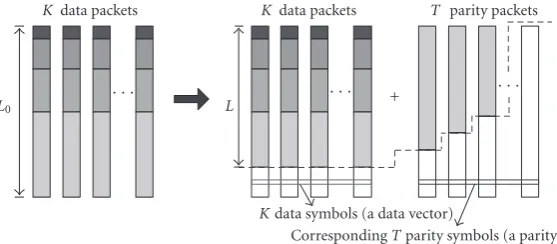
CorrespondingTparity symbols (a parity vector) Figure2: The error-resilient unequal error protection scheme.
R-D optimal bit allocation on the MB-level across all bit-planes and MBs within a time slot. Notice that collecting the R-D function of a simple FGS bitstream (e.g., gener-ated from MPEG-4 FGS [4]) is relatively easy. However, it is more difficult for a bitstream generated from a more efficient FGS encoder such as the progressive fine granularity scalable (PFGS) encoder [5], which brings drifting errors to subse-quent frames. To achieve the R-D optimal bit allocation, we need to consider the influence of the drifting errors, referring to [11] for one such method of calculating the drifting errors in the PFGS scheme.
After the bit allocation, selected bits are packetized into packets by grouping all selected bits from the same MB into one packet subject to the maximum packet length constraint. Clearly, both the decoding dependency and usefulness de-pendency are completely removed because each packet is now self-contained such that it can be decoded without the knowledge of other packets.Figure 1(b)shows one example of this packetization strategy. Notice that each packet is still fine scalable, as bits from the selected MBs are still scanned sequentially on the bitplane-by-bitplane basis, as depicted by thepacketizing orderin the figure. Refer to [10] for the details of the development of this optimal packetization algorithm.
3. ERROR-RESILIENT UNEQUAL ERROR PROTECTION
In this section, we will present our error-resilient unequal er-ror protection (ER-UEP) scheme with emphasis on the fea-tures mentioned inSection 1.
3.1. System-level description
Figure 2shows the principle diagram of the proposed ER-UEP method. The originalKdata packets,P1,P2,. . .,PK, are generated using the optimal packetization method in [10] with the rate budget R. In order to apply an FEC, bits in each data packet are processed on the symbol-by-symbol ba-sis. That is, thekth data packet is interpreted as a sequence of fixed-length symbols. LetPk = {sk,1,sk,2,. . .,sk,L0}, where
sk,idenotes theith data symbol of thekthdata packet andL0
is the packet length in symbols. Next,Kdata symbols with the same index, sayi, across allKdata packets are grouped to form a data vectorvi= {s1,i,s2,i,. . .,sK,i}. Now,Koriginal
data packets are equivalently expressed as a list of data vectors
{v1,v2,. . .,vL0}. Channel coding is then applied to generate
a parity vectorqi, which consists ofTparity symbols for the data vectorviusing the Reed-Solomon codeRS(K+T,K).1
Clearly, there are totally L0 parity vectors. These generated
parity vectors are then reorganized into T parity packets. Each parity packet is of length L0 with one parity symbol
from each parity vector.
Notice that all data packets and parity packets are of the same lengthL0so far, meaning that the protection so far is an
equal protection. From the parity packet generation mecha-nism described above, it is evident that there is no depen-dency between parity symbols in a parity packet because a parity symbol only depends on its corresponding data vector. Moreover, since all data packets are independent and scal-able, the resulting parity packets are also scalable and can be arbitrarily truncated. Finally, the data packets and parity packets are separate: a data packet does not contain any par-ity symbols and vice versa.
According to the UEP principle, different numbers of parity symbols are desired for different data vectors. This can be easily achieved by pruning away some less important par-ity symbols. Doing this ensures that more important sym-bols (e.g., bits from more significant bitplanes) obtain more protection. Nevertheless, in order to meet the overall rate constraint, R, we also need to prune away some data vec-tors of less significance. Thanks to the scalability of both data packets and parity packets, the pruning is feasible. In prac-tice, such pruning is much faster than repacketization be-cause there is almost no memory shuffling. This feature en-ables us to generate all data packets and parity packets offline and perform necessary online pruning during the streaming services. This is in sharp contrast against conventional UEP schemes which inevitably require repacketization because the data symbols and parity symbols in those schemes are inter-leaved together. In the following, we will first formulate the
optimal budget allocation between data packets and parity packets into an optimization problem, and then develop a Lagrangian-type algorithm to solve this problem.
3.2. Problem statement
Streaming quality can be quantitatively measured by the ex-pected distortion at the receiver side. In this paper, we as-sume that the base layer of an FGS video bitstream is always received correctly2and focus on the error protection for the
enhancement layer. All notations such as bitstream,packet, andratehereafter refer to those for the enhancement-layer bitstream.
For theith data symbol of thekth data packet, sk,i, its expected contribution (i.e., distortion reduction) is
EΔDsk,i
=ΔDsk,i×1−pesk,i×pAsk,i|sk,i, (1)
whereΔD(sk,i) is the actual distortion reduction contributed
by successfully receiving and decoding symbolsk,i;pe(sk,i) is
the loss probability after the FEC recovery for sk,i;A(sk,i)
represents the dependent symbol set ofsk,i; and the condi-tional probability p(A(sk,i) | sk,i) expresses the impact of bitstream dependency. Thanks for the optimal packetization used in our ER-UEP scheme,A(sk,i)= {sk,1,sk,2,. . .,sk,i−1}.
Hence, the decoding of symbolsk,iis independent ofA(sk,i).
In other words, the conditional probability p(A(sk,i)| sk,i) always equals 1. Therefore, (1) can be simplified as
EΔDsk,i
=ΔDsk,i
×1−pesk,i
. (2)
LetΔD(vi) be the distortion reduction of data vectorvi. It is easy to see that the distortion reduction is additive, and thusΔD(vi) can be computed by accumulating the distortion reduction of its component data symbols:
ΔDvi=K k=1
ΔDsk,i. (3)
Clearly, the importance of data symbols decreases from more significant bitplanes to less significant bitplanes, and
ΔD(vi) is ensured to be convex [10]. Thus,ΔD(vi)≤ΔD(vj) for alli > j. Let the packet loss rate after loss recovery be Pe(k,t) whenkdata symbols are protected bytparity sym-bols. This function quantifies the loss recovery performance and can be either obtained in the transmission system or cal-culated through some mathematical approaches [13]. Now, the overall expected distortion (with UEP) at the receiver side can be calculated as follows:
E{D} =DBL− L
i=1
1−PeK,Ti×ΔDvi, (4)
2This assumption is reasonable since the base layer of an FGS bitstream is very small and yet very important, heavy error protection (even ARQ) can usually be applied to ensure error-free transmission in practice.
whereDBLdenotes the distortion when only the base layer is received,L(withL ≤ L0) is the number of selected data
vectors, andTi is the number of parity symbols for theith data vector. Note that UEP is achieved by varying the parity symbol numberTifor different data vectors, with constraint Ti ≤ Tj, for alli > j, which is derived from the fact that
ΔD(vi) is monotonously decreasing.
Finally, as the data packet rateRS and the parity packet rateRCare constrained by the total budget rateR, the rate constraint can be expressed as
RS+RC=
L
i=1
K+Ti×m≤R, (5)
wheremis the symbol length in bits.
Now, the optimization problem can be formulated as fol-lows: given the number of data packetsK(each data packet hasL0symbols), the R-D function (R(vi),ΔD(vi)) (which
de-generates toΔD(vi) as the rate for each data vector is equal) and the loss-recovery performance functionPe(k,t) find the most important data vectors and determine the protection strength for each data vector such thatE{D}is minimized subject to the rate constraint. In other words, we need to find the number of selected data vectorsLand the number of par-ity symbolsTifor each data vectorvi(i=1, 2,. . .,L).
3.3. Solution
Since the ultimate protection strengthTi satisfiesTi ≤ Tj for alli > j, when a certain data vectorviis received or re-covered, all its dependent vectorsvj(j =1, 2,. . .,i−1) are ensured to be received or recovered. Therefore, in the ER-UEP scheme, the R-D function after loss recovery for each data vector can be computed independently without requir-ing other data vectors. As a result, the Lagrangian optimiza-tion can be applied here to solve the optimizaoptimiza-tion problem formed above [14].
According to the Lagrangian optimization principle, the optimal solution can be found by applying theequal slope (or, constant slope) optimization [14], where the term slope means the expected distortion reduction efficiency of a data vector after being protected by one more parity symbol. To apply the equal slope optimization, we should compute the slopes of each data vector when it is protected by different numbers of parity symbols. Specifically, for a data vectorvi, two vectorsSi andRi, which represent the protection effi -ciency (slope) and the corresponding rate, can be obtained as follows:
Si=s(i,t)t=0,1,...,T, Ri=r(i,t)t=0,1,...,T, (6)
where
r(i,t)=(K+t)×m,
s(i,t)=ΔDvi·Pe(rK,t−1)−Pe(K,t)
(i,t)−r(i,t−1) .
(7)
distortion reduction function over a common vector Wof lengthT+ 1, that is,
Si=ΔDvi·w0 w1 · · · wT
, (8)
where
wt=Pe(rK(i,,tt)−−1)r(−i,tP−e(K1),t). (9)
Note that applying the equal slope optimization requires that elements of the slope vector should be monotonously decreasing. However, because of the introduction of the loss recovery function, even though the R-D function of data vec-tors is convex, elements of the slope vecvec-tors Si (or equiv-alently, elements of the common vector W) may not be strictly monotonously decreasing in general. Consequently, a postprocessing stage is required for merging those non-decreasing elements inW. The postprocessing includes two iterative steps: (1) divide the elements inWinto rising, flat, and falling sections; and (2) if there are any rising or flat sec-tions, merge all elements in the rising or the flat sections as one single element and then return to step (1), otherwise, the postprocessing is completed. A similar postprocessing method and a relevant example can also be found in [8].
After the postprocessing, we can obtain a strictly monotonously decreasing vectorWof lengthT+ 1:
W=w
0 w1 · · · wT, (10)
where
w
j=Pe
K,tj−1
−PeK,tj
ri,tj−ri,tj−1
(11)
andtj is the corresponding protection strength of the jth element inW. Next, the strictly monotonously decreasing slope matrixSand the corresponding rate matrixRcan be easily obtained fromW, each of sizeL0×(T+ 1):
S=
⎡ ⎢ ⎢ ⎣
S1
.. .
SL0
⎤ ⎥ ⎥ ⎦= ⎡ ⎢ ⎢ ⎣
s1,t
0
· · · s1,t T ..
. . .. ...
sL
0,t0
· · · sL
0,tT ⎤ ⎥ ⎥ ⎦,
R= ⎡ ⎢ ⎢ ⎣
R1
.. .
RL0
⎤ ⎥ ⎥ ⎦= ⎡ ⎢ ⎢ ⎣
r1,t
0
· · · r1,t T ..
. . .. ...
rL
0,t0
· · · rL
0,tT ⎤ ⎥ ⎥ ⎦, (12) where
ri,t
j=ri,tj=K+tj×m,
si,t
j=ΔDvi×wj. (13)
Now it is ready to apply the equal slope optimization. The optimal solution that minimizes (4) can be found through looking for the best protection strengthTi = tj for the ith data vector that satisfies s(i,tj+1) < λ ≤ s(i,tj), with the
Initially, letλL=0,λH=a large number,Rcost=0,
and letδbe a given parameter for exiting condition.
WhileRcost−R> δ
λ=λL+λH2;
FindTi=tjfor theith data vector that satisfies
si,t
j+1
< λ≤si,t
j;
FindL—the maximumisatisfyingλ≤si,T
i; IfRcost=
L i=0r
i,Ti≤R, thenλH=λ; else,
λL=λ.
Algorithm1
constraint of the total rate budgetRfor the time-slot under optimization:
L
i=1
ri,T
i≤R, (14)
whereλis the Lagrangian multiplier andLis the maximum i that satisfies s(i,Ti) ≥ λ. Some efficient iterative algo-rithms such as the bisection searching can be applied here (seeAlgorithm 1).
Finally, rate shaping can be efficiently performed since both the data packets and parity packets are scalable. Specif-ically, for each data packet, the first L data symbols are kept whereas the data symbols from position L+ 1 to L0
are discarded. Similarly, the parity packets are selected and truncated according to the determined optimal protection strengthTi.
4. FAST PROTECTION SCHEMES
The complete ER-UEP framework consists of four steps, namely data packets generation, parity packets generation, data and parity rate calculation, and rate shaping. Since gen-erating data packets and parity packets can be performed offline in ER-UEP and the rate shaping is also very simple, the complexity only comes from the process of data and par-ity rate calculation, that is, selecting data vectors and their corresponding parity symbols. The optimal algorithm is de-tailed inSection 3.3, with a moderate/high computing cost that is acceptable perhaps only when supporting a limited number of users. In this section, we present three simplified schemes for supporting a large number of users simultane-ously at cost of marginal quality degradation.
4.1. Segment-level ER-UEP scheme
Algorithm 1, described in Section 3.3, tries to allocate the rate budget between data packets and parity packets at the symbol level. The complexity is therefore determined by the size of the rate-contribution matrices, L0×(T + 1).
L0 L
K data packets
+ LFEC
T parity packets
(a) ER-SUEP
L0 L
K data packets
+
T parity packets
(b) ER-EEP
Figure3: Two fast implementations of the ER-UEP scheme.
symbols within each data packet into one segment and pro-vide equal protection to all symbols in the same segment. As a result, the size of the rate-contribution matrices is reduced to (L0/M)×(T+ 1), and the computing cost is only 1/Mof
the original one. Moreover, the value ofMmay be altered to achieve different speedups.
4.2. Error-resilient simple unequal error protection
As depicted inFigure 3(a), in this error-resilient simple un-equal error protection (ER-SUEP) scheme, each data packet is divided into two parts. The upper part withLFECsymbols
is of high importance and will be protected by sendingT par-ity packets, while the lower part withL—LFECsymbols is of
low importance and will not be protected. The expected dis-tortion is now simplified as
ED1
=DBL−1−Pe(K,T)· LFEC
i=1 ΔDvi
−1−Pe(K, 0)· L
i=LFEC+1 ΔDvi,
(15)
while the optimization problem is simplified as follows: given the available rate R for a time slot and the loss-recovery performance function Pe(k,t), choose the number of par-ity packets T and parity packet length LFEC such that the
expected distortionE{D1}is minimized with the rate
con-straint: (L×K+LFEC×T)×m≤R.
4.3. Error-resilient equal error protection
The maximum number of searching points equals to L0×
(T+ 1) in the ER-SUEP scheme. To further reduce it, an error-resilient equal error protection (ER-EEP) scheme is proposed in the following. In this scheme, all selected data symbols are equally protected with strengthT, as illustrated inFigure 3(b). The simplified optimization problem can be stated as follows: given the available rateRfor a time-slot and the loss-recovery performance functionPe(k,t), choose the best protection strengthTsuch that the expected distortion is minimized:
ED2
=DBL−1−Pe(K,T)· L
i=1
ΔDvi, (16)
where
L=
R (K+T)×m
. (17)
Notice that the complexities of the above-presented three simplified schemes are decreasing, and one later scheme can be viewed as a special case of an earlier scheme, as can be seen from (15) and (16).
5. EXPERIMENTAL RESULTS
The proposed ER-UEP scheme and all its simplified versions are extensively tested against various packet loss cases to sim-ulate streaming FGS video bitstreams over the Internet. Some standard test sequencesForeman,Coastguard,News, and Si-lencein CIF format and 10 Hz are used in our experiments. As the PFGS scheme [5] gives the highest coding efficiency among all the available FGS schemes, it is used for gener-ating the FGS bitstream in our experiment. Only the first frame is encoded asI frame and all others asPframes. The bit rate for the base layer is chosen as 96 kbps and that for the enhancement layer is allowed to be up to 5 000 kbps. As-sume that the base-layer bitstream is transmitted without er-rors.
To simulate the bandwidth fluctuation in the Internet, the total available enhancement-layer rate is assumed to be uniformly distributed within the range of (512, 1024) kbps for each time slot of one second. Meanwhile, to simulate the burst loss in the Internet, a two-state Gilbert model, char-acterized by the global packet loss rate (PLR) and the av-erage burst length (ABL), is used in our experiments. Fur-thermore, in order to evaluate the performance and ro-bustness of our ER-UEP scheme under degraded channel conditions, the enhancement-layer bitstreams are first pro-tected at three Gilbert models with different (PLR, ABL): (0.01, 1.5), (0.05, 2.0), and (0.10, 2.5), and then transmit-ted over channels with varying PLR (over a wide range) but fixed ABL (as given in the three models selected above). Finally, to randomize the burst packet loss, packets from two adjacent FEC blocks, BLOCKA = {P1A,PA2,P3A,. . .}
and BLOCKB = {PB
1,PB2,PB3,. . .}, are interleaved before
0 0.02 0.04 0.06 0.08 0.1 Global packet loss ratio
31 32 33 34 35 36 37 38
A
ver
age
P
SNR
(dB)
Norm. pack. Opt. pack. MD-FEC
ER-UEP ER-SUEP ER-EEP (a) Protected at (PLR=0.01, ABL=1.5)
0.04 0.06 0.08 0.1 0.12 0.14 0.16 Global packet loss ratio
31 32 33 34 35 36 37
A
ver
age
P
SNR
(dB)
Norm. pack. Opt. pack. MD-FEC
ER-UEP ER-SUEP ER-EEP (b) Protected at (PLR=0.05, ABL=2)
0.1 0.12 0.14 0.16 0.18 0.2 Global packet loss ratio
30 31 32 33 34 35 36 37
A
ver
age
P
SNR
(dB)
Norm. pack. Opt. pack. MD-FEC
ER-UEP ER-SUEP ER-EEP (c) Protected at (PLR=0.10, ABL=2.5)
Figure4: Comparative evaluation of the proposed scheme at different packet loss rates (forForemansequence).
PA
1,PB1,PA2,P2B,. . ., wherePijdenotes the jth packet of theith
FEC block.
The MD-FEC method [8] mentioned before is chosen as the benchmark for comparison. In our implementation of the MD-FEC scheme, the enhancement-layer bitstream of each frame is first ordered as that in the normal packetiza-tion: bits of all MBs are ordered MB by MB and bitplane by bitplane, from the most significant bitplane of all MBs to the least significant bitplane of all MBs. As a result, the impor-tance of the bitstream from the first to the last bit is in a decreasing way. The bitstream is then partitioned into de-creasing prioritized segmentsm0,m1,. . . .Usually, bits from
the same bitplane can be considered as one segment. For the given channel bandwidth and the loss-recovery performance functionPe(k,t), the optimal protection parameters (Ki,Ti) of segmentmican be calculated by locating the points on the
R-D curve of the enhancement-layer bitstream. After that, the Reed-Solomon codeRS(Ki+Ti,Ki) is used to generate parity symbols for segmentmibased on the found protec-tion parameters (Ki,Ti). In the end, the protected segments along with their parity symbols are packetized into 800-byte long packets using the packetization scheme used by MD-FEC [8]. Refer to reference [8] for more details. Notice that to improve error resilience for both the MD-FEC scheme and the normal packetization scheme without error protection, we insert a 23-bits resynchronization marker followed by 9-bits MB address information at the MB boundary for any 9-bits interval greater than 1000 bits.
0 0.02 0.04 0.06 0.08 0.1 Global packet loss ratio
36 37 38 39 40 41 42
A
ver
age
P
SNR
(dB)
Norm. pack. Opt. pack. MD-FEC
ER-UEP ER-SUEP ER-EEP (a) Protected at (PLR=0.01, ABL=1.5)
0.04 0.06 0.08 0.1 0.12 0.14 0.16 Global packet loss ratio
36 37 38 39 40 41 42
A
ver
age
P
SNR
(dB)
Norm. pack. Opt. pack. MD-FEC
ER-UEP ER-SUEP ER-EEP (b) Protected at (PLR=0.05, ABL=2)
0.1 0.12 0.14 0.16 0.18 0.2 Global packet loss ratio
35 36 37 38 39 40 41 42
A
ver
age
P
SNR
(dB)
Norm. pack. Opt. pack. MD-FEC
ER-UEP ER-SUEP ER-EEP (c) Protected at (PLR=0.10, ABL=2.5)
Figure5: Comparative evaluation of the proposed scheme at different packet loss rates (forNewssequence).
optimal packetization strategy presented inSection 2. Each data packet is also 800 bytes long. After generating parity packets, the length of data packets and the number of parity packets are computed for the given channel conditions. Fi-nally, all the packets are shaped accordingly by pruning away the least significant symbols.
To differentiate the actual gain of the proposed ER-UEP scheme, we also performed experiments where only the opti-mal packetization is applied (without any error protection). Figures 4 and 5 show the performances of the ER-UEP scheme, its simplified versions, and the benchmarks for the ForemanandNewssequences. As for the other two sequences, we did not include their figures since they are quite similar to Figures4and5.
A few observations can be made from Figures4and5. (1) The performance of all UEP schemes indeed degrades gracefully when the actual PLR deviates from the assumed
one when performing error protection. However, conven-tional UEP schemes achieve graceful degradation only in a small range while the proposed ER-UEP schemes (includ-ing the simplified versions) are more robust over a much wider range. Clearly, our proposed UEP framework is more error resilient. (2) Under the best conditions (i.e., packet loss rate prediction is accurate), the proposed ER-UEP schemes outperform the MD-FEC scheme. The gain comes from two sources: optimal packetization and UEP. (3) The optimal packetization provides significant gain and the UEP fur-ther improves the performance significantly as well. (4) The performance degradation for the simplified ER-UEP schemes (ER-SUEP and ER-EEP) is marginal.
Table1: Channel rate percentage under different (PLR, ABL).
Sequence (PLR, ABL) ER-UEP MD-FEC
(0.01, 1.5) 2.3% 4.3%
Foreman (0.05, 2) 7.4% 11.9%
(0.1, 2.5) 12.1% 19.7%
(0.01, 1.5) 3.3% 4.6%
Coastguard (0.05, 2) 9.5% 12.8%
(0.1, 2.5) 15.5% 20.8%
(0.01, 1.5) 2.2% 4.1%
News (0.05, 2) 7.9% 13.3%
(0.1, 2.5) 14.5% 21.7%
(0.01, 1.5) 1.2% 4.2%
Silence (0.05, 2) 4.8% 12.8%
(0.1, 2.5) 8.4% 18.7%
Table2: Comparison of average PSNR (dB) under varying PLR (PLR denotes the predicted PLR).
Sequence PLR NO-EP MD-FEC ER-UEP
0.01 36.23 36.8 37.21
Foreman 0.05 35.34 36.33 36.92
0.1 33.01 35.75 36.54
0.01 33.62 34.05 34.49
Coastguard 0.05 31.7 33.54 33.98
0.1 30.23 33.07 33.57
0.01 40.84 41.32 41.89
News 0.05 38.75 40.98 41.57
0.1 37.5 40.57 41.22
0.01 38.18 38.16 38.79
Silence 0.05 36.88 37.51 38.39
0.1 35.77 36.94 38.03
loss rate. For example, we can find that the UEP schemes aiming at PLR = 0.1 (the bottom sub-plot) yield the best performance among all three experiments when the actual PLR is exactly 0.1. This observation confirms with our con-clusion that a good packet loss prediction is still critical to UEP schemes.
As mentioned in Section 1, the proposed ER-UEP scheme achieves higher bandwidth utilization because of the error resilient property. The reason is that in our ER-UEP framework any received data bits can be decoded, whereas this cannot be guaranteed in conventional schemes. Furthmore, because our scheme is less sensitive to transmission er-rors, more bits can be allocated for data packets. InTable 1, we present the percentage of parity bits for different UEP
schemes under three experimental scenarios when the total enhancement-layer rate equals 768 kbps. Clearly, our scheme needs lighter protection. Notice that even though less protec-tion is applied, the resulting PSNR is higher in our scheme thanks for its strong error resilient capability.
At last, we evaluate the performances on channels with prediction errors when the total enhancement-layer rate equals 768 kbps. This kind of channel is simulated by adding a Gaussian noise on the PLR of the Gilbert loss process. That is, for the predicted PLR on which the loss protection is based, the actual packet loss rate equals PLR +w, wherew is an additive Gaussian noise (updated every time slot) with zero mean andσ2(PLR)2 variation (σ =0.2 in our
experi-ments). Hence, the channel condition for each time slot can be either better or worse than the predicted one. It can be seen from Table 2 that the MD-FEC scheme improves the quality of the normal packetization scheme a lot, and our ER-UEP scheme provides the best quality.
6. CONCLUSIONS AND FUTURE WORKS
We presented an error resilient unequal error protection scheme for streaming FGS video bitstreams over the Internet. Based on the optimal packetization method, our proposed scheme overcomes the common constraints that other con-ventional UEP schemes suffer from. As a result, the proposed scheme not only provides better quality at the target packet loss rate, but also is more robust over a wide range of packet loss rates. Several fast implementations were also presented. Extensive simulation results demonstrated the effectiveness of our proposed scheme.
Besides the FGS video bitstreams, the proposed method can also work for other scalable image/video bitstreams such as the SPIHT [15] encoded image bitstream and the SVC [16] encoded enhancement-layer video bitstream, as long as they can be packetized into independent and scalable data packets. Moreover, we believe that the unequal error protec-tion and error-resilience concept could give remarkable qual-ity improvements for wireless videos, which is getting more and more interests recently. This is one focus of our future works.
ACKNOWLEDGMENT
The authors would like to thank Dr. Feng Wu from Microsoft Research Asia for many fruitful discussions on the imple-mentation of the proposed protection scheme for FGS video bitstreams.
REFERENCES
[1] ISO/IEC 13818-2, “Generic coding of moving pictures and as-sociated audio, part-2 video,” November 1994.
[2] ISO/IEC 14496-2, “Coding of audio-visual objects, part-2 vi-sual,” December 1998.
[4] W. Li, “Overview of fine granularity scalability in MPEG-4 video standard,”IEEE Transactions on Circuits and Systems for Video Technology, vol. 11, no. 3, pp. 301–317, 2001.
[5] F. Wu, S. Li, and Y.-Q. Zhang, “A framework for efficient pro-gressive fine granularity scalable video coding,”IEEE Trans-actions on Circuits and Systems for Video Technology, vol. 11, no. 3, pp. 332–344, 2001.
[6] R. Blahut,Theory and Practice of Error Control Codes, Addison-Wesley, Reading, Mass, USA, 1993.
[7] A. Albanese, J. Blomer, J. Edmonds, M. Luby, and M. Sudan, “Priority encoding transmission,”IEEE Transactions on Infor-mation Theory, vol. 42, no. 6 pt 1, pp. 1737–1744, 1996. [8] R. Puri, K.-W. Lee, K. Ramchandran, and V. Bharghavan,
“An integrated source transcoding and congestion control paradigm for video streaming in the internet,”IEEE Transac-tions on Multimedia, vol. 3, no. 1, pp. 18–32, 2001.
[9] A. E. Mohr, E. A. Riskin, and R. E. Ladner, “Unequal loss pro-tection: graceful degradation of image quality over packet era-sure channels through forward error correction,”IEEE Journal on Selected Areas in Communications, vol. 18, no. 6, pp. 819– 828, 2000.
[10] H. Cai, G. Shen, Z. Xiong, S. Li, and B. Zeng, “An optimal packetization scheme for fine granularity scalable bitstream,” in Proceedings of IEEE International Symposium on Circuits and Systems (ISCAS ’02), vol. 5, pp. 641–644, Scottsdale, Ariz, USA, May 2002.
[11] H. Cai, G. Shen, S. Li, and B. Zeng, “Optimal rate alloca-tion for macroblock-based progressive fine granularity scal-able video coding,” inProceedings of IEEE International Con-ference on Image Processing, vol. 3, pp. 745–748, Rochester, NY, USA, September 2002.
[12] S. Lin and D. J. Costello,Error Control Coding: Fundamentals and Applications, Prentice-Hall, Englewood Cliffs, NJ, USA, 1983.
[13] P. Frossard, “FEC performance in multimedia streaming,”
IEEE Communications Letters, vol. 5, no. 3, pp. 122–124, 2001. [14] A. Ortega and K. Ramchandran, “Rate-distortion methods for image and video compression,”IEEE Signal Processing Maga-zine, vol. 15, no. 6, pp. 23–50, 1998.
[15] A. Said and W. A. Pearlman, “A new, fast, and efficient im-age codec based on set partitioning in hierarchical trees,”
IEEE Transactions on Circuits and Systems for Video Technol-ogy, vol. 6, no. 3, pp. 243–250, 1996.
[16] J.-R. Ohm, “Advances in scalable video coding,”Proceedings of the IEEE, vol. 93, no. 1, pp. 42–56, 2005.
Hua Cai received the B.S. degree from the Shanghai Jiaotong University, Shanghai, China, in 1999, and the Ph.D. degree from the Hong Kong University of Science and Technology (HKUST) in 2003, all in elec-trical and electronic engineering. He is a Member of the IEEE and ACM. He joined Microsoft Research Asia, Beijing, China, in December 2003 and is currently an Asso-ciate Researcher in the Media
Communica-tion Group. His research interests include digital image/video sig-nal processing, image/video coding and transmission, multiview video system, multiview video coding and transmission, and mo-bile media computing.
Bing Zeng joined the Hong Kong Uni-versity of Science and Technology in 1993 and is currently an Associate Professor at the Department of Electrical and Electronic Engineering. His general research interests include digital signal and image process-ing, linear and nonlinear filter design, and image/video coding and transmission. His most recent research focus is on some fun-damental issues in image/video coding such
as directional transform, truly optimal rate allocation, and smart motion estimation/compensation, as well as various solutions for real-time video streaming applications over the Internet and wire-less. His research efforts in these areas have produced over 150 journal and conference publications. He received the B.Eng. and M.Eng. degrees from the University of Electronic Science and Tech-nology of China in 1983 and 1986, respectively, and the Ph.D. de-gree from Tampere University of Technology, Finland, in 1991, all in electrical engineering. He worked as a postdoctoral fellow at the University of Toronto and Concordia University during 1991– 1993 and was a Visiting Researcher at Microsoft Research Asia, Bei-jing, China, in 2000. He was an Associate Editor for the IEEE Trans-actions on Circuits and Systems for Video Technology during 1995 to 1999 and served in various capacities in a number of interna-tional conferences. He is currently a Member of the Visual Signal Processing & Communications Technical Committee of the IEEE CAS Society.
Guobin Shenreceived the B.S. degree from Harbin University of Engineering, Harbin, China, in 1994, the M.S. degree from South-east University, Nanjing, China, in 1997, and the Ph.D. degree from Hong Kong Uni-versity of Science and Technology (HKUST) in 2001, all in electrical and electronic en-gineering. He is a Member of the IEEE and ACM. He was a Research Assistant at HKUST from 1997 to 2001. Since then, he
has been with Microsoft Research Asia where he is now a Researcher and Project Leader in the Wireless and Networking Group. His re-search interests include digital image and video signal processing, video coding and streaming, distributed/parallel computing and peer-to-peer networking, general computing on GPU, wireless net-working and mobile computing, and media management. He has published about a dozen journal papers and more than thirty con-ference papers. He has been granted two US patents and filed more than a dozen patent applications. He is now serving as a TPC Mem-ber for several international conferences and as a Reviewer for sev-eral journals and many conferences.
Zixiang Xiongreceived the Ph.D. degree in electrical engineering in 1996 from the Uni-versity of Illinois at Urbana-Champaign. From 1997 to 1999, he was with the Univer-sity of Hawaii. Since 1999, he has been with the Department of Electrical and Com-puter Engineering at Texas A&M Univer-sity, where he is an Associate Professor. He spent the summers of 1998 and 1999 at Mi-crosoft Research, Redmond, Wash, and the
Award in 2000, and an ONR Young Investigator Award in 2001. He also received Faculty Fellow awards in 2001, 2002, and 2003 from Texas A&M University. He served as an Associate Editor for the IEEE Trans. on Circuits and Systems for Video Technology (1999– 2005) and the IEEE Trans. on Image Processing (2002–2005). He is currently an Associate Editor for the IEEE Trans. on Signal Process-ing and the IEEE Trans. on Systems, Man, and Cybernetics (part B).
Shipeng Lireceived the B.S. and M.S. de-grees from the University of Science and Technology of China (USTC), Hefei, in 1988 and 1991, respectively, and the Ph.D. degree from Lehigh University, Bethlehem, Pa, in 1996, all in electrical engineering. He was with the Electrical Engineering Depart-ment, USTC, during 1991 and 1992. He was a Member of the Technical Staffat Sarnof-fCorporation, Princeton, NJ, during 1996–