Jung Hee Cheon1, Miran Kim1, and Kristin Lauter2
1
Seoul National University (SNU), Republic of Korea
{jhcheon,alfks500}@snu.ac.kr 2
Microsoft Research [email protected]
Abstract. These days genomic sequence analysis provides a key way of understanding the biology of an organism. However, since these sequences contain much private information, it can be very dangerous to reveal any part of them. It is desirable to protect this sensitive information when performing sequence analysis in public. As a first step in this direction, we present a method to perform the edit distance algorithm on encrypted data to obtain an encrypted result. In our approach, the genomic data owner provides only the encrypted sequence, and the public commercial cloud can perform the sequence analysis without decryption. The result can be decrypted only by the data owner or designated representative holding the decryption key.
In this paper, we describe how to calculate edit distance on encrypted data with a somewhat homomorphic encryption scheme and analyze its performance. More precisely, given two encrypted sequences of lengthsn andm, we show that a somewhat homomorphic scheme of depth O((n+
m) log log(n+m)) can evaluate the edit distance algorithm in O(nmlog(n+m)) homomorphic computations. In the case ofn=m, the depth can be brought down toO(n) using our optimization technique. Finally, we present the estimated performance of the edit distance algorithm and verify it by implementing it for short DNA sequences.
Keywords:Edit distance, Homomorphic encryption, Arithmetic circuit.
1 Introduction
In bioinformatics, the term “Sequence Analysis” refers to the process of arranging DNA, RNA, or peptide sequences to understand their structures and features. Relationships between sequences are usually discovered by aligning them appropriately and identifying the most closely matching subsequences. In this paper, we focus on the well-known edit distance algorithm [25], which measures the dissimilarity of two strings. Calculating the edit distance between public reference strings and patients’ DNA sequences can be used to solve the problem of approximate string matching. In practice, there are deployed services to compare DNA sequences. For example, the European Bioinformatics Institute (EBI) website [6] provides “Bic-SW Database Searches” where one can apply a sequence analysis algorithm to any two DNA sequences (e.g., Smith-Waterman algorithm).
inference [19], location-visit patterns [20], family structure [10], and dictionary attacks. Thus, DNA sequences are sensitive and valuable enough that we should not reveal our own sequences even when performing sequence analysis.
Privacy through Encryption.In this work, we consider the potential for using homomorphic encryption to protect privacy in genomic computations. Compared with MPC protocols based on recent optimizations of garbled circuit techniques [14, 11], homomorphic encryption is often considered to be slower and less efficient. But homomorphic encryption has a number of other advantages, allowing for more flexible scenarios and functionality and requiring less interaction, thereby reducing communication complexity. Typically no interaction is required for applications of (single-key) homomorphic encryption. Also, homomorphic encryption schemes have become more practical recently, due to a number of improvements, including techniques which avoid the costly bootstrapping procedure for fixed computations, such as using leveled or somewhat homomorphic encryption (SWHE) schemes.
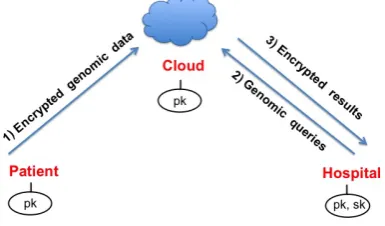
Scenarios.Homomorphic encryption allows the data owner to upload encrypted data to a cloud service. The cloud service can operate on the encrypted data without requiring the decryption key or any interaction with the data owner. The service returns the encrypted results to the data owner, who can decrypt using the secret key. A cloud provider could thus provide Direct-to-patient services in encrypted form, such as the service mentioned above provided by EBI.
Fig. 1.Scenario of proposed system
As an extension to the scenario, additional functionality can be achieved using public key homomorphic encryption schemes by allowing third parties to upload data directly to the cloud service, encrypted using the public key of the data owner. This scenario could be of interest in situations relevant to genomic computation: for example the data owner is a hospital or clinic, and the third parties are patients or other health-care providers for those patients. The hospital would like to use the cloud service for analyz-ing lots of patients. Auxiliary data (from tests,
genome sequencing, etc) can be uploaded to the service using the public key of the hospital. Computations on the encrypted data, such as comparing DNA sequences, output encrypted results which can be decrypted by the hospital or clinic. The secrecy of DNA sequences in the cloud can be protected under the semantic security of homomorphic encryption scheme.
Our Contributions. In this paper, we first describe the homomorphic evaluation of the edit distance algorithm which was suggested by Wagner and Fischer [25]. We show that the algo-rithm can be implemented on two encrypted sequences of lengths n and m with a somewhat homomorphic scheme of depthO((n+m) log(log(n+m))) in O(nmlog(n+m)) homomorphic computations. Moreover, we introduce an optimization technique to reduce the depth required to implement the algorithm: Divide the edit distance matrix into sub-blocks of size-(τ + 1) and solve the edit distance problem in each block. We can compute each of them diagonally, consuming O(τ) levels in one diagonal-round. Namely, evaluating the circuits in each cell can be processed by a somewhat homomorphic encryption of a constant depth. In particular, in the case of n =m, it suffices to compute only a little part of the sub-blocks, so the depth can be brought down to O(n).
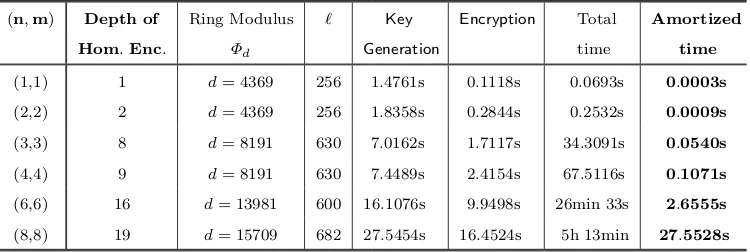
we expect that the algorithm would run in one day when estimated based on the recent CCK+ scheme [4]. We also demonstrate the experimental result that it takes about 27.5 seconds for
n=m= 8 using the GHS scheme [8].
Related works. Since Wagner and Fischer [25] introduced the problem of determining the edit distance between two strings and presented an algorithm for calculating the distance, there have been a number of approaches for private computation of the distance. In 2003, Atallah et al. [1] proposed a privacy-preserving protocol using an additive homomorphic encryption scheme and oblivious transfers, which had expensive computational and communication costs. Given two strings of lengths n and m, the number of iterations is equal to nm and the to-tal online computational cost is O(nmlog(n+m)). In 2008, Jha et al. [14] presented a more practical privacy-preserving protocol to compute the edit distance with Yao’s “garbled circuits” method [18, 26], and it was improved by Huang et al. [11]. Their computation cost is tractable, but their protocol requires a lot of interactions (e.g., O(nmlog(n+m)) oblivious transfers for Protocol 2 in [14]).
On the other hand, there is prior art on analyzing genomic data using homomorphic encryp-tion. Some of the work is based on additively homomorphic encryption schemes: Kantarcioglu et al. [15], Kolesnikov et al. [16], and Ayday et al. [2]. In [15], they presented a novel cryp-tographic framework that allows organizations to support data mining without violating the privacy of the genomic sequences, and in particular they used the Paillier cryptosystem for experimental analysis. The garbled circuit protocols of [16] were given for secure computation of the minimum distance (Hamming distance and Euclidean distance). In [2], they proposed a “privacy-preserving disease susceptibility test” on encrypted genomic data using a modified Paillier cryptosystem. Meanwhile, Cristofaro et al. [5] presented an efficient and secure protocol called “Size- and position-hiding private substring matching” based on a multiplicative homo-morphic ElGamal variant so as to check for the presence of DNA markers. Finally, Yasuda et al. [27] gave a practical solution for computation of multiple Hamming distance values using the LNV scheme [17], so that they could find the locations where a pattern occurs in a text. By contrast, the aim of this paper is to compute edit distance on encrypted sequences under somewhat homomorphic encryption schemes (which support additions and a limited number of multiplications of encrypted inputs). Besides DNA sequence analysis, edit distance has many other applications such as spelling correction or determining the longest common subsequences of two strings.
Outline.In Section 2, we review the main concept of homomorphic encryption and explain the edit distance algorithm. Section 3 presents the basic circuit building blocks for equality, compar-ison, and addition. Next, in Section 4, we describe our encrypted edit distance algorithm using these primitive circuits and give the analysis of our method. We also introduce optimizations to reduce the depth of implementing the algorithm. Finally, in Section 5, we estimate the per-formance of the proposed algorithm for large DNA sequences and present the real perper-formance for our implementation of the algorithm for short sequences.
2 Preliminaries
2.1 Homomorphic Encryption
We will encrypt bit-by-bit in this paper, so consider the concept of homomorphic encryption in this respect. For x ∈ {0,1}, we denote the encryption of x by ¯x or Enc(x). Let ⊕ and ∧ be the XOR and AND gate, each of which corresponds to addition and multiplication over
Z2, respectively. Also, we let + and × denote homomorphic addition and multiplication over encrypted data. Then a homomorphic encryptionEnc(-) satisfies the following properties:
Enc(x⊕y) =Enc(x) +Enc(y), Enc(x∧y) =Enc(x)×Enc(y).
In our paper, we focus on SWHE schemes for which additions are essentially free and a limited number of multiplications are supported. In particular, SWHE schemes [3, 8] use a practical noise-management technique-modulus switching, which scales down the ciphertext after every multiplication to reduce the noise by its scaling factor. When we say the (multiplicative) depth D(C) of a circuit C under homomorphic encryption, it means the total number of reduced levels in the circuit that is being evaluated homomorphically.
2.2 Edit Distance
Assume that there are two stringsα=α1. . . αn andβ=β1. . . βmover an alphabetΣ. One can
make another string with the same length by inserting spaces “−”, called gaps, and consider a matrix having two rows with these new strings. A gap in the first (resp. second) row is called Insertion (resp. Deletion). A column with the same (resp. distinct) characters is called Match(resp.Mismatch). Then the edit distance between two strings is the minimum number of these edit operations needed to transform one string into the other. More specifically, for two characters αi and βj, let us defineti,j as follows:
ti,j =
(
0 ifαi =βj (Match),
1 ifαi 6=βj (Mismatch).
In Algorithm 1, we describe the Wagner-Fischer edit distance algorithm [25], and the edit distance is simply Dn,m.
AlgorithmEdit distance
Input:α=α1. . . αn andβ =β1. . . βm 1: for i← 0 to n do
2: Di,0←i; 3: end for
4: for j← 0 to m do 5: D0,j ←j;
6: end for
7: for i← 1 to n do
8: for j← 1 to m do
9: t←(αi=βj)? 0 : 1;
10: Di,j ←min{Di−1,j−1+t, Di,j−1+ 1, Di−1,j+ 1};
3 Circuit Building Blocks
In this section, we present the basic circuit building blocks for computing the edit distance: equality circuit (for checking the equality of two numbers so as to determine match/mismatch of two characters), comparison circuit, and addition circuits. Since it may assume that we can evaluate homomorphic additions for free, it suffices to count the number of multiplication gates sequentially in order to compute the depth of a homomorphic encryption scheme. Thus, we focus on minimizing the number of sequential multiplication gates for circuits so that we can implement them efficiently.
For a circuit C, we denote the number of homomorphic additions and multiplications by
HA(C) andHM(C). Note that addition with a constant is faster than a classical homomorphic addition, so those are not counted in the number of the homomorphic additions. In Table 1,2, and 4, the depth of homomorphic encryption is cumulative while the number of homomorphic computations is not cumulative.
We will express an unsigned µ-bit integer in its binary representation xµ. . . x1 and denote thei-th coordinate ofx by xi (orx[i]). Then the encryption of xmeans{x¯1,x¯2, . . . ,xµ¯ }.
3.1 Equality Circuit
A binary circuit for checking the equality of two µ-bit values is defined to have value 1 if the inputs are the same and 0 otherwise. Then it can be written as an arithmetic circuit EQU(x, y) =∧µi=1(1⊕xi⊕yi). Using a binary tree, we give the required depth and complexity
in Table 3 where log is the binary logarithm.
3.2 Comparison Circuit
For two unsigned µ-bit values x and y, the comparison circuit is defined by
COM(x, y) =
(
0 ifx≥y,
1 otherwise,
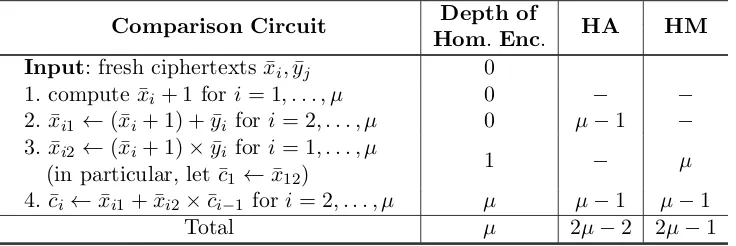
and this is written recursively asCOM(x, y) :=cµwhereci = ((xi⊕1)∧yi)⊕((xi⊕1⊕yi)∧ci−1) fori≥2 with an initial valuec1 = (x1⊕1)∧y1. In Table 1, we provide a pseudocode description of this circuit together with an approximation of the levels that it consumes during these operations. Unlike the other steps, the fourth cannot be computed simultaneously for eachi, so it consumes linear levels and we have D(COM) = µ. On the other hand, the comparison circuit can be evaluated homomorphically with a logarithmic depth, which is formally captured in Lemma 1 below.
Comparison Circuit Depth of HA HM
Hom.Enc.
Input: fresh ciphertexts ¯xi,yj¯ 0
1. compute ¯xi+ 1 fori= 1, . . . , µ 0 − −
2. ¯xi1 ←(¯xi+ 1) + ¯yi fori= 2, . . . , µ 0 µ−1 − 3. ¯xi2 ←(¯xi+ 1)×yi¯ fori= 1, . . . , µ
1 − µ
(in particular, let ¯c1←x¯12)
4. ¯ci ←x¯i1+ ¯xi2×c¯i−1 fori= 2, . . . , µ µ µ−1 µ−1
Total µ 2µ−2 2µ−1
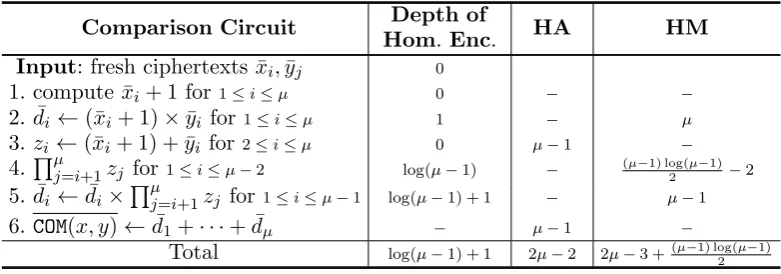
Lemma 1 The Comparison circuit of Table 2 can be evaluated homomorphically on two µ-bits with a somewhat homomorphic encryption of depth log(µ−1) + 1 in O(µlogµ) homomorphic computations.
Proof. We consider the comparison circuit as the following expression:
COM(x, y) =d1⊕d2⊕. . .⊕dµ
wheredi= (xi⊕1)∧yi∧(∧jµ=i+1(xj⊕1⊕yj)). From now, the following arguments are underlying ciphertexts for the above circuit. For simplicity, we denotezi:= (¯xi+1)+ ¯yifori= 2, . . . , µ, and
HMi the number of homomorphic multiplications to evaluate Qµj=i+1zj fori= 1, . . . , µ− 2.
We first construct a binary tree of product with {z2, . . . , zµ}. Then the total number of multiplications to proceed recursively with each of the two nodes is
1 + 2 + 4 +· · ·+µ−1
2 ≈µ−2,
and it needs log(µ−1) levels. We observe that Qµ
j=i+1zj has been computed if the number to
be multiplied by is in the form of powers of 2 orµ−1.
Now, we consider the case ofi∈ {1,2,· · · , µ−2}withµ−i6= 21,22,· · · ,2blog(µ−1)c, µ−1.
It is true that µ−i is uniquely written as 2ki1 + 2ki2 +· · ·+ 2kil where ki
j’s are increasing nonnegative numbers. Denote µir := µ−
2kil + 2kil−1 +· · ·+ 2kir+1 + 2kir
for 1≤r≤l and
µil+1 =µ, then we have
µ
Y
j=i+1
zj =
l
Y
r=1
(zµir+1zµir+2· · ·zµir+1).
Since all zµir+1zµir+2· · ·zµir+1’s have been computed as above, what we have to do is just to
multiply them each other, which requires logl levels and (l−1) homomorphic multiplications. From these observations, we see that
X
2t−1<u−i<2t
HMi= t−1
X
l=1
l·
t−1
l
= (t−1)·2t−2
fort∈ {2,3, . . . ,blog(µ− 1)c}. So we have
µ−2
X
i=1
HMi=
X
u−i=21,22,...,µ−1
HMi+
X
t=2,3,...,blog(µ−1)c
X
2t−1<u−i<2t
HMi
≈ (µ−2) + X
t=2,3,...,blog(µ−1)c
(t−1)·2t−2
= (µ−1) log(µ−1)
2 −2.
Therefore, as described in Table 2, evaluating theCOM circuit can be accomplished using
µ+
(µ−1) log(µ−1)
2 −2
+ (µ−1) = 2µ−3 +(µ−1) log(µ−1) 2
homomorphic multiplications with a SWHE scheme of depth log(µ−1) + 1. ut
Table 2.Pseudocode ofCOMbetween twoµ-bit values and its complexity
Comparison Circuit Depth of HA HM
Hom.Enc.
Input: fresh ciphertexts ¯xi,yj¯ 0
1. compute ¯xi+ 1 for1≤i≤µ 0 − −
2. ¯di ←(¯xi+ 1)×yi¯ for1≤i≤µ 1 − µ
3. zi ←(¯xi+ 1) + ¯yi for2≤i≤µ 0 µ−1 −
4. Qµ
j=i+1zj for 1≤i≤µ−2 log(µ−1) −
(µ−1) log(µ−1)
2 −2
5. ¯di ←di¯ ×Qµ
j=i+1zj for1≤i≤µ−1 log(µ−1) + 1 − µ−1
6. COM(x, y)←d¯1+· · ·+ ¯dµ − µ−1 −
Total log(µ−1) + 1 2µ−2 2µ−3 +(µ−1) log(2 µ−1)
Lemma 2 Given two µ-bit values x = xµ. . . x1 and y = yµ. . . y1, then z = zµ. . . z1 is the minimum value ofx andy where
zi= (COM(x, y)∧xi)⊕(1⊕COM(x, y)∧yi).
Proof. Let us denote a multiplication over integers by “·”. Then it is true that
min{x, y}=COM(x, y)·x+ (1⊕COM(x, y))·y
=COM(x, y)·
µ
X
i=1
xi·2i−1
+ (1⊕COM(x, y))·
µ
X
i=1
yi·2i−1
=
µ
X
i=1
(COM(x, y)·xi) + ((1⊕COM(x, y))·yi)
·2i−1,
where the inputs x and y can be written as binary representations in the second line. Since “COM(x, y)·xi” and “(1⊕ COM(x, y))·yi” cannot simultaneously be “1”, the lemma follows. ut
From Lemma 2, we define minimum circuits MIN2= (MIN21, . . . ,MIN2µ) by
MIN2i = (COM(x, y)∧xi)⊕((1⊕COM(x, y))∧yi).
Then one can evaluate these circuits homomorphically with a SWHE scheme of depth (log(µ− 1) + 2). We also obtain a natural generalization of computing the minimum value between many numbers: apply repeatedly the minimum circuits. Then this naive method hasD(MIN2) = (log(µ−1) + 2)·(logk).
On the other hand, we consider another way to compute the minimum value which requires circuits of lesser depth: Given µ-bit values x1, . . . , xk, we define MINk = (MINk1, . . . ,MINkµ) by
MINki =Lk
j=1
cj∧xji
where
cj =
COM(x1, x2)∧ · · · ∧COM(x1, xk) ifj= 1,
1⊕COM(x1, xj)
∧ · · · ∧ 1⊕COM(xj−1, xj)
∧COM(xj, xj+1)∧ · · · ∧COM(xj, xk) if 2≤j≤k−1,
1⊕COM(x1, xk)
∧ · · · ∧ 1⊕COM(xk−1, xk)
ifj=k. It is easy to show that this method has
D(MINk) = log(µ−1) + log(k−1) + 2,
HM(MINk) =
2µ−3 +(µ−1) log(µ−1) 2
(k−1)(k−2)
Table 3.Complexity of primitive circuits between twoµ-bit values
Circuit Depth of Hom.Enc. HA HM
EQU logµ µ µ−1
COM log(µ−1) + 1 2µ−2 2µ−3 +(µ−1) log(2 µ−1)
ADD µ−1 3µ−3 2µ−3
More specifically, it first needs log(µ−1) + 1 levels to computeCOM(xi, xj)’s by Lemma 1. Then it requires log(k−1) levels to compute cj for 1 ≤ j ≤ k by multiplying COM(xi, xj)’s with a binary tree. Finally, the claim follows because we need one more level to compute cj∧xji.
3.3 Addition circuits
For two unsigned µ-bit valuesx and y, we assume that their sum over the integers is less than 2µ, say s1+· · ·+sµ·2µ−1. Then the standard method to add them is the Ripple-carry adder such thatADD(x, y) is defined by (s1, . . . , sµ) satisfying
si =
(
x1⊕y1 ifi= 1,
xi⊕yi⊕ei−1 otherwise,
ei =
(
x1∧y1 ifi= 1,
(xi∧yi)⊕((xi⊕yi)∧ei−1) otherwise.
From now, thek-th valuesk of the sum is denoted byADD(x, y)[k]. Table 3 reports the required
depth and its complexity analysis.
4 Encrypted Edit Distance Algorithm
We now describe how to execute the homomorphic computation of the edit distance algorithm with regards to the primitive circuits and analyze the performance of our encrypted edit distance algorithm.
Let |Σ| be the size of a alphabet and denote ω = dlog|Σ|e. As mentioned before, let α
and β be two strings over ω-bit alphabet. Then each character of the strings can be seen as an
ω-bit value. Suppose that each of them is given encrypted bit-by-bit through a homomorphic encryption.
4.1 Encrypted Edit Distance Algorithm
Since all the valuesDi,j’s are less thann+m−1, we may assume that they aredlog(n+m−
1)e-bits, say µ. Suppose that we have computed Di−1,j−1, Di,j−1, Di−1,j, and ω-bit characters αi
and βj. From the fact that ti,j =EQU(αi, βj)⊕1, we know
(Di−1,j−1+ti,j)[k] = ((ti,j⊕1)∧Di−1,j−1[k])⊕(ti,j∧ADD(Di−1,j−1,1)[k])
= (EQU(αi, βj)∧Di−1,j−1[k])⊕((EQU(αi, βj)⊕1)∧ADD(Di−1,j−1,1)[k])
for 1≤k≤µand
ADD(Di−1,j−1,1)[k] =
(
Di−1,j−1[1]⊕1 ifk= 1,
Di−1,j−1[k]⊕
∧kl=1−1Di−1,j−1[l]
Table 4.Pseudocode of computing the encrypted valueDi,j and its complexity (µ= log(n+m−1))
Binary Circuit Depth of HA HM
Hom.Enc.
Input:Di−1,j−1, Di,j−1, Di−1,j, αi, βj
1.t←EQU(αi, βj) and computet⊕1 D(EQU) HA(EQU) HM(EQU)
2. computeADD(Di−1,j−1,1),ADD(Di,j−1,1),ADD(Di−1,j,1) D(ADD) 3HA(ADD) 3HM(ADD) 3. fork= 1, . . . , µ,
Di−1,j−1[k]←(t∧Di−1,j−1[k])⊕((t⊕1)∧ADD(Di−1,j−1,1)[k]) 1 +D(ADD) µ 2µ
Di,j−1[k]←ADD(Di,j−1,1)[k] D(ADD) − −
Di−1,j[k]←ADD(Di−1,j,1)[k] D(ADD) − −
4.c1←COM(Di−1,j−1, Di,j−1) 1 +D(ADD) +D(COM) HA(COM) HM(COM)
c2←COM(Di−1,j−1, Di−1,j) 1 +D(ADD) +D(COM) HA(COM) HM(COM)
c3←COM(Di,j−1, Di−1,j) D(ADD) +D(COM) HA(COM) HM(COM)
5.c1←c1∧c2,c2←(1⊕c1)∧c3,c3←(1⊕c2)∧(1⊕c3) 2 +D(ADD) +D(COM) − 3
6. fork= 1, . . . , µ,
3 +D(ADD) +D(COM) 2µ 3µ
Di,j[k]←(c1∧Di−1,j−1[k])⊕(c2∧Di,j−1[k])⊕(c3∧Di−1,j[k])
Total 3 +D(ADD) +D(COM) HA(EQU) + 3HA(ADD) HM(EQU) + 3HM(ADD) +3HA(COM) + 3µ +3HM(COM) + 5µ+ 3
In the same way as in Section 3.2,ADD(Di−1,j−1,1) can be implemented with a SWHE scheme of depth log(µ− 1) in µ homomorphic additions and (µ−1) log(2 µ−1)−2 homomorphic mul-tiplications since we only need to compute Qk−1
l=1 Enc(Di−1,j−1[l]). From these observations,
Di,j = min{Di−1,j−1+ti,j, Di,j−1+ 1, Di−1,j+ 1} can be written as arithmetic circuits using
the above circuits. Hence, given ciphertexts Enc(Di−1,j−1), Enc(Di,j−1), Enc(Di−1,j), Enc(αi),
andEnc(βj), one can apply these operations so as to compute the encryption ofDi,j. Continuing this way, we obtain the encrypted edit distance Enc(Dn,m).
4.2 Performance Analysis of Encrypted Edit Distance Algorithm
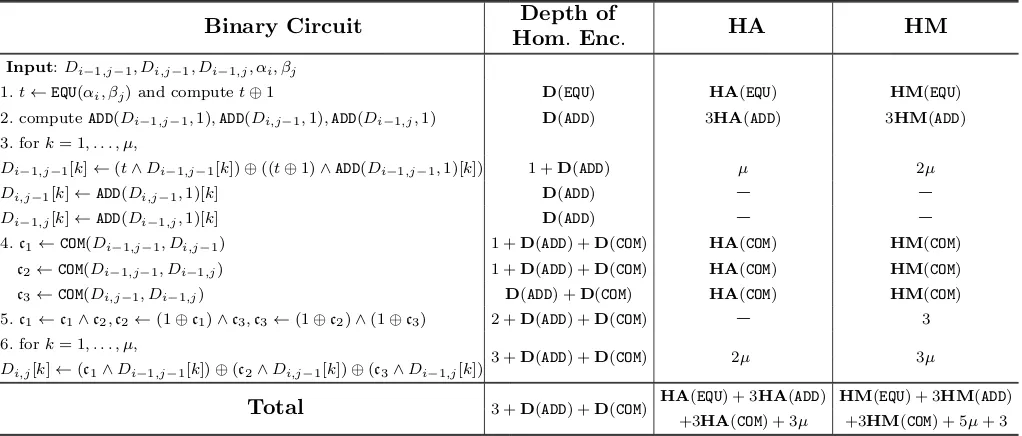
In Table 4, we describe a pseudocode for obtaining the encrypted value Di,j, and provide an
approximation of the levels and computational complexity during homomorphic operations. By the building block algorithms of COM(in Lemma 1) and ADD(in Section 4.1), the one diagonal-round circuits have
D= 2 log(µ−1) + 4, HA= 15µ+ω−6, HM= 3(µ−1) log(µ−1) + 11µ+ω−13.
It is possible to computeDi,j’s simultaneously wheni+jis a fixed value from 1,2, ...,(n+m−1), so we expect to consume (2 log(µ−1) + 4)·(n+m−1) levels for computing them diagonally, which requires (15µ+ω−6)nmhomomorphic additions and (3(µ−1) log(µ−1)+11µ+ω−13)nm
multiplications in total. In other words, given two encrypted sequences of lengths n and m, a SWHE scheme of depthO((n+m) log(log(n+m))) can evaluate the edit distance algorithm in O(nmlog(n+m)) homomorphic computations.
Remark 1 Lemma 1 shows that we can compare two µ-bits with a circuit of depthlogµ using a homomorphic bit-encryption scheme. If we consider a large integer ring Zt as a message
algorithm. Moreover, the comparison algorithm seems to require a circuit of at least depthlogt. This implies that a large message space increases the depth of one diagonal-round circuits to O(log(n+m)), so the edit distance algorithm can be evaluated with a SWHE scheme of depth O((n+m) log(n+m)).
4.3 Optimization of Encrypted Edit Distance Algorithm
We present an optimization to reduce the depth during the homomorphic evaluations of the algorithm. Let us consider the 3×3 blockB in Figure 2.
Di−2,j−2Di−2,j−1 Di−2,j
Di−1,j−2Di−1,j−1 Di−1,j
Di,j−2 Di,j−1 Di,j T
B
L R
Fig. 2.Block of size 3
It is true that if we have computed the top and left values of this block, Di−2,j−2, Di−2,j−1,
Di−2,j, Di−1,j−2,Di,j−2, then all other values can be expressed in terms of them. For example,
Di,j is the minimum value between the following 7 numbers:
Di−2,j−2+ti−1,j−1+ti,j, Di−2,j−1+ti−1,j+ 1, Di−2,j−1+ti−1,j+ 1,
Di−1,j−2+ti,j−1+ 1, Di−1,j−2+ti,j−1+ 1, Di−2,j+ 2, Di,j−2+ 2. In general, we consider a block of size-(τ + 1) which consists of the following sets:
top :T ={Di−τ,j−τ, Di−τ,j−τ+1, . . . , Di−τ,j},
left :L={Di−τ,j−τ, Di−τ+1,j−τ, . . . , Di,j−τ},
right :R={Di−τ,j, Di−τ+1,j, . . . , Di,j},
bottom :B={Di,j−τ, Di,j−τ+1, . . . , Di,j}.
Then all the values ofRand B are expressed in terms of values ofT and L.
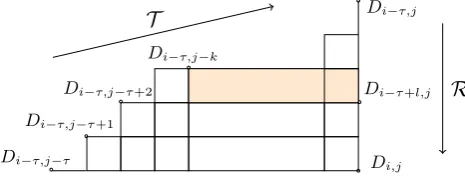
More precisely, consider the grid shown in Figure 3. One can only move one unit right or down on the grid: if moving right from Di−k,j−l, then ti−k+1,j−l+1 is added to the value and we obtainDi−k,j−l+ti−k+1,j−l+1. In the case of moving one unit down, “1” is added to it. We
Di−τ,j−τ Di−τ,j−τ+1
Di−τ,j−τ+2 Di−τ+l,j
Di−τ,j−k
Di−τ,j
Di,j
R T
note that the number of shortest paths from Di−τ,j−k to Di−τ+l,j is k!(ll−!k)! =
l k
for some
l≥k since the paths includek steps in the x axis and (l−k) steps in y axis. It is seen as the the number of the functions ofDi−τ+l,j in terms ofDi−τ,j−k. From these observations,Di−τ+l,j
is the minimum between Pl
k=0
l k
= 2l values. In particular, Di,j is the minimum between
2·Pτ
k=0
τ k
−τ = 2τ+1−τ values because the set of all the paths of D
i,j is symmetric with
respect to the line from Di−τ,j−τ to Di,j. We know that the minimum circuits consume the
largest number of levels than others (equality circuit or addition circuits), and it needsO(logk) levels to evaluate the minimum circuits MINk that compute the minimum value between k
numbers, which requires O(k2) homomorphic computations. Thus, one can compute a block of size-(τ + 1) by evaluating the circuits with a SWHE of depthO(log(2τ+1−τ))≈ O(τ) in
X
k=2,22,...,2τ−1
O(k2) +O((2τ+1−τ)2)≈ O(22τ)
homomorphic operations. From the fact that all the blocks of size-(τ + 1) can be computed diagonally while shares of the values ofT andL have been computed, we can conclude that the edit distance algorithm can be implemented usingO(22τ·nm
τ2 ) homomorphic operations with a
SWHE scheme of depthO(τ·(n+m
τ −1))≈ O(n+m) for given two encrypted sequences of lengths n and m. Hence, this optimization reduces the depth, but the entire computation increases as
τ becomes larger. In particular, in the case of n = m, we can implement the algorithm with lesser depth circuits. The essence of the idea is formally captured in Lemma 3 below.
Lemma 3 Let σj denote the elementary symmetric polynomial of degree j in x1, x2, . . . , xn and eσj the binary circuit which is a conversion of σj by the following rules: +7→ ⊕and · 7→ ∧. Also, let µ:=dlogne. Then the addition circuits ADDn convert the sum of none-bit xi’s into a µ-bit integer, defined by(S[1], S[2], . . . , S[µ]) satisfying
S[i] = M 1≤j≤n
( M
1≤k≤j k[i]=1
j k
2
)∧ σj.e
Proof. DenoteSn the symmetric group on thenletters and
Xk :=
X
ζ∈Sn
xζ(1)· · ·xζ(k)·(xζ(k+1)+ 1)· · ·(xζ(n)+ 1)
.
Let us cj denote a coefficient of σj in Xk over integers. We show that cj · nj
= nj−−kk
· nk
. More precisely, the number of monomials of degree j inXk is cj· nj
because nj can be seen as the number of the monomials ofσk. Note that for a fixedζ ∈Sn, the number of monomials
of degree j in xζ(1)· · ·xζ(k)·(xζ(k+1)+ 1)· · ·(xζ(n)+ 1)
is nj−−kk
. Since the number of such
polynomials is nk, we have cj = kj and Xk=
P
cjσj =P
k≤j≤n j k
·σj.
Now let us consider the binary circuit Xke , that is,
e
Xk =
M
ζ∈Sn
so we have Xek =⊕k≤j≤n( j
k
2∧eσj). Hence, we can conclude that
S[i] = M 1≤k≤n
(Xek∧k[i]) = M
1≤k≤n
M
k≤j≤n
j k
2 ∧eσj
∧k[i]
= M
1≤k≤j≤n k[i]=1
j k
2
∧eσj = M 1≤j≤n
M
1≤k≤j k[i]=1
j k 2
∧σje .
The first equality follows since only kvalues ofx1, . . . , xn can be “1” (i.e.,Pni=1xi =k) if and
only if Xke = 1. ut
For example, if we let n= 3, then we know that
S[1] =
1 1
2 ∧σe1
⊕ 3 1 2 ⊕ 3 3 2
∧σe3
=eσ1 =x1⊕x2⊕x3,
S[2] =
2 2
2 ∧σe2
⊕ 3 2 2 ⊕ 3 3 2
∧σe3
=eσ2 = (x1∧x2)⊕(x2∧x3)⊕(x3∧x1).
The lemma implies that if we have computed “⊕ j k
2” satisfying 1 ≤k≤j and k[i] = 1 (for 1≤i≤µ and 1≤j≤n), then Si’s are expressed in terms of the symmetric polynomials with degree no more than n. The following proposition follows from Lemma 3.
Proposition 4 Encrypted Edit distance algorithm can be implemented on two sequences of length n over anω-bit alphabet with a somewhat homomorphic scheme of depth
dlogωe+dlogne+dlog
blog(n+dn 2e −1)c
e+dlog n0e+ 2
where n0 =−dn
2e −1 + 2
Pd
n
2e−1
i=0
n i
.
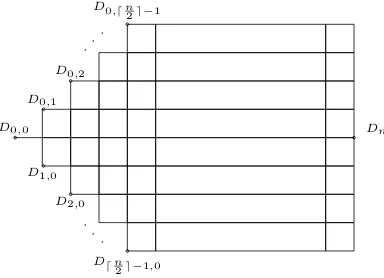
Proof. Let us consider a size-(n+ 1) block. Since Dn,n = Dn is less than n and Di,0, D0,i are
greater than 2i,Dncan be expressed as a function ofD0,0, D1,0, . . . , Ddn2e−1,0, D0,1, . . . , D0,dn2e−1, andti,j’s satisfying|i−j| ≤ dn2e, as shown in Figure 4 (which means that it is enough to compute
only a little part of the block).
D0,0 D0,1
D0,2 ··
· D0,dn
2e−1
Dn
D1,0
D2,0
Ddn 2e−1,0 ·
· ·
Firstly it needs dlogωe levels to compute ti,j’s with the equality circuits overω-bits. Next, from the fact that the number of the functions ofDnwith respect toDi,0 is ni
, the edit distance
Dnis the minimum betweenn0 =−dn2e+ 2Pdn2e−1
i=0
n i
values which have the following form:
Di,0+ti1,j1+ti2,j2+· · ·+tin−k,jn−k+i= 2i+ti1,j1 +ti2,j2 +· · ·+tin−k,jn−k
where 1 ≤ i1 ≤ i2 ≤ · · · ≤ in−k ≤ n and 1 ≤ j1 ≤ j2 ≤ · · · ≤ jn−k ≤ n. In particular,
“t1,1+t2,2+· · ·+tn,n” has binary circuits which consume the largest levels to be evaluated,
and from Lemma 3 we expect that it needs dlogne levels. We note that all the values to be compared are less thann+dn
2e −1 and they are considered to be ofblog(n+d
n
2e −1)c+ 1-bit, so we have D(COM) =dlog blog(n+dn
2e −1)c
e+ 1. Finally, the proposition follows that
D(ti,j) +D(t1,1+· · ·+tn,n) +D(COM) +D(MINn
0 )
= (dlogωe) + (dlogne) +dlog(blog(n+dn
2e −1)c)e+ 1
+ dlog n0
e+ 1
.
u t
The result of Proposition 4 tells us that we can reduce the depth of computing edit distance toO(logn0)≈ O(log(2·2n2−1))≈ O(n). In particular, ifn=m= 8, then the number of levels
consumed by the edit distance algorithm is approximately 16.
5 Implementation and Discussions
In the following we give an estimated performance of the encrypted edit distance algorithm over DNA sequences and provide concrete timings for homomorphic evaluation of the algorithm with Shoup’s NTL library [22] and Halevi-Shoup’s HE library [13] over GMP. A complete description of this scheme is given in [8]. We may assume thatω= 2 from the fact that Σ={A, G, C, D}. In our scenario, the third parties first partition their own DNA sequences into segments of lengthnor m. Then each of the DNA sequences is expressed in a binary representation. After that, each bit is encrypted as a different ciphertext with a homomorphic encryption scheme. For parallel computation, we use an encryption scheme with plaintext space Z`2 supporting SIMD operations with`slots. Then one party sends the ciphertexts which hold the`segments together to a cloud. Finally, the cloud service computes the edit distances of ` different sequence pairs simultaneously. The amortized time is computed as the total time of this algorithm evaluation divided by`.
5.1 Estimates
In addition to the modulus switching method, there is another noise-management technique-bootstrapping which evaluates the decryption circuit of homomorphic encryption scheme using the decryption key. This results in a different encryption of the ciphertext with reduced noise, so the number of homomorphic operations becomes unlimited, called fully homomorphic en-cryption (FHE).
Table 5.Estimates of amortized timing for homomorphic edit distance computation using a FHE scheme [4]
(n,m) Toy Small Medium Large
Security 42 52 62 72
# of slots 10 37 138 531
pksize 647kB 13.3MB 304MB 5.6GB
(1,1) 0.108s 0.297s 0.891s 3.402s
(2,2) 1.104s 3.046s 9.107s 34.776s
(3,3) 3.996s 11.025s 32.962s 2min 5s
(4,4) 7.104s 19.600s 58.599s 3min 44s
(6,6) 22.032s 1min 1s 3min 2s 11min 34s
(8,8) 39.168s 1min 48s 5min 23s 20min 34s (10,10) 1min 18s 3min 35s 10min 43s 40min 57s (20,20) 6min 19s 17min 26s 52min 8s 3h 19min (30,30) 14min 13s 39min 14s 1h 57min 7h 27min (50,50) 46min 30s 2h 8min 6h 23min 1day 24min (100,100) 3h 34min 9h 50min 1day 5h 4days 16h
algorithm in Section 4.3 needs many more multiplications than the one in Section 4.1. For these reasons, the latter is more suitable for being evaluated via FHE.
We assume that the length of DNA sequence segments is less than 100 because a single DNA sequencer can generate millions of short DNA sequences with 100-120 nucleotides. We first count the total number of homomorphic multiplications in the edit distance algorithm up to size (100,100), which can be seen as the number of bootstrapping operations during the evaluations. Then it is multiplied by the timing for a single bootstrapping operation with their results (using the same parameters as in [4]). We present the estimates of the proposed algorithm in Table 5.
5.2 Experimental result
Using the optimization techniques as described in Section 4.3, we can evaluate the edit distance algorithm homomorphically with low depth circuits for small DNA sequences. Taking 80-bits of security, we used many different parameters for several level parameters L according to the length of the two DNA sequences, that is, we chose SWHE scheme so as to support the depth which are incurred by the computations for each case. In the set up stage, we determine the parameters of a SWHE scheme and generate a secret/public key pair and the modulus switching data.
Table 6. Timing of an implementation of homomorphic edit distance on an Intel Xeon i7 2.3GHz, 192GB (80 bit security)
(n,m) Depth of Ring Modulus ` Key Encryption Total Amortized Hom.Enc. Φd Generation time time
(1,1) 1 d= 4369 256 1.4761s 0.1118s 0.0693s 0.0003s
(2,2) 2 d= 4369 256 1.8358s 0.2844s 0.2532s 0.0009s
(3,3) 8 d= 8191 630 7.0162s 1.7117s 34.3091s 0.0540s
(4,4) 9 d= 8191 630 7.4489s 2.4154s 67.5116s 0.1071s
(6,6) 16 d= 13981 600 16.1076s 9.9498s 26min 33s 2.6555s
(8,8) 19 d= 15709 682 27.5454s 16.4524s 5h 13min 27.5528s
6 Conclusion
In this paper, we proposed an algorithm to perform the edit distance algorithm on encrypted genomic sequences. More precisely, upon input two encrypted sequences of lengthsnand m by a SWHE scheme, our algorithm outputs an encrypted value of their edit distance. We show that this can be done in O(nmlog(n+m)) computations with a SWHE scheme which can homo-morphically evaluate any circuit of depth O((n+m) log(log(n+m))). With our optimization technique, we can reduce the depth of computing edit distance toO(n+m) and the implemen-tation shows that it takes 27.5 seconds forn=m= 8 using the Halevi-Shoup code [13].
Currently we could not implement our algorithm for larger parameters due to large memory requirements, but if one can manage large memory or improve the scheme to reduce the memory requirements, it is expected that the algorithm would run in one day for n = m = 50 when estimated based on the recent CCK+ scheme [4].
The proposed algorithm enables us to perform any sequence analysis over encrypted genomic sequences without worrying about privacy leakage. It would be very interesting to make our algorithm practical for larger parameters by improving the algorithm with the help of more efficient homomorphic encryption.
Acknowledgements. This work was supported by IT R&D program of MSIP/KEIT [No. 10047212] and the MSIP (Ministry of Science, ICT&Future Planning), Korea, under the ITRC (In-formation Technology Research Center) support program (NIPA-2014-H0301-14-1010) super-vised by the NIPA (National IT Industry Promotion Agency). The authors would like to thank the anonymous reviewers of WAHC 2015 for their helpful comments.
References
1. M. J. Atallah, F. Kerschbaum, and W. Du. Secure and private sequence comparisons. InWPES, pages 39-44, 2003.
2. E. Ayday, J.-P. Hubaux, J.L. Raisaro, and J. Rougemont. Protecting and evaluating genomic privacy in medical tests and personalized medicine. InWPES, pages 95-106, 2013.
3. Z. Brakerski, C. Gentry, and V. Vaikuntanathan. (Leveled) fully homomorphic encryption without boot-strapping. In S. Goldwasser, editor,ITCS, pages 309-325, 2012.
4. J. H. Cheon, J.-S. Coron, J. Kim, M. S. Lee, T. Lepoint, and M. Tibouchi, and A. Yun. Batch fully homomorphic encryption over the integers. In T. Johansson and P. Q. Nguyen, editors, EUROCRYPT, LNCS 7881, pages 315-335, 2013.
5. E. D. Cristofaro, S. Faber, and G. Tsudik. Secure Genomic Testing with Size- and Position-Hiding Private Substring Matching. InWPES, pages 107-117, 2013.
7. Y. Erlich and A. Narayanan. Routes for breaching and protecting genetic privacy. InarXiv:1310.3197, 2013. 8. C. Gentry, S. Halevi, and N. Smart. Homomorphic evaluation of the AES circuit. In R. Safavi-Naini and
R. Canetti, editors,Advances in Cryptology-Crypto, LNCS 7417, pages 850-867, 2012.
9. M. Gymrek, A. L. McGuire, D. Golan, E. Halperin, and Y. Erlich. Identifying personal genomes by surname inference. InScience 339, pages 321-324, 2013.
10. M. Humbert, E. Ayday, J.-P. Hubaux, and A. Telenti. Addressing the concerns of the lacks family: Quantifi-cation of kin genomic privacy. Secure pattern matching using somewhat homomorphic encryption. InCCSW, ACM, pages 1141-1152, 2013.
11. Y. Huang, D. Evans, J. Katz, and L. Malka. Faster secure two-party computation using garbled circuits. In Proceedings of the 20th USENIX Security Symposium, pages 35-50, 2011.
12. HapMap. Inhttp://www.hapmap.org/, 2007.
13. S. Halev and V. Shoup. Design and implementation of a homomorphic-encryption library. Technical report, IBM Technical Report, 2013.
14. S. Jha, L. Kruger, and V. Shmatikov. Towards practical privacy for genomic computation. InIEEE Sympo-sium on Security&Privacy, pages 216-230, 2008.
15. M. Kantarcioglu, W. Jiang, Y. Liu, and B. Malin. A cryptographic approach to securely share and query genomic sequences. InIEEE Transactions on Information Technology in Biomedicine, pages 606-617, 2008. 16. V. Kolesnikov, A.-R. Sadeghi, and T. Schneider. Improved garbled circuit building blocks and applications
to auctions and computing minima. InCANS, pages 1-20, 2009.
17. Kristin Lauter, Michael Naehrig, and Vinod Vaikuntanathan. Can homomorphic encryption be practical? InCCSW, ACM, pages 113-124, 2011.
18. Y. Lindell and B. Pinkas. A proof of Yao’s protocol for secure two-party computation. In
http://eprint.iacr.org/2004/175, 2004.
19. B. Malin and L. Sweeney. Inferring genotype from clinical phenotype through a knowledge based algorithm. InPacific Symposium on Biocomputing, pages 41-52, 2002.
20. B. Malin and L. Sweeney. How (not) to protect genomic data privacy in a distributed network: using trail re-identification to evaluate and design anonymity protection systems. Journal of Biomedical Informatics, 37(3):571-588, 2004.
21. Personal Genome Project. Inhttp://www.personalgenomes.org/community.html.
22. V. Shoup. NTL: A library for doing number theory. Inhttp://www.shoup.net/ntl, 2009.
23. L. Sweeney, A. Abu, and J. Winn. Identifying Participants in the Personal Genome Project by Name, In Harvard University. Data Privacy Lab. White Paper 1021-1, 2013.
24. Stranger Visions. Inhttp://deweyhagborg.com/strangervisions, 2012.
25. R. A. Wagner and M. J. Fischer. The string to string correction problem.Journal of the ACM, 21(1):168-173, 1974.
26. A. Yao. How to generate and exchange secrets. In R. Ostrovsky, editor,FOCS, pages 162-167, 1986. 27. M. Yasuda, T. Shimoyama, J. Kogure, K. Yokoyama, and T. Koshiba. Secure pattern matching using
![Table 5. Estimates of amortized timing for homomorphic edit distance computation using a FHE scheme [4]](https://thumb-us.123doks.com/thumbv2/123dok_us/7945700.1318839/14.595.151.443.114.349/table-estimates-amortized-timing-homomorphic-distance-computation-scheme.webp)