Ultraviolet-B Light Radiation and its
Effect on the Growth and Development
of Solanum lycopersicum L.
Okon, Okon Godwin*1, Okhueleigbe, Austine2and Akpan, Gabriel Ukpong3
1
Department of Botany and Ecological Studies, University of Uyo, Nigeria.
2
Biological Sciences Department, University of Abuja, Nigeria.
3
Department of Crop Science, University of Uyo, Nigeria. *Corresponding author: [email protected]
Abstract
The Effect of Ultra-Violet light radiation on growth and development of tomato plant (Solanum lycopersicum) was carried out within a period of 4 weeks at Etinan L.G.A,
Akwa Ibom State, Nigeria. After
transplanting, the plants were inserted into a cupboard with different diameters, with chamber openings ranging from 20cm, 15cm 10cm, 0 cm (closed) and control (open). In the control chamber, the plant height, number of leaves, number of branches and number of fruits recorded thus; 14.00, 13.83, 5.00, and 0.00 respectively. Chamber A (20cm) recorded; 16.13, 12.96, 3.830, and 0.00. Chamber B (15cm) recorded; 18.750, 0.00, 0.00, and 0.00, Chamber C (10cm) recorded; 16.29, 15.50, 4.420, and 0.00 and Chamber D (0cm) recorded; 15.42, 0.00, 0.00, and 0.00 respectively. From this research it is observed that UV-B light radiation is very important in the growth and development of Solanum lycopersicum, but it’s required in a reduced amount which records increase in their growth parameters. Increased UV-light radiation can result in decreases in biomass or total dry matter
production and marketable yield of
agriculturally important plants.
Key Terms –Light Radiation,Tomato, Ultraviolet, UV-B,Radiation and Solanum
lycopersicum.
1. Introduction
attention because UV-B is absorbed by ozone. Different species have different response to the level of UV-B irradiation (Matthew et al., 1996; Skórska, 1996a, b). Different plant responses to supplemental UV-B radiation have been established, mostly injurious but sometimes beneficial. UV-B can influence plant processes either through direct damage or via various regulatory effects (Potters et al., 2009). The injury can be classified into two categories: direct injury to DNA, which can cause heritable mutations, and direct and indirect injury to plant physiological functions (Lidon, 2012). In plants, wide inter and intra specific differences have been reported in response to UV-B irradiation with respect to growth, production of dry matter and physiological and biochemical changes (Fedina et al., 2010). Some plant species are unaffected by UV-B irradiation and several are apparently stimulated in their growth, but most species are sensitive and results in damages, example; Oryza sativa L. (rice)
and Zea mays L. (maize) (Lidon, 2012). On
the other hand, plants have developed protective mechanisms against UV-B stress, such as enhancement of the anti-oxidant system and accumulation of UV-absorbing
compounds. Furthermore, numerous
environmental factors such as water deficit, high temperature, ambient levels of visible radiation and nutrient status have also been shown to weaken or enhance the responses of plants to UV-light radiation, (Lidon, 2012). Understanding the mechanisms by which physiological processes are damaged, repaired, and/or protected is important for understanding the eco-physiological role of UV-light radiation. The aim of this research
is to examine the effect of the varying levels of UV-B radiation on the growth parameters and development of Solanum lycopersicum.
2. Materials and Methods 2.1 Study Area
This research work was carried out at Etinan Local Government Area, Akwa Ibom State, Nigeria. Etinan Local Government Area lies between latitude 050010N and longitude 070540E. It land mass covers a total of 26 square kilometres South of Uyo the Akwa Ibom State Capital and 24 kilometres North of Eket.
2.2 Collection of Experimental plant
The seeds of the experimental plant
(Solanum lycopersicum) used in this
research was collected fromAkwa Ibom State Agricultural Development Project (AKADEP), local farms and markets in Etinan, Akwa Ibom State. The plant used was identified by a plant taxonomist in the Department of Botany, University of Uyo, Nigeria.
2.3 Bucket/Land Preparation
The sandy- loamy soil used was collected from an abandoned plot land (farm land) in Etinan. The soil was sterilized for two hours and sieved through a 2mm mesh to remove pebbles and mixed with cow dung after which it was transferred into the plastic
buckets to raise Solanum lycopersicum
plant.
The obtained seeds were pretreated by picking out infected seeds. The viable ones were used for this research. Cow dung was used as organic manure for all the treatments. This treatment helps in good seed germination, reduces stress and also overcomes drought effectively (De Ridder and Kuelen, 1990).
2.5Weed Control
Hand pulling was done for weeding at second week after sowing and subsequently at two weeks interval, to prevent weeds from competing with the crops for nutrients, sunlight and water. The plants were also watered daily.
2.6 Experimental Design
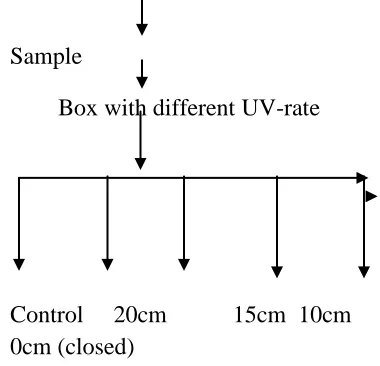
The already grown tomato plants was collected from the bed and then transplanted to the buckets containing soil and the organic manure; there were four buckets with three replications each. The samples were then transferred into the box with different UV-rates. (20cm, 15cm, 10cm, and 0cm), there was also a sample used as the control (open) which was opened to full radiation of the sunlight. The experimental work was carried out in the format shown below; the diameter for the UV rates was measured in centimeter (cm).
Figure 1:chart showing how the experimental work was carried out.
Sample
Box with different UV-rate
Control 20cm 15cm 10cm 0cm (closed)
2.7 Determination of growth parameters
Measurement of growth parameters such as plant height, number of leaves, number of branches, and number of flowers in centimeters (cm) and counting was done after four weeks.
2.8 Statistical Analysis
All the data generated during the field work was analyzed using statistical package for social science (SPSS) 19.0 versions on the independent sample.
3. Results
Table 1 shows the initial readings before the plant specimens were exposed to UV-light, the plant in chamber D had the highest plant height, number of leaves and number of branches with 19.25cm, 24.00cm and 5.50cm respectively. The plant used as control (opened) had the lowest plant height (12.55cm). The plant in chamber B had the least number of leaves (11.00), while all the plants had no flowers.
Collection of already grown tomatoes plant.
Transplanting of the tomatoes plant
Table 1: The measure of initial growth
parameters of Solanum
lycopersicum before exposure to
UV-light radiation. Meas
ured Param
eters UV -Le vel Cham bers Plant Heigh t (cm) No. of Leave s No. of Bran ches No. of flow ers
20 A 12.79 15.50 4.00 0.00
15 B 12.50 11.00 4.00 0.00
10 C 10.75 13.00 4.50 0.00
0 D 19.25 24.00 5.50 0.00
Op en
E 12.25 15.00 4.00 0.00
Data is presented as mean of triplicate experiments
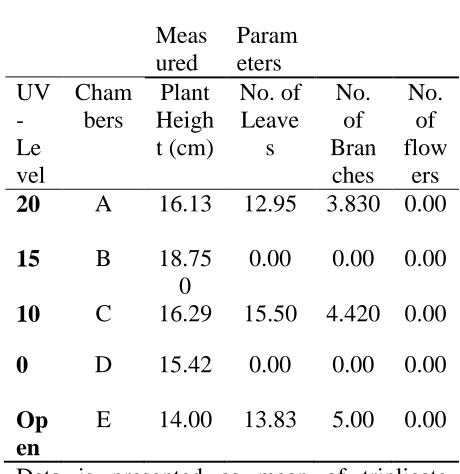
Table 2 shows the average readings of
Solanum lycopersicum after four weeks of
exposure to UV-light, the plant specimen in chamber B had the highest plant height with (18.750 cm), while the specimen in chamber C recorded the highest number of leaves with (15.50), The plant specimen in the open (control) had the lowest plant height with 13.83 cm and recorded the highest number of branches (5.00), also, the plant in chamber A, recorded the lowest of branches
with (3.83). In chamber DSolanum
lycopersicum had lost all its branches, leaves
and reduced in height drastically (15.42cm). All the specimens had no flowers as at the time of these recordings.
Table 2: The growth parameters of Solanum
lycopersicumafter 4 weeks of
exposure to UV-light radiation.
Meas ured Param eters UV -Le vel Cham bers Plant Heigh t (cm) No. of Leave s No. of Bran ches No. of flow ers
20 A 16.13 12.95 3.830 0.00
15 B 18.75
0
0.00 0.00 0.00
10 C 16.29 15.50 4.420 0.00
0 D 15.42 0.00 0.00 0.00
Op en
E 14.00 13.83 5.00 0.00
Data is presented as mean of triplicate experiments
Table 3 shows the differences in the plant height of Solanum lycopersicumafter the period of four weeks of exposure to the U-V light at different levels. The plant in chamber B, had the highest increase in plant height (6.25cm), while the plant in chamber D, recorded the lowest in plant height (-3.83cm).
Table 3: The Difference in plant height of
Solanum lycopersicum after 4
weeks of exposure to UV-light radiation.
Chambers Initial
value (mean) Values after 4 weeks (mean) Difference
A 12.79 16.13 3.38
B 12.50 18.750 6.25
C 10.75 16.29 5.54
E 12.25 14.00 1.75
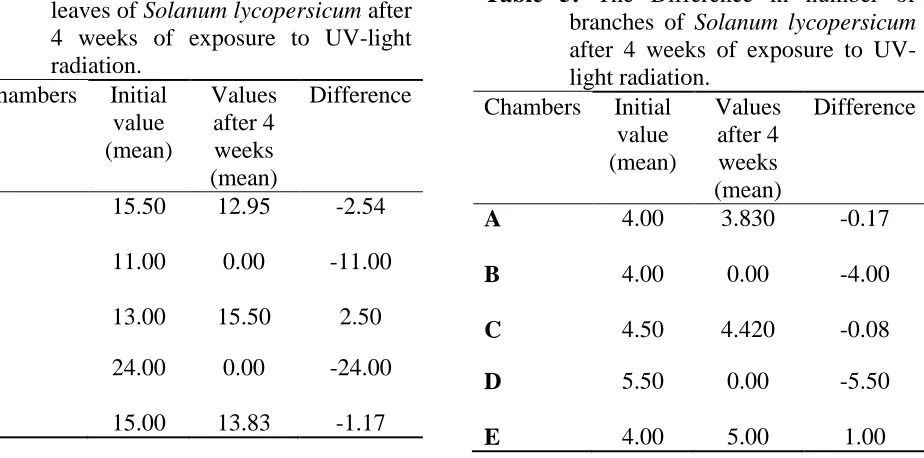
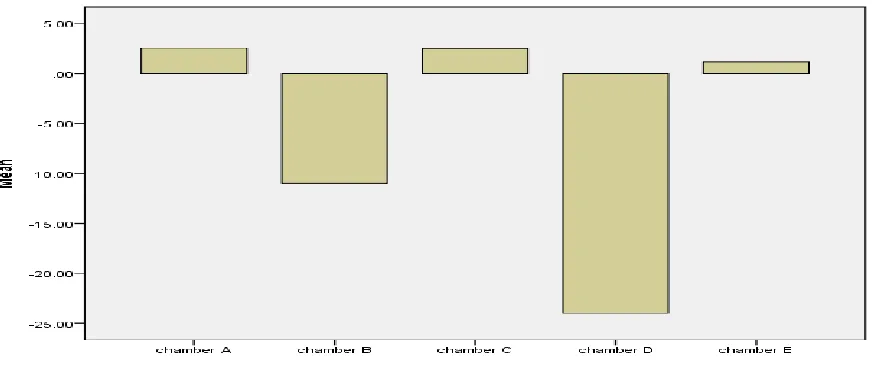
Table 4 shows the differences in the number of leaves of Solanum lycopersicum after four weeks of exposure to U-V at different levels. The plant specimen in chamber C recorded the highest number of leaves with a difference of (2.50); the least in the number of leaves was the plant specimen in chamber D with differences of (-24.00). While all other specimens recorded reduction.
Table 4: The Difference in number of leaves of Solanum lycopersicum after 4 weeks of exposure to UV-light radiation.
Chambers Initial
value (mean)
Values after 4 weeks (mean)
Difference
A 15.50 12.95 -2.54
B 11.00 0.00 -11.00
C 13.00 15.50 2.50
D 24.00 0.00 -24.00
E 15.00 13.83 -1.17
Table 5 shows the differences in the number of branches of Solanum lycopersicum after four weeks of exposure to the UV-light. The plant specimen in chamber E had an increase in the number of branches with (1.00); the least in the number of branches was the specimen in chamber D with a difference of (-5.50). While the other entire specimens lost their branches. The entire treatments had no flowers after four weeks of exposure to different levels of UV-B light radiation.
Table 5: The Difference in number of branches of Solanum lycopersicum
after 4 weeks of exposure to UV-light radiation.
Chambers Initial
value (mean)
Values after 4 weeks (mean)
Difference
A 4.00 3.830 -0.17
B 4.00 0.00 -4.00
C 4.50 4.420 -0.08
D 5.50 0.00 -5.50
Plant height
Figure 2: Changes in the height of Solanum lycopersicum after 4 weeks of exposure to UV-light radiation
Number of leaves
Number of branches
Figure 4: Changes in the number of branches of Solanum lycopersicum after 4 weeks of exposure to UV-light radiation
4. Discussion
Light is the main environmental factor
affecting plant growth. The Solanum
lycopersicum grown in chambers under
different UV-light radiation had different growth habit and different reaction to UV
radiation. Values of the measured
parameters before and after experiment, revealed differences in the readings it showed that at reduced and maintained level of UV radiation, growth in the parameters such as the number of leaves and plant height of Solanum lycopersicumhad grown and increased significantly. It was also observed that Solanum lycopersicum would not grow and develop faster under an increased UV-light radiation. This is in line with the work of Zuk-Golaszewska et al.
(2003) who reported species Avena fatua
and Setaria viridis grown in the greenhouse
under the UV-B radiation had different growth habit and different reaction to UV-B
radiation. The high level of irradiation caused leaf curling, especially at the Setaria
viridis.Similarly, Barness et al. (1988),
Greenberg et al. (1997) and Furness et al.
(1999),they reported the distinguished
changes in the morphological traits such as the plant height and the leaf area reduction and the curling of leaves. This could be as a result of the different sunlight conditions in the series of the experiment. Middleton and Teramura (1994) reported that plant species (and groups) vary considerably in their
response to UV-light, depending on
shrinking at just three days of transplant. It was also observed that transplanting had effect on the plants; the UV radiation helped the tomato plants to stabilize and acclimatize to the environment because the specimen in chamber D had lost all its branches little over five days after the transplant was done.Increased UV-light radiation can result in decreases in biomass or total dry matter production and marketable yield. Correia et al. (1999) reported that increased UV radiation have negative effect on some plants example, Wheat plants (Triticum
aestivum L.) was exposed to high UV
radiation levels showed a reduction in total
plant biomass, leaf area and net
photosynthetic rate compared to the control
that was exposed to ambient UV
radiation.Apart from the negative effect caused by increased Ultra-violet radiation, it also played important role in some species of plants helping in DNA repair, showing that both genetic and epigenetic effects controls DNA repair in plants like in Zea
mays and Arabidopsis thaliana (Campi et
al., 2012).
5. Conclusion
Based on this research it is clear and obvious that UV-B light radiation is a vital environmental factor that can affect the
growth and development of Solanum
lycopersicumeither positively or negatively
depending on the amount of exposure of these plants to UV-B light. The absences of UV-B light lead to poor growth of the plant and may even lead to the death. It was also observed that UV-B light is very important
in the growth and developmentSolanum
lycopersicum, but it’s required in a reduced
amount which records increase in their parameters. Increased UV-B light radiation can result in decreases in biomass or total dry matter production and marketable yield.
References
[1] Barnes P.W., Jordan P.W., Flint
W.G., Caldwell M.M. (1988):
Competition, morphology and
canopy structure in wheat (Triticum
aestivum L.) and wild oat (Avena
fatua L.) exposed to enhanced
ultraviolet-B radiation. Funct. Ecol.,
2: 391–330.
[2] Campi, M., L. D’Andrea, J. Emiliani and P. Casati. (2012). Participation of chromatin remodeling proteins in the repair of UV-B damaged DNA.
Journal of Plant Physiology. 158 (2):
Pp. 981-995.
[3] Cohill, T. P. (1993) Ultraviolet action spectra (280 nm to 380 nm) and solar effectiveness spectra for higher plants. Photochem. Photobiol.
50, 451-457.
[4] Correia, C. M., M. S. Torres Pereira and J. M. G. Torres Pereira.(1999). Growth, photosynthesis and UV-B absorbing compounds of Portuguese Barbela wheat exposed to
ultraviolet-B radiation. Environmental
Pollution.104:Pp. 383-388.
[5] De Ridder, N and van Kuelen, H. (1990).Some Aspects of the Role of
Organic Matter in Sustainable
Intensified Arable Farming Systems in the West African Semi-Arid tropics (SAT). Fertilizer Research.
[6] Fedina, I., J. Hidema, M. Velitchkova, K. Georgieva and D. Nedeva. (2010). UV-B induced
stress responses in three rice
cultivars. Plant Biology. 54 (3):Pp. 571-574.
[7] Frederick, J. E. (1993) Ultraviolet sunlight reaching the earth’s surface. A review of research. Photochem.
Photobiol. 57, 175-178.
[8] Furness, N., Upadhyaya, M. K. and Ormrod, D. P. (1999): Seedling
growth and leaf surface
morphological responses of three rangeland weeds to ultraviolet-B radiation. Weed Sci., 47: 427–434.
[9] Greenberg B.M., Wilson M.I.,
Huang X.-D., Duxbury C.L.,
Gerhaddt K.E., Gensemer R.W. (1997): The effects of ultraviolet-B radiation on higher plants. In: Wang W., Goursuch J., Hughes J.S. (eds.): Plants for environmental studies.
Boca Raton, Fl: CRC Press: 1–35.
[10] Lidon, F. J. C., M. Teixeira and J. C. Ramalho (2012). Decay of the chloroplast pool of ascorbate switches on the oxidative burst in UV-B-irradiated rice. Journal of
Agron Crop Science. 198:Pp. 130–
144.
[11] Matthew C.A. Hoffmann
G.L., McKenzie R.L., Kemp P.D., Osborne M.A. (1996): Growth of ryegrass and white clover under
canopies with contrasting
transmission of ultraviolet-B
radiation. Proc. Ann. Conf. Agron.
Soc. New Zealand, 26: 23–30.
[12] Middleton, E. M. and A. H.
Teramura (1994).Understanding
photosynthesis, pigment and growth responses induced by B and
UV-Air radiances. Journal of
Photochemistry and Photobiology.
60:Pp. 38–45.
[13] Potters, G., T. P. Pasternak, Y. Guisez and M. A. K. Jansen (2009). Different stresses, similar morphogenic responses: integrating a plethora of pathways. Plant Cell
Environment. 32:Pp. 158-169.
[14] Skorska, E. (1996a): Changes
inducted by short-term ultraviolet (UV-B) radiation in photosynthetic activities in pea and rape leaves.
Folia Histochem. Cytobiol., 34: 44.
[15] Skorska, E. (1996b): Reakcja
rzepaku na promieniowanie
ultrafioletowe UV-B. Rosl. Oleist.,
17: 287–282.
[16] Zuk-Golaszewska, K.,
Upadhyaya, M. K. and
Golaszewski1, J. (2003). The effect of UV-B radiation on plant growth
and development. Plant Soil