Article
1
The Daily and Hourly Rainfall Data Modeling using
2
Vector Autoregressive (VAR) with Maximum
3
Likelihood Estimator (MLE) and Bayesian Method
4
(Case Study in Sampean Watershed of Bondowoso,
5
Indonesia)
6
Suci Astutik1, Umu Sa’adah2, Supriatna Adhisuwignjo3 and Rauzan Sumara4,*
7
1 Department of Statistics, Brawijaya University, East Java, Indonesia; [email protected]
8
2 Department of Statistics, Brawijaya University, East Java, Indonesia; [email protected]
9
3 Department of Electronics Engineering, State Polytechnic of Malang, East Java, Indonesia;
10
11
* Correspondence: [email protected]; Tel.: +6281909111417
12
13
Abstract: The hourly and daily rainfall data which is spatially distributed are required as an input
14
for run-off rain model. Furthermore, the run-off rain model is used to detect early flooding. The
15
daily and hourly rainfall data have characteristics that most of data are zero. Therefore we need a
16
model which can capture the phenomenon. A time series model involving location, which is a
17
model that can be developed to approach the daily and hourly rainfall data, we can call Vector
18
Autoregressive (VAR) model. The VAR model allows us for modeling rainfall data in several areas.
19
However, in certain conditions the VAR model often occurs over-parameterization and reduces
20
degrees of freedom. The aim of this study is to compare the VAR model with Maximum Likelihood
21
Estimator (MLE) and Bayesian to hourly and daily rainfall data in SampeanWatershed of
22
Bondowoso. The results showed that the hourly and daily rainfall data are fitted to VAR process of
23
orde 5 and 1 respectively. Based on the AIC and SBC values indicate that the Bayesian is better than
24
the MLE method. The Bayesian is able to predict parameters by producing a smaller variance
25
covariance matrix than the MLE.
26
Keywords: VAR; MLE; Bayesian
27
28
1. Introduction
29
Disasters in Indonesia increase from 2002 to 2015. According to the National Disaster
30
Management Agency the number of disasters which occurred in Indonesia is 143 disasters in 2002
31
and 1,681 disasters in 2015. Most of disasters in Indonesia are hydro-meteorological disasters such
32
floods. From 1 January to 8 February 2016, the National Disaster Management Agency recorded 103
33
floods in Indonesia and 74,369 people were affected by flooding. The areas affected by flooding are
34
East Java about 36 percent, Central Java 21 percent, Aceh 11 percent, West Sumatra 11 percent, Riau
35
7 percent, Jambi 4 percent, North Sumatra 4 percent, West Java 4 percent and West Nusa Tenggara 4
36
percent.
37
Therefore, it is necessary to have an early warning system about flooding in the areas. One of
38
solutions is by simulating and predicting rainfall in these locations. Simulations and predictions on
39
time series data such as rainfall data can use statistical models to explain dynamic of data. A
40
statistical model which allows us for modeling rainfall data in several areas at once is the Vector
41
Autoregressive (VAR) model.
42
Estimating parameter of the VAR model can use the Maximum Likelihood Estimator (MLE). In
43
many cases of using MLE, there are a number of problems such as over-parameterization and
44
collinearity. Therefore, Litterman [4], Sacakli [6] and Tahir [9] use the Bayesian VAR model to avoid
45
these problems. The aim of this study is to model hourly and daily rainfall data with the VAR model
46
using MLE and Bayesian and to compare the two estimation results based on the AIC and SBC
47
values.
48
49
2. Materials and Methods
50
2.1. Materials
51
We collected secondary data from Sampean Baru Waterhed, Bondowoso. The data are hourly
52
and daily rainfall in 7 rain stations these Sentral, Maesan, Ancar, Kejayan, Pakisan, Maskuning
53
Wetan and Sukokerto during January 2006 and January 2007, which is hourly data e.g
54
Sentral( , )and Maesan( ,), and daily data e.g Sentral( , ), Maesan( , ), Ancar( ,), Kejayan
55
( , ), Pakisan ( , ), Maskuning Wetan ( , ), dan Sukokerto ( , ). Stages of the analyses are (1)
56
Stationary test, (3) order VAR(p), (4) estimating parameter of VAR model using MLE and Bayesian,
57
(5) selecting the best model.
58
2.2. Methods
59
2.2.1. Order selection
60
Stationarity of data can be identified by looking at the Matrix Autocorrelation Function
61
(MACF) and Matrix Partial Autocorrelation Function (MPACF). Order selection would be difficult
62
if in the large matrix form, so Tiao and Box in Wei [11] noted the symbols (+), (-), and (.) in the (i, j)
63
position of the sample correlation matrix. The three symbols are explained in Table 1.
64
Table 1.The meanings of the symbols
65
Symbol Summary
+ Denotes a value greater than 2 times the estimated standard errors
- Denotes a value less than 2 times the estimated standard errors
. Denotes a value within 2 times the estimated standard errors
2.2.2. Matrix autocorrelation function (MACF)
66
According to Wei [11], a vector of time series is defined as , , … , then we can calculate
67
( ) = ( ) (1)
69
Where ( ) are the sample cross-correlations for the i th and j th component series,
70
( ) = ∑ ( , )( , )
∑ ( , ) ∑ ( , )
⁄ (2)
71
Where ̅ and ̅ are sample means of the corresponding component series.
72
2.2. 3. Matrix partial autocorrelation function (MPACF)
73
Tiao and Box in Wei [11] define the partial aautoregression matrix at lags, denoted by ( ), to
74
be the last matrix coefficient when then data are fitted to VAR process of orde s. Therefore, ( ) is
75
equal to , . The partial autoregression matrix function is defined as,
76
( ) =
′(1)[ (0)] , = 1
′(s) − ′( )[ ( )] ( ) (0) − ′( )[ ( )] ( ) , > 1 (3)
77
covariance matrices (s) can be obtained by the sample covariance matrices (s),
78
(s) = ∑ ( − )( − )′ , = 1,2, … (4)
79
where = ( ̅ , ̅ , … , ̅ ) is the sample mean vector.
80
2.2. 4. Vector Autoregressive (VAR) using MLE
81
Vector Autoregressive (VAR) model is one of multivariate time series models which has dinamic
82
interrelationship among variabels. Wei [11] defines stationary process of VAR(p),
83
′ = ′+ ∑ ′ ′ + ′ (5)
84
There are T observations, for = + 1, + 2, … , where p is VAR ordo. We have
85
= + (6)
86
where,
87
=
′
⋮
′
, =
′ ⋯ ′
⋮ ⋮ ⋯ ⋮
′ ⋱ ′
, =
′ ′
⋮
′
, dan =
′
⋮
′
88
where and are( − ) × matrices, is( − ) × (1 + ) matrix of observations, and
89
is(1 + ) × matrix of unknown parameters. Defined = − , likelihood function can be
90
writen,
91
( | , ) = (2 ) | | − ( − )′( − ) (7)
and MLEs of and are
93
= ( ′ ) ′
94
and (8)
95
= ( )=( )′( )
96
2.2. 5. Vector Autoregressive (VAR) using Bayeisan or Bayesian Vector Autoregressive (BVAR)
97
Bayesian method is one of the estimation methods used to estimate parameter. There are two
98
important components in estimating using the Bayesian method, prior and posterior distribution.
99
Ntzoufraz [5] noted posterior distribution equal to likelihood function times prior distribution
100
which can be written,
101
( | ) ∝ ( | ) ( ) (9)
102
A conjugate prior is used in this case. According to Berger [1], prior and posterior distributions
103
in the conjugate prior have similar distributions. It is a multivariate normal distribution for
104
parameters and a wishart distribution for parameters. Kadiyala and Karlsson [2] stated that the
105
normal multivariate-wishart prior for BVAR models is better than normal multivariate-diffuse,
106
minnesota, and extended natural conjugate priorbased on RMSE (Root Mean Square Error) and
107
CPU-Time. Tahir [9] noted the normal multivariate-wishartprior is better than minnesota and
108
minnesota-wishart prior based on MSFE (Mean Square Forecast Error). Sims and Zha [7] added that
109
the normal multivariate-wishart prior is suitable in complex models. Koop and Korobilis [3] and
110
Sugita [8] define prior distribution of and ,
111
( ) ~ N( ( ), ) (10)
112
~ Wishart( , )
113
Where , , , are hyperparameter. Initialization of hyperparamter can use non
114
informative prior such as , , , and near to zero. The join posterior is obtained by the join
115
prior
116
( ) ∝ ( ( )) ( )
117
∝ | | −1
2 ( − )
′ ( − ) × | | | | −1
2 [ ]
118
∝ | | | | | | − ( ) + ( − )′ ( − ) (11)
119
with the likelihood function (7), so that the join posterior can be written,
120
( | ) ∝ ( | , ) ( )
∝ | | −1
2 ( − )′( − )
122
× | | | | | | −1
2 ( )
123
+ ( − )′ ( − )
124
∝ | | | | | | − ( − )′( − ) +
125
× − ( − )′ ( − ) (12)
126
From the join posterior (12), we can derive the conditional posterior density for ,
127
( | , ( )) ∝ ( | )
( ( ))
128
∝ | | −1
2 ( − )
′( − ) +
129
∝ | | − [ ] (13)
130
where = ( − )′( − ) + and = − + .So that the conditional posterior
131
statistic form is
132
| , ( ) ~ Wishart( , ) (14)
133
Then we derive the conditional posterior density for ,
134
( ( )| , ) ∝ ( | )
( )
135
∝ −1
2 ( − )
′( − ) + ( − )′ ( − )
136
∝ −1
2 ( − )′( ⊗ ) ( − )
137
+ ( − )′ ( − )
138
∝ − ( − ∗)′ ( − ∗) (15)
where = + ( ⊗ ( ′ )) and (
∗) = ( ) + ( ⊗ ) ( ′ ) ,
140
and we get the conditional posterior statistic form is
141
( ) | , ~ ( ( ∗), ) (16)
142
In this study we use Gibbs Sampler Markov Chain Monte Carlo (MCMC) methods to sample
143
the parameter of and . The conditional posterior distribution is used to process in Gibbs
144
Sampler algorithm.
145
2.2. 6. Markov Chain Monte Carlo (MCMC)
146
Markov Chain Monte Carlo (MCMC) methods are widely used in Bayesian inference.
147
According to Ntzoufraz [5], a Markov chain is a stochastic process { ( ), ( ), ( ), … , ( )} such that
148
( ( )| ( ), … , ( )) = ( ( )| ( )) (17)
149
In order to generate a sample from ( | ), we must contruct a Markov chain with two desired
150
properties. First, ( ( )| ( )) should be easy to generate from, and second, equilibrium
151
distribution of the selected Marcov chain must be the posterior distribution of interest ( | ).
152
Assuming that we have met with these requirements, we then
153
1. Select an initial value ( ).
154
2. Generate R values until the equilibrium distribution is reached.
155
3. Monitor the convergence of MCMC. If convergence diagnostics fail, we then generate
156
more observations.
157
4. Cut off the first B observations (Burn-in Priod).
158
5. Consider{ ( ), ( ), … , ( )}as the sample for the posterior analysis.
159
We refers to analysis of the MCMC, ( ), ( ), ( ), … , ( ). From this sample, for any function
160
( ) of the parameters of interest we can
161
1.
Obtain a sample of the desired parameter ( ) by sample considering162
( ( )), ( ( )), ( ( )), … ( ( )), … , ( ( ))
163
2.
Obtain any posterior summary of ( ) from the sample using traditional sample estimates.164
For instance, we can estimate the posterior mean by
165
( ( )| ) = 1
−
( )
166
and the posterior standard deviation by
167
( ( )| ) = 1
− − 1 (
( )) − ( ( )| )
168
3.
Obtain other measures of interest might be posterior such as 2.5% and 97.5% credible169
4.
Calculate Monte Carlo Error (MC Error).171
2.2. 7. Gibbs Sampler
172
Gibbs Sampler is usually cited as a separate simulation technique because of its popularity and
173
convenience. One advantage of the Gibbs Sampler is that, in each step, random values must be
174
generated from unidimensional distributions for which a wide variety of computational tools exists.
175
Frequently, these conditional distributions have a known form and, thus, random number can be
176
easily simulated using standard function in statistical and computing software. Ntzouftaz [5] noted
177
the algorithm can be summarized by the following steps :
178
1. Set initial values,
179
( )= ( ( )
, ( ), … , ( ))
180
2. For = 1, … , repeat the following steps
181
( )
dari ( | ( ), ( ), … , ( ), )
182
( )
dari ( | ( ), ( ), … , ( ), )
183
( )
dari ( | ( ), ( ), ( ), … , ( ), )
184
. . .
185
( )
dari ( | ( ), ( ), … , ( ), )
186
3. Set ( )= and save it as the generated set of + 1 iteration of the algorithm.
187
2.2. 8. Information Criteria
188
Information criteria have been shown to be effective in selecting a statistical model. In the time
189
series literature, several criteria have been proposed. Two criteria functions are commonly used to
190
determine VAR model, these are AIC (Akaike Information Criterion) and SBC (Schwarzt Bayesian
191
Criterion). The best model is that produce the smallest AIC and SBC values. Tsay[10] provided to
192
calculate the AIC
193
= ln| | + (18)
194
and SBC
195
= ln| | + (19)
196
Here is observation, | | is determinant of variance-covariance matrix, is order model
197
and is variables.
198
199
3. Results
200
For check stationarity in data, we use Dickey-Fuller test (DF). The hypotesis of DF test is ∶
201
= 0 (data are non-stationary) vs ∶ < 0 (data are stationary), as shown on Table 1.
202
Table 2. Dickey-Fuller test
Data Variable df p-value Conclusions
low time-scale (hourly data) , -768.16 0.0001 Stationary
, -1128.20 0.0001 Stationary
high time-scale (daily data) , -15.40 0.0046 Stationary
, -20.53 0.0008 Stationary
, -13.14 0.0094 Stationary
, -18.15 0.0019 Stationary
, -30.70 0.0001 Stationary
, -20.12 0.0010 Stationary
, -15.86 0.0040 Stationary
Based on Table 2, probability values of statistic tests are less than (0.05), reject 0. So the data were
204
stationary. Order selection can be identified by looking at the Matrix Autocorrelation Function
205
(MACF) and Matrix Partial Autocorrelation Function (MPACF). If the time lag of MACF decreases
206
exponential or sinusoid whereas the MPACF is cut off at lag p, it is identified as the VAR(p) model.
207
these MACF and MPACF of hourly data based on Table 3 and 4.
208
Table3. Schematic MACF of hourly data
209
Schematic Representation of Cross Correlations
Variable/Lag 0 1 2 3 4 5 6 7 8 9 10
Sentral +. ++ ++ ++ ++ .+ .+ .+ .+ .+ ..
Maesan .+ .+ +. .+ .. .+ .+ +. +. .. ..
Table 4. Schematic MPACF of hourly data
210
Schematic Representation of Partial Cross Correlations
Variable/Lag 1 2 3 4 5 6 7 8 9 10
Sentral +. +. ++ .. .+ .. .. .. .. ..
Maesan .+ +. .. .. .+ .. .. .. .. ..
And Schematic MACF and MPACF of daily data based onTable 5 and 6,
211
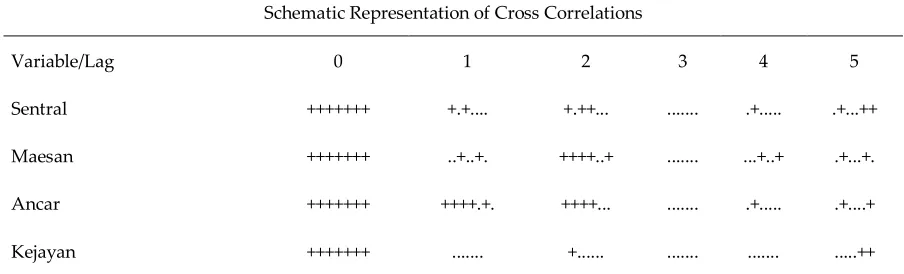
Table 5. Schematic MACF of daily data
212
Schematic Representation of Cross Correlations
Variable/Lag 0 1 2 3 4 5
Sentral +++++++ +.+.... +.++... ... .+... .+...++
Maesan +++++++ ..+..+. ++++..+ ... ...+..+ .+...+.
Ancar +++++++ ++++.+. ++++... ... .+... .+....+
Schematic Representation of Cross Correlations
Variable/Lag 0 1 2 3 4 5
Pakisan +++++++ ... ... ... ... ...
Maskuning_Wetan +++++++ +.+.... +.++... ... ... .+...
Sukokerto +++++++ +++..+. +.++..+ ...+... ... ...
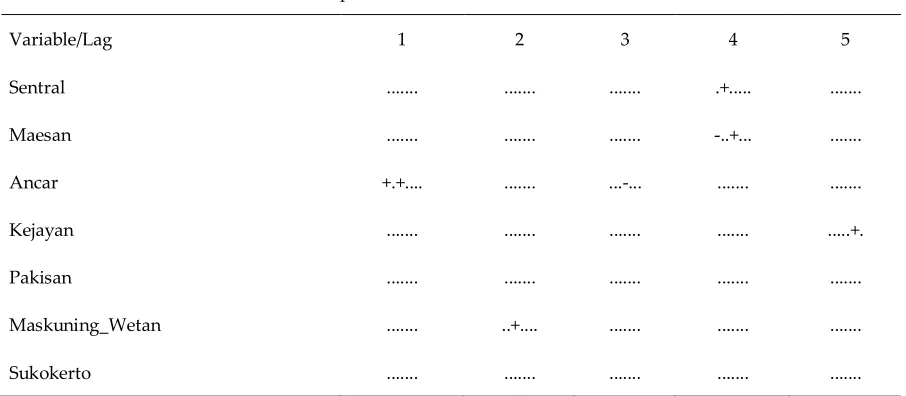
Table 6. Schematic MPACF of daily data
213
Schematic Representation of Partial Cross Correlations
Variable/Lag 1 2 3 4 5
Sentral ... ... ... .+... ...
Maesan ... ... ... -..+... ...
Ancar +.+.... ... ...-... ... ...
Kejayan ... ... ... ... ...+.
Pakisan ... ... ... ... ...
Maskuning_Wetan ... ..+.... ... ... ...
Sukokerto ... ... ... ... ...
From schematic MACF and MPACF above, we can conclude the hourly data following VAR(5)
214
process and the daily data following VAR(1) process. Estimating parameter is showed on Table 7
215
and 8.
216
Table 7.Estimation of VAR(5) parameter using MLE
217
Parameter Estimation Standard Error p-value
0.32857 0.02602 0.0001
0.03919 0.03044 0.1981
0.06520 0.02739 0.0174
0.10129 0.03060 0.0010
⋮ ⋮ ⋮ ⋮
0.01775 0.02309 0.4420
-0.00566 0.02567 0.8256
0.06263 0.02204 0.0046
0.16358 0.02523 0.0001
218
Table 8. Estimation of VAR(1) parameter using MLE
219
Parameter Estimation Standard Error p-value
-0.18800 0.16959 0.2591
-0.19337 0.23768 0.3496
-0.67658 0.42041 0.3327
⋮ ⋮ ⋮ ⋮
-0.09275 0.23840 0.6988
0.05637 0.20870 0.7881
-0.13940 0.42170 0.7423
0.23132 0.21750 0.2923
Based onTabel 7 and 8, VAR(5) model of hourly rainfall data is
220
, , = 0.32857 0.03919 0.02949 0.10497 , , + 0.0652 0.10129 0.00277 0.01727 , , + 0.08415 −0.03713 0,07183 0.05306 , ,221
+ 0.01734 −0.01373
0.01775 −0.00566 , , + −0.0406 0.0399 0.06263 0.16358 , , + , , (20)
222
VAR(1) model of daily rainfall data is
223
⎝ ⎜ ⎜ ⎜ ⎜ ⎛ , , , , , , ,⎠ ⎟ ⎟ ⎟ ⎟ ⎞ = ⎝ ⎜ ⎜ ⎜ ⎛−0.18800 −0.19337 0.85982 −0.67658 0.09860 −0.03643 0.63522
−0.05576 0.11628 0.22896 −0.07745 −0.09388 −0.11320 0.43326
−0.07923 −0.10828 0.88104 −0.75124 −0.06305 0.17090 0.67162
−0.08718 −0.00664 0.41018 −0.43418 0.13383 −0.21618 0.42185
0.03235 0.01375 0.19344 −0.22428 0.09159 −0.41097 0.44491
−0.06043 0.10110 0.13431 −0.12422 0.00324 −0.15626 0.31318
−0.13302 0.12277 0.26998 −0.09275 0.05637 −0.13940 0.23132⎠
⎟ ⎟ ⎟ ⎞ ⎝ ⎜ ⎜ ⎜ ⎜ ⎛ , , , , , , , ⎠ ⎟ ⎟ ⎟ ⎟ ⎞ + ⎝ ⎜ ⎜ ⎜ ⎛ , , , , , , , ⎠ ⎟ ⎟ ⎟ ⎞
224
(21)225
The simulation process in estimating parameters with Bayesian method uses Gibbs Sampler
226
algorithm. Initial values in the simulation process are approximated by MLE. The first step of
227
simulation process generates the parameter then the second step generates the parameter . To
228
compile and run the MCMC algorithm for 10000 iterations and 500 burn in. It is divided into 97
229
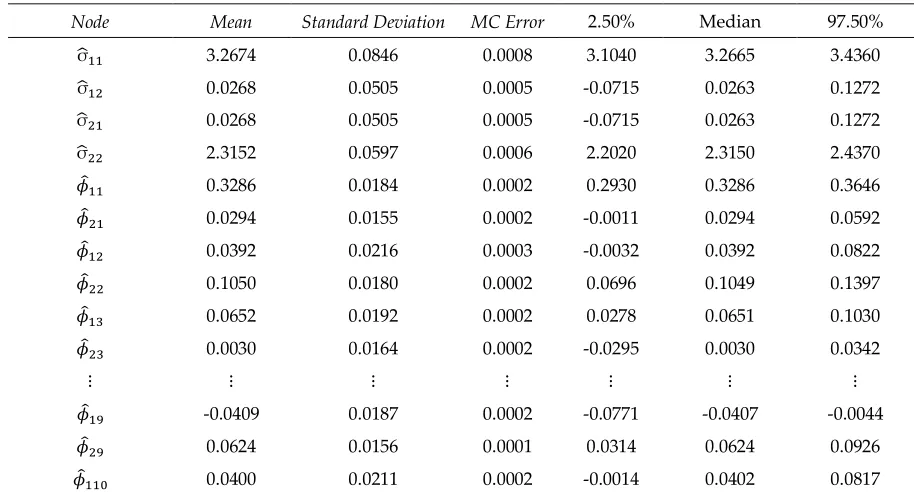
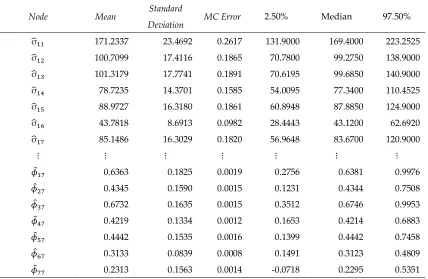
batches for calculating MC error. The posterior summary is showed in Table 9 and 10
230
Table 9. Estimation of BVAR(5) parameter
231
Node Mean Standard Deviation MC Error 2.50% Median 97.50%
σ 3.2674 0.0846 0.0008 3.1040 3.2665 3.4360
σ 0.0268 0.0505 0.0005 -0.0715 0.0263 0.1272
σ 0.0268 0.0505 0.0005 -0.0715 0.0263 0.1272
σ 2.3152 0.0597 0.0006 2.2020 2.3150 2.4370
0.3286 0.0184 0.0002 0.2930 0.3286 0.3646
0.0294 0.0155 0.0002 -0.0011 0.0294 0.0592
0.0392 0.0216 0.0003 -0.0032 0.0392 0.0822
0.1050 0.0180 0.0002 0.0696 0.1049 0.1397
0.0652 0.0192 0.0002 0.0278 0.0651 0.1030
0.0030 0.0164 0.0002 -0.0295 0.0030 0.0342
⋮ ⋮ ⋮ ⋮ ⋮ ⋮ ⋮
-0.0409 0.0187 0.0002 -0.0771 -0.0407 -0.0044
0.0624 0.0156 0.0001 0.0314 0.0624 0.0926
0.1637 0.0179 0.0002 0.1286 0.1638 0.1990
232
Table 10. Estimation of BVAR(1) parameter
233
Node Mean Standard
Deviation MC Error 2.50% Median 97.50%
σ 171.2337 23.4692 0.2617 131.9000 169.4000 223.2525
σ 100.7099 17.4116 0.1865 70.7800 99.2750 138.9000
σ 101.3179 17.7741 0.1891 70.6195 99.6850 140.9000
σ 78.7235 14.3701 0.1585 54.0095 77.3400 110.4525
σ 88.9727 16.3180 0.1861 60.8948 87.8850 124.9000
σ 43.7818 8.6913 0.0982 28.4443 43.1200 62.6920
σ 85.1486 16.3029 0.1820 56.9648 83.6700 120.9000
⋮ ⋮ ⋮ ⋮ ⋮ ⋮ ⋮
0.6363 0.1825 0.0019 0.2756 0.6381 0.9976
0.4345 0.1590 0.0015 0.1231 0.4344 0.7508
0.6732 0.1635 0.0015 0.3512 0.6746 0.9953
0.4219 0.1334 0.0012 0.1653 0.4214 0.6883
0.4442 0.1535 0.0016 0.1399 0.4442 0.7458
0.3133 0.0839 0.0008 0.1491 0.3123 0.4809
0.2313 0.1563 0.0014 -0.0718 0.2295 0.5351
Based on table 9 and 10, each of parameters is konvergence, because MC Error values are less than
234
1% standard deviation. If 2.5% and 97.5% percentiles does not contain a zero, the parameter will be
235
significant. We have BVAR(5) model of hourly data,
236
, , = 0.3286 0.0392 0.0294 0.1050 , , + 0.0652 0.1012 0.0030 0.0172 , , + 0.0845 −0.0374 0,0716 0.0530 , ,237
+ 0.0174 −0.0136
0.0180 −0.0055 , , + −0.0409 0.0400 0.0624 0.1637 , , + , , (22)
238
and BVAR(1) model of daily data
239
⎝ ⎜ ⎜ ⎜ ⎜ ⎛ , , , , , , ,⎠ ⎟ ⎟ ⎟ ⎟ ⎞ = ⎝ ⎜ ⎜ ⎜ ⎛−0.1866 −0.1923 0.8610 −0.6816 0.1009 −0.0404 0.6363
−0.0539 0.1167 0.2302 −0.0831 −0.0927 −0.1142 0.4345
−0.0802 −0.1078 0.8832 −0.7547 −0.0598 0.1671 0.6732
−0.0851 −0.0074 0.4104 −0.4376 0.1351 −0.2158 0.4219
0.0349 0.0137 0.1925 −0.2277 0.0933 −0.4120 0.4442
−0.0597 0.1012 0.1344 −0.1262 0.0041 −0.1558 0.3133
−0.1305 0.1229 0.2703 −0.0980 0.0584 −0.1401 0.2313⎠
⎟ ⎟ ⎟ ⎞ ⎝ ⎜ ⎜ ⎜ ⎜ ⎛ , , , , , , , ⎠ ⎟ ⎟ ⎟ ⎟ ⎞ + ⎝ ⎜ ⎜ ⎜ ⎛ , , , , , , ,⎠ ⎟ ⎟ ⎟ ⎞ (23)
240
The model selection uses AIC and SBC values. The AIC and SBC values are showed in Table 11
241
bellow,
242
Table 11. AIC and SBC values
243
Model Estimation Method AIC SBC
VAR(5) MLE 3.4257 3.4972
VAR(1) MLE 33.5855 35.2811
Bayesian 29.7573 31.4385
It shows that Bayesian method is better than MLE, because the AIC and SBC values are smaller than
244
MLE method.
245
4. Discussion
246
Based on Table 2 - Table 6 it can be seen that hourly and daily rainfall data have fulfilled the
247
stationary assumption, which is the assumption of the VAR model. The corresponding hourly
248
and daily rainfall models are VAR (5) and VAR (1), respectively, seen from MACF and
249
MPACF. The estimation results of the VAR(1) model parameter for daily rainfall data with
250
the MLE method (Equation 20) and the Bayesian method (Equation 22) produce values that
251
are not much different. So do the VAR(5) model for hourly rainfall data by the MLE
252
method (equation 21) and the bayesian method (Equation 23). This shows that the MLE and
253
bayesian methods provide the results of estimating the parameters of the VAR model that are
254
almost the same. However, based on the AIC and SBC values (Table 11) shows that the
255
Bayesian method produces a VAR model with smaller AIC and SBC values compared to the
256
MLE method for both hourly and daily rainfall data. This means that in hourly and daily
257
rainfall data, the Bayesian method produces a VAR model that is better than the MLE
258
method.
259
5. Conclusions
260
We can conclude that the hourly rainfall data and daily rainfall data at Sampean Bondowoso
261
watershed station follow VAR(5) and VAR(2) respectively. The criteria of best models show that
262
parameter estimation using Bayesian method is better than MLE method, because Bayesian method
263
is able to predict parameters with the smaller variance matrix than MLE method.
264
Acknowledgments: Thank you to Kemenristekdikti for the support of research funding in the Fundamental
265
Research Grant 2018, the Rector of Brawijaya University, the Dean of FMIPA and the Chair of the Mathematics
266
Department of Brawijaya University for the support of the permission and funding assistance for this
267
conference.
268
269
References
270
271
1. Berger, J.O. Statistical Decision Theory and Bayesian Analysis, Second Edition, Springer, New York, 1985.
272
2. Kadiyala, K.R.; Karlsson, S. Numerical Methods for Estimation and Inference in Bayesian VAR-Models, Journal
273
of Applied Econometrics.12 (1997), pp. 99-132.
274
3. Koop, G.; Korobilis, D. Bayesian Multivariate Time Series Methods for Empirical Macroeconomics, University of
275
Strathclyde, Galasgow Scotland, 2010.
276
4. Litterman, R.B. Forecasting with Bayesian Vector Autoregressive : Five Years of Experience, Journal of Business &
277
Economic Statistics. 4 (1986), pp. 25-38.
278
5. Ntzoufras, I. Bayesian Modeling Using WinBUGS, John Wiley & Sons, United States, 2009.
279
6. Sacakli, I.S. Do BVAR Models Forecast Turkish GDP Better Than UVAR Models ?, British Journal of
280
7. Sims, C.A.; Zha, T. Bayesian Methods for Dynamic Multivariate Models. International Economic Review.
282
39(1998), pp. 949-968.
283
8. Sugita, K. Bayesian Analysis of a Vector Autoregressive Model With Multiple Structural Breaks,
284
Economics Bulletin. 3(2008), pp. 1-7.
285
9. Tahir, M.A. Analyzing and Forecasting Output Gap and Inflation Using Bayesian Vector Auto Regression (BVAR)
286
Method: A Case of Pakistan,International Jurnal of Economics and Finance.6 (2014), pp. 233-243.
287
10. Tsay, R.S. Multivariate Time Series AnalysisWith R and Financial Applications, John Wiley & Sons, Canada,
288
2014.