
© 2016, IJCSMC All Rights Reserved 66
Available Online atwww.ijcsmc.com
International Journal of Computer Science and Mobile Computing
A Monthly Journal of Computer Science and Information Technology
ISSN 2320–088X
IMPACT FACTOR: 6.017IJCSMC, Vol. 5, Issue. 12, December 2016, pg.66 – 73
Optimizing Energy Consumption in WSN
using Clustering and SPIN Protocol
SAIYED FAIAYAZ WARIS AJEET SINGH
Department of Computer Science Ph.D (CSE) Scholar
Mizan Tepi University, Ethiopia USICT, GGSIPU, Delhi, India [email protected] [email protected]
Abstract— Conservation of energy has been an important issue in wireless sensor networks that is made of tiny sensor nodes with little power, memory and computation power. Restricted resources of the network require mechanism that can efficiently communicates information from sensor nodes to sink. Many existing clustering protocols are there to transfer sensed data from sensor nodes to cluster head and then to sink. Sensor nodes exhaust more energy in communication compared to sensing and computation. Spin protocol decreases notable amount of energy by reducing number of transmission in the network. Spin protocol sends meta-data before circulation of actual data in the network thus reduces traffic. This scheme can be used in clustered network which will further decrease depletion of energy. In this proposed algorithm whole network is partitioned in clusters with one elevated energy playing as cluster head in each clu ster. Each cluster head first collects meta-data of sensed information which is sent by sensor nodes in each cluster. Then cluster head sends request to interested nodes. Only interested nodes will forward actual packet to next hop (CH). Next hop will be decided based on distan ce of that CH from base station. Sink propagates Start-Up packet which holds hop-count .The node which is near to base station will get less hop-count. Significant amount of energy can be reduced by forwarding packet only toward CH which has lesser hop-count than its own hop-count. It expands overall lifespan of network. In this work, we are using Zig-Bee protocol to model and simulate the wireless sensor network. The performance of the IEEE802.15.4 is analyzed based on NS2 Simulator.
Keywords— WSN: Wireless Sensor Network; BI : Beacon interval; BO : Beacon Order; CH : Cluster Head; SO : superframe order; MAC : Medium Access Control; PAN : Personal Area Network; QoS :Quality of Service.
I. INTRODUCTION
(Fig. 1)
An application of Wireless Sensor Network lies in various fields. They are mostly employed in military, home security and medical monitoring. They are also deployed in robot control, automatic manufacturing, and inventory management, industrial and manufacturing automation. In WSN each sensor node consists of power unit, processing unit, communicating unit and sensing unit. The architecture is shown in fig. 1.
A. WSN Protocol Stack
The fig. 2 shows protocol stack that is employed by sensor nodes and sink. Protocol stack shown in fig merges routing and power awareness, combines data with networking protocols. It encourages collaborative attempts of sensor nodes and interacts power efficiently by the wireless channel. The protocol stack contains transport layer, network layer, physical layer, data link layer, application layer. It also consists of power management plane, task management plane and mobility management plane. We can develop various types of software and can use them on application layer based on sensing work. Transparency of software and hardware of lowest layer is possible to end user by application layer. The transport layer is responsible for controlling the flow of data if it is the requirement of sensor network application. The network layer routes the packet coming from transport layer, particular multi-hop wireless routing techniques between sink and sensor nodes. The data link layer takes care of multiplexing of data streams, error control, frame detection and media Access Control (MAC). The MAC protocol should be power aware and able to reduce collision with transmission of neighbors because sensors are mobile and atmosphere is noisy.
(Fig. 2)
node is more in communication than in computation. Depletion of energy can be reduced by proper routing in wireless sensor network. Power failure of sensor node disables node ability to forward packets of other sensor node, and if packet gets lost due to failure of any sensor node during routing, it leads to re-transmission which again will consume more energy, will create more delay in the network and increases the wastage of bandwidth in the sensor network.
In wireless sensor network, information which is sensed by tiny sensor node is transmitted and processed by base station (sink). Sink can be at a long distance from sensor node which does not lie in the transmission range of sensor node. So it may be possible that data had to transfer to sink by multiple hops. Thus it is very necessary to develop a efficient routing scheme for forwarding information from sensor node to base station which consume less energy compared to existing routing techniques. Many routing, data dissemination and power management protocols have been implemented for WSNs where energy consumption is an essential design issue.
II. LITERATURE REVIEW
Many protocols have been presented to route the packet efficiently in the network which depletes less energy as compared to previous protocols.
In [4], the authors have introduced modification in traditional spin protocol so that energy depletion can be reduced. The idea is to send packet only to neighboring node which are toward the base station instead of circulating in the whole network. In this, Distance Discovery phase is added to reduce number of transmission in network; remaining phase negotiation and data transmission are same as traditional spin protocol. In this new phase, base station broadcasts a StartUp packet which holds the value of hop count which is initially set as 1. Sensor node who will receive this startup will store the value of hop count as 1 in its memory. And forward this packet to its neighbors after increasing hop count by 1, when node gets StartUp packet more than once from its neighbors. Node accepts packet with minimum hop count and store hop count in its memory. This process continued till all the nodes in the network gets startup packet once. This way the sensor node which is far away from sink, will get greater hop count.
In this protocol sensor node send ADV packet to its neighbors. Neighbor node checks whether it has transmitted or received the same packet before or not. And hop count of receiving node should be lesser than hop count of sender node means receiving node should be near to sink from sender node. Then receiving node will send request message for actual data.
After that sender sends actual data, Exchanging control information depletes network resources which are useful to do important network operations. In, less constrained and resource abundance base station has been used to propose network partitioning scheme to divide the load uniformly in the network. Energy efficient wireless sensor network can be made by distributing sensor nodes uniformly in the network.
In this scheme [2] whole network is divided by the transmission power level in to rings. This provides one unique location information means unique ring number and by changing beam width of antenna network is divided in to sector. Each sector gets sector number. Thus location of sensor node is identified by two values ring number and sector number. This uniform division of network reduces energy depletion and increases packet delivery ratio.
In[7] algorithms has been proposed which uses static clustering and cluster heads are decided dynamically based on remaining residual energy , degree of node and distance of sensor node from base station. In this approach, sink is kept in the middle of the network which is divided in to fixed clusters using the communication range of sensor node. Clusters are formed by distance based vector routing where sink transmits signal to logically divide network. Selection parameter for cluster head in particular region are energy of node , number of surrounding nodes and distance from base station. Because CH selection is this approach is based on remaining energy and distance from sink so it decreases communication distance between sink and CH which leads to reduction in exhaustion of battery of sensor nodes and that ultimately maximize the lifetime of system.
In EECBRP [5], algorithm had been proposed, in which formation of clusters is started by the happening of any events. Process is started by initiator sensor node which first senses the event and send request to neighbors. Neighbors which are at 2 hop distance from initiator join the initiator and form clusters. If two nodes are sensing same event then node with higher remaining residual energy will play role of initiator. Next step is selection of cluster head for that each node checks the residual energy of itself which should be greater than threshold then only a sensor node can be cluster head. Node has remaining energy greater than threshold it means it has capability to collect data from other sensor nodes aggregate it and forward it to base station. The node which has residual energy more than threshold will calculate competition id which is formulated by following formula.
CVi = Eri * Ni (1)
Where Eri is Remaining Energy of node and Ni is Number of Adjacent nodes of node i
degree of neighbor node. The node that will have highest value of weight will collect data from cluster head and will forward it to next neighbor. This process continues till data reaches to base station.
In wireless sensor network, data must be routed in this way that it should consume minimum energy instead of taking a path that consumes more energy. Path selection should be very energy efficient. In [6] authors observed same path is selected for routing data from sensor nodes to base station based on the hop distance of each sensor node from base station. Selection of same path for forwarding data causes earlier depletion of those involved sensor node than other nodes which reduces lifetime of the whole network. So a new algorithm is required for saving the earlier exhaustion of battery of sensor nodes and has the capability to forward data toward base station. Here authors have proposed a new cluster head selection scheme for spin protocol. In this scheme cluster head is selected in every 50m distance in network. The objective is to shorten the distance between nodes and cluster head by route shorten method. Hello packet is sent to generate cluster head with in 50m distance. Role of cluster head is revolved between sensor nodes based on the total energy of cluster head and sensor nodes in the cluster, because cluster head consumes more energy than normal node in the network. This rotation of cluster head is done after every round of data transmission based on energy. At last, data is transferred from CH to CH and finally to base station.
Tiny sensor node which is operated by irreplaceable and non-rechargeable batteries? It is very important to save the scarce resource of sensor network which can be saved by grouping the sensor nodes in the clusters with node having more energy working as cluster head. But Failure of cluster head network can affect network very badly which may require re clustering of network. Authors [1] have proposed a mechanism of forming cluster of cluster heads with in each cluster of sensor nodes. First sensor nodes are placed in the network in such a way that each sector of the network contains enough number of high energy nodes. To select cluster of cluster heads, sink communicates to all sensor nodes to know their location, energy. Nodes with high residual energy will be selected as cluster heads with in one cluster. One node that has highest remaining energy will act as master node. Only master node will communicate with the other nodes in the cluster. Cluster of cluster heads will visible as a one cluster head in one cluster. To balance the energy depletion among node, role of master among cluster heads is switched after every round of communication. Master node is responsible for forwarding data which is collected by sensor nodes to sink. Here this algorithm has prolonged the lifespan of sensor network by using group of cluster heads instead of traditional one cluster head with in a cluster. It increases fault tolerance of system by using another cluster head in case of failure of one cluster head. It avoids need of re-clustering which requires extra energy.
BEEM algorithm [5] says lifespan of whole network can be decreased by balancing the load on every unit area of sensor network. Previous algorithms LEACH and HEED decrease energy exhaustion by evening the load on sensor nodes. Authors say that lifetime of network not only depends on the death of first node of network but also on coverage of network.
III. OBJECTIVE
Tiny Sensor nodes have limited power for utilization of that power efficiently is very much essential, because the battery of sensor node is not replicable. So choosing suitable routing scheme is one of the main tasks in WSN, to transmit data from source to sink while absorbing less amount of energy. Objective is to reduce energy consumption by employing SPIN protocol in clustered network.
IV. PROBLEM STATEMENT
Energy consumption of network increases by transmission of unnecessary and non-required data. Need methods that can identify which data to send before sending actual data .This can be achieved by first sending the meta-data of data to cluster-head instead of actual data. Cluster head dies more quickly by unnecessary processing of data received from different nodes.
V. METHODOLOGY
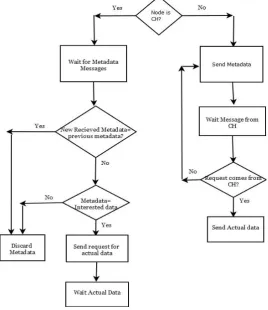
In this section we are going to explain the research methodology,with the help of two models namely are working model and energy consumption model.
A. Working Model
When tiny sensor node senses a new image data and node wants to propagate in the network, then it first transmits advertisement of its metadata to its CH by giving ADV message. After getting metadata of an image(data), cluster head decides whether it is required data or not .If, it is required data then clustered head will send request for that data otherwise it would discard that request And then sensor node will send actual data after receiving request from cluster head. Here energy consumption will be reduced because this process will reduce the number of packets that is being transferred in network.
B. Energy Consumption Model
Fig. 3. Methodology Flow Chart
The first part is the energy depleted to transfer the packet from SN to the CH is E (O1) and second is the energy depleted E(O2) to transmit the packet from cluster head to base station by using Nhop cluster head
E01 = Etransmit + Ereceive (2)
E02 = Nhopj (Etransmit + Ereceive) (3)
Where
Ereceive denotes Energy exhausted when SN receives data.
Etransmit denotes Energy exhausted when SN transfer data
Nhopj denotes number of CHs between SN and base station
Pi is no of nodes in each cluster
C is no of cluster heads.
Pi is number of nodes in each cluster C is number of cluster heads.
The total energy consumption E(m)in SPIN with clustered network is divided in the following parts. The first is the Energy consumed in sending metadata from sensor node to cluster head which is E(m1). Second is the Energy consumed in sending request from cluster head to sensor node which is E(m2). Third is the Energy consumed in sending actual data from sensor node to cluster head which is E(m3). Last is the energy consumed in sending actual data from cluster head to base station by using Nhop cluster heads which is E(m4).
Em1 = Erecmeta + Etransmeta (4)
Em1 = Ereqrecmeta + Ereqtransmeta (5)
Em3 = Ereceive + Etransmit (6)
Em4 = Ehopj (Ereceive + Etransmit) (7)
Where j=1...C-1
Equation (8) Here
Where
Ri << Pi Erecmeta represent energy consumed when CH receive metadata. Erecmeta << Erecieve Etransmeta represent energy
consumed when SN transmit metadata Etransmeta << Etransmit Ereqrec Meta represent energy consumed when CH transmit
request for data.
On comparing Eq3 and Eq7 Ereq rec Meta represent energy consumed when SN receive request for data Ri is the
number of SN which are requested for actual data by any of the CH So E(m) < E(o)
VI. SIMULATION AND RESULTS
In this, we show the simulation set-up and experimentation results on a clustered wireless sensor network to understand the network behavior. Our topology contains three types of devices: Pan Coordinator, Routers and End-Devices.
A. Simulator Used
We have used NS2 simulator which is extremely efficient and powerful software which allows the chances to simulate whole heterogeneous networks with several protocols. NS is a discrete event simulator targeted at networking research. NS provides substantial support for simulation of TCP, routing, and multicast protocols over wired and wireless (local and satellite) networks.
NS began as a variant of the REAL network simulator in 1989 and has evolved substantially over the past few years. In 1995 ns development was supported by DARPA through the VINT project at LBL, Xerox PARC, UCB, and USC/ISI. Currently NS development is support through DARPA with SAMAN and through NSF with CONSER, both in collaboration with other researchers including ACIRI. NS has always included substantial contributions from other researchers, including wireless code from the UCB Daedalus and CMU Monarch projects and Sun Microsystems.
B. NS simulation model of IEEE 802.15.4
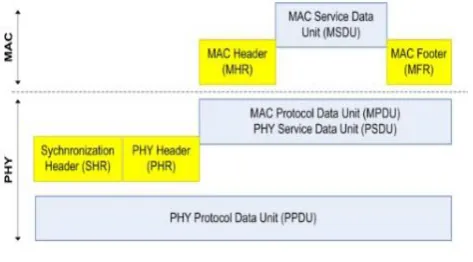
The key idea of using this simulation model was prompted because of necessity to develop a reliable model of the IEEE 802.15.4/ZigBee protocols for WSNs. This NS simulation model performs more precisely the IEEE 802.15.4/Zig Bee protocols without needed overheads and gives appropriate results as compared to Other Modeler standard library. Initially, we made rather correct simulation tool for the IEEE 802.15.4 slotted CSMA/CA scheme by NS standard Modeler simulator library. Then, we enlarged this simulation model about Guaranteed Time Slot (GTS) scheme which assist deterministic real-time traffic. After that, ZigBee network layer which supports cluster-tree topology and hierarchical tree routing was implemented. This simulation model implements the physical layer of the IEEE 802.15.4 standard which is working at 2.4 GHz Frequency band and its data rate is 250 kbps. Slotted CSMA/CA and GTS mechanism are performed by mac layer according to the standard specification and mac layer also assists the beacon-enabled mode. Battery module which calculates the remaining and consumed energy of whole network, the network layer is responsible for implementing hierarchical tree routing according to the ZigBee standard.
Fig. 4. Layers used
The application layer which produce real-time or/and best effort of Contention Free Period (CFP) which include GTS or Contention Access Period (CAP) of the super-frame, respectively. It supports different packet format command, beacon, Ack, PHY packet, MAC packet.
C. Simulation Setup
We have created a clustered wireless sensor network with 4 clusters each having its cluster head. Simulator used: NS2 Topology formation
Fig. 5. Topology Setup
D. Simulation Results
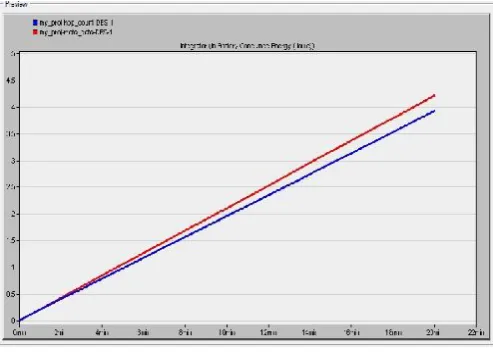
Fig. 6. Total Consumed Energy by Network
This graph shows reduction of energy consumption after employing spin protocol in clustered network.
Fig.7. Comparison of Energy Consumption
Fig.8. Comparison of three Energy Consumption scenarios
This graph depicts the comparison of energy consumption of all three scenarios.
VII. CONCLUSION
The Spin protocol is modified to Cluster Based SPIN protocol which uses hop count to forward packet to sink. Although in time critical operation like war zone it is not appropriate because it consumes much more time to deliver information between sensor nodes.
It exhausts more energy to propagate data between sensor nodes that results energy depletion faster and node dies rapidly. It reduces energy consumption where many nodes transfer unnecessary information to cluster head.
REFERENCES
[1].Wendi Rabiner Heinzelman, Anantha Chandrakasan, and Hari Balakrishnan, “Energy-efficient communication protocol for wireless microsensor networks”, In System sciences, 2000, Proceedings of the 33rd annual Hawaii international
conference on, pages 10–pp. IEEE, 2000.
[2] Sanjay Kumar et al, “Energy efficient clustering algorithm for wsn” In Signal Processing and Integrated Networks (SPIN), 2015 2nd International Conference on, pages 990– 993, IEEE, 2015.
[3]Venkateswarlu K Muni, A Kandasamy, and K Chandrasekaran, “Energyefficient edge-based network partitioning scheme for wireless sensor networks”, In Advances in Computing, Communications and Informatics (ICACCI), 2013 International Conference on, pages 1017–1022, IEEE, 2013.
[4] Zeenat Rehena, Sarbani Roy, and Nandini Mukherjee, “A modified spin for wireless sensor networks”, In 2011 Third International Conference on Communication Systems and Networks (COMSNETS 2011), pages 1–4, IEEE, 2011.
[5] Sohini Roy and Ayan Kumar Das, “Energy efficient cluster based routing protocol (eecbrp) for wireless sensor network”, In Networks & Soft Computing (ICNSC), 2014 First International Conference on, pages 25– 29. IEEE, 2014.
[6] Ashutosh Tripathi, Narendra Yadav, and Reena Dadhich “Spin with cluster for data centric wireless sensor networks”,In 2015 Fifth International Conference on Advanced Computing & Communication Technologies, pages 352–355, IEEE, 2015.
![{μ trans N,N′ Bis[(diphenylphosphanyl)methyl]benzene 1,4 diamine κ2P:P′}bis{(acetonitrile κN)[dipyrido[3,2 a:2′,3′ c]phenazine κ2N4,N5]copper(I)} bis(tetrafluoridoborate)](data:image/gif;base64,R0lGODlhAQABAIAAAP///wAAACH5BAEAAAAALAAAAAABAAEAAAICRAEAOw==)