Preparation Development Of Learning Device
Problem Based Learning Model With Scientific
Approach To Improve Mathematical Problem
Solving Ability
Neilur Rahmi, I Made Arnawa, Yerizon
Abstract— The problem in this study is the students' mathematical problem solving ability is still low, the cause is that the learning device designed by the teacher has not supported the formation of these abilities. Through learning device development will improve students’ mathematical problem solving. This is a development research with Plomp model. The Statistic Group Comparison Design is the experimental design being used in this research. Research result reveals that: (1) Learning device developed by the researcher is 3. 55 in average resulted from validation result by experts and it is a very valid category. (2) On average both teacher and students respond toward learning device based on Problem Based Learning as a whole is valid with 80.675% average percentage and in including in a good or practical respond criteria. (3) Students learning result reveals sig. score (2-tailed) 0.014 smaller than (0.05) score, hence is rejected and is accepted. Conclusions obtained that learning device based on Problem Based Learning with a scientific approach has a significant impact toward class VIII students of Islamic Junior High School (MTs) ability in solving mathematics problem.
Index Terms—Problem Based Learning Model, Scientific Approach and Mathematical Problem Solving Ability.
—————————— ——————————
1 I
NTRODUCTIONSkills in solving problems are the ultimate goal of mathematics learning. This is also stated in Permendiknas No. 22 of 2006, namely that students can solve mathematical problems namely having problem solving skills, designing mathematical models, completing the model and interpreting the solutions obtained [1].
Mathematical problem solving ability is the ability of students to use mathematics in their daily lives [2] [3].This ability can also be applied in the field of field studies other than mathematics [4]. Problem solving is the process used to solve problems [5]. Therefore students need to understand and master mathematics so that various competencies are expected to be achieved well and optimally. Hence, students need to understand and master mathematics in order to achieve a well and optimal competences.
In fact, students’ ability of mathematics problem solving is still low. Many research such as conducted by Cut Yuniza Eviyanti [6], Sandro J. Simamora [7], K. Darma [8] also state the same result that students ability in solving mathematics problem is low.
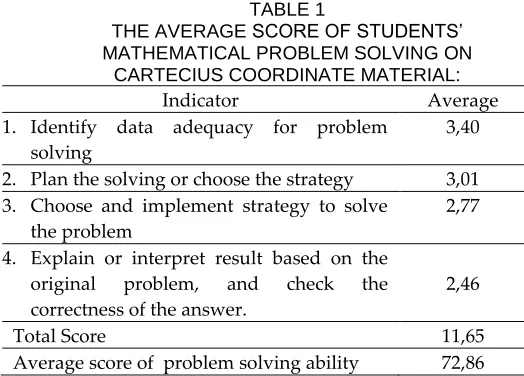
This is supported by the observation result conduct by researcher in Public Islamic Junior High School (MTsN) 1 and Public Islamic Junior High School (MTsN) 2 Bukittinggi. It is known that numerous students are not able yet to solve mathematics problem related with daily life. Researchers provide 2 mathematical problems about cartecius coordinate system. Researchers then ask some students during the test, their answers reveal that they are not used to work on this kind of question.The main factor which causes the low ability of the students to solve mathematics problem is the learning that has conducted are not yet able to develop students’ problem solving ability. Some students look confuse on how to work on that kind of questions. The analysis result shows that students’ ability solving mathematics problem is under the average, as can be seen in Table 1 as follow:
TABLE 1
THE AVERAGE SCORE OF STUDENTS’ MATHEMATICAL PROBLEM SOLVING ON
CARTECIUS COORDINATE MATERIAL:
Indicator Average
1. Identify data adequacy for problem solving
3,40
2. Plan the solving or choose the strategy 3,01 3. Choose and implement strategy to solve
the problem
2,77
4. Explain or interpret result based on the original problem, and check the correctness of the answer.
2,46
Total Score 11,65
Average score of problem solving ability 72,86
KKM (Minimum Completeness Criteria): 75
———————————————— Neilur Rahmi, I Made Arnawa, Yerizon
Postgraduate Student of FMIPA, Padang State University [email protected]
Teaching Staff of FMIPA, Andalas University [email protected] Teaching Staff of FMIPA, Padang State University
523 One of the reasons to the low success of learning is the less
optimal of learning device planning. It is due to the achievement of mathematics learning cannot be separated from the used learning device. [9]. The used learning devices are worksheet (LKPD) and Lesson Plan (RPP). The interview result as conducted by the researcher to teacher in MTsN revealed that learning model in the lesson plan is conventional or direct learning, where teacher delivers learning material in front of class and students sit still while listening teacher explanation without feedback . Next, in the core activity of the learning, teacher did not provide any questions for students, but provides only concept material. As the effect, students are not used to work on that kind of question. In addition, teachers do not design their own LKPD and students also do not have LKPD which can help to support their ability to solve problem.
Based on the above problem, it is important to have a learning model that can be a basic in developing RPP and LKPD. RPP and LKPD can be more improved by relying on one of the learning models which purpose is to improve students’ ability in problem solving and teach them the way to solve problem. One of the learning models used to achieve the purpose is Problem Based Learning (PBL) [10].
PBL was sparked by Dewey (1938) in the field of medical education at McMaster University. There, students are taught content and clinical reasoning by identifying symptoms, making diagnoses, etc. then other fields that use PBL are advertising, architecture, engineering, nursing. They have found this PBL as an effective means [11].
PBL is a learning model that use real world problem as a context for the students to enable them to learn to think critically and to teach them the ability to solve problem, as to allow them to obtain essential knowledge and concept of the learning material [12]. The goals of PBL are to help the students develop flexible knowledge, effective problem solving skills, self-directed learning, effective collaboration skills and intrinsic motivation [13]. Teacher role in developing PBL is not only to stand up in front of class and provide the students with the ready steps of problem solving but teacher plays role a facilitator in discussion, asking question, and help students to be aware on the importance of the learning. PBL also require teacher to be creative in the learning process so that students would be challenged and motivated in solving the problem. [14].
The application of this PBL model is carried out with a scientific approach. The scientific approach is the steps of learning following scientific rules in the form of steps in acquiring knowledge, namely observing, seeking, gathering information, associating and concluding [15].
For this reason, a research on the Development of Learning Device with PBL Model to improve mathematical problem solving ability of class VIII students.
Based on the background above, the research problems are as follow: (1) how is the characteristics a valid and practical
learning device based on PBLwith scientific approach for class VIII students of Islamic Junior High School (MTs)? (2) How is the effectiveness of a valid and practical learning device based on PBL with scientific approach toward class VIII students of Islamic Junior High School (MTs) in solving mathematical problem?
The purposes of this research is: (1) To produce a valid and practical learning device based on PBL with scientific approach for class VIII students of Islamic Junior High School (MTs). (2) To see the effectiveness of learning device based on PBL with scientific approach toward class VIII students of Islamic Junior High School (MTs) ability in solving problem.
2.
METHODS
This is a development research. Development research is a research used to produce particular product and to test the effectiveness of the product itself [16]. Development model employed is Plomp Model. Plomp (Plomp & Nieveen, 2013:30) divides development phases into three, namely, preliminary research, design phase and development and prototyping phase, and assessment phase [17] [3] [18] [19].
Data collection in this research is through validation sheet distributed to expert lecturer and mathematics teacher of class VIII Public Islamic Junior High School (MTsN) 1 Bukittinggi, validation sheet, student respond questionnaire, and final test for student.
Then in determining the validity of the learning device using the formula [20]:
Information:
Validity of learning devices
Average results of the j-item evaluation
many items
The criteria for obtaining the validity level of learning devices use criteria as in Table 2. Following:
TABLE 2
CRITERIA FOR VALIDITY OF LEARNING DEVICES AVERAGE CRITERIA
Average Criteria
R > 3,20 Very Valid 2,40 < R < 3,20 Valid 1,60 < R < 2,40 Fairly Valid 0,80 < R < 1,60 Less Valid
R < 0,80 Invalid
Source: Muliyardi [21]
Learning tools that will be tested are said to be valid and very valid, if the validity criteria used in this study are valid or very valid with R> 2.40.
Information: P: Practical Value R: Score obtained SM: Maximum score
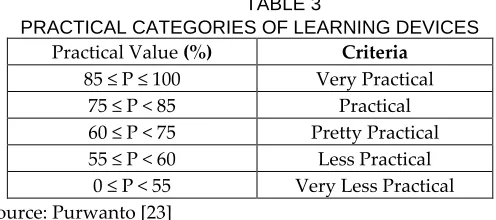
The practicality category of learning devices is determined by the achievement level criteria in Table 3 below:
TABLE 3
PRACTICAL CATEGORIES OF LEARNING DEVICES Practical Value (%) Criteria
85 ≤ P ≤ 100 Very Practical 75 ≤ P < 85 Practical 60 ≤ P < 75 Pretty Practical 55 ≤ P < 60 Less Practical
0 ≤ P < 55 Very Less Practical Source: Purwanto [23]
Learning devices that are tested are said to be practical and very practical with criteria of 75% to 100%.
The effectiveness of learning devices is seen from the results of the final test in the form of problem solving questions that have been assessed based on the problem solving rubric. Then continue using the formula:
TABLE 4
ASSESSMENT CRITERIA FOR EFFECTIVENESS
Range of Category (%) Category
0-20 Very Less Effective
21-40 Ineffective
41-60 is quite effective
61-80 Effective
81-100 Very effective Source: Modified from Eko Putro Widoyoko [23]
Learning devices are said to be effective if the number of students who achieve completeness is greater or equal to 61%. The design of research experiment used on learning result is the Static-Group Comparison. The research design can be described as follow:
TABLE 5
THE STATIC-GROUP COMPARISON
Classes Treatment Post-Test
Experiment X1 O1
Control X2 O2
Appendix:
X1 = PBL model treatment
X2 = Direct learning model treatment O1 = Post-test result in experiment class O2 = Post-test result in control class
Steps in statistics test are as follow: (1) formulate hypothesis,
(2) normality test, (3) homogeneity test, (4) hypothesis test. Statistics test in this research employs version 23 of SPSS software.
Hypothesis test employs test one sample. This one sample t-test is aimed to reveal whether the influence of PBL is better than Direct Learning Model. T-test is conducted by using version 23 of SPSS. Data in this research is two independent samples. Statistics employs independent sample T-Test. Independent t-test is to test the difference between two independent groups (to test two classes, experiment and control classes). The criterion of the test is if sig. score (2-tailed) is smaller than 0.05, hence is rejected and is accepted.
3.
RESULT AND DISCUSSION
On the development and the prototype making process, some experts conduct design and validation processes. The prototype making stage initiated by designing LKPD based on PBL. The result of the design is called as prototype 1. Self evaluation takes place after producing LKPD based on PBL. On self evaluation stage, there found mistyping, imperfect sentence, and inappropriate punctuation. After revising on self evaluation, learning device will be handed over to the experts to do validation. The validated aspects on RPP are its component, learning activity, and language. Lesson Plan validation is conducted by 4 experts consist of 3 mathematics experts, and 1 language expert. The validation result of RPP by the experts can be seen on the following Table 6.
TABLE 6.
THE RESULT OF VALIDATION ASSESSMENT OF RPP Aspect The Average
Assessment Score
Averag e
Criteria
V1 V2 V3 V4 RPP
component 3,1 4 3,4 -
3,52 Very Valid Learning
Activity
3 4 3,5 - 3,5 Very
Valid Language 3 4 3,5 3,5 3,75 Very Valid
Final Average 3.59 Very
525 TABLE 7.
THE RESULT OF RPP REVISION AS SUGGESTED BY VALIDATOR
Before Revision
1. Students can observe geometry in the form of pyramid in their environment
2. Through observation, students can identify the component of the geometry.
3. After identifiying, students can find and explain the width of the pyramid surface by using their own language.
4. Solving the problem in real life in relation with pyramid.
After Revision
1. Through group discussion, students can find the correct width of pyramid surface.
2. Through group discussion, students can solve the problem related with width of pyramid surface correctly.
LKPD is designed based on preliminary analysis conducted by researcher toward need analysis, student analysis, curriculum analysis, and concept analysis. LKPD based on PBL is designed in line with PBL. The designed students work sheet (LKPD) validated by 5 experts consists of 3 mathematics experts, 1 language expert and 1 education technology expert. The validated aspects on LKPD are presentation, appropriateness, content, graphic or display, and language. Validators assess the learning device after revision. The result of LKPD validation can be seen in the following Table 8.
TABLE 8.
VALIDATION RESULT OF LKPD Assessed
Aspect
The Average Assessment Score
Aver age
Criteria
V1 V2 V3 V4 V5 Presentation
3,2 4 3 -
- 3,55 Very Valid Content
Appropriate
ness 3 4 4 -
- 3,51 Very Valid
Language - - - 3,75 - 3,75 Very Valid
Graphics - - - - 3,5 3,5 Very
Valid
Average 3.58 Very
Valid
As a whole, LKPD based on PBL as validated by mathematics expert has fulfilled very valid criteria with 3.55 validity index on presentation aspect. Validation result implies that LKPD is in line with the targeted competence. The other aspect is content appropriateness on LKPD with 3.51 validity index.
The validity result implies the appropriateness between material and task.
The next one is language aspect with 3.75 validity index. The validity result implies that the use of sentence on LKPD is suitable with correct Indonesian language grammar, yet communicative. The last one is graphic aspect with 3. 5
validity index. The validity result implies the characteristics and the suitability of LKPD with PBL model which can help students to improve their ability in solving mathematical problems. Finally, it can be concluded that LKPD with PBL is very valid according to the expert.
Validator suggests improving LKPD such as start with the easy one, and improving the difficulty on the next level gradually. One example of LKPD before and after the revision can be seen as follow on Table 9.
TABLE 9.
RESULT OF LKPD REVISION AS SUGGESTED BY VALIDATOR
Before/After Revision Before revision :
After Revision
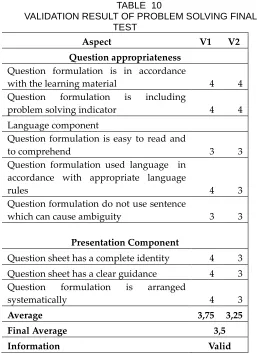
Question validation of final test is conducted by 2 mathematics experts. The validation result can be seen in the following Table 10:
Lathifah was asked by her teacher to make a cuboids tissue box made of paperboard with 15cm rib size. Determine the width of the paperboard used by Lathifah?
Problem 1 Let’s experiment Mr. Ibnu will paint a cubical room with ceiling. The height of the wall is 3 m. 1 small can of paint is assumed to be able to paint the surface of the wall with 9m2 width. The price of one small can of Avian paint is Rp. 16.000, 00. The floor also will be equipped with ceramic size 30 cm x 30 cm. The price of a dozen ceramic is Rp. 48.000,00. How much does it all cost Mr. Ibnu to buy paint and ceramic for the room?
TABLE 10
VALIDATION RESULT OF PROBLEM SOLVING FINAL TEST
Aspect V1 V2
Question appropriateness
Question formulation is in accordance
with the learning material 4 4
Question formulation is including
problem solving indicator 4 4
Language component
Question formulation is easy to read and
to comprehend 3 3
Question formulation used language in accordance with appropriate language
rules 4 3
Question formulation do not use sentence
which can cause ambiguity 3 3
Presentation Component
Question sheet has a complete identity 4 3
Question sheet has a clear guidance 4 3 Question formulation is arranged
systematically 4 3
Average 3,75 3,25
Final Average 3,5
Information Valid
Based on final average, hence question of problem solving can be used in final test. However, there still is revision from the experts, one of the revisions is the question should be more about real life, so that student has more opportunity to deal with the question. Question revision can be seen in this following Table 11.
TABLE 11.
REVISION OF FINAL TEST QUESTION
Before revision
After revision
The average result of learning device validity can be seen in Table 12:
TABLE 12
THE AVERAGE OF INSTRUMENT VALIDATION RESULT
No Instrument Result Critera
1 RPP 3,59 Vey valid
2 LKPD 3,58 Very valid
3 Final Test 3,5 Very valid
Vinal Average 3,55 Very valid
The above table shows that learning device is in a very valid category and can be tested.
Data of device practicality is obtained from student’s respond questionnaire result and teacher’s respond. Both can be seen in Table 13:
TABLE 13.
THE RESULT OF PRACTICALITY QUESTIONNAIRE Questionnaire Practical Category
Student’s Respond 83,68 % Teacher Respond 77,67 %
Vinal Average 80,675 %
Student’s respond is obtained through the fulfillment of student respond questionnaire after learning process with PBL. The questionnaire was distributed toward students of class VIII.6 as an experiment class. The calculation result of student respond questionnaire toward PBL model is in practical category, 83.68%. Next, device practicality by teacher is 77.67 %. It is a practical category. Hence, final average of practicality toward device is 80.675% with practical category. Since the result of teacher respond and student respond is practical, therefore PBL model is appropriate to be used in the learning process in Islamic Public Junior High School (MTsN) 1 Bukittinggi. Next, the result of student learning test is Angga will make an aquarium in a cube form. The height
is 70 cm. Determine the width of the glass needed! If the aquarium is fullfil with 60 cm water, how many liter is water in the aquarium? (Please note that the aquarium is a cube without cover!)
527 discussed by using hypothesis test with t test along with
discussion. Table 14 presents statistical descriptive result of final test result:
TABLE 14.
STATISTICS DESCRIPTION OF LEARNING RESULT EVALUATION
Classes N Mean Std. Deviation Max Min Control class 32 73,28 12,49 96,25 46,25
Experiment Class
37 80,06 9,71 95 57,50
Normality test employed in this research is Kolmogorov-Smirnov test (by using version 23 SPSS software). In this normality test, H0 will be tested with H1, where in normality test H0 is population with normal distribution. Meanwhile, H1 is the comparison hypothesis which is a population with abnormal distribution. The result of normality calculation with Kolmogorov-Smirnov by using version 23 SPSS software will be presented in Table 15.
TABLE 15.
NORMALITY TEST OF EXPERIMENT AND CONTROL CLASSES
Tests of Normality
Classes
Kolmogorov-Smirnova Shapiro-Wilk Statistic Df Sig. Statistic Df Sig. Value Control ,094 32 ,200* ,971 32 ,521
Expe ,112 37 ,200* ,952 37 ,116 *. This is a lower bound of the true significance.
a. Lilliefors Significance Correction
The above table shows the signification score of Kolmogorov-Smirnov test result in experiment class with p value = 0.112 meanwhile control class with p value = 0.094.The result in the table reveals that score data of post-test is in normal distribution. It can be concluded that H0 can be accepted since data of learning result of both experiment and control classes are in normal distribution due to its probability score is bigger than real standard 0.05. It is known that in normality test, population is in normal distribution and can be continued to conduct homogeneity test. Homogeneity test is conducted to reveal whether the two samples have the same variant. This research used Levene-Statistics test (by using version 23 SPSS which presented in Table 16).
TABLE 16.
HOMOGENEITY TEST OF EXPERIMENT AND CONTROL CLASSES
Test of Homogeneity of Variances
Value
Levene Statistic df1 df2 Sig.
2,225 1 67 ,140
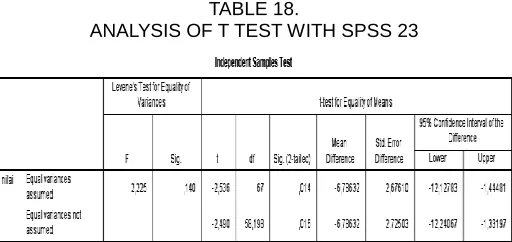
Homogeneity test reveals that the two classes have the same variant. The sig. score of both classes is 0.140 and is bigger than the real standard 0.05. Moreover, once the data has normal and homogeny, hypothesis test by using t test took place. T test is calculated by using version 23 of SPSS. Data in this research is two independent samples. Statistics used is independent sample T-Test. Independent t test used to test the difference between two independent groups (to test two classes, experiment and control classes). One sample t test by using version 23 of SPSS with independent sample t test can be seen in Table 17:
TABLE 17.
STATISTICS DATA OF STATISTICS GROUP
Group Statistics
Classes N Mean
Std. Deviation
Std. Error Mean Value Control 32 73,2813 12,49092 2,20810
Expe. 37 80,0676 9,71354 1,59690
Statistics Group presents GPSS calculation result about amount of data, the average score, deviation standard, and the average error standard. Class VII.4 is a control class which uses direct learning model. Meanwhile, class VIII.6 is the experiment one which uses PBL model.
TABLE 18.
ANALYSIS OF T TEST WITH SPSS 23
Through activities to observe and gather information in group discussions, students can identify the adequacy of data for problem solving. Students can write down what is known from the problem completely and correctly. Furthermore, through associating and questioning activities in PBL syntax guiding individuals / groups, students are able to determine what is asked in the problem. Then plan a solution or choose a strategy, where students are able to develop mathematical models that will be used in solving problems correctly and are able to choose and apply these strategies to solve problems correctly. Then through the activities of communicating in the syntax presenting the results of the discussion, students are able to explain and interpret the results according to the original problem both in the LKPD and in front of their friends. Furthermore, through evaluating the results of problem solving and checking the truth of the results or answers evaluated by the teacher, students can re-examine the results of solving the problems they have done correctly.
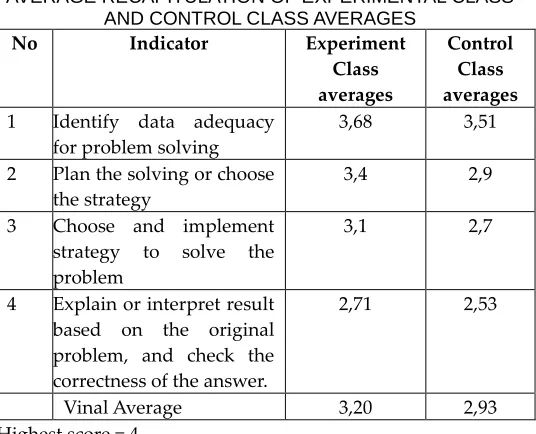
The following are the results of the recapitulation of the final test of the experimental class and the control class:
Through activities to observe and gather information in group discussions, students can identify the adequacy of data for problem solving. Students can write down what is known from the problem completely and correctly. Furthermore, through associating and questioning activities in PBL syntax guiding individuals / groups, students are able to determine what is asked in the problem. Then plan a solution or choose a strategy, where students are able to develop mathematical models that will be used in solving problems correctly and are able to choose and apply these strategies to solve problems correctly. Then through the activities of communicating in the syntax presenting the results of the discussion, students are able to explain and interpret the results according to the original problem both in the LKPD and in front of their friends. Furthermore, through evaluating the results of problem solving and checking the truth of the results or answers evaluated by the teacher, students can re-examine the results of solving the problems they have done correctly.
The following are the results of the recapitulation of the final test of the experimental class and the control class:
TABLE 19.
AVERAGE RECAPITULATION OF EXPERIMENTAL CLASS AND CONTROL CLASS AVERAGES
No Indicator Experiment
Class averages
Control Class averages
1 Identify data adequacy for problem solving
3,68 3,51
2 Plan the solving or choose the strategy
3,4 2,9
3 Choose and implement strategy to solve the problem
3,1 2,7
4 Explain or interpret result based on the original problem, and check the correctness of the answer.
2,71 2,53
Vinal Average 3,20 2,93
Highest score = 4
It means that PBL model learning device with scientific approaches are effective in improving problem solving abilities of class VIII MTs Students. Previous researchers who also supported this were Anti Prodjosantoso [25] [2].
4.
CONCLUSION
The research result and discussion can be concluded as follow: (1) The development of learning device model based on PBL consists of RPP, LKPD, and final test question. Based on the validation result by the experts, the development of this learning device is appropriate to be used as learning device in MTsN 1 Bukittinggi, with average 3.55 in a very valid category, (2) The analysis result of practicality questionnaire calculation conducted by teacher and students toward learning device based on PBL has a positive respond and is in practical category with average 80.675%. Since the result of both teacher and students responds are in practical category, hence PBL model is appropriate to be used in the learning process in Islamic Public Junior High School (MTsN) 1 Bukittinggi, (3) The calculation result of post-test score shows that sig. score (2-tailed) 0.014 is smaller than score (0.05) hence is rejected and is accepted. Therefore, it can be concluded that learning device based on PBL with scientific approach has a significant influence toward the ability to solve mathematics problem of class VIII students in MTs. In the other words, it can be said that learning device based on PBL with scientific approach is effective in improving the ability to solve problem of class VII students in MTs.
5.
REFERENCES
[1] Depdiknas.2013. Permendiknas No 22 Tentang Standar isi. [2] Nasution, ML., Yerizon., Gusmiyanti, R. 2018. Students’
529 IOP Conference Series: Materials Science and
Engineering.
[3] Dewi Harni nasuton, Yerizon. 2019. Development of Student Worksheet Based On Discovery Learning To Improve Student Mathematical Problem Solving Ability in Class X Senior High School. International Journal of Scientific&Technology Research Volume 8, ISSUE 06, JUNE 2019 ISSN 2277-8616.
[4] Ruseffendi, E.T. 2006. Pengantar Kepada Membantu Guru Mengembangkan Kompetensinya dalam Pengajaran Matematika untuk Meningkatkan CBSA. Bandung: Tarsito.
[5] Bilgin, Ibrahim., Senocak, Erddal., Sozbilir, Mustafa.2009. The Effects of Problem-Based Learning Instruction on University Students Performance of Conceptual and Quantitative Problem in Gas Concepts. Eurasia Journal of Mathematics, Science and Technologi Education, 2009, 5(2), 153-164.
[6] Eviyanti, Cut Yuniza. 2017. Improving The Students Mathematical Problem Solving Ability by Applying Problem Based Learning Model in VII Grade at SMPN 1
Banda Aceh Indonesia.
www.researchgate.net/profile/Edy-Surya/publication/318529138. Accessed in September 2018.
[7] Simamora, Sandro J. 2017. Application of Problem Based Learning to Increase Student’s Problem Solvibg Ability on Geometry in Class X Sma Negeri 1 Pagaran. Bisa di akses di gssrr.org/index.php?journal=journal of basic and applied&page=articles. Accessed in September 2018. [8] Darma, K. 2017. The Effect of Problem Based Learning
Model and Auntentik Assessmant on Mathematical Problem Solving Ability by Using Numeric Ability as The Covariable. Accessed in September.
[9] Permendikbud No. 65 tahun 2013 Tentang Standar Proses Pendidikan Dasar dan Menengah.
[10] Musfiqon dan Nurdyansyah.2015. Pendekatan Saintifik. Sidoarjo: Nizamia Learning Center.
[11] Merritt,Joi., Lee, Mi Yeon., Rillero, Peter and Kinach, Barbara M. 2017. Problem-Based Learning in K-8 Mathematics and Science education: A Literature Review. The Interdisciplinary journal of problem-based learning. [12] Sugiyono. 2006. Metode penelitian kuantitatif kualitatif .
Bandung: Alfabeta.
[13] Triantafylou, Eva & Timcenko,Olga. 2013. Applying Constructionism and Problem Based Learning for Developing Dynamic Educational Material for Mathematics At Undergraduate University Level. International Reserach Symposium on Problem-Based Learning (IRSPBL) 2013.
[14] Redzuan, Haji Mohammad., Botty, Haji., Shahril, Masitah, Jainatul, Halida Jaidin., Hui-Chuan Li, Maureen Siew Fang Chong. 2016. The Implementation of Problem-Based Learning (PBL) in year 9 Mathematics Classroom:
A Study in Brunei Darussalam. Internasional Research in Education 2016, Vol 4 No 2.
[15] Widiani, Teresia., M.Rif’at, Ijuddin, Romal. 2013. Penerapan pendekatan saintifik dan pengaruhnya terhadap kemampuan komunikasimaematis dan berpikir kreatif siswa. Program Studi Magister Pendidikan Matematika FKIP Untan.
[16] Sugiyono. 2006. Metode penelitian kuantitatif kualitatif . Bandung: Alfabeta.
[17] Plomp, T dan N. Nieveen. 2013. Education Design Research. Enshede: Netherland Institute for Curriculum Development (SLO).
[18] Nitiaroza., Arnawa, I Made., Yerizon. 2018. Practicality Of Mathematics Learning Tools Based On Discovery Learning For Topic Sequence And Series. International Journal Of Scientific & Technology Research Volume 7, Issue 5, May 2018 ISSN 2277-8616.
[19] Arnawa, I Made.,Yerizon, Nita,Sri., Putra, Roni Tri. 2019. Develeopment Of Students Worksheet Based On APOS Theory Approach To Improve Student Achievment In Learning System Of Linear Equations. International Journal Of Scientific&Technology Research VOLUME 8, ISSUE 04, APRIL 2019 ISSN 2277-8616.
[20] Walpole, Ronald E. 1992. Pengantar Statistik Edisi ke-3. Jakarta: Penerbit PT Gramedia Pustaka Utama.
[21] Muliyardi. 2006. Pengembangan Model Pembelajaran Matematika Menggunakan Komik di Kelas 1 Sekolah Dasar. Disertasi UNESA Surabaya: Not Published. [22] Purwanto. 2012. Metodologi Penelitian Kuantitatif.
Yogyakarta : Pustaka Pelajar.
[23] Purwanto. 2009. Evaluasi Hasil Belajar. Surakarta: Pustaka Belajar.
[24] Widoyoko, Eko Putra.2009. Evaluasi Program Pembelajaran. Yogyakarta: Pustaka Belajar.
[25] Prodjosantoso, Anti., Jelatu, Silfanus., Ramda, Apolonia Hendrice. 2018. Problem Based Learning (PBL) Menggunakan Pendekatan Saintifik Terhadap Kemampuan Pemecahan Masalah Kimia Siswa Stkip Santu Paulus Ruteng. Journal Of Komodo Science Education. Vol. 01 No. 01 November 2018. ISSN :
2621-1238 (Online).