Direct Constructions of Bidirectional Proxy Re-Encryption
with Alleviated Trust in Proxy
Jian Weng1, Yunlei Zhao2∗
1 Department of Computer Science, Jinan University, Guangzhou, China 2 Software School, Fudan University, Shanghai, China
[email protected] [email protected]
Abstract
In this work, we study (the direct constructions of) bidirectional proxy re-encryption (PRE) with alleviated trust in the proxy, specifically the master secret security (MSS) and the non-transitivity (NT) security, in the standard model, and achieve the following:
• A multi-hop MSS-secure bidirectional PRE scheme with security against chosen plain-text attacks (CPA) in the standard model, where the cipherplain-text remains constant size regardless how many times it has been re-encrypted. To the best of our knowledge, there exists previously no MSS-secure multi-hop bidirectional PRE scheme with constant size of ciphertexts (whether in the random oracle model or not).
• Asingle-hop MSS-secureandnon-transitivebidirectional PRE scheme with security against
chosen ciphertext attacks (CCA) in the standard model. The CCA-secure scheme is based on the CPA-secure scheme, and particularly employs a new re-encryption key (REK) gen-eration mechanism to which each user makes equal contributions, where asingle REK is used in both directions with the same computation so that the proxy needs not to distin-guish the transform direction when it re-encrypts ciphertexts. Besides alleviated trust in proxy, single-hop non-transitive bidirectional PRE schemes also enjoy better fine-grained delegate right control (against malicious proxy).
The security analysis uses Coron’s technique [Coron, Crypto 2000], which particularly allows adaptive secret-key corruption. Along the way, we also refine and clarify the security models for bidirectional PRE.
1
Introduction
Proxy re-encryption (PRE), introduced in [7], allows a proxy to transform ciphertexts computed under the public-key of Alice (the delegator) into other ciphertexts for Bob (the delegatee). The proxy, however, learns nothing about the underlying messages encrypted, and has no knowledge of the secret keys of the delegators and delegatees. PRE has many applications (for example, encrypted email forwarding, outsourced filtering of encrypted spam, law enforcement, secure file systems, and performing cryptographic operations on storage-limited devices, etc), and becomes increasingly popular as a method for managing encrypted file systems [3–5, 14, 21, 22, 24, 28–30].
According to the direction of transformation, PRE can be classified into two types: unidirec-tional and bidirectional [24]. In unidirectional PREs, the proxy can only transform ciphertexts from Alice to Bob. While in bidirectional PREs, the proxy can transform ciphertexts in both directions. Both types of PRE have their respective interesting applications. In this paper, we shall concentrate on bidirectional PRE. As an example to illustrate the application of bidirectional PRE, consider the following scenario: Alice and Bob collaborate to conduct a secret assignment, and they need to share their encrypted data in a fair manner (i.e., Alice needs to read all of Bob’s encrypted data, and Bob needs also to read all of Alice’s encrypted data). Indeed, this can be done
by exchanging their secret keys. However, such a solution is highly unsatisfactory, since it places too much trust on each other. Bidirectional PRE can provide solutions in a more desirable way for such scenarios. PRE can also be categorized into multi-hop PRE, in which the ciphertexts can be transformed from Alice to Bob and then to Charlie and so on, and single-hop PRE, in which the ciphertexts can only be transformed once [24]. In this work, as is typical in this literature, we only consider single-key PRE schemes, where both the re-encryption key (REK) and the secret-key of each user (delegator or delegatee) consist of only asingle group element.
Up to now, the only known CCA-secure bidirectional PRE scheme in the standard model is the one proposed by Canetti and Hohenberger [14] (referred to as CH07 scheme), which is multi-hop and is based on Blaze et al.’s [7] CPA-secure bidirectional PRE scheme. The generation of re-encryption key (REK) in both these schemes [7, 14] uses the following strategy: for two users (say, Alice and Bob) with secret keys xa and xb respectively, the re-encryption key is simply computed
as rka↔b = xxba. Actually, xxba is used for re-encryption from Alice to Bob, and for re-encryption
from Bob to Alice, the proxy uses rka−↔1b = xa
xb (that is, the proxy action in the two re-encryption
directions is not identical). Unfortunately, in this way, if the proxy (who knows the re-encryption key) colludes with one of the user, it can recover the other user’s secret key. It is worth noting that, in practice, a user may also use its secret-key to perform other cryptographic operations such as signing, identifications, etc (cf. [4, 5]). This means that the collusion in such bidirectional PRE schemes not only surrenders the user’s decryption right, but also can totally surrender the user’s digital identity [4, 5]. Another observation on the REK generation mechanism of [7, 14] is the transitivity of REK, by which the proxy alone can create delegation rights between two entities that have never agreed on this. Specifically, from the REK rka↔b= xxab between Alice and
Bob and the REK rkb↔c = xxcb between Bob and Charlie, the proxy alone can compute the REK
rka↔c = rka↔b ·rkb↔c = xc
xa between Alice and Charlie. We note that multi-hop PRE schemes
intrinsically suffer from such delegation right uncontrol against a malicious proxy, as what can be done by the proxy with the created REK rka→c can actually be done with the existing REKs
rka→bandrkb→c(though with higher computational complexity). That is, formulti-hopPRE, users may have to rely upon the trust of the proxy to not generate delegation rights to unnegotiated users, even if the underlying REK generation is non-transitive. But, for single-hop PRE, where a transformed ciphertext generated by the proxy cannot be further transformed, if the underlying REK generation is non-transitive a malicious proxy itself may be unable to delegate rights among unnegotiated users. This indicates that, suppose the underlying REK generation is non-transitive, single-hop PRE can enjoy better fine-grained delegation right control (against malicious proxy) than multi-hop PRE. Motivated by the above observations and aimed for alleviating the trust in the proxy, Ateniese et al. [4, 5] introduced for PRE the notions of non-transitivity (NT) security (which informally says that given re-encryption keys rka→b and rkb→c no efficient algorithm can compute rka→c) and master secret security (MSS) (which informally says that the delegator’s
secret-key cannot be derived even if the proxy and the delegatee collude).
Several CPA-secure single-hop unidirectional PRE schemes with the MSS security and NT security in the standard model were proposed by Ateniese et al. [4,5]. Based on the schemes of [4,5], Libert and Vergnaud [29,30] proposed more advancedsingle-hop unidirectional PRE schemes with the MSS security and NT security in the standard model. The PRE scheme proposed in [29, 30] is secure against replayable chosen ciphertext attacks (RCCA), which is a weaker variant of the CCA security in the sense that the re-randomizing of the challenge ciphertext is tolerated.
Canetti and Hohenberger [14] ever mentioned a generic method for transforming any unidi-rectional PRE into a bidiunidi-rectional one by generating two unidiunidi-rectional REKs between Alice and Bob (i.e., rka→b and rkb→a) and setting the bidirectional REK to be rka↔b = (rka→b, rkb→a).
However, since in unidirectional PRE schemes the REK of one direction (e.g., rka→b) cannot be computed from the REK of the opposite direction (e.g., rkb→a), the complexity of REK
cause much overload to the PRE system in reality) or some (usually impractical) secure multi-party computation protocols (particularly for some exisitingbidirectional PRE schemes). Also, for proxy cryptosystems, the workload of the proxy is usually the bottle-neck of the whole system. Thus, it is naturally desirable to devise direct constructions of bidirectional PRE schemes with alleviated trust in the proxy (say, the MSS and NT security).
Still no direct constructions of MSS-secure or NT-secure (whether CPA-secure or CCA-secure) bidirectional PRE are known (whether in the random oracle model or not). Note that, even with the above generic transformation method [14], still no fully CCA secure bidirectional PRE with the MSS and NT security in the standard model is known. Moreover, even with the above generic transformation method, up to now there still exists no MSS-secure multi-hop bidirectional PRE schemes with constant size of ciphertexts. So, a further interesting question is how to construct MSS-secure multi-hop PRE schemes with constant size of ciphertexts, even with only chosen plain-text security.
Our contributions. In this paper, we deal with direct constructions of (single-key) bidirectional PRE schemes with the MSS security and NT security in the standard model, and achieve the following contributions:
1. We present the firstMSS-secure multi-hop (bidirectional) PRE scheme with constant size of ciphertexts. We prove its CPA security under the DBDH assumption, and its MSS security under the discrete logarithm (DL) assumption.
2. We present (direct construction of) aCCA-secure single-hop bidirectional PRE schemewith both the MSS security and the NT security. The CCA-security of transformed ciphertexts is based upon the 2-weak decisional bilinear Diffie-Hellman inverse (2-wDBDHI) assumption [9]. The CCA-security of original ciphertexts (resp., the NT-security that is stronger than the CCA-security of original ciphertexts) is based upon a newly introduced assumption, called 1-augmented wDBDHI (1-AwDBDHI) (resp., 2-AwDBDHI), with complexity of only about twice (resp., thrice) of that in solving the decisional bilinear Diffie-Hellman (DBDH) assumption in the generic bilinear group model.
Our PRE constructions are novel: the CPA-secure scheme is new; the CCA-secure scheme is based on the CPA-secure scheme, and particularly employs a new re-encryption key generation mechanism, similar to Diffie-Hellman key-exchange (DHKE) but w.r.t. a different generator, to which each user makes equal contributions. Besides rendering the MSS security and the NT security, another particular advantage of this DHKE-like re-encryption key generation is that, when queried for re-encrypting ciphertexts, (unlike in all previous bidirectional PRE schemes) the proxy does not need to distinguish the re-encryption direction (i.e., from Alice to Bob, or vice versa) as its actions for both directions are the same. The security analysis uses Coron’s technique [Coron, Crypto 2000], which particularly allows adaptive secret-key corruption. Along the way, we refine the security models for (particularly, single-hop) bidirectional PRE, including CCA security, MSS security and NT security, and clarify the subtleties surrounding security formulations.
2
Preliminaries
Notations. We use x ← S$ to denote that an element x is chosen uniformly at random from S. For a string x,|x| denotes its bit-length. We useA(x1, x2,· · ·) to denote that A is an algorithm with the input (x1, x2,· · ·), and use y ← A(x1, x2,· · ·) to denote the running of A(x1, x2,· · ·) with the output y. For AO1,O2,···(x
1, x2,· · ·), it means that A is an algorithm with the input
(x1, x2,· · ·) and can access to oracles O1,O2,· · ·. By y ← AO1,O2,···(x
1, x2,· · ·), we denote the
running of AO1,O2,···(x
1, x2,· · ·) with the output y. Let G and GT be two cyclic multiplicative
groups with the same prime order p. A bilinear pairing is a map e : G×G → GT with the following properties: (1) Bilinearity: ∀g1, g2 ∈ G,∀a, b ∈ Zp, we have e(ga1, gb2) = e(g1, g2)ab; (2) Non-degeneracy: There exist g1, g2 ∈ G such that e(g1, g2) = 1GT, where 1GT is the identity element in group GT; (3) Computability: There exists an efficient algorithm to computee(g1, g2) for∀g1, g2 ∈G. Throughout this paper, we denote byτ the maximum over the time to compute an exponentiation, a multi-exponentiation and a pairing. To distinguish from the notation of pairing operation, we use e˙to denote the base of the natural logarithm.
Definition 1. The decisional bilinear Diffie-Hellman (DBDH) problem [10] in groups (G,GT) is,
given (g, ga, gb, gc, Z) ∈ G4×GT with unknown a, b, c ←$ Z∗p, decide whether Z = e(g, g)abc. For an adversary B, we define its advantage in solving the DBDH problem in groups (G,GT) as
AdvDBDHB Pr[B(g, ga, gb, gc, e(g, g)abc) = 1|a, b, c←$ Z∗p]−Pr[B(g, ga, gb, gc, e(g, g)z) = 1|a, b, c, z←$ Z∗p].
We say that the(t, )-DBDHassumption holds in(G,GT) if no t-time adversaryB has advan-tage at least in solving the DBDH problem in G.
Definition 2. The q-weak decisional bilinear Diffie-Hellman inversion assumption (q-wDBDHI)
[9] in groups(G,GT)is, given(g, ga,· · · , gaq, gb, Z)∈Gq+2×GT with unknowna, b←$ Z∗p, to decide whether Z =e(g, g)b/a. For an adversary B, we define its advantage AdvqB-wDBDHI in solving the
q-wDBDHI problem as
Pr[B(g, ga,· · · , gaq, gb, e(g, g)ba) = 1|a, b←$ Z∗
p]−Pr[B(g, ga,· · ·, ga
q
, gb, e(g, g)z) = 1|a, b, z←$ Z∗p],
We say that the(t, )-q-wDBDHIassumption holds if not-time adversary Bhas advantage at least
in solving theq-wDBDHI.
In this paper, our proposed scheme shall also use a variant ofq-wDBDHI assumption namedq
augmented weak decisional bilinear Diffie-Hellman inversion assumption (q-AwDBDHI), which is almost identical to theq-wDBDHI assumption except introducing the additional termg1/a2
.
Definition 3. Theq-AwDBDHI assumption in groups(G,GT)is, given(g, g1/a2, ga,· · · , gaq, gb, Z)∈
Gq+3×GT with unknown a, b ←$ Z∗
p, to decide whether Z = e(g, g)b/a. For an adversary B, we
define its advantage AdvqB-AwDBDHI in solving the q-AwDBDHI problem as
Pr[B(g, g1/a2, ga,· · ·, gaq, gb, e(g, g)ab) = 1|a, b←$ Z∗
p]−Pr[B(g, g1/a
2
, ga,· · ·, gaq, gb, e(g, g)z) = 1|a, b, z←$ Z∗p],
We say that the (t, )-q-AwDBDHI assumption holds in (G,GT) if no t-time adversary B has advantage at least in solving the q-AwDBDHI.
3
Security Model for Bidirectional PRE
Formally, a bidirectional PRE scheme consists of the following six algorithms [14]: (1) Setup algorithm Setup(k), which on input a security parameter k outputs the global parameter param; (2) Key generation algorithmKeyGen(param), by which each userigenerates its public/private key pair (pki, ski); (3) REK generation algorithm ReKeyGen(ski, skj), which on input two private keys
ski andskj outputs a re-encryption keyrki↔j to the proxy; (4) Encryption algorithm Enc(pki, m),
which outputs a ciphertext CTi of m ∈ M under pki (Here M is the message space); (5) Re-encryption algorithmReEnc(rki↔j,CTi), which, on input a re-encryption keyrki↔j and an original
ciphertext CTi under public key pki, outputs a transformed ciphertext CTj under public key pkj;
(6) Decryption algorithm Dec(skz,CTz), which, on input a private key skz and a ciphertext CTz, outputs a messagem∈ Mor the error symbol⊥(if CTz is invalid). We remark that for each user the secret-key used for decryption and that for REK generation are the same.
Next, we introduce the following oracles which will be used to model the abilities of the ad-versary: (1) Public key oracle Opk(·): On input Opk(i), it runs (pki, ski) ← KeyGen(param) and returns pki. (2) Secret key oracle Osk(·): On input Osk(pki), it returns the
correspond-ing secret key ski. (3) Re-encryption key oracle Ork(·,·): On input Ork(pki, pkj), it returns
rki↔j ← ReKeyGen(ski, skj). (4) Re-encryption oracle Ore(·,·,·): On input Ore(pki, pkj,CTi), it returns CTj ←ReEnc(rki↔j,CTi). (5) Decryption oracle Od(·,·): On inputOd(pkz,CTz), it returns
the result of Dec(skz,CTz), where skz is the secret key w.r.t to public keyspkz. Note that for the last four oracles, it is required that pki, pkj and pkz are all generated by oracle Opk.
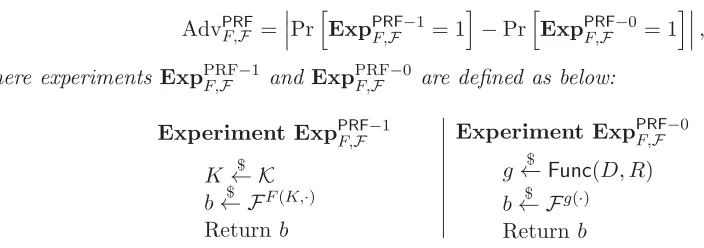
CCA security (of original ciphertexts) for bidirectional PRE.For an adversaryArunning in two stagesfindand guess, we define its advantage as
AdvIND-PRE-oCCAPRE,A (k) =Pr
ExpIND-PRE-oCCA-PRE,A 1(k) = 1
−Pr
ExpIND-PRE-oCCA-PRE,A 0(k) = 1,
or equivalently (by some standard trick [6, 20]),
AdvIND-PRE-oCCAPRE,A (k) =|2 Pr[δ =δ]−1|,
where ExpIND-PRE-oCCA-PRE,A δ is defined by the following experiment:
Experiment ExpIND-PRE-oCCA-PRE,A δ(k)
param←Setup(1k);
(m0, m1, pki∗)← AOpk(·),Osk(·),Ork(·,·),Ore(·,·,·),Od(·,·)(find, param), where|m
0|=|m1|; CT∗ ←Enc(pki∗, mδ), where δ← {$ 0,1};
δ ← AOpk(·),Osk(·),Ork(·,·),Ore(·,·,·),Od(·,·)(guess, param,CT∗);
returnδ.
During the above experiment, as in [14] it is required that the following requirements are simultaneously satisfied:
1. For any re-encryption key queryOrk(pki, pkj), it is required that either both the secret keys
with respect topki andpkj are corrupted (by oracle queries toOskbyA) or alternately both are uncorrupted;
2. pki∗ is generated by oracle Opk, andA cannot issue the secret key queryOsk(pki∗);
3. Acannot simultaneously issueOsk(pkj) andOre(pki, pkj,CTi) such that (pki,CTi) is a deriva-tive of (pki∗,CT∗). (The derivatives of (pki∗,CT∗) are defined below.)
4. A cannot issueOd(pkz,CTz) such that (pkz,CTz) is a derivative of (pki∗,CT∗). The derivatives of (pki,CTi) are inductively defined by the following rules:
Rule-2: If (pkj,CTj) is a derivative of (pki,CTi) and (pkz,CTz) is a derivative of (pkj,CTj), then
(pkz,CTz) is a derivative of (pki,CTi).
Rule-3: IfAhas issued a re-encryption query Ore(pki, pkj,CTi) and obtained the resulting
trans-formed ciphertext CTj, then (pkj,CTj) is a derivative of (pki,CTi).
Rule-4: If A has issued a re-encryption key generation queryOrk(pki, pkj) or Ork(pkj, pki), and
Dec(skj,CTj)∈ {m0, m1}, then (pkj,CTj) is a derivative of (pki,CTi).
Remark 1. The above IND-PRE-oCCA security formulation for single-hop bidirectional PRE is essentially identical to the IND-PRE-CCA security formulated in [14] for multi-hop bidirectional PRE, but have the following key differences (which make IND-PRE-oCCA strictly stronger than IND-PRE-CCA):
• Adaptive vs. non-adaptive secret-key corruption. Our IND-PRE-oCCA formulation allows adaptive secret-key corruption. That is, adversary Acan adaptively learn users’ secret-keys by querying the oracle Osk(pki) (as long as pki was formerly generated by the oracle Opk). In the IND-PRE-CCA formulation of [14], the oracle Osk is defined to have no input and work as follows: when queried, Osk generates a new pair (pk, sk) by running KeyGen, and returns (pk, sk) to A. Note that Acannot corrupt the secret-keys corresponding to already existing public-keys. As a consequence, the simulator in the CCA proof of [14] does not need to handle queries of adaptive secret-key corruption.
• Rule-4 difference. The Rule-4 is formulated in [14] as follows: “ifAhas queriedOrk(pki, pkj) or Ork(pkj, pki), or alternatively a series of queries Ork(pki, pkk1), · · ·,Ork(pkkτ−1, pkkτ),
Ork(pkkτ, pkj) where τ ≥ 2 (which is mentioned in the Rule-4 motivation in [14]), and
Dec(pkj,CTj)∈ {m0, m1}, then (pkj,CTj) is the derivative of (pki,CTi).” In contrast, from the series of queries Ork(pki, pkk1),· · · ,Ork(pkkτ−1, pkkτ),Ork(pkkτ, pkj), even ifAcan get rki↔j
but without querying either Ork(pki, pkj) or Ork(pkj, pki), (pkj,CTj ←ReEnc(rki↔j,CTi)) is
not the derivative of (pki,CTi) according to our Rule-4 specification.
Remark 2. A further stronger formulation of Rule-4 (which renders further stronger IND-PRE-oCCA security), for bidirectional PRE with deterministic re-encryption algorithm ReEnc, is: If
A has issued a re-encryption key generation query Ork(pki, pkj) or Ork(pkj, pki) to learn rki↔j,
and CTj = ReEnc(rki↔j,CTi) then (pkj,CTj) is a derivative of (pki,CTi). The observation is that
the requirement Dec(pkj,CTj) ∈ {m0, m1} in the Rule-4 specification of [14] may be over strict, which particularly excludes re-randomizing the challenge ciphertext CT∗i. Specifically, consider the following ciphertext re-randomizing attack: given (pki,CTi) where CTi is the original (resp.,
transformed) ciphertext under public-keypki, an adversaryAfirst re-randomizesCTi intoCTi=CTi
and then gets CTj ← ReEnc(rki↔j,CTi) (resp., A first gets CTj ← ReEnc(rki↔j,CTi) and then re-randomizes CTj into CTj =CTj). Such attacks are forbidden by definition within the definitional
framework of [14] as (pkj,CTj) (resp., (pkj,CTj)) is still defined to be the derivative of (pki,CTi), while such an attack is allowed with the above stronger Rule-4 formulation as (pkj,CTj) (resp., (pkj,CTj)) is not viewed as the derivative of (pki,CTi)). We show our CCA-secure PRE scheme,
which is of deterministic re-encryption, satisfies the stronger IND-PRE-oCCA security with this modified stronger Rule-4 formulation.
Definition 4. A single-hop bidirectional PRE scheme is said to be (t, qpk, qsk, qrk, qre, qd, )- IND-PRE-oCCA secure, if for anyt-time adversaryA who asks at mostqpk, qsk, qrk, qre andqd queries to oracles Opk,Osk,Ork,Ore and Od, respectively, we have AdvIND-PRE-oCCAPRE,A (k) ≤ . The probability is taken over the choice of the random bit δ, coins of adversary A and the oracles.
Non-Transitivity. One might think the following definition for NT-security would be sufficient: the proxies alone cannot generate a new valid re-encryption key between two users who has never agreed on the delegations, e.g., from the re-encryption keysrki↔j andrkj↔k, the adversary cannot
produce the re-encryption key rki↔k. However, such a definition is somewhat weak, since it does
not prevent an adversary from computing some other information that will allow it to re-encrypt ciphertexts from i to k (which is what we actually care about). For example, suppose a PRE scheme dose not satisfy the above NT-security (i.e., a valid re-encryption key can be generated transitively), and then we can easily convert it into another PRE scheme satisfying the above “NT-security” in the following way:1 Letri↔j be a re-encryption key for the original scheme. In the new
scheme, we define a valid re-encryption key to be the triplet (ri↔j,Sign(ski, ri↔j),Sign(skj, ri↔j)),
where Signis some secure signature algorithm. It is easy to see that the proxy will not be able to generate any new valid re-encryption keys involving user iwithout breaking the signature scheme. However, since the original scheme is not “NT-secure”, the adversary could still compute ri↔k
from ri↔j and rj↔k, and thus is still able to redelegate decryption rights. Therefore, a reasonable NT-security definition should satisfy: if the proxy has the re-encryption keys rki∗↔j and rkj↔k,
even in collusion with user k it shouldn’t be able to decrypt ciphertexts intended for user i∗. We formally define the NT-security as below:
For an adversaryArunning in two stages findandguess, we define its advantage as
AdvNTPRE,A(k) =Pr
ExpNT-PRE1,A(k) = 1
−Pr
ExpNT-PRE0,A(k) = 1,
where ExpNT-PREδ,A is defined by the following experiment:
Experiment ExpNT-PREδ,A(k)
param←Setup(1k);
(m0, m1, pki∗)← AOpk(·),Osk(·),Ork(·,·),Ore(·,·,·),Od(·,·)(find, param), where|m
0|=|m1|; CT∗ ←Enc(pki∗, mδ), where δ← {$ 0,1};
δ ← AOpk(·),Osk(·),Ork(·,·),Ore(·,·,·),Od(·,·)(guess, param,CT∗);
returnδ.
During the above experiment, it is required that the following requirements are simultaneously satisfied:
1. For a public key pkj whose secret key is corrupted (by oracle query toOsk), Acannot issue Ork(pki∗, pkj) or Ork(pkj, pki∗).
2. pki∗ is generated by oracle Opk, andA cannot issue the secret key queryOsk(pki∗);
3. Acannot simultaneously issueOsk(pkj) andOre(pki, pkj,CTi) such that (pki,CTi) is a deriva-tive of (pki∗,CT∗).
4. A cannot issueOd(pkz,CTz) such that (pkz,CTz) is a derivative of (pki∗,CT∗).
Definition 5. A bidirectional PRE scheme is said to be (t, qpk, qsk, qrk, qre, qd, )-NT-secure, if for anyt-time adversaryAwho asks at mostqpk, qsk, qrk, qre, qdqueries to oraclesOpk,Osk,Ork,Ore,Od, respectively, we have AdvNTPRE,A(k)≤.
Remark 3. In the above definition, it would be legal for adversaryAto issue queriesOrk(pki∗, pkj),
Ork(pkj, pkk) and Osk(pkk), only if A does not issue Osk(pkj). Thus the above definition can
ensure that, the proxies with re-encryption keysrki∗↔j and rkj↔kis unable to decrypt ciphertexts
intended for user i∗, even in collusion with userk.
Remark 4. At first glance, one might think that the above NT-security is still too weak in the sense that, it does not secure against the collusion of the delegatees (j and k) and the proxy (who
holds the re-encryption key between usersi∗ andj). However, such an attack would make no sense, since the proxy can first re-encrypt the challenge ciphertextCT∗ into a transformed ciphertext for user j, and then decrypt it with user j’s secret key. Nevertheless, as stressed in [4, 5, 29, 30], it is still an open problem to come up with a (unidirectional or bidirectional) PRE scheme secure against transfer of delegation attacks, i.e., the collusion of the delegatees (j and k) and the proxy (with re-encryption keys between usersi∗ and j) cannot produce the re-encryption key fromi∗ to
k.
Remark 5. The NT definition is almost identical to the IND-PRE-oCCA definition, with the exception in Requirement 1. It can be verified that Requirement 1 in the NT definition is strictly weaker than that in theIND-PRE-oCCAdefinition. Thus theIND-PRE-oCCA security is implied by the NT security (as stated in Proposition 1). The reason we separateIND-PRE-oCCAsecurity from NT security is that, as we shall see, the former can normally be achieved with weaker assumption than that for achieving the latter.
Proposition 1. For a single-hop bidirectional PRE E, the IND-PRE-oCCA security is implied by the non-transitivity security. That is, if there exists an adversary A who can also break the IND-PRE-oCCA security ofE, then there also exists an adversary B who can also break the NT security of E.
CCA Security of transformed ciphertexts for single-hop bidirectional PRE.Note that, for single-hop bidirectional PRE, the original and transformed ciphertexts have different forms. The above IND-PRE-oCCA definition provides A with an original ciphertext in the challenge phase. An orthogonal definition of security is to capture the indistinguishability of transformed ciphertexts, in which adversary A is given a challenge transformed ciphertext. For single-hop schemes, since transformed ciphertexts cannot be re-encrypted, we should allow the adversary to obtain any re-encryption keys (including those between the target user and the corrupted users). Consequently, the re-encryption oracle becomes useless to A since A can re-encrypt ciphertexts itself using the corresponding re-encryption keys.
Specifically, for an adversary A running in two stages findand guess against a bidirectional single-hop PRE scheme, we define its advantage in distinguishing transformed ciphertexts as
AdvIND-PRE-tCCAPRE,A (k) =Pr
ExpIND-PRE-tCCA-PRE,A 1(k) = 1
−Pr
ExpIND-PRE-tCCA-PRE,A 0(k) = 1,
where ExpIND-PRE-tCCA-PRE,A δ is defined by the following experiment:
Experiment ExpIND-PRE-tCCA-PRE,A δ(k)
param←Setup(1k);
(m0, m1, pki∗, pki)← AOpk(·),Osk(·),Ork(·,·),Od(·,·)(find, param), where |m
0|=|m1|; CT ←Enc(pki, mδ), where δ← {$ 0,1};CT∗ =ReEnc(rki↔i∗,CT);
δ ← AOpk(·),Osk(·),Ork(·,·),Od(·,·)(guess, param,CT∗);
returnδ.
During the above experiment, the following requirements are required to be simultaneously satisfied:
1. pki and pki∗ are generated by oracle Opk, andA has never issued the queryOsk(pki∗). But, the query Osk(pki) is allowed to A.
2. A has never issued the queryOd(pki∗,CT∗).
Definition 6. A single-hop bidirectional PRE scheme is said to be (t, qpk, qsk, qrk, qd, )- IND-PRE-tCCA secure, if for any t-time adversary A who asks at mostqpk, qsk, qrk and qd queries to oracles
Experiment ExpMSSPRE,A(k)
param←Setup(1k);
(pki∗, ski∗)← AOpk(·),Osk(·),Ork(·,·)(param);
Ifski∗ is a valid secret key w.r.t. pki∗ then return 1, else return 0.
Master secret security. For an adversary against the MSS security of a bidirectional PRE scheme, we define its advantage as AdvMSSPRE,A(k) = PrExpMSSPRE,A(k) = 1, where ExpMSSPRE,A is defined by the following experiment:
During the above experiment, it is required thatpki∗ is generated by oracleOpk, andAhas never issued the secret key queryOsk(pki∗).
Definition 7. A bidirectional PRE scheme is said to be(t, qpk, qsk, qrk, )-MSSsecure, if for anyt -time adversaryAwho asks at mostqpk, qskandqrkqueries to oraclesOpk,OskandOrk, respectively, we have AdvMSSPRE,A(k)≤.
Remark 6. The MSS-security is actually a refinement of the MSS-security considered in [4, 5]. But, we would like to reminder here that, for some unusual or unnatural cases, the situation is a bit subtle. One example is, in a PRE scheme, the secret-key of each user consists of two elements (sk, sk) but the element of sk is never used in re-encryption key generation and decryption. Another example is: the user’s secret-key is defined to be sk, but it actually uses sk =f(sk) for decryption and REK generation where f is a one-way function. All these unusual or unnatural protocol examples can be trivially MSS-secure, though we are unaware of any existing PRE scheme being of such unusual structures. For the general case, roughly speaking, we say a PRE scheme is MSS-secure if the adversary is infeasible to output the secret-key elements of the delegator that are actually put into effect in REK generation and ciphertext decryption. Formal formulation of MSS-security for the general case is outside the scope of this paper, and is left for future exploration.
Due to the space limitation, we present the formulation and discussion of NT-security in Ap-pendix D, where we in particular show that, forsingle-hop bidirectional PREs, theIND-PRE-oCCA (resp., MSS) security is implied by the NT (resp.,IND-PRE-tCCA) security. The reason we separate IND-PRE-oCCA (resp., MSS) security from NT (resp.,IND-PRE-tCCA) security is that, as we shall see, the former can normally be achieved with weaker assumptions than those for achieving the latter.
4
CPA-Secure Multi-Hop Bidirectional PRE with MSS-Security
Let (G,GT) be bilinear groups with prime orderp≥2k, where k is the security parameter. Then our multi-hop bidirectional PRE scheme is specified as below:
Setup(1k): Picks two generatorsg, g1 ←$ G, and output the public parameter param= (g, g1). KeyGen(param): User irandomly pick xi ←$ Z∗p, and sets its public key aspki =gxi and private
key as ski=xi.
ReKeyGen(ski, skj): On input two private keys ski and skj, this algorithm outputs the bidirec-tional re-encryption key rki↔j =g1−skig1skj(=g1−ski+skj).
Enc(pki, m): To encrypt a message m ∈GT under the public key pki, the sender picks r ←$ Z∗p, and outputs the ciphertext CTi as below:
ReEnc(rki↔j,CTi): On input a re-encryption key rki↔j = g1−xig1xj, a ciphertext CTi = (C1, C2)
under public key pki, this algorithm computes C2 = C2 ·e(C1, rki↔j) = m·e(pki, g1)r ·
e(gr, g−ski
1 g
skj
1 ) =m·e(pki, g1)r·e(pki, g1)−r·e(pkj, g1)r=m·e(pkj, g1)r, and outputCTj =
(C1, C2) as the transformed ciphertext under public key pkj.
Dec(CTz, skz): On input a private key and ciphertextCTz, this algorithm outputsm← e(C1C,g21)skz.
Theorem 1. Our scheme is IND-PRE-CPA secure, assuming the DBDH assumption holds in (G,GT).
Proof. Given a DBDH instance (g, ga, gb, gc, Z) ∈ G4 ×GT with unknown a, b, c ←$ Z∗p, B’s goal is to decide whether Z =e(g, g)abc. B works by interacting with adversary A in experiment ExpIND-PRE-CPAPRE,A (where A is only allowed to make queries to Opk, Osk and Ork in the findand
guess stages), as follows:
Initialize. B definesg1 =gb, and returns the public parameter param= (g, g1) to A.
Find Stage. AdversaryAissues a series of queries as in experimentExpIND-PRE-CPAPRE,A . Bmaintains a listLlist, and answers these queries for Aas follows:
• Public key oracle Opk(i): B picks xi ←$ Z∗p. Next, using Coron’s technique [15], it flips a
biased coin ci ∈ {0,1} that yields 1 with probability θ and 0 otherwise, where θ is a fixed probability that will be determined later. Ifci = 1, it setspki =gxi (meaning thatski=xi);
else pki=ga+xi (meaning thatski=a+xi). Next, it adds the tuple (pki, xi, ci) toLlist and
returns pki to A.
• Secret key oracle Osk(pki): Bfirst recovers (pki, xi, ci) fromLlist. Ifci= 1,Breturnsski =xi
to A; otherwise, it outputs a random bit and aborts.
• Re-encryption key oracle Ork(pki, pkj): B first recovers tuples (pki, xi, ci) and (pkj, xj, cj) from Llist, and responds according to the following three cases:
– ci =cj = 1: Breturns rki↔j =g1−xi+xj =g−1skig1skj to A.
– ci =cj = 0: Breturns rki↔j =g1−xi+xj =g1−(a+xi)+(a+xj) =g−1skigsk1 j to A. – ci =cj: Boutputs a random bit andaborts.
Challenge. When A decides that find stage is over, it outputs a public key pki∗ and two equal-length messages m0, m1 ∈GT with the restrictions specified in experimentExpIND-PRE-CPAPRE,A . Algorithm B first recovers the tuple (pki∗, xi∗, ci∗) from Llist. If ci∗ = 1, B outputs a random bit and aborts. Otherwise (it means that pki∗ = ga+xi∗), B flips a random coin δ ← {$ 0,1}, defines
C1∗ =gc, C2∗=Z·e(gb, gc)xi∗·mδ, and returnsCT∗ = (C∗
1, C2∗) as the challenge ciphertext toA.
Observe that, ifZ =e(g, g)abc, CT∗ is a valid challenge ciphertext. To see this, lettingr∗ =c, we have
C1∗ = gc =gr∗,
C2∗ = Z·e(gb, gc)xi∗ ·m
δ =e(g, g)abc·e(gb, gc)xi∗ ·mδ=e(ga+xi∗, gb)c·mδ=e(pki∗, g1)r∗·mδ.
On the other hand, if Z is uniform and independent in GT, the challenge ciphertext CT∗ is independent of δ from the adversary’s view.
Guess Stage. Adversary A continues to issue the rest queries with the restrictions described in experiment ExpIND-PRE-CPAPRE,A , andB answers these queries just as it does in the findstage.
Output. Eventually, adversary A returns a guess δ ∈ {0,1}. If δ = δ, B outputs 1 to guess
Z =e(g, g)abc; otherwise, Boutputs 0 to guess thatZ is a random element in GT.
Pr[¬Abort] = θqsk(θ2+ (1−θ)2)qrk(1−θ) ≥ θ2qrk+qsk(1−θ). By setting θ = 1− 1
1+2qrk+qsk, we
get Pr[¬Abort]≥ e˙−1(1+2q1
rk+qsk) =
1 ˙
e(1+2qrk+qsk). Note that, if event Abort does not occur during
the simulation, the simulations for Osk,Ork and Challenge stage all are perfect. In this case, if A can break the IND-PRE-CPA security of our scheme, B can also resolve the DBDH instance. Specifically, Pr[B(g, ga, gb, gc, Z) = 1|Z =e(g, g)abc] = 12 as in this case the view ofAis independent of δ, Pr[B(g, ga, gb, gc, Z) = 1|Z = e(g, g)abc)] = 12 ·Pr[Abort] + Pr[δ = δ|¬Abort]·Pr[¬Abort] =
1
2 ·(1−Pr[¬Abort)] + Pr[δ = δ|¬Abort]·Pr[¬Abort] = 12 + Pr[¬Abort](Pr[δ = δ|¬Abort]− 12).
Thus, = AdvDBDHB =|Pr[B(g, ga, gb, gc, Z) = 1|Z =e(g, g)abc)]−Pr[B(g, ga, gb, gc, Z) = 1|Z =
e(g, g)abc]| = |Pr[¬Abort](Pr[δ = δ|¬Abort]− 12)|. As = AdvIND-PRE-CPAPRE,A = |2 Pr[δ = δ]−1| and Pr[¬Abort]≥ e˙(1+2q1
rk+qsk), we have
= AdvDBDH
B ≥ 2 ˙e(1+2qrk+qsk). It’s easy to see that the
running time of B is bounded byt≤t+O(τ(qpk+qrk)).
Theorem 2. Our scheme is MSSsecure, assuming the DL assumption holds in group G.
Proof. Given a DL instance (g, ga)∈G2 with unknown a←$ Z∗p, B’s goal is to output the value
a. Bworks by interacting with adversaryA in experimentExpMSSPRE,A as follows:
Initialize. B picks α1 ←$ Z∗p and defines g1=gα1, and returnsparam= (g, g
1) to A.
Query Stage. Adversary A issues a series of queries as in experimentExpMSSPRE,A. B maintains a list Llist, and answers these queries forA as follows:
• Public key oracle Opk(i): Identical to that in the proof of Theorem 1.
• Secret key oracle Osk(pki): Identical to that in the proof of Theorem 1.
• Re-encryption key oracle Ork(pki, pkj): B first recovers tuples (pki, xi, ci) and (pkj, xj, cj)
from Llist, and responds according to the following three cases: – ci =cj = 1: Breturns rki↔j =g1−xi+xj =g−1skig1skj to A.
– ci =cj = 0: Breturns rki↔j =g1−xi+xj =g1−(a+xi)+(a+xj) =g−1skigsk1 j to A.
– ci = 1∧cj = 0: It means that ski = xi and skj = a+xj. B returns rki↔j =
g−1xi+xjgα1a=g−xi
1 (gα1)a+xj =g− ski
1 g
skj 1 to A.
– ci = 0∧cj = 1: It means that ski = a+xi and skj = xj. B returns rki↔j =
g−1xi+xjg−aα1 =g−(a+xi)
1 g
xj 1 =g−
ski
1 g
skj 1 to A.
Output stage. Finally, A outputs a secret key ski∗ w.r.t. the public key pki∗ that has not been queried to Osk. B recovers (pki∗, xi∗, ci∗) from Llist. If ci∗ = 1, B outputs “failure” and aborts. Otherwise (it means ski∗ =a+xi∗),B outputsa=ski∗−xi∗ as the solution to the DL instance. Analysis. It’s easy to check that the running time ofBis bounded byt ≤t+O(τ(qpk+qrk)). Let Abortdenote the event of B’s aborting during the simulation of oracleOsk or inOutputstage. We have Pr[¬Abort] =θqsk(1−θ). By setting θ = qsk
1+qsk, we get Pr[¬Abort]≥
1 ˙
e(1+qsk). Note that, if
event Abortdoes not occur, the simulation is perfect from the view ofA. Therefore, ifAcan break theMSSsecurity with probability,B can solve the DL instance with probability ≥ e˙(1+q
sk).
5
CCA-Secure Single-Hop Bidirectional PRE with both MSS
Se-curity and NT SeSe-curity
malleability from original ciphertexts to transformed ciphertexts is the only way of malleating ciphertexts. In particular, a CCA-secure (single-hop) PRE scheme should guarantee both the non-malleability of original ciphertexts and the non-malleability of transformed ciphertexts.
Let (G,GT) be bilinear groups with prime order p > 2k, where k is the security parameter. Our CCA-secure bidirectional PRE scheme is specified by the following algorithms:
Setup(1k): This setup algorithm works as follows:
1. Pick generators g, g0, g1, u1, u2, u3 ←$ G.
2. Choose a target collision-resistant hash function H : G× {0,1} → Z∗p. Choose also a pseudo-random function (PRF) family F : GT ×G → {0,1}−1{0,1}1 such that,
given a seed in GT and an input in G, it outputs an -bit pseudorandom string. Here “||” denotes the operator of string concatenation, and and 1 are all polynomial in k. 3. Output the public parameter param= (p,G,GT, g, g0, g1, u1, u2, u3, H, F, 1, ).
KeyGen(param): User i picks xi ←$ Z∗p, and sets its public key as pki = gxi and private key as
ski =xi.
ReKeyGen(ski, skj): On input two private keys ski and skj, this algorithm outputs the
bidirec-tional re-encryption key rki↔j =g1skiskj.
Note that, fromrki↔j =g1skiskjandskino efficient algorithm can computeskj, which ensures the MSS security. Also, given two REKs rki↔j =g1skiskj and rkj↔k =gsk1 jskk and even also the secret keyskk, no efficient algorithm can decrypts (original) ciphertexts generated under
pki, which implies the infeasibility of computing rki↔k = gsk1 iskk and thus ensures the NT
security. Formal analysis of the MSS-security and NT-security is referred to Appendix E. Enc(pki, m): To encrypt a messagem∈ {0,1}1 under pki, the sender proceeds as follows:
1. Pick r←$ Z∗p, and setC0 =gr0 andC1 =gr.
2. Compute K = e(pki, g1)r and set C2 = [F(K, C0)]−1
[F(K, C0)]1 ⊕m, where
[F(K, C0)]−
1 (resp., [F(K, C0)]
1) denotes the (−
1)-bit prefix (resp., the1-bit suffix)
of [F(K, C0)].
3. Pick t←$ Z∗p, and computeh=H(C0, C2) andC3 =uh1ut2u3r. 4. Output the ciphertextCTi= (t, C0, C1, C2, C3).
Here, the use of PRF, rather than a generic authentication mechanism (e.g., encrypt-then-MAC), is to get shorter ciphertext and to have more concise security proof. Note that the value t can be viewed to serve as the randomness of a chameleon hash function in an application of the Canetti-Halevi-Katz and Boyen-Mei-Waters techniques [11, 13]. This use of a chameleon hash function with randomness enables our scheme to achieve the adaptive security, i.e., the adversary needs not to commit ahead of time which public key she wants to challenge. We note that the use of a chameleon hash function with randomness was also previously appeared in [2, 23, 27, 32].
ReEnc(rki↔j,CTi): On input an REKrki↔j =g1xixj, an original ciphertextCTiand another public
key pkj, this algorithm re-encrypts this ciphertext intended for public key pkj as follows:
1. Compute h = H(C0, C2), and then check the validity of CTi by testing whether the following equalities hold:
e(C0, uh1ut2u3) =e(C3, g0), (1)
e(C0, g) =e(C1, g0). (2)
efficiency of the above verifications can be further improved by reducing two pairings (at the cost of two more multi-exponentiations). Concretely, the verifications can be
alternately done by picking r1, r2←$ Z∗p and testing whether
e C0, gr1uh
1ut2u3
r2=e(Cr1
1 C r2
3 , g0). (3)
2. If the above verifications fail, output ⊥ indicating an invalid ciphertext. Otherwise, compute C1 = e(C1, rki↔j), and output the transformed ciphertext under public key
pkj asCTj = (t, C0, C1, C2, C3). Observe that CTj is of the following forms:
CTj = (t, C0, C1, C2, C3) = t, gr0, Kskj,[F(K, C
0)]−1
[F(K, C0)]1⊕m,uh
1ut2u3
r
,
whereK =e(pki, g1)r.
Dec(skz,CTz): On input (skz,CTz), this algorithm works according to two cases: • CTz is an original ciphertext CTz = (t, C0, C1, C2, C3) (whereC1 ∈G):
1. First check the validity of the ciphertext as in Eq. (3). If the verification fails, output “⊥” indicating an invalid ciphertext.
2. Compute K = e(C1, g1)skz, and output m = [F(K, C
0)]1 ⊕[C2]1, where [C2]1
denotes the1-bit suffix of C2.
• CTz is a transformed ciphertextCTz = (t, C0, C1, C2, C3) (whereC1 ∈GT):
1. First check the validity of the ciphertext as in Eq. (1). If the verification fails, output “⊥” indicating an invalid ciphertext.
2. Compute K =C11/skz. Outputm= [F(K, C0)]1 ⊕[C
2]1 if the following equality
holds:
[F(K, C0)]−1 = [C2]−1. (4)
Otherwise, output “⊥” indicating an invalid ciphertext.
Remark 7. In the security proofs, to answer adversary A’s decryption queries on transformed ciphertexts, the simulator needs to know the original public key pki. To deal with this problem, we can slightly modify the above scheme by including public key pki into both original ciphertext
and transformed ciphertext, and computing h = H(pki, C0, C2) instead of h = H(C0, C2) (the
description of H should accordingly be H :G2× {0,1} → Z∗p). The security analysis, as well as the comparison with CH07, is w.r.t. this modified version.
Remark 8. At a high level, the equalities (1) and (2) (resp., (1) and (4)) ensure the well-formedness of original (resp., transformed) ciphertexts, and thus the above PRE construction fits the afore-mentioned design rationales of non-malleability for achieving CCA-secure PRE schemes.
Remark 9. In algorithm ReKeyGen, users i and j make equal contributions to the REK key
rki↔j =gsk1 iskj. Such an advantageous feature enables the proxy to transform ciphertexts without distinguishing the re-encryption direction, since its actions for both directions are the same. To our knowledge, this is the first bidirectional PRE scheme that enjoys this advantageous feature.
5.1 Security Analysis
Theorem 3. Our scheme is IND-PRE-oCCA secure, assuming the hash function H is target colli-sion resistant, F is a PRF family and the 1-AwDBDHI assumption holds in groups(G,GT).
Proof. Suppose there exists an adversary Awho can break the (t, qpk, qsk, qrk, qre, qd, )- IND-PRE-oCCAsecurity of our scheme, then we show how to construct another algorithmBthat can break the 1-AwDBDHI assumption in (G,GT). Given a 1-AwDBDHI instance (g, ga12, ga, gb, Z) ∈G4×GT
Initialize. BprovidesAwith public parameter includingg0 =gγ0, g
1=
ga12γ1, u
1 =
ga12α1gβ1, u
2 =
ga12α2gβ2 and u
3 =
ga12α3gβ3 for randomγ
0, γ1, α1, α2, α3, β1, β2, β3 ←$ Z∗p.
Find Stage. AdversaryAissues a series of queries as in experimentExpIND-PRE-oCCAPRE,A . Bmaintains a listLlist, and answers these queries for Aas follows:
• Public key oracle Opk(i): B picksxi ←$ Z∗p. Using the Coron’s technique [15], it flips a biased
coinci∈ {0,1}that yields 1 with probabilityθand 0 otherwise, whereθis a fixed probability to be determined later. Ifci = 1, it sets pki=gxi (meaning that ski=xi); else pki = (ga)xi
(meaning thatski=axi). Next, it adds (pki, xi, ci) to Llist and returns pki to A.
• Secret key oracle Osk(pki): Bfirst recovers (pki, xi, ci) fromLlist. Ifci= 1,Breturnsski =xi
to A; otherwise, it outputs a random bit and aborts.
• Re-encryption key oracle Ork(pki, pkj): B first recovers tuples (pki, xi, ci) and (pkj, xj, cj)
from Llist, and responds according to the following three cases: – ci =cj = 1: Breturns rki↔j =g1xixj =g1skiskj to A. – ci =cj = 0: Breturns rki↔j =gγ1xixj = ga12γ1
axiaxj
=gsk1 iskj to A. – ci =cj: Boutputs a random bit andaborts.
• Re-encryption oracle Ore(pki, pkj,CTi): Bfirst parsesCTi as (pki, t, C0, C1, C2, C3), computes
h = H(pki, C0, C2), and then checks the validity of the ciphertext as in Eq. (3). If the verification fails, it returns “⊥” toA(indicating an invalid ciphertext). Otherwise,Brecovers tuples (pki, xi, ci) and (pkj, xj, cj) fromLlist, and works according to the following two cases: – ci = cj: B first generates the re-encryption key rki↔j as in the response for the
re-encryption key oracleOrk, and returnsCTj ←ReEnc(rki↔j,CTi) toA.
– ci = cj: Without loss of generality, suppose ski = axi and skj = xj. B first checks
whether α1h+α2t+α3 = 0 or not, whereh = H(pki, C0, C2). If α1h+α2t+α3 = 0 then B outputs a random bit and aborts. Otherwise, from C0 = gr0 = gr·γ0 and
C3= (uh1ut2u3)r= ga12α1h+α2t+α3gβ1h+β2t+β3
r
,B can compute
gr1 =gγa12r =
⎛ ⎜
⎝ C3
C
β1h+β2t+β3
γ0
0
⎞ ⎟ ⎠
γ1
α1h+α2t+α3
. (5)
Then Bcomputes C1 =e(ga, gr1)xixj, and returnsCTj = (pki, t, C0, C1, C2, C3) toA. Observe that CTj is indeed a valid transformed ciphertext as required, since ci =
cj means skiskj = axixj, and hence we have C1 = e(ga, g1r)xixj = egr, g1axixj =
e(gr, g1skiskj) =e(C1, rki↔j).
Note that, in the public parametersu1 =ga12α1gβ1,u
2 =
ga12α2gβ2 andu
3=
ga12α3gβ3,
α1 (α2, α3, resp.) is perfectly blinded by β1 (β2, β3, resp.), and hence no information about
α1, α2 and α3 is leaked to the adversary. So, in Eq. (5), the equality α1h+α2t+α3 = 0 mod p information-theoretically holds with probability 1/p.
• Decryption oracle Od(pkz,CTz): B first recovers tuple (pkz, xz, cz) from Llist. If cz = 1 (it means that skz = xz), algorithm B returns the result of Dec(xz,CTz) to A. Otherwise, B
proceeds according to the following two cases:
– CTz = (pkz, t, C0, C1, C2, C3) is an original ciphertext: Compute h = H(pkz, C0, C2)
and then check the validity of the ciphertext as in Eq. (3). If the verification fails, output “⊥” indicating an invalid ciphertext. Then, check whether α1h+α2t+α3 = 0 mod p. If α1h+α2t+α3= 0 mod p, output a random bit andabort; Otherwise, from
C0 =g0r =gr·γ0 and C
3 = (uh1ut2u3)r = g
1
a2α1h+α2t+α3gβ1h+β2t+β3
r