Teruo Saito1
NEC Software Hokuriku, Ltd. 1, Anyoji, Hakusan, Ishikawa 920-2141, Japan
Abstract. KASUMI is a block cipher used in the confidentiality and integrity algorithms of the 3GPP (3rd Generation Partnership Project) mobile communications. In 2010, a related-key attack on full KASUMI was reported. The attack was very powerful and worked in practical complexity. However the attack was not a direct threat to full KASUMI because of the impractical assumptions related to the attack. Therefore, this paper concentrates on single-key attacks considered to be practical attacks. This paper proposes a single-key attack on 6-round KASUMI. The attack, which applies a technique of higher order differential attacks, requires 260.8 data and 265.4 encryption time. To the best of our knowl-edge, the attack reported in this paper is the most powerful single-key attack against reduced-round KASUMI in terms of time complexity.
Keywords: A5/3, Block cipher, GSM, Higher order differential attack, KASUMI, 3GPP.
1
Introduction
KASUMI [21] is a block cipher used in the confidentiality and integrity algo-rithms of the 3GPP (3rd Generation Partnership Project) [20] mobile communi-cations, developed through the collaborative efforts of the 3GPP organizational partners. KASUMI is a modified version of the MISTY1 block cipher [14] having a provable security regarding differential and linear cryptanalysis [4, 13], opti-mized for implementation in hardware. It is also known as the A5/3 encryption algorithm [22] for GSM (Global System for Mobile Communications), and it will become one of the widely used block ciphers in the world.
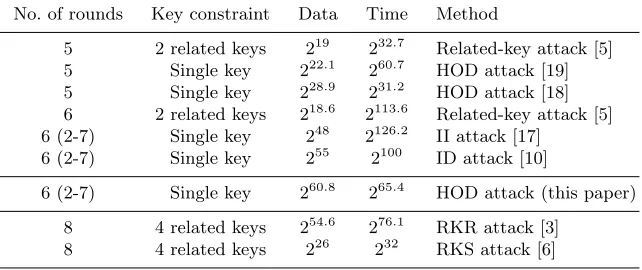
Several cryptanalyses of KASUMI have been reported. In 2005, the first attack against full KASUMI was proposed [3]. The attack, which used the tech-niques of boomerang and rectangle attacks [2, 24], required the 254.6 data and 276.1encryption time. In 2010, an improved attack on full KASUMI was reported [6]. The paper also proposed an attack, named sandwich attacks, and the attack required 226 data and 232 encryption time and 232 memory. The complexity of the attack in [6] was very practical, and the authors could simulate the efficiency of their attack using a personal computer.
most real cryptosystems that generate session keys at random. That’s why, even though the two attacks are very powerful and work in practical complexity, the attacks described above are not a direct threat to full KASUMI and the cryp-tosystem using the cipher, e.g., the A5/3 crypcryp-tosystem.
This paper concentrates on single-key attacks since those are considered to be practical attacks. Some single-key attacks against reduced-round KASUMI have been proposed. In 2001, an impossible differential attack on 6-round KASUMI was reported [10]. The paper of [10] showed an attack using a 5-round impos-sible differential, which requires 255 data and 2100encryption time. In 2006, an integral-interpolation attack on 6-round KASUMI was reported [17]. The paper of [17] showed a 16th order differential and was applied to an attack that requires 248data and 2126.2 encryption time.
This paper proposes an improved single-key attack on 6-round KASUMI. The attack applies a technique of higher order differential attacks [9, 11]. We firstly show a 48th order differential of 4-round KASUMI by extending the previously known 3-round characteristic. We secondly demonstrate an attack using the 48th order differential. Our attack requires 260.8data and 265.4encryption time. The summary of the attacks on KASUMI is listed in Table 1. To the best of our knowledge, the attack reported in this paper is the most powerful single-key attack against reduced-round KASUMI in terms of time complexity.
Section 2 describes the structure of KASUMI. Section 3 explains higher order differential attacks. Section 4 shows a higher order differential of KASUMI and its application to attacks. Finally, section 5 concludes the paper and suggests future work.
Table 1.Summary of the attacks on KASUMI
No. of rounds Key constraint Data Time Method
5 2 related keys 219 232.7 Related-key attack [5] 5 Single key 222.1 260.7 HOD attack [19] 5 Single key 228.9 231.2 HOD attack [18] 6 2 related keys 218.6 2113.6 Related-key attack [5] 6 (2-7) Single key 248 2126.2 II attack [17]
6 (2-7) Single key 255 2100 ID attack [10]
6 (2-7) Single key 260.8 265.4 HOD attack (this paper)
8 4 related keys 254.6 276.1 RKR attack [3] 8 4 related keys 226 232 RKS attack [6]
2
KASUMI
This section describes the structure of KASUMI. For a more detailed description refer to the specification document [21].
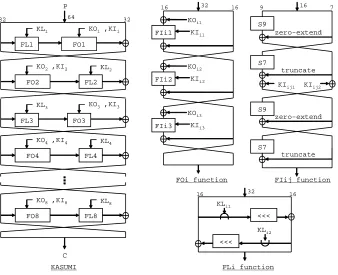
KASUMI is a 64-bit block cipher with a 128-bit secret key. It has a recursive Feistel structure in the same manner as the MISTY1 construction. KASUMI has 8 rounds; each round is composed of two functions: the F O function that has 3 rounds of the F I function, and the F Lfunction that has a Feistel structure performing logical AND/OR operations with subkeys. The order of the two functions depends on the round number: in the even rounds the F O function is applied first, and in the odd rounds theF Lfunction is applied first. TheF I function is a 4-round unbalanced Feistel structure using two types of S-boxes, 9 bits and 7 bits in size.
The KASUMI encryption function is shown in Fig. 1. In this paper, bitwise AND, OR, exclusive OR, and one bit left rotation operations are denoted as∩, ∪, ⊕, and≪, respectively. We denote plaintext as P and ciphertext asC. We denote the subkey input to the F Oifunction as KOi, the subkey input to the
F Iij function asKIij, and the subkey input to the F Lifunction asKLi.
KASUMI FLi function
FOi function FIij function
32 16 16 KOi1 KIi1 KOi2 KIi2 KOi3 KIi3 16 9 7 zero-extend zero-extend truncate
KIij1 KIij2 P
64 32
FL1
KO1 ,KI1
32 C FO1 KL1
∩
∩
∩
∩
∪
∪
∪
∪
32 16 16 KLi1 KLi2 FIi1 FIi2 FIi3 S9 S7 S9 FL2KO2 ,KI2
FL3
KO3 ,KI3 FO3
KL3
FO2
KL2
FL4 KO4 ,KI4 FO4
KL4
FL8 FO8
KL8
KO8 ,KI8
<<<
<<<
truncate S7
The i-th-round output data is defined as Xi for the internal variables. In
KASUMI, 0≤i≤8, soX0=P andX8=C. Considering the Feistel structure of KASUMI, 64-bit internal data Y consists of left and right 32-bit portions defined as YL and YR. Other divisions are also defined with regard to the F O
function:
Y =Y3∥Y2∥Y1∥Y0 , Yi∈GF(2)16.
The∥ indicates data concatenation. We denote thei-th (0≤i < n) bit ofZ as Z[i] and the range from thei-th bit of Z to the j-th bit of Z as Z[i−j]. For example, the leftmost 16 bits of plaintext P is denoted as
P[63−48] =PL[31−16] =P3=X30.
The key schedule divides the 128-bit secret key into 16-bit data blocksKi
(1 ≤ i ≤ 8) and generates subkeys Ki′. Since the characteristics of the key schedule are not used in this paper, we omit a detailed description of its manner for deriving round keys.
3
Higher Order Differential Attacks
Here, we describe both the higher order differential characteristic and the method for solving the attack equation used in higher order differential attacks.
3.1 Higher Order Differential Characteristic
Let the encryption function be theE(X;K) defined by Eq. (1) with dataX and key K as input and data Y as output. Here, X ∈ GF(2)n, K ∈ GF(2)s, and
Y ∈GF(2)m.
Y =E(X;K) (1)
Let (A1, A2,· · ·, Ad) bed linearly independent vectors on GF(2)n, and
de-note the subspace of GF(2)d expanded by them as V(d). Then the d-th order differential with respect toX ofE(X;K) is defined by Eq. (2). Here, the symbol
⊕
A∈V(d) denotes the total sum by exclusive OR. ∆V(d)E(X;K) =
⊕
A∈V(d)
E(X⊕A;K) (2)
We call the subspace V(d) the variable sub-blocks and the subspace other than V(d) the fixed sub-blocks. In the following, we abbreviate ∆
V(d) as ∆(d), when the subspaceV(d)is clearly understood. If the Boolean degree ofE(X;K) with respect toX isN, Eq. (3) necessarily holds without dependence onX.
{
∆(N)E(X;K) =constant
3.2 Attack Equations
This section explains the equations required for an attack using the higher or-der differential characteristic described in section 3.1. If encryption function E comprisesRrounds of functionsFi(1≤i≤R), the (R−1)th-round output for inputX is expressed as
YR−1(X) =FR−1(FR−2(· · ·F2(F1(X;K1);K2)· · ·;KR−2);KR−1), (4) whereKiis the subkey input in thei-th round. If the Boolean degree ofYR−1(X)
with respect toX isN, Eq. (5) necessarily holds according to Eq. (3).
{
∆(N)YR−1(X) =constant
∆(N+1)YR−1(X) = 0 (5)
Denoting the ciphertext for inputX asC(X) and the function for obtaining YR−1from C(X) asF−1, we obtain
YR−1(X) =F−1(C(X);KR). (6)
Substituting Eq. (6) into Eq. (5), we obtain
{ ⊕
A∈V(N)F−1(C(X⊕A);KR) =constant ⊕
A∈V(N+1)F−1(C(X⊕A);KR) = 0
. (7)
Equation (7) holds when the final round subkey KR is correct, so the true
key,KR, can be determined by solving Eq. (7). Therefore, Eq. (7) is called the
attack equation.
3.3 Algebraic Method
One method of solving the attack equation presented in section 3.2 is an alge-braic method. This method regards attack equations as functions onGF(2) and subjects them to linearization, that is, transforms them into linear equations, by redefining the higher degree terms related to the key as new first-degree unknown terms [15, 16]. This approach has the potential to reduce the time complexity of solving attack equations.
Let Eq. (7) be ann-bit attack equation derived using ad-th order differential. Denoting the key contained in the attack equation as KR = (KR1, KR2), we determine KR1 by an exhaustive search and obtainKR2 by using an algebraic method. Here, we letLdenote the number of unknown terms excluding constant terms included in the linearized attack equation with regard toKR2. As forKR1, we letKR1∈GF(2)s1.
for determining KR2, the probability that the linearized equations for a false KR1 key are not inconsistent is estimated to be 2−m. Thus, by using L+m linearized equations whose probability of not being inconsistent for a falseKR1 key is extremely small, that is, that satisfy the condition 2−m×2s1 ≪1, false KR1 keys can be rejected with very high probability.
Because the attack equation is ann-bit attack equation, n linearized equa-tions are obtained with one set ofd-th order differentials. Therefore, the number of plaintexts needed to obtainL+mlinearized equations is given by
D= 2d×
⌈
L+m n
⌉
. (8)
Furthermore, to obtain n linearized equations, the round function must be calculated D times for each of L unknown terms and 1 constant term. Here, considering that the time complexity for Gaussian elimination to solve the simul-taneous equation is negligibly small, the time complexity for solving the attack equation is equivalent to that of calculating the coefficient matrix. Thus, con-sidering thatKR1 is to be determined by an exhaustive search, time complexity T is given by
T = 2s1×D×(L+ 1) = 2s1+d×
⌈
L+m n
⌉
×(L+ 1). (9)
Here, time complexity signifies the number of times the round function is calcu-lated.
4
Higher Order Differential Attack on 6-Round KASUMI
The following section describes a higher order differential characteristic of KA-SUMI and an attack that make use of this characteristic.
4.1 Higher Order Differentials of KASUMI
Here, we describe higher order differential characteristics of KASUMI. First, we present Theorem 1 from [19] for KASUMI. In this theorem,αandβ denote fixed and variable 16-bit sub-blocks, respectively.
Theorem 1 Given a 16th order differential in the form of plaintextP ∈(α, α, β, α)
in KASUMI, intermediate dataX3
L satisfies Eq. (10).
∆(16)XL3[24−16] = 0 (10)
Theorem 2 Given a 48th order differential in the form of 2nd-round inputX2∈ (β, α, β, β)in KASUMI, intermediate data XL5 satisfies Eq. (11).
∆(48)XL5[24−16] = 0 (11)
The 48th order differential of 4-round KASUMI is illustrated in Fig. 2.
Proof. Data X1
L is equal to XR2 since KASUMI is the Feistel structure. The
higher order differential characteristic is, therefore, unchanged. In addition, though 216values of random data are output from theF L2 function,X2
Lcan be given
ex-haustively by giving 2nd-round inputX1
R, exhaustively. Thus, since the value of
the 16th order differential of Eq. (10) appears 232times in the intermediate data X5
Laccording to Theorem 1, its total sum is zero.
(β,α) (β,β)
( )48 5
[
24−16]
=0∆ XL
FO4 FL4
FL5 FO5
FO2 FL2
FL3 FO3
Fig. 2.The 48th order differential of 4-round KASUMI
4.2 Derivation of Attack Equation
CL
FO2
KO7, KI7
CR
4-round
5 R X
PL PR
5 L X
FL2
FO6 FL6
FL7 FO7
KL7
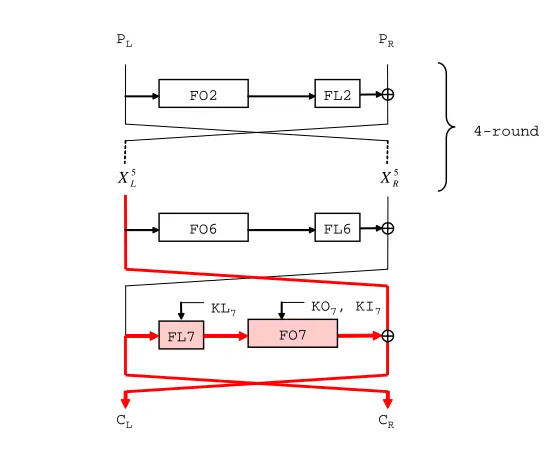
Fig. 3.Six-round KASUMI
We can derive Eq. (12) as the attack equation from Fig. 3 and Eq. (11).
⊕
A∈V(48)
{ F O7(F L7(CR;KL7);KO7, KI7)[24−16]⊕CL[24−16]}
=∆(48)XL5[24−16] = 0 (12)
To solve attack equation (12), we denote the functionG9 for obtainingXL5[24−
16] from the 41 bits of the ciphertext C and the 82 bits of the subkey SK = {KO71, KO72, KI712, KI722, KL7} relevant to the attack equation as:
XL5[24−16] =G9(C;SK). (13) We get the attack equation (14) from Eq. (12) and (13).
⊕
A∈V(48)
G9(C(X⊕A);SK) = 0 (14)
4.3 Complexity of the Attack
In this section, we perform a detailed estimation of the amount of data and time complexity required for solving the attack equation presented in section 4.2.
Table 2.Number of unknown coefficients in the attack equation
Bit position, No. of unknowns for the No. of unknowns for the
i original subkey,Li equivalent subkey,L′i
16th bit 34007 32321
17th bit 34086 31998
18th bit 32425 30583
19th bit 32213 30499
20th bit 32684 30852
21st bit 34285 32435
22nd bit 33309 31265
23rd bit 33927 31403
24th bit 36078 33616
Total 67746 62958
The number of plaintexts D required to collect the linear equations for 9 bits of Eq. (14) can be obtained by substituting the total number of unknown coefficients, L′i, into Eq. (8). Furthermore, there is no guessing key bits for solving Eq. (14), sos1= 0. Accordingly, from the condition for eliminating false keys, 2−m+s1 <<1, if we letm= 10,1we have
D= 248×
⌈
62958 + 10 9
⌉
≈260.78. (15)
In addition, the time complexity required for calculating the coefficients of the linear equation is obtained by substituting the sum of the numbers of un-known coefficients,L′i, into Eq. (9). Furthermore, as explained in section 3.3, the calculations must be performed 2d times to determine the unknown coefficients
of linearized equations. However, in the case that the unknown coefficients of the linearized equations can be calculated independently, it is known that time complexityT can be reduced provided that the size of data required for calcu-lating the unknown coefficients isw bits and the relationw < dis satisfied [8]. Specifically, it was shown in [8] that calculations for a value that appears an even number of times can be omitted since performing an exclusive-OR operation on the same value an even number of times results in a value of 0. With this tech-nique, only the values ofw-bit data that appear an odd number of times need to be used to calculate the unknown coefficients. As a result, time complexityT as expressed by Eq. (9) takes on the form of Eq. (16) when the relation w < d is satisfied.2
T = 2s1+w−1×
⌈
L+m n
⌉
×(L+ 1) (16)
1
10−3<<1
Here, d= 48 andw= 41, so the conditionw < dis satisfied, we have
T = 20+41−1×
⌈
62958 + 10 9
⌉
×(62958 + 1)≈268.72. (17)
This time complexity signifies the number of times one round function is per-formed.
Furthermore, in the estimation of time complexity below, we assumed that the processing times for one S-box lookup and for two logical operations are the same.3On the basis of this assumption, the estimated processing time of the one round function including the exclusive-OR of the Feistel structure is 55 logical operations. The required calculations of theF O7 function are illustrated in Fig. 4. In Fig. 4, EKI means the equivalent keys of KI7. From Fig. 3 and Fig. 4, determining the coefficients of linearized equation (14) requires the calculation of theF L7 function, the 6 S-box lookups and 13 exclusive OR operations including the exclusive-OR of the Feistel structure. Thus, convertingT to a number of 6-round encryptions, we get
T ≈268.72×6 + 2×6 + 13
55 ×
1 6 ≈2
65.31. (18)
FI71
FI72
FI73 zero-extend
zero-extend truncate S9
S7
S9
truncate S7
EKI711
EKI712
zero-extend
zero-extend truncate S9
S7
S9
truncate S7
EKI721
EKI722
KO71
KO72
KO73
Fig. 4.The required calculations of theF O7 function
3
5
Conclusion and Future Work
This paper reports the higher order differential attack of 6-round KASUMI. This attack requires 260.8 data and 265.4 encryption time. The type of our attack is categorized as a single-key attack. This type of attack is considered to be a more practical attack than a related-key attack. Our attack is not a direct threat to full KASUMI, but to the best of our knowledge, the attack proposed in this paper is the most powerful single-key attack in terms of time complexity.
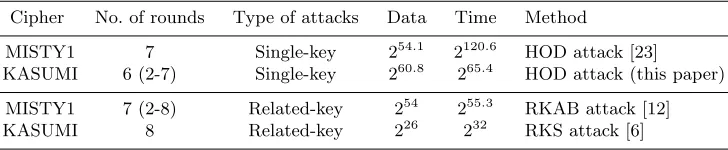
In another interesting topic, the comparison between MISTY1 and KASUMI was described in [6]. The authors of [6] argued that the transition from MISTY1 to KASUMI led to a much weaker cryptosystem. However, this argument is appropriate for only a situation in which related-key attacks can be mounted. The comparison had to be done on the same situation. The best attacks on MISTY1 and KASUMI are listed in Table 3.
Table 3.The best attacks on MISTY1 and KASUMI
Cipher No. of rounds Type of attacks Data Time Method
MISTY1 7 Single-key 254.1 2120.6 HOD attack [23] KASUMI 6 (2-7) Single-key 260.8 265.4 HOD attack (this paper)
MISTY1 7 (2-8) Related-key 254 255.3 RKAB attack [12]
KASUMI 8 Related-key 226 232 RKS attack [6]
HOD attack : Higher order differential attack
RKAB attack : Related-key amplified boomerang attack RKS attack : Related-key sandwich attack
From Table 3, the security margin of KASUMI, which is the modified ver-sion of MISTY1, is greater than that of MISTY1 regarding single-key attacks. However, the security margin of KASUMI is less than that of MISTY1 regard-ing related-key attacks because the key schedule of KASUMI is too simple to be secure against related-key attacks. Therefore, KASUMI is still stronger than MISTY1 in practical use.
Finally, we suggest future work. It is known that the amount of data and time complexity can be reduced if any of theLunknown coefficients have a linear sum relation in the linearized equations [7]. In section 4.3, we could not calculate the rank ofL×(L+ 2) coefficient matrix because of the computational difficulty to perform the Gaussian elimination. If we can derive the upper bound of rank by dividing the attack equation to multiple linearized equations, the data and time complexity must be reduced.
thanks to Erin Hayashi who checked this paper from the viewpoit of English usage.
References
1. Biham, E.: New Types of Cryptanalytic Attacks Using Related Keys. J. Cryptology 7(4), pp. 229–246 (1994)
2. Biham, E., Dunkelman, O., Keller, N.: The Rectangle Attack - Rectangling the Serpent. In: Pfitzmann, B. (ed.) EUROCRYPT 2001, LNCS, vol. 2045, pp. 340– 357. Springer, Heidelberg (2001)
3. Biham, E., Dunkelman, O., Keller, N.: A Related-Key Rectangle Attack on the Full KASUMI. In: Roy, B. (ed.) ASIACRYPT 2005. LNCS, vol. 3788, pp. 443–461. Springer, Heidelberg (2005)
4. Biham E., Shamir A.: Differential Cryptanalysis of DES-Like Cryptosystems. J. Cryptology 4(1), pp. 3–72 (1991)
5. Blunden, M., Escott, A.: Related Key Attacks on Reduced Round KASUMI. In: Matsui, M. (ed.) FSE 2001. LNCS, vol. 2355, pp. 277–285. Springer, Heidelberg (2002)
6. Dunkelman, O., Keller, N., Shamir, A.: A Practical-Time Attack on the KASUMI Cryptosystem Used in GSM and 3G Telephony. In: Rabin, T. (ed.) CRYPTO 2010. LNCS, vol. 6223, pp. 393–410. Springer, Heidelberg (2010)
7. Hatano Y., Tanaka H., Kaneko T.: Optimization for the Algebraic Method and Its Application to an Attack of MISTY1. IEICE Transactions 87-A(1), pp. 18–27 (2004)
8. Igarashi, Y., Kaneko, T.: The 32nd-order differential attack on MISTY1 without FL functions. In: 2008 International Symposium on Information Theory and its Applications, WTI-4-4 (2008)
9. Knudsen L.R.: Truncated and Higher Order Differentials. In: Preneel B. (ed.) FSE 1994. LNCS, vol. 1008, pp. 196–211. Springer, Heidelberg (1995)
10. K¨uhn U.: Cryptanalysis of Reduced-Round MISTY. In: Pfitzmann B. (ed.) EU-ROCRYPT 2001. LNCS, vol. 2045, pp. 325–339. Springer, Heidelberg (2001) 11. Lai X.: Higher Order Derivatives and Differential Cryptanalysis. In: Symposium
on Communication, Coding and Cryptography, pp. 227–233. Kluwer Academic Publishers (1994)
12. Lee E., Kim J., Hong D., Lee C., Sung J., Hong S., Lim J.: Weak-Key Classes of 7-Round MISTY 1 and 2 for Related-Key Amplified Boomerang Attacks. IEICE Transactions 91-A(2), pp. 642–649 (2008)
13. Matsui M.: Linear Cryptanalysis of the Data Encryption Standard. In: Helleseth T. (ed.) EUROCRYPT 1993. LNCS, vol. 765, pp. 386–397. Springer, Heidelberg (1994)
14. Matsui M.: New Block Encryption Algorithm MISTY. In: Biham E. (ed.) FSE 1997. LNCS, vol. 1267, pp. 54–68. Springer, Heidelberg (1997)
15. Moriai S., Shimoyama T., Kaneko T.: Higher Order Differential Attak of CAST Cipher. In: Vaudenay S. (ed.) FSE 1998. LNCS, vol. 1372, pp. 17–31. Springer, Heidelberg (1998)
17. Sugio, N., Aono, H., Hongo, S., Kaneko, T.: A Study on Integral-Interpolation Attack of MISTY1 and KASUMI. In: Computer Security Symposium 2006, pp.173– 178 (2006, in Japanese)
18. Sugio, N., Aono, H., Hongo, S., Kaneko, T.: A Study on Higher Order Differential Attack of KASUMI. IEICE Transactions 90-A(1), pp. 14–21 (2007)
19. Sugio, N., Tanaka, H., Kaneko, T.: A Study on Higher Order Differential Attack of KASUMI. In: 2002 International Symposium on Information Theory and its Applications, (2002)
20. 3rd Generation Partnership Project (3GPP),http://www.3gpp.org/
21. 3rd Generation Partnership Project, Technical Specification Group Services and System Aspects, 3G Security, Specification of the 3GPP Confidentiality and In-tegrity Algorithms; Document 2: KASUMI Specification, V.3.1.1 (2001)
22. 3rd Generation Partnership Project, Technical Specification Group Services and System Aspects, 3G Security, Specification of the A5/3 Encryption Algorithms for GSM and ECSD, and the GEA3 Encryption Algorithm for GPRS; Document 4: Design and evaluation report, V6.1.0 (2002)
23. Tsunoo Y., Saito T., Shigeri M., Kawabata T.: Security Analysis of 7-Round MISTY1 against Higher Order Differential Attacks. IEICE Transactions 93-A(1), pp. 144–152 (2010)