Tools for Building an Interlinked Synonym Lexicon Network
Zde ˇnka Urešová, Eva Fuˇcíková, Eva Hajiˇcová, Jan Hajiˇc
Charles University, Faculty of Mathematics and PhysicsInstitute of Formal and Applied Linguistics Malostranské nám. 25
11800 Prague 1, Czech Republic
{uresova,fucikova,hajicova,hajic}@ufal.mff.cuni.cz
Abstract
This paper presents the structure, features and design of a new interlinked verbal synonym lexical resource called CzEngClass and the editor tool being developed to assist the work. This lexicon captures cross-lingual (Czech and English) synonyms, using valency behavior of synonymous verbs in relation to semantic roles as one of the criteria for defining such interlingual synonymy. The tool, called Synonym Class Editor - SynEd, is a user-friendly tool specifically customized to build and edit individual entries in the lexicon. It helps to keep the cross-lingual synonym classes consistent and linked to internal as well as to well-known external lexical resources. The structure of SynEd also allows to keep and edit the appropriate syntactic and semantic information for each Synonym Class member. The editor makes it possible to display examples of class members’ usage in translational context in a parallel corpus. SynEd is platform independent and may be used for multiple languages. SynEd, CzEngClass and services based on them will be openly available.
Keywords:Lexical Resource, Parallel Corpus, Semantics, Syntax, Synonymy, Valency
1.
Introduction
We present a demonstration of our lexicon editor, called SynEd, for creating an interlinked multilingual (for the time being, bilingual) lexical resource—a contextually-based synonym lexicon of verbs contextually-based on their syntac-tic and semansyntac-tic behavior in (bilingual) context. We also present the design and structure (scheme) of the lexicon dataset proper.
The lexicon, under the working name “CzEngClass” (Ure-šová et al., 2018), is being built “bottom-up”, using a par-allel bilingual corpus with a rich manual annotation (the Prague Czech-English Dependency Treebank, version 2.0), its associated valency lexicons, i.e., EngVallex, PDT-Vallex and CzEngVallex, and it is being linked to other exter-nal lexical resources–VALLEX, FrameNet, VerbNet, Prop-Bank and Czech and English WordNets (Sect. 3.).
One of the crucial parts of the “CzEngClass” project was to establish a scheme for this resource (Sect. 4.), taking into account not only its intended multilinguality, but also links to the initial bilingual parallel corpus (and more corpora in the future) and the existing relevant lexical resources. The semantic role labels used for defining the individual syn-onym classes are based mostly on FrameNet (and in some cases on VerbNet), while the argument labels and their mor-phosyntactic behavior are taken from the valency lexicons used for the PCEDT annotation. One of the main princi-ples for the design of “CzEngClass” follows A. Kilgariff’s idea of corpus - dictionary linkage (cf. the PDIC and PCID model described in (Kilgariff, 2005)), so we are strictly keeping references to all of the used lexical resources (in-ternal and ex(in-ternal) as well as to the corpus examples influ-encing the class divisions.
Since the goal of the project is to identify contextually-based Czech and English synonyms, each verb has to be first broken down to senses. The initial set of senses for both Czech and English has been taken from the Czech and English valency lexicons, since they have been determined
during the creation of these lexicons and linked manually to each occurrence of the verb in the parallel corpus. SynEd, the editor for “CzEngClass” (Sect. 4.), is currently used as a standalone application, with links to all the refer-enced external resources that can be immediately accessed directly inSynEd, through third-party applications and/or through web browsers. Currently, there are 60 synonym classes with approx. 470 English and over 1000 Czech verbs (verb senses) included in CzEngClass,1 A selection and/or creation of a web-based customized interface for browsing and searching will follow and is part of future work (Sec. 5.). The editor as well as the associated data will be publicly available under a CC license.
2.
Related Work
When designing the “CzEngClass” lexicon as well as the editor, we were looking for an existing annotation tool for a similar type of lexicon(s) we could possibly adapt. We con-centrated on those that allow working with corpora, since that is also the way we approach building the lexicon. Lexicons have been built using software tools (and corpora) since the 1980s, mainly at publishers, such as (Ahlswede, 1985); such efforts are summarized in (Teubert, 2007). We have considered many other existing tools, either stan-dalone or available as web services and applications. Lex-icon Creatoris a tool designed to help developers produce lexical data for its use in a variety of linguistic applica-tions. According to (Fontenelle et al., 2008),Lexicon Cre-ator enables to work on existing wordlists derived either directly from corpora or from previously created wordlist data. Lexicon Builder, available as web service (Parai et al., 2010), aims at automated methods to compile custom lexicons from BioPortal ontologies.CoBaLT(Kenter et al., 2012), is a web-based editor optimized for work with large
1The final size should cover at least the current Czech and
datasets and to produce historical lexica. Dicet(Gader et al., 2012) is a knowledge-based, tailor-made lexical graph editor and browser that allows lexicographers to browse through the lexical network and directly expand and re-vise it. DECFC,2 a specialized dictionary editor (Decary and Lapalme, 1990), provides a multi-windowing environ-ment that enables the simultaneous execution of different processes on different parts of the screen. A database schema for developing and maintaining Japanese linguistic resources (Asahara et al., 2002) is a stand-off framework combining XML and a relational database. SIL’s3 latest version (8.3) of FLEx(FieldWorks Language Explorer) is a next specific program designed to assist linguists in col-lecting, managing and publishing linguistic data.4 FLEx features powerful bulk editing tools and a large number of built-in fields.
For the resources we are linking CzEngClass to, there are also several tools. A specific editor -Cornerstone(Choi et al., 2010a) - has been specifically customized to cre-ate and edit frameset files for PropBank project.5 One of the biggest advantages of Cornerstone is that it accommo-dates several languages (it was used for e.g., Arabic, Chi-nese, English, Hindi, and Korean). A semi-automatic Ver-baLex–FrameNetlinking tool (Materna, 2009; Materna and Pala, 2010; Materna, 2011; Materna, 2014) has been devel-oped. This tool aims to build a core of Czech FrameNet. All the above mentioned editors and tools are very sophis-ticated and useful, but rather specialized for the particu-lar lexical resource. Those few exceptions, such as the Japanese lexical resource builder, are on the other hand too general and would need a substantial amount of cus-tomization, since for the CzEngClass lexicon we need to express more specific requirements. We have thus decided to write a new editor, reusing some parts that have been developed in the past for editing the valency lexicons and linking them to the associated treebanks. This new editor is calledSynEd, and we describe it in (Sect. 4.).
3.
Resources Used
Our approach to the development of a synonym lexicon for both NLP and linguistic studies builds on corpus ex-amples with natural contexts. Therefore, we build our research on electronically accessible and richly annotated data, namely, on the Prague Czech-English parallel tree-bank and on the Prague Dependency Treetree-bank (Hajiˇc et al., 2006) valency lexicons (PDT-Vallex, EngVallex and CzEngVallex), as well as on other well-established lexical databases (e.g., FrameNet, VerbNet, Semlink, PropBank and Czech and English WordNets).
The core corpus resource is the Prague Czech-English De-pendency Treebank (Hajiˇc et al., 2012), which stores paral-lel PDT-style annotations (manual annotation of morphol-ogy, syntax and semantics) of English texts (Wall Street Journal part of Penn Treebank (Marcus et al., 1993)) and
2DECFC (Explanatory and Combinatory Dictionary of
Con-temporary French).
3Originally known as the Summer Institute of Linguistics, Inc. 4https://software.sil.org/fieldworks
5For proper PropBank annotation another editor calledJubilee
(Choi et al., 2010b) has been used.
their professional translation into Czech6. The PCEDT an-notations capture linkage of the surface and deep syntactic layers; moreover, the deep layer contains verbal word sense labeling by keeping links of each verb occurrence to the ap-propriate valency frame in the associated valency lexicons, PDT-Vallex and EngVallex.
The main lexicon resources we build on are thus the following valency lexicons: EngVallex (Cinková et al., 2014),(Cinková, 2006), PDT-Vallex (Urešová et al., 2014), (Urešová, 2011) and also CzEngVallex (Urešová et al., 2015), (Urešová et al., 2016). These lexicons are based on the Functional Generative Description Valency The-ory (FGDVT)7. In the lexicons, each entry has a head-word with one or more valency frame(s). Every va-lency frame contains labeled arguments, their obligatori-ness and the required surface form of valency frame mem-bers (arguments). PDT-Vallex contains about 12,000 va-lency frames for about 7,000 verbs; EngVallex, contains about 7,000 valency frames for almost 4,500 verbs. CzEng-Vallex links them across Czech and English using the auto-matic PCEDT corpus alignments (after manual pruning of erroneous alignments has been applied).8
Since CzEngClass aims at synonymy based on semantics, we also use the following lexical resources: FrameNet (Fill-more et al., 2003; Fill(Fill-more et al., 2003), VerbNet (Schuler, 2006), Semlink (Palmer, 2009; Bonial et al., 2012), Prop-Bank (Palmer et al., 2005), Czech WordNet (Pala et al., 2011), (Pala and Smrž, 2004) and English WordNet (Miller, 1995; Fellbaum, 1998).9 These resources are mainly be-ing referred to by the newly built CzEngClass entries; in addition, FrameNet and VerbNet semantic roles are being consulted when defining any particular synonym class.
4.
Lexicon Design
The lexicon groups translational verbal equivalents, i.e., verb senses, together both in Czech and English, originally represented as valency frames in the Czech and English va-lency lexicons, into “Synonym Classes.” We call the syn-onymous senses in one class “Class Members.”
Each class is assigned a common set of “Semantic Roles” (SRs) and the valency frame elements of each Class Mem-ber are mapped to SRs assigned to this set. This mapping is the crucial defining feature of the CzEngClass lexicon, since it defines, through the original argument mapping to their morphosyntactic features, the use of the arguments in text, and therefore the context in which the particular verb can be considered a synonym to the other, similarly defined (or “restricted”) verbs (their senses).
Class Members are then further individually linked to the original lexicon (PDT-Vallex or EngVallex) and also to en-try(ies) in all the additional resources used (if such
rele-6For further information see the project web page: http://
ufal.mff.cuni.cz/pcedt2.0.
7For details on the FGDVT theory see e.g., (Panevová, 1977;
Lopatková, 2010)
8The CzEngClass lexicon refers also to VALLEX (Lopatková
et al., 2016), a much more elaborated lexicon, built on the same theoretical framework as PDT-Vallex. However, VALLEX it is not based on the PDT data.
vant entries exists in them). More than one link to any of the additional resources can be included; in such a case, it means that the same or similar meaning has been found in the external lexicons, with an unclear distribution of senses. In other words, mappings between CzEngClass entries and the entries in the other lexical resources are not necessarily 1:1.
Table 1 shows a (simplified)10 example. Both Czech and English verbs, determined to be synonymous in the partic-ular sense defined by the PDT-Vallex and EngVallex links, are listed as this synonym class members. The semantic roles chosen for this class have been simplified from the FrameNet. Once selected, the arguments of the particu-lar verb sense, as found in the valency lexicons, must be mapped to these semantic roles; however, if some of the SRs are not listed as an argument, the corresponding ad-junct might be used, too. In the examples in Table 1, an-other phenomenon is displayed: in some cases, a semantic role can be expressed as one argument (e.g.,PATforhear, as in... they heard about it.PAT in local news), or as two (part of the Phenomenon is expressed asPAT, part asEFF
for know, as in -... he didn’t know anything.EFF about him.PAT). In such a case, all possibilities must be listed in the particular mapping field.
For such a lexicon, a stand-off XML schema has been developed and is used as the storage format. The XML document contains a header part, which gives local or re-mote reference to the external resources, lists all possible SRs (semantic roles) that are used in the lexicon (for sistency checking), etc. The body of the document con-tains the classes. Each class first lists the assigned SRs, and then the class members by verb lemmas, references to valency frames in PDT-Vallex and EngVallex defining the sense IDs, and references to external resources (FrameNet, VerbNet, PropBank, WordNets) for each class member. In addition, bookkeeping information is stored as well, such as annotator’s ID, timestamps, etc. A (simplified) extract of the XML-formatted lexicon follows, for the classbuild -budovat:
<CzEngClass owner="EF">
... (header with SRs, arg. labels, lexicon URLs etc.)
<body>
<veclass lemma="budovat (v-w228f1)" id="vec00001"> <commonroles>
10For space reasons, specific morphosyntactic restrictions and
additional external links to PropBank and WordNets are not shown; the list of class members is also substantially shortened.
<argfrom idref="vecargpdtACT"/>
... (other arg pair mappings to SRs)
</maparg>
... (more links to aligned valency frames)
<link idref="vw2305f1p1" enid="ev-w2903f1"
... (more classes of synonyms)
</body> </CzEngClass>
Class Roles External Links
member Cognizer Phenomenon Speaker PDT/EngVallex FrameNet VerbNet
dozvˇedˇet se ACT PAT ORIG v-f1
hear ACT PAT ORIG ev-f1 Hear discover-84-1-1, see-30.1-1-1-1
know ACT PAT+EFF ORIG ev-f1 Awareness consider-29.9-1-1
learn ACT PAT ORIG ev-f1 Becoming_aware learn-14-2-1
doslýchat se ACT PAT+EFF ORIG ev-f1
pouˇcit se ACT PAT+EFF ORIG v-f1
... ... ... ... ... ...
Table 1: Mappings and External Links for class “dozvˇedˇet se, hear, ..., pouˇcit se, ...”
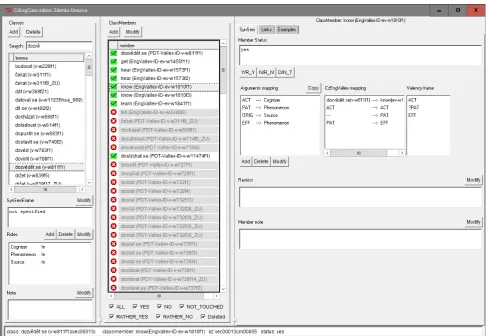
Figure 1: A screenshot of theSynEdeditor
many in the relatively small PCEDT corpus, the annotator can mark the “best” (most illustrative) example sentence(s) from the corpus to be shown first to the future user once the lexicon is finished and made public.
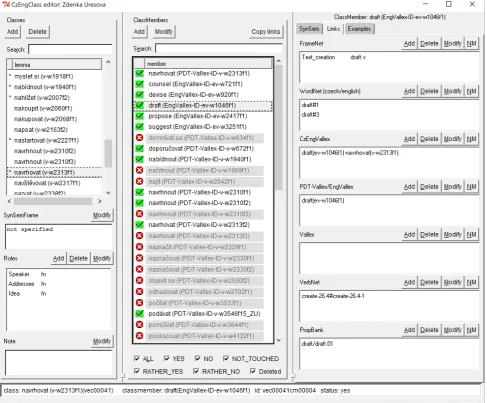
As seen in Fig. 1, the editor’s screen contains three sections: list of all lemmas (allowing search for their class) and basic information for the selected class on the left, then a list of all class members (with PDT-Vallex/EngVallex IDs) in the middle, and then on the right information pertaining to the selected class member: argument mapping to SRs, status, additional restrictions and notes. The right-hand pane can be also switched to see and edit the Links to external re-sources (Fig. 2), or to see lists of Examples (using the tabs above the pane).
All external links are “clickable” in order to both sim-plify and speed up annotator’s work. The lexical
re-source links (tab “Links”, see also Fig. 2) are expanded to a full external or local URL and opened in a new browser tab. For example, the ID link for “draft,” which is part of thecreate-26.4-1VerbNet class, is expanded to http://verbs.colorado.edu/verb-index/vn3.3/ vn/create-26.4.php#create-26.4-1and shown in the user’s new browser tab. Similarly, in the “Examples” tab, user can click on a “Show” button and the examples from PCEDT 2.0 are shown in thetred11 viewer/editor, which must be installed locally.12
11https://ufal.mff.cuni.cz/tred
12In the future, links to examples will possibly be converted
Figure 2: A screenshot of the Links to external resources tab in theSynEdeditor
5.
Future Work
This paper presented the design of the structure of the CzEngClass lexicon and the editorSynEdused for its edit-ing and maintenance. The editor is currently beedit-ing exten-sively tested in order to be used (simultaneously) by multi-ple annotators. Two annotators had worked withSynEdon the CzEngClass lexicon for almost a year so the editor has already been sufficiently tested and gradually improved, in-cluding time-saving as well as ergonomical features and is now ready to begin routine work.
We plan to investigate the relation of valency and seman-tic roles in more detail, also from their morphosyntacseman-tic realization point of view, and adjust our editor to such newly emerging requirements. We will continue to de-velopSynEdby improving its functionality and practicality through more feedback from future annotators.
In the future, we plan to explore cooperation with the On-toLex Community Group (Piasecki et al., 2017) in order to integrate our work into methods for representing linked lexical data.
We also plan to join the Cross-lingual FrameNet Group. We believe that our editor will be–possibly after some refinements–suitable for editing resources linked to FrameNet (and other lexical resources), including its de-ployment for other languages.
Acknowledgments
6.
Bibliographical References
Ahlswede, T. E. (1985). A Tool Kit for Lexicon Building. In23rd Annual Meeting of the Association for Computa-tional Linguistics.
Asahara, M., Yoneda, R., Yamashita, A., Den, Y., and Matsumoto, Y. (2002). Use of XML and Relational Databases for Consistent Development and Maintenance of Lexicons and Annotated Corpora. In Proceedings of the Third International Conference on Language Re-sources and Evaluation (LREC’02). European Language Resources Association (ELRA).
Bonial, C., Feely, W., Hwang, J. D., and Palmer, M. (2012). Empirically Validating VerbNet Using SemLink. In Sev-enth Joint ACL-ISO Workshop on Interoperable Seman-tic Annotation, Istanbul, Turkey, May.
Choi, J. D., Bonial, C., and Palmer, M. (2010a). Propbank Frameset Annotation Guidelines Using a Dedicated Ed-itor, Cornerstone. InProceedings of the Seventh confer-ence on International Language Resources and Evalua-tion (LREC’10). European Languages Resources Asso-ciation (ELRA).
Choi, J. D., Bonial, C., and Palmer, M. (2010b). Prop-bank Instance Annotation Guidelines Using a Dedicated Editor, Jubilee. In Proceedings of the Seventh confer-ence on International Language Resources and Evalua-tion (LREC’10). European Languages Resources Asso-ciation (ELRA).
Cinková, S. (2006). From PropBank to EngValLex: adapt-ing the PropBank-Lexicon to the valency theory of the functional generative description. In Proceedings of LREC 2006, Genova, Italy.
Decary, M. and Lapalme, G. (1990). An Editor for the Explanatory and Combinatory Dictionary of Contem-porary French (DECFC). Computational Linguistics, 16(5):145–154.
Fellbaum, C. (1998). WordNet: An Electronic Lexical Database. Language, Speech, and Communication. MIT Press, Cambridge, MA.
Fillmore, C. J., Johnson, C. R., and L.Petruck, M. R. (2003). Background to FrameNet: FrameNet and Frame Semantics. International Journal of Lexicogra-phy, 16(3):235–250.
Fontenelle, T., Cipollone, N., Daniels, M., and Johnson, I. (2008). Lexicon Creator: A Tool for Building Lex-icons for Proofing Tools and Search Technologies. In Janet DeCesaris Elisenda Bernal, editor,Proceedings of the 13th EURALEX International Congress, pages 359– 369, Barcelona, Spain, jul. Institut Universitari de Lin-guistica Aplicada, Universitat Pompeu Fabra.
Gader, N., Lux-Pogodalla, V., and Polguère, A. (2012). Hand-Crafting a Lexical Network With a Knowledge-Based Graph Editor.
Kenter, T., Erjavec, T., Žorga Dulmin, M., and Fiser, D. (2012). Lexicon Construction and Corpus Annotation of Historical Language with the CoBaLT Editor.
Kilgariff, A. (2005). Putting the corpus into the dictionary. InProceedings of the second Meaning workshop, pages 1–6, Trento, Italy, February.
Lopatková, M., Kettnerová, V., Bejˇcek, E., Vernerová,
A., and Žabokrtský, Z. (2016). Valenˇcní slovník ˇceských sloves VALLEX. Nakladatelství Karolinum, Praha, Czechia.
Lopatková, M. (2010). Valency Lexicon of Czech Verbs: Towards Formal Description of Valency and Its Modeling in an Electronic Language Resource. Habilitation thesis. Charles University in Prague, Praha, Czechia.
Marcus, M. P., Santorini, B., and Marcinkiewicz, M. A. (1993). Building a Large Annotated Corpus of En-glish: The Penn Treebank. COMPUTATIONAL LIN-GUISTICS, 19(2):313–330.
Materna, J. and Pala, K. (2010). Using Ontologies for Semi-automatic Linking VerbaLex with FrameNet. In Nicoletta Calzolari (Conference Chair), et al., editors, Proceedings of the Seventh International Conference on Language Resources and Evaluation (LREC’10), Val-letta, Malta, may. European Language Resources Asso-ciation (ELRA).
Materna, J. (2009). Linking Czech Verb Valency Lexicon VerbaLex with FrameNet. In Proceedings of 4th Lan-guage and Technology Conference, pages 215–219, Poz-na´n. Wydawnictwo Pozna´nskie Sp. z o.o.
Materna, J. (2011). Building FrameNet in Czech [online]. Rigorózní práce, Masarykova univerzita, Fakulta infor-matiky, Brno.
Materna, J. (2014). Probabilistic Semantic Frames [on-line]. Disertaˇcní práce, Masarykova univerzita, Fakulta informatiky, Brno.
Miller, G. A. (1995). WordNet: A Lexical Database for English. Commun. ACM, 38(11):39–41, November. Pala, K. and Smrž, P. (2004). Building Czech Wordnet.
Romanian Journal of Information Science and Technol-ogy, 7(1-2):79–88.
Palmer, M., Gildea, D., and Kingsbury, P. (2005). The Proposition Bank: An Annotated Corpus of Seman-tic Roles. Computational Linguistics, 31(1):71–106, March.
Palmer, M. (2009). Semlink: Linking PropBank, VerbNet and FrameNet. InProceedings of the Generative Lexicon Conference, page 9–15.
Panevová, J. (1977). Verbal Frames Revisited.The Prague Bulletin of Mathematical Linguistics, (28):55–72. Parai, G. K., Jonquet, C., Xu, R., Musen, M. A., and Shah,
N. H. (2010). The Lexicon Builder Web service: Build-ing Custom Lexicons from two hundred Biomedical On-tologies. In American Medical Informatics Association Annual Symposium, AMIA’10.
Piasecki, M., Walkowiak, T., Rudnicka, E., Naskret, T., and Bond, F. (2017). The Concept of Lexical Platform. In Proceedings of the LDK 2017 Workshops: 1st Workshop on the OntoLex Model (OntoLex-2017), Shared Task on Translation Inference Across Dictionaries & Challenges for Wordnets co-located with 1st Conference on Lan-guage, Data and Knowledge (LDK 2017), Galway, Ire-land, June 18, 2017., pages 197–208.
Teubert, W. (2007). Text Corpora and Multilingual Lexi-cography. John Benjamins Publishing Company. Urešová, Z., Fuˇcíková, E., and Šindlerová, J. (2016).
CzEngVallex: a Bilingual Czech-English Valency Lex-icon. The Prague Bulletin of Mathematical Linguistics, 105:17–50.
Urešová, Z., Fuˇcíková, E., Hajiˇcová, E., and Hajiˇc, J. (2018). Creating a Verb Synonym Lexicon Based on a Parallel Corpus. InProceedings of the 11th Interna-tional Conference on Language Resources and Evalua-tion (LREC’18), Miyazaki, Japan, May. European Lan-guage Resources Association (ELRA).
Urešová, Z. (2011). Valenˇcní slovník Pražského závislost-ního korpusu (PDT-Vallex). Studies in Computational and Theoretical Linguistics. Ústav formální a aplikované lingvistiky, Praha, Czechia.
7.
Language Resource References
Cinková, S., Fuˇcíková, E., Šindlerová, J., and Ha-jiˇc, J. (2014). EngVallex - English Valency Lexicon. LINDAT/CLARIN PID: http://hdl.handle.net/11858/00-097C-0000-0023-4337-2.
Hajiˇc, J., Hajiˇcová, E., Panevová, J., Sgall, P., Cinková, S., Fuˇcíková, E., Mikulová, M., Pajas, P., Popelka, J., Semecký, J., Šindlerová, J., Štˇepánek, J., Toman, J., Urešová, Z., and Žabokrtský, Z. (2012). Prague Czech-English Dependency Treebank 2.0, https://catalog.ldc.upenn.edu/LDC2004T25. Institute of Formal and Applied Linguistics, LINDAT/CLARIN PID: http://hdl.handle.net/11858/00-097C-0000-0015-8DAF-4.
Hajiˇc, J., Bejˇcek, E., Bémová, A., Buráˇnová, E., Ha-jiˇcová, E., Havelka, J., Homola, P., Kárník, J., Ket-tnerová, V., Klyueva, N., Koláˇrová, V., Kuˇcová, L., Lopatková, M., Mikulová, M., Mírovský, J., Nedoluzhko, A., Pajas, P., Panevová, J., Poláková, L., Rysová, M., Sgall, P., Spoustová, J., Straˇnák, P., Synková, P., Ševˇcíková, M., Štˇepánek, J., Urešová, Z., Vidová Hladká, B., Zeman, D., Zikánová, Š., and Žabokrtský, Z. (2018). Prague Dependency Treebank 3.5. Institute of Formal and Applied Linguistics, LIN-DAT/CLARIN, Charles University, LINDAT/CLARIN PID: http://hdl.handle.net/11234/1-2621.
Hajiˇc, J., Panevová, J., Hajiˇcová, E., Sgall, P., Pajas, P., Štˇepánek, J., Havelka, J., Mikulová, M., Žabokrtský, Z., Ševˇcíková, M., and Urešová, Z. (2006). Prague De-pendency Treebank 2.0. LDC, number LDC2006T01, LINDAT/CLARIN PID: http://hdl.handle.net/11858/00-097C-0000-0015-8DAF-4.
Pala, K., Capek, T., Zajíˇcková, B., Bart˚ušková, D.,ˇ Kulková, K., Hoffmannová, P., Bejˇcek, E., Straˇnák, P., and Hajiˇc, J. (2011). Czech WordNet 1.9 PDT. LINDAT/CLARIN PID: http://hdl.handle.net/11858/00-097C-0000-0001-4880-3.
Urešová, Z., Štˇepánek, J., Hajiˇc, J., Panevova, J., and Mikulová, M. (2014). PDT-Vallex: Czech Valency lexicon linked to treebanks. LINDAT/CLARIN PID: http://hdl.handle.net/11858/00-097C-0000-0023-4338-F.