Implementation of Plastic Surgery Face
Recognition Using Multimodal Biometric Features
Minal Mun and Prof. Anil Deorankar
Department of Computer Science and Engineering, Government College of Engineering, Amravati, Maharashtra, India
Abstract— Plastic surgery procedures provide a proficient and enduring way to enhance the facial appearance by correcting feature anomalies and treating facial skin to get a younger look. When an individual undergoes plastic surgery, the facial features are reconstructed either globally or locally. However, the variations introduced by plastic surgery remain difficult to be modelled by existing face recognition systems and degrade the performances of face recognition algorithm. Therefore Facial plastic surgery changes facial features to large extend and thus creating a major problem to face recognition system This paper proposes a new Multimodal Biometric approach using principle component analysis and local binary pattern feature extraction algorithm cascaded with periocular feature for plastic surgery invariant face recognition. This method capable of extracting shape as well as texture features and improve the recognition rate using periocular biometric. The experiments conducted using non-surgery face database and plastic surgery face database. On the plastic surgery face database and non-surgery face database, the proposed algorithm yields high identification accuracy as compared to existing face recognition system.
Keywords— Face Recognition, Local Binary Pattern, Multimodal Biometric, Periocular Biometric, Plastic Surgery, Principal Component Analysis.
I. INTRODUCTION
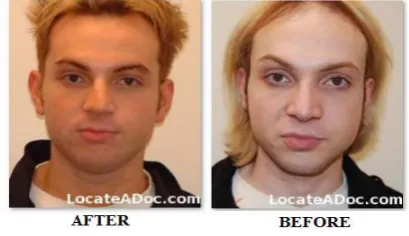
A facial recognition system is a computer application for automatically identifying or verifying a person from a digital image or a video frame from a video source. One of the ways to do this is by comparing selected facial features from the image and a facial database. Facial recognition systems at a very high level work by recognizing a human face from scene and extract it. The system then measures nodal points on the face, distance between eyes, shape of the cheekbones and other distinguishable features. Face recognition is one of the few biometric methods that possess the merits of both high accuracy and low intrusiveness. Also, it provides information about Age, gender, personal identity (physical structure), Mood and emotional state (facial expression) and Interest / attentional focus (direction of gaze). However, even after decades of research, face is still an active topic because of the variability observed in face due to illumination [1], pose, expression and occlusion [2]. A new challenge to face recognition is facial plastic surgery [3]. These surgeries alters the facial features to such an extent that human being often struggle to identify a person face after surgery. The Fig. 1 shows an example of the effect of plastic surgery on facial appearances.
Due to advances in technology, affordability, and the speed with which these procedures can be performed,
several people undergo plastic surgery for medical reasons and some choose cosmetic surgery to look younger or for better appearance. The procedures can significantly change the facial regions both locally and globally, altering the appearance, facial features and texture. Each facial plastic surgery changes shape or texture of a particular face region [4]. It is very difficult to predict which features are invariant (a region without surgery effects) with unavailable surgery information. The difficulty is further supplemented, when an individual undergoes more than a surgery. The plastic surgery can also be misused by individuals who are trying to conceal their identity with the intent to commit fraud or evade law enforcement. Also this surgery allows the theft or terrorist to freely move around without any fear of being identified by any face recognition system. Again it might lead to rejection of genuine users. Therefore the proposed method is used to recognition of facial images that have previously undergone some feature modifications through plastic surgery.
Fig. 1 The effect of plastic surgery on facial appearances.
When an individual undergoes plastic surgery, the facial features are reconstructed either globally or locally. Therefore, in general, plastic surgery can be classified into two distinct categories.
Disease correcting local plastic surgery (Local surgery): [3] This is a kind of surgery in which an individual undergoes local plastic surgery for correcting defects, anomalies, or improving skin texture. This local surgery is used for correcting jaw and teeth structure, nose structure, chin, forehead and eyelids etc. Local plastic surgery is also aimed at reshaping and restructuring facial features to improve the aesthetics. For example, surgical treatment of ptosis (drooping of the upper eyelid due to weak muscles).
functional damage rather than to improve the aesthetics. In this type of surgery, the appearance, texture and facial features of an individual are reconstructed to resemble normal human face but are usually not the same as the original face For example, restoring damaged skin due to burn injuries or accidents.
II. EXISTING APPROACHES
Singh et al. [3][4] reported recognition accuracies on the plastic surgery database using six different face recognition algorithms: Principal Component Analysis (PCA), Fisher Discriminant Analysis (FDA), Local Feature Analysis (LFA), Circular Local Binary Patterns (CLBP), Speeded Up Robust Features (SURF), and Neural network Architecture based 2-D Log Polar Gabor Transform (GNN). These algorithms were selected because they provide a combination of appearance-based, feature-based, descriptor based, and texture-based feature extraction and matching approaches. Despite combining local and global recognition approaches, the matching performance obtained was rather low.
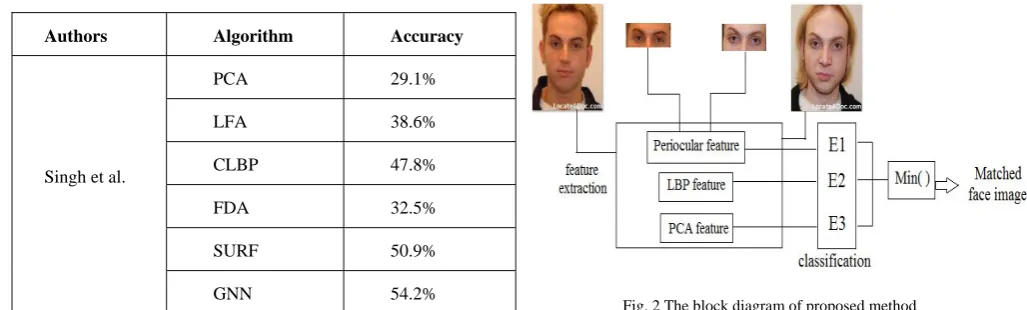
Table 1 shows list of algorithms used for performing face recognition on plastic surgery images and the corresponding accuracies.
TABLEI
LIST OF ALGORITHMS AND THEIR ACCURACIES ON PLASTIC SURGERY IMAGES
Authors Algorithm Accuracy
Singh et al.
PCA 29.1%
LFA 38.6%
CLBP 47.8%
FDA 32.5%
SURF 50.9%
GNN 54.2%
K. R. Singh, Roshni S Khedgaonkar, Swati P Gawande [5], proposed a new approach to find the nearness between the pre plastic surgical face to the post plastic surgical face. They develop a classifier for facial images that have previously undergone some feature modifications through plastic surgery based on near set theory. Gaurav Aggarwal, Soma Biswas, Patrick J. Flynn and Kevin W. Bowyer[6], proposed a novel approach to address the challenges involved in automatic matching of faces across plastic surgery variations. Partwise facial characterization is combined with the recently popular sparse representation approach to address these challenges. One limitation to this approach is, it requires several images per subject in the gallery. Himanshu S. Bhatt, Samarth Bharadwaj, Richa Singh, and Mayank Vatsa [7], proposed a multiobjective evolutionary granular algorithm to match face images before and after plastic surgery. The algorithm first generates non-disjoint face granules at multiple levels of granularity. The first level of granularity processes the
image with Gaussian and Laplacian operators to assimilate information from multiresolution image pyramids. The second level of granularity tessellates the image into horizontal and vertical face granules of varying size and information content. The third level of granularity extracts discriminating information from local facial regions. After feature is extracted from that face granules by SIFT and EUCLBP algorithm. Then Multiobjective Evolutionary Approach is use to optimization of weight. Decision is take place on the basis of weight.
III.PROPOSED APPROACH
This paper proposes a new multimodal biometric using face and periocular biometric for the recognition of face invariant to plastic surgery. This method makes the use of different features from face and periocular region to match face images before and after plastic surgery. The block diagram of propose method is shown in Fig. 2. Feature is extracted from both face and periocular region with the help of local binary pattern and then dimension reduction is done with the help of PCA. Then for classification Euclidian distance is used. If face is not match, then periocular biometric is performed for face recognition under plastic surgery. The flowchart contains the following steps: Data Collection, Pre-processing, Feature Extraction, Classification, and Periocular biometric.
Fig. 2 The block diagram of proposed method
A. Data collection
As the plastic surgery face database is not available, data required for face recognition across plastic surgery is collected from different sources on internet. These images have noise and irregularities. So some pre-processing like image contrast maximization, filtering is done. Using these images, the plastic surgery face database is created. This plastic surgery face database contains one pre- and post-surgery face image with frontal pose, proper illumination, and neutral expression.
B. Pre-processing
accurate comparison of the features and to reduce the computational effort needed for processing, all the images should be scaled to a uniform size. So, normalization is done on face images in which images are geometrically normalized and size of each image is uniform.
C. Feature Extraction
Another phase in face recognition is feature extraction. This is phase where the system does the localizing of the characteristics of face component (i.e. eyes, mouth, nose etc) in an image. In other words, feature extraction is a step in face recognition where the system locates certain points on the face such as corner and centre of the eyes, tip of the nose, mouth, etc. it analyze spatial geometry of differentiate feature of a face. The result of this analyzing is a set of template generated for each face. The template consists of reduced set of data that represent the uniqueness of the face image. This proposed method uses the LBP and PCA for extraction of feature from face region. And again LBP is used for extraction of feature from periocular region.
1) Principal component analysis (PCA): PCA for face recognition is based on the information theory approach. It extracted the relevant information in a face image and encoded as efficiently as possible. It identifies the subspace of the image space spanned by the training face image data and decorrelates the pixel values. The classical representation of a face image is obtained by projecting it to the coordinate system defined by the principal components. The projection of face images into the principal component subspace achieves information compression, decorrelation and dimensionality reduction to facilitate decision making. In mathematical terms, the principal components of the distribution of faces or the eigenvectors of the covariance matrix of the set of face images, is sought by treating an image as a vector in a very high dimensional face space [8] [9].We apply PCA on this database and get the unique feature vectors using the following method .Suppose there are P patterns and each pattern has t training images of m x n configuration.
• The database is rearranged in the form of a matrix where each column represents an image.
• With the help of Eigen values and Eigen vectors covariance matrix is computed.
• Feature vector for each image is then computed. This feature vector represents the signature of the image. Signature matrix for whole database is then computed. • Euclidian distance of the image is computed with all
the signatures in the database.
• Image is identified as the one which gives least distance with the signature of the image to recognize.
2) Local Binary Pattern: Local Binary Patterns
provides a powerful means of texture description [10]. LBP features are gray scale and rotation invariant texture operator. These features are more widely used for expression recognition. LBP features are also applied for face recognition task [11], [10]. LBP feature extraction is faster than any other feature extraction method and it
provides good performance make this most researched features.
Consider a 3*3 pixels with (XC , YC) intensity value be
GC and local texture as T = t(G0, G1, G2, G3, G4, G5, G6, G7)
where Gi ( i =0, 1, 2, 3, 4, 5, 6, 7) corresponds to the grey
values of the 8 surrounding pixels. These surrounding pixels are threshold with the centre value GC as t(s(G0 -
GC),.... s(G7 - GC)) and the function s(x) is defined as,
Then the LBP pattern at the given pixel is defined as an ordered set of the binary comparisons and the resulting value can be obtained using following equation. An example of LBP operator is shown in Fig. 3.
Fig. 3 feature extraction using LBP.
D. Periocular Biometrics
Eye lids, eye brow and eye surrounding area is called as periocular region[12] which is considered to be more discriminative in nature There is no database available with periocular region images. Only way to fetch this is using available face image [13].
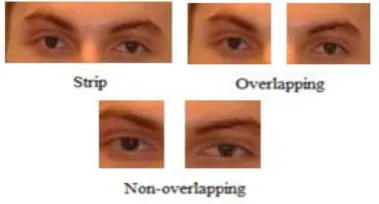
Fig. 4 Different types of periocular regions.
Periocular biometric is a process in which the periocular region feature can be used for the classification. Periocular biometrics [13] is performed in three different ways such as overlapping, Non-overlapping and Strip [11]. All this three different types of periocular regions are obtained using four significant points in the eye region and lips are shown in Fig. 4. LBP is used for feature extraction.
E. Classification
texture or shape feature for classification of object. There are various classification techniques available, but I use Euclidean distance [11]. It is used as the classifier to identify which training set image belongs to the given test image. Classification is performed by comparing from each training set image with the test image C using Euclidean distance, i
2
=(|| Ctest – Ci ||)2
Where, is a shape texture parameter of the ith face image in training set. Test image is classified as belonging to image i when minimum of is obtain.
Let 1 be the minimum Euclidian distance between test
and train face image using PCA. 2 be the minimum
Euclidian distance between test and train face image using LBP. 3 be the minimum distance between test and train
face image using Periocular biometric. Score level fusion was performed to combine the face and periocular information. In that minimum operation is used to performed recognition i.e. among 1, 2 and 3 minimum i
is calculated where i=1,2,3 and test image is assign to the class i if i is less than other two Euclidian distances.
IV.EXPERIMENT
The experiments conducted using surgery and non-surgery face database. The images available in the face database are collected from different source of internet. Using these images, the plastic surgery face database is created. This plastic surgery face database contains one pre- and post-surgery face image with frontal pose, different lighting condition, and various expressions. As well, the resolution of face image is very low. This may also affect performance and accuracy of the face recognition system. Pre-surgery images are used for training purpose and post-surgery images as test set. The required software for this experiment is matlab. Step to perform recognition are as follows
:
1) Select the path of training database which contain the pre-surgery face image.
2) Select the path of testing database which contains the post-surgery face image.
3) Enter name of test image.
4) Then feature is extracted from test image and all train image using PCA and Euclidian distance E1 is
calculated between that images. Again the feature is extracted from test and train image using LBP and minimum distance E2 is calculated between that
images. Now, the periocular region is cropped from the test and train image and then extraction of feature is done with the help of LBP and minimum distance E3 is calculated between that images.
Finally Test image is classified as belonging to train image i when minimum of E is obtained.
5) Result of propose multimodal biometric approach on non-surgery face image.
6) Result of propose method on Plastic-surgery face image.
V. CONCLUSIONS
This paper presents an approach for the recognition of surgically alter human face. This paper proposes a multimodal biometric system which extracts features from face and periocular area using local binary pattern operator. This clearly extract the shape and texture features which represents a face image in more meaningful way than any other feature extractor. The periocular biometric improving the overall system performance. Compared to existing approaches, the proposed scheme presents a method to improve recognition performance without using training based methods. Based on the results, it is opined that the problem of face recognition using the publicly available plastic surgery database could be further improved if the non-ideal factors (e.g., duplicate entries, low image resolutions, etc.) of the database are accounted for.
REFERENCES
[1] Harine Sellahewa, Sabah A. Jassim, “Image Quality Based Adaptive Face Recognition”, IEEE Transaction On Instrumentation And Measurement, Vol. 59, No. 4, 2010.
[2] Hassen Drira, Boulbaba Ben Amor, Anuj Srivastava, Mohamed Daoudi, Rim Slama, “3D Face Recognition Under Expression, Occlusions, And Pose Variations”, IEEE Trasaction On Pattern AnalysisAnd Machine Intelligence, Vol. 35, No. 9, 2013.
[3] R. Singh et al., “Plastic surgery: A new dimension to face recognition”, IEEE Transaction On Information Forensics and Security”, vol. 5, no. 3, pp. 441–448, 2010.
[4] M. Singh, R. Vatsa and A. Noore, “Effect of plastic surgery on face recognition: A preliminary study”, IEEE Computer Society Conference on Computer Vision and Pattern Recognition Workshops, pp. 72–77, 2009.
[5] K. R. Singh, Roshni S Khedgaonkar, Swati P Gawande, “A New Approach to Local Plastic Surgery Face Recognition Using Near Sets”, International Journal of Engineering Science and Technology, 2011.
[6] Gaurav Aggarwal, Soma Biswas, Patrick J. Flynn and Kevin W. Bowyer, “A Sparse Representation Approach to Face Matching across Plastic Surgery”, IEEE Workshop on Applications Of Computer Vision (WACV), 2012.
[7] Himanshu S. Bhatt, Samarth Bharadwaj, Richa Singh, and Mayank Vatsa, “Recognizing Surgically Altered Face Images Using Multiobjective Evolutionary Algorithm”, IEEE Transactions On Information Forensics And Security, Vol. 8, No. 1, 2013.
[8] P. J. B. Hancock, V. Bruce and A. M. Burton, “Testing Principal Component Representations for Faces”, Proc. of 4th Neural Computation and Psychology Workshop, 1997.
[9] Rajesh Kumar Gupta, Umesh Kumar Sahu, “Real Time Face Recognition under Different Conditions”, International Journal of Advanced Research in Computer Science and Software Engineering, Volume 3, Issue 1, 2013.
[10] Di Huang, Caifeng Shan, Mohsen Ardabilian, Yunhong Wang, and Liming Chen, “Local Binary Patterns and Its Application to Facial Image Analysis: A Survey”, IEEE Transactions On Systems, Man, And Cybernetics—Part C: Applications And Reviews, Vol. 41, No. 6, 2011.
[11] N. S. Lakshmiprabha, J. Bhattacharya, and S. Majumder, “Face recognition using multimodal biometric features”, International Conference on Image Information Processing IEEE, pp. 1–6, 2011. [12] P. Fasca Gilgy Mary, P. Sunitha Kency Paul, J.Dheeba, “Human
Identification Using Periocular Biometrics”, International Journal of Science, Engineering and Technology Research (IJSETR) Volume 2, Issue 5, 2013.