Secret-Fragment-Visible Mosaic Image Based Innovative Data
Hiding Algorithm Implementation in the Digital Information Era
Dr. S. A. Mohammad Gazni
1 ;Fasiha Shereen
2; Juveria Bushra
3 1Ph.D (Dept of Physics), Osmania College, Kurnool, AP,518001-India2M.Tech (Dept of ECE), Pullaiah college of Engineering and Technology, Kurnool, AP,518001-India
3B.Tech(Dept of ECE), Pullaiah college of Engineering and Technology, Kurnool, AP,518001-India3
Abstract---
In the era of digital information age, the internet has explored as decisive technology with its immense popularity and the user friendly interface to connect the entire world and it plays the important role in the development of innovative applications ranging from the normal to high level. Although, the internet has offered wide range of advantages but the applications based on it seriously suffer from lack of security. The digital images are the popular medium to perceive the information in the internet and providing the relevant security to them is the prominent research area and it is the research interest of this research paper. Security has great importance in the image processing domain and it's applications, hiding the relevant information in digital images has been a area of interest from decades and maintaining the privacy of hidden information has utmost priority. Intense research work has carried out in the past to increase the data capacity, creating the secret image which look alike of target image but majority of the works fails to meet the requirements. A database independent approach is proposed in this work, a secret image is intelligently transformed to a secret fragment- visible mosaic image with same resolution in terms of appearance and this resolution (size) is of any selected target image. The generation of the mosaic image is followed by the sequential steps, i.e. division of the secret image into fragments and its relative color transformation into corresponding blocks of the target image. The simulation results are performed in the MATLAB programming language and the proposed results produce better results than the traditional data hiding methods.
Keywords: Digital image processing, Data hiding, Mosaic images, Target image, Secret Image, Block's, Data capacity
1. I
NTRODUCTION
The inventions and technological innovations have not only changed the world but also make the 21st
century as “era of the technology” and the security domain has become the integral part of the each application to provide the ample security to the information. The security domain reaches to next level with the introduction of the digitalization and the applicative algorithms such as Cryptography, Steganography and Watermarking, have changed facet of modern security standards. The digitalization collaboration with the internet has introduced the revolutionary changes in the security standards and the secure data transmission has been a research area from years which needs depth research to make it hacking free and attacks free.
The digital image usage has increased tremendously in the modern world and its presence can be visualized in the renowned research fields such as robotics, medicine, genetics, satellite image processing, security, computer vision and so on. The transmission of the digital images through internet has increased due to various reasons and the flaws associated with it also increased in unimaginable manner. The secure data transmission intention is to provide the security to private information and to the confidential data.
In 21stcentury digital image play the crucial role to
Fig. 1: The figure of online data transmission
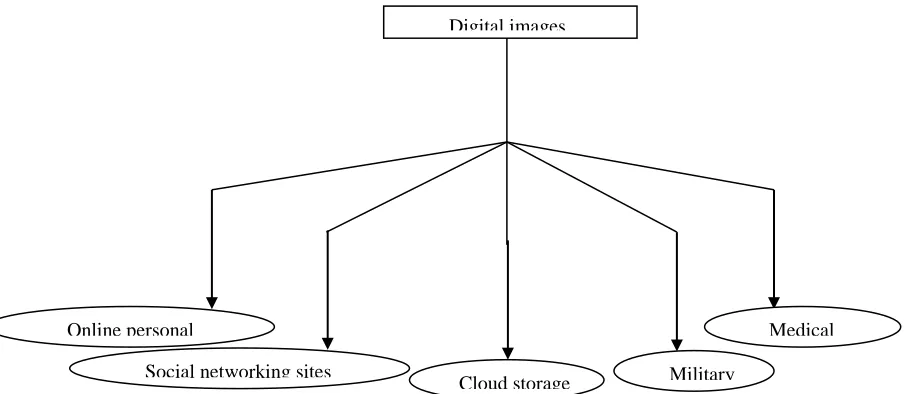
Nowadays transmission of digital images through internet has been increasing day by day through social networking sites, online personal albums, cloud storage and as well as high equipped
professional areas confidential enterprise archives and high end areas like medical imaging systems, and military image databases.
Fig. 2: Digital images and its usage application areas
The respective digital which are widely used in various applications usually contain private or confidential information related to military or any private organization. The research work in the literature shows the importance of the secure image transmission advantages and disadvantages of the secure image transmission. The most important drawback facing in the image transmission is leakages during transmissions.
In this study, a new approach is proposed for the secure image transmission which is focused to transform a secret image into the respective meaningful mosaic image. The transformed mosaic image is of same size as target image and it must look like the preselected target image. The secret key is generated in this approach which controls the
transformation process in well-defined manner and the same key is used by the user to recover the secret image nearly losslessly from the mosaic one. The proposed approach is considered as the computer art image and called as
secret-fragment-visible
mosaic image.
2.RELATED CONTENT
(i) Image encryption
The development achieved in the past years in security field made it more robust against the attacks, but still the data transmission through internet is challenging the standards of the security algorithms and the robust algorithms which achieved the Sender sending the
confidential data
Receiver receiving the confidential data Internet acts as
the medium Transmission
Initialized
Transmission
Ended
Digital images
Online personal albums
Social networking sites
Cloud storage
Medical
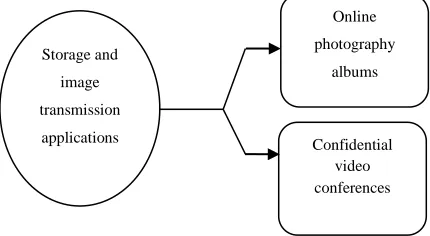
accurate results in data hiding fails to maintain their reliability in the transmission. The image encryption gives privacy and it provides the ample security measures to the data. The security in the encryption algorithm depends on the “KEY” and it stops the unauthenticated user to read the confidential information without approval. The image encryption algorithm utilizes the unique properties of the image to provide the robustness. The data storage and image transmission are diagrammatically shown as follows
Fig. 3: Storage and image transmission applications
The image encryption algorithms are categorized into three segments as follows
The position permutation based algorithms are considered as initial encryption works, reported in the literature
The valued transformation based encryption algorithms are followed by the position permutation, which are widely used in the high profile applications
The data transformation in terms of color or any other content is the third segment of the image encryption and the condition of the data transformation is the operation must be perceptible to the human visual system
(ii) Covering up approach
The prediction of the hidden secret image is a drawback in the image encryption and the solution to this problem is covering up the secret image with any other content which perfectly hides the secret image behind it with robust behavior. The mysterious aspect which hides encrypts along with secret image is transmitted with it till it reach the destination in hassle free manner. The mysterious aspect conquers the large space which might be a limitation when transferring the large amount of data.
3.P
ROBLEM
D
EFINITION
The digitally transmitted information has become the integral part of the various applications which has a vital role in many daily needs in terms of confidential privacy. The advancement in the technology introduces high level risk factors and fails to provide the ample security measurements. The information related to the prominent fields such as medicine and military are highly sensitive and needs to provide high level security cover when it is transmitted through the online as the attackers easily grab the information in a fraction of time.
The proposed method achieves the reliability in the secure image transmission along with robustness against the attacks and the key generation is the important aspect which prevents the grabbing of confidential information in online transmission. The algorithm has ability to handle the transmission even in the worst situations.
4.
P
ROPOSED
M
ETHODOLOGY
The proposed study is composed of two prominent segments as follows
The mosaic image generation is performed at the initial phase
The secret image recovery is the second implementation followed by the mosaic image generation
The generation of the mosaic images is considered as the crucial aspect in the proposed study and the mosaic image which is generated is composed of color corrected fragments as of input image. The preselected secret image and the target image have huge importance in the proposed study, where tile images of the preselected image are selected and the selected tile images are well fitted in the target image blocks. The transformation of color characteristics for each selected tile image corresponding to the target image block. The rotation of the tile image in exact desired direction with minimum RMSE value with reference to preselected target image. The confidential information is embedded into the generated mosaic image is recovered in a lossless manner at the extraction process.
The secretly fragmented image includes the following
Online photography
albums
Confidential video conferences Storage and
The successful embedding of the confidential information in the mosaic image and its lossless extraction is the initial work carried out in this
segment. The extraction of the secret image utilizes the reliability of proposed work to achieve the accuracy.
Fig.4. Algorithm flow
(i) Detailed analysis
(1) The first step in the proposed method is to divide the secret image into tile images with a specific size as well as divide the target image into block image. Segmentation of images is technically called as fragments, which are used to hide the tile images with respect to block image.
(2) Compute the mean and standard deviation of the tile image and block image with respect to three different color channels. Based on the average standard deviation value, the mosaic image is generated.
(3) The next step is to sort the tile image and block image according to the average standard deviation value and sort the tile image block into target image block in a 1-by-1 manner with respect to their positions.
(4) Standard deviation coefficients (QC) are generated by the ratio of standard deviation of target image to the secret image. qcconsists of 7 bits ranges
from 0.1 to 12.8.
(5) Compute the RMSE value of the tile image with respect to the block image after every rotation of tile image at an angle 0o, 90o, 180o, and 270o and note
down the residual value. Rotation of an image can be done only at smaller RMSE value.
(6) To retrive the secret image from the mosaic image a bit stream is generated with respect to
standard deviation coefficient, target blocks, tile image and the indices.
(7) The secret key is generated to avoid the secret image get hacked as well as to provide a better security to the secret image.
(ii) The target blocks selection for each tile
image in accurate manner
To obtain the best similarity of color content, the transformation of the color characteristics is performed on tile image that belongs to the secret image. The similarity of the color will be obtained between the each secret image tile to the corresponding block of the preselected target image. But there an issue, i.e. for tile image T on what basis appropriate block b is selected. There is a solution for this issue named as the standard deviation parameter. It is most popular image processing parameter. By using this parameter performance can be evaluated to check most B for each respective T.
From the secret image Stile a sequence is formed
based on all tile images. Equally from the target blocks another sequence is formed i.e. Starget ,from
some average values the three color standard deviation values are taken based on that values sequence fitting is implemented as first in 𝑆𝑡𝑖𝑙𝑒 into the first in 𝑆𝑡𝑎𝑟𝑔𝑒𝑡, fit the second in 𝑆𝑡𝑖𝑙𝑒into the
second in 𝑆𝑡𝑎𝑟𝑔𝑒𝑡 , and so on.
FIT TILE IMAGES INTO TARGET
BLOCKS
EXTRAXT THE PREVIOUSLY EMBEDDED INFORMATION
TRANSFORM COLOR CHARACTERISTICS OF TILE IMAGES TO MATCH TARGET
BLOCKS
ROTATE TILE IMAGES INTO DIRECTIONS WITH
MINIMM RMSE
EMBEDDED THE RELVENT INFORMATION
RECOVER SECRET IMAGE
TARGET IMAGE
MOSAIC IMAGE SECRET
(iii) Transformations color characteristics between Blocks
In the initial approach of the projected framework, the various secret image tile square measure match into the corresponding block of the target image and therefore the downside arise here is create the color characteristics of 2 totally different pictures contents into similar one. Already several works square measure reported within the literature however the color transfer theme enforced within the projected work is realistic in nature and converts the characteristic of 1 in lαβ color house on behalf of different content. The projected work is additionally enforced on 3 color rework approach i.e. RGB color house rather than lαβ color house in elective eventualities.
Let Tand Bbe described as two pixel sets { p1, p2, . . . , pn}and { p1', p2', . . . , pn' },respectively.
Let the color of each pibe denoted by ( ri, gi, bi ) and
that of each pi' by ( ri', gi', bi' ). At first, we compute
the means and standard deviations of Tand B, respectively, in each of the three color channels R, G, and B by the following formulas :
µc= 𝟏 𝒏∑ 𝐜ᵢ 𝒏 𝒊=𝟏 (1)
µc'= 𝟏 𝒏∑ 𝐜ᵢ
𝒏 𝒊=𝟏 ′
σc = √ 𝟏
𝒏∑ (𝐜ᵢ 𝒏
𝒊=𝟏 −µ𝐜)²
(2)
σc' = √ 𝟏
𝒏∑ (𝐜ᵢ 𝒏
𝒊=𝟏 ′−µ𝐜′)²
Where, in which ciand ci'denote the C-channel values
of pixels pi and pi', respectively, with c= r, g, or band
C = R, G, or B.
Next, we compute new color values ( ri'', gi'', bi'' ) for
each piin Tby
ci'' = qc ( ci - µc) + µc' (3)
in which qc= σc'/σcis the standard deviation quotient
and c = r, g, or b. It can be verified easily that the new color mean andvariance of the resulting tile image T' are equal to those of B, respectively. From this, we must say that the obtained mosaic image is look similar to that of target image.
(iv) Rotating blocks to fit better with smaller RMSE value
After a target block B is chosen to suit a tile image T and when the colour characteristic of T is remodeled, we have a tendency to conduct an extra improvement on the colour similarity between the ensuing tile image T' and therefore the target block B by rotating T' into one in every of the four directions, 0o, 90o,
180o, and 270o, that yields a turned version of T' with
the minimum root mean sq. error (RMSE) worth with relation to B among the four directions for final use to suit T into B.
(v) Embed the relevant secret image recovery information into obtained mosaic image
In order to recover the key image from the mosaic image, we've to implant relevant recovery data into the mosaic image. For this, we tend to adopt a method, the reversible distinction mapping technique [2] that applies easy number transformations to pairs of pel values. Specifically, the tactic conducts forward and backward number transformations as follows, severally, during which (x, y) area unit a combine of pel values and (x’, y’) area unit the reworked onesx' = 2x-y
(4) y' = 2y-x
x = ⌈𝟐 𝟑 𝐱′ +
𝟏 𝟑 𝐲′ ⌉
(5) y = ⌈𝟏
𝟑 𝐱 ′+ 𝟐
𝟑 𝐲 ′⌉
The method yields high data embedding capacities close to the highest bit rates and has the lowest complexity reported so far.
The information required to recover a tile image Twhich is mapped to a target block Bincludes: 1) the index of B; 2) the optimal rotation angle of T; 3) the truncated means of T and Band the standard deviation quotients, of all color channels; These data items for recovering a tile image Tare integrated as a four-component bit stream of the form
M = t1t2...tmr1r2m1m2...m48q1q2...q21(6)
in which the bit segments represent the values of the index of B, the rotation angle of T, the means of T
and B, the standard deviation quotients, respectively.
(vi) Total length of recovery information
Specifically, for each color channel we allow each of the means of Tand B to have 8 bits with its value in the range of 0 to 255, and the standard deviation quotient qc to have 7 bits with its value in the range
of 0.1 to 12.8. That is, each mean is changed to be the closest value in the range of 0 to 255, and each qcis
changed to be the closest value in the range of 0.1 to 12.8.
In more detail, the numbers of required bits for the four data items in M are discussed below: 1) it needs two bits to represent the rotation angle of T because there are four possible rotation directions; 2) 48 bits are required to represent the means of Tand Bbecause we use
eight bits to represent a mean value in each color channel; 3) it needs 21 bits to represent the quotients of Tover Bin the three color channels with each channel requiring 7 bits. Then, the above-defined bit streams of all the tile images are concatenated in order further into a total bit stream Mt for the entire
secret image, which is finally embedded into the pixel pairs in the mosaic image using the RCM technique. So, for one tile image we required to embed 71 bit length information. and for entire secret image we requires:
5.
R
ESULTS AND
A
NALYSIS
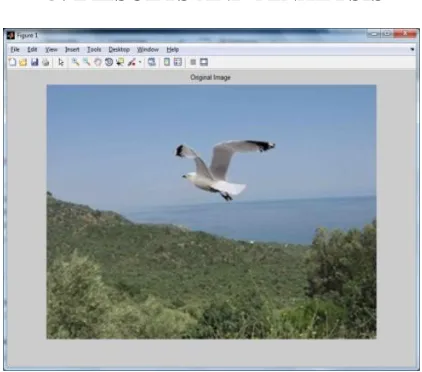
Fig. 4: Original image
Analysis
The original is also termed as target image which plays crucial role in generating secure mosaic fragmented image to provide robust secure image transmission approach
Fig. 5: Secret image
Analysis
The selection of the different tile images of the preselected secret image and fitting the selected tile images of the target images into the already generated blocks of the target image.
Fig. 6:Before embedding mosaic image
Analysis
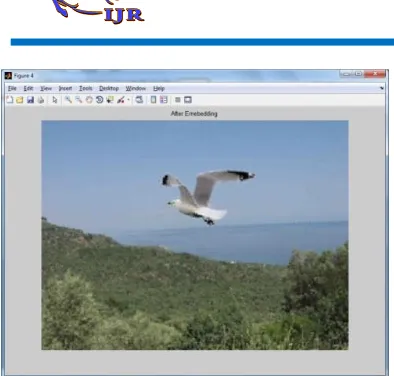
Fig. 7:After embedding mosaic image
Analysis
After embedding mosaic image is an image where the confidential data is embedded it is the step where the fitting of block and tile has completed
Fig. 8: Extracted image
Analysis
The extraction of the data is done in lossless manner by successfully from the secret fragmented mosaic image
6.
C
ONCLUSION
The internet security has become the important criteria in the 21st century security applications and
its prominence is increasing along with the implementation of the innovative technologies. The data transmission based algorithms has gained popularity in the security domain to provide the
protection to the secret information in a reliable way. The secure data transmission is been a concerned area in the field of security and the accidental/incidental attacks on secure data makes it more challenging to provide the ample security without any flaws. The secure image transmission technique paid a lot of attention from the research organizations because of its unique ability to recover the secret image almost losslessly. Although tremendous progress has been made in the past decade on this area but it is consider as unresolved issue in the security domain of the digital image processing domain. The novelty of the proposed method is it automatically transforms the large-volume secret image into a so-called secret-fragment-visible mosaic image of the same size. In order to convert the secret image into a mosaic image make use of color transformations is done by dividing the secret image into fragments and transforming their color characteristics to be those of the corresponding blocks of the target image. A scheme namely lossless hiding scheme is utilized along with the key which is used to recover the secret image from the mosaic image by using the information which is embedded into mosaic image. The reliability and efficiency of the proposed method are evaluated by simulation results.
R
EFERENCES
[1] E. Reinhard, M. Ashikhmin, B. Gooch, and P. Shirley, “Color transfer between images,” IEEE Comput. Graph. Appl., vol. 21, no. 5, pp. 34–41, Sep.–Oct. 2001.
[2] D. Coltuc and J.-M. Chassery, “Very fast watermarking by reversible contrast mapping,” IEEE Signal Process. Lett., vol. 14, no. 4, pp. 255–258, Apr. 2007.
[3] C. K. Chan and L. M. Cheng, “Hiding data in images by simple LSB substitution,” Pattern Recognit.., vol. 37, pp. 469–474, Mar. 2004.
[4] Z. Ni, Y. Q. Shi, N. Ansari, and W. Su, “Reversible data hiding,” IEEE Trans. Circuits Syst. Video Technol., vol. 16, no. 3, pp. 354–362, Mar. 2006.
[5] J. Fridrich, “Symmetric ciphers based on two-dimensional chaotic maps,” Int. J. Bifurcat. Chaos, vol. 8, no. 6, pp. 1259–1284, 1998.
[7] L. H. Zhang, X. F. Liao, and X. B. Wang, “An image encryption approach based on chaotic maps,” Chaos Solit. Fract., vol. 24, no. 3, pp. 759–765, 2005. [8] H. S. Kwok and W. K. S. Tang, “A fast image encryption system based on chaotic maps with finite precision representation,” Chaos Solit. Fract., vol. 32, no. 4, pp. 1518–1529, 2007.
[9] S. Behnia, A. Akhshani, H. Mahmodi, and A. Akhavan, “A novel algorithm for image encryption based on mixture of chaotic maps,” Chaos Solit. Fract., vol. 35, no. 2, pp. 408–419, 2008.