AMES-Cloud: A Framework of Adaptive Mobile Video
Streaming, Fetching and Preservation Over cloud computing
Miss. Payal Krishnarao Hedau Mr. Manoj S. Chaudhari
Department of CSE Department of CSE
Priyadarhini Bhagwati College of Engineering, Priyadarshini Bhagwati College of Engineering
Nagpur, India Nagpur, India
Abstract
There is an exponential increase in traffic of effective video mobile streaming with an increasing need for optimizing the quality of delivery of video along the mobile network. The existing result shows that poor quality of video streaming service over a mobile network such as buffering time should be long and intermittent disruptions happens in the video streaming. The new cloud computing technology suggest that the framework to improve the quality of video service for each mobile user i.e Adaptive Mobile Video Streaming (AMoV) and Efficient Mobile Video Sharing (EMoV). For a particular client adaptive video mobile streaming lets her private agent and adaptively alter the streaming pour with coding of scalable video coding (SVC) technique. The technique is depends on the reaction of link excellence. In the same way, ESoV observes the social network intimated between mobile client and their private mediator try to hold the video pre-fetch in advance. The behavior production model is introduced to predict and cognize user behavior and the adaptive policy of pre-fetching and catching method is address for an efficient cloud management. Hence, we proposed a new framework that reduces a packet loss rate, reducing delay, jitter, buffering time etc. Each mobile user has its own private agent in the cloud data center to adjust the streaming flow of video by the method of scalable video coding technique based on the response from mobile user and perform the video pre-fetching based on social network analysis and also providing the preservation over cloud computing.
Keywords:Adaptive Video Streaming, Scalable Video Coding (SVC), Efficient Social Video Sharing, Video Cloud.
1. Introduction
The advanced wireless network has huge research interest which is turning into great commercial success. Mobile cloud computing (MCC) has introduced the way in which mobile user across the globe leverage service. MCC encompass the wide range of applications presented to mobile user away from the conventional applications by supporting the hardware, large storage capacity, 3D virtual environments and also users shares the cloud infrastructure to their friends. Mobile cloud computing integrates cloud computing into the mobile environments and the obstacles are overcome related to performance (like bandwidth, battery life, service delay and storage), environments (like heterogeneity, scalability, availability), security (like reliability and privacy). This technology offers the hardware resources which are cost-effectively [1]. The increasing of more video traffic is accounted by video streaming over a mobile network have become a prevalent over a past few
years. Mobile cloud computing can be defined as the combination of mobile web and cloud computing which is the most popular tool for each mobile user to access application and services on the internet efficiently. MCC provides data storage and processing services in cloud. The streaming of mobile video over a mobile network becomes widespread over a past few years. The network operator have to be improve the wireless link bandwidth, high video traffic delay from mobile phone users are rapidly consuming the wireless network capacity. Thus, it has to be improves the service quality of mobile video streaming using the networking and computing resources efficiently.
The adaptive streaming and scalable video coding technique are jointly to accomplish the effective best possible quality of service. That is it should be dynamically adjust the number of SVC layer depending on the current link status. The most of the proposals seeking combine to utilized the video scalability and adaptability rely on the active control on the server side. Thus, each mobile user periodically needs to be transmit the status of report to the mobile server (i.e. packet loss, delay, signal quality) which predict the available bandwidth for each mobile user. Thus the problem should be occurs that the server should take over the substantial processing overhead as a number of user increases. Recently the social network services (SNSs) have been improve the quality of content delivery. In social network service user may share, comment or re-post the videos with the friends and the member of the same group which implies, user may watch the videos that his/her friends recommended. In SNSs user also follow the popular videos based on their interest, which is likely to be watch by its followers. The mobile cloud computing should design adaptive video streaming and pre-fetching framework for users. It construct private agent for each mobile user in the cloud computing environment which is used by Adaptive Mobile Video Streaming and Social Video Sharing.
AMoS offers the best possible quality of streaming by adaptively controlling the streaming bit rate depending on the fluctuation of link quality.
The private agent of each user keeps track of information of feedback on the link status. They are dynamically initiated and optimized in the cloud computing platform.
Cloud supports the distributed video streams efficiently by using two tier structure: content delivery network and data center. By using these two structure video sharing can be optimized within the cloud.
Depending on the SNS activities, UBoP seeks to provide a user with instant playing of video clips pre-fetching in advance from her private agent to the local storage of her device.
The strength of social link between users and various social activities can be probabilistically determined by how much and which video will be pre-fetch.
2. Literature Review
The video traffic rate is adjusted on the fly so the user should get maximum possible quality of video depending on his/her links time-varying bandwidth capacity [2]. The adaptive streaming techniques have two types mainly based on whether the adaptivity is controlled by the client or server. Microsoft’s Smooth streaming is a live bit rate segments encoded with configurable bit rate and the resolution of video at servers where the clients are dynamically request videos depend on the local monitoring of video quality [11]. The Adaptive streaming services controls the Adaptive transmission of video segments e.g. the Quavlive Adaptive Streaming. In Quavlive Adaptive streaming most of the solutions maintain multiple copies of video content with different bit rate which brings huge storage of videos on the server.
According to the Adaption rate control technique, TCP is the friendly rate control method for streaming service over a mobile networks [12], [13], where the throughput of TCP flow is estimated as a function of round trip time, packet loss rate and packet size, The bit rate of streaming traffic can be adjusted by using estimated throughput. The cross-layer can be check by few adaptation techniques [14], [15] which acquires accurate information of link quality, so the rate adaptation can be more accurately made.
The Scalable Video Coding Technique (SVC) H.264 has gained a momentum [6]. The Adaptive Video Streaming Technique based on the SVC technique [5] which is the real time scalable encoding and decoding at servers. The work proposes [8] quality-oriented scalable video delivery using SVC. At the time of encoding performance of SVC the cloud streaming mainly proposes to deliver high quality of streaming videos through cloud based scalable coding technique proxy [10] which proposes the cloud can improve the performance of SVC coding. The studies are motivated to use the scalable video coding technique for streaming of video on the cloud computing. Because of the scalability and capability cloud computing provides video streaming services especially in the wired Internet [4]. The extending cloud computing based services to the mobile environments requires more factors like user mobility, wireless link dynamics, the limited capability
of mobile devices [10]. More recently the cloud computing environment proposes a private agent that are satisfying the quality of service of video of individual users such as stratus [7] and cloudlets [6]. Hence we are proposed to be designed the AMES-Cloud framework by using private agents in the cloud to provide preservation and adaptive video streaming services.
3. Existing System
The receiving video streaming traffic via a mobile network, the users often suffers from lengthy buffering time and asymmetrical disturbances due to the partial bandwidth and link condition fluctuation caused by multipath fading and user mobility. Thus, it has to be improves the service quality of video streaming while using the networking and computing resources efficiently.
Advantages of Existing System:
1. The same quality of video which is available on the server should be seen by user.
2. The constant bandwidth throughout the streaming can be monitored by the server.
3. It should be control the resolution.
4. It maintains the constancy of video streaming.
5. The user should never get paused on the screen till the video streams.
4. Proposed System
We proposed the adaptive streaming and sharing framework of cloud i.e AMES-Cloud. In that the videos should be stored in the cloud and utilizes the cloud computing for each mobile user by constructing the private agent using scalable video coding technique (SVC). The private agent should be reduced the buffering time and also provides non-buffering experiences of video loading by background work among the Video Base (VB), sub Video Base, local Video Base of mobile user. Framework is implemented by using archetype and can be significant improvement on adaptivity of video streaming. It provides preservation over cloud computing. It will reduce the traffic and provides the maximum utilization of the bandwidth capacity. We propose the algorithmic approach for video format conversion from one format to other based on the strength of signal received from mobile.
5. Framework of AMES-Cloud
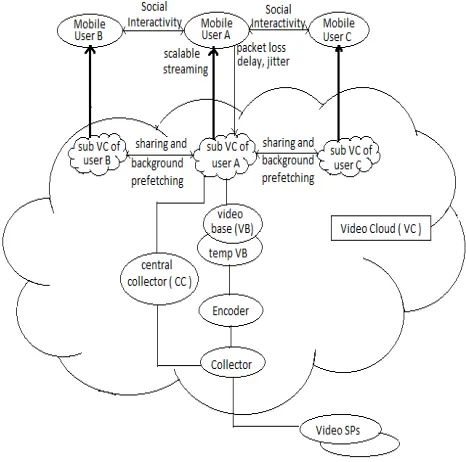
The cloud framework of mobile cloud computing includes two parts Adaptive mobile video streaming and Efficient mobile video sharing. The video streaming and storing videos in a cloud system is called as Video Cloud (VC). The VC has large scale of Video Base (VB) which stores most popular video clips for Video Service Providers (VSPs). The temporal videos base is try to
catch the new candidates for popular videos (temp VB) where the temp VB counts the access frequency of each video.
Fig. 1 : Framework of AMES-Cloud
The VC keeps collector running continuously to seek videos which are already popular in video separator and the encoder will re-encode the collected video into scalable video coding format (SVC) and stores into temp VB first. This is the two tier architecture which can keeps most popular videos eternally. The central controller handles the management work in the Video Cloud (VC). Sub Video cloud should be created dynamically for each mobile user if there is any streaming demand from the user. The sub video cloud has sub video base which stores recently fetched video segments. The video content delivery among the sub video cloud and video cloud are not actually a copy but there is just a link operation on the same file within the cloud data center. There is also a encoding function in the cloud if mobile user demands for a new video which is not available in the sub VB or VB in VC, the sub VB will fetch, encode and transfer the video. At the time of video streaming mobile user will always report the link condition to their sub VC then sub VC offers adaptive video streaming. The cloud service may across the different places so in the case of video delivery and pre-fetching between different data centers, the transmission will be carried out which is called as copy. Because of the optimal deployments in data center as well as capable link among data centers, the copy of large video file take tiny delay.
5.1. Adaptive Mobile Video Streaming (AMoV)
A. AMoV: In adaptive mobile video streaming technique the traffic rate is adjusted in fly so that the maximum
possible video is depend on the his/her link condition time-varying bandwidth capacity [2]. The adaptive streaming techniques have two types depending on whether the adaptivity is Controlled by the client or server. The Microsoft’s Smooth streaming is the live adaptive streaming service. The contents of video are segmented into small chunks and usally multiple bit rate are encoded. So that the client should the best video bit rate. Apple and Adobe, suppose just have to produce an app thet delivers video which is longer than 5MB greater so that we devloped client side HTTP live adaptive streaming, it should be create multiple file for destination to the player change stream to optimize playback.
B. An Adaptive and Efficient video streaming and sharing in the cloud, the architecture was constructed based on the video service provided in the cloud is called as AMES-Cloud which contains-
Video Service Provider (VSP): It is the originated place of actual video data. It should be handles the multiple request at a same time while coming to the quality of service with the mobile user, does not provides service up to the mark.
Video Cloud (VC): The whole video storing and streaming system should be done in the cloud. Video Base (VB) :The VC has large scale of
video base which stores the most populer video clips for the VSP.
Temp Video Base (TVB): It should be contains the most recently accesses video and most frequently accessed data.
Private Agent: Private agent is created for every mobile user who request for the video service to the video cloud.
Mobile Users: The mobile user who providing the availability of service to their location is difficult. The video cloud provides service depending on two methodologies, Adaptive Mobile Video Streaming and Efficient Mobile Video Sharing.
5.2. Efficient Social Video Sharing (ESoV)
A. Social Content Sharing: In social content sharing one can post the video in public to his or her subscriber to watch it or one can directly recommended the videos to his or her friends, one can get noticed by publisher for the popular videos. The videos which are probably watched by recipients shared by one user is called as “Hitting Probability” which is help in pre-fetching the video to avoid the delay. The strength of social activities is determined by the amount of pre-fetched segments. The social network can be categorized in three types of social activities-
Subscription: The user should be subscribes to the video publisher depends on their interest. If the subscriber may
not watched the subscribe videos then it is consider to be “Median”.
Direct Recommendation: The user should directly recommend the videos to his/her friend so the watching of video should have high probability. It is to be considered as “Strong”.
Public Sharing: Each user should have timeline which shows all the recent activities performed by user. The user who watched the videos will known to his/her friends. Then, it is to be considered as “Weak”.
B. Pre-fetching Levels: The mobile users defined the social activities of three pre-fetching levels-
Parts: The subscriber who publishes the videos are watched with the median probability, pushing the parts of base layer (BL) and enhance layer (EL) segments is sufficient.
All: Direct recommendation who shared the videos will be watched with high probability, pushing all base layer and enhance layers is necessary. Then the user can watch the video with good quality without buffering.
Little: The video shared by public sharing has low probability, Hence pre-fetching of only base layer.
5.3. Video Storage And Streaming Flow By EMoV And EMoS
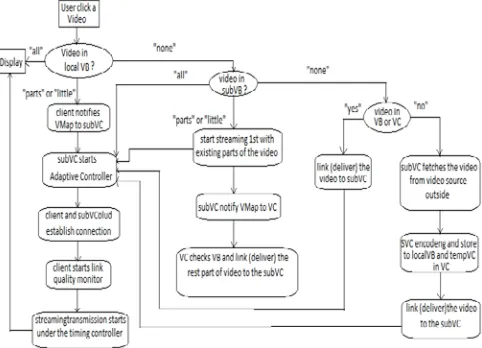
An Adaptive Mobile Video Streaming (AMoV) and Efficient Social Video Sharing (ESoV) is based on the cloud computing platform. AMoV ans ESoV has its own private agent to get a better quality of video without any buffering time and interruptions delay by per-fetching the user interested videos. The flowchart of AMoV and ESoV is given below. For exchanging videos among the localVB, subVB, tempVB and the VB, the video map function (VMAP) is used to refer a requested segments.
Fig. 2 : Working flow of video streaming in VC and subVC
From the above flowchart, when mobile user start to watch the video, the localVB should check first for pre-fetched segments for video to display. If there are no or just few parts then the client should report the subVC
using VMAP. If subVC has parts in subVC then sub VC will transmit the segments. If there is none in subVB, tempVB and VB in the center of video cloud should be checked. If there is no video in the video cloud, the collector can fetched to the external source and the encoder will re-encode the video in the SVC format and then subVC should transfer to the video. If the video is shared among subVC at the pre-defined frequency threshold e.g. 10 times per day should be loaded to the tempVB, so that it should be shared at higher frequency e,g. 100 times per day. In this way subVB and VB should stores fresh and popular videos for re-usages.
6. Proposed Methodologies
6.1. Scalable video coding technique (SVC):
The Scalable Video Coding (SVC) technique is the combination of three lowest scalability is known as Base Layer (BL) and Enhance Layer (EL). If BL is guaranteed to be delivered while many ELs can also be obtained ,when the link should be afford a better quality of video can be expected. By using this encoding technique, the server do not have any need to concern the client side or the link quality. If some packets are lost then the client still decode the video and display. Due to the unnecessary packet loss bandwidth will not efficient. Hence, it is necessary to control the SVC based video streaming at the server side with the rate adaptation method to efficiently utilize the bandwidth.
6.2. AES algorithm for secure data store over cloud:
The setof specially derived keys for encryption process is called as round keys. These applied along with the other operation on an array data that holds exactly one block of data that the data is to be encrypted. The encryption steps for 128-bit block.
1. Determine the round keys for cipher key.
2. Initialize the state array with plaintext (block data). 3. ADD initial round key to start the array.
4. Perform the nine rounds of manipulation.
5. Perform the tenth and final round of state manipulation.
6. Copy the state array out as encrypted ciphertext.
The nine round is followed by a final tenth round because the tenth round is involved a slightly different manipulation from the others. The block is to be encrypted in a sequence of 128 bit block. It converts 128 bit into 16 bytes. The operation in AES performed in 2-D byte array for four rows and four columns. By starting encryption 16 byte data numbered as D0-D15 are loaded into array. Each round of encryption process four step to alter array: SubByte, ShiftRows and MixColumns, XorRoundKey.
Matching algorithm between bandwidth and segment:
Proposed Term: Bw -Bandwidth
SINR- Simple Noise Ratio Rbl- Bit rate length of base layer RTT- Round Triple Time Bl- Base layer ; El-Enhance Layer
Input:
1. Sequence of no timing window i = 0
Bandwidth equals to bit stream length Bw = Rbl Video rate layer Rl
Output:
2. Estimated bandwidth: Bw^estimate Delay time Tm
System Resource Utilization Sres Round Triple Time RTT
SINR
Packet Loss Rate Plr
Initialization:
3. Bandwidth with Enhance Layer BwEl El = 0
Procedure:
4. Compute estimated bandwidth Bw^estimate 5. Compute practical bandwidth Bw^practical 6. Compute packet loss rate Plr
7. Bit rate of 1P
st
P
enhance layer Rel^l Repeat
1++
If 1 ≥ k (total enhance layer) Then break
BwEl = BwEl + Rel^l Until
BwEl ≥ Bw i+1 ^ estimate – Rbl 8. if Bw i+1 ^ estimate ≤ Bwi^practical Break
9. transmit SVC segment of Bl with temporal sequence i Rl^1 i+1, Rl^2 i+1,….., Rl^l-1 i+1
10. Check Bw i+1^practical in time interval Tm 11. Increment sequence number timing window i++ 12. Untill
Last frame Rl of stream transmitting.
7. Implementation And Evaluation
In the implementation of cloud-framework prototype, we choose the cloud server (premium) in the cloud computing service offered by cryptonindia and utilizes the virtual server. The virtual server uses virtual CPU core and 32 GB memory which is fast enough for encoding 480P (480 by 720) video with H.246 SVC format in 30fts at real time [3]. We deploy our server application based on Java including one main program handling the whole task of video cloud. While the
program should dynamically initialize, maintains and terminates, instant of another small Java application as a private agents of each active user. For e.g. we implement the mobile client at mobile phone Samsung galaxy II with android version 4.0. The data service of mobile is offered by LGU + LTE network, also in uncovered area 3G network is used. 3G network still used to indicate the general cellular network. This is tested in downtown area so that the practical bandwidth of mobile link is not as high as we expected but this is not impact in our experiments results.
The “Gangnam” style is the tested video in H.264 scalable format with 480P resolution downloaded from YouTube. The size of this video is 13. 849 Mbytes with the duration of 180 Seconds. Then we first decode it by the x264 decoder into YUV format and re-encode it by SVC H.264 format encoder. The Joint Scalable Video Model (JSVM) software of version 9.1 [9] is used. We use the default setting for decoding and encoding and also do the H.264 SVC encoding at virtual format in the cloud platform. We splits the segments of video by 1Sec-5Sec that it is vary with the value of 1Sec, 2Sec, 3Sec, 4Sec and 5Sec.
Sub Video Cloud:
The scalable video coding technique has two type of layers base layer and enhance layer. The base layer which should be provides reliability in delivery and enhance layer which provides the quality link with encoding and decoding method. Thus, the optimal utilization of bandwidth sometimes packet data lost in transits due to low bandwidth. The implementation of this model involves-
1. Admin: Admin is the user who have an his own account if not then the user should made a new account and then log in first.
2. User1: The User1 performs the following task they are-
News Feed: The user of this social site can see the status from his/her friends like messages or videos.
Search Friend: In this module, the user should search for a friend and send request to them and also can see the details.
Share Video: The user should share a video with his friend by adding new videos and also share the status by sending message to friends. Update details: In this, the user should update
his own details in the system.
3. User2: In User2 module, user should register their detail like name, age, password and gender. Also the user can makes friend by sending them the friend request. They can share videos also share status with their friends and gets comment from them.
Snapshots :
In the registration form, the time of interference with software then user first register and creates username and password. After creating the username and password the user should login.
In the main form, user should send a friend request, upload video and comment to his/her friend. The mobile users who watch the video can be play efficiently. After playing video, the user can view the delay graph which shows the difference between outside the network and inside the network. In inside the network it takes minimum time delay as compared outside network.
8. Conclusion
The user behavior prediction oriented based on adaptive mobile video streaming and social video sharing which is efficiently stores and retrieve videos from the cloud. It constructs a private agent for each active mobile user and try to watch the non-terminating video streaming by adjust based on the user behavior. The private agent try to provide video streaming depend on the link capacity scalable video coding technique (SVC) which try to provide non-buffering video streaming service by pre-fetching depends on their social network service. The cloud computing technique proposes the significant improvement in adaptability and scalability and also proposes a large scale implementation energy and price cost on the basis of each mobile user. We try to extend our cloud framework with privacy and security. This paper verify that how cloud computing can improve the transmission adaptability and scalability and also try to improve the SNS based pre-fetching and security issues in the AMES-Cloud.
References
[1] “Cisco Visual Networking Index: Global Mobile Data Traffic Forecast Update, 2011–2016,” CISCO, 2012.
[2] Y. Li, Y. Zhang, and R. Yuan, “Measurement and analysis of a large scale commercial mobile Internet TV system,” in Proc. ACM Internet Meas. conf., 2011, pp. 209–224.
[3] M. Wien, R. Cazoulat, A. Graffunder, A. Hutter, and P. Amon, “Real-Time System for Adaptive Video Streaming Based on SVC,” in IEEE Transactions on Circuits and Systems for Video Technology, vol. 17, no. 9, pp. 1227– 1237, Sep. 2007
[4] T. Taleb, K. Kashibuchi, A. Leonardi, S. Palazzo, K. Hashimoto, N. Kato, and Y. Nemoto, “A cross-layer approach for an efficient delivery of TCP/RTP-based multimedia applications in heterogeneous wireless networks,” IEEE Trans. Veh. Technol., vol. 57, no. 6, pp. 3801– 3814,Jun. 2008.
[5] M. Wien, R. Cazoulat, A. Graffunder, A. Hutter, and P. Amon,“Real-time system for adaptive video streaming based on SVC,”IEEE Trans. Circuits Syst. Video Technol., vol. 17, no. 9, pp.1227–1237, Sep. 2007.
[6] H. Schwarz, D. Marpe, and T. Wiegand, “Overview of the scalable video coding extension of the H.264/AVC standard,”IEEE Trans.Circuits Syst. Video Technol., vol. 17, no. 9, pp.1103–1120, Sep. 2007.
[7] H. Schwarz and M. Wien, “The scalable video coding extension of the H. 264/AVC standard,” IEEE Signal Process. Mag., vol. 25, no. 2, pp.135–141, Feb. 2008. [8] P. McDonagh, C. Vallati, A. Pande, and P. Mohapatra, “Qualityoriented scalable video delivery using H. 264 SVC on an LTE network,”in Proc. WPMC, 2011.
[9] “JVSM,” https://github.com/kierank/jsvm.
[10] Z. Huang, C. Mei, L. E. Li, and T. Woo, “CloudStream: Delivering high-quality streaming videos through a cloud-based SVC proxy,” in Proc. IEEE INFOCOM Mini-conf., 2011, pp. 201–205.
[11] A. Zambelli, “IIS smooth streaming technical overview,” Microsoft Corp., 2009.
[12] Y. Fu, R. Hu, G. Tian, and Z. Wang, “TCP-friendly rate control for streaming service over 3G network,” in
Proc. WiCOM, 2006, pp. 1–4.
[13] K. Tappayuthpijarn, G. Liebl, T. Stockhammer, and E. Steinbach,“Adaptive video streaming over a mobile network with TCPfriendly rate control,” in Proc. IWCMC, 2009, pp. 1325–1329.
[14] S. Akhshabi, A. C. Begen, and C. Dovrolis, “An experimental evaluation of rate-adaptation algorithms in adaptive streaming over HTTP,”in Proc. ACM MMSys, 2011, pp. 157–168.
[15] E. Piri, M. Uitto, J. Vehkaper, and T. Sutinen, “Dynamic cross-layer adaptation of scalable video in wireless networking,” in Proc. IEEE GLOBECOM, 2010, pp. 1–5.