Unsupervised Learning-based Anomalous Arabic Text Detection
Nasser Abouzakhar, Ben Allison, Louise Guthrie
NLP Research GroupDept of Computer Science The University of Sheffield
E-mail: [email protected], [email protected], [email protected]
Abstract
The growing dependence of modern society on the Web as a vital source of information and communication has become inevitable. However, the Web has become an ideal channel for various terrorist organisations to publish their misleading information and send unintelligible messages to communicate with their clients as well. The increase in the number of published anomalous misleading information on the Web has led to an increase in security threats. The existing Web security mechanisms and protocols are not appropriately designed to deal with such recently developed problems. Developing technology to detect anomalous textual information has become one of the major challenges within the NLP community. This paper introduces the problem of anomalous text detection by automatically extracting linguistic features from documents and evaluating those features for patterns of suspicious and/or inconsistent information in Arabic documents. In order to achieve that, we defined specific linguistic features that characterise various Arabic writing styles. Also, the paper introduces the main challenges in Arabic processing and describes the proposed unsupervised learning model for detecting anomalous Arabic textual information.
1.
Introduction
Consider the following problem: given a collection of documents, how does one determine whether any text(s) within the collection are out of context with the collection as a whole? This paper presents work which addresses this problem automatically for the case where the documents are written in Arabic. Some previous work (Guthrie et al., 2007) has approached this problem where the documents are written in English; however, the characterisation of English text is something well-studied and comparatively well-understood. Arabic, on the other hand, has received little attention within the NLP community (and until recently, almost none) and provides a much more challenging application for an already ambitious task. However, we believe that this paper shows that in certain cases, anomalous documents can be detected with high accuracy, and the framework and methods we propose can easily be extended to improve performance still further.
We call a text which is out-of-context with the rest of a collection an anomaly. We appreciate that this subjective notion of anomaly embraces texts that are out-of-context because their topic is different, or they have different authors, different writing styles and genres, and so on, or indeed any combination of the above.
As a language, Arabic has attracted much attention in recent years for various socio-political reasons and due to links between certain groups in the Middle East such as Alqaeda and terrorism. However, much technology is extremely naïve, performing simple keyword-spotting and leaving more complicated analysis to humans. However, with the wealth of intelligence being gathered exceeds the human capacity to analyse, and the gap between what can be analysed and what is being collected
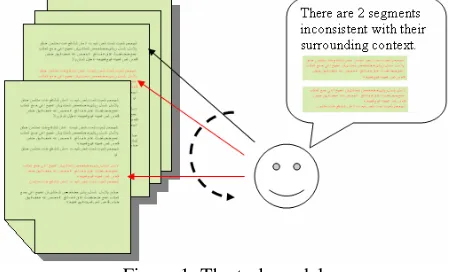
is undoubtedly increasing. Thus the need for more sophisticated automatic techniques to pre-process text is great; this paper proposes a framework which at least partially fulfills that goal. Figure 1 shows a high level model and indicates the task of detecting anomalous text. The task model is scanning through data collection to identify any inconsistency.
Figure 1: The task model
As a highly inflected language Arabic poses several challenges in terms of language processing in general and anomalous text detection in particular. To explore those challenges, this research proposes a frame work of unsupervised learning solution that is able to locating unusual segments of text or simply collection of documents that are used abnormally. Our work centers around collecting various content and performing the tasks for developing detection models that can aid NLP community in better understanding Arabic language processing and analysis.
2.
Related Work
detecting breaches of intellectual copyright (Clough et al., 2002). However, in the artificial intelligence community, similar problems to ours have been approached differently such as detecting anomalous communication traffic between various computer networks (Abouzakhar and Manson, 2002). The major difference between those various applications is the type of knowledge that is extracted from the relevant environment. This knowledge is evaluated in order to select and derive specific features which are used to differentiate what could be abnormal object/event from its normal boundaries.
The problem of detecting anomalous Arabic text has not been previously explored by the NLP community. However, similar little work on this problem has been performed by various research centres. Abbasi and Chen (2005) adopted machine learning classifiers for authorship analysis by extracting linguistic features from online Arabic messages. These features are evaluated for patterns of terrorist communications. They developed a multilingual model by incorporating a message extraction component tailored toward online messages. Our work investigates three unsupervised learning approaches which assume no prior knowledge about what could be normal language. These techniques have already been applied in a previous successful work (Guthrie et al., 2007) for detecting anomalous English textual information. However, English stylistic features are different to Arabic but similar unsupervised learning models could be applied by gearing these models toward the Arabic unique characteristics.
3.
Major Challenges in Arabic
Arabic poses various specific challenges in terms of the language writing stylistic properties and rules. However, the linguistic complexities of Arabic language create serious issues for the anomaly detection. Also, Arabic (De Roeck and Al-Fares, 2000; Rozovskaya et al., 2006) has morphological characteristics that pose several critical problems to text analysis techniques. These specific Arabic language characteristics impact the anomaly detection parameters such as the language lexical and stylistic features and part of speech features … etc.For example, the absence of the diacritics which are optional in Arabic could lead to an ambiguous case. It is impossible to distinguish between the words ُ
/hubb/love and َ/habb/seed without using the relevant diacritics. The lack of diacritics in most of the modern standard Arabic (MSA) is considered as a major challenge to many of Arabic NLP tasks. Recent studies (Maamouri et al., forthcoming) have indicated the impact of diacritisation in text-based NLP research in general and syntactic analysis and parser development in particular. As a highly inflected language, Arabic constructs its vocabulary through a complicated derivational process using root words. These sorts (Habash, 2006) of linguistic characteristics pose challenges in terms of features extraction, morphological and text analysis.
3.1 Segmentation Ambiguity
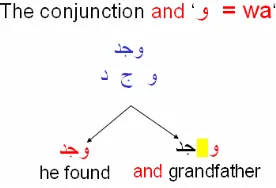
One of the features that we extract from our Arabic corpus is the percentage of conjunctions in each paragraph. The conjunction "و" “wa – and” has got certain properties that limit the process of its extraction. One property of this conjunction is that is should not be joined to the following word. Also, this conjunction could be used as a normal letter like any other letter that can be used with any possible word. However, if it is part of a word then we would not expect to have a space between "و" as a letter and the following letter of the same word. However, people tend to ignore including a space between "و" as a conjunction and the following word. Figure 2 shows an example of a segmentation ambiguity during the extraction of the conjunction "و" “wa – and”.
Figure 2: Segmentation Ambiguity
Figure 2 indicates how "و" as a letter is used as part of a word that means “he found” where there is no a space between "و" and the following letters. Also, it shows how
" و
" is used as a conjunction to the following word which
gives the meaning of “and grandfather”. Notice that we have to have a space in the latter case. So, in terms of this feature extraction we base our decision on the following rule: if there is no space we can not decide whether this conjunction is present or not therefore, we decide not to count as a conjunction if ambiguous.
3.2 Abridged Words Ambiguity
This kind of ambiguity often leads to inflectional ambiguity as well. Figure 3 shows an example of abridged word ambiguity. The example shows an Arabic sentence
" و
" “and we will say it” that is written using a single
Arabic word. This sentence contains the abridged form of the pronoun "" “We”. Another feature that we extract is the percentage of pronouns in each paragraph. However, the abridged form of the pronoun "" is represented by one letter "ن" “N”. Of course such a letter could be found in any possible Arabic word.
determining and extracting the specific linguistic features of the language, however, this task (Smrz, 2005) is complicated by the requirements of Arabic language processing and lack of effective and applicable resources such as morphological analysers. Similarly, the linguistic complexities of Arabic inflectional morphology create issues for the developing syntactic features and semantic annotation.
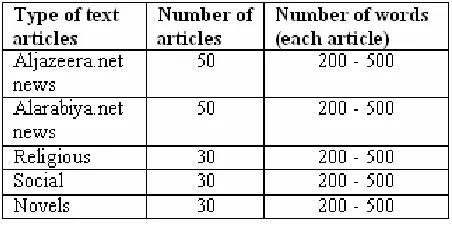
Various Arabic Web sites were used for text collections including Aljazeera.net as the main sources for normal text. Three main types of text were used to represent anomalous segments, religious description text, social text and novels, as shown in Table 1. Aljazeera.net is a well established news sources in the Middle East that reflect the news from its TV broadcast channels. The collected news articles including those inserted out-of-context information would then be segmented and statistical features were computed for each segment.
We defined Arabic specific linguistic features that characterise various writing style, however, well-established general stylistic features have been applied as well. For example, general stylistic features include:
• average word length
• average sentence length
• average number of question sentences
• frequent words
• vocabulary richness
• short sentences
• long sentences
• punctuation marks
• prepositions
• conjunctions
• personal pronouns
• demonstrative pronouns
• relative pronouns
• positive words
• negative words
• …
It is interesting to make use of Arabic specific features as they can effectively differentiate various writing styles. For example, religious description text tends to refer to Quran in which diacritics are often used. However, the “general” features such as average size of sentences in a segment and so on are also useful. For example, Arabic specific features include:
• diacritics
• diphthongs
• nunation
• elongation
• numbers (Arabic and/or Indian)
• calendar (lunar and/or crescent (qamari or Hijri))
• …
The underlying assumption is that if two segments have dissimilar writing style based on selected features, both
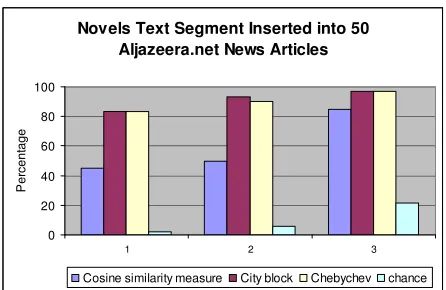
should have a high dissimilar score i.e. high distance measure. Each segment has been converted into a vector of the features and in a form of numerical values. Three unsupervised learning approaches were used, the cosine (dis)similarity (distance) measure, city block distance and chebychev distance have been used to measure the distance of each segment (paragraph) from every other segment in the same document.
Table 1: The Corpus data
In order to appreciate the differences amongst all features in terms of their effects on the distance measures we normalize our vectors by calculating the Z-score of each feature individually before applying the distance measures. All three measures represent three solution models that used the numerical vectors of each segment in the document. This research work is operating within the context of two domains the first drawn from the machine learning community and the other from the natural language processing community. It investigates the deployment of unsupervised learning as a statistical approach to identify anomalous Arabic text. This is to detect as well as predict future textual anomalies, and hence minimise their negative effects. Consequently, it may provide innovative solutions that can be implemented in a cost-effective manner.
6.
Results
Analysis to Extremist-Group Web Forum Messages, Intelligent Systems, IEEE Computer Society.
Abbasi, A. and Chen, H. (2005). Applying Authorship Analysis to Arabic Web Content, Springer-Verlag, Berlin Heidelberg.
Al-Shartuni, R. (2006), Elementary Arabic Morphology 1 (Mabadi Al-Arabiyyah). Translated by: Hamid Hussein Waqar.
Ben Amara, N. E. and Bouslama, F. (2003). Classification of Arabic Script Multiple Sources of Information: State of the Art and Perspectives, International Journal on Document Analysis and Recognition (IJDAR), Springer-Verlag.
Clough, P. Gaizauskas, R. Piao, S. and Wilks, Y. (2002). METER: MEasuring TExt Reuse. In proceedings of the 40th Anniversary Meeting for the Association for Computational Linguistics (ACL-02), pp.152-159, 7-12 July, University of Pennsylvania, Philadelphia, USA.
De Roeck, A. N. and Al-Fares, W. (2000). A Morphologically Sensitive Clustering Algorithm for Identifying Arabic Roots, Proceedings of Association for Computational Linguistics (ACL oo).
Guthrie, D. Guthrie, L. Allison, B. and Wilks, Y. (2007). Unsupervised Anomaly Detection, International Joint Conferences on Artificial Intelligence, India.
Habash, N. Arabic Tutorial, (2006). The fifth international conference on Language Resources and Evaluation, LREC 2006, Genoa, Italy.
Maamouri, M. Kulick, S. Bies, A. (2006). Diacritisation: A Challenge to Arabic Treebank Annotation and Parsing. The Challenge of Arabic for NLP/MT, International Conference at the British Computer Society (BCS), London.
Maamouri, M. Bies, A. and Kulick, S. (2006). Diacritisation in Arabic Treeback Annontation and Parsing, University of Pennsylvania
Messoudi, A. Lamel, L. and Gauvain, J. (2004). The LIMSI RT-04 BN Arabic System, Proceedings of the EARS RT-04 Workshop.
Rozovskaya, A. Sproat, R. and Benmamoun, E. (2006). Challenges in processing colloquial Arabic, The Challenge of Arabic for NLP/MT, International Conference at the British Computer Society (BCS), London.