© 2018 IJSRCSEIT | Volume 3 | Issue 5 | ISSN : 2456-3307
Advance Approach for Load Balancing in Cloud Computing
Using (HMSO) Hybrid Multi Swarm Optimization
Akshita Jain
Computer Science Department, RGPV, Bhopal, Madhya Pradesh, India
ABSTRACT
Cloud computing is a technology that simplifies tasks by assigning virtual machine (VM) dynamically. Users demand resources as they require, creates difficulties. There are so numerous complexities faced by cloud provider. One of the further most tasks for him is load balancing. There are many algorithms which are accessible for appropriate load balancing but the main purpose of the cloud system is that its client can operate the resources to have economic profits. A resource distribution supervision process is essential to avoid under utilization or over utilization of the resources which might affect the services of the cloud. Equally load distributing acquires improved performance by transferring load from an over loaded server. Resourceful scheduling and resource distribution is an important characteristic of cloud computing based on which the performance of the system is predictable. In this paper I have proposed advance approach for load balancing in cloud computing using hybrid multi swarm optimization (HMSO) and compared the number of load balancing algorithm in terms of cost optimization, response time and processing time.
Keywords: Cloud Computing, load balancing, Virtual Machines, Cloud Provider, HMSO
I.
INTRODUCTION
Cloud computing is a huge concept. Numerous of the algorithms planned for load balancing in cloud computing has been proposed. A measure of those algorithms has been overviewed in this research. The comprehensive Internet can be leisurely as a cloud of a lot of connections less and association oriented services. So the isolatable load scheduling theory for Wireless networks exemplify in can as well be beneficial for clouds. The performance of dissimilar algorithms have been thoughtful and compared. Cloud computing is single of the best implementing technology in the decade. A lot of company are annoying to implement and bring in clouds, outstanding to its easy and flexible architecture. These consequence in the growing number of users reaching cloud. Though clouds are bifurcated in public private and hybrid models but still difficulty
inside same data centres or dissimilar and balance the resource usage among all servers a number of load balancing algorithm are introduce like round robin algorithm a mining enhancement in the performance. The only dissimilarity with this algorithm is in their complicity. The consequence of the algorithm depends on the architectural intend of the clouds. Today cloud computing is a set of a quantity of data centre which are sliced into virtual servers and located at dissimilar geographical location for given that services to clients. The objective of this research work is to suggest load balancing for such virtual servers for higher performance rate. The load balancing is the method of allocate the load amongst a variety of resources in several system. Consequently load require to be distributed over the resources in cloud-based architecture so that every resources does just about the equal amount of task at several point of time. The essential require is to give a quantity of technique to balance requests to give the resolution of the application faster. Every cloud vendors are based on routine load balancing services, it consent to clients to boost the number of CPUs or memories for their resources to scale with improved demands. These services are optional and depend on the clients business requirements. So the load balancing serves two significant requirements, initially to promote accessibility of Cloud resources and secondarily to promote performance. In order to balance the resources it is important to recognize diminutive primary areas of load balancing algorithms: Cost effectiveness: primary objective is to complete an inclusiveimprovement in system performance at a realistic cost. Scalability and elasticity: distributed scheme in which the algorithm is contrivance strength regulate in size or topology accordingly the algorithm have to be ascendable and elastic sufficient to permit such modification to be handled fluently. Priority: development of the resources or jobs require to be accomplished on before throughout the algorithm itself for improved service to the major or high arranged jobs in spitefulness of corresponding service condition for
completely the jobs notwithstanding of their source. The rest of the paper is planned as follows. Section 2 presents the related works. Section 3 classifies and correctly describes load balancing problem, our proposed methodology, presents the summary and the detailed strategy of our load balancing structure. Finally, Section 5 concludes this paper and indicates our future work.
II.
RELATED WORK
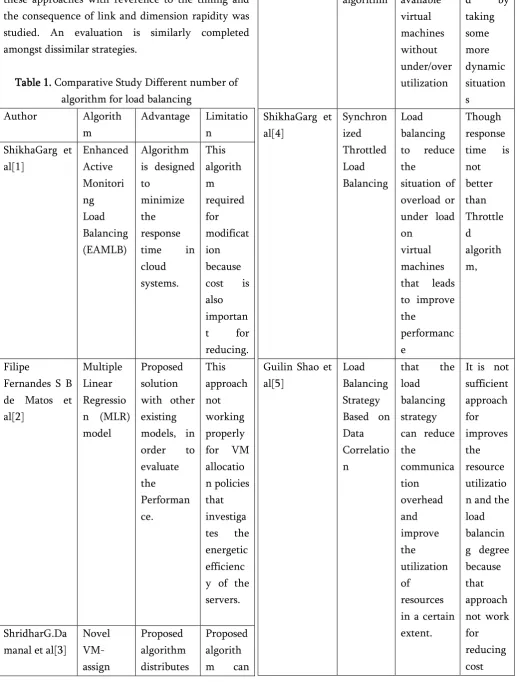
particular existing load balancing algorithms, this is applicable in cloud computing. The performance of these approaches with reverence to the timing and the consequence of link and dimension rapidity was studied. An evaluation is similarly completed amongst dissimilar strategies.
Table 1. Comparative Study Different number of algorithm for load balancing
Considerable enhancement in performance Stability preservation of the schemeIncrease flexibility of the system so as to adapt to the modifications.Build a fault tolerant system by creating backups.
III.
PROPOSED METHODOLOGY
In this research paper to study performance of specific of the existing load balancing algorithms. We have design and improve the perception of load balancing expending Enhanced Active Monitoring Load Balancing (EAMLB) algorithm for the clouds of dissimilar sizes .we have toassess the concert of the proposed advance approach using analytical studies proposing and expending. In this research work, to deliberate the VM migration based load balancing difficultthroughextremely dynamic resource demands. Through our literature survey tostudy, authenticate that in number the resource exploitation of VMs are extremely dynamic. The existing load balancing structuresperceive andchoose VM relocationscreated on discovering resourcerequestprediction, which canister lead to poor performance and plain SLA defilements. To address this concern, toproposed ahybrid multi swarm optimization balancing scheme.
Proposed Algorithm
Step 1: Evaluation affecting probability for entirely of its neighbours and Determine the majorunique as its subsequent destination.
Step 2: Determine to a novel node and evaluator whether it is a runner node. This connation is full fill then produce a regressive partial swam optimization Then modify in the form of regressive. For presumptuous partials, otherwise go to step 1;
Step 3: The regressive partials goes back to the preliminary topic of its presumptuous practical (in the form of virtual machine), beside the route of its presumptuous practical (in the form of virtual machine) through the differing track. Selected the particular information for modification of every node
the regressive VM permits by, and obliterate the regressive VM after accomplishment the initial topic. Step 4: Estimate the amount resources of the runner nodes, and stop the method if this process fulfil the requirement of load balancing process.
Step 5:select the particular operation for execution the number of process in particular manner.
In our advance approach, the foremostprocess of load balancing through HMSO contains of two stages previously load balancing execution as below. Phase1: VM Selection. Choose the cloud platform intermittently, and producemulti piratical if and merely if around are current load nodes or above load nodes and
Phase 2: To discovery target VM. Giving to selection process, the multi practical is viewing for the target nodes which meet the situations of load balancing in its immediate part. The target node is similarly called the runnernode for load balancing.Aimed at fast merging, we work two dissimilar multi practical in exploration of the slave nodes. At the similar time, we influence Active Monitoring Load Balancing to activate multi practical generation, so as to expand the effectiveness of the algorithm.
our scheme associated complete the existing discovery load balancing schemes. Study the distribution of VM difficulties in a significant, and evaluate the effect of dissimilardisseminations of capabilities on the performance of load balancing. Exactly, we will aspect into the exponential Dissemination and its effect on the effectiveness of discoveringLoad balancing schemes. We will extend the Enhanced Active Monitoring Load Balancing scheme allowing fordissimilar probability disseminations. In accumulation, although our VM migration algorithm deliberates the network topology by attractive into account the distance after the source to the destination PM aimed at a VM migration, it does not deliberate the bandwidth procedureson the links of the relocation path. In preparation, the link Congestion on a path canextend migration time. On the additionalpointer, numerousrequests run on numerous VMs in a disseminatedmethod. To make sure application performance, the bandwidth requestbetween these VMs have to be contented.Thus, responsible the purpose of VM relocationsessentialto deliberate the accessible bandwidth on the routesbetweenthe destinations and additional VMs used by the request.As such cloud computing presence wide area of investigation and some of the foremostissues of exploration is dynamic load balancing, so the subsequent research will be meeting on algorithm allowing formostlyfind out the parameters initially, load on the server and furthermore, existingconcert of server. The aim of load balancing is to proliferation client gratification and maximize resource exploitation and considerablygrowth the performance of the cloud system and minimizing the response time and dropping the quantity of job rejection thus reducing the energy expended and the emission rate.
in our proposed improvement techniqueIn the interpretation of the beyonddeficiencies, a load balancing approach based on swam optimization in cloud computing is suggestedin this paper, the plan
implements the load balancing of serverform two characteristics. Primarily, the load concentrated collections which are migrated are originate based on the relationship of data, this stage is the selection of relocation unit. Furthermore, in completing the load balancing of server, the load is migrated based on load concentrated groups, this is a process is to the selection of migration serverIn instruction to reality the load balancing based on swam intelligent in cloud computing, our proposed technique used the number of level swam optimization based on probabilistic load balancing is mostlylikened with the relocationapproach of particular virtual machine from the subsequent concert index. Average response time it deliberates to the time of the data after the time of arriving into the cloud system to implementation the data processing, resource utilization. It mentions to the usage condition of the resource demanded by the users. Load balancing degree the data resources are assignedto the numerous servers in instruction to balance the numerous servers.
IV.
CONCLUSION
V.
REFERENCES
[1]. ShikhaGarg', Dr. D.V. Gupta and Dr.Rakesh Kumar Dwivedi," Enhanced Active Monitoring Load Balancing Algorithm for Virtual Machines in Cloud Computing" Proceedings of the SMART -2016, IEEE Conference ID: 39669 5th International Conference on System Modeling& Advancement in Research Trends, 25th_27'h November, 2016 College of Computing Sciences & Information Technology, TeerthankerMahaveer University, Moradabad, India.
[2]. Filipe Fernandes S B de Matos, JoaquimCelestinoJunior , Andre Ribeiro Cardoso ," VBalance: A Selection Policy of Virtual Machines for Load Balancing in Cloud Computing" 20th IEEE Symposium on Computers and Communication (ISCC) 978-1-4673-7194-0/15 IEEE-2015.
[3]. ShridharG.Damanal and G. Ram Mahana Reddy," Optimal Load Balancing in Cloud Computing By Efficient Utilization of Virtual Machines" 978-1-4799-3635-9/14/ IEEE -2014. [4]. ShikhaGarg, Rakesh Kumar Dwivediy and
Himanshu Chauhan,"Efficient Utilization of Virtual Machines in Cloud Computing using Synchronized Throttled Load Balancing"2015 1st International Conference on Next Generation Computing Technologies (NGCT-2015) Dehradun, India, 4-5 September 2015. [5]. Guilin Shao ,Jiming Chen,"A Load Balancing
Strategy Based on Data Correlation in Cloud Computing"IEEE/ACM 9th International Conference on Utility and Cloud ComputingUCC '16, December 06-09, 2016, Shanghai, China.
[6]. X.J.Feng, Y.Pan. The resource load balancing algorithm of DPSO in cloud computingJ]. Computing engineering and Applications, China, 2013,06:105-108.
[7]. Z.H. Liu, X.L. Wang. Load balancing algorithm with genetic algorithm in virtual cluster in
cloud computingJ]. Journal of Fuzhou University(Natural science edition), China, 2012, 04: 453-458.
[8]. Mauch, Viktor, Kunze, Marcel, &Hillenbrand, Marius, "High performance cloud computing," Future Generation Computer Systems, International Journal of Grid Computing and eScience, Elsevier, ISSN: 0167-739)(, Vol. 29, Issue. 2013, pp. 1408-1416, 2012.
[9]. Ahmed, Tanveer, &Singh, Yogendra, " Analytic Study Of Load Balancing Techniques Using Tool Cloud Analyst," International Journal of Engineering Research and Applications (IJERA), ISSN: 2248-9622, Vol. 2, Issue. 2, pp. 1027-1030, 2012.
[10]. Behal, Veerawali, &Kumar, Anil, "Cloud Computing: Performance Analysis o f Load B alancingAlgorithms in Cloud Heterogeneous Environment," Proceedings of 5'" International Conference- ConfluenceThe Next Generation Information Technology Summit (Confluence), IEEE, pp. 200-205, 2014.