Available online: https://edupediapublications.org/journals/index.php/IJR/ P a g e | 587
Review of Apriori Based Algorithms on Mapreduce Framework In
Big Data
1DR.M.SURESH, 2SHAIK. JAKEER HUSSAIN, 3RAJANI PARIMALA
1
HOD, Dept. of CSE, Mahaveer Institute of Science And Technology, Hyderabad. 2
Associate Professor, Dept. of CSE, Mahaveer Institute of Science And Technology, Hyderabad. 3
Assistant Professor, Dept. of CSE, Mahaveer Institute of Science And Technology, Hyderabad.
ABSTRACT— Frequent pattern Mining is an important discovery in data mining tasks.Thus, it has been the subject of numerous studies and research since its concept came . Mostly studies find all the frequent patterns from collection of precise data, in which the items within each datum or transaction are definitely known. But,in many real-life scenario in which the user is interested in only some tiny portions of these frequent patterns. Thus we go for constrained mining , which aims to find only those frequent patterns that are interesting to the user. Moreover, there are also many real-life scenario in which the data are uncertain .In our project, we propose algorithms which will efficiently find frequent patterns and by applying constraint from collections of uncertaindata.
Keywords— MapReduceModel; programming skill for Big Data mining; Big Data analysis;
Searching and mining Big Data; Frequent Pattern; Constraints; Uncertain data.
I. INTRODUCTION
A Database involves many different work that help to extract useful knowledge from raw dirty data is known as Knowledge Discovery. The process requires a tough user interaction in order to make client job easy help him to get useful knowledge. This can be done by means of data mining primitives that should include :-
1. The sourcedata
2. The kind of knowledge to bemined
3. Backgroundknowledge
4. Interestingness measures for
patternsevaluation
5. The representation of the extractedknowledge
By using a query language useful to apply all above features may result,The implementation is a challenge.Thisgoalisindicatedin[12]whereM anilaintroducesanimportantinteractiveminin gprocess:thatisinductivedatabase which is relational database added with the set of all sentences from a specified class of sentences that are true ofthedata. TheInductiveDatabaseisnaturallyinrule-basedlanguages,suchasdeductivedatabases[1 3,14].Adeductive database is both extensional and in tensional data, thus allowing a higher degree of
expressivenessthantraditional relational algebra. This efficiency makes it easy for better representation of domain knowledge and support the steps of
the KDD process.
A.Background
In the past few years ago data are need to be stored that has increased drastically all over the world. The data generated from web logs, machine logs, human generated data etc. are being stored by companies. This phenomenon is known as "Big Data" and is popular everywhere. This incredibly fast growth of data results in the need to analyse the huge amount of data.And due to lack of proper tools and programs, data remains unused and unutilized with important useful knowledgehidden.
Available online: https://edupediapublications.org/journals/index.php/IJR/ P a g e | 588
learning library which implements frequent pattern growth algorithm on Hadoop using MapReduce programming model.
B.Motivation
There are many existing data mining algorithms that search interesting patterns from transactional databases of precise data. However, there are scenario in which data are uncertain. Items in each transaction of databases of uncertain data are related to existential probabilities, which shows the probability of these items to be present in the transaction. After comparing with mining from precise data, the search space for mining from uncertain data is much larger due to the presence of the existential probabilities. This problem is increased with the arrival of Big data. In many real-lifeapplications, users may be interested in a tiny portion of this large search space for Big Data mining. Without providing facilities for users to express the interesting patterns to be mined, many existing data mining algorithms return lots patterns out of which only some are interesting.
When the data is uncertain,then each transaction contains items and their existential probabilities[3],[4],[5] .The uncertainty of such expected item can be expressed in terms of existential probability [3],[4]. In uncertain data, each item in a transaction is associated with probability that indicate the possibility that the item exists in the transaction. Normally these types of set of data items is called uncertain dataset. Figure.1 shows an example of transactional dataset of Precise and uncertain data
Thus pruning of unimportant patterns also becomes an important step in this frequent pattern mining.So,we parallelize all mining of frequent itemset to deal with large scale data mining problems. Parallel algorithms are developed to minimize memory use and computational cost on each machine. Recent works of parallelizing Apriori Algorithm suffers from high communication cost between nodes.
To reduce the resource constraints and also restarting computational failures we
have used a MapReduce based parallel Apriori Algorithm. This research is used to successfully generate important patterns of itemsets from huge transactional datasets. The patterns that are generated will help in future analysis of other data mining tasks. It aims to yield correct results in minimum considerable of time after processing huge volume of data.
II. LITERATURESURVEY
Author in this paper [2] tried to consider all the existing data mining algorithms for searching information with interesting patterns from transactional databases of precise data.But when the data are uncertain items in each transaction of these probabilistic databases of uncertain data are usually associated with existential probabilities, which shows the possibility of items to be present in the transaction.
In comparision with precise data, the search space for mining data from uncertain data is much larger due to the presence of the existential probabilities. This problem is worsened in Big Data era. And, in some real-life applications, users are onlyinteresteed in little portion of this large search space for Big data mining. So by providing opportunities for users to express their interest for interesting patterns mining.But mostly existing data mining algorithms returns number of patterns out of which only some are interesting. In this paper,we propose an algorithm that (i) allows users to express their interest in terms of constraints and (ii) uses the MapReduce model to mine uncertain Big Data for frequent patterns that satisfy the user-specified constraints. By exploiting constraints properties, our algorithm minimizes the search space for Big data mining of uncertain data, and returns required requested patterns for Big dataanalytics.
Available online: https://edupediapublications.org/journals/index.php/IJR/ P a g e | 589
computing [8] on large clusters or grids of nodes (i.e.,commodity machines), which consist of a master node and multiple worker nodes. As it shows by its name, MapReduce involves two key functions: ―map‖ and ―reduce‖.One of the probem to
uncover hidden knowledge from Big Data is concept drift where statistical properties of the attributes and their target classes shift over time, making the designed trained model less accurate.
SrNo. Paper title Author Name Technique Used
Advantages Disadvantages
1 Efficient
Mining of Frequent Patterns from Uncertain Data
Carson Kai-Sang Leung∗ Christopher L. Carmichael Boyu Hao ReverseApri ori Algorithm
Handles uncertain data and reduces the generation of candidates
Less efficient in Handling
preci se data
compared to FP growth 2 Result
Analysis of Mining Fast Frequent Itemset Using Compacted Data
Shweta Kharat and Neetesh Gupta
Reverse Apriori Algorithm
It works faster than existing Apriori Algorithm & generateless
candidates
Still have drawback of more time ,space& memory needs for
candid ate generation 3 Reducing the
Search Space for Big Data Mining for Interesting Patterns from Uncertain Data
Carson Kai-Sang Leung* Richard Kyle MacKinnon Fan Jiang Map Reduce Techniqu e
Users only need to focus on map & reduce functions without worrying about partitioning i/p data ,m/c failures etc.
When you will have OLTP needs, Map Reduce is not suitable for a large no. of online short
transaction 4 Online
Association Rule Mining over Fast Data
ErdiÖlmezoğ ulları, Ismail Ari
―Receptor‖ a complex event processing engine
They can eliminate unwanted data early in the pipeline,saving further
cpu,memory
,storage & energy costs.
5 Counterin g the Concept-drift
Hang Yang, Simon Fong
iOVFDT a Decision tree of
It balances accuracy,tree size and learning
Concept drift Issue
Problem in Big Data Using iOVFDT
single tree Speed
A.Algorithm
U- Reverse Apriori
In reverse apriori approach it generate large frequent itemsets which starts by considering a maximum contribution of all the values in pairs.It is obvious to find out these combinations by having a glance at it and generally a minimum support value in thedataset.
The proposed methodology uses reverse Apriori algorithm where we backtrack a database. In order to find maximum number of frequent patterns and step by step will derive the corresponding association rules. In contrary to Apriori, this approach starts with maximum number of collected attributes from database transaction. These collective attributes are compared against the minimum support for the associated rule and is selected and fed into nextstep.
B.Finding Frequent Itemsets Using
Reverse- AprioriAlgorithm
Available online: https://edupediapublications.org/journals/index.php/IJR/ P a g e | 590
disjunctive patterns are those which contains all the different and irrelevant pairs of sets and therefore should be rejected as they are outliers Disjunctive if (A,B)! E user defined support.For example in generalized terms, let’s consider a transaction based on a super market which contains a huge set of items and their occurrence frequency. It has been zeroed in user defined support on milk-made items. Considering a transaction that has all the possibilities of items being paired, Nowthis transaction consists of all the items ranging from–T = {bread, onion, banana, butter, toothpaste, cheese, egg, pasteurized milk, peas,wafers,
biscuits ...}
Now user defined support is to bakery products then it’s not an intelligent step to take sample combination of all the item sets one by one and then generate candidate-1 item sets and so on. Thus what can be done here is that it will just take only those items which seem to lie in this category of user defined support and that is bakery made products.Thus the conjunctive pattern will contain only those products which fall into this specified range. And the rest of the items are considered as disjunctive patterns since they do not fall under the category of selection and therefore needs to be discarded.
Conjunctive sets=
{bread,biscuit,pastries…}Disjunctive sets = {bread, egg, toothpaste, wafers…}.The reverse Apriori is then applied which works faster than the existing Apriori algorithm. ITEMSET VALUES OF ITEMSET
Temperature Hot, mild, chilling Humidity High, normal, low Pitch Dry, damp
Soccer Yes, no
Here let’s assume that John has a fixed user defined support of playing the soccer if and only if the weather is mild and dry. Then by declining the combination of irrelevant and unnecessary items and their values is an effective way to reach onto the decision rather than considering all in all sets. Through these very simple and easy to understand examples, the conjunctive and disjunctive pattern are getting deployed and how they can be diminish the need of higher
order candidate generation procedure. The proposed bottom-up algorithm with conjunctive pattern is: Input:
A database D containing transactions T. Min_support S
Output:
Large frequent item set Algorithm:
1. Scan the database transaction which has some distinct items T = {X, Y, Z, F, P, M, L,S}
2. Find out the conjunctive patterns from thetransaction
3. If X, Y, F €usr-def-sup
Conj = ( X, Y, F ) Else
Disj = {P, L, M, Z}
4. Max=con 5. j=0
6. For all further combinations of (max-i) number of attributes
7. Do
8. Generate candidate (max-i) itemsets
9. Frequent (max-i) item sets FPkis generated from candidate (max-i) itemsets
10. Where support count of generated item sets >=min_sup
11. If successful then go tostep13
12. Else j=j+1 and go to step6
13. Return sets of large frequent itemsets
14. End
III. RESULTS ANDDISCUSSION
To calculate the efficiency and effectiveness of the improved algorithm, two algorithms has been performed: Apriori algorithm and Reverse Apriori algorithm. All the experiments were examined on Intel i3 processor, running Microsoft windows 7.The algorithm is implemented in Java1.8.
Below figure show full execution of the projects.
Available online: https://edupediapublications.org/journals/index.php/IJR/ P a g e | 591
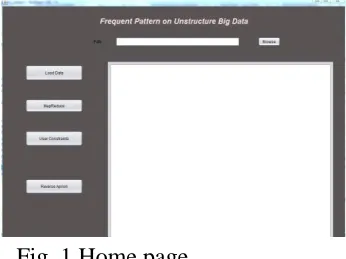
Fig.1 show the home page, in home page there are some button, 1stuser will click on browse button to select dataset show in fig. 2
Fig. 2 Selection of dataset
After selecting dataset, user will click on MapReduse phase, output of MapReduse phase shown in fig 5.3.
Fig. 3 OutPut of Map
Reduce After MapReduce user will
provide user Constraints that show in fig
.4
Fig. 4 User constraints
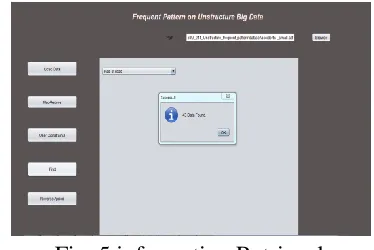
After selection of user constraints, here user select constraints ―Type of Road is highway‖ and output of this constraints are only those data which have attribute ―highway‖. Fig.5 show how many number of transaction are retrieved.
Fig. 5 information Retrieval
Fig.5 show 43 records out of 8 lack are retrieved, now system will calculate frequent pattern from this 43 record, for that purpose we have implemented reverse Apriori algorithm. Output is show in fig.6
Available online: https://edupediapublications.org/journals/index.php/IJR/ P a g e | 592
So the frequent pattern are for ―Type of Road is highway‖ are ―Downhill , Monday , Highway‖ Comparison of the two algorithms on two different measures. Those are mentioned below:
(a) Timerequirement
(b) Memoryusage
The following table 5.1 shows time required for both algorithm.
Table I Comparison basis on time
IV. CONCLUSION AND
FUTURESCOPE
A.Conclusion
Discovering association rules and frequent pattern mining have an ample space to propound deep and many efficient algorithms have been proposed up to now but applying those rules still found to be computationally expensive. An Apriori were suggested for frequent item set mining. Reverse Aprioriis partly refined in this study Instead of pairing all the frequent item sets at the end, which results in generating even higher number of generated candidate sets, it is viable to collect a heavy collection of frequent item set and then pruning it out thus giving lesser scans. And we have implement mapreduce to reduce search space and user constraint which effect minimum memory usage andtime.
B.FutureScope
Implementation of whole scenario with Hadoop framework which reduce time for execution and for frequent pattern use FP-growth algorithm which reduce database hit.
REFERENCES
[1] Carson Kai-Sang Leung, Christopher L. Carmichael ―Efficient Miningof
Frequent Patterns fromUncertainData‖ Seventh IEEE International Conference on Data Mining – Workshops DOI 10.1109/ICDMW.2007IEEE
[2] Carson Kai-Sang Leung,Richard Kyle MacKinnon,Fan Jiang ―Reducing the Search Space for Big Data Mining for Interesting Patterns from Uncertain Data‖ 2014 IEEE International Congress on Big Data 978-1-4799-5057- 7/14
[3]
C.K.-S.Leung&F.Jiang,―Frequentpatternm
iningfromtime-fadingstreamsofUncertaindata,‖inDa WaK2011 (LNCS 6862), pp.252– 264.
[4] C.K.-S.Leung&S.K.Tanbeer,―PUF-tree:Acompacttreestructureforfreque ntpatternMiningofuncertain data,‖ in PAKDD 2013 (LNCS7818), pp.13– 25.
[5] D.S. Rajput, R.S. Thakur, G.S. Thakur ―Fuzzy Association Rule Mining based FrequentPatternExtractionfrom Uncertain Data‖978-1-4673-4805-8/12 2012IEEE
[6] E. ¨O lmezo˘gullari& I. Ari, ―Online association rule mining over fast data,‖ in IEEE Big Data Congress2013, pp.110–117
[7] H. Yang & S. Fong, ―Countering the concept-drift problem in big datausingiOVFDT,‖ in IEEE BigData congress 13, pp.126-132. [8]
M.J.Zaki,―Parallelanddistributedassociati onmining:asurvey,‖IEEEConcurrency,7(4):1 4–25,Oct.–Dec.
1999.322.
[9] P. Agarwal, G.Shroff, & P. Malhotra, ―Approximate incremental bigdataharmonization,‖ in IEEE BigData Congress 2013, pp.118–125. [10] S. Madden, ―From databases to big data,‖ IEEE Internet Computing, 16(3): 4–6, May–June2012.
Available online: https://edupediapublications.org/journals/index.php/IJR/ P a g e | 593
concept-drift problem in big data using iOVFDT,‖ in IEEE Big Data Congress 2013, pp. 126–132. [12] Mannila, H. Inductive databases and
condensed representations for data mining. In International Logic Programming Symposium (1997), pp.21-30.
[13] Giannotti, F., and Manco, G. Querying Inductive Databases via Logic- Based User-De_ned Aggregates. In Procs. of the European Conference on Principles and Practices of Knowledge Discovery in Databases (September 1999), J. Rauch and J. Zitkov, Eds., no. 1704 in Lecture Notes on Arti_cial Intelligence, pp. 125{135. [14] Giannotti, F., and Manco, G. Making