ABSTRACT
YUILL, JAMES JOSEPH. Defensive Computer-Security Deception Operations: Processes, Principles and Techniques. (Under the direction of Dr. Mladen Vouk and Dr. Ana I. Antón.)
This dissertation is concerned with the processes, principles and techniques that are involved in deception-operations for computer-security defense. In this work, computer security deception-operations are defined as the planned actions taken to mislead hackers and thereby cause them to take (or not take) specific actions that aid computer-security defenses. Computer security researchers have investigated hackers’ use of deception to attack networks and the deceptive honeypot systems used to defend networks. However, relatively little has been done to systematically model and examine computer security deception-operations. This work addresses these issues by focusing on deception for computer-security defense. The four main contributions of this dissertation are:
1) A process model for deception operations: this model, which is based on military deception theory and practice, provides deception planners with a framework for conducting deception operations. The framework includes a set of processes, principles and techniques.
2) A process model of deceptive hiding: this model aids the defender in developing new hiding techniques and in evaluating existing techniques. Deceptive hiding is modeled as defeating the target’s discovery processes: direct observation, investigation based on evidence, and learning from others.
3) Two novel deception-based intrusion detection systems: the two deception models informed the design and evaluation of these systems. The Honeyfiles system extends the network file system to provide bait files for hackers. These files trigger an alarm when opened. The Net-Chaff system employs computer-impersonations to detect and contain hacker’s network scans within an intranet.
DEFENSIVE COMPUTER-SECURITY DECEPTION OPERATIONS: PROCESSES, PRINCIPLES AND TECHNIQUES
by
JAMES JOSEPH YUILL
A dissertation submitted to the Graduate Faculty of North Carolina State University
in partial fulfillment of the requirements for the Degree of
Doctor of Philosophy
COMPUTER SCIENCE
Raleigh 2006
APPROVED BY:
___________________________ ____________________________ Dr. Donald Bitzer Dr. Dorothy Denning
___________________________ ____________________________ Dr. Mladen Vouk Dr. Ana I. Antón
Biography
Acknowledgements
This dissertation is the culmination of over eight years of research. I have long awaited this opportunity to thank those who contributed to this work and made it possible.
I’d like to thank my PhD advisors and committee for working patiently with me over these many years. I’d very much like to thank Dr. Vouk for all the time he generously spent with me, especially given his busy schedule as department head. Also, I’m grateful that, as a boss, Dr. Vouk is kind and forbearing. Dr. Vouk’s requirement for analytical models led to the net-chaff research, and it was developed under his advising. Dr. Bitzer suggested the rate-based models that were developed for net-chaff, as well as the Poisson model. Dr. Antón’s advising greatly improved my writing skills, and helped me to be much better focused. Dr. Felix Wu was my first advisor, before he left NCSU. He kindly allowed me much freedom in my research, which led to this work in deception.
I owe a special note of thanks to Dr. Denning and Fred Feer for their contribution to this research. The dissertation’s deception process-models were the result of collaboration among Dr. Denning, Fred Feer and myself. Dr. Denning was the academic advisor for these models. Her keen insights, and her exceptional analytical skills, greatly enhanced and expanded these models. I’m also very grateful to Dr. Denning for serving on my PhD committee.
Fred Feer is retired from a career in the DoD and U.S. intelligence agencies. Fred kindly tutored me in deception and security. Fred’s insights on deception are profound and go beyond the published literature. They had a formative influence on much of this dissertation. The dissertation’ primary principle, the deception exploit, is Fred’s contribution.
Funding was also provided by Drs. Anton and Rappa, at NCSU.
I’ve been blessed to collaborate with, and be mentored by, several experts who work outside of the NCSU Computer Science Department. Their instruction and advising was the basis for most of this research. Their friendship, encouragement and support enabled me to persevere and complete this work:
• Dr. Chris Bassford, National War College: this research began with Dr Bassford’s suggestion to apply the Army’s deception manual to computer security. He also kindly advised me in my studies of military theory.
• Dr. Bowyer Bell: funding for much of this research was obtained by Dr. Bell. His untimely death prevented him from seeing the project’s completion. Dr. Bell was an expert on terrorism, and the co-author of a seminal book on deception theory. The dissertation’ flow-chart of the deception process is primarily from his research.
• Jim Settle, FBI, ret.: Jim’s tutelage greatly improved my understanding of real-world computer security. Before Jim died from cancer last spring, I told him I would dedicate the dissertation to him, in gratitude. Jim was chief of the FBI’s first computer crime squad. His security savvy and wisdom were amazing.
• Colonel G. I. Wilson, USMC: my collaboration with Dr. Denning and Fred Feer was brought about by Col. Wilson. He kindly made possible a number of my other research accomplishments, such as a presentation we gave at the Office of the Secretary of Defense, and instruction I received in maneuver warfare.
• Alvin Wallace, USAF CERT: some of the key funding for this research was facilitated by Alvin. He also made possible several of the presentations I made, including the DoD Cyber Crime Conference.
• Ken DeLavigne, IBM, ret.: this research is also based on prior study in software engineering, quality, Austrian Economics, and writing. Ken was my mentor when I worked at IBM, and he advised me in these studies. I have benefited much from his wisdom.
Thanks are due to my father, Dr. Stuart Yuill, and to Dr. Allard at Duke University, for reviewing the net-chaff math models. Dr. Allard also suggested the rationale used for the Poisson distribution.
A note of thanks is due to my family and close friends, for their support and prayers. My mom traveled to North Carolina on several occasions to help me prepare my tax filings, when I was inundated with dissertation research. My friend Ed Trench kindly rebuilt my car’s engine and front suspension, as a favor, and spared me student loans. In working on this research, I’ve received help from many others, and wish I could acknowledge them all.
Table of Contents
List of Tables ... ix
List of Figures ... xi
Nomenclature ... xiii
1 Introduction... 1
2 Background and related work ... 8
2.1 Deception processes... 8
2.2 Scanning and scan defenses ... 11
2.3 Deception use in honeypots and other tools ... 26
2.4 Summary ... 27
3 Deception framework... 29
3.1 Deception operation process ... 29
3.1.1 An overview of deception operations ... 29
3.1.2 Deception planning ... 35
3.1.3 The deception story... 39
3.1.4 Summary of the deception operations model... 45
3.2 Hiding model ... 47
3.2.1 The process of deceptive hiding ... 49
3.2.2 Direct observation... 50
3.2.3 Investigation... 56
3.2.4 Learning from other people or agents ... 62
3.2.5 Summary of the hiding model... 65
4 Deception-based intrusion detection systems ... 67
4.1 Net-Chaff: deception-based scan detection and containment ... 67
4.1.1 Environment and assumptions ... 68
4.1.2 Net-Chaff system ... 69
4.1.3 Requirements ... 78
4.1.4 Summary ... 93
4.2 Honeyfiles: deceptive files for intrusion detection ... 94
5 Evaluation ... 95
5.1 Net-Chaff ... 95
5.1.2 Simulation ... 152
5.1.3 Hiding analysis... 168
5.1.4 Limitations ... 171
5.1.5 Future research... 173
5.1.6 Summary of the Net-Chaff analysis... 176
5.2 Honeyfiles ... 178
5.3 Deception process models... 179
6 Conclusion ... 183
6.1 Main contributions of this work... 183
6.2 Limitations of this work... 185
6.3 Future work... 185
7 Bibliography ... 187
List of Tables
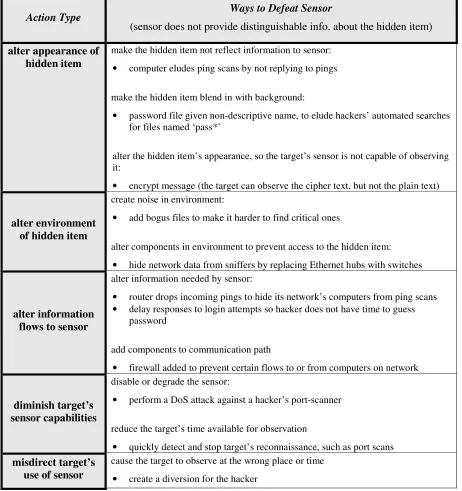
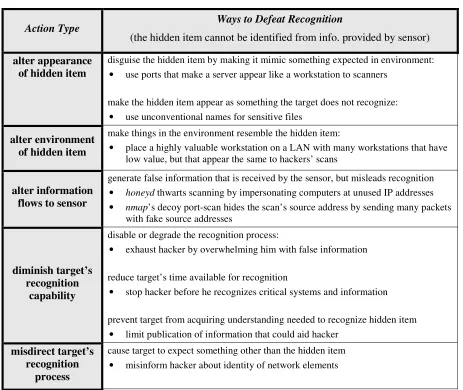
Table 3.2.2.2-1 : Hiding techniques that defeat the target's sensors... 53
Table 3.2.2.2-2 : Hiding techniques that defeat the target's recognition... 55
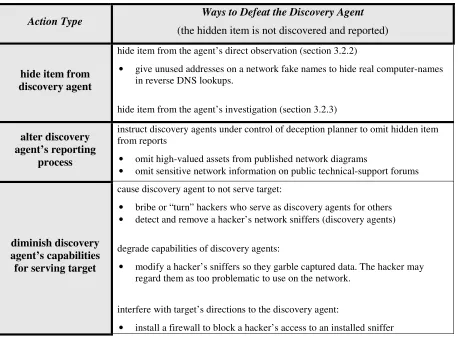
Table 3.2.3.2-1 : Hiding techniques that defeat the target's evidence collection... 61
Table 3.2.3.2-2 : Hiding techniques that defeat the target's creation of discovery hypotheses... 62
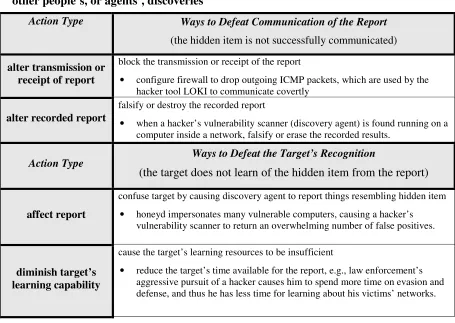
Table 3.2.4.2-1 : Techniques for hiding when the target learns from other people’s, or agents’, discoveries... 64
Table 4.1.3.1.1-1 : Common types of scans, categorized by the scan objective... 80
Table 4.1.3.2.2-1 : Net-Chaff’s uses of deception for defending against scans... 91
Table 5.1.1.1.3-1 : Probe-response types... 100
Table 5.1.1.2.4-1 : Computer distribution on network... 115
Table 5.1.1.2.4-2 : Probe-response type distribution on network... 115
Table 5.1.1.2.4-3 : Parameters for probe rate calculations... 116
Table 5.1.1.2.4-4 : Packets used in TCP scan-and-attack... 116
Table 5.1.1.2.4-5 : Calculations for individual probe rates, for TCP scan-and-attack 117 Table 5.1.1.2.4-6 : Calculations for individual probe rates, for the web-server TCP ping-scan... 117
Table 5.1.1.2.4-7 : Calculation for individual probe rate, for the UDP scan-and-attack ... 118
Table 5.1.1.2.4-8 : Calculations for individual probe rates, for the UDP filtering-scan with an attack... 119
Table 5.1.1.3.1-1 : Rates of compromise (computers per second) for the TCP scan-and-attack... 121
Table 5.1.1.3.1-2 : Rates of compromise for the UDP scan-and-attack with a filtering-scan... 123
Table 5.1.1.3.1-3 : Rates of discovery for the information-retrieval scan... 125
Table 5.1.2.1.2.1-1 : The simulation’s probe-response types... 156
Table 5.1.2.1.2.1-2 : Probe responses, as recorded in the RDB table... 157
Table 5.1.2.1.2.1-3 : Probe arrival times at the Net-Chaff WAN server, as recorded in the RDB table... 158
List of Figures
Figure 3.1.1-1 : Deception as a form of perception (adapted from [Wha82])... 9
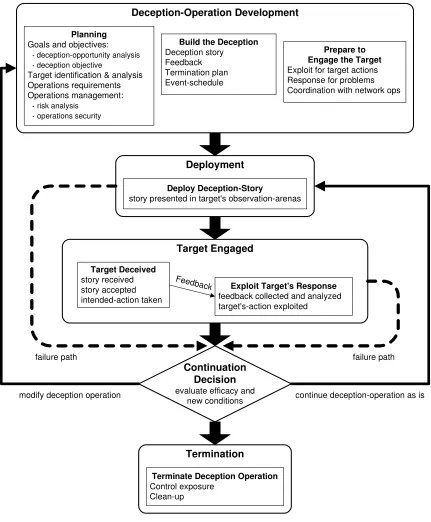
Figure 3.1.1.2-1 : The basic deception process... 31
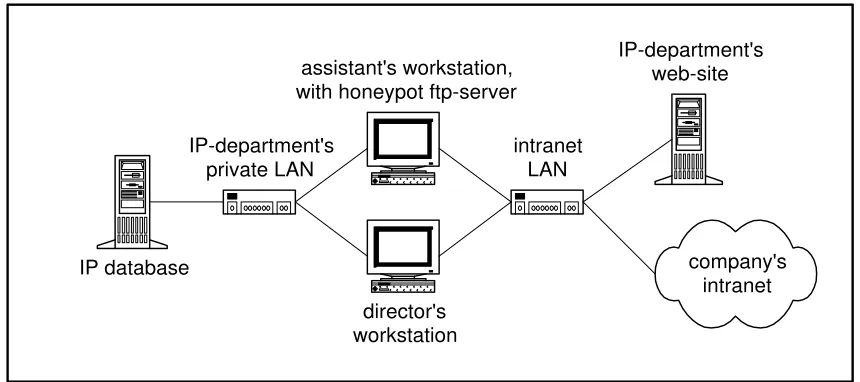
Figure 3.1.3-1 : The intellectual-property (IP) deception operation... 40
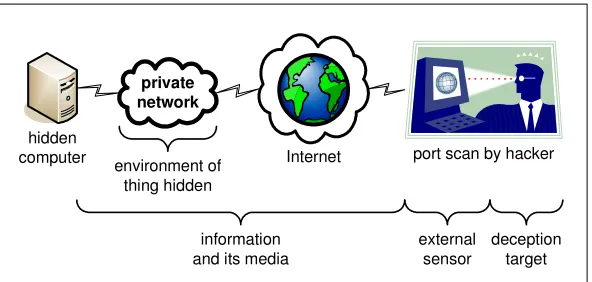
Figure 3.2.2.1-1 : The process of direct observation, illustrated by a computer-security example... 51
Figure 3.2.4.1-1 : How the target learns from other people’s, or agents’, discoveries... 63
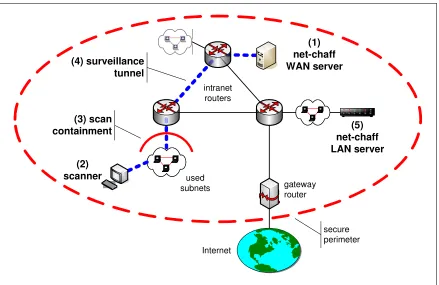
Figure 4.1.2.1-1 : Net-Chaff architecture... 71
Figure 4.1.3.1-1 : Examples of probe types... 79
Figure 4.1.3.1.2-1 : TCP scan-and-attack... 82
Figure 5.1.1.1.2-1 : Scan probes, from Net-Chaff's perspective... 98
Figure 5.1.1.1.3-1 : TCP scan-and-attack probes, using serial (non-interleaved) and parallel (interleaved) transmission... 102
Figure 5.1.1.3.1-1 : TCP scan-and-attack at 1Mbps... 122
Figure 5.1.1.3.1-2 : TCP scan-and-attack at 100 Mbps... 122
Figure 5.1.1.3.1-3 : UDP scan-and-attack with filtering-scans... 124
Figure 5.1.1.3.1-4 : The information-retrieval scan... 125
Figure 5.1.1.3.2-1 : Calculations of PVULN for the default networks... 128
Figure 5.1.1.4.1-1 : C¯VULN(b)... 135
Figure 5.1.1.4.1-2 : C¯VULN(z)... 136
Figure 5.1.1.4.1-3 : C¯VULN(r¯nc)... 138
Figure 5.1.1.4.2-1 : ¯ as a function of (Nnc_imp / Nx NC)... 141
Figure 5.1.1.4.2-2 : C¯VULN as a function of (Nnc_imp / NNC)... 142
Figure 5.1.1.4.2-3 : ¯ as a function of (Nx NC / (NT - NR))... 144
Figure 5.1.1.4.2-4 : C¯VULN as a function of (NNC / (NT - NR))... 144
Figure 5.1.1.4.2-5 : ¯ as a function of Nx T... 146
Figure 5.1.1.4.2-6 : C¯VULN as a function of NT... 146
Figure 5.1.1.4.3-1 : r¯vuln as a function of the network size (NT)... 148
Figure 5.1.2.1.1-1 : Overall simulation process... 154
Figure 5.1.2.2.2-1 : Simulation results vs. analytical models for (C¯C_S_sim < 100)... 164
Figure 5.1.2.2.2-2 : Simulation results vs. analytical models for (C¯C_S_sim≥ 100)... 165
Nomenclature
CND computer network defense
computer security in this dissertation, the term refers to computer-security defenses, unless stated otherwise
critical vulnerability an enemy vulnerability that permits friendly forces to destroy an enemy capability that he needs to function effectively deception exploit a statement of how the target-action will benefit CND. See
deception objective
deception objective the desired result of the deception operation; it consists of: 1) the intended target action, and 2) the deception exploit.
deception-operation for computer security, it is the planned actions taken to mislead hackers and thereby cause them to take (or not take) specific actions that aid computer-security defenses
deception story an outline of how the computer system will be portrayed so as to cause the target to adopt the desired perception, and take the intended target action
deception planner the person who plans, develops and carries out the deception operation
denial see hiding
desired perception what the target must believe in order for it to take the intended target action
footprinting a hacker’s use of publicly available information to learn about an organization and its network
hiding we consider hiding to be deceptive if it intends to mislead, and hiding that is not intended to mislead is referred to as
denial. See showing.
Honeyfiles a system that extends the network file system to provide bait files for hackers. These files trigger an alarm when opened.
honeynet a network of honeypots
honeypots computer systems that are designed to be probed, attacked or compromised by hackers
intelligence information and knowledge obtained through observation, investigation, analysis, or understanding
Net-Chaff a system that employs computer-impersonations to detect and contain hacker’s network scans within an intranet
planner see deception planner
ruse a trick designed to deceive
scan-and-attack a type of scan, in which the scan probes include an attack showing deception includes showing what is false and hiding what is
real. See hiding.
target the person the deception operation seeks to deceive target action a statement of what the hacker is to do (or not do) at some
1 Introduction
The research reported in this thesis provides models for designing and conducting defensive deception operations. The models are based on the underlying nature of deception and were, as much as possible, made independent of the current technologies. The models provide a framework for conducting deception operations and include a set of processes, principles and techniques that were examined and validated as part of the current work. The deception models informed the design and implementation of two deception-based intrusion detection systems: Honeyfiles and Net-Chaff. The Honeyfiles system extends the network file system to provide bait files for hackers and trigger an alarm when opened. The Net-Chaff system impersonates computers at an intranet’s unused addresses. By using simple and large-scale impersonations, Net-Chaff can effectively detect and contain hackers’ intranet scans. A prototype Honeyfile system was implemented, and Net-Chaff was simulated and modeled analytically. This work provides exploratory and confirmatory assessment of the two deception models.
1.1 Problem statement
In computer security, an advantage of deception is that it can pit the defender’s strengths against the hacker’s weaknesses. Hackers often rely heavily, if not exclusively, on a single source of information—data acquired via the network. Often, the network-based data can be manipulated to the defender’s advantage. Furthermore, when a hacker first arrives at the network, he 1 must learn about the network by investigating it. The investigation includes scanning and perusing the network itself and computers attached to it. The hacker’s investigation process, combined with this initial naiveté, can create an unavoidable and predictable conduit for deception. Typically, the network defender has physical control of his network, and he knows it well. The defender can exploit the hacker’s investigation process to supply him with falsehood and thereby attack his decision-making process.
Deception is an integral part of human nature and experience. There are legitimate, even necessary, reasons for deceiving others, as in sports and games. Deception is a frequent theme of history, literature, drama, and marketing. Consumers routinely exercise counter-deception. However, few people use deception in the calculated manner needed for computer security. As the military deception literature reveals, effectively deceiving an adversary is a job skill, and it requires an understanding of deception processes, principles and techniques [JDD96, USA88, USM89]. Deception can be used to attack hackers’ decision-making processes; thus deception provides an offensive security measure––something computer security defenders sorely lack.
1.2 Scope of this research
Computer-security deception is defined as the planned actions taken to mislead hackers and to thereby cause them to take (or not take) specific actions that aid computer-security defenses.2 The deception aims to mislead the hacker into a predictable course of action or inaction that can be exploited [Dew89]. Tricking a hacker, and making him think a certain way, is important only as a step toward getting him to make the decision that will result in the desired action [JDD96]. Thoughts without action are of little computer security
1
Unless stated otherwise, this paper’s masculine pronouns refer to both men and women.
2
value. Deception includes showing what is false and hiding what is real [BW82, Wha82]. We consider hiding to be deceptive if it intends to mislead, and hiding that is not intended to mislead is referred to as denial.
In this dissertation, the term computer security refers to computer-security defenses, unless stated otherwise. Some of this dissertation’s other terms are defined as: 1) deception planner, or planner: the person who plans, develops and carries out the deception operation, 2) deception operation: the planned development and deployment of a deception-based computer security measure, 3) target: the person the deception operation seeks to deceive, 4)
intelligence: information and knowledge obtained through observation, investigation, analysis, or understanding, 5) ruse: a trick designed to deceive. (A glossary appears after the table of contents.)
The scope of this research is deception-operations for computer-security defenses. Deception can be used to provide or enhance computer-security, including incident response, intelligence, detection, and prevention. The research focuses primarily on the design and conduct of deception operations for thwarting attacks and for collecting intelligence. Honeypots are currently one of the most widely used defensive deception technologies [Spi02]. This work does not focus on honeypots, but it uses them to explore, illustrate, verify, and validate principles. Additionally, counter deception (i.e., detecting hackers’ deceptions) and legal issues concerning the use of deception are not addressed. Hackers’ use of deception and deception for counter attacks (i.e., hacking hackers) are also out of scope. However, using deception to thwart, or attack, the hacker’s decision-making process is one of the research’s primary topics.
1.3 Research overview
1.3.1 Deception process models
Two types of process models were developed for use in computer-security.
• Process models for deception operations:
A set of descriptive and predictive models was developed for use in computer-security deception operations. These models are formed by synthesizing the principles in the extensive and disparate military-deception literature, and by adapting them for use in information technology and computer security. Two other sources are used in developing the deception-operation models presented here. They are the computer security literature and this research’s experimental and analytical findings. The contribution of these models is their extensive coverage of the deception-operation process, their derivation from the stated sources, and their application to computer security.
The principles of military deception are highly applicable to computer-security deception. The principles are well documented in the military deception literature (as described in Chapter 2), and they are based on millennia of experience and thought. The military deception literature is extensive, and it is also disparate, as the sources cover different aspects of deception. This research also draws upon the intelligence deception-literature (also described in Chapter 2). An additional research source is private communications and collaboration with a deception expert who has had extensive experience in both military and intelligence deception. This expert has significant insights that do not appear in the deception literature.
“The basic principles and objectives of reinforcing the desires and perceptions of the deceived will not change, since human nature and the psychological mechanism of human perception are ever the same. In terms of its forms and the means employed, deception will, like war itself, change as new weapons and technologies appear [Han85].”
For this research, the deception models describe how deception can be used to advantage in computer security. The models describe the processes followed in deception operations, and they describe the principles and techniques for developing and conducting deception operations.
• A process model of deceptive hiding:
A second part of the research is a novel model of deceptive hiding. The model addresses one component of deception operations, and it extends existing hiding models. The model is intended for use in developing new hiding techniques and for evaluating existing hiding techniques. It characterizes deceptive hiding in terms of how it defeats the underlying processes that an adversary uses to discover a hidden item. An adversary’s process of discovery can take three forms: direct observation (sensing and recognizing), investigation (evidence collection and hypothesis formation), and learning from other people or agents. Deceptive hiding works by defeating one or more elements of these processes.
1.3.2 Systems, experiments, and evaluation
A significant component of deception research requires analysis of human nature. Often, human behavior and nature are not amenable to quantification, so qualitative analysis needs to be applied, such as an appropriate non-quantitative deception process-model. Further, although deception is an integral part of human life, computer-security deception operations are not. Consequently, to learn more about deception operations, the third part of the research involves the development of a prototype, simulation, and analytical models, as well as their use in experiments and evaluation. 3
The two deception models informed the design and implementation of two deception-based intrusion detection systems. These implementations, and subsequent experimentation,
3
provide exploratory and some confirmatory assessment of the two deception models. One of the systems is a deception-based intrusion detection system called Honeyfiles. A honeyfile is a bait file that is intended for hackers to open, and when the file is opened, an alarm is set off. For example, a file named passwords.txt could be used as a honeyfile on a workstation. Hackers who gain unauthorized access to the workstation will be lured by the file’s name, and when they open the file an alarm will be triggered. Honeyfiles are implemented as a file server enhancement, and the file server’s users can make any of their files a honeyfile. A prototype Honeyfile system was built. The system was tested by deploying it on a deceptive network and, when subjected to hacking, was observed to be an effective means for intrusion detection.
The second system impersonates computers on an intranet for the purpose of detecting and stopping hackers’ port scans. The system is called Net-Chaff, and it impersonates computers at the intranet’s unused addresses. Net-Chaff only impersonates computers below the application layer, as this greatly simplifies the implementation, yet still affords significant advantages over scanners. When Net-Chaff detects a scan, it blocks the scanner’s network access via the intranet’s routers. Further, Net-Chaff’s use of deception can significantly slow down scans, reduce the usefulness of scan findings, and lure follow-on attacks against Net-Chaff’s impersonated computers. Net-Chaff uses concepts from existing deception-based security systems (e.g., honeyd [Hon05]), and it combines and applies them in a novel way.
Net-Chaff’s use of deception, and its ability to thwart scans, were assessed using simulations and analytical models. They confirm that the Net-Chaff system can effectively thwart scans and that deception plays a significant role in the process. In military theory, a
1.4 Expected uses and benefits of this research
Although appealing, deception appears to be used only sparingly in computer security. Furthermore, at present, the computer security literature does not appear to address, in depth, the general processes and principles of deception operations. This research provides such deception models, for developing deception skills and knowledge. Also, this research presents two novel deception-based computer security tools that can be used for detecting and preventing attacks.
The overarching expectation is that deception can significantly improve the current state of computer security. Deception may even be essential in compensating for the intrinsic limitations of conventional security. There is strong precedent for these expectations. In adversarial contests observed throughout history—among both men and beasts—deception plays a pervasive and significant role [BW82].
2 Background and related work
This chapter summarizes the deception and computer-security literature related to this dissertation. This summary is based on extensive surveys of: 1) the literature on deception processes for computer security, war fighting, and intelligence, 2) the prior work on scanning and scan defenses, that is related to the Net-Chaff system, and 3) deception use in honeypots and other computer security tools. The background and related work from these surveys is presented in the following three subsections,.
2.1 Deception processes
This dissertation includes two models of deception processes. They are the models of deceptive hiding and the models for designing computer-security deception operations. This section surveys the prior work related to the general areas these models address.
2.1.1 An overview of deception processes
Deception is a form of perception in which a target is intentionally led to an incorrect perception, through the actions of another [Wha82]. Deception, as illustrated in Figure 3.1.1-1, is distinguished from unintentional acts of misrepresentation and from self-induced acts of misrepresentation (self-deception).
perception
misperception accurate perception
other induced self-induced
intentional
(deception)
unintentional (unintentional misrepresentation)
intentional (self-deception)
unintentional (e.g., optical
illusion)
Figure 3.1.1-1 : Deception as a form of perception (adapted from [Wha82])
Bell and Whaley offer a taxonomy of deceptive techniques based on three ways of hiding: masking, repackaging, and dazzling; and three ways of showing: mimicking, inventing, and decoying [BW82]. This taxonomy has been used in both the military and computer security literature [USM89, Jul02]. The military deception literature also lists common types of battlefield deceptions, examples being camouflage, feints (fake attack-initiation), ruses (tricks designed to deceive), demonstrations (fake force deployment), and displays (the showing of fake military forces or equipment, e.g., inflatable tanks) [USA88, Dew89, FN95]. Cohen [Coh98] and Rowe and Rothstein [RR04] have shown how these can be applied to computer network defense. Rowe and Rothstein have also published a taxonomy of deception techniques based on semantic cases in computational linguistics such as agent, instrument, location-from, time-at, and purpose [RR04]. In addition, Rowe has developed a taxonomy for deception in virtual communities [Row05b]. The taxonomy applies primarily to computer misuse, and not to computer security.
taxonomies. The model shows how deceptive hiding can be understood in terms of processes, mainly the discovery processes used by a target to acquire information. Particular hiding techniques work by defeating elements of these processes.
2.1.2 Deception processes in computer science
Some computer-security literature addresses, at least in part, deception itself. Fred Cohen led a major deception-research project at Livermore Labs [CLP01, CMS01, Coh98, Coh00]. His research attempted to statistically characterize the general effectiveness of deception [CMS01]. The results are of very limited applicability, since such results cannot adequately address the wide variation in the causative effects in general deception-operations. Cohen has also applied military deception principles to computer security, though he only draws from one source on military history and a small collection of military deception techniques [Coh98].
Rowe and Rothstein have built a probability model based on military deception techniques. The model is intended for assessing the usefulness of those techniques [RR04]. Unfortunately, the deception model overly simplifies complex phenomena and the probability model appears to be mathematically flawed. For example, the “appropriateness” of a deception technique is assigned a number, and that number is used in an equation to rank deceptions. However, that number is not a cardinal value, but an ordinal value, so its use in an equation is not valid nor meaningful.
Two Australian researchers are addressing the process and principles of deception [Hut04, HW00, HW01, HW02]. They present high-level conceptual models for understanding deception, and the models include deception for both offense and defense. The models are general and do not provide the level of detail needed for designing specific deception operations.
2.1.3 Military deception processes
deception literature, and applying it to computer security. Deception is a key focus of the military and intelligence communities [YDF06]. Three U.S. military deception-manuals provide deception models for different aspects of deception operations. The Joint manual addresses deception planning for command and control warfare (C2W) [JDD96]; the Army manual addresses tactical deception [USA78, USA88]; and the Marine Corps manual addresses strategic deception [USM89]. Useful models are also found in books written by soldiers and intelligence analysts with expertise in deception [Dew89, Heu81, Mur80]. Civilian researchers, from academia, intelligence contractors, and defense contractors, have also provided deception models for warfighting [CIA80, DH82b, FN95, Han85]. In all of this literature, each source addresses a subset of deception. Consequently, the literature contains a disparate collection of deception processes and principles. Prior to this dissertation, the only known attempt to synthesize this literature is by the author of the Marine Corps manual, which addresses strategic deception, not tactical deception [USM89]. In contrast, this dissertation provides a comprehensive synthesis of the military and intelligence literature’s disparate deception models, and its focus is primarily on the tactical use of deception.
2.2 Scanning and scan defenses
A major component of this dissertation is the Net-Chaff system, the purpose of which is scan defense. The related work for Net-Chaff is in the areas of scanning and scan defenses. They are presented in the following two sections.
2.2.1 Scanning
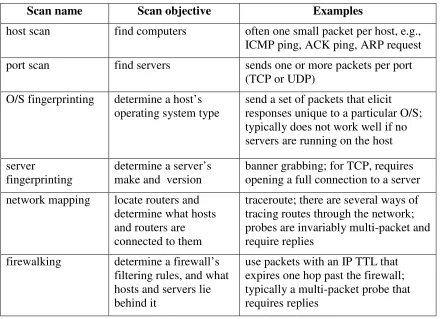
Net-Chaff’s purpose is to defend against hackers’ active scans. An overview of scanning is provided here, and it frames the aspects of scanning that are relevant to Net-Chaff. Further details on scanning are provided with the Net-Chaff description in Chapter four.
will be gathered” [Ark05]. Passive scanning is an alternative form of scanning. It learns about network elements by observing network traffic. Research comparing active and passive scanning indicates that the two techniques find largely disjoint sets of information [WLZ06]. A major disadvantage of passive scanning is that a significant percentage of its discoveries can take a very long time, e.g., weeks. Hereafter, active scanning will be referred to as simply “scanning”, except when it must be differentiated from passive scanning.
There are three major applications of scanning, and each includes tools, techniques and research that are relevant to Net-Chaff. 1) There are numerous stand-alone scanning tools, and they are used by hackers and network administrators [MSK03]. One of the best-known scanners is nmap [Fyo04]. 2) Scanning is also incorporated in programs that are used to find vulnerable systems and break into them. These programs include vulnerability scanners (such as Nessus [Nes06]) and worms [Naz04]. 3) Scanning is a topic of research and development within the field of network management [TB98, VVZ02]. Scanners are incorporated in network management tools, to perform network discovery. Scanning tools and techniques will be described in chapter 4.
A number of studies have been conducted to analyze Internet hacking activity, including the prevalence and content of scans. Monitoring any portion of the Internet address space reveals incessant activity [PYB04]. There are on-going projects that continuously monitor and report Internet hacking activity [DS06, ISC06]. On the Internet, scanning occurs constantly, and in high volume [JPB04, PYB04]. For instance, traffic logs from the Lawrence Berkeley National Laboratory (LBNL) were examined for an arbitrarily-chosen day [JPB04]. It showed that 138 different remote hosts scanned LBNL addresses, with a total of about 8 million connection attempts. A more detailed study found that 13,000 remote scanners had probed LBNL addresses on a particular day.
background radiation [PYB04]. It is nonproductive traffic that, in general, is either malicious (from flooding, vulnerability scans, and worms) or benign (from misconfigurations). Analysis of Internet background radiation shows that it is not only incessant, but also “complex in structure, highly automated, frequently malicious, potentially adversarial, and mutates at a rapid pace” [PYB04]. Internet background radiation poses significant challenges for intrusion detection.
In contrast, Net-Chaff works within a secure intranet. This intranet has a secure perimeter that provides good, though not perfect, protection from direct Internet access. Net-Chaff is not intended for use on networks that are directly accessible from the Internet, e.g., typical campus networks. Scans on the Internet are incessant (part of the background “noise”), and thus far, there appears to be little that can be done to stop them.
We are not aware of formal published research on the incidence of scans within such secure intranets, although a lot of anecdotal evidence exists, as well as a number of internal reports in a wider range of organizations However, it is reasonable to assume that within this environment, unauthorized scans are relatively infrequent, and worthy of detection, containment and investigation. Sources of scans within protected intranets include attacks from authorized personnel (i.e., insiders), worm-infected laptops, and unintended network paths through the perimeter [Naz04].
Insider attacks can come from employees and contractors, and also from trusted networks (e.g., VPN connections from business partners). The Wall Street Journal reports that “23% of 229 U.S. organizations with more than 1,000 employees had at least one internal security breach in 2004, while another 27% didn't know whether or not their networks had ever been compromised -- from inside or outside” [Yua05]. The Code Red and Nimda worms were able to deeply penetrate protected networks [Naz04].
2.2.2 Scan defenses
following three subsections. The first subsection compares and contrasts each of Net-Chaff’s distinctive features with similar prior-work. Next, whole systems that are similar to Net-Chaff are presented. The third subsection describes scan defenses that work differently than Net-Chaff.
Before analyzing the prior work, a summary of Net-Chaff’s distinctive features is needed. Net-Chaff is used within a secured intranet. It’s primary purpose is to detect and contain scans, and its primary objective is to contain scans before they can access vulnerable computers. The Net-Chaff system detects scans by monitoring traffic to a large number of unused addresses within the intranet. There are two ways that Net-Chaff slows down scans, to prevent them from accessing vulnerable computers before containment: 1) a relatively large number of unused addresses, and 2) the Net-Chaff system’s low-level impersonations. Net-Chaff’s performance is analyzed using analytical models and a simulation, and both are based on detailed calculations of scanners’ probe rates. Most of Net-Chaff’s individual features exist in prior work. Net-Chaff combines and applies these features in a novel way.
There is a tremendous amount of prior work on scan defenses. It comes from a number of sources, and they are summarized here. This summary describes broad categories of the prior work. For each of the categories, an example of the prior work is cited. In the sections that follow, specific instances of the prior work are described and cited. For scan defenses, research and development has been carried out in academia (e.g., [JX04]), industry (e.g., [PSN04]) and in the open-source community (e.g., [Ras01]). Scan-defense systems have been developed, including prototypes (e.g., [WOK05]), open-source systems (e.g., [Ras01]), and products (e.g., [PSN04]). Scan defenses include prevention (e.g., [WSM04]), detection (e.g., [Ras01]), containment (e.g. [PSN04]), and also intelligence collection and analysis (e.g., [YBP04]). The three primary areas in which scan-defense work has been performed are: 1) defenses specifically for scans (e.g., [Ras01]), 2) worm defenses (e.g., [WOK05]), and 3) intrusion detection systems (e.g. [BFP03]).
Most worms use active scanning to find new victims [Naz04]. These worms are referred to as scanning worms. Hereafter, scanning worms will be referred to as simply
results in huge volumes of network scans. Many worm-defense systems detect worms via their scanning (e.g., [PSN04]). However, worm detection involves more than scan detection, since not all scanners are worms [GSX04]. Some worm-defense systems contain worms (e.g., [PSN04]). There are a number of intrusion detection systems that include scan detection (e.g. [BFP03]). However, in general, intrusion detection systems are concerned with a wide variety of attacks, and not just scans. Hereafter, the term scan defense will be used to refer to any type of defense against scans, unless differentiation of the type of defense is needed.
2.2.2.1
Prior work related to Net-Chaff’s distinctive features
Each of Net-Chaff’s distinctive features are compared and contrasted with the related prior work:
• Secure-intranet environment
Net-Chaff is designed for use within a secured intranet. Here, it is assumed that unauthorized scans are infrequent and each warrants investigation. Also, the intranet environment provides the centralized control needed to implement automated containment, and to prevent source-address spoofing. Collectively, these attributes of secured intranets provide significant opportunities for scan defenses. However, there appears to be little in-depth research on these scan-defense opportunities. We are only aware of three systems that focus on the opportunities for scan detection and containment for the secure intranet environment. They are Arbor Network’s product Safe Quarantine [PSN04], and two LAN-based products from Mirage Networks [MN06] and ForeScout [For04a, For04b]. These systems are described in the next section.
• Monitoring unused addresses to detect scans
Net-Chaff detects scans by monitoring traffic to unused addresses. Typically, many of a scan’s probes are to unused addresses. Such probes can be used to detect scans, as the traffic is anomalous relative to benign traffic. There are two ways that network traffic can be monitored, to detect scanners’ probes of unused addresses: 1) unused addresses can be assigned to a monitoring system. Packets sent to those addresses are delivered to the monitor via network routing. Net-Chaff uses this technique, as do several other systems which will be described shortly. 2) Alternatively, a system can sniff network links to monitor traffic to unused addresses. To filter-out benign traffic, the system must know which addresses are unused. They can be specified a priori, or the system can deduce which addresses are unused. Unused addresses can be identified by their lack of traffic (e.g., they do not send ARP broadcasts) and also by failed connections (e.g., ICMP host unreachable messages). There are several systems that monitor traffic to unused addresses by sniffing network links, and they are described later.
Network intrusion detection systems (NIDSs) typically monitor network links, and attempt to identify intrusions from amidst the legitimate traffic. There are a number of significant difficulties and challenges with this approach [Naz04, RSM03, Spi02]. Monitoring an entire network can be very difficult, as many links may need to be monitored. The large volume of legitimate traffic makes it difficult to accurately detect intrusions: 1) often, intrusions make-up a very small portion of the traffic. 2) The large volumes of traffic make it difficult to examine events over long time-scales. (Hackers use slow scans to exploit this weakness in NIDSs.) 3) When multiple links are monitored, it is difficult to aggregate this data and obtain a network-wide view of events. (Hackers use distributed scans to exploit this weakness in NIDSs.) Aggregation is difficult due to the huge volumes of data, the need for real-time detection, and also, the asymmetric routing of full-duplex connections (e.g., TCP) [RSM03].
smaller, 2) there is little or no legitimate traffic, and 3) network-wide surveillance is much easier. Research in intrusion detection for high speed network links has found that real-time monitoring becomes difficult, if not impossible, at very high speeds [LPV04]. As an alternative, they recommend monitoring unused addresses because, there, the signal to noise ratio is much higher.
There are other systems, in addition to Net-Chaff, that assign unused addresses to a monitoring system, for the purpose of detecting scans. Spitzner discusses honeypot’s use of unused addresses, for intrusion detection and for collecting intelligence on hackers [Spi02]. However, traditional honeypots typically use a small number of unused addresses. Also, traditional honeypots typically require labor-intensive log reviews, which make them unsuitable for a real-time IDS [DQG04]. Recently, researchers have developed a honeypot system, called Honeystat, that uses many unused addresses for worm detection [DQG04].
As described earlier, Internet sinks monitor large numbers of unused Internet addresses [HA05, PYB04, YBP04]. iSink is one such system, and it has the added feature of providing deceptive replies to scanners’ probes of the unused addresses [YBP04]. iSink is further described in the next section. There are other intrusion detection systems that monitor a large number of unused addresses, and they include a distributed Internet IDS [YBJ04] and two network worm-detection systems [JX04, WVG04].
As described earlier, traffic to unused addresses can also be monitored by sniffing network links. There are scan and worm detection systems that attempt to learn, or deduce, which addresses are unused [For04a, For04b, MN06, SJB04, PSN04]. honeyd is a honeypot system that can learn unused addresses by monitoring a LAN for unanswered ARP requests [Hon05]. honeyd has been adapted for use in detecting scans [YLM04]. It is further described in the next section. There are other systems that monitor unused addresses, and the addresses are specified by human operators [HC04, TK02].
• Slowing down scans
computers a scan can access prior to containment. We are not aware of any other scan-defense systems that use a large number of unused addresses for these purposes, especially for IPv4. However, the idea of thwarting scans via a large address space is not novel; others have observed that the large address space in IPv6 makes scanning very difficult [ZGT05].
To slow down scans, Net-Chaff also uses low-level impersonations at the unused addresses. There are a number of scan-defense systems that use deception at unused addresses. However, most of them use deception to elicit responses from scanners, in order to better identify them [DQG04, JX04, Spi02, YBJ04, YBP04, YLM04]. Some scan-defense systems use deceptive replies to confuse and misinform scans [Bec01, HC04, XDM01]. We know of two deception techniques that are used to slow down scans. One is La Brea, an it is described in a later section [LaB05]. The other deception technique is used by firewalls.
We have observed that firewalls can slow-down scans by dropping disallowed packets. Nmap’s source code reveals that it interprets dropped packets as an indicator of congestion [Fyo04]. The dropped packets can induce nmap to reduce its scanning rate, retransmit packets, and delay probe transmission. However, if host-firewalls drop scan packets, then those hosts can potentially be discovered by an “inverse scan” [Ark01]. Normally, routers send ICMP host-unreachable messages in response to packets that are sent to unused IP addresses. An inverse scan works by sending probes and looking for addresses that generate no reply. Routers can defeat inverse scans by not sending ICMP host-unreachable messages. Alternatively, hosts can defeat inverse scans by using a host firewall that sends false ICMP host-unreachable messages [Rus02].
impersonation can be easily detected by a hacker. We are not aware of other research that focuses on the use of low-level deceptions, as a simple means for slowing-down scans.
• Scan containment
Net- chaff uses intranet routers to contain scans. Other systems that do this are Arbor Network’s “Safe Quarantine” [PSN04] and CyberTrace [JX04]. PSAD is a firewall-based system that detects scans, and contains them by blocking sources [Ras01]. There are also systems that monitor intranet links for scans, and block scans over those links [HCL06, WSP04]. There are two LAN-based products that detect worms, and they contain infected hosts by sending them spoofed packets that disable communications, such as TCP RST and ARP [For04a, For04b, MN06]. Similarly, La Brea replies to scanners with packets that can potentially put them in a long wait-state [LaB05]. Systems have been proposed for worm containment using host-based firewalls [TK02]. An alternative to containment is throttling, which reduces scanning rates by dropping a portion of the packets sent [SJB04, Will02]
• Performance models
Another contribution of the Net-Chaff work is its performance analysis, which includes both analytical models and simulations. There are systems that have features similar to Net-Chaff’s. Among those systems, some have analytical models or simulations. However, these analytical models and simulations do not appear to be applicable to Net-Chaff [CGK03, GSX04, JX04, WKO05, WVG04, ZGT05]. The reason is that the modeled systems work differently than Net-Chaff, or have different objectives.
There has been a substantial amount of research on modeling the growth of worms, and the research includes analytical models and simulations [Naz04]. These models show that worm growth is exponential and difficult to contain. They also show the need for stopping scanning-worms before they can access a single vulnerable computer, which is Net-Chaff’s objective.
2.2.2.2
Scan-defense systems similar to Net-Chaff
There are two systems for worm detection and containment that are intended for use on enterprise networks. Arbor Network’s product Safe Quarantine detects worms by monitoring network links for signs of worm scanning and propagation [PSN04].4 It automatically contains worms by blocking them at intranet routers. An important contribution of this product is its emphasis on not inadvertently blocking critical operations. To avoid this, it learns normal network traffic, to know what traffic should not be blocked. Net-Chaff differs from Safe Quarantine in that Safe Quarantine does not use unused addresses to slow down scans, nor does it use deception to slow-down scans.
Another enterprise network solution for worm detection and containment is CyberTrace, and it is an academic research project [JX04]. It uses unused addresses to detect worms. It automatically contains worms by blocking them at intranet routers. An important contribution of this system is its use of intranet routers to create an Internet sink, using unused Internet address-spaces. When worms within the enterprise network scan the Internet, they are likely to probe these address spaces. CyberTrace differs from Net-Chaff in that it assumes a network that is largely open to the Internet, such as a campus network. Also, CyberTrace focuses exclusively on worms, and not scanning in general. It does not use unused addresses to slow down scans, nor does it use deception to slow-down scans.
Researchers at the University of Wisconsin have developed an Internet sink, called iSink, and it also provides deceptive replies [YBP04]. The system is intended for studying Internet background radiation, so its purpose and functionality are very different from Net-Chaff’s. However, it makes two significant contributions that can be applied to Net-Chaff’s implementation and deployment. The iSink system includes requirements analysis and system designs for providing deceptive replies to large volumes of scan probes. iSink’s techniques for generating its rudimentary deceptions could be used by Net-Chaff in generating its low level impersonations. iSink was deployed on several lightly populated class B networks. Its routing techniques, for unused addresses, could also be used for Net-Chaff deployments.
4
La Brea is a system that attempts to suspend scanners, including scanning worms [LaB05]. It does this by providing deceptive replies to probes sent to unused addresses on a LAN. It detects these probes by monitoring the LAN for unanswered ARP requests. La Brea attempts to suspend a scanner by sending it a TCP packet that is crafted to put the scanner in a long wait state. It appears that La Brea could be easily countered by scanners that detect this unusual TCP packet, or by scanners that work asynchronously [MSV03]. Researchers have investigated La Brea’s potential use for thwarting Internet worms [CGK03]. Net-Chaff and La Brea are clearly differ in the environments in which they are used, the ways they monitor unused addresses, and the ways they use deception.
honeyd is another system that provides deceptive replies to connections sent to unused addresses [Hon05, Pro04]. honeyd can detect traffic sent to unused addresses by monitoring a LAN for unanswered ARP requests. Alternatively, unused addresses can be assigned to honeyd. honeyd simulates honeypots at the unused IP addresses, and it has the potential for a diverse set of interactive responses. One proposed use of honeyd is to thwart scanning by 1) providing deceptive replies that confuse and deter scanners, and 2) coupling honeyd with an IDS for scan detection [Pro04]. However, no further details are provided about this system. Another proposed use of honeyd is to counter-attack scanning worms on the Internet, and thereby stop them from spreading [Pro04]. Math models are developed for the proposed system. They show that stopping an Internet worm would require hundreds of thousands of honeypots. A significant problem with this system is that it requires knowledge of a vulnerability that can be exploited to counter-attack the worm. An exploit for the vulnerability is also required. This would be especially difficult for new worms.
works with. A bigger difference with these honeyd-based systems is that they do not provide containment of scans, in general, on an intranet.
There are two noteworthy LAN-based products that detect and contain worms. One is from Mirage Networks [MN06] and the other from ForeScout [For04a, For04b]. These systems sniff traffic on a LAN, and detect worms based on their traffic patterns, e.g., packets sent to unused addresses. They implement containment by sending specially crafted packets to infected hosts, such as TCP RST and spoofed ARP packets. An important contribution from these systems is that they are designed to be installed on a LAN, with little or no modification to the LAN. In contrast, Net-Chaff deployments can potentially require significant changes to a network, e.g., converting to the 10.0.0.0 address space. We were unable to find enough information on these products to adequately assess how they work, and what their limitations are. A major difference between these products and Net-Chaff, is that they only protect a LAN.
Researchers have experimented with systems that detect scans on a network link, and send deceptive replies in response. CTCP is a system that works on an edge router that proxies connections to the Internet [HC04]. Incoming connections to nonexistent or blocked ports are redirected to a system that provides deceptive replies. The intention is to render port scans useless by making it appear that all ports are open. There is a similar system, called IEDP, that runs on a firewall [XDM01]. A major difference between these systems, and Net-Chaff, is that they only work on network choke points that control network access.
2.2.2.3
Scan defenses different than Net-Chaff
There has been much research and development for scan-defenses, and the majority of it is fundamentally different than Net-Chaff. This section describes the prior work on scan-defenses that is dissimilar to Net-Chaff.
2.2.2.3.1
Monitoring operational network traffic
network links, and it includes legitimate and benign traffic, as well as scans and attacks. Net-Chaff is distinguished from the scan-detection work for operational traffic, as that work must deal with the problem of identifying scan traffic that is mixed in with legitimate traffic. This section provides an overview of the scan-detection work that involves monitoring operational traffic. This overview shows the types of problems and solutions that have been addressed.
Scan detection has been investigated for different volumes and types of operational traffic. Research related to high-bandwidth environments includes scan detection on backbone routers [RSM03, SBB04, SYB06] and on high-speed networks (i.e., 10s of Gbps) [GZC06]. Scan detection research has also focused on networks [HCL06, SHM02, WKO05] and smaller local networks (e.g., LANs) [JPB04, SJB04, WSP04]. For network scan detection, the use of mobile agents has been investigated [FA04]. Researchers have also focused on scan detection within Internet traffic [QH04, ZGT05].
A large assortment of scan detection techniques have been researched for operational traffic. Much of the scan-detection research introduces novel detection techniques that attempt to solve the problem of finding scans within large volumes of legitimate data. An overview of that research follows.
Commercial and open-source intrusion detection systems (IDSs) typically detect scans by using a threshold-based detection mechanism [JPB04, RSM03, SHM02]. This detection mechanism works by looking for X probes in a rolling window of Y seconds. Examples of such systems will be given in section 2.2.2.3.2 (page 24). Net-Chaff uses a simple threshold-based detection mechanism, and its use of other detection techniques is left as a topic for future research.
Researchers have investigated probabilistic techniques for scan detection. These techniques have been used to rapidly detect scans [JPB04], to detect slow scans [SHM02], and to achieve accurate detection in real-time [LK02]. Researchers have also investigated scan detection techniques based on statistical analysis of network traffic [TRB06], and on the use of fuzzy systems [DJK01].
There are other forms of anomalous traffic that are generated by scans, and that can potentially be used to identify scans within operational traffic. Researchers have investigated techniques for detecting scans based on anomalous sequences of connections [QH04], asymmetries in traffic [HCL06], and anomalous numbers of half-open connections from a source [SBB04]. Another technique detects scans by identifying connections for which no host-name look-up was made via DNS [WKO05].
There are scanning techniques that use unusual or malformed packets for the purpose of evading detection or for fingerprinting a host’s operating system [Ark01, Fyo97]. These scan packets provide a signature that can be used to detect scans, and two systems that uses this technique are Snort [BFP03] and psad [Ras01].
2.2.2.3.2
Scan detection systems
This section describes some of the most well-known scan detection systems that work by monitoring operational traffic. Research in intrusion detection includes four systems whose scan detection capabilities are often cited. The Network Security Monitor (NSM) was the first NIDS, and it was also the first NIDS to detect scanning [SHM02]. It uses a threshold-based detection mechanism. Another system is Bro. It uses a threshold-based detection mechanism, and it also monitors failed connections [JPB04]. The Graph Based Intrusion Detection System (GrlDS) detects scans by building graphs of activity where the nodes represent hosts, and the edges represent traffic between hosts [SHM02]. The EMERALD system constructs statistical profiles for subjects, and compares their short and long-term behavior. One way it detects scans is a sudden increase in the volume of SYN packets, for example, from a particular source IP-address [SHM02].
Checkpoint, Cisco, ForeScout, Juniper, NetScreen, and Network Associates [LPV04]. They indicate that these products monitor operational traffic. In addition, there are a number of open-source tools that perform scan detection. Two of the most prominent are Snort [BFP03] and psad [Ras01]. Both use threshold-based detection mechanisms, and they can also detect several known scan-packet signatures. Snort is a commonly used NIDS and the de facto standard in small stub networks [SYB06]. Scan detection is just one of its intrusion detection functions. psad focuses primarily on scan detection, and it works with Linux’s iptables rule-sets, e.g., as part of a Linux firewall [Ras01].
McClure, et al., make the observation that most IDSs are configured by default to detect only very noisy or clumsy port scans [MSK03]. They state that an IDS must be “highly sensitized” and “fine-tuned”, or stealthy scans will “go completely unnoticed”.
2.2.2.3.3
Other scan defenses
Net-Chaff’s scan-defenses primarily involve detection and containment. There are several other types of scan defenses that have been researched and/or used in practice. Research has been performed on visualizing scans, and the purpose of visualization includes rapid comparison and identification of large numbers of network scans [MMB05]. There are a number of techniques used to prevent scanning [XDM01]. Firewalls and systems that perform network-address-translation (NAT) are well known techniques for blocking scanners. Another well known technique is to configure servers so they listen on unconventional ports. Routers can be configured to limit or drop certain ICMP messages that scanners elicit to learn about the network [Ark01, XDM01]. Beck describes techniques to evade scanners’ attempts to fingerprint host operating systems [Bec01]. Protocol scrubbing
involves filtering and modifying traffic to ensure there are no malformed or unusual packets [WSM04]. Such packets can be used by scanners to elicit information or evade intrusion detection systems.
2.2.3 Summary of scanning and scan defenses
concerned with scanning within a protected intranet. The incidence of scanning on the Internet is a topic of much past and current research. However, we are not aware of any in-depth research on the incidence of scanning within a protected intranet.
Most of the prior work on scan defense is concerned with operational traffic. Net-Chaff is differentiated from this work by its technique of monitoring traffic to large numbers of unused addresses. Most of Net-Chaff’s distinctive features are found in prior work. However, Net-Chaff combines and applies these features in a novel way. Of the systems that are most similar to Net-Chaff, they all work differently and/or have different objectives. In addition, there does not appear to be any in-depth prior work on two of Net-Chaff’s distinctive features. They are Net-Chaff’s techniques for slowing down scans prior to containing them, by using large numbers of unused addresses and by using deceptive replies. This dissertation includes analytical models and a simulation for evaluating Net-Chaff’s performance. There does not appear to be prior work on scan-defense that includes similar analytical models or simulations.
2.3 Deception use in honeypots and other tools
Although appealing, deception appears to be used only sparingly for computer security. The primary use of deception is with honeypots, and that work is summarized here. A survey was made of deception use in other computer security tools, and that work is also summarized. The use of deception for scan-defense systems was described in the prior section. The dissertation’s Honeyfile system is a deception-based computer security tool, and it does not appear to exist in the prior work.
An extensive survey of computer-security tools that use deception was conducted in 2003. The primary sources were two popular web-sites that disseminate security tools: SecurityFocus 5 and Packet Storm 6. For each site, its tools database was searched using deception-related terms such as trick, spoof, and hide. The search showed that aside from
5
http://www.securityfocus.com
6
honeypots, deception did not appear to be widely used for computer security. Over 75 tools were found. Many of them are public-source prototypes that do not appear to be widely used nor known. However, some of the tools were very useful as examples in the dissertation’s deception models. The tools provide concrete illustrations for the abstract models.
Honeypots are computer systems that are designed to be probed, attacked or compromised by hackers [Spi02]. Typically, a honeypot contains servers and content that are attractive to hackers. Also, the honeypot is typically placed on a network where hackers will likely encounter it. Currently, the primary uses of honeypots are collecting intelligence about hackers and detecting attacks. A honeynet is a network of honeypots. In the honeypot literature, the primary topics include: design and construction [CDF04, Spi02], specific honeypot devices [Cha04b, Hon05, LaB05], monitoring hackers [Bal04, HP04], deployment [Góm04, Hoe04], incident investigations [JLG04, OL04, RBB04], legalities [Cha04a, MW03, Row05a], hacker intelligence [Chu03, Fis04, HP04], hacker countermeasures to honeypots [Cor04, DHK04, Kra04]. To date, there has been very little discussion of deceptive data on honeypots. It appears that honeypots are typically deployed with stock operating systems and servers, but with no user or application data. Aside from this dissertation, there has been little discussion of general deception processes and principles for honeypot operations.