DEVELOPMENT OF METHOD FOR SIMULTANEOUS DETERMINATION OF PLASTICIZERS IN PLASTIC FOOD PACKAGING BY GAS
CHROMATOGRAPHY
ZALILAH NASIR
BAHAGIAN A – Pengesahan Kerjasama *
Adalah disahkan bahawa projek penyelidikan tesis ini telah dilaksanakan melalui kerjasama antara _____________________ dengan _________________________ Disahkan oleh:
Tandatangan : ... Tarikh : ... Nama : ...
Jawatan :... (Cop rasmi)
* Jika penyediaan tesis/projek melibatkan kerjasama.
BAHAGIAN B – Untuk Kegunaan Pejabat Sekolah Pengajian Siswazah Tesis ini telah diperiksa dan diakui oleh:
Nama dan Alamat : Prof. Madya Dr. Zaini Asim Pemeriksa Luar Jabatan Kimia
Fakulti Sains dan Teknologi Sumber Universiti Malaysia Sarawak
Sarawak
Nama dan Alamat : Prof. Madya Dr. Mohd Shahru Bahari Pemeriksa Dalam I Jabatan Kimia
Fakulti Sains
i
DEVELOPMENT OF METHOD FOR SIMULTANEOUS DETERMINATION OF PLASTICIZERS IN PLASTIC FOOD PACKAGING BY GAS CHROMATOGRAPHY
ZALILAH NASIR
A thesis submitted in fulfilment of the requirements for the award of the degree of
Master of Science (Chemistry)
Faculty of Science Universiti Teknologi Malaysia
iii
ACKNOWLEDGEMENT
All praises are due to Allah, the Almighty God. We praise Him, and seek His Help, and ask for His forgiveness. Without His mercy and grace, I wouldn’t have the strength and time to complete this work.
Firstly, I am fully grateful to my project supervisor, Prof. Dr. Mohd Marsin Sanagi for his time and patience in supervising, his commentary and encouragement towards the completion of this research. I am also very thankful to my co-supervisors, Assoc. Prof. Dr. Wan Aini Wan Ibrahim and Assoc. Prof. Dr. Ahmedy Abu Naim for their advice and motivation. Their continuing enthusiasm and guidance have made this thesis possible.
I thank my colleague cum friend Susie for sharing the journey of developing this work where ideas, creativities, fruitful discussions as well as difficult situations were exchanged with. I thank my colleagues at Public Health Laboratory Johor Bahru especially to all the staff at Food Packaging Unit and Administration Unit for providing me necessary supplies, information, conducive working environment and friendship throughout my two years of doing laboratory works. I thank the Ministry of Health and the Public Service Department on opportunity given for the study leave and scholarship. I also thank my true friends Zawiyah, Tosiah, Abdullah, and Zahaitun for their long distant enduring opinion, motivation, and kindness throughout my study.
iv
ABSTRACT
An analytical method has been developed for the simultaneous determination of plasticizers belonging to the classes of phthalates, adipates, sebacates, azelates, phosphates, glycolate, citrates, and trimellitates which are often present in plastic food packaging. Sample extraction consists of solvent dissolution, precipitation, centrifugation, and concentration steps before analysis by gas chromatography with flame ionization detector (GC-FID). The developed analytical procedure makes possible the simultaneous determination of 20 compounds in common plastic materials for food packaging industry, namely dimethyl phthalate, diethyl phthalate, diisopropyl phthalate, n-propyl phthalate, diisobutyl phthalate, n-butyl phthalate, dipentyl phthalate, di-n-butyl sebacate, acetyl-tri-di-n-butyl citrate, butylphthalyl butyl glycolate, butylbenzyl
v
ABSTRAK
vi
TABLE OF CONTENTS
CHAPTER TITLE PAGE
DECLARATION ii
ACKNOWLEDGEMENT iii
ABSTRACT iv
ABSTRAK v
TABLE OF CONTENTS vi
LIST OF TABLES ix
LIST OF FIGURES xi
LIST OF ABBREVIATIONS xiii
LIST OF APPENDICES xvi
1 INTRODUCTION
1.1 Research Background 1
1.2 Statement of Hypothesis 2
1.3 Research Aim 2
1.4 Research Objectives 2
1.5 Scope of Study 3
1.6 Outline of The Thesis 3
2 LITERATURE REVIEW
2.1 Food Packaging 5
vii
2.2.1 Characteristics, Usage and Trends of Plasticizers 6 2.2.2 Health and Environmental Effects of Plasticizers 11 2.2.3 Regulatory Consideration 12 2.3 Determination of Plasticizers in Plastic 14 2.4 Analytical Method Validation 16
2.4.1 Introduction 16
2.4.2 Performance Characteristics for Method Validation
18
2.4.2.1 Selectivity/Specificity 18 2.4.2.2 Limit of Detection and Limit of
Quantification
19
2.4.2.3 Calibration and Linearity 22
2.4.2.4 Trueness 23
2.4.2.5 Precision 24
2.4.2.6 Robustness and Ruggedness 26 2.4.2.7 Measurement Uncertainty 26
3 EXPERIMENTAL
3.1 Materials and Test Compounds 28
3.2 Glassware 29
3.3 Standard Solution Preparation 30 3.4 Exctraction of Plasticizers from Food Packaging Plastics 30
3.5 Instrumental Analysis 31
3.5.1 FT-IR 31
3.5.2 Gas Chromatography/Flame Ionization Detector 31 3.5.3 Gas Chromatography/Mass Spectrometer 32 3.6 Quantitative Analysis of Plasticizers in Food Packaging
Plastics
32
3.7 Method Validation 33
viii
3.7.2 Limit of Detection (LOD) and Limit of Quantification (LOQ)
34
3.7.3 Calibration and Linearity 35
3.7.4 Trueness 43
3.7.5 Precision 44
4 RESULTS AND DISCUSSION
4.1 Method Development 47
4.1.1 Instrument Optimization 47 4.1.2 Sample Preparation Procedure 48 4.1.3 Final Method of Analysis 49
4.2 Method Validation 56
4.2.1 Limit of Detection (LOD) and Limit of Quantification (LOQ)
56
4.2.2 Calibration and Linearity 61
4.2.3 Trueness 76
4.2.4 Precision 77
4.2.5 Application on the Real Sample 79
5 CONCLUSIONS AND SUGGESTIONS FOR FURTHER
STUDY
5.1 Conclusions 85
5.2 Suggestions for Further Study 87
REFERENCES 89
ix
LIST OF TABLES
Table No. Title Page
1.1 List of 20 plasticizers studied 4 2.1 Properties and applications of several commercial plasticizers
(Rahman & Brazel, 2004; Radian Corporation, 1987)
10
2.2 Various limit of plasticizers in food packaging in the USA (CFR, 1998)
13
3.1 Description of chemicals and analytical reference materials 29 3.2 ANOVA test used to determine the linearity domain 41 4.1 Parameters of linear regression for the twenty plasticizers at
five different levels of concentration, n = 3
57
4.2 Results of the statistical evaluation of the linear regression curve
58
4.3 Results of ANOVA statistics on significance test for regression model for ten plasticizers namely DEP, DiPP, DnPP, DiBP, DBS, BPBG, DHxP, DCHP, TBTM and DEHA8.
67
4.4 Results of ANOVA statistics on significance test for regression model for ten plasticizers namely DMP, DnBP, DPeP, ATBC, BBP, DEHA, TOP, DEHP, DnOP and TOTM.
x
4.5 Results for significant test on y-intercept for twenty plasticizers compound
71
4.6 Results for significance test on matrix effect studies on twenty plasticizers.
73
4.7 Summary of findings for linearity testing and calibration function based on the IUPAC Guidelines (Thompson et al., 2002) for simultaneous determination of ten plasticizers in plastic food packaging using GC-FID
75
4.8 Method trueness by recovery studies at 100 mg/kg spiking concentration using polystyrene matrix.
76
4.9 Calculation of precision value, r for DMP compound with 5 samples at random days, where each sample was tested twice in a same day.
77
4.10 Results of precision value in repeatability for twenty plasticizers using the proposed method
79
4.11 Occurrence of plasticizers in different kinds of samples (mg/kg) by GC-FID method. Results shown are an average of triplicate analysis for PS, PVC & PVdC sample while duplicate analysis for PC sample
xi
LIST OF FIGURES
Figure
No.
Title Page
2.1 Structures of several commercial plasticizers 9 3.1 Schematic diagram for linear range testing 37 3.2 Schematic diagram for general matrix effect study 38 4.1 GC-FID chromatograms of (a) acetone blank, (b) standard solution of
20 plasticizers in acetone (10 mg/L each). Peak identification: (1) DMP; (2) DEP; (3) DiPP; (4) DnPP; (5) DiBP; (6) DnBP; (7) DPeP; (8) DBS; (9) ATBC; (10) BPBG; (11) BBP; (12) DHxP; (13) DEHA; (14) TOP; (15) DCHP; (16) DEHP; (17) TBTM; (18) DEHA8; (19) DnOP; (20) TOTM.
50
4.2 Total ion chromatogram of GC-MS analysis for standard solution of 20 plasticizers in acetone, (10 mg/L each). Peak identification: (1) DMP; (2) DEP; (3) DiPP; (4) DnPP; (5) DiBP; (6) DnBP; (7) DPeP; (8) DBS; (9) ATBC; (10) BPBG; (11) DHxP; (12) BBP; (13) DEHA; (14) TOP; (15) DCHP; (16) DEHP; (17) TBTM; (18) DEHA8; (19) DnOP; (20) TOTM.
51
4.3 Mass spectra of synthetic plasticizers namely ATBC, BBP, BPBG, DBS and DCHP.
52
4.4 Mass spectra of synthetic plasticizers namely DEHA8, DEHA, DEHP, DEP And DHxP
xii
4.5 Mass spectra of synthetic plasticizers namely DiBP, DiPP, DMP, DnBP and DnOP
54
4.6 Mass spectra of synthetic plasticizers namely DnPP, DPeP, TBTM, TOP, and TOTM.
55
4.7 LOD and LOQ estimated using linear regression approach for simultaneous determination of 20 plasticizers by GC-FID.
59
4.8 y-residual plots of εij versus concentration for ten plasticizers namely
DEP, DiPP, DnPP, DiBP, DBS, BPBG, DHxP, DCHP, TBTM and DEHA8.
64
4.9 y-residual plots of εij versus concentration for ten plasticizers namely
DMP, DnBP, DPeP, ATBC, BBP, DEHA, TOP, DEHP, DnOP and TOTM.
65
4.10 Calibration curves of peak area of GC-FID versus concentration for ten plasticizers (DEP, DiPP, DnPP, DiBP, DBS, BPBG, DHxP, DCHP, TBTM and DEHA8) after discarding outliers with respective Ordinary Least Squares method statistics.
69
4.11 Calibration curves of peak area of GC-FID versus concentration for ten plasticizers (DMP, DnBP, DPeP, ATBC, BBP, DEHA, TOP, DEHP, DnOP and TOTM) after discarding outliers with respective Ordinary Least Squares method statistics.
70
4.12 Gas chromatogram of GC-FID for real plastic food packaging sample made of (a) polyvinyl chloride, (b) polyvinylidene chloride.
80
4.13 Gas chromatogram of GC-FID for real plastic food packaging sample made of (a) polystyrene, (b) polycarbonate.
xiii
LIST OF ABBREVIATIONS
AOAC - Association Officials of Analytical Chemistry ATBC - Acetyl-tri-n-butyl citrate
BBP - Benzylbutyl phthalate
BPBG - Butyl phthalyl butyl glycolate CRM - Certified reference materials CV - Coefficient of variation DBA - Dibutyl adipate
DBS - Dibutyl sebacate DCHP - Dicyclohexyl phthalate DEHA - Di-2-ethylhexyl adipate DEHA8 - Di-2-ethylhexyl azelate DEHP - Di-2-ethylhexyl phthalate DEP - Diethyl phthalate
xiv
DnBP - Di-n-butyl phthalate DnOP - Di-n-octyl phthalate DnPP - Di-n-propyl phthalate DOS - Di-2-ethylhexyl sebacate DPeP - Di-n-pentyl phthalate FID - Flame Ionization Detector
FT-IR - Fourier Transform Infrared Spectroscopy GC - Gas Chromatography
HDPE - High density polyethylene
HPLC - High Performance Liquid Chromatography
ICH - International Conference of Harmonization of Technical Requirements for Registration of Pharmaceutical for Human Use
ISO - The International Organization for Standardization IUPAC - International Union of Pure and Applied Chemistry LLPE - Linear low polyethylene
LOD - Limit of detection LOQ - Limit of quantification
MAFF - Ministry of Agriculture, Fisheries and Food United Kingdom MS - Mass spectrometry
PC - Polycarbonate PE - Polyethylene
PET - Polyethylene tetraphthalate PP - Polypropylene
xv
TOP - Tri-(2-ethylhexyl) phosphate TOTM - Tri-(2-ethylhexyl) trimellitate TPhP - Triphenyl phosphate
xvi
LIST OF APPENDICES
Appendix Title Page
A Overview of Laws and Regulations in food packaging materials at different countries
103
B FT-IR spectra of the (a) milk bottle made of PC, (b) disposable bowl made of PS, (c) general food wrapper film made of PVC, (d) microwave wrapping film made of PVdC
107
C Data collected for estimation of LOD and LOQ on nineteen plasticizers using linear regression approach.
108
D Data collected for estimation of linearity parameters and constructing y-residual plots on nineteen plasticizers.
109
E Data collected for the determination of sample matrix effect on nineteen plasticizers.
110
CHAPTER 1
INTRODUCTION
1.1 Research Background
Plasticizer is a plastic additive that is not bound chemically in the plastics and can consequently penetrate these materials, and migrate into food that comes into contact. The presence of phthalates, a common plasticizer in packaging materials and their migration into packaged foods have been confirmed by a number of researchers (Balafas et al., 1999; MAFF, 1996; Nerin et al., 1993; Peterson & Breindahl, 2000; Tsumura et al., 2001a & b). The amount of plasticizers in packaged food depends on many factors including the concentration of plasticizers in the packaging material or printing ink, the storage period, the storage temperature, the fat content in the food and the contact area (Balafas et al., 1999).
2
2003a; Penalver et al., 2000; Prokupkova et al., 2002). It was found that thus far, there are only limited numbers of proposed analytical method for the simultaneous determination of all synthetic plasticizers group in any possible media.
1.2 Statement of Hypothesis
Since some plasticizers could pose a risk to public health, there is a need to have an analytical method to identify and quantify residues of concern in polymeric materials intended for food packaging. This work develops a single in-house method that can be used for simultaneous determination of twenty types of synthetic plasticizers included phthalates, phosphates, trimellitates, citrates, adipates and sebacates used in plastic food packaging. It is expected that such method is feasible using gas chromatography with flame ionization detector (GC-FID) or mass spectrometry (GC-MS).
1.3 Research Aim
The aim of this study was to develop a method for determination of plasticizers in plastic food packaging using gas chromatography. The method would be evaluated by investigating several performance criteria including its application to real samples.
1.4 Research Objectives
3
ii. To validate performance criteria of the established method including limit of detection and limit of quantification, calibration and linear range, specificity/selectivity, trueness and precision.
1.5 Scope of Study
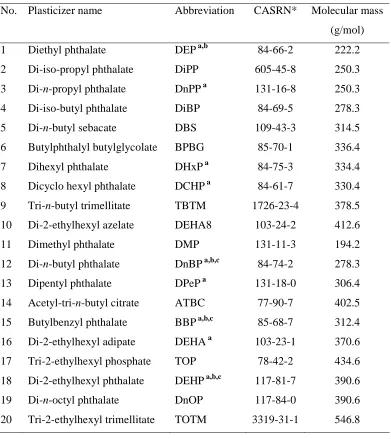
The twenty types of synthetic plasticizers as listed in Table 1.1 were studied. The table also presents their corresponding abbreviations, general name, Chemical Abstract Service Registration Number (CASRN) and molecular mass. The established method was validated to ensure that it fits the purpose before being used in routine laboratory works.
1.6 Outline of the Thesis
4
Table 1.1. List of 20 plasticizers studied
No. Plasticizer name Abbreviation CASRN* Molecular mass (g/mol)
1 Diethyl phthalate DEP a,b 84-66-2 222.2
2 Di-iso-propyl phthalate DiPP 605-45-8 250.3
3 Di-n-propyl phthalate DnPP a 131-16-8 250.3
4 Di-iso-butyl phthalate DiBP 84-69-5 278.3
5 Di-n-butyl sebacate DBS 109-43-3 314.5
6 Butylphthalyl butylglycolate BPBG 85-70-1 336.4
7 Dihexyl phthalate DHxP a 84-75-3 334.4
8 Dicyclo hexyl phthalate DCHP a 84-61-7 330.4
9 Tri-n-butyl trimellitate TBTM 1726-23-4 378.5 10 Di-2-ethylhexyl azelate DEHA8 103-24-2 412.6
11 Dimethyl phthalate DMP 131-11-3 194.2
12 Di-n-butyl phthalate DnBP a,b,c 84-74-2 278.3
13 Dipentyl phthalate DPeP a 131-18-0 306.4
14 Acetyl-tri-n-butyl citrate ATBC 77-90-7 402.5 15 Butylbenzyl phthalate BBP a,b,c 85-68-7 312.4 16 Di-2-ethylhexyl adipate DEHA a 103-23-1 370.6 17 Tri-2-ethylhexyl phosphate TOP 78-42-2 434.6 18 Di-2-ethylhexyl phthalate DEHP a,b,c 117-81-7 390.6
19 Di-n-octyl phthalate DnOP 117-84-0 390.6
20 Tri-2-ethylhexyl trimellitate TOTM 3319-31-1 546.8 Note:
a
Suspected endocrine disruptor chemicals by Japan Environmental Agency (1998) b
Priority toxic pollutants by United States EPA (1999)
c
Suspected endocrine disruptor chemicals by European Parliment (2001)
REFERENCES
American Chemical Society (ACS) (2007). Online service of CAS databases. http://www.cas.org/expertise/cascontent/index.html
American Plastic Council (APC) (2003). APC Plastic Industry Producers’ Statistics Group; October 20, 2003, VERIS Consulting LLC. http://www.americanplasticscouncil.com/ benefits/ economic/ economic. html Analytical Methods Committee Royal Society of Chemistry (RSC) (1987). Recommendations for the definition, estimation and use of the detection limit, Analyst, 112: 199-204
Asaoka, K., Hagihara, K., Kabaya, H., Sakamoto, Y., Katayama, H., and Yano, K. (2000). Uptake of phthalate esters, di(n-butyl) phthalate and di(2-ethyl hexyl) phthalate, as environmental chemicals in monkeys in Japan. Bull. Environ. Contam. Toxicol., 64: 679-685
Association Official of Analytical Chemist (AOAC) (1998). Peer-Verified Methods Program Manual on Policies and Procedure, Arlington: AOAC International
Aurela, B., Kulmala, H., and Soderhjelm, L. (1999). Phthalates in paper and board packaging and their migration into Tenax and sugar, Food Addit. Contam., 16: 571-577
Balafas, D., Shaw, K.J., and Whitfield, F.B. (1999). Phthalate and adipate esters in Australian packaging materials. Food Chem., 65: 279-287
90
in wastewater samples, J. Chromatogr. A , 1121: 154-162
Barwick, V. J., and Ellison, S. L. R. (2000). The evaluation of measurement uncertainty from method validation studies Part 1: Description of a laboratory protocol, Accred.. Qual. Assur., 5:47–53
Blount, B.C, Milgram, K.E., Silva, M.J., Malek, N.A., and Reidy, J.A. (2000). Quantitative detection of eight phthalate metabolites in human urine using HPLC-APCI-MS/MS, Anal. Chem., 72: 4127-4134
Bouma, K., and Schakel, D.J. (2002). Migration of phthalates from PVC toys into saliva simulant by dynamic extraction, Food Addit. Contam., 19(6): 602-610 Bradbury, J. (1996). UK panics over phthalates in babymilk formulae. Lancet, 347:
1541
Cai, Y., Jiang, G., and Liu, J. (2003a). Solid-phase microextraction coupled with High Performance Liquid Chromatography-UV detection for the determination of n-propyl phthalate, iso-butyl phthalate, and Di-cyclohexyl phthalate in environmental sample, Anal. Lett., 36(2): 389-404 Cai, Y., Jiang, G., Liu, J., and Zhou, Q. (2003b). Multi-walled carbon nanotubes
packed cartdrige for the solid-phase extraction of several phthalate esters from water samples and their determination by high performance liquid chromatography, Anal. Chim. Acta , 494: 149-156
Cano, J.M, Marin, M.L, Sanchez, A., and Hernandis, V. (2002). Determination of adipate plasticizers in polyvinyl chloride by microwave-assisted extraction, J. Chromatogr. A, 962: 401-409
Casajuana, N., and Lacorte, S. (2004). New methodology for the determination of phthalate esters, Bisphenol A diglicidyl ether, and nonylphenol in commercial whole milk samples, J. Agric. Food Chem., 52: 3702-3707
91
Castillo, M., Barcelo, D., Pereira, A.S., and Aquino Neto, F.R. (1999). Characterization of organic pollutants in industrial effluents by high-temperature gas-chromatography mass spectrometry, Trends Anal. Chem., 18: 26-36
Castle, I., Mercer, A. J., Startin, J. R., and Gilbert, J.(1988). Migration from plasticized films into foods 3. Migration of phthalate, sebacate, and citrate and phosphate esters from film used for retail food packaging. Food Addit. Contam., 5: 9-20
Castle, L., Jickells, S.M, Nichol, J., Johns, S.M, and Gramshaw, J.W. (1994). Determination of high and low molecular mass plasticizers in strecth-type packaging films, J. Chromatogr. A, 675: 261-266
Chaler, R., Canton, L., Vaquero, M, and Grimalt, J.O. (2004). Identification and quantification of n-octyl esters of alkanoic and hexanedoic acids and phthalates as urban wastewater markers in biota and sediments from estuarine areas, J. Chromatogr. A, 1046: 203-210
Code of Federal Regulations (CFR) (1998). Title 21-Food and Drugs, Part 178, §178.3740 Plasticizers in Polymeric Substances, Washington, DC: US Government Printing Office
Codex Alimentarius Commission (CODEX) (1997). Procedural Manual of the Codex Alimentarius Commision, 10th Ed., Rome: FAO
Codex Alimentarius Commission (CODEX) (2005). CODEX STAN 1: General standard for the labelling of prepackaged foods, Rev. 4: 1-7, Rome: Codex Alimentarius Commission
Cortazar, E., Zuloaga, O., Sanz, J., Raposo, J.C., Etxebarria, N., and Fernandez, L.A. (2002). Multisimplex optimisation of the solid-phase microextraction-gas-chromatographic-mass sppectrometric determination of polycyclic aromatic hydrocarbons, polychlorinated biphenyls and phthalates from water smples, J. Chromatogr. A, 978: 166-175
92
detection and quantification capabilities (IUPAC Recommendations 1995), Anal. Chim. Acta, 391: 105-126
Davis, B.J., Maronpot, R.R., and Heindel, J.J. (1999). Di-(2-ethyl hexyl phthalate suppresses estradiol and ovulation in cycling rats. Toxicol. Appl. Pharm., 128: 216-223
de Souza, S. V. C., and Junqueira, R. G. (2005). A procedure to assess linearity by ordinary least squares method, Anal. Chim. Acta, 552: 25-35
Draper, N. R., and Smith, H. (1998). Applied Regression Analysis, New York: Wiley, p.706.
Ema, M., Miyawake, E., and Kawashima, K. (2000). Effects of dibutyl phthalate on reproductive function in pregnant and pseudopregnant rat. Reprod. Toxicol., 14: 13-19
EURACHEM (1995) Quantifying uncertainty in analytical measurement. Laboratory of the Government Chemist (LGC), London
EURACHEM (1998). The Fitness for Purpose of Analytical Methods : A Laboratory Guide to Method Validation and Related Topics. United Kingdom: LGC (Teddington) Ltd.
European Parliament (2001). Communication from the commission to the Council and the on the implementation of the community strategy for endocrine disrupters – a range of substances suspected of interfering with the hormone systems of humans and wildlife, COM (1999) 706; COM (2001) 262 final, Brussels, 2001
Fatoki, O.S, and Noma, A. (2001). Determination of phthalic esters in the aquatic environment, S. Afr. J. Chem., 54: 4-19
Feinberg, M., and Raguenes, N. (1999). Development and application of a standardized validation procedure for Food Chem. laboratories, Anal. Chim. Acta, 391: 239-252
93
some platicizers compounds in landfill leachate, Chemosphere, 50: 657-663 Food Act 1983 (Act 281) and Regulations. (2006). Petaling Jaya: International Law
Book Services
Frados, J. (1996). Plastic Engineering Handbook, 4th ed., NewYork: Van Nostrand Reinhold
Garcia, I., Ortiz, M.C., Sarabia, L., Vilches, C., and Gredilla, E. (2003). Advances in methodology for the validation of methods according to the International Organization for Standardization Application to the determination of benzoic and sorbic acids in soft drinks by high-performance liquid chromatography, J. Chromatogr. A, 992: 11-27
Hao, Y.S. (2005). Simultaneous screening and determination eight phthalates in plastic products for food use by sonication-assisted extraction/GC-MS methods, Talanta, 66: 734-739
Herring, R., and Bering, C.L. (1988). Effects of phthalate esters on plant seedlings and reversal by a soil microorganism. Bull. Environ. Contam. Toxicol., 40: 626-632
Hirayama, K., Tanaka, H., Kawana, K., Tani, T., and Nakazawa, H. (2001). Analysis of plasticizers in cap-selaing resins for bottled foods, Food Addit. Contam., 17(2): 133-141
Hoppin, J.A., Brock, J.W., Davies, B.J., and Bard, D.D. (2002). Reproducibility of urinary phthalate metabolites in first morning urine samples. Environ. Health Perspect., 110: 515-518
Horn, O. Nalli, S., Cooper, D., and Nicell, J. (2004). Plasticizer metabolites in the environment, Water Res., 38: 3693-3698
Horwitz, W. (1995). Protocol for the design, conduct and interpretation of method performance studies. Pure Appl. Chem., 67: 331-343
94
International Conference of Harmonisation of Technical Requirements for Registration of Pharmaceutical for Human Use (ICH) (1995). Text on Validation of Analytical Procedures, Q2A: Recommended for adoption at Step 4 of the ICH Process, UK
International Conference of Harmonisation of Technical Requirements for Registration of Pharmaceutical for Human Use (ICH) (1996). Validation of analytical procedures: Methodology Q2B, Recommended for adoption at Step 4 of the ICH Process, UK
International Conference of Harmonisation of Technical Requirements for Registration of Pharmaceutical for Human Use (ICH) (2005). Validation of analytical procedures: Text and methodology Q2(R1) Recommended for adoption at Step 4 of the ICH Process, UK
Japan Environmental Agency. (1998). Strategic Program for Environmental Endocrine Disruptors Report (SPEED). Tokyo: Japan Environmental Agency
Jara, S., Lysebo, C., Greibrokk, T., and Lundanes, E. (2001). Determination of phthalates in water samples using polystyrene solid-phase extraction and liquid chromatography quantification, Anal. Chim. Acta , 407: 165-171 Jenke, D. R. (1996). Chromatographic method validation: a review of current
practices and procedures. II. Guidelines for primary validation parameters, J. Liq. Chromatogr. Rel. Technol., 19(5): 737-757
Jonsson, S., and Born, H. (2002). Analysis of mono- and diester of o.phthalic acid by solid-phase extraction with polystyrene divinylbenzene based polymers, J. Chromatogr. A , 963: 393-400
Kelly, M. T., and Larroque, M. (1999). Trace determination of diethyl phthalate in aqueous media by solid-phase microextraction liquid chromatography. J. Chromatogr. A , 841: 177-185
95
Krauskopf, L.G. (1993). Monomeric plasticizers, In: Wickson E. J., editor. Handbook of PVC Formulating, New York: John Wiley, p. 86.
Li, X., Zeng, Z., Chen, Y., and Xu, Y. (2004). Determination of phthalate acid esters plasticizers in plastic by ultrasonic solvent extraction combined with solid-phase microextraction using calix[4] arene fiber, Talanta, 63: 1013-1019 Lin, Z.P., Ikonomou, M.G., Jing, H. Mackintosh, C., and Gobas, F.A.P.C. (2003).
Determination of phthalate ester congeners and mixtures by LC/ESI-MS in sediments and biota of an urbanizeed marine inlet, Environ. Sci. Technol., 37: 2100-2108
Ma, L.L, Chu, S.G., and Xu, X.B. (2003). Phthalate residues in greenhouse soil from Beijing suburbs, People’s Republic of China, Bull. Environ. Contam. Toxicol., 71: 394-399
Mackintosh, C.E., Maldonado, J., Hongwu, J., Hoover, N., Chong, A., Ikonomou, M.G., and Gobas, F.A.P.C. (2004). Distribution of phthalate esters in a marine aquatic food web: comparison to polychlorinated biphenyls, Environ. Sci. Technol., 38: 2011-2020
Marin, M. L., Jimenez, A., Lopez, J., and Vilaplana, J. (1996). Analysis of poly(vinyl chloride) additives by super critical fluid extraction and gas-chromatography, J. Chromatogr. A, 750:183-190
Marin, M. L., Lopez, J., Sanchez, A., Vilaplana, J., and Jimenez, A. (1998). Analysis of potentially toxic phthalate plasticizers used in toy manufacturing, Bull. Environ. Contam. Toxicol., 60: 68-73
Mark, H. (2003). Application of an improved procedure for testing the linearity of analytical methods to pharmaceutical analysis, J. Pharm. Biomed. Anal., 33: 7-20
Mathews, G. (1996). PVC: Production, Properties and Uses, London, England: Institue of Metals, p. 141.
96
N.Y., John Wiley & Sons, 1993, p. 81.
Miller, J.N and Miller, J.N (2000). Statistics and Chemometrics for Anal. Chem.. Fourth Edition. England: Prentice Hall.
Ministry of Agriculture, Fisheries and Food (MAFF) (1995). Phthalates in paper and board packaging. Food Surveillance Paper No.60. London:HMSO
Ministry of Agriculture, Fisheries and Food (MAFF) (1996). Phthalates in infant formulae. Food Surveillance Paper No.83. London:HMSO
Ministry of Health, Labour and Welfare (MHLW) (2003). Japan Food Sanitation Law, Tokyo: Ministry of Health, Labour and Welfare
Montgomery, D.C., and Runger, G. C. (2003). Applied Statistics and Probability for Engineers, New York: John Wiley and Sons Inc., p. 293.
Morita, M., Nakamura, H., and Mimura, S. (1973). Phthalic acid esters in foods. Annual Report of Tokyo Metropolitan Research Laboratory of Public Health, 24: 357-362
Mulholland, M. (1988). Ruggedness testing in Anal. Chem., Trends in Anal. Chem., 7 :383-389
Murphy, J. (2001). Additives for Plastics Handbook, 2nd ed., New York: Elsevier, p. 25
Mylechreest, E., Cattley, R. C., and Foster, P. M. D. (1998). Male reproductive tracts malfunctions in rats following gestational and lactational exposure to di(n-butyl) phthalate: An anti androgenic mechanism? Toxicol. Sci., 43: 47-60 Nerin, C. Gancedo, P., and Cacho, J. (1992). Determination of Bis(2-ethylhexyl)
adipate in food products, J. Agric. Food Chem., 40: 1833-1835
Nerin, C., Cacho, J., and Gancedo, P. (1993). Plasticizers from printing ink in a selection of food packaging and their migration to food. Food Addit. Contam., 10: 453-460
97
potential migrants in polycarbonate containers used for microwave ovens by High-Performance Liquid Chromatography with ultraviolet and fluorescence detection, J. Agric. Food Chem., 51: 5647-5653
Niino, T., Ishibashi, T., Itho, T., Sakai, S., Ishiwata, H., Yamada, T., and Onodera, S. (2002). Simultaneous determination of phthalate di- and monoesters in polyvinyl chloride products and human saliva by gas chromatography-mas chromatography, J. Chromatogr. B, 780: 35-44
Oi, W.L. and Siu, K.W. (2000). Contamination in food from packaging material, J. Chromatogr. A , 882: 225-270.
Penalver, A., Pocurull, E., Borrul, F., and Marce, R. M (2000). Determination of phthalate esters in water samples by solid-phase microextraction and gas-chromatography mass spectrometry, J. Chromatogr. A, 872: 191-201
Penalver, A., Pocurull, E., Borrul, F., and Marce, R. M. (2001). Comparison of different fibers for the solid-phase microextraction of phthalate esters from water, J. Chromatogr. A, 922: 377-384
Petersen, J.H., Naamansen, E. T., and Nielsen, P.A. (1995). PVC cling film in contact with cheese: health related to global migration and specific migration of DEHA Food Addit. Contam., 12: 245-253
Petersen, J.H, and Breindahl, T. (2000). Plasticizers in total diet samples, baby food and infant formula. Food Addit. Contam., 17(2): 133-141
Polo, M., Llompart, M., Jare, C.G., and Cela, R. (2005). Multivariate optimization of a solid-phase microextraction method for the analysis of phthalate esters in environmental waters, J. Chromatogr. A, 1072: 63-72
Prokupkova, G., Holadova, K., Poutska, J., and Hajslova, J. (2002). Development of a solid-phase microextraction method for the determination of phthalate acid esters in water, Anal. Chim. Acta , 457: 211-223
98
Rahman, M., and Brazel, C.S. (2004). The plasticizer market: an assessment of traditional plasticizers and research trends to meet new challenges. Prog. Polym. Sci., 29: 1223-1248
Rastogi, S.C. (1998) Gas chromatographic analysis of phthalate esters in plastic toys. Chromatographia, 47: 724-726
Robertson, G.L. (1993). Food Packaging: Principle and Practice, New York: Marcell Dekker, p. 65
Rosen, S. L. (1993). Fundamental principals of polymeric materials, 2nd ed. New York: Wiley, p. 97
Sablayroller, C., Vignoles, M. M., Benanou, D., Patria, L., and Treihou, M. (2005), Development and validation of methods for the trace determination of phthalates in sludges and vegetables, J. Chromatogr. A, 1072: 233-242 Sanz, M. B., Sarabia, L. A., Herrero, A., and Ortiz, M. C. (2002). A study of
robustness with multivariate calibration. Application to the polarographic determination of benzaldehyde, Talanta, 56: 1039-1048
Sendra, J. M. B., Nechar, M., and Rodríguez, L. C. (1999). Decision protocol for checking robustness with previous outlier detection in the validation of analytical methods, Fresenius J. Anal. Chem., 365: 480–488
Silva, M. J., Reidy, J. A., Herbert, A. R., Preau Jr, J. L., Needham, L., and Calafat, A. M. (2004). Detection of phthalate metabolites in human amniotic fluid. Bull. Environ. Contam. Toxicol., 72: 1226-1231
Song, Y.S., Park, H.J., and Komolprasert, V. (2000). Analytical procedure for quantifying five compounds suspected possible contaminants in recycled paper/paperboard for food packaging, J. Agric. Food Chem. , 48: 5856-5859 Staples, C.A, Peterson, D.R., Paterton, T.F., and Adam, W.J. (1997). The
99
Stevens, M. P. (1999). Polymer Chemistry: An Introduction, 3rd Ed., New York: Oxford University Press, p. 157
Summerfield, W., and Cooper, I. (2001). Investigation of migration from paper and board into food-development of food for rapid testing, Food Addit. Contam., 18: 77-88
The International Organization for Standardization (ISO) (1993) Guide to the expression of uncertainty in measurement, International Organization for Standardization, Geneva
The International Organization for Standardization (ISO) (1994a). ISO 5725 Accuracy (trueness and precision) of measurement methods and results, International Organization for Standardization, Geneva
The International Organization for Standardization (ISO) (1994b). ISO 5725-1 Accuracy (trueness and precision) of measurement methods and results— General Principles and definitions, International Organization for Standardization, Geneva
The International Organization for Standardization (ISO) (1994c). ISO 5725-2 Accuracy (trueness and precision) of measurement methods and results- Basic methods for the determination of the repeatability and reproducibility of a standard measurement method, International Organization for Standardization, Geneva
The International Organization for Standardization (ISO) (1994d). ISO 5725-3 Accuracy (trueness and precision) of measurement methods and results- Intermediate measures of the precision of a standard measurement method, International Organization for Standardization, Geneva
The International Organization for Standardization (ISO) (1996). ISO 11095 Linear calibration using reference materials, International Organization for Standardization, Geneva
100
General Requirements for the Competence of Testing and Calibration Laboratories, International Organization for Standardization, Geneva
The International Organization for Standardization (ISO) (2003). ISO 11843 Capability of detection - Part 4: Methodology for comparing the minimum detectable value with a given value, International Organization for Standardization, Geneva
Thompson, M., Ellison, S. L. R., and Wood, R. (2002). Harmonized Guidelines for Single-Laboratory Validations of Methods of Analysis (IUPAC Technical Report), Pure Appl. Chem., 74(5): 835-855
Thomsen, V., Schatzlein, D., and Mercuro, D. (2003). Limits of Detection in Spectroscopy, Spectroscopy, 18(12): 112-114
Tickener, J.A., Schettler, T., Gudotti, T., McCally, M., and Rossi, M. (2001). Health risks posed by use of DEHP in PVC medical devices: a critical review. Am. J. Ind. Med., 39: 100-111
Tsumura, Y., Ishimitsu, S., Saito, I., Kobayashi, Y., and Tonogai, Y. (2001a). Eleven phthalate esters and di(2-ethylhexyl) adipate in one-week duplicate diet samples obtained from hospitals and their estimated daily intake. Food Addit. Contam., 18: 449-460
Tsumura, Y., Ishimitsu, S., Kaihara, A., Yoshii, A., and Tonogai, Y. (2001b). Di(2-ethylhexyl) phthalate contamination in retail packed lunches after prohibition of DEHP-containing PVC gloves for cooking purposes. Food Addit. Contam., 18: 569-579
Tsumura, Y., Ishimitsu, S., Saito, I., Sakai, H., Kobayashi, Y., and Tonogai, Y. (2003). Eleven phthalate esters and di(2-ethylhexyl) adipate in one week duplicate diet samples obtained from hospitals and their estimated daily intake. Food Addit. Contam., 18(5): 449-460
101
United States Food and Drug Administration (USFDA). (1993). Technical Review Guide: Validation of Chromatographic Methods, Center for Drug Evaluation and Research (CDER), Rockville, MD
Vessman, J. (1996). Selectivity or specificity ? Validation of analytical methods from the perspective of an analytical chemist in the pharmaceutical industry, J. Pharm. Biomed. Anal., 14: 867-869
Vial, J., and Jardy, A. (1999). Experimental Comparison of the Different Approaches To Estimate LOD and LOQ of an HPLC Method, Anal. Chem., 71(14): 2672-2677
Virgin, H.I, Holst, A.M., and Morner, J. (1981). Effects of di-n-butyl phthalate on the carotenoid synthesis in green plants. Physiol. Plant, 53: 58-163
Wahl, H.G., Hoffman, A., Haring, H.U., and Liebich, H.M. (1999). Identification of plasticizers in medical products by a combined direct thermodesorption-cooled injection system and gas chromatography-mass spectrometry, J. Chromatogr. A, 847: 1-7
Wang, Q., and Storm, B.K. (2005). Separation and analysis of low molecular weight plasticizers in polyvinyl chloride tubes, Polym. Test., 24: 290-300
Weisberg, S. (2005). Applied Linear Regression, 3rd ed., Hoboken NJ: John Wiley,
p. 269
Yano, K., Hirosawa, N., Sakamoto, Y., Katayama, H., Moriguchi, T., Joung, K.E., Sheen, Y.Y., and Asaoka, K. (2002). Phthalate levels in beverages in Japan and Korea. Bull. Environ. Contam. Toxicol., 68: 463-469
102