Resources Management. (Under the direction of Gary E. Moore, Ph.D.).
This study examined factors that influence the interagency collaborative behavior of North
Carolina non-regulatory public sector field employees in natural resources management. It
included the impact of supervisory techniques, regional cultural differences, individual
agency policy, procedures, and practices, agency interaction with partners and stakeholders,
and the provision of interagency training programs. Additionally, in preparation for
assessing the specific factors that impact collaborative behavior, the status of interagency
collaboration among all agencies in the partnership was examined. The agencies that
participated in the study included the North Carolina Cooperative Extension Service
(NCCES), the North Carolina Department of Agriculture and Consumer Services
(NCDA&CS) Agronomic Division and Division of Soil and Water Conservation, the North
Carolina Forest Service (NCFS), the North Carolina Wildlife Resources Commission
(NCWRC), local Soil and Water Conservation Districts (SWCDs), and the United States
Department of Agriculture Natural Resources Conservation Service (USDA-NRCS). The
perceptions of both field employees and their direct supervisors were gathered by conducting
a census survey of both groups in order to understand the elements’ impact on field employee
collaborative behavior. Differences among geographic region, among employing agency,
and between attendance or non-attendance of interagency training were examined for
self-reported field employee collaborative behavior and perception of the opportunity to
collaborate. In terms of quantifying the level of collaboration among North Carolina public
is ample room for expanded collaboration. Substantiating this idea, both field employees and
supervisors perceived the opportunity to collaborate as higher than what had been perceived.
It appears that cultural differences, in terms of both geographic region, and within individual
agencies, have an impact on field employee collaborative behavior in North Carolina
non-regulatory public sector natural resources management, while employee training and
supervisory support appeared to have only a limited, or perhaps no effect. In order to
increase collaborative outcomes in other regions or public sector fields of practice, it is
recommended that agency leadership work toward providing consistent policy, procedure,
and practices to support collaboration, toward creating an organization culture embracing
interagency collaboration, toward encouraging supervisors to become active in collaboration,
and toward development of intelligent interactions with partners and stakeholders. For the
partnership in question, the North Carolina non-regulatory public sector natural resources
management agencies, it is important to further analyze the cultures that are present in each
geographic region and within each agency to possibly identify some sociological features that
could be acting as drivers or barriers to collaborative activities, since cultural factors have
been confirmed to be associated with collaborative outcomes. Additionally, further
examination is warranted on the influence of supervisors on field employees in the
collaborative context, especially why supervisory techniques might not be resulting in
desired outcomes among field employees. Also, more instances of formal training programs,
as well as more informal instruction, such as on-the-job training, should be examined for
© Copyright 2017 by Amanda Mary Schaller
by
Amanda Mary Schaller
A dissertation submitted to the Graduate Faculty of North Carolina State University
in partial fulfillment of the requirements for the degree of
Doctor of Education
Agricultural and Extension Education
Raleigh, North Carolina
2017
APPROVED BY:
_______________________________ _______________________________
Gary E. Moore, Ph.D. James E. Bartlett, II, Ph.D.
Committee Chair
_______________________________ _______________________________
BIOGRAPHY
Amanda Schaller is employed by the United States Department of Agriculture
Natural Resources Conservation Service (USDA NRCS), and works on developing national
policy for the agency at their national headquarters in Washington, DC. She previously held
positions with NRCS as the North Carolina state grazing lands specialist, an area resource
conservationist in North Carolina’s Coastal Plain region, and as a district conservationist in a
Duplin County, North Carolina field office. Prior to working with NRCS, she held positions
at Montgomery County Soil and Water Conservation District in Fultonville, New York, at
The Nature Conservancy in Albany, New York, and on two commercial vegetable operations
in central New York. Amanda earned a Bachelor of Technology in Plant Science –
Agronomy from the State University of New York College of Agriculture and Technology at
Cobleskill (2004), a Bachelor of Technology in Wildlife Management from the State
University of New York College of Agriculture and Technology at Cobleskill (2007), and a
Master of Environmental Assessment from North Carolina State University (2013). Together
with her cousin, John Cassidy, and her husband, Richard Filiberto, in 2015 Amanda began
development of a commercial vineyard and winery venture in Caroline County, Maryland.
Through this venture, Amanda hopes to preserve the tradition of agricultural
entrepreneurship and land conservation that have been part of her family’s heritage for over
ACKNOWLEDGMENTS
Support, assistance, and mentorship from others are the universal accompaniment to every
accomplishment and milestone in my career and personal life. I am eternally grateful to all
of those who have supported me in this exhilarating episode of life. Without the generous
resources of my wonderful parents, Mary and Bruce Schaller, and my loving husband,
Richard Filiberto, I would not have had the stamina to persevere through this endeavor. The
emotional support and understanding provided by my exceptional friends, Barbara and
Stephen Brabetz, Jim Green, Celeste Roeller Harp, Suzie Adamsky, and Josh Spencer
bolstered my confidence and kept my spirits up. I am especially thankful for my incredibly
kind and reassuring academic advisor, Dr. Gary Moore, and for the attentiveness and
dedication of my committee members, Dr. James Bartlett, Dr. Jim Flowers, and Dr. K.S.U.
Jayaratne. Additionally, the impacts of the ideas and encouragement I received from Dr.
Matt Poore, David Williams, Jerry Raynor, and Matt Flint in the pursuit of higher
understanding of interagency collaboration cannot go understated. Lastly, I cannot express
my gratitude enough for the comfort and solidarity I have found in my “immediate family,”
TABLE OF CONTENTS
List of Tables………...vi
CHAPTER 1: Introduction……….1
Introductory Statement………...1
Conceptual Framework………..4
Research Questions………....6
Definition of Terms………....7
Assumptions………...7
Limitations……….8
Summary………8
CHAPTER 2: Theoretical Framework and Review of Related Research………10
Introduction………..10
Theoretical Framework………10
Review of Related Research………11
Summary………..35
CHAPTER 3: Methodology………..37
Overview………...37
Research Design………...38
Populations………...40
Field employees………...……41
Instrumentation………42
Supervisor instrument………..43
Field Employee instrument………..44
Data Collection………....47
Response rate and nonresponse error………...47
Analysis of Data………...50
Summary………..50
CHAPTER 4: Results………....52
Introduction………..52
Findings...53
Status of interagency collaboration………..53
Differences in Field Employee interagency collaborative behavior…………58
Differences in supervisory support for interagency collaboration…………...66
Differences in perceptions of opportunity for collaboration………69
Summary...72
CHAPTER 5: Summary, Conclusions, Implications, and Recommendations………….78
Introduction………..78
Summary of Study Background and Premise………..79
Summary of Supporting Literature………..80
Summary of Procedures………...81
Conclusions………..88
Implications and Discussion……….…………...91
Recommendations………96
Recommendations for practice………96
Recommendations for future research……….97
REFERENCES………...99
APPENDICES………..110
Appendix A: Supervisor Instrument………..111
Appendix B: Field Employee Instrument………..115
LIST OF TABLES
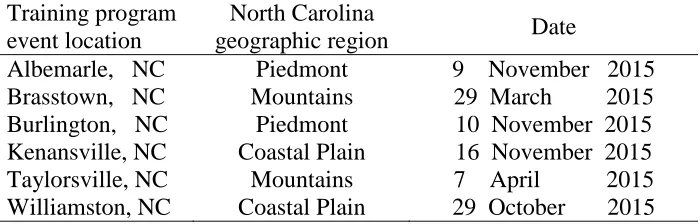
Table 1. “Building Cooperative Interagency Teams” Training Program Locations and
Dates………..40
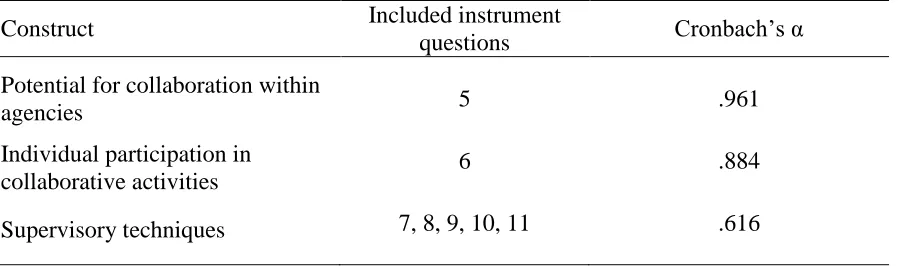
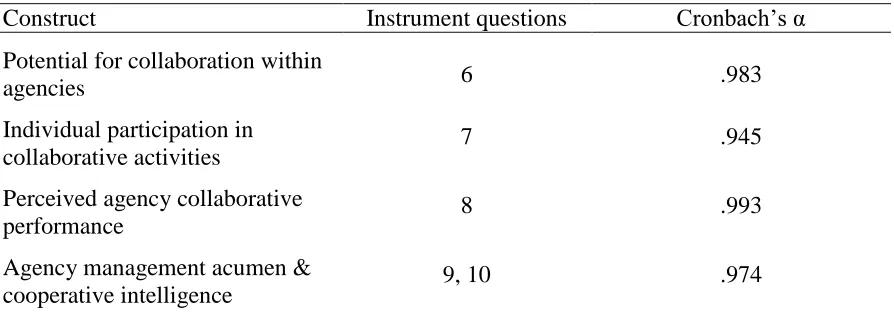
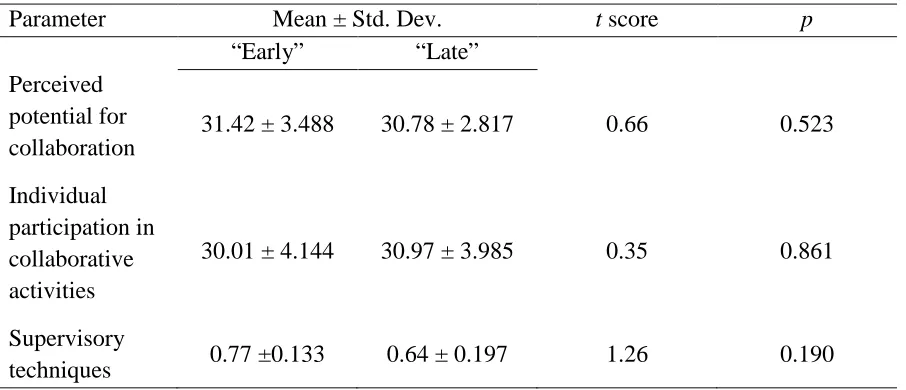
Table 2. Supervisor Instrument Reliability Coefficients from Pilot Study………...44 Table 3. Field Employee Instrument Reliability Coefficients from Pilot Study………...46 Table 4. Comparison of “Early” to “Late” Responders for Supervisor Survey Replies…...48
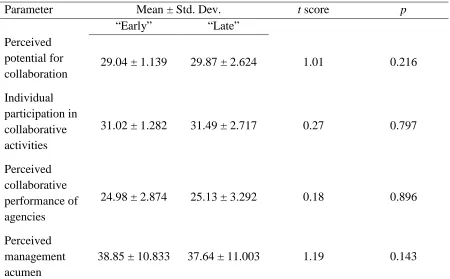
Table 5. Comparison of “Early” to “Late” Responders for Field Employee Survey
Replies………..49
Table 6. Perceived Agency Collaborative Performance…...…...……..………..54 Table 7. Cooperative Intelligence, as Perceived by Field Employees……...…….………….56 Table 8. Collaborative Management Acumen, as Perceived by Field Employees………..….59
Table 9. Individual Field Employee Collaborative Behavior………..62 Table 10. Differences among North Carolina Geographic Regions in Individual Field
Employee Collaborative Behavior………...64 Table 11. Differences in Individual Field Employee Collaborative Behavior between Those
Who Attended Interagency Training and Those Who Did Not Attend……….65 Table 12. Utilization of Select Supervisory Techniques to Support Employee Collaborative
Behavior………...…67
Table 13. Individual Supervisor Collaborative Behavior………....………68 Table 14. Perceptions of the Opportunity to Collaborate……….………...…70
Table 15. Differences among North Carolina Geographic Regions in Field Employee
Perception of the Opportunity to Collaborate……….73 Table 16. Differences in Perceptions of the Opportunity to Collaborate between Field
CHAPTER 1 Introduction Introductory Statement
Interagency collaboration within the public sector is far from a new phenomenon.
Brecher, Stewart, Holden, Harnly, and Wolf (2009) traced collaboration between the United
States Department of Agriculture (USDA) and other agencies to the 1860s to address such
issues as links between nutrition and chronic diseases. Pinter, Ritchie, Hatfield, and Hart
(2001) point to the collaborative efforts between USDA and the National Aeronautics and
Space Administration (NASA) on remote sensing applications that began in the 1960s.
Political administrations in recent decades have continued this trend through increased
emphasis on collaboration within the public sector (Mergel, 2013), endeavoring to tackle
tasks of amplified complexity and scope with limited resources available to the individual
agencies involved (Polivka, 1995).
As a general premise, collaboration enhances the capacity of people and organizations
to achieve their goals (Lasker, Weiss, & Miller, 2001) and increases the welfare of individual
organizations involved by building social capital (Lubell, Henry, & McCoy, 2010). In many
instances, such as the attempts to solve barriers to education for migrant farmworker families
documented by Rivera-Singletary (2010), the addressed issues are far too complicated and
multi-faceted to be handled by a single agency; public sector collaboration is simply a
requirement for success, or what Page, Stone, Bryson, and Crosby (2015) term “substantive
confront a particular challenge, the advantages of collaboration are many-fold. In financial
terms, Mendis and Green (2010) contended that the efficiencies generated through
government-wide collaboration led to boosts in national trade. Less specific to purely
economic outcomes, Bryson, Crosby, and Stone (2006) described what they have labeled as
“third order effects” to be present as eventual results of all collaborative endeavors, including
the development of new behavior norms, the resolution of existing and potential conflicts,
and the improved implementation of “on-the-ground” results. Furthermore, Cronin and
Ostergren (2007) attested to the collaborative process as the most effective way to find
solutions to discords not possible through traditional means, such as via the court systems.
Additionally, collaboration can increase the efficiency of resource management and remove
redundancies or duplicative services in existing systems (Lemieux, Thompson, Slocombe, &
Schuster, 2015; Tseng, Liu, & Wang, 2011).
Despite the many aforementioned benefits of interagency collaboration and political
encouragement, there is evidence of a need for improved collaboration across public sector
organizations (U.S. Government Accountability Office, 2012), and the specific features of
institutional arrangements have been found to be of particular importance in either aiding or
hindering collaborations (Crosby & Bryson, 2010; Peled, 2011). Identifying the
environmental or organizational elements that affect collaborative actions is among the first
steps in understanding the status of collaborative frameworks, even in unique situations
(Emerson, Nabatchi, & Balogh, 2011). Because commonalities exist across collaborative
2012), recognized common factors that influence collaboration can be useful tools to assist
organizational leaders in eliminating barriers in a variety of circumstances (Foster-Fishman,
Berkowitz, Lounsbury, Jacobson, & Allen, 2001).
Though indicators and influencers of collaborative actions are often identified at the
organizational level (Dedrick & Greenbaum, 2011), it is essential to understand the dynamics
that may be affecting collaborative behavior at an employee level. As demonstrated by
Smith and Mogro-Wilson (2007), individual behavior of agency staff may differ substantially
from official organizational policy, profoundly affecting “on-the-ground” results. According
to Tyree (2014), non-regulatory public sector natural resources management provides
specific circumstances where individual employee actions are particularly impactful in the
success of overall collaborative activities. Furthermore, recognizing the unique perceptions
of field employees presumes “that the activities and practices related to interagency
collaboration are diverse and are manifested in multiple forms within an agency” (Dedrick &
Greenbaum, 2011, p. 28), as opposed to the presumption “that interagency collaboration is a
construct that is a relatively objective, descriptive, easily observable characteristic of a unit
that originates at an organizational level” (Dedrick & Greenbaum, 2011, p. 28). As such, a
major premise of this study is built on capturing the attributes shaping interagency
collaboration that are of distinct significance to employees working in the decentralized field
office structure common to non-regulatory public sector natural resource management
Conceptual Framework
The purpose of this study was to examine factors that influence the interagency
collaborative behavior of North Carolina non-regulatory public sector field employees in
natural resources management, including the impact of supervisory techniques, regional
cultural differences, individual agency policy, procedures, and practices, agency interaction
with partners and stakeholders, and the provision of interagency training programs. The
agencies involved in the study included the North Carolina Cooperative Extension Service
(NCCES), the North Carolina Department of Agriculture and Consumer Services
(NCDA&CS) Agronomic Division and Division of Soil and Water Conservation, the North
Carolina Forest Service (NCFS), the North Carolina Wildlife Resources Commission
(NCWRC), local Soil and Water Conservation Districts (SWCDs), and the United States
Department of Agriculture Natural Resources Conservation Service (USDA-NRCS). The
perceptions of both field employees and their direct supervisors were gathered by conducting
a census survey of both groups in order to understand the elements’ impacts on field
employee collaborative behavior.
In preparation for assessing the specific factors that impact collaborative behavior, the
status of interagency collaboration among all agencies in the partnership was examined.
Employee self-reported collaborative behavior as well as field employee perceptions of
agency collaborative performance were explored. Field employees indicated their perception
of the policy, procedures, and practices in place within each agency to support collaboration,
measures were used to quantify the standing of collaboration among public sector
non-regulatory natural resource management agencies in North Carolina.
As supervisory support has been documented as a driver of employee behavior
(Bryson et al. 2006; Crosby & Bryson 2010; Dedrick & Greenbaum, 2011; Emerson et al.
2012; Johnson, Wistow, Schulz, & Hardy, 2003; Mendis & Green, 2010; Mullin & Daley,
2010; Stolovich, Clark, & Condly, 2002; U.S. Government Accountability Office, 2012; Van
den Bossche, Segers, & Jansen, 2010), this study examined differences in supervisory
support among agencies. Supervisory support was defined in terms of specific actions taken
by supervisors, such as providing incentives for employees, as well as the example of their
own behavior.
Because agency-oriented, environmental, and geographically-centered cultural
features have been recorded as both aids and deterrents to collaborative behavior (Johnson et
al., 2003; Lee & Rao 2007; Mattessich & Monsey, 1992; Mattessich, Murray-Close, &
Monsey, 2001; Smith & Mogro-Wilson, 2007; U.S. Government Accountability Office,
2012; Williams & Federowicz, 2012), differences in both field employee self-reported
behavior and field employee perceptions of the opportunity to collaborate were examined by
agency and by geographic region of North Carolina (Mountain, Piedmont, and Coastal
Plain).
Finally, the impact of a 2015 training program, “Building Cooperative Interagency
Teams,” was evaluated for differences between field employees who attended the program
an influential element in efforts to build agency collaborative capacity and increase
collaborative behavior among employees (Chen & Perchonok, 2008; Dedrick & Greenbaum,
2011; Emerson et al., 2011; Foster-Fishman et al., 2001; Smith & Mogro-Wilson, 2007; U.S.
Government Accountability Office, 2012). This facet of the study endeavored to gauge if
attendance of the specified training program resulted in differences in self-reported
involvement in collaborative actions as well as perceptions of the opportunity to collaborate.
Research Questions
In order to measure results for the aforementioned study components, four research
questions were developed. They follow below:
1. What is the current status of interagency collaboration among North Carolina public
sector natural resources management agencies and their field employees?
2. Are there differences in interagency collaboration behavior in field employees
a. among geographic regions?
b. among agencies?
c. between those who attended a Building Cooperative Interagency Teams
training event in 2015 and those who did not?
3. Are there differences in supervisory support for interagency collaboration among
agencies?
4. Is there a difference in perceptions of opportunity for collaboration
a. between supervisors and field employees?
c. among geographic regions?
d. between those who attended a Building Cooperative Interagency Teams
training event in the last 12 months and those who did not?
Definition of Terms
Field employee: In this study, field employees are those who directly serve public customers
and whose services may be accessed through local means, such as county-level field
offices. They do not supervise or manage other employees.
Supervisor: In this study, supervisors are those who are considered public sector employees
and directly oversee the day-to-day operations of field employees, but not higher
level managers who provide State-level agency leadership or officials who have been
elected or appointed to their posts.
Assumptions
In this study, the researcher presumed that the individuals who were asked to respond
to questions on a survey instrument were knowledgeable in the given subject areas, able to
answer the questions with relative ease, and could provide useful information. Additionally,
it was presumed that the publicly available information about individuals working for each
agency, including name, job title, and official email address, is both current and accurate.
Lastly, it was presumed that all survey recipients were able to equally access survey
Limitations
There was one major limitations to this study: individuals employed by some
agencies receiving study invitations and reminders from differing email addresses. During
the first phase of instrument deployment in April 2016, it was discovered that employees
whose emails were supported by USDA network infrastructure, which included
USDA-NRCS and some SWCD employees, could not receive emails sent via Qualtrics (2016). In
order for these employees to be invited to participate in the study and gain access to the
survey instrument, the researcher sent emails from her North Carolina State University
(NCSU) email address, which consequentially removed the functionality of Qualtrics (2016)
to track individual responses. Receiving an email invitation from a personal email account as
opposed to a Qualtrics (2016)-generated email invitation may have unintended consequences
on individual responses rate.
Summary
The purpose of this study was to examine factors that influence the interagency
collaborative behavior of North Carolina non-regulatory public sector field employees in
natural resources management, including the impact of supervisory techniques, regional
cultural differences, individual agency policy, procedures, and practices, agency interaction
with partners and stakeholders, and the provision of interagency training programs.
Additionally, in preparation for assessing the specific factors that impact collaborative
behavior, the status of interagency collaboration among all agencies in the partnership was
NCWRC, local SWCDs, and USDA-NRCS. The perceptions of both field employees and
their direct supervisors were gathered by conducting a census survey of both groups in order
to understand the elements’ impact on field employee collaborative behavior. Differences
among geographic region, employing agency, and attendance of interagency training were
examined for self-reported field employee collaborative behavior and perception of the
opportunity to collaborate.
This study is valuable because though there are many documented benefits of
interagency collaboration, there is evidence of a need for improved collaboration across
public sector organizations (U.S. Government Accountability Office 2012), with institutional
arrangements of particular importance in either aiding or hindering collaborations (Crosby &
Bryson, 2010). Identifying the environmental or organizational elements that affect
collaborative actions is among the first steps in understanding the status of collaborative
frameworks, as recognized common factors that influence collaboration can be useful tools to
assist organizational leaders in eliminating barriers in a variety of circumstances
CHAPTER 2
Theoretical Framework and Review of Related Research Introduction
To form the basis for this study’s research questions and development of the survey
instruments utilized, a review of relevant theories and previous research was conducted.
Peer-reviewed journal articles, doctoral dissertations, government reports, and books were
included, and an extensive review was compiled to structure and reference this study’s major
constructs. After framing the theoretical basis for the study’s research questions, reviews
focused on defining interagency collaboration, cultural influences on collaborative behavior,
organizational influences on collaborative behavior, and the influence of education and
workforce training on collaborative behavior. This chapter presents the major findings of the
aforementioned areas in terms of factors influencing collaborative behavior that are germane
to this study’s premise.
Theoretical Framework
This study is based on Ajzen’s (1991) Theory of Planned Behavior, which has three postulates. The first postulate concerns a person’s attitude toward the behavior. This
includes a person’s willingness and intention to perform the behavior, whether or not a
person finds the behavior to fit his or her moral code, and the personal outlook of the
individual toward the behavior. The second postulate is focused on the subjective norm, or
cultural views and expectations toward the behavior. It reflects whether or not the behavior
postulate addresses a person’s perceived behavioral control. It examines a person’s
knowledge of the behavior and perceived opportunity and ability to perform said behavior.
According to Ajzen (1991), all three components – attitude, subjective norm, and perceived
behavioral control – interact and play a role in a person’s likelihood of performing a
particular behavior. As factors for each postulate increase, the person is more likely to
implement the behavior, and postulates working simultaneously multiply the effect.
In this study, two of Azjen’s (1991) postulates are examined as the basis for the
proposed research questions: subjective norm and perceived behavioral control. Subjective
norm in terms of regional culture as well as institutional or organizational culture were
examined for their influence on field employee interagency collaborative behavior. This
includes the example of supervisors, the supervisory support of collaborative behavior,
agency “collaborative intelligence,” and agency collaborative “management acumen.”
Perceived behavioral control was examined in terms of perceptions of the opportunity to
collaborate and field employee preparation for collaborative activities through participation
in an interagency training program.
Review of Related Research
Defining interagency collaboration. When assessing the status of interagency collaboration for single agencies or for group of organizations, it is essential to understand
the defining characteristics and features of collaborative activities. Many of the frameworks
that have been developed to describe the inter-workings of interagency collaborative
Gash, 2007; Bryson et al., 2006), interagency structure and governance (Bryson et al., 2006),
collaborative actions (Emerson, Nabatchi, & Balogh, 2011), and collaborative outcomes
(Polivka, 1995). Using somewhat similar language, Lubell et al. (2010) provided a
relational concept of interagency collaboration in terms of collaborative institution
participation and informal cooperative behaviors. Yet, the frameworks developed by Ansell
& Gash (2007), Bryson et al. (2006), Emerson et al. (2011), Lubell et al. (2010), and Polivka
(1995) are all based on meta-analysis or reviews of case studies as opposed to direct
examination of the behavior of individual employees, managers, or agency leaders involved
in collaborative action, which is a goal of this study. Although cases studies in
non-regulatory natural resource management fields dominate the landscape of collaborative
literature in the United States (U.S.) (Ansell & Gash, 2007), most of the case studies
document particular collaborative projects or initiatives, and do not explore interagency
collaborative behavior as a phenomenon pervasive in the routine function and fulfillment of
an agency mission (Ansell & Gash, 2007; Bryson et al., 2006; Emerson et al., 2011; Lubell et
al., 2010; Polivka, 1995).
A few studies describe with granularity the specific activities of the individuals or
entities involved that become collaborative behavior. Mattessich et al. (2001) are perhaps
most well-known for their work developing and testing 20 distinct factors that comprise
collaboration efforts, including the development of survey instruments that can be used to
gather information from persons at all organizational levels involved in collaboration.
initiative-focused instances of collaboration, and they stop short of identifying specific actions of
which collaborative behavior would consist. It was Esteve, Boyne, Sierra, and Ysa (2013)
that were able to specify and test 11 main activities that constitute public sector
inter-organizational collaborative behavior, including informal collaboration, mutual aid
agreements, providing training, receiving training, joint planning, providing equipment,
receiving equipment, providing technical assistance, receiving technical assistance, providing
grant management, and receiving grant management. By utilizing Likert-type scales to
measure these behaviors in a web-based survey of all of the agencies involved in Catalonia,
Spain’s provincial and municipal governments, they demonstrated that these actions are
applicable across many public sector fields (Esteve et al., 2013).
In addition to recognizing the isolated components of collaborative behavior, when
assessing the status of collaboration, it is equally important to understand the level at or
degree to which collaboration is taking place among organizations. Though there are many
ways of determining this (Dedrick & Greenbaum, 2011; Hardy & Koontz 2008; Margerum,
2008; Mattessich & Monsey, 1992; Mattessich et al. 2001; O’Donnell, 2012; U.S.
Government Accountability Office, 2012; Woodland & Hutton, 2012), little agreement on a
particular method is found in the literature. For example, the U.S. Government
Accountability Office (2012) promotes the use of a checklist-like scorecard that is interpreted
similarly to academic grades, while Hardy & Koontz (2008) cite the percentage of agency
funds directed to collaborative work, and Margerum (2008) proposed three functional levels;
However, a consensus method has been determined in the field of public sector children’s
services using a five-level scale of communication, cooperation, coordination, coalition, and
integration (Horwath & Morrison, 2007; Miller & McNicholl, 2003; Roaf, 2002). This scale
has been applied in the field of non-regulatory public sector natural resource management by
Tyree (2014), and there appeared to be no barriers to using this continuum for collaboration
to characterize any particular partnership, with agencies attaining higher levels of
collaboration as they move toward integration.
Cultural influencers. Unique cultural characteristics associated with places, peoples, and organizations have been repetitively identified as important factors affecting
collaborative activities. As Cronin and Ostergren (2007) pointed out through their work in
intergovernmental tribal collaborations, the effects of national or ethnic culture can have
direct impacts on the people involved in collaborative activities. The three tribal case
studies they detailed were characterized by cultural attachment to only specific natural
resources, particular cultural values coloring the decisions of individuals involved in
collaborative activities, and varying degrees of trust and respect with outside communities
affecting communication and the establishment of understanding (Cronin & Ostegren, 2007).
These case studies were examples of culture existing as a dynamic that governs the entire
“system context” in which collaboration takes place (Emerson et al., 2011), a concept that is
also readily agreed upon from the perspective of geographic regions’ cultures exerting
influence on interagency collaborative behavior (Johnson et al., 2003; Margerum, 2007; U.S.
regional perspectives on collaborative natural resource management work in the relatively
large countries of Australia and the United States, though it is not a phenomenon restricted to
only large-scale partnerships. Johnson et al. 2003 cited regional differences in the ability of
government agencies to work collaboratively while providing community care services for
physical or mental health in the relatively small area of the United Kingdom. However, while
not discounting the impacts of ancestral or regional culture, there is general accord among
researchers that in the context of public sector interagency collaboration, organizational
culture, environment, and climate may be more prominent barriers or promoters of
collaborative behavior among employees (Johnson et al. 2003; Lee & Rao 2007; Mattessich
& Monsey, 1992; Mattessich et al., 2001; Smith & Mogro-Wilson, 2007; U.S. Government
Accountability Office, 2012; Williams & Federowicz, 2012).
Organizational influencers. Within the framework of organizational culture, environment, or climate that affect collaborative behavior of employees, influence can be
divided into three major categories, including supervisory support, an agency’s “cooperative
intelligence,” or the extent of intelligent interaction with partners and stakeholders, and an
agency’s collaborative “management acumen,” or the policies, procedures, and practices it
has in place to support collaborative actions.
Supervisory support. The actions of supervisors have repeatedly been shown to
influence the interagency collaborative behavior of employees (Bryson et al. 2006; Crosby &
Bryson 2010; Dedrick & Greenbaum, 2011; Emerson et al. 2012; Johnson et al., 2003;
Accountability Office, 2012; Van den Bossche, Segers, & Jansen, 2010). While there has
been some evidence that merely leading by example and creating expectations for a behavior
are effective supervisory supports (Smith & Mogro-Wilson 2007), the U.S. Government
Accountability Office (2012) specified five areas of greatest importance in the setting of
supervisory support. These include encourage employees verbally or in writing to participate
in interagency collaborative activities; providing incentives to employees for their
participation in interagency collaborative activities; recognizing or rewarding employees’
accomplishments related to interagency collaboration; using a mechanism to monitor or track
employee progress toward desired collaborative outcomes; and including
collaboration-related measures, standards, or competencies in employee performance plans. Van den
Bossche et al.’s (2010) findings supported the verbal or written encouragement of employees
specifically in the form of feedback. Stolovitch et al. (2002) pointed to significant
performance improvements that can be gained from providing employee incentives, Mullin
& Daley (2010) posited that professional incentives create conditions that promote
collaboration, and Emerson et al. (2011) suggested that consequential incentives were among
the major drivers for interagency collaborative dynamics. Monitoring and tracking employee
progress was also supported by Bryson et al. (2006), Crosby and Bryson (2010), Dedrick and
Greenbaum (2011), and Mendis and Green (2010). Mendis and Green (2010) and Mullin and
Daley (2010) each provided findings that aligned with using employee performance plans to
“Cooperative intelligence”. The measure of how intelligently an agency interacts
with partners and stakeholders can be a major determinant of its organizational climate for
collaboration (Foster-Fishman et al., 2001). During the review of relevant literature, 16
factors within the “cooperative intelligence” category were identified as important elements
for interagency collaboration: building relationships with partners at all organizational levels
(Margenum 2007; Margenum 2008; O’Donnell 2012); facilitating the collaborative process
as a leader or team member to accomplish tasks (Foster-Fishman et al. 2001; Ansell & Gash
2007; Marek, Brock, & Savia 2014; O’Donnell 2012; Thompson, Socoloa, Brown, &
Haggerty 2002); cultivating support for desired collaborative outcomes (Lasker, Weiss, &
Miller 2001; Margerum 2007; Margerum 2008; O’Donnell 2012); valuing diverse
perspectives (Ansell & Gash 2007; Getha-Taylor 2012; Lasker et al. 2001; Marek et al.
2014); communicating effectively with partners (Foster-Fishman et al. 2001; Chen &
Perchonok 2008; Lemieux, Thompson, Slocombe, & Schuster 2015; Schuett, Selin, & Carr
2001); effectively organizing or managing collaborative activities (Foster-Fishman et al.
2001; Thompson et al. 2002; Thomson, Perry, & Miller 2007); mediating conflict through
accountability (Bryson et al. 2006; Getha-Taylor 2012); performing needs assessment
analysis (Woodland & Hutton 2012); collecting relevant data (Koontz & Bodine 2008);
conducting key stakeholder analysis (Koontz & Bodine 2008; Margerum 2008); developing
collaborative program evaluation processes (Dedrick & Greenbaum 2011; Marek et al. 2014;
Schuett et al. 2001; Woodland & Hutton 2012); identifying political, social, or economic
cross-agency action plans (Foster-Fishman et al. 2001; Chen & Perchonok 2008); soliciting
partner feedback on cross-agency activities (Foster-Fishman et al. 2001; Van den Bossche et
al. 2010); communicating with external stakeholders about interagency collaborative efforts
(Foster-Fishman et al. 2001; Lemieux et al. 2015; Marek et al. 2014; Mattessich & Monsey
1992; Mattessich et al. 2001; Schuett et al. 2001); and aligning expectations and priorities for
collaboration (Smith & Mogro-Wilson 2007). Foster-Fishman et al. (2001) emerged as the
predominant champion of the importance of agencies’ capacity for intelligent interaction
with partners and stakeholders, and developed an integrative framework for collaboration
that outlined core competencies and processes required for collaborative success. Through
an analysis and review of the relevant literature, they identified many of the aforementioned
elements of the “cooperative intelligence” construct as critical aspects of a schema applicable
to all forms of public sector collaborative venues, from task forces to interagency
coordinating councils (Foster-Fishman et al., 2001).
Collaborative “management acumen”. Similarly to “cooperative
intelligence” an agency’s policies, procedures, and practices that are in place to support
interagency collaborative activities are essential determinants of the status of interagency
collaboration (U.S. Government Accountability Office, 2012). During the review of relevant
literature, 13 elements were recognized as significant factors contributing to interagency
collaboration: clearly defining desired short-term collaborative outcomes (Mattessich et al.
2001; Schuett et al. 2001, U.S. Government Accountability Office 2012); clearly defining
Government Accountability Office 2012); monitoring progress toward collaborative
outcomes (Bryson et al. 2006; Crosby & Bryson 2010; Dedrick & Greenbaum 2011;
Getha-Taylor 2012; Mendis & Green 2010; U.S. Government Accountability Office 2012;
Woodland & Hutton 2012); full employee knowledge of partner agency resources (Dedrick
& Greenbaum 2011; Emerson et al. 2011; Pitz & Intindola 2015; Smith & Mogro-Wilson
2007; U.S. Government Accountability Office 2012); full employee knowledge of partner
agency missions (Dedrick & Greenbaum 2011; Emerson et al. 2011; Pitz & Intindola 2015;
Smith & Mogro-Wilson 2007; U.S. Government Accountability Office 2012); clearly
defining the roles and responsibilities for collaborative activities (Ansell & Gash 2007;
Foster-Fishman et al. 2001; Lemieux et al. 2015; Schuett et al. 2001; U.S. Government
Accountability Office 2012); developing a process for interagency collaboration (Ansell &
Gash 2007; Foster-Fishman et al. 2001; Getha-Taylor 2012; U.S. Government Accountability
Office 2012); defining a common language or terminology for collaborative activities (Ansell
& Gash 2007; Foster-Fishman et al. 2001; Getha-Taylor 2012; U.S. Government
Accountability Office 2012); encouraging employees to participate in collaborative activities
through incentives ( Mullin & Daley 2010; Stolovich et al. 2002; U.S. Government
Accountability Office 2012); compatible technologies or technological systems (U.S.
Government Accountability Office 2012); defining leaders for collaborative projects or
initiatives (Foster- Fishman et al. 2001; U.S. Government Accountability Office); employees
possessing the appropriate skills for interagency collaboration (Dedrick & Greenbaum 2011;
Government Accountability Office 2012); and formalizing collaborative activities through
written documents or agreements (Dedrick & Greenbaum 2011; Foster-Fishman et al. 2001;
U.S. Government Accountability Office, 2012). The U.S. Government Accountability Office
(2012) surfaced as the primary proponent of the collaborative “management acumen”
construct, and advocated for the inclusion of every element of this construct to be a
component of the interagency collaboration implementation plan used by any U.S. agency.
Acting on the directive of the U.S. Congress and the executive branch, the U.S. Government
Accountability Office (2012) conducted an extensive review of the relevant literature, as well
as carried out interviews with expert academics and practitioners in the field of interagency
collaboration, prior to developing formal guidance and recommendations for future
interagency collaborative endeavors involving the U.S. Government or other public sector
actors.
Education and workforce training. Training of employees has been suggested by several researchers as an influential element in efforts to build agency collaborative capacity
and increase collaborative behavior among employees (Chen & Perchonok 2008; Dedrick &
Greenbaum 2011; Emerson et al. 2011; Foster-Fishman et al. 2001; Smith & Mogro-Wilson
2007; U.S. Government Accountability Office 2012). However, the effectiveness of training
is deeply intertwined with supervisory support, and there is evidence that effects from
training may be only temporary (Tseng, Liu, & Wang 2011), or not realized at all if
supervisors fail to reinforce it (Kaufman, 2002; Kirwan & Birchall, 2006; Silberman, Beich,
(2015) likened “training sessions followed up with on-the-job support,” to a “300 percent
return on every dollar invested,” while “little retention of skills” will occur without support
from supervisors (Silberman et al., 2015, p. 329). Stolovich et al. (2002), Kaufman (2002),
Kirwan & Birchall (2006), and Van den Bossche et al. (2010) contended that mostly as a
result of inadequate supportive workplace and supervisory environment, application of
trained concepts on the job, or training transfer, is commonly as low as 10 percent.
Scope of Related Research
The literature reviewed to identify the relevant factors associated with interagency
collaboration varied substantially in terms of method, scale, and focus. A substantial portion
of the references relied on meta-analyses and literature reviews to make inferences from
perceived patterns. Alternatively, many studies collected data in the form of surveys or
interviews with managers, employees, or key informants, using purposive or random
sampling. Some analyses were national in scale, while others concentrated on specific
regions or sectors of government, and a few explored particular case studies.
Ansell and Gash (2007), Dedrick and Greenbaum (2011), Stolovich et al. (2002), and
Woodland and Hutton (2012) all provided meta-analyses, though with varying foci. Ansell
and Gash (2007) and Woodland and Hutton (2012) included studies on public sector
collaboration in all fields and levels of government, while Stolovich et al. (2002) specifically
examined studies concentrated on the use of employee incentive programs. Dedrick and
analysis from the perspective of its results on the Interagency Collaborative Activities Scale
(ICAS).
Reviews of literature formed the basis for quite a number of conclusions drawn on
factors affecting interagency collaboration, including those offered by Bryson et al. (2006),
Chen and Perchonok (2008), Emerson et al. (2011), Foster-Fishman et al. (2001), Margerum
(2007), Margerum (2008), Mattesich and Monsey (1992), Mendis and Green (2010), Pitz and
Intindola (2015), and Thomson et al. (2007). While most reviews were broadly-based in
public sector collaboration, there were a few with special emphasis, including Margerum
(2007, 2008) who targeted Australian and U.S. organizations in his review, and Bryson et al.
(2006) who emphasized public-private partnerships. Additionally, while Foster-Fishman et
al. (2001) aimed their review and analysis on community-level public sector collaborations,
Chen and Perchonok (2008) looked mainly at collaboration taking place in the U.S. at a
federal level.
Case studies were presented by Cronin and Ostegren (2007), Crosby and Bryson
(2010), Lemieux et al. (2015), O’Donnell (2012), and Thompson et al. (2002), each with a
different emphasis. Crosby and Bryson (2010) examined Minneapolis – St. Paul’s work on
the development of the Metro GIS project, while O’Donnell considered the actions of Irish
townships, Lemieux et al. (2015) investigated climate change initiatives in two mid-western
U.S. cities, Cronin and Ostegren (2007) focused on three western Tribes’ efforts to protect
and restore aquatic resources, and Thompson et al. (2002) reviewed a home visitation
informants, or purposive sampling, Lemieux et al. (2015) used a questionnaire to gather
information, while the others all utilized unstructured or semi-structured interviews and
observation.
Purposive sampling was also utilized by several researchers examining collaboration
at larger scales beyond the case study level. Schuett et al. (2001) employed the purposive
sampling technique with U.S. Forest Service employees, Hardy and Koontz (2008) used it
with key informants in watershed partnerships, Koontz and Bodine (2008) with U.S. Forest
Service and U.S. Bureau of Land Management employees, and the U.S. Government
Accountability Office (2012) with expert academics and collaborative practitioners. In most
cases purposive sampling was applied with interviews to collect data, however Koontz &
Bodine (2008) used a questionnaire in conjunction with semi-structured interviews, while
Hardy & Koontz (2008) used only a questionnaire. Conversely, random sampling was
employed by the other reviewed researchers who collected data as part of their exploration of
interagency collaboration, including Esteve et al. (2013), Getha-Taylor (2012), Lee & Rao
(2007), Lemieux et al. (2015), Lubell et al. (2010), Marek et al. (2014), Mattesich et al.
(2001), Mullin & Daly (2010), Smith & Mogro-Wilson (2007), Tyree (2014), Van den
Bossche et al. (2010), and Williams & Fedorowicz (2012). With the exception of
Getha-Taylor (2012) who conducted interviews and Lubell et al. (2010) who completed telephone
surveys in addition to using a questionnaire, all those researchers who utilized random
Many of the authors who collected data as part of their examination of interagency
collaboration focused on specific levels of government, geographic regions, fields of public
sector activity, or roles within an organization. Hardy & Koontz (2008), Koontz & Bodine
(2008), Lemieux et al. (2015), Schuett et al. (2001), and Tyree (2014) were specifically
focused on actors or agencies within public sector natural resource management, while
Johnson et al. (2003), Lasker et al. (2001), Mullin & Daly (2010), Smith & Mogro-Wilson
(2007), and Thompson et al. (2012) centered on aspects of public health, and Lee & Rao
(2007) looked into public safety. Frontline or field-level employees were the population of
interest for Koontz & Bodine (2008), Lee & Rao (2007), Lubell et al. (2010), Marek et al.
(2014), Mullin & Daly (2010), Schuett et al. (2001), and Tyree (2014); while managers and
executives formed the relevant populations in the work of Esteve et al. (2013), Getha-Taylor
(2012), and Williams & Fedorowicz (2012). Marek et al. (2014), Johnson et al. (2003) and
the U.S. Government Accountability Office (2012) had national-level perspectives as they
carried out their studies, while others were more narrow in focus, such as Esteve et al. (2013)
who looked at Catalonia, Spain, Lubell et al. (2010) who focused on parts of California,
Mullin & Daly (2010) who were interested in Wisconsin, and Tyree (2014) who examined
agencies in Virginia.
Lastly, there were also differences among the studies related to how they analyzed the
collected data. The majority of the authors who collected data used their results to describe
or characterize the status of or certain aspects of interagency collaboration. Some looked for
Lemieux et al. (2015), Tyree (2014), Smith & Mogro-Wilson (2007), Mullin & Daly (2010),
and Williams & Fedorowicz (2012). Smith & Mogro-Wilson (2007) and Williams &
Fedorowicz (2012) additionally used correlations to characterize relationships and predict
future trends.
Examples in Natural Resources Management
Among the aforementioned related research there are a few that specifically
contribute to the body of knowledge surrounding interagency collaboration in the natural
resources management discipline, including the works of Cronin and Ostegren (2007), Hardy
and Koontz (2008), Koontz and Bodine (2008), Lemieux et al. (2015), Margerum (2007,
2008), Schuett et al. (2001), and Tyree (2014).
Cronin and Ostegren (2007) focused on collaborative watershed management,
examining factors that influenced tribal participation. Concentrating on three case study
watersheds with the common features of established watershed groups, tribal land ownership
in the watershed, water quality and quantity issues in the watershed, and involved
stakeholders who had not previously been studied; a combination of direct perceptions of
group meetings, document review, and structured, open-ended interviews were employed to
gather data. Interviews were conducted with thirty-one individuals from the three watershed
cases, including Native and non-Native American stakeholders, elected leaders, tribal
scientists and managers, counties, cities, government agencies, and farmers. The three
watersheds were the Dungess River Management Team on the Olympic Peninsula in the state
Council in southeastern Washington and northeastern Oregon involving the Confederated
Tribes of the Umatilla Indian Reservation; and the Yavapai County Water Advisory
Committee in central Arizona’s Rio Verde Valley including the Yavapai – Apache Nation.
Though the influence of tribes and other entities throughout the three watershed cases was
quite variable, Cronin and Ostegren (2007) identified six factors that influences tribal
participation in watershed collaborations, involving cultural connection to aquatic resources,
political clout and legal standing of tribes, relationships between nontribal and tribal
communities and relevant agencies, recognition of the benefits of collaboration, consistency
and vision of tribal leadership, and the availability of resources. There is increased tribal
participation when the aquatic resources are the center of tribal culture, economy and
spirituality, and the non-tribal entities maintain respect for this cultural perspective. Legal
and court success bolstered the participation of tribes in the northwestern watersheds, while
the lack of legal standing for the Yavapai-Apache tribe weakened tribal participation. In the
northwestern case watersheds, the positive relationships between nontribal and tribal
communities contributed to tribal participation, whereas negative interactions including
racism and misunderstandings clouded participation in Arizona. Likewise, tribes in the
northwest and their non-tribal counterparts recognized collaborative success when both
parties were satisfied; whereas the Yavapai-Apache tribe in Arizona didn’t perceive benefits
from collaborative activities. In each of the case watersheds there were strong tribal leaders
present, though in Arizona the Yavapai-Apache leaders were focused on priorities that
Additionally, in each case watershed, financial resources, technical expertise, staff, and time
influenced tribal participation; whereas the northwestern tribes had built resources within the
tribe and promoted watershed participation while the Yavapai-Apache tribe outsourced or
contracted its resources, limiting tribal watershed participation.
Hardy and Koontz (2008) examined collaborative watershed efforts to tackle
nonpoint-source pollution implemented through the U.S. Environmental Protection Agency’s
(USEPA) Section 319 program and state-level nonpoint-source pollution programs. They
conducted two rounds of email surveys and follow-up interviews with 104 key informants
across all fifty states. The key informants consisted of USEPA nonpoint-source program
personnel, state nonpoint-source program coordinators, other government employees,
watershed coordinators, university extension specialists, and stakeholders involved in
collaborative watershed efforts. One round of interviews was with state-appointed
source program coordinators from each state. The four USEPA regional office
nonpoint-source program coordinators corroborated data collected through surveys and interviews, and
the USEPA nonpoint-source program Branch Chief verified the data. Hardy and Koontz
(2008) found that states allocated between zero and ninety percent of available section 319
and state-level funds to collaborative watershed groups, with thirty-five percent as the mean
value and twelve states allocating between fifty and fifty-nine percent of available funds to
collaborative watershed groups. The collaborative watershed groups provided technical
assistance, financial assistance, education, training, technology transfer, demonstration
watershed groups are found in all fifty states, and the state governments commonly provide
matching technical, financial, and/or training resources to watershed groups. Over time,
states have begun collaborating more with local conservation districts than they had early in
the history of the USEPA Section 319 program, and the emphasis of watershed groups has
shifted from planning activities to implementation of best management practices in the
watersheds. Recommendations from the study’s participants in improvements for
collaborative activities were grouped into four categories, including more consistent funding,
more funding for stormwater-focused projects, more structure and rigidity in the time frame
for allocation, and more flexibility in the use of funds for local priorities.
Koontz and Bodine (2008) examined collaborations using ecosystem-based
management (EBM) strategies in the U.S. Forest Service (USFS) and the Bureau of Land
Management (BLM), focusing on the extent of implementation key EBM characteristics,
including collaborative stewardship; interagency cooperation; integration of scientific
information into management decisions; integration of social and economic information into
management decisions; preservation of ecological processes; and adaptive management.
BLM employee perceptions of EBM were measured in 2004 through a mail survey of the
principal line officials at each BLM state, district, and field or resource office; the principal
managers of field stations; and a stratified random sample of field specialists. USFS
perceptions were gathered via a 2002 survey of line managers using a questionnaire with
many identical questions to the 2004 BLM questionnaire. Additionally, Koontz and Bodine
western state where both the BLM and USFS operated, asking questions identical to those
that appeared on the 2002 USFS and 2004 BLM survey instruments. Between the line
managers in BLM and USFS, there were little differences found between the agencies in
either the interagency cooperation or collaborative stewardship elements, where both
agencies were perceived to be performing near the top of the four-point scale used to assess
implementation in each area. However, among the stakeholder leaders who were
interviewed, both BLM and USFS were perceived to be operating at mid-range on the
four-point scale assessing of collaborative stewardship, and BLM was perceived to be performing
below mid-range in the interagency cooperation element at a statistically different level than
the USFS, which was perceived to be performing at a level slightly above mid-range. The
most prominent barriers to the implementation of EBM-focused collaborations were
identified by stakeholder leaders in the categories of politics and culture. Political barriers
included pressure from entities such as the U.S. Congress, the White House, the public and
interest groups, as well as a lack of resources such as staff time to build relationships.
Cultural barriers included fear of and/or resistance to change, turf battles, personnel conflicts,
and parochialism.
Lemieux et al. (2015) focused on climate change collaboration among resource
management agencies in two U.S. regions, an area where the issues are complex enough that
collaborative work is required among agencies with shared authority or jurisdiction over
various aspects of the resource problem. Case studies in the Rocky Mountains of northern
to develop findings, including an online survey using a questionnaire with qualitative and
quantitative elements deployed to northern Colorado and South Dakota regional personnel of
the USFS, BLM, the U.S. National Park Service, the U.S. Fish and Wildlife Service, the U.S.
Geological Survey, The Nature Conservancy, and state-level wildlife and parks departments;
as well as data collected from 2011 workshops in each region for regional land and resource
managers. Factors that were identified by the online survey to enable collaboration in the
northern Colorado and South Dakota regions were adequate time, adequate financial
resources, adequate communications channels among agencies, focus on issues of high
political urgency, clear roles and responsibilities among agencies, and equitable sharing of
the burden of responsibility among collaborating entities. Factors that were found to be
barriers to effective collaboration were lack of time, lack of financial resources, lack of
human resources, lack of information on which to base decisions, unclear roles and
responsibilities or participating entities, conflict among the entities involved, and focus on
issues of low political urgency. From the workshop for regional and land resource managers,
it was found that in the Great Plains and Forests region of South Dakota, ninety-four percent
of participants were unsure of or did not perceive there to be a presence of common goals or
vision among natural resources management agencies with respect to climate change, while
100 percent of the participants in the northern Colorado region were unsure of or did not
perceive the same common goals or vision. In both the Great Plains and Forest region of
South Dakota and the northern Colorado region, roughly one third of participants perceived
on climate change issues while two thirds were unsure or did not perceive that their agency
was collaborating on the same. Over eighty percent of the northern Colorado region
participants perceived the impact of agency-specific priorities on collaborative climate
change adaption planning to be positive or strongly positive, while approximately sixty-five
percent of the Great Plains and Forests South Dakota region participants perceived the same
positive or strongly positive influence. Challenges and drawbacks to collaboration on
climate change issues were identified in both regions in the categories of agency-specific
management goals and priorities; lack of time, funding, and resources for collaborative
planning; lack of support from agency leadership, the public, and politicians; and the lack of
coordination among agencies. The benefits of collaboration perceived by participants at both
regional workshops were categorized as the pooling of resources, management efficiencies,
removing redundancy, and landscape scale approaches.
Margerum’s 2007 study focused on overcoming locally based collaboration
constraints in natural resource management, relying on a synthesis of previously documented
case studies, a mail survey of watershed stakeholders, and three detailed case studies where
data was collected through direct observation, interviews, and document review. The
previously documented case studies consisted of thirty-six watershed projects dating from
1993 to 2006, where sixteen cases were based in the U.S. and twenty cases were based in
Australia. The mail survey incorporated a questionnaire sent to 550 stakeholders of
collaborative catchment (watershed) groups in eastern Australia. The three detailed case
Basin, Oregon. Interviews were conducted in each case study with fifteen participants
ranging from watershed council members, local government representatives, interest group
members, and federal agency representatives. The constraints to collaboration that were
identified in common among the case studies and survey results were in the categories of
transaction costs such as personnel time, resources, and travel expenses during the initiation
phase of the watershed projects; limited perspectives and parochial views on natural
resources management; sustainability of the watershed groups themselves that were
dependent on volunteers, grant funding, or a few key participants; policy issues; and the
adequacy of representation. Margerum (2007) suggested that solutions to these
aforementioned constraints were found in the “nested” approach of the Rogue River Basin
Coordinating Council, where the hierarchical formation reduces the costs of interaction,
allows for increased awareness of natural resources issues of regional or national
significance, allows pooling of resources to improve sustainability, easy access to
decision-makers on policy issues, and increases the ease of obtaining adequate representation from all
affected parties.
Margerum’s 2008 work utilized the same previously-documented thirty-six watershed
case studies from the U.S. and Australia, as well as the same survey of 550 stakeholders in
southeastern Australia catchment committees that were employed in his 2007 (Margerum)
study. However, Margerum’s 2008 study focused on using factors to categorize
collaborative efforts in environmental management into types, and additionally made use of a
in-depth interviews with twelve of the local government elected officials from the same
survey, and examination of six Southeast Queensland local government land use plans before
and after the collaborative growth management process; as well as a survey of 207 elected
officials involved in Denver, Colorado watershed projects and in-depth interviews with
twenty-five elected officials from the same survey. Margerum (2008) found that
collaborative efforts in environmental management could be categorized into three types –
Action, Organizational, or Policy – based on the scale of the effort, the population affected
by resulting change, the significance of the problem, the institutional setting, and the focus of
the problem. Action collaboratives include local stakeholders, community leaders, and
agency field staff; arrangements for implementation of plans is similar to consensus building;
and change is achieved through direct action. Organizational collaboratives include local and
regional stakeholders, interest group representatives, and government entities; and change is
implemented through organization programs and budgets. Policy collaboratives involve
regional, state, and federal stakeholders, government entities, and policy makers; plans are
implemented through new management arrangements; and change occurs through policy
actions such as new legislation or development of new agency policy.
Schuett et al. (2001) examined USFS collaborative initiatives using a mail survey of
647 purposively sampled active participants in thirty collaborative initiatives with foci
ranging from ecosystem-based management, to watershed restoration, forest management,
urban green space, and wildlife habitat. Study participants were asked to answer open-ended
categories of factors. These categories consisted of development, such as the identification
of clear roles and responsibilities and adequate representation; information exchange in terms
of facilitation, regularity and consistency; organization support such as time, staff, and
resources; personal communications, including the valuation of diverse perspectives;
relationship and team building, including trust and transparency; and accomplishments,
involving outcome-orientation of evaluation-based approaches.
Tyree (2014) conducted a census study of all forty-seven Virginia SWCDs, including
district directors, associate directors, and staff. She used a mixed-methods survey instrument
to assess current perceptions of collaboration based on environment, membership, process
and structure, communication, purpose, and resources factors that had been identified
through review of literature; as well as to examine district use of collaboration at a grassroots
level and desired levels of collaboration. Findings included perceptions that factors in the
category of purpose, such as clear goals and objectives, and the category of environment,
such as political and social climate, are satisfactorily met to support collaborative efforts in
which Virginia SWCDs are involved. Simultaneously, there is a perception among district
actors that resources, including the level of financial and human input are insufficient to
develop and sustain collaborative groups in which Virginia SWCDs are involved. Tyree
(2014) found little differences in perceptions between SWCD staff and directors. Barriers to
collaboration that were raised by study participants were categorized in the areas of general
improvements needed in the collaborative efforts between SWCDs and Virginia Cooperative