0021-9193/78/0136-0688$02.00/0
Copyright©1978 American Society forMicrobiology PrintedinU.S.A.
Classes of Anabaena variabilis
Mutants with
Oxygen-Sensitive Nitrogenase Activity
JOHN F. HAURYt AND C. PETER WOLK*
MSU-DOEPlantResearchLaboratory, MichiganStateUniversity, EastLansing, Michigan 48824 Received for publication 8 February 1978
Mutants of Anabaena variabilis deficient in the envelope glycolipids of het-erocysts have no or very low nitrogenase activity when assayed aerobically. Revertants capable of aerobic growth on N2 have increased quantities ofthese glycolipids. Among mutants which require fixed nitrogen for growth in air and which have a normal complement ofglycolipids, one expresses highnitrogenase activity at low oxygen tension. Three others show highnitrogenase activityonly inthe presence of dithionite and are therefore impaired in electron transfer. Nitrogenase functions in many
photosyn-thetic, i.e., 02-evolving, cyanobacteria (blue-green algae) even though the enzyme is highly
02
labile. In certain of theseorganisms,
protec-tion from inactivaprotec-tion by 02 is related to the occurrence of differentiated cells called hetero-cysts, in which nitrogenase is completely or nearly completely localized during aerobic growth (3, 10, 17, 19, 21, 22; R. B. Peterson and C. P.Wolk, Abstr. 3rd Int. Symp. N2 Fixation, p. 18). The isolation of mutants of Anabaena var-iabilis Kutz.requiringnitrate orammoniumfor growth in air (2) offered an opportunity to elu-cidate the physiological systems supporting ni-trogen fixation in a heterocyst-forming cyano-bacterium. In this paper,we identify certainof these mutants as being capable ofnitrogenase
activity, but onlyunder microaerobic or
anaer-obic conditions.
MATERIALS AND METHODS
The mutant strains of A. tariabilis Kutz. (ATCC
29413) examined in the series ofexperiments to be
describedwereisolated, aftermutagenesiswith
nitro-soguanidine and enrichmentwithpenicillin,asstrains
requiring fixed nitrogen (either ammoniumornitrate willsuffice) forgrowth(2). All strainsweregrown with 2.5 mMNaNO3 and2.5mMKNO3onculture medium (1) which was eithersolidified with 1% (wt/vol)
puri-fied agar (2) or, forliquid culture, diluted eightfold
(AA/8). Liquid cultures (25 ml in50-milflasks) were
grownat roomtemperature(ca.23°C)at88rpmon a
rotatory shaker (model 6140; Eberbach Corp., Ann
Arbor, Mich.).Thelight intensityat 85 cmfrom four cool-white fluorescentlamps(Sylvania FR40CW-235)
wasapproximately4,900 ergcm2S asmeasured with
amodel68KetteringRadiant Power Meter
(Labora-tory DataControl, RivieraBeach,Fla.)and280 foot-candlesasmeasured withatype214light meter (Gen-tPresent address: Plant GrowthLaboratory,Universityof California, Davis,CA 95616.
eralElectricCo., Cleveland, Ohio). For assays of
glu-taminesynthetaseactivity (see below), cultureshaving avolume ofupto400mlwereemployed.
Wildtypeandmutantsgrownwithnitrate to 1.4 to 6.2
tsg
ofchlorophyllaperml(8) werewashedfree of nitratebytwocycles of centrifugation (5min, 250 xg) andsuspensionin 20ml ofAA/8andwerefinally
suspendedinAA/8at adensityof 1
tig
ofchlorophyllaperml.Portions(35ml)wereplacedintostoppered, sterileglasstesttubes(25by150mm).Each tube was
bubbledwith gas(seebelow)atca. 40ml/min,which helped to keep the filaments dispersed. The gas was
sterilized by passage through a sterile
0.22-tsm-pore
size membrane filter(Millipore Corp., Bedford,Mass.)
and passed through a2-mm-ID glass tubewhich
ex-tendedtowithin 1cmof the bottomofthetesttube. Also to aid dispersion ofthefilaments,the test tubes,
mountedat45°from thevertical,wererotatedat125 rpm on a model 6140 shaker (Eberbach) within a growth chamber (model MG-8; Sherer-Gillett Co., Marshall,Mich.) maintainedat30'C.Illuminationwas provided by two cool-white fluorescent lamps (Syl-vaniaFR40CW-235) 38cmabove thetesttubes. The
lightintensitywas ca.5,400ergcm-'s-'.
After4daysofbubblingwithhumidifiedCO2inN2
(1:99, vol/vol; amixture of gasses purchased
individ-ually from Matheson Gas Products, Joliet, Ill.), the
cultures were sampled under anaerobic conditions. Portions of the cultures were supplemented with 4 mM N-tris(hydroxymethyl)methyl-2- aminoethane-sulfonic acid (TES; Sigma Chemical Co., St. Louis,
Mo.),pH 7.6. Acetylene reductionby the intact
fila-ments was assayed in the light in 5-ml serum vials underanatmosphereof0.3cm3ofacetylenein argon (22) aftera30-minincubation in the absenceor
pres-ence of5 mM Na2S204. Alternatively, the cultures were gassedwithhumidifiedair for4days,and acet-ylenereductionwasassayedin thelightunder0.3cm' of acetylene in air. Protein determinations (7) were
made on samples which were frozen, thawed, and cavitated in a test tube held for 8 min in a sonic
cleaningbath (model8845-3;Cole-Parmer Instrument
Co., Chicago, Ill.).Cultures ofmutants werealso bub-bled with CO2inN2for 4days, followedby airfor 2
days, and acetylene reductionactivitywasthen
mea-suredaerobically.
Glutamine synthetaseactivitywasassayed (13) by
using materialgrownwithAA/8 plus nitrate, washed
(see above), incubated in AA/8 for4 to 5 days, and then cavitated at 13°C in a Branson model S-125
Sonifier (HeatSystems Co., Melville, N.Y.) under air
at2.5 A for 60s/ml. This cavitation breaks virtually all cells. For determination ofthe localization of
tet-razolium reduction (17), suspensions of filaments which had been incubated in AA/8 for from4 to 6 daysunder airwere evacuated andregassedwithH2.
Theywerethen combinedanaerobically withanequal
volume ofa0.1% (wt/vol) solution of
2,3,5-triphenyl-tetrazolium chloride(TTC; Sigma) in0.1MTES, pH 7.2,underH2andwereincubated inthe darkatroom
temperature. Samples were taken at intervals and examined by light microscopy for the production of
formazan, the product of reduction of 2,3,5-triphenyl-tetrazolium chloride.
For determination of heterocyst lipids, wild-type and mutant cultures were washed free of nitrate as
describedabove, suspended in 100nilofAA/8 in 250-ml Erlenmeyer flasks, and incubated for 6 days to
permit the differentiation ofheterocysts. The
devel-opment ofheterocystswas followedby light
micros-copy,andheterocystswereenumerated witha
hemo-cytometer. Lipids were extracted with
chloroform-methanol (2:1, vol/vol) from pellets (5min, 250xg) of filament suspensions containing 3.7 x 10'
hetero-cysts. Publishedmethodswereused for
chromatogra-phy (9), visualization (9), and identification of the lipids (4, 6). To select for revertants able to grow
aerobicallyonN2,mutantswerewashed free of nitrate
(see above), cavitated tofragment the filaments (2), and incubated in the light on nitrate-free, solidified
culture medium.
RESULTS
In vivoacetylene reduction (nitrogenase activ-ity) by filaments of cyanobacteriacanbelimited by the rate ofsupply of reductant and ATP to
theprotein constituents of nitrogenaseaswellas by the amounts of those protein constituents
present and active, amounts which in turn
de-pendupontheextentoftheprotection ofthose
constituents from inactivation by oxygen. A groupofmutantsincapable ofutilizing dinitro-genforgrowth in air (2)wassurveyedtoidentify strains defective eitherinprotectionof nitrogen-ase fromoxygenorin provisionofreductantto
theenzyme.
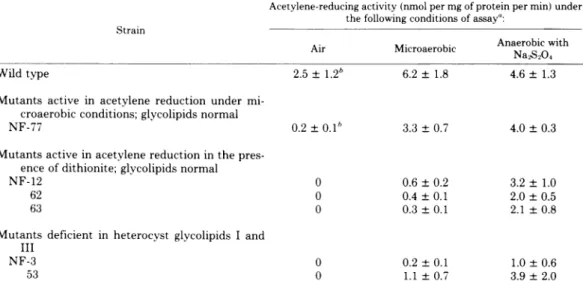
Table 1 shows the mean acetylene-reducing activity of wild-typeandmutantcultures inAA/ 8 after4daysofbubblingwith airorN2-CO2or after 4 days with N2-CO2 and 2 days with air.
Samples from cultures bubbled with air were assayedaerobically, whereassamples from
cul-tures incubated with N2-CO2 were assayed mi-croaerobically and,bythe addition ofdithionite, anaerobically. Dithionite alsoservesasasource of reductant to cyanobacterial nitrogenase (5, 10, 17,19).
The acetylene-reducing activity ofwild-type cultures was greatest under argon and was de-creased approximately 26% by the presence of
dithionite; the activity was lowest when mea-suredinair afteraperiodof aerobicincubation. The average rate of reduction ofacetylene by
mutant NF-77 wasmore than 50% ofthe
wild-type rate under microaerobic conditions, but
TABLE 1. Meanacetylene-reducingactivityof wild-typeand mutantstrainsofA. variabilis Acetylene-reducing activity(nmolper mgofproteinpermin)under
thefollowingconditions ofassay': Strain
Anaerobicwith
Air Microaerobic Na:S204
Wild type 2.5± 1.2b 6.2± 1.8 4.6± 1.3
Mutants active in acetylene reduction under mi-croaerobic conditions; glycolipids normal
NF-77 0.2±0.1b 3.3±0.7 4.0±0.3
Mutants active inacetylenereduction in the pres-enceofdithionite; glycolipids normal
NF-12 0 0.6±0.2 3.2± 1.0
62 0 0.4±0.1 2.0±0.5
63 0 0.3±0.1 2.1±0.8
Mutants deficient in heterocyst glycolipids I and III
NF-3 0 0.2±0.1 1.0± 0.6
53 0 1.1±0.7 3.9±2.0
"Wild-typeand mutant strains of A. variabilis were incubated microaerobically (unless otherwise indicated) for4daysandthen assayed eitherunder air or under argon in the absence or presence of 5 mMNa2S204.
"Incubatedunder air for 4 days.Similar results were obtained if the cultures were first incubated
690 HAURY AND WOLK
only 8% of the wild-type activity in air. The
nitrogenase activities of NF-77 and the other mutants, unlike the activity of wild-type cul-tures, weregreaterunder anaerobic than under microaerobic conditions. Three mutants, NF-12, 62, and 63, reduced acetylene anaerobically in the presence of dithionite at 44 to 70% of the rate ofwild-type cultures, but at only 5 to
10%c
of the rate of wild-type cultures under microaer-obic conditions anddid not reduce acetylene in the presence of air. Mutants NF-3, 15, 35, 47, 53, and 58, the heterocysts of which are deficient in their content of envelopeglycolipids (see below), had no or very low nitrogenase activity (<0.1nmol of C2H4 per mg of protein per min) when assayedunder air and measurable but very var-iable activity when assayed microaerobically or anaerobically after microaerobic incubation.
Wild-type A. Lariabilisincubated with
2,3,5-triphenyltetrazolium chloride under H2 in the
dark deposited crystals of formazan in hetero-cystswithin15 to20minand inalow percentage ofvegetative cells within 1 h. Under these con-ditions, all heterocysts of mutants NF-62 and 63 showed crystalsof formazan within 25 min, and
amajorityofheterocysts of NF-12 showed crys-tals of formazan within40min.
The mutants shown in Table 1 all grow on nitrate at approximately the same rate as does wild-type A. variabilis, and allproduce hetero-cystsinAA/8 medium. Vegetative cells of
NF-12 (2) and NF-20 differentiate into heterocysts
at anabnormallyhighfrequency,andvegetative cells of NF-76 differentiate at a very low fre-quency (2) whenplatedonagarathighdensity. The specific glutamine synthetase activity (mean of threedeterminations) ofmutants NF-12, 20, and 76was 5.5, 5.3, and 6.9 nmol of
y-glutamyl hydroxamateformed per mg ofprotein
permin,respectively,or76 to99% of theactivity
of thewild-typeorganisms.
The contentof theglycolipids comprisingthe innerlayerof theenvelopeofheterocysts (20)in
NF-77, 12,62,and63 wassimilartothecontent
ofthose glycolipids in wild-type A. Lariabilis.
However, therewas amarkeddeficiency of those lipidsin mutantsNF-3, 15, 47, 53, and58 (Fig. 1 and 2). Mutants NF-15, 47, and58 gave rise to spontaneous revertants which were capable of N2 fixation under aerobic conditions and all of which had anincreased amount of those
glyco-lipids (Fig. 2), whereas mutants NF-3 and 53
havenotyieldedstablerevertants.Eachsample
representsanextractof3x 107heterocysts. DISCUSSION
In order for nitrogenase to function in vivo,
the enzymemustbe protected against inactiva-tionby oxygen andmustbeprovidedwith ATP
FIG. 1. Thin-layerchromatographic separationof
lipids extracted from filaments (WT) and partially
purified heterocysts (H) ofwild-type A.Cariabilis and fromfilamentsofmutants NF-3, 15, 47, and 53. Each spot corresponds to a sample containing 3 x 10'
heterocysts. 0, Origin;IandIII, heterocystenWelope
glycolipidsI andIII,respectively.
and with a supply of reductant. Our work rep-resentsan approach to investigation of the de-tails of the physiological systems which are
re-quiredtosupport theactivityof thenitrogenase which is present in aerobically grown,
hetero-cyst-forming cyanobacteria.
BothH2,whichisproducedbyaside reaction during assimilation ofN2, and substrates of the dehydrogenases of the oxidative pentose
phos-phatecyclecan serve as sourcesof reductantfor
02
or for substrates ofnitrogenase
within het-erocysts (5, 10-12). It has been suggested thatthe envelope ofheterocysts may soextensively restrict the ingress of oxygen that that which enters canbe assimilatedbythe oxidative reac-tions taking place inside the cells, whereby a very lowpartial pressureofoxygenismaintained
intheirinterior (16).
Working withintact cells, we have described three experimentally distinguishable classes of
mutantswhich have the potentialfor nitrogen-ase activity under anaerobic conditions,butare largelyorcompletelyinactivatedby oxygen. The oxygen sensitivity ofone class, the mutants of which are deficient in the envelope glycolipids
ofheterocysts, may be accounted for by more rapid penetration of oxygen into their
FIG. 2. Thin-layer chromatographic separation of lipids extracted from filaments (WT) andpartially
purifiedheterocysts (H)of wild-typeA. variabilisandfrom filamentsofthefollowingmutantsandrevertants (Rn) ofthosemutants: (A)NF-15, (B)NF-47,and(C)NF-58. Thewild-typeandrevertantstrainsweregrown withN2asnitrogen source; themutants weregrownwithnitrateand thentransferredtonitrate-freemedium.
Eachsamplerepresentsan extractof3x 10 heterocysts. 0, Origin;IandIII, heterocystenvelopeglycolipids IandIII,respectively.
cyststhan intotheheterocystsofwild-type
cul-tures. The fact that it was possible to isolate from a number of these mutants revertants which arecapableof aerobicfixation of dinitro-genand which haveanincreasedbut still
abnor-mallylowcomplement ofheterocyst glycolipids
isconsistent with thefollowingidea. These
gly-colipids, whicharelocalized in the envelopesof the heterocysts, may be a part of the oxygen-protective mechanism. However, in the absence ofdetailed biochemical definition of the lesions in the mutants, it remains possible that the mutations had pleiotropic effects. That is, the
effect ofthemutations onthesystem
providing
oxygenprotectionmayhavebeen different fromtheir effect on the productionof theglycolipids
ofheterocysts.
Themutantsof the othertwoclasses have the normalcomplements ofglycolipids,but the mu-tantsofoneof those classesrequireprovision of
dithionite for theexpressionofhigh nitrogenase activity, whereas the one mutant of the other class doesnot. Specifically, after4daysof incu-bation under microaerobic conditions, i.e., ex-posure to photosynthetically active lightunder
flowing N2-CO2, mutants NF-12, 62, and 63
re-duce acetylene much morerapidly in the pres-ence of dithionite than in its absence. Their nitrogenase, althoughrelatively inactive,cannot
have beenirreversibly damaged under microae-robicconditions. Therefore,these mutants must providesomeprotectionagainst inactivation by oxygen. Thefact thattheyrequiredithionite for highactivitythusimplies that, as in a mutant of Klebsiella pneumoniae which has been de-scribed (15), some component intheir pathway
ofelectrontransfertonitrogenase (although not
to 2,3,5-triphenyltetrazolium chloride) may be impaired. (In particular, it is possible that the electron-acceptingsite oftheirnitrogenase may
be modified.) Such a component could be in a
pathway separate from those which protect against inactivation by oxygen. Alternatively, the component could be ina pathway common
to both processes, but witha limited supply of
electrons usedpreferentially for oxygen
protec-tion.
Because glutamine synthetase and/or gluta-mine mayinfluencetheformation of heterocysts (14, 18), we examined the activity of glutamine
692
synthetase inthreemutants in whichvery high or very low frequencies ofheterocysts can be
observed (2). Little or no difference was ob-served in this activityinthe mutantsrelativeto
wild-type A. variabilis.
ACKNOWLEDGMENTS
Wethank DavidNettleton and Sharon Mohrlok for capable assistance.
This work was supported by the Utnited States Energy
Research and Development Administration undercontract EY-76-C-02- 1338.
LITERATURE CITED
1. Allen, M. B., and D.I.Arnon. 1955.Studieson nitrogen-fixing blue-green algae.I.Growth andnitrogenfixation bv Anabaena cvlindrica Lemm. Plant Physiol. 30:366-372.
2. Currier, T. C., J. F. Haury, and C. P. Wolk. 1977. Isolation and preliminary characterization of
auxo-trophs ofafilamentous cyanobacterium. J. Bacteriol.
129:1556-1562.
3. Fay,P., W. D. P. Stewart, A. E. Walsby, and G.E. Fogg. 1968. Is the heterocvst thesiteofnitrogen fixa-tion inblue-green algae? Nature (London) 220:810-812.
4. Lambein, F., and C. P. Wolk. 1973. Structural studies
ontheglycolipids from the envelope of the heterocyst
ofAnabaena cylindrica. Biochemistry 12:791-798.
5. Lockau, W., R. B. Peterson, C. P. Wolk, and R. H. Burris. 1978. Modes of reduction ofnitrogenase in
heterocvsts isolated from Anabaena species.Biochim.
Biophys. Acta 502:298-308.
6. Lorch, S.K.,and C. P. Wolk. 1974.Application of
gas-liquidchromatographytostudy oftheenvelope lipids of heterocysts.J. Phycol.10:352-355.
7. Lowry,0.H., N. J.Rosebrough, A. L. Farr, and R. J.
Randall. 1951. Protein measurement with the Folin phenolreagent.J. Biol. Chem.193:265-275.
8. Mackinney, G. 1941. Absorption oflightby chlorophyll solutions. J. Biol. Chem. 140:315-322.
9. Nichols, B. W., and B. J. B. Wood. 1968. New glycolipid specific to nitrogen-fixing blue-green algae. Nature (London) 217:767-768.
10. Peterson, R. B., and R. H. Burris. 1976.Properties of heterocvstsisolated with colloidal silica. Arch. Micro-biol. 108:35-40.
11. Peterson, R. B., and R. H. Burris. 1978.H,metabolism in isolated heterocysts of Anaoaena7120.Arch. Micro-biol. 116:125-132.
12. Peterson,R. B.,and C. P. Wolk. 1978. Localization of
anuptake hydrogenase in Anabaena. Plant Physiol.
61:688-691.
13. Rowe, W. B., R. A. Ronzio, V. P. Wellner, and A. Meister. 1970. Glutamine synthetase (sheep brain). MethodsEnzymol.17A:900-910.
14. Rowell,P., S. Enticott, and W. D. P. Stewart. 1977.
Glutamine synthetase andnitrogenase activity in the blue-green alga Anabaena cylindrica. New Phytol. 79:41-54.
15. St. John, R. T., H. M. Johnston, C. Seidman, D. Garfinkel, J. K. Gordon, V. K. Shah, and W. J. Brill. 1975. Biochemistry and genetics ofKlebsiella
pneumonlaemutant strainsunabletofix N2.J. Bacte-riol. 121: 759-765.
16. Stewart, W. D. P. 1973. Nitrogen fixation by photosyn-thetic microorganisms. Annu. Rev. Microbiol. 27: 283-316.
17. Stewart, W. D. P., A. Haystead, and H. W. Pearson. 1969. Nitrogenase activityinheterocysts ofblue-green algae. Nature(London) 224:226-228.
18. Stewart, W. D. P., and P. Rowell. 1975. Effects of
L-methionine-DL-sulphoximine on the assimilation of newly fixedNH:, acetylene reduction and heterocyst productioninAnabaena cylindrica. Biochem. Biophys.
Res.Commun. 65:846-856.
19. Thomas, J., J. C. Meeks, C. P. Wolk,P. W.Shaffer, S. M.Austin, and W.-S. Chien. 1977. Formation of glutamine from [':'N]ammonia, [`2N]dinitrogen, and ['4C]glutamate by heterocysts isolated from Anabaena
cylindrica.J. Bacteriol. 129:1545-1555.
20. Winkenbach, F., C. P. Wolk, and M. Jost. 1972. Lipids ofmembranes and of the cellenvelope inheterocysts of
ablue-green alga. Planta 107:69-80.
21. Wolk, C. P., S. M. Austin, J. Bortins, and A. Galon-sky. 1974. Autoradiographic localization of '`N after fixation of`N-labeled nitrogen gas by a heterocyst-formingblue-green alga. J. Cell Biol. 61:440-453. 22. Wolk, C. P., andE.Wojciuch. 1971.Photoreductionof
acetylene byheterocysts. Planta97:126-134.