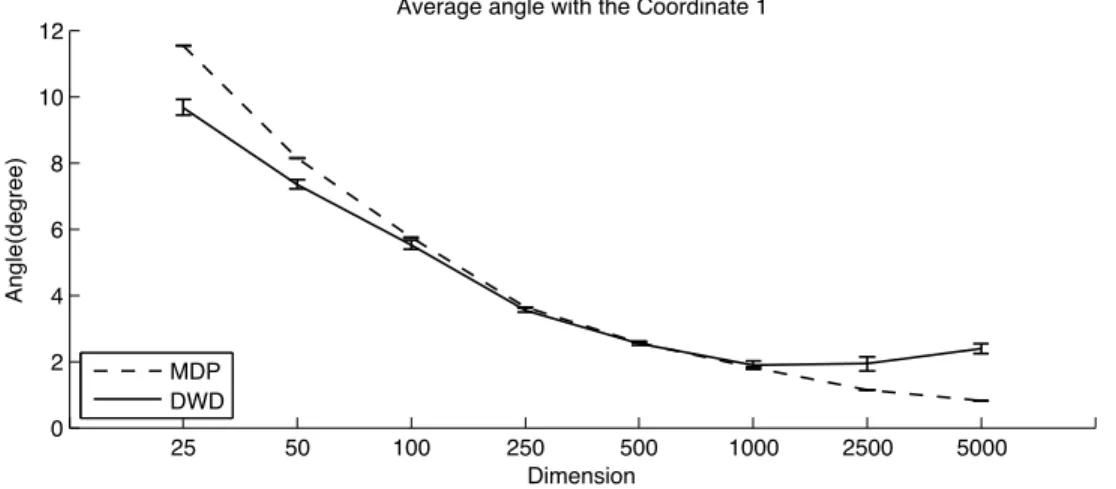
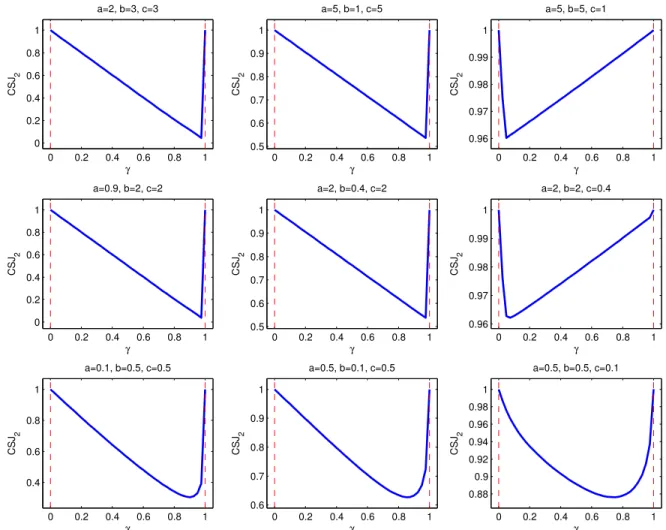
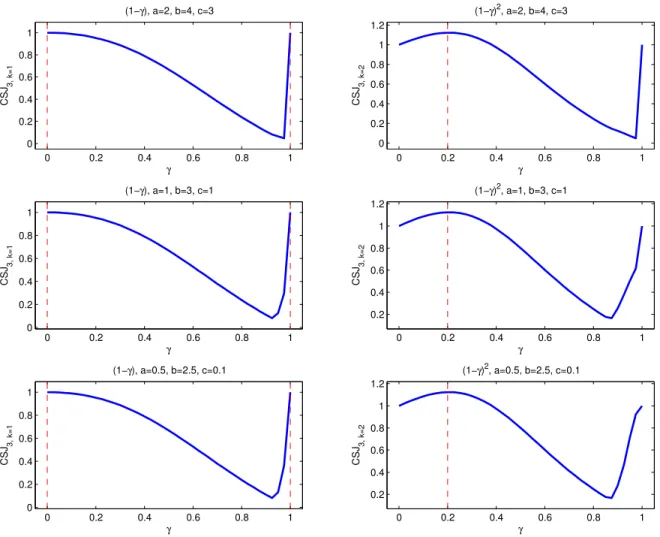
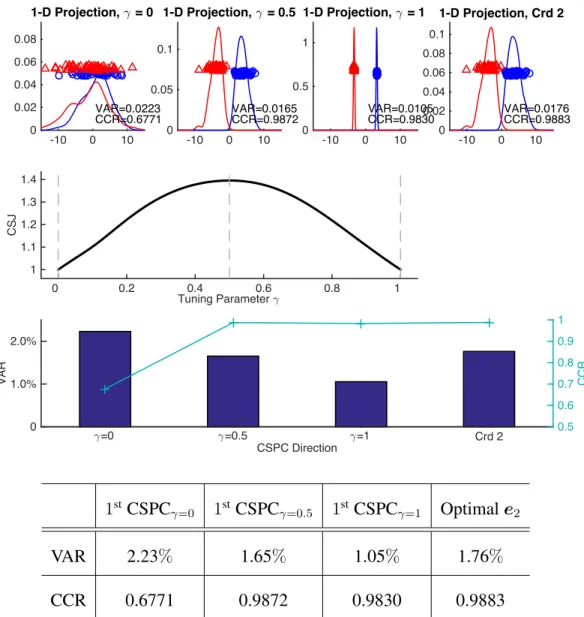
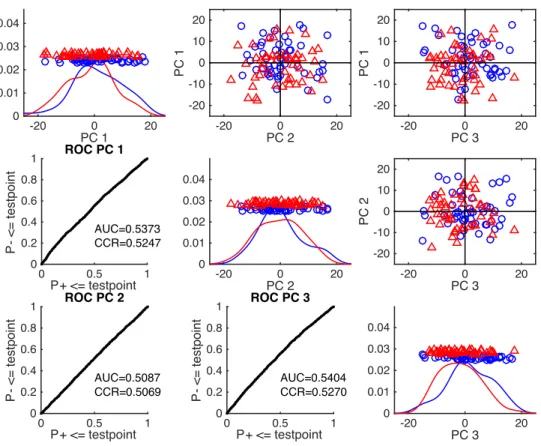
CLASS-SENSITIVE PRINCIPAL COMPONENTS ANALYSIS
Di Miao
A dissertation submitted to the faculty at the University of North Carolina at Chapel Hill in
partial fulfillment of the requirements for the degree of Doctor of Philosophy in the
Department of Statistics and Operations Research.
Chapel Hill
2015
Approved by:
J. S. Marron
Jason P. Fine
Andrew B. Nobel
Yufeng Liu
c
2015
Di Miao
ABSTRACT
DI MIAO: CLASS-SENSITIVE PRINCIPAL COMPONENTS ANALYSIS
(Under the direction of J. S. Marron and Jason P. Fine)
Research in a number of fields requires the analysis of complex datasets. Principal
Com-ponents Analysis (PCA) is a popular exploratory method. However it is driven entirely by
variation in the dataset without using any predefined class label information. Linear
clas-sifiers make up a family of popular discrimination methods. However, these will face the
data piling issue often when the dimension of the dataset gets higher. In this dissertation, we
first study the geometric representation of an interesting dataset with strongly auto-regressive
errors under the High Dimensional Low Sample Size (HDLSS) setting and understand why
the Maximal Data Piling (MDP), proposed by Ahn et al. (2007), is the best in terms of
clas-sification compared with several other commonly used linear discrimination methods. Then
we introduce the Class-Sensitive Principal Components Analysis (CSPCA), which is a
com-promise of PCA and MDP, that seeks new direction vectors for better Class-Sensitive
visual-ization. Specifically, this method will be applied to the Thyroid Cancer dataset (see Agrawal
et al. (2014)). Additionally, we investigate the asymptotic behavior of the sample and
pop-ulation MDP normal vector and Class-Sensitive Principal Component directions under the
HDLSS setting. Moreover, the Multi-class version of CSPCA (MCSP) will be introduced as
ACKNOWLEDGMENTS
I would like to express my deepest gratitude and appreciation to my advisors, Dr. J. S.
Marron and Dr. Jason P. Fine for their generous guidance, support and encouragement. I am
especially indebted to Dr. J. S. Marron for his patience, criticism and help during the writing
of this dissertation.
I would like to deliver thanks to other committee members: Dr. Andrew Nobel, Dr.
Yufeng Liu and Dr. Eric Bair for their valuable suggestions and comments. Thanks also go
to Dr. Vonn Walter for kindly providing the Thyroid cancer data, which led to interesting
applications in this dissertation.
I wish to thank my parents for their care from far away and confidence in me. Last but
not least, I would like to give my special appreciation to my wife, Mingjun Zhu. Without her
sacrificial love, everlasting support and constant prayers, getting to this point would have not
TABLE OF CONTENTS
LIST OF TABLES
. . . ix
LIST OF FIGURES
. . . .
x
1 INTRODUCTION
. . . .
1
2 EXPLORATORY METHODS
. . . .
4
2.1 Singular Value Decomposition . . . .
4
2.2 Principal Components Analysis . . . .
5
2.3 Canonical Correlation Analysis . . . .
9
2.3.1 Review of Canonical Correlation Analysis . . . .
9
2.3.2 The relationship between
⇢
and the size of dataset . . . 12
3 LINEAR DISCRIMINATION METHODS
. . . 18
3.1 Fisher Linear Discrimination . . . 18
3.2 Support Vector Machine . . . 20
3.3 Maximal Data Piling . . . 23
3.3.1 Review of Maximal Data Piling . . . 24
3.3.2 Maximal Data Piling solved by Canonical Correlation
Analysis . . . 25
3.3.3 Relationship to Fisher Linear Discrimination . . . 27
3.3.4 Relationship to Support Vector Machine . . . 29
3.3.5 Geometric Representation of Two-class Auto-Regressive
High Dimension Low Sample Size Data . . . 33
3.4.1 Review of Distance Weighted Discrimination . . . 51
3.4.2 Distance Weighted Discrimination of Auto-Regressive High
Dimension Low Sample Size Data . . . 53
3.5 Standardized WithIn Class Sum of Squares . . . 58
3.5.1 Review of Standardized WithIn Class Sum of Squares . . . 59
3.5.2 Relationship to Maximal Data Piling . . . 60
3.6 Supervised Principal Components Analysis . . . 61
3.7 The PCA-FLD Integrated Methods . . . 63
4 CLASS-SENSITIVE PRINCIPAL COMPONENTS ANALYSIS
. . . 64
4.1 Class-Sensitive Principal Components Analysis . . . 64
4.2 The Generalized Eigen-analysis . . . 77
4.3 Measure of Class-Sensitive visualization performance . . . 79
4.3.1 Criterion of Class-Sensitive visualization and the choice
of the optimal tuning parameter . . . 79
4.3.2 Simulated examples for Class-Sensitive Principal
Components Analysis . . . 86
4.3.3 Real data example for Class-Sensitive Principal
Components Analysis . . . 121
4.4 The Advantages of Class-Sensitive Principal Components
Analysis . . . 131
4.5 A Variation of Class-Sensitive Principal Components Analysis . . . 133
4.5.1 Review of Continuum Canonical Correlation . . . 133
4.5.2 A Variation of Class-Sensitive Principal Components
Analysis . . . 134
4.5.3 General Relationship to Continuum Canonical Correlation . . . 136
4.5.4 The reason why this is not used in this dissertation . . . 137
5 HIGH DIMENSION LOW SAMPLE SIZE ASYMPTOTICS
. . . 141
5.1 HDLSS asymptotic properties of Principal Components Analysis . . . 141
5.1.1 Consistency and strong inconsistency . . . 147
5.1.2 Alternative asymptotic domain . . . 152
5.1.3 Boundary behavior of Principal Components Analysis
HDLSS asymptotics . . . 154
5.2 HDLSS asymptotic properties of Maximal Data Piling . . . 155
5.2.1 Review of Ahn et al. (2012)’s research . . . 155
5.2.2 HDLSS asymptotics of Maximal Data Piling . . . 157
5.2.3 Simulation study . . . 164
5.2.4 Proof of Maximal Data Piling HDLSS Asymptotics
Theorem . . . 165
5.2.5 General HDLSS asymptotics of Maximal Data Piling . . . 190
5.3 HDLSS asymptotic properties of Class Sensitive Principal
Components Analysis . . . 197
5.3.1 Population Class Sensitive Principal Components directions . . . 197
5.3.2 Simulation study . . . 203
5.3.3 Proof of Class Sensitive Principal Components Analysis
HDLSS Asymptotics Theorem . . . 204
5.3.4 General HDLSS asymptotics of Class Sensitive Principal
Components Analysis . . . 212
5.4 Open Problems . . . 222
6 MULTI-CLASS CLASS-SENSITIVE PRINCIPAL COMPONENTS
ANALYSIS
. . . 224
6.1 Multi-class Maximal Data Piling . . . 224
6.2 A null space approach to Multi-class Maximal Data Piling . . . 225
6.3 Multi-class Class-Sensitive Principal Components Analysis . . . 234
6.3.2 Real data example for Multi-class Class-Sensitive Principal
Components Analysis . . . 244
LIST OF TABLES
4.1 Sample sizes of the training and testing datasets of each class of
the Thyroid cancer data . . . 122
6.1 Sample sizes of the training and testing datasets of each class of
LIST OF FIGURES
2.1 Empirical correlations of X and Y for different dimensions . . . 15
2.2 Empirical correlations of X and Y if Y is a indicator vector for
different dimensions . . . 17
3.1 Projections of low dimensional example showing the relationship
between MDP and SVM . . . 30
3.2 Projections of high dimensional example showing the relationship
between MDP and SVM . . . 32
3.3 Projection of Two-class Auto-Regressive data onto the first 3
coordinates . . . 34
3.4 One-dimensional projection onto the diagonal direction and QQ
plot of Two-class Auto-Regressive data . . . 38
3.5 Projections of Two-class Auto-Regressive data onto the diagonal
direction and first 2 orthogonal PC directions . . . 39
3.6 Monte Carlo average angle between the MDP normal vector and
e
1for Two-class Auto-Regressive data structure . . . 48
3.7 Monte Carlo average angle between MDP (and DWD) normal
vector and
e
1for Two-class Auto-Regressive data structure . . . 57
4.1 Examples showing the disadvantages of the second version of
the CSPCA optimization criterion . . . 74
4.2 Examples showing the disadvantages of the third version of the
CSPCA optimization criterion . . . 76
4.3 One-dimensional projections onto CSPC directions corresponding
to three different values of
. . . 82
4.4 Comparison of the data representation and classification
performances for a series CSPC directions . . . 85
4.5 Projections of the Two-class Auto-Regressive data onto the first
3 sample PC directions . . . 88
4.6 Projections of the Two-class Auto-Regressive data onto the Bayes
optimal direction and first 2 orthogonal PC directions . . . 90
4.7 Projections of the Two-class Auto-Regressive data onto the MDP
4.8 The curve of CSJ as a function of of the Two-class
Auto-Regressive data . . . 92
4.9 One-dimensional projections onto CSPC directions corresponding
to three different values of
. . . 93
4.10 Projections onto two CSPC directions where is near
0
of the
Two-class Auto-Regressive data . . . 95
4.11 Projections onto two CSPC directions where is near
1
of the
Two-class Auto-Regressive data . . . 96
4.12 Projections of the Two-class Auto-Regressive data onto the first
3 CSPC directions . . . 97
4.13 Projections of the Two-class Auto-Regressive data onto the FLD
normal vector and first 2 orthogonal PC directions . . . 99
4.14 Projections of the Two-class Auto-Regressive data onto the DWD
normal vector and first 2 orthogonal PC directions . . . 100
4.15 Projections of the Two-class Auto-Regressive data onto the SVM
normal vector and first 2 orthogonal PC directions . . . 102
4.16 Monte Carlo average performances of different methods of the
Two-class Auto-Regressive data . . . 103
4.17 Monte Carlo average percentage of VAR and log error rate for
different methods of the Two-class Auto-Regressive data . . . 105
4.18 Projections of the first simulated example onto the first 3 sample
PC directions . . . 108
4.19 Projections of the first simulated example onto the first 4 sample
PC directions . . . 109
4.20 The curve of CSJ as a function of of the first simulated example . . . 110
4.21 Projections of the first simulated example onto the first 4 CSPC
directions . . . 111
4.22 Comparison of the absolute value of the loadings for PCA and
CSPCA of the first simulated example . . . 112
4.23 Projections of the first simulated example onto the DWD normal
vector and first 3 orthogonal PC directions . . . 114
4.24 Projections of the first simulated example onto the FLD normal
vector and first 3 orthogonal PC directions . . . 117
4.26 Projections of the first simulated example onto the SVM normal
vector and first 3 orthogonal PC directions . . . 118
4.27 Monte Carlo average performances of different methods of the
first simulated example . . . 120
4.28 Projections of the Thyroid cancer data onto the first 3 sample PC
directions . . . 123
4.29 The curve of CSJ as a function of of the Thyroid cancer data . . . 124
4.30 Projections of the Thyroid cancer data onto the first 3 CSPC
directions . . . 125
4.31 Projections of the Thyroid cancer data onto the DWD normal
vector and first 2 orthogonal PC directions . . . 126
4.32 Projections of the Thyroid cancer data onto the FLD normal
vector and first 2 orthogonal PC directions . . . 127
4.33 Projections of the Thyroid cancer data onto the MDP normal
vector and first 2 orthogonal PC directions . . . 128
4.34 Projections of the Thyroid cancer data onto the SVM normal
vector and first 2 orthogonal PC directions . . . 129
4.35 Monte Carlo average performances of different methods of the
Thyroid cancer data . . . 130
5.1 Relationship between HDLSS asymptotic properties of MDP
normal vector for different choices of
a
and
max (
b, c
)
. . . 160
5.2 Graphical illustration of the asymptotic properties of the
1
stPC
direction under the population model (5.3) and (5.4) . . . 162
5.3 Simulation illustration of MDP HDLSS asymptotic theorem . . . 165
5.4 MDP HDLSS asymptotic projection of Case 2 . . . 177
5.5 MDP HDLSS asymptotic projection of Case 3a . . . 179
5.6 MDP HDLSS asymptotic projection of Case 3b . . . 181
5.7 MDP HDLSS asymptotic projection of Case 4a . . . 183
5.8 MDP HDLSS asymptotic projection of Case 4b . . . 185
5.10 MDP HDLSS asymptotic projection of Case 5b . . . 189
5.11 Relationship between HDLSS asymptotic properties of CSPC
direction(s) for different choices of
max (
a, b
)
and
c
. . . 202
5.12 Simulation illustration of CSPCA HDLSS asymptotic theorem . . . 204
6.1 MDP null space graphical illustration . . . 228
6.2 Simulated data illustrates the projection of the 3-class data onto
the MMDP subspace proposed by Ahn and Marron (2010) . . . 231
6.3 Simulated data illustrates the projection of the 3-class data onto
the MMDP subspace using the new null space approach . . . 232
6.4 Simulated data illustrates the projection of the 3-class data onto
the MMDP subspace after rotation . . . 233
6.5 Graphically illustration of the underlying distribution of the
simulated example for the MCSP . . . 236
6.6 Projections of the simulated data for MCSP onto the first 3 PC
directions . . . 237
6.7 Projections of the simulated data for MCSP onto the 4
th, 5
thand
6
thdirections . . . 238
6.8 Projections of the simulated data for MCSP on the Multi-class MDP
subspace . . . 239
6.9 The curve of MCSJ as a function of of the simulated data . . . 240
6.10 Projections of the simulated data for MCSP onto the first 4 MCSP
directions . . . 241
6.11 First 6 PC and MCSP loading vectors comparison of the simulated
data for MCSP . . . 242
6.12 Projections of the Thyroid cancer data (3 classes) onto the first 3
PC directions . . . 246
6.13 Projections of the Thyroid cancer data (3 classes) onto the
Multi-class MDP subspace . . . 247
6.14 The curve of MCSJ as a function of for the Thyroid cancer data
(3 classes) . . . 248
6.15 Projections of the Thyroid cancer data (3 classes) onto the first 3
6.16 The PCA and MCSP 1-dimensional projections comparison of the
Thyroid cancer data (3 classes) . . . 250
6.17 The PCA and MCSP 2-dimensional projections comparison of the
Thyroid cancer data (3 classes) . . . 251
6.18 SWISS permutation test of the Thyroid cancer data (3 classes) . . . 253
6.19 SWISS permutation test of the Thyroid cancer data (3 classes) for
N components . . . 255
6.20 Projections of the testing Thyroid cancer data (3 classes) onto the
first 3 training PC directions . . . 256
6.21 Projections of the testing Thyroid cancer data (3 classes) onto the
first 3 training MCSP directions . . . 257
6.22 Projections of the Thyroid cancer data (4 classes) onto the first 4
PC directions . . . 259
6.23 Projections of the Thyroid cancer data (4 classes) onto the
Multi-class MDP subspace . . . 260
6.24 The curve of MCSJ as a function of of the Thyroid cancer data
(4 classes) . . . 261
6.25 Projections of the Thyroid cancer data (4 classes) onto the first 4
MCSP directions . . . 262
6.26 The PCA and MCSP 2-dimensional projections comparison of the
Thyroid cancer data (4 classes) . . . 263
6.27 SWISS permutation test of the Thyroid cancer data (4 classes) for
N components . . . 265
6.28 Projections of the testing Thyroid cancer data (4 classes) onto the
first 4 training PC directions . . . 266
6.29 Projections of the testing Thyroid cancer data (4 classes) onto the
CHAPTER 1: INTRODUCTION
In the past few decades, the scope of statistics has been broadened to include exploratory
analysis and data visualization - going beyond the usually taught standard paradigms of
esti-mation and testing, to look for patterns in data beyond initial expectations (see Tukey (1970),
Tukey (1977), Velleman and Hoaglin (1981), Chambers (1983), Buja et al. (1996) and
Gel-man (2004) for detailed discussions).
Exploratory Data Analysis
, an approach to analyzing
datasets to summarize their main characteristics, uncover underlying structure and extract
important variables, often with visual methods is continuously developing. Exploratory
tech-niques for datasets in which a small number of variables are measured for a given set of
ob-jects are well developed. However, improvements in measurement, computation and
technol-ogy have produced complex datasets that require new exploratory techniques. Among them
the
High Dimension Low Sample Size
(
HDLSS
) data are becoming increasingly common in
various fields. These fields include genetic micro-arrays, medical imaging and chemometrics
in which hundreds or thousands of variables are measured for each object of interest (see
Hall et al. (2005)).
The technique of
Principal Components Analysis
(
PCA
), invented by Pearson (1901) and
named by Hotelling (1933), is a famous exploratory method which has been successfully
ap-plied in a variety of disciplines. However, PCA is driven entirely by variation of the dataset
not give effective data visualization. Therefore, the result is often difficult to interpret. Some
sparse PCA methods such as Zou et al. (2006) and Shen and Huang (2008) seek combinations
of few variables (modified PC directions with sparse loadings) to find informative structure
of high dimensional data. However, class labels are not considered in these methods. On the
other hand, linear classifiers such as
Fisher Linear Discrimination
(
FLD
),
Maximal Data
Pil-ing
(
MDP
),
Support Vector Machine
(
SVM
) and
Distance-Weighted Discrimination
(
DWD
)
focus on finding the best hyperplane to separate different types of data. The normal vector is
the direction perpendicular to the separating hyperplane. The projection of the dataset onto
the normal vector can give good visualization of the separation. As the dimension get higher,
some linear discrimination methods are going to overfit the data. Therefore they cannot give
effective data visualization. Some sparse regression methods such as Tibshirani (1996), Fan
and Li (2001), and Zou (2006) select subset of variables to provide better prediction.
How-ever, within-class variations are not targeted by these methods. In a variety of applications,
the within-class variations are important for visualization. For example, suppose we have a
dataset consisting of gene expressions of two types of cancer cells. In each type, men and
women may have different gene profiles. Although linear classifiers can separate the two
cancer types very well, from the 1-dimensional projection onto the normal vector, we may
not be able to visualize the different variations of men and women within each type. Hence
we develop a new statistical method that seeks direction vectors which capture not only the
variations but also the predefined class label information of the dataset. This method
com-bines the advantages of PCA and linear classifiers and compensates their disadvantages at the
can provide very informative data visualization.
The rest of this dissertation is laid out as follows. In Chapter 2 and Chapter 3 we give
the background of the
Object Oriented Data Analysis
(
OODA
) (Marron and Alonso (2014))
including exploratory methods, discrimination methods and some mathematical statistical
properties. In Subsection 3.3.5, we study the geometric representation of an interesting
dataset with strongly auto-regressive errors under the HDLSS setting and understand why the
MDP, proposed by Ahn et al. (2007), is the best in terms of classification compared with
sev-eral commonly used discrimination methods. In Chapter 4, we introduce the
Class-Sensitive
Principal Components Analysis
(
CSPCA
), which is a compromise of PCA and MDP, that
seeks new direction vectors for better Class-Sensitive visualization. Section 4.1 describes the
CSPCA method, 4.3 describes the criterion of choosing the tuning parameter and gives
ap-plications on simulated examples and a real dataset, and 4.5 describes a variation of CSPCA
and its relationship to the
Continuum Canonical Correlation
(
CCC
), proposed by Lee (2007).
In Chapter 5, we investigate the asymptotic behavior of MDP normal vector and CSPC
di-rections under the HDLSS setting. In Chapter 6 we introduce the Multi-class version of
CHAPTER 2: EXPLORATORY METHODS
In this chapter we review three commonly used exploratory methods for Objected
Ori-ented Data Analysis (OODA) (see Marron and Alonso (2014) and Wang and Marron (2007)
for detailed discussions). These methods can be utilized to explore the structure and uncover
patterns within a single multivariate dataset or discover relationship among multiple datasets.
In particular, we review the
Singular Value Decomposition
(
SVD
) in Section 2.1, Principal
Components Analysis (PCA) in Section 2.2 and
Canonical Correlation Analysis
(
CCA
) in
Section 2.3 respectively.
2.1 Singular Value Decomposition
The Singular Value Decomposition (SVD) is a factorization of a real-valued or
complex-valued matrix into a product of a diagonal matrix and two orthogonal matrices. Formally, let
X
be a real-valued matrix of dimension
d
⇥
n
:
d
variables measured on
n
samples. Then
there exists a factorization of the form
X
=
U
⇤
V
T,
(2.1)
where
U
is a
d
⇥
d
unitary matrix,
⇤
is a
d
⇥
n
diagonal matrix with non-negative numbers
on the diagonal, and
V
is an
n
⇥
n
unitary matrix. The diagonal entries
iof
⇤
are the
left-singular vectors and right-left-singular vectors of
X
respectively. The singular values are usually
listed in descending order, giving the SVD a unique representation if all the singular values
are different. The number of non-zero singular values of
X
(found on the diagonal entries of
⇤
) is equal to the rank of
X
. Therefore, the number of non-zero singular values is less than
or equal to
min (
d, n
)
.
The SVD has a variety of applications, one of the most important is the low-rank matrix
approximation. Consider solving the problem of approximating a matrix
X
by another same
size matrix
X
ˆ
, which has a specific rank
r
. In this case the approximation is based on
minimizing the
Frobenius norm
(
k
X
k
=
qPd
i=1Pn
j=1x
2ij
) of the difference between
X
and
X
ˆ
:
ˆ
X
= ˆ
U
⇤
ˆ
V
ˆ
T,
(2.2)
where
⇤
ˆ
is the same as
⇤
except that it contains only the
r
largest singular values,
U
ˆ
is a
d
⇥
r
matrix of the first
r
columns of
U
, and
V
ˆ
is an
n
⇥
r
matrix of the first
r
columns of
V
. This is known as the
Eckart-Young
Theorem (see Eckart and Young (1936)).
2.2 Principal Components Analysis
The technique of Principal Components Analysis (PCA) was invented by Karl Pearson
(see Pearson (1901) and Jolliffe (2005) for detailed discussions). The principal components
transformation of a centered data matrix (row means have been subtracted) can be associated
X
is centered so that each row of
X
has mean 0. Then the first
r
principal components are
computed by the rank
r
SVD approximation of
X
as (2.1), where the
d
⇥
r
matrix
U
ˆ
gives the
first
r
principal component loading vectors for each variable and the
r
⇥
n
matrix
S
ˆ
= ˆ
⇤
V
ˆ
Tgives the first
r
principal component scores for each sample. Therefore the approximation
ˆ
X
can be written as
ˆ
X
= ˆ
U
S
ˆ
.
The scores
S
ˆ
reveal the structure in the samples that represent the amount of variability in the
data matrix
X
and the loading vectors
U
ˆ
define the size of the contribution of each original
variable to the principal components.
Rather than being merely associated with SVD, PCA also has an important geometric
interpretation in terms of variation. Since the row centered
d
⇥
n
data matrix
X
can be
decomposed as (2.1). The projections of
X
on
U
and
V
are:
Proj
U=
U
TX
=
U
TU
⇤
V
T=
⇤
V
T,
Proj
V=
XV
=
U
⇤
V
TV
=
U
⇤.
The first column vector of
U
, denoted by
u
1, satisfies
u
1= arg max
kuk=1Var
u
TX
= arg max
kuk=1u
TX
u
TX
TThe Equation (2.3) can be rephrased as
u
1= arg max
kuk=1u
TT SS
u
(2.4)
where TSS refers to the Total Sum of Squares (
T SS
=
XX
T).
After subtracting the first
k
1
principal components from
X
:
˜
X
k 1=
X
k 1
X
s=1
usu
TsX
then the
k
thcolumn vector of
U
, denoted by
uk
, satisfies
uk
= arg max
kuk=1Var
⇣
u
TXk
˜
1⌘
.
Therefore
u
1is the direction in the
d
-dimensional sample space maximizing the variation
of the projected samples in
X
, and
ui
, for all
i
= 2
,
3
, . . .
is the direction maximizing the
variation while orthogonal to the first
i
1
directions. Hence the scores
S
of the first
r
principal components are given as
S
=
U
TX
=
0
B
B
B
B
B
B
@
u
T1
X
...
u
T rX
1
C
C
C
C
C
C
A
.
With this geometric interpretation, visualization of the first few principal component
vantage points, in terms of variation explained.
The principal components can not only be interpreted as maximizing the projected
vari-ation, but also be interpreted as minimizing the projection Residual Sum of Squares (RSS).
To see why this is, let
u
2
R
dbe a vector with norm 1. Then
uu
TX
is the projection of the
data matrix
X
onto
u
. We minimize the projection RSS over
u
:
RSS
(u) =
k
X
uu
TX
k
2=
n
X
i=1
k
x
iuu
Tx
ik
2(2.5)
where
xi
for all
i
= 1
, . . . , n
is the
i
thcolumn of the matrix
X
. After some algebra we have
RSS
(u) =
nX
i=1
xix
Ti nX
i=1
x
Tiuu
Txi
.
(2.6)
The first term doesn’t depend on
u
, so it doesn’t appear in the minimization of the residual
sum of squares. To make RSS small, what we must do is make the second term big, i.e., we
want to maximize
n
X
i=1
x
Tiuu
Txi
=
u
TX
u
TX
T=
u
TXX
Tu
.
(2.7)
Therefore the optimal solution of minimizing RSS
(u)
is the 1
stprincipal component
direc-tion of data matrix
X
. In general it is useful to project onto multiple vectors, say
r
vectors,
which are orthogonal and have norm 1. Then the residual sum of squares is
RSS
(u
1, . . . ,ur) =
k
X
rX
Similar algebra as in (2.5), (2.6) and (2.7) gives that the optimal solutions are the first
r
principal components of the data matrix
X
. In other words, the RSS of
X
projected onto
r
orthonormal vectors is minimized by the first
r
principal components.
2.3 Canonical Correlation Analysis
Canonical Correlation Analysis (CCA) (first introduced by Hotelling (1936)) is one of
the principle tools in multivariate statistics for studying the relationship between two sets of
multivariate data. CCA seeks two vectors such that the correlation between the projections
of variables onto these vectors are maximized.
2.3.1 Review of Canonical Correlation Analysis
Formally, let
X
and
Y
be two centered (row means have been subtracted) matrices of
dimension
d
X⇥
n
and
d
Y⇥
n
respectively. Denote
u
and
v
as
d
X⇥
1
and
d
Y⇥
1
vectors
respectively. The correlation between the two projections Proj
u=
u
TX
and Proj
v=
v
TY
can be written as
⇢
=
p
Cov
(
Proj
u,
Proj
v)
Var
(
Proj
u)
p
Var
(
Proj
v)
=
u
T
XY
Tv
p
u
TXX
Tu
p
v
TY Y
Tv
.
Note that the correlation is scale invariant under affine transformation of both data matrices,
constraints
u
TXX
Tu
=
v
TY Y
Tv
= 1
. Then CCA is equivalent to the following:
max
u,v
u
T
XY
Tv
(2.8)
subject to
u
TXX
Tu
=
v
TY Y
Tv
= 1
. The corresponding Lagrange form is
u
TXY
Tv
x2
u
T
XX
Tu
1
y2
v
T
Y Y
Tv
1
.
Take the partial derivatives w.r.t.
u
and
v
, and setting the them equal to 0 gives the following
equations
XY
Tv
=
xXXTu
,
(2.9)
Y X
Tu
=
yY Y
Tv
.
(2.10)
Subtracting
u
times (2.9) from
v
times (2.10), we obtain
xuT
XX
Tu
yv
TY Y
Tv
= 0
,
which implies
x
=
y=
⇢.
Assuming
Y Y
Tis invertible we have
v
=
Y Y
T 1
Y X
Tu
Similarly assuming
XX
Tis invertible we have
u
=
XX
T 1
XY
Tv
⇢
.
(2.12)
Substituting (2.11) and (2.12) into equations (2.9) and (2.10) and rearranging terms gives the
following generalized eigen-analysis
XY
TY Y
T 1Y X
Tu
=
⇢
2XX
Tu
,
(2.13)
Y X
TXX
T 1XY
Tv
=
⇢
2Y Y
Tv
.
(2.14)
The solution is therefore:
•
u
is an eigenvector of
XX
T 1XY
TY Y
T 1Y X
Tif
XX
Tis invertible,
•
v
is an eigenvector of
Y Y
T 1Y X
TXX
T 1XY
Tif
Y Y
Tis invertible.
Therefore the eigenvectors
u
1and
v
1corresponding to the largest eigenvalues of
XX
T 1XY
TY Y
T 1Y X
Tand
Y Y
T 1Y X
TXX
T 1XY
Trespectively are the first pair of canonical direction vectors. Then the empirical correlation
between projections
u
Tvari-2.3.2 The relationship between
⇢
and the size of dataset
Suppose we have two data matrices
X
and
Y
from probability distributions that are
ab-solutely continuous with respect to Lebesgue measure. We have the following theorem which
claims that, with probability
1
, there exist a pair of direction vectors such that the correlation
between the projections of
X
and
Y
is 1 if the dimension of the vertical concatenation of the
two data matrices is greater than or equal to the samples size.
Theorem 1.
Suppose we have two data matrices
X
and
Y
from probability distributions
that are absolutely continuous with respect to Lebesgue measure. Their sizes are
d
X⇥
n
and
d
Y⇥
n
respectively. Denote
d
=
d
X+
d
Yas the dimension of the vertical concatenation of
X
and
Y
. If
d
n, then with probability 1, there exist vectors
a
2
R
dXand
b
2
R
dYsuch
that the empirical correlation between the projections Proj
a=
a
TX
and Proj
b
=
b
TY
is 1.
Define
Z
= (X;
Y
)
to be the
d
⇥
n
vertical concatenation of
X
and
Y
. Since the mean
of
Z
for each row is 0 and
d
n
, we know that rank
(Z) =
r
n
1
. Thus
Z
can be
decomposed by SVD as
Z
=
r
X
i=1
iuivTi
where
ui
2
R
d,
vi
2
R
n,
u
Ti
ui
=
v
Tivi
= 1
, for all
i
= 1
, . . . , n
and
u
Tiuj
=
v
Tivj
= 0
, for
all
i
6
=
j
.
It naturally follows that
ZZ
T=
rX
i=1 2
And it is easy to see that, given any pair
a
2
R
dXand
b
2
R
dY, we have
a
TXY
Tb
=
1
2
2
6
6
4
✓
a
Tb
T◆
ZZ
T0
B
B
@
a
b
1
C
C
A
a
TXX
Ta
b
TY Y
Tb
3
7
7
5
(2.15)
and
✓
a
Tb
T◆
ZZ
T0
B
B
@
a
b
1
C
C
A
=
rX
i=1✓
a
Tb
T◆
ui
u
Ti0
B
B
@
a
b
1
C
C
A
.
(2.16)
Solving for
a
and
b
to make (2.16) be 0, we have
✓
a
Tb
T◆
ui
= 0
,
for all
i
= 1
, . . . , r
(2.17)
because
2i
>
0
and
✓
a
Tb
T◆
uiu
T i0
B
B
@
a
b
1
C
C
A
0
, for all
i
= 1
, . . . , r
. We write
ui
as
0
B
B
@
ui,X
ui,Y
1
C
C
A
, where
ui,X
is a vector which consists of the first
d
Xelements of
ui
and
ui,Y
is a
vector which consists of the remaining
d
Yelements of
ui
. Then (2.17) can be rephrased as
a
Tui,X
=
b
Tui,Y
,
for all
i
= 1
, . . . , r.
(2.18)
Since
Z
=
rX
i=1=
0
B
B
@
Pr
i=1 iui,X
v
TiPr
iui,Y
v
T1
C
C
A
and
Z
=
we know that
X
=
r
X
i=1
iui,X
v
Ti,
Y
=
r
X
i=1
iui,Y
v
Ti.
Equations (2.18) imply that
a
TXX
Ta
=
b
TY Y
Tb
.
(2.19)
Then equations (2.15) and (2.19) together imply that
⇢
=
a
T
XY
Tb
p
a
TXX
Ta
p
b
TY Y
Tb
= 1
.
Because
⇢
is scale invariant under affine transformations of
a
and
b
, we can set another
constraint
a
TXX
Ta
=
C,
where
C
is a positive constant to make the solution unique. Therefore we have
a
TXX
Ta
=
C
(2.20)
a
Tui,X
b
Tui,Y
= 0
for all
i
= 1
, . . . , r
(2.21)
1. If
d
n
1
, there may not exist any vectors
a
and
b
such that
⇢
= 1
.
2. If
d
=
n
, with probability 1, there exist at least one pair of vectors
a
and
b
such that
⇢
= 1
.
3. If
d
n
+ 1
, with probability 1, there exist many pairs of vectors
a
and
b
such that
⇢
= 1
.
Next we use simulated examples to illustrate the above conclusions. In each panel of
Figure 2.1, two datasets
X
and
Y
follow two uncorrelated Gaussian distributions. For each
distribution we simulated
n
= 50
samples. The projections onto the first pair of CCA
direc-tion vectors are plotted in Figure 2.1.
CC sample scores X
-5 0 5
CC sample scores Y
-5 0 5
;=0.202 dX=2, dY=2, n=50
CC sample scores X
-5 0 5
CC sample scores Y
-5 0 5
;=0.835
dX=15, dY=15, n=50
CC sample scores X
-5 0 5
CC sample scores Y
-5 0 5
;=1
dX=25, dY=25, n=50
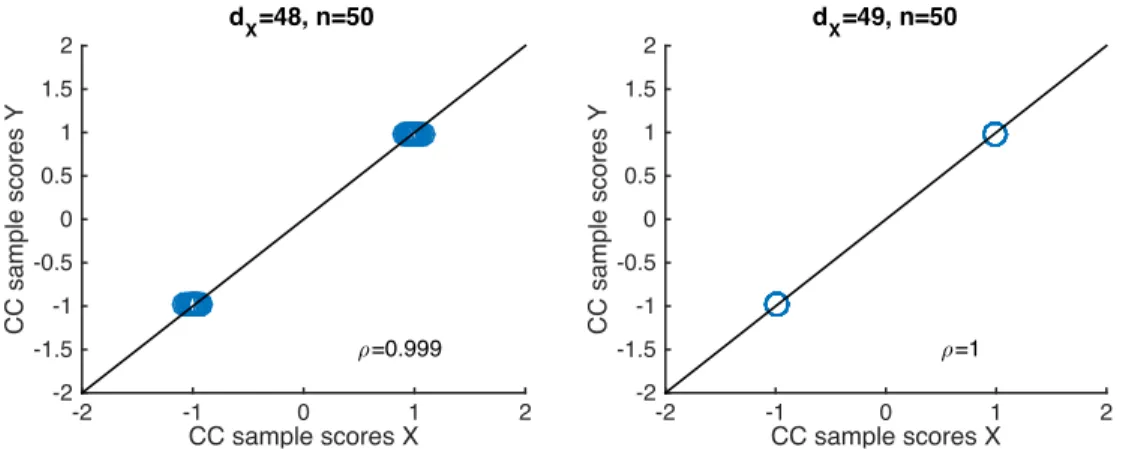
Figure 2.1: The first pair of CCA scores forX andY. The left two panels show that whend < n 1,
the empirical correlation between CCA scores is less than1. The right panel shows that
when d = n, the empirical correlation between CCA scores is 1. These three panels
illustrate the tendency of CCA to overfit asd! 1.
In the left two panels of Figure 2.1, the dimension
d
is less than the sample size
n
. We
can see that the projections do not lie along the 45
oline perfectly. Therefore the correlation
perfectly. Therefore the correlation is
1
. These three panels illustrate the tendency of CCA to
overfit as
d
! 1
. If the matrix
Y
is a class indicator vector, we have the following corollary.
Corollary 1.
Suppose a
d
X⇥
n
data matrix
X
is from a probability distribution that is
absolutely continuous with respect to Lebesgue measure. Further assume that
Y
˜
is a
1
⇥
n
class indicator vector
˜
Y
= (˜
y1, . . . ,
y
˜
n),
(2.22)
where
y
˜
i2
{
1
,
+1
}
for all
i
= 1
, . . . , n. We denote
Y
as the centered version of
Y
˜
, then
the dimension of matrix
Z
= (X;
Y
)
is
d
X+ 1
. Suppose rank
(X
) = min (
d
X, n
1)
, then
we have the following conclusions
1. If
d
X
n
2
, there do not exist any vectors
a
and
b
such that
⇢
= 1
. In other words,
⇢
is always less than 1.
2. If
d
Xn
1
, with probability 1, there exist at least one pair of vectors
a
and
b
such
that
⇢
= 1
.
Again, we will use simulated examples to illustrate the above conclusions. The
CC sample scores X
-2 -1 0 1 2
CC sample scores Y
-2 -1.5 -1 -0.5 0 0.5 1 1.5 2
;=0.999 dX=48, n=50
CC sample scores X
-2 -1 0 1 2
CC sample scores Y
-2 -1.5 -1 -0.5 0 0.5 1 1.5 2
;=1 dX=49, n=50
Figure 2.2: The first pair of CCA directions forX andY, whereY is a1⇥nclass indicator vector. The left panel shows whendX = n 2, the empirical correlation between CCA scores
is less than 1. The right panel shows whendX =n 1, the projection of all points onto
the CCA directions are piled at two distinct values. Therefore the empirical correlation between CCA scores is perfect as 1.
In each panel of Figure 2.2,
Y
is a class indicator vector defined as (2.22), data matrix
X
consists of
n
= 50
d
X-dimensional samples simulated from a Gaussian distribution. In the
left panel, the dimension of
X
is
d
X= 48
n
2
. We can see that the projections do not
lie along the 45
oline perfectly. Therefore the correlation is less than 1. In the right panel,
the dimension is
d
X= 49
n
1
. We can see that the projections lie along the 45
oline
perfectly. Therefore the correlation is perfect as 1. In addition, if we project the data onto the
first CCA direction of
X
, all data points will pile at only two distinct values. This interesting
CHAPTER 3: LINEAR DISCRIMINATION METHODS
In this chapter we first review four linear methods for two-class discrimination. The goal
of discrimination is to find a rule for assigning the labels
+1
or
1
to new data vectors,
depending on whether the vectors are “more like class
+1
” or “more like class
1
”. In
particular, we review the Fisher Linear Discrimination (FLD) in Section 3.1, Support Vector
Machine (SVM) in Section 3.2, Maximal Data Piling (MDP) in Section 3.3 and Distance
Weighted Discrimination (DWD) in Section 3.4. In Subsection 3.3.5, we study the geometric
representation of an interesting dataset with strongly auto-regressive errors under the HDLSS
setting and understand why the MDP is the best in terms of classification compared with
several other commonly used linear discrimination methods. Then we review a quantitative
measurement called Standardized WithIn class Sum of Squares (SWISS) for quantifying how
well a data clusters into predefined classes in Section 3.5. Within this section, we will also
discuss the relationship of SWISS with MDP.
3.1 Fisher Linear Discrimination
As we reviewed in Section 2.2, PCA is an exploratory technique which does not use
the predefined class label information. We refer to this kind of technique as
unsupervised
techniques
. How can the class label information be used in finding information projections?
sification in this 1-dimensional space.
Formally, we use a
d
⇥
n
matrix
X
= (x
1, . . . ,xn)
to denote our centered (where row
means have been subtracted) dataset. Let
X
+1and
X
1denote the collection of samples
xi
which belong to Class
+1
and Class
1
respectively. We use
n+1
and
n
1to denote the
number of samples of each class. Besides, we let
X
˜
+1and
X
˜
1denote the centered versions
of
X
+1and
X
1respectively.
Suppose the two classes of samples have sample means
x
¯
+1and
x
¯
1and sample
covari-ances matrices
S
+1and
S
1respectively. The normal vector perpendicular to the
discrimi-nant hyperplane is defined as the solution
w
2
R
dfound by maximizing
J
(w) =
w
T
BSS
w
w
TW SS
w
(3.1)
subject to
w
Tw
= 1
, where BSS is the “Between-class Sum of Squares” defined as
BSS
=
XX
TX
˜
+1X
˜
T
+1
X
˜
1X
˜
T
1
,
and WSS is the “Within-class Sum of Squares” defined as
W SS
= ˜
X
+1X
˜
T
+1
+ ˜
X
1X
˜
T
1
.
Maximizing
J
(w)
yields a closed form of optimal normal vector, i.e., the FLD normal vector
w
=
W SS
1
(¯
x
If WSS is not invertible, then we use the Moore-Penrose pseudoinverse (see Chapter 1 of
Ben-Israel and Greville (2003) for detailed discussions). Thus we have obtained
w
for FLD
- the linear function yielding the maximum ratio of BSS to WSS. The classification has been
converted from a
d
-dimensional problem to a more manageable 1-dimensional one.
Similar to Canonical Correlation Analysis reviewed in Subsection 2.3.1, solving the
op-timization problem (3.1) yields the following generalized eigen-analysis
BSS
w
=
W SS
w
,
(3.3)
and the FLD normal vector is the eigenvector corresponding to the largest eigenvalue. Since
matrix BSS is of rank 1, there is only 1 non-zero eigenvalue of this generalized eigen-analysis
(3.3). And the unit length eigenvector corresponding to this eigenvalue has the closed form
as (3.2).
3.2 Support Vector Machine
The Support Vector Machine (SVM) was first proposed by Cortes and Vapnik (1995). The
SVM constructs a hyperplane in a high-dimensional space, which can be used for
classifica-tion, regression, or other tasks. Intuitively, a good separation is achieved by the hyperplane
that has the largest distance to the nearest training data point of any class. Again, let our
training dataset be the same as in Section 3.1. Defined a hyperplane by
where
w
is a unit vector. For the moment we assume that the classes are separable, i.e., we
can find a function
f
(x) =
x
Tw
+
with
y
i
f
(xi)
>
0
for all
i
= 1
, . . . , n
. The key idea
behind SVM is to find
w
and to keep the data in the same class all on the same side of, and
also as far as possible from, the separating hyperplane. This is quantified using a maximum
optimization formulation, focusing only on the training data points closest to the separating
hyperplane, called
support vectors
. The optimization problem
max
w,
M
(3.4)
subject to
y
ix
Tiw
+
M
for all
i
= 1
, . . . , n
and
w
Tw
= 1
captures this concept. This
problem can be more conveniently rephrased as
min
w,
k
w
k
(3.5)
subject to
y
ix
Tiw
+
1
for all
i
= 1
, . . . , n
, which is equivalent to
min
w,
1
2
w
T
w
(3.6)
subject to
y
ix
Tiw
+
1
for all
i
= 1
, . . . , n
where we have dropped the norm constraint
on
w
. Note that
M
= 1
/
k
w
k
. Equation (3.6) is the usual way of writing the support vector
criterion for separated data.
Suppose now that the classes are no longer separable, i.e., they overlap in feature space.
as
y
ix
Tiw
+
M
(1
⇠
i)
,
for all
i
= 1
, . . . , n
,
⇠
i0
,
Pn
i=1⇠
i
C
,
C
is a constant. The value
⇠
iis the proportional
amount by which the prediction
f
(x
i) =
x
Tiw
+
is on the wrong side of its margin. Hence
by bounding the sum
Pn
i=1⇠
i, we bound the total proportional amount by which predictions
fall on the wrong side of their margin. Then the optimization problem is
min
w, ,⇠1
2
w
T
w
subject to
y
ix
Tiw
+
1
⇠
i⇠
i0
,
nX
i=1
⇠
i
C
for all
i
= 1
, . . . , n
, which can be rephrased as
min
w, ,⇠1
2
w
T
w
+
C
1
Tn
⇠
(3.7)
subject to
y
ix
Tiw
+
1
⇠
ifor all
i
= 1
, . . . , n
, where
1n
= (1
, . . . ,
1)
Tand
C
is a positive penalty parameter. In the
rest of this article we use Gunn’s recommendation of
C
= 1000
for SVM. This is the usual
way the SVM is defined for the non-separable case. By the nature of the criterion (3.7), we
see that points inside their class boundary do not play a role in shaping the boundary. More
details of SVM including the computation and examples can be found in Vapnik (2000);
Vapnik and Kotz (2006) , Burges (1998), Cristianini and Shawe-Taylor (2000), Schlkopf and
Smola (2001) and Hastie et al. (2013).
3.3 Maximal Data Piling
In two-class discrimination when the dimension is larger than the sample size, there exist
direction vectors onto which the data project to only two distinct values, one for each class.
The Maximal Data Piling (MDP) direction for discrimination was proposed by Ahn and
Marron (2010). Why it is called maximal data piling direction vector is because the data
are piled on two points while maximizing the distance in between. We assume that the
dimension
d
satisfies
d
n
1
, where
n
is the sample size. We also assume that the data are
not degenerate, in the sense of generating a subspace of dimension
n
. Data piling was first
discussed in Marron et al. (2007). They observed that the SVM classifier yielded substantial
data piling when it was applied to HDLSS data. MDP can be regarded as an extreme version
3.3.1 Review of Maximal Data Piling
We use the same notations as in Section 3.1. In addition, we use
X
˜
=
⇣
X
˜
+1,X
˜
1⌘
to
denote the horizontal concatenation of the two centered matrices of the two classes.
The MDP normal vector is defined as the solution
w
2
R
dfound by solving the
opti-mization problem
max
w⇥
w
T(¯
x
+1x
¯
1)
⇤
2(3.8)
subject to
w
Tw
= 1
and
X
˜
Tw
= 0
. This optimization problem can be interpreted as
maximizing the squared difference between the projected class means while insisting that the
projection of each class point onto the unit direction vector is the same as its class mean.
There are some insightful optimization problem that are equivalent to (3.8). The MDP
normal vector
w
2
R
dcan be found by solving the problem of maximizing
J
(w) =
w
T
BSS
w
w
TT SS
w
,
(3.9)
subject to
w
Tw
= 1
, where TSS is the “Total Sum of Squares” defined as
T SS
=
XX
T.
We can see that the above optimization problem is a simple replacement of the Within-class
Sum of Squares WSS in FLD optimization problem (3.1) by the Total Sum of Squares TSS.
Why does this make sense? It says that a good solution is one where the class means are
section that when
d
n
2
, (3.9) is equivalent to FLD, which does not have the piling
property. When
d
n
1
, (3.9) yields complete data piling. The FLD is invariant under
affine transformation of data when
d
n
2
, but (3.9) is not. However, we can view MDP
as an appropriate high dimension, low sample size version of FLD in the sense that it yields
data projections with zero WSS and maximized BSS.
Similar to Equation (3.2), maximizing
J
(w)
in (3.9) yields a closed form of optimal
normal vector, i.e., the MDP normal vector
w
=
T SS
1
(¯
x
+1
x
¯
1)
k
T SS
1(¯
x
+1
x
¯
1)
k
.
(3.10)
If TSS is not invertible, we use the Moore-Penrose pseudoinverse. Similarly, solving the
MDP optimization problem (3.9) yields the following generalized eigen-analysis
BSS
w
=
T SS
w
(3.11)
and the MDP normal vector is the eigenvector corresponding to the largest eigenvalue of
T SS
1BSS
. More detailed discussion and examples can be found in Ahn and Marron
(2010).
3.3.2 Maximal Data Piling solved by Canonical Correlation Analysis
In this subsection, we derive the connection between MDP and CCA. From the
connec-tion we can see that the MDP normal vector is a special case of the canonical vector using
indicator vector
Y
to have the form
Y
= (
y1, . . . , y
n),
(3.12)
such that
y
i2
{
q
n1 n·n+1
,
q
n+1n·n 1
}
for
i
= 1
, . . . , n
. We assume that there are
n
+y
is equal
to
q
n 1n·n+1
and
n y
is equal to
q
n+1n·n 1
. Therefore it naturally follows
n
=
n+1
+
n
1.
The reason why we use this specific class indicator vector instead of the conventional one
(2.22) in Subsection 2.3.2 is because applying this class indicator vector (3.12) to the CCA
calculation will give us the same generalized eigen-analysis as (3.11).
First we have that
XY
T=
r
n+1n
1n
(¯
x
+1x
¯
1)
.
With the fact
Y Y
T= 1
and using the result (2.13) in Subsection 2.3.1
XY
TY Y
T 1Y X
Tu
=
⇢
2XX
Tu
we have
n+1n
1n
(¯
x
+1x
¯
1) (¯
x
+1x
¯
1)
T
=
⇢
2XX
Tu
.
After some easy algebra we have
This can be equivalently rewritten as
BSS
u
=
⇢
2T SS
u
,
(3.13)
which is identical to the generalized eigen-analysis of MDP (3.11).
This relationship shows that the MDP normal vector is the canonical vector of the
ma-trix
X
when
Y
is a class indicator vector. Next we use equation (3.13) to help us better
understand the connection between MDP and FLD.
3.3.3 Relationship to Fisher Linear Discrimination
Ahn discovered the identity of MDP and FLD normal vectors under non-HDLSS settings,
i.e.
d
X
n
2
, from their closed form solutions given by (3.10) and (3.2) respectively
in her dissertation (see Subsection 3.3.2 of Ahn (2006)). However, we study this property
from another perspective using generalized eigen-analysis in this subsection. The following
theorem says the FLD and MDP normal vectors are equivalent up to a
±
sign under
non-HDLSS settings.
Theorem 2.
Let
wF LD
and
wM DP
be the FLD and MDP normal vectors of the same dataset.
If
d
X
n
2
and the data matrix
X
is full rank, i.e., rank
(X) =
d
X, then
wF LD
and
wM DP
are equivalent up to a
±
sign.
Proof.
It is easy to see that
Therefore the Equation (3.13) can be written as
1
⇢
2BSS
u
=
⇢
2W SS
u
.
(3.14)
From the assumptions we know rank
(X) =
d
X
n
2
, then by Corollary 1 we know
that the correlation follows
⇢
<
1
. Therefore Equation (3.14) can be written as
BSS
u
=
⇢
2
1
⇢
2W SS
u
.
(3.15)
This is identical to the generalized eigen-analysis of FLD in Equation (3.3) but with
=
⇢
2/
(1
⇢
2)
. This implies that when
d
X