104
RESEARCH ON THE EVALUATION OF QUALITY CHARACTERISTICS IN
SOME SORGHUM GENOTYPES UNDER THE CONDITIONS SANDY
SOILS FROM SOUTHERN OLTENIA
CROITORU MIHAELA1, DRĂGHICI I1., DRĂGHICI RETA1, DIMA MILICA1
1) Research and Development Station for Plant Culture on Sandy Soils Dăbuleni
E-mail: [email protected]
Keywords:sorghum, quality, protein, sandy soils
ABSTRACT
The present paper aims at the behavior of some sorghum genotypes in terms of adaptability to the climatic conditions specific to the sandy soils areas in southern Oltenia, manifested during the testing of the production capacity and its quality.
The quality of grains at sorghum specie is strongly influenced by the genotype, the technology of culture and climatic conditions during the experimentation period.
The best results were obtained from the hybrids: Es Mousson (75.6 kg /
hl hectolitric mass, 31.5 g mass of one thousand grains, 7.4% moisture, 20.5% protein, 10.8% fats), Elan (74.8 kg / hl hectolitric mass, 28.8 g weight of one thousand grains (WTG), 5.2% moisture, 19.2% protein, 8.9% fats) and Es Alize (72.4 kg / hl hectolitric mass, 23.9 mass of one thousand grains, 7.8% moisture, 18.3% protein, 8.4% fats). The highest yields were obtained from hybrids Es Shamal (9646kg / ha) and Es Foehn (9421kg / ha).
INTRODUCTION
Sorghum is a high-grain cereal, ranked fourth in the world after grains production, and fifth on the cultivated surface (wheat, rice, corn and barley). It has a great development due to its use in human nutrition, especially in the semi-arid areas of the world, where the pedoclimatic conditions offer limited conditions for agriculture [16].
Of the total world production of sorghum, the consumption has the following weight: 53.3% serve in human food, 39.4% is used in animal feed and 2% in the light food industry [14].
The climatic evolution towards heating and aridization in 2001-2050 in the Balkans area, where Romania is located, obliges the sorghum to be reconsidered as: food cereal (the grains are used in the formula the composite flour for gluten and agltutenic baking, juice, extracts from strains used in the manufacture of syrup, vinegar and other
food), fodder plant (green meal, hay, silo, fodder pellets) and technical plant (sugar sorghum and broomstick) intended for the production of raw materials for the energy industry (fuels, liquids, solids, gasses, electricity, heat), chemical industry (paper and textile pulp, plastic), building materials industry and handicraft (household and industrial brushes, braids) [2].
105
quality of sorghum is an important aspect of the sorghum improvement program [18].
Sorghum is a cereal rich in nutrients, dietary fiber and bioactive components, but considered to be of low value for humans and often used as animal feed.
Determinations of the qualities of sorghum grains have been the subject of many research that has highlighted the influence of variety, technological factors
and climatic factors on protein, fat, water, cellulose,tannins,etc.[1, 2, 4, 5, 7, 9 ,10 ,14, 16, 17].
In Romania, the research aimed to determine the production potential of grain sorghum hybrids (Sorghum bicolor (L.) Moench var. Eusorghum) in terms of the use of restrictive pedo-climatic conditions [3, 6, 11, 13], and the results obtained varied under the influence of the experimental factors (fertilization, rotation, water regime, sowing distance, density).
MATERIAL AND METHOD
Research has been conducted in Research and Development Station for Plant Culture on Sandy Soils Dăbuleni. The biological material studied consisted in 10 varieties of sorghum: Es Alize, Albanus, Arsky, Calatur, Es Mousson, Es Shamal, Es Foehn, Armorik, Alimentar 1, Elan. Were performed the following observations and determinations: * determined protein (%) - Perten method;
* determined moisture (%) - Perten method;
* determined faths(%) - Perten method; * determined hectolitric mass (HM) (kh/hl)- Swantec device method; * determined the weight of one thousand grains (WTG), (g) - weighing balance KERN digital electronic type method; * production (kg / ha).
RESULTS AND DISCUSSIONS
The sorghum crop, in the form of grains used in food, or in the food industry, as well as the silo, or paste used in animal feed, can be characterized qualitatively after several parameters. Sorghum is a cereal rich in nutrients, dietary fiber and bioactive components, but considered to be of low value for humans and often used only as animal feed.
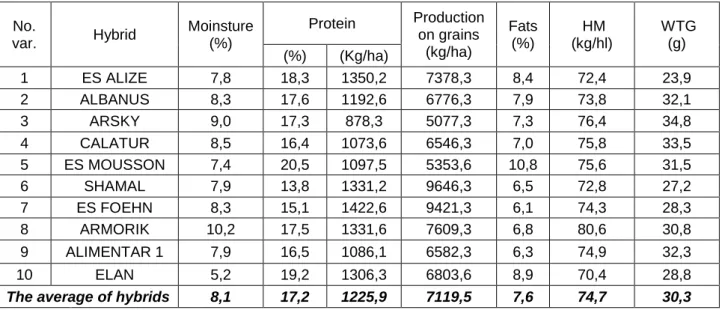
Sorghum grains are made up mostly of non-added extractive substances, proteinaceous substances, and water. Fatty substances are found in smaller quantities. The grains of sorghum also contain mineral substances, vitamins, enzymes and others. Their nutritional value is close to that of corn. In this experience we studied the influence of the hybrid on qualitative qualities of sorghum grains. The results obtained are shown in Table 1.
Moisture grains is an important indicator of quality appreciation. Optimum grains moisture at harvest is 14%. At hybrids studied, grains humidity was between 5.2% for the Elan hybrid and 10.2% for the Armorik hybrid, with an average hybrid of 8.05%.
The amount of protein in the beans showed different values depending on the hybrid studied, as well as the climate conditions in the area of culture. In the sorghum grains, an average protein content of 13.8% for the Shamal hybrid and 20.5% for the Es Mousson hybrid was determined, with an average hybrid of 17.22%. Greater than the hybrids higher hybrids were found in the hybrids: Elan (19.2%), Es Alize (18.3%), Albanus (17.6%) and Armonik (17.5%).
106
(15.3-15.9%), and the researches of M. Mabelebele et al., 2015,[10] showed much lower protein content (8.1-9.5%) but similar to those of Rooney and
Serna-Saldivar 2000,[17] which reported a crude protein content in sorghum grains ranging from 6.0 to 10.0%.
Table 1 The influence of variety on the nutritional quality of grains sorghum
No.
var. Hybrid
Moinsture (%)
Protein Production on grains
(kg/ha)
Fats (%)
HM (kg/hl)
WTG (g) (%) (Kg/ha)
1 ES ALIZE 7,8 18,3 1350,2 7378,3 8,4 72,4 23,9
2 ALBANUS 8,3 17,6 1192,6 6776,3 7,9 73,8 32,1
3 ARSKY 9,0 17,3 878,3 5077,3 7,3 76,4 34,8
4 CALATUR 8,5 16,4 1073,6 6546,3 7,0 75,8 33,5
5 ES MOUSSON 7,4 20,5 1097,5 5353,6 10,8 75,6 31,5
6 SHAMAL 7,9 13,8 1331,2 9646,3 6,5 72,8 27,2
7 ES FOEHN 8,3 15,1 1422,6 9421,3 6,1 74,3 28,3
8 ARMORIK 10,2 17,5 1331,6 7609,3 6,8 80,6 30,8
9 ALIMENTAR 1 7,9 16,5 1086,1 6582,3 6,3 74,9 32,3
10 ELAN 5,2 19,2 1306,3 6803,6 8,9 70,4 28,8
The average of hybrids 8,1 17,2 1225,9 7119,5 7,6 74,7 30,3
The amount of protein calculated from the production in kg / ha was influenced by the hybrid studied and the production of the grains obtained. The amount of protein expressed in kg / ha was between 878.3kg / ha for Arsky hybrid and 1422.6kg / ha for the Es Foehn hybrid. These results are similar to those obtained by I Antohe, 2007,[7] on the soils from Fundulea (the amount of crude protein in grain sorghum hybrids created and tested on zonal soils at INCDA Fundulea, between 1982-1986 ranged between 959 kg / ha in hybrid F31 and 976kg / ha in hybrid F21), but higher compared to those obtained by Pochiscanu Simona, 2015[16] (the amount of protein ranged between 178kg / ha in Alize hybrid and 802kg / ha in the Armida hybrid) under the conditions pedoclimatic center of Moldova.
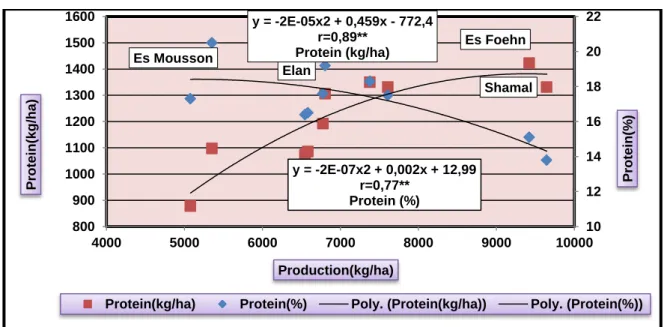
Between the grain production and the amount of protein expressed as a percentage and in kg / ha were established polynomial correlations given by the second degree equations with significant correlation factors (Figure 2).
The amount of protein expressed as a percentage decreases with the increase in production and the one expressed in kg / ha increases with the increase in production.
Fat content ranged between 6.1% for the Es Foehn hybrid and 10.8% for Es Mousson, with an average hybrid of 7.6% (Table 1). Similar values were obtained by I. Antohe, 2007, [2] under the conditions of Fundulea (the amount of fat was between 3.2% for hybrid F32 and 6.5% for hybrid F26l hl).
107
Figure 1 - The correlation between grains production and the amount
of protein expressed in % and kg / ha
The hectolitreal mass ranged from 70.4kg / hl to the Elan hybrid and 80.6kg / hl to the Armorik hybrid with an average hybrid of 74.7kg / hl. A polynomial correlation given by a second degree equation with a significant correlation
factor (r = 0.90 **) was established between the hectolitric mass of sorghum grains and grain humidity. The hectolitreal mass of the grains increases with increasing humidity (Figure 2).
Figure 2 - The correlation between grain s moinsture (%) and mass hectolitric(kg/ha)
As for the weight of one thousand grains (WTG), the values ranged from 23.9g to the Es Alize hybrid and 34.8g to the Arsky hybrid, with an average hybrid of 30.3g.
Drăghici I., 2007, [7] in the conditions of sandy soils in southern Oltenia, resulted in a series of sorghum hybrids obtained at ICDCC Fundulea
WTG values ranging from 20.1-24.8g, thus lower compared to the results obtained at hybrids studied under the same conditions, and Volf M., 2009,[19] under the conditions of Fundulea determined a WTG in sorghum grains, between 20-38g, so similar values. The obtained results reveal the influence of the studied hybrid and the climatic
Shamal Es Foehn Es Mousson
Elan
y = -2E-05x2 + 0,459x - 772,4 r=0,89**
Protein (kg/ha)
y = -2E-07x2 + 0,002x + 12,99 r=0,77**
Protein (%)
10 12 14 16 18 20 22
800 900 1000 1100 1200 1300 1400 1500 1600
4000 5000 6000 7000 8000 9000 10000
Prote
in
(%
)
Pr
otei
n(kg
/ha
)
Production(kg/ha)
Protein(kg/ha) Protein(%) Poly. (Protein(kg/ha)) Poly. (Protein(%))
Arsky Armonik y = 0,309x2 - 2,861x + 77,20
r=0,90**
68 70 72 74 76 78 80 82
4 5 6 7 8 9 10 11 12
Hec
tol
itric
m
a
s
s
(k
g/
hl
)
Moinsture(%)
108
conditions in the area of culture on the qualities of sorghum grains.
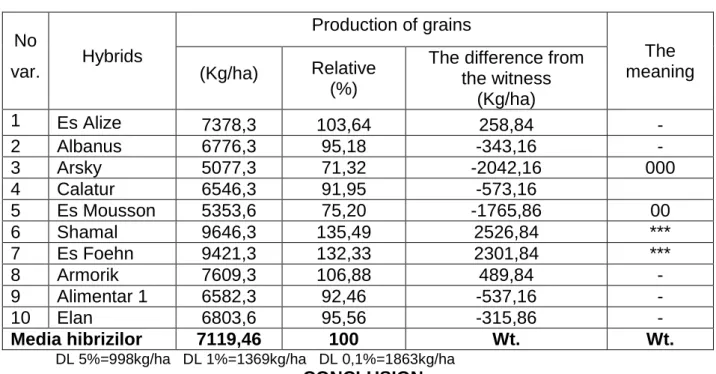
The grains yield was 5077.3kg / ha for the Arsky hybrid and 9646.3kg / ha for Shamal hybrid, with an average hybrid of 7119.46kg / ha. Compared to the mean value statistical gains were obtained from the Shamal and Es Foehn hybrids.
Similar results were also obtained on the sandy soils in southern Oltenia by Drăghici I, 2007, [7] at a series of hybrids obtained at ICDCC Fundulea (5283-7866kg / ha). Also, Oprea Cristina Andreea, 2018, [15] under conditions in the southeastern part of Romania, obtained production ranging from 5000 to 11880kg / ha.
Table 2 Production of grains obtained in 2018 for grain sorghum hybrids
No
var. Hybrids
Production of grains
The meaning (Kg/ha) Relative
(%)
The difference from the witness
(Kg/ha)
1 Es Alize 7378,3 103,64 258,84 -
2 Albanus 6776,3 95,18 -343,16 -
3 Arsky 5077,3 71,32 -2042,16 000
4 Calatur 6546,3 91,95 -573,16
5 Es Mousson 5353,6 75,20 -1765,86 00
6 Shamal 9646,3 135,49 2526,84 ***
7 Es Foehn 9421,3 132,33 2301,84 ***
8 Armorik 7609,3 106,88 489,84 -
9 Alimentar 1 6582,3 92,46 -537,16 -
10 Elan 6803,6 95,56 -315,86 -
Media hibrizilor 7119,46 100 Wt. Wt.
DL 5%=998kg/ha DL 1%=1369kg/ha DL 0,1%=1863kg/ha CONCLUSION
The quality of grains at sorghum specie is strongly influenced by the genotype, the technology of culture and climatic conditions during the experimentation period.
The best results were obtained from the genotypes: Es Mousson (75.6 Kg/hl hectolitric mass, 31.5 g mass of one thousand grains, 7.4% moisture, 20.5% protein, 10.8% fats), Elan (70.4
kg/hl hectolitric mass, 28.8 g mass of one thousand grains, 5.2% moisture, 19.2% protein, 8.9% fats) and Es Alize (72.4 kg / hl hectolitric mass, 23.9 mass of one thousand grains, 7.8% moisture, 18.3% protein, 8.4 % fats). The highest yields were obtained from hybrids Shamal (9646.3kg / ha) and Es Foehn (9421kg / ha).
AKNOWLEDGEMENT This work was supported by a grant of the Romanian Ministery of Research and Innovation, CCCDI - UEFISCDI, project number
9PCCDI/2018, entitled „Complex system of integral capitalization of agricultural species with energy and food potential", within PNCDI III.
109
BIBLIOGRAPHY
1.Abdel-Rahman I.E., 2000.
Microbiological and biochemical changes during fermentation of sorghum. M.Sc. thesis, University of Khartoum, Sudan
2.Antohe I., 2007, Realizări în
ameliorarea sorgului la Fundulea, An. I.N.C.D.A. Fundulea, Vol. LXXV, 2007, Volum jubiliar, Genetica şi Ameliorarea Plantelor, p. 137-157
3.Antohe, I., Drăghici, I., Naidin, C., 2002
– Sorghum an alternative crop for south of Romania. In: Drought mitigation and prevention of land desertification, 22-24 April, 2002, Bled, Slovenia: 112.
4.Basahy, A., 1995. Chemical
composition of sorghum grains (Sorghum bicolor (L.) Moench, Poaccae) grown in Gizan area, Saudi Arabia. J. Sci. Res. 13, 151-161.
5.BeanS.R., J.D. Wilson, R.A. Moreau, A
. Galant, J.M. Awika, R. C. Kaufman,
S.L. Adrianos, B.P. Ioerger ,
2014,Structure and Composition of the Sorghum Grain, Book: Sorghum: State of
the Art and Future Perspectives,
doi:10.2134/agronmonogr58.2014.0081
6.Drăghici I., 2007, Cercetari privind
comportarea unor genotipuri de sorg pentru boabe pe solurile nisipoase irigate, Lucrări Ştiinţifice C.C.D.C.P.N. DăbulenI Vol.XVI, p. 7-22
7.Gassem, M.A.A. & Osman, A.M., 2003.
Proximate composition and the content of sugars, amino acids and anti-nutritional
factors of three sorghum varieties.
Agricultural Research Center, King Saud University, Research Bulletin No 125, 5-19.
8.Gopalan C., Srikantia S.G., 1960.
Leucine and pellagra, Lancet 1, 954–957.
9.Khalil J.K., W.N. Sawaya, W.J. Safi,
H.M. Al-Mohammad, 1984, Chemical
composition and nutritional quality of sorghum flour and bread, Qual Plant Plant Foods Hum Nutr 34 (1984) 141-150
10.Mabelebele M., M. Siwela, R.M. Gous,
P.A. Iji, 2015, Chemical composition and
nutritive value of South African sorghum varieties as feed for broiler chickens, South African Journal of Animal Science 2015, 45 (No. 2
11.Matei Gh., 2011, Research on some
technological measures for increasing the yields on grain sorghum cultivated on sandy soils from Tâmbureşti, Annales Of The University Of Craiova, Agriculture, Montanology, Cadastre Series (ISSN 1841-8317; ISSN CD-ROM 2066- 950X) - Congres ESNA 2011, vol. XLI/1 2011
12.Morton J.R., 1970, Tentative
correlations of plant usage and
esophageal cancer zones.Economic
Botany 24, 217–220.
13.Mureşan T., Cosmin O., Sarca Tr.,
1961 – Importanta culturii sorgului şi comportarea unor hibrizi încercaţi la Baza experimentală Fundulea în anii 1958-1960. Probleme agricole, 8: 19-26.
14.Nica V., 2011,Studiul comporativ
privind productivitatea, calitatea producției și rentabilitatea culturilor de porumb și sorg în condițiile pedoclimatice din județul Ialomița, Teză de doctorat USAMV București
15.Oprea Cristina Andreea, 2018,
Cercetări privind cultura sorgului pentru boabe (Sorghum Bicolor var. Eusorghum) în condițiile din zona de sud-est a României , Teză de doctorat USAMV București
16.Pochiscanu Simona, 2015,Cercetări
privind aplicarea unor secvențe
tehnologice moderne la sorg (Sorghum bicolor L.) în condițiile pedoclimatice din Centrul Moldovei, Teză de doctorat USAMV Iași.
17.Rooney L.W., Serna-Saldvar, S.O.,
2000. Sorghum. Handbook of Cereal Science and Technology. (2nd ed.). Eds: Kulp, K. & Ponte, J., New York, NY. pp. 149-175.
18.Salunkhe D. K., S. S. Kadam, J. K.
Chavan, 1977, Nutritional quality of
proteins in grain sorghum, Qualitas Plantarum, Volume 27 , Issue 2, pp 187– 205
19.Volf M., 2009,Îmbunătăţirea tehnologiei