NEITHER FORCE NOR WILL: A THEORY OF JUDICIAL POWER
Alixandra B. Yanus
A dissertation submitted to the faculty of the University of North Carolina at Chapel Hill in partial fulfillment of the requirements for the degree of Doctor of Philosophy in the
Department of Political Science.
Chapel Hill 2010
ABSTRACT
ALIXANDRA B. YANUS: Neither Force Nor Will: A Theory of Judicial Power (Under the direction of Georg Vanberg)
TABLE OF CONTENTS
LIST OF TABLES...vi
LIST OF FIGURES ...vii
Chapter I. NEITHER THE PURSE NOR THE SWORD...1
The Evolution and Institutionalization of Judicial Power...2
The Court as Policy Maker...5
Courts as Policy Venues: Constitutional v. Statutory Law ...7
Interactions with Media...12
Interactions with Interest Groups...14
Looking Forward ...16
II. EXPLAINING HOW COURTS AFFECT MEDIA ATTENTION TO JUDICIAL BUSINESS...19
Theoretical Foundation ...19
Hypotheses ...26
Data and Methods ...28
Findings: Breadth of Coverage...36
Findings: Depth of Coverage...37
Discussion...40
Conclusion...44
Theoretical Foundation ...49
Hypotheses ...56
Data and Methods ...57
Findings...62
Discussion...65
Conclusion...70
IV. EXPLAINING HOW COURTS INFLUENCE INTEREST GROUP PARTICIPATION AS AMICUS CURIAE...76
Theoretical Foundation ...76
Hypotheses ...84
Data and Methods ...86
Findings...91
Discussion...97
Conclusion...101
V. EXPLAINING JUDICIAL EFFECTS ON LEGISLATIVE LOBBYING ...107
Theoretical Foundation ...113
Hypotheses ...113
Data ...117
Findings...122
Discussion...124
Conclusion...134
VI. …BUT ONLY JUDGMENT ...134
A Broader View of Judicial Power ...134
LIST OF TABLES
Table
2.1. Characteristics of State Supreme Court Decisions ...xx
2.2. Predictors of the Breadth of News Coverage of State Supreme Courts ...xx
2.3. Predictors of the Depth of News Coverage of State Supreme Courts ...xx
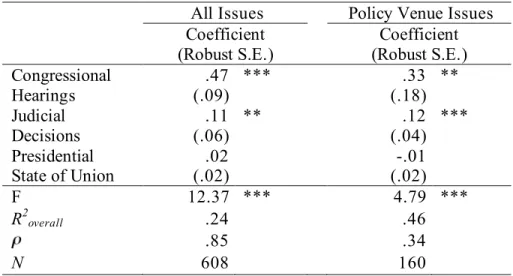
3.1. Predictors of Media Attention to Political Issues ...xx
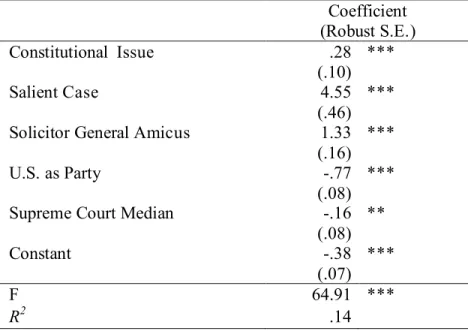
4.1. Predictors of Amicus Participation Before the Supreme Court ...xx
4.2. Predictors of Amicus Participation Before the Supreme Court Reconsidered...xx
5.1. Policy Agendas Project Issue Areas ...xx
LIST OF FIGURES
Figure
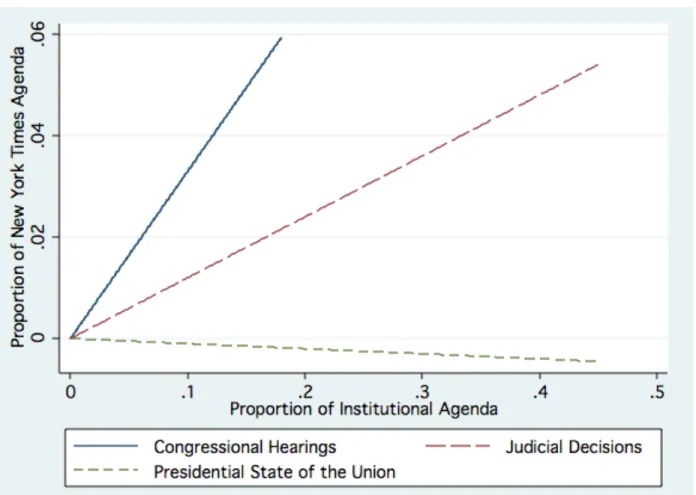
3.1. Institutional Effects on Media Attention, All Issues ...xx
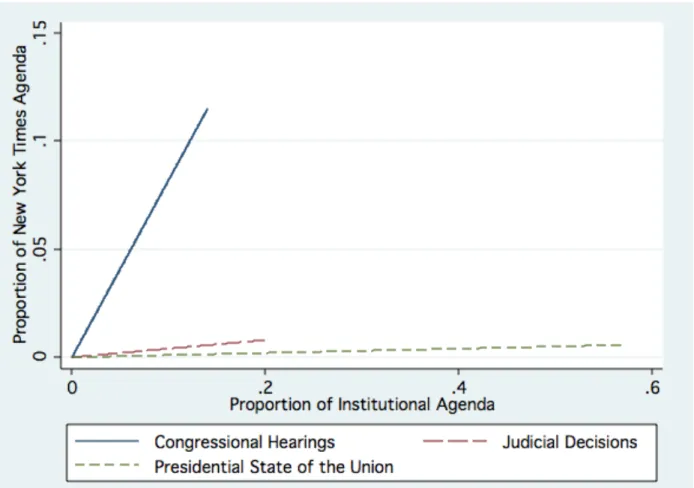
3.2. Institutional Effects on Media Attention, Policy Venue Issues...xx
3.3. Institutional Effects on Media Attention, Non-Policy Venue Issues...xx
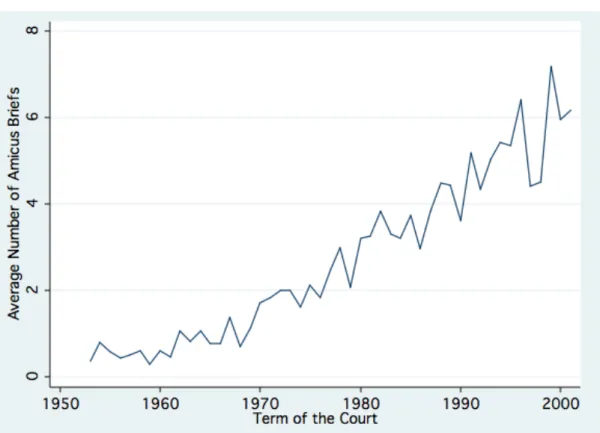
4.1. Average Number of Amicus Briefs Per Year, 1946-2001 ...xx
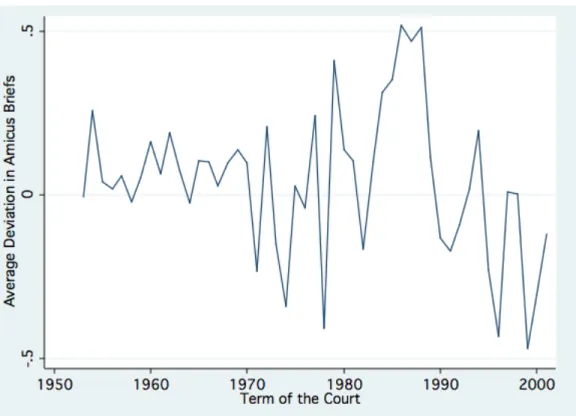
4.2. Average Deviation of Amicus Briefs Per Year, 1946-2001 ...xx
5.1. Congressional Hearings by Issue Area ...xx
5.2. Supreme Court Docket by Issue Area...xx
5.3. Interest Group Participation in the Legislature by Issue Area ...xx
5.4. Interest Group Participation in the Judiciary by Issue Area ...xx
CHAPTER 1
NEITHER FORCE NOR WILL
Questions about the scope of judicial power in the American political system are as old as the United States itself. Writing in Federalist No. 78, Alexander Hamilton argued that the Supreme Court’s inability to enforce or implement its decisions—the idea that the Court had neither the purse nor the sword—made the judiciary the “least dangerous branch.” Later, on the heels of the Court’s decision in Worcester v. Georgia (1832), President Andrew Jackson is reported to have again pointed to this relative lack of power, declaring, “[Chief Justice] John Marshall has made his decision. Now let him enforce it.”
But, much has changed since 1832, including the judiciary’s visible role in many twentieth century social movements. This role has spawned volumes of judicial politics scholarship documenting the courts as agents of social change (e.g. Vose 1957, 1959, 1972, O’Connor 1980). These studies have demonstrated that, at least in some conditions, the involvement of the judiciary can be a significant impetus to altering public policy, changing grassroots opinion, and inspiring political change.
political power. I argue that the interactions between the courts and these agents have significant effects on public policy, both within the judiciary and in the broader political system.
The Evolution and Institutionalization of Judicial Power
The judicial branch occupies a unique role in the American political system. As Hamilton noted, the courts have neither the purse nor the sword. They can neither make laws nor command power in the appropriations process; these powers are given to Congress under the U.S. Constitution of 1787. The judiciary also lacks the power to implement or enforce legislation; these tasks fall to the president and the executive branch.
In fact, the Framers are said to have regarded the judiciary as little but a strategic necessity within the new political system. As a result, little thought was given to this third branch of government, and few specifics about the judiciary are enumerated in Article III of the U.S. Constitution. The document creates a Supreme Court and grants Congress the power to establish inferior courts as it sees fit. It establishes the original and appellate
jurisdiction of the high court, but says little about how the inferior courts should be structured or what types of cases they should consider.
to reassume the post after serving as governor of New York. One associate justice also resigned so that he could serve as chief justice of the South Carolina Supreme Court.
The Court was so insignificant in the early days of the republic that the planners of the new capital city, Washington, D.C., failed to include a home for the Supreme Court in their sketches of the new city. When this mistake was discovered, the Court was given a room in the basement of the U.S. Capitol building. By all accounts, it was a crowded, dark, dismal place.
The Court remained largely invisible and insignificant in the new republic until the appointment of Chief Justice John Marshall in 1801. Chief Justice Marshall took a number of steps to establish the judiciary as a more equal (although still quite inferior) branch in the American political system. Among these were claiming for the Court the power of judicial review of the constitutionality of federal laws in Marbury v. Madison (1803) and state laws in Martin v. Hunter’s Lessee (1816). The Court also asserted its power in adjudicating provisions of the Constitution, including the necessary and proper clause and the commerce clause, in cases such as McCulloch v. Maryland (1819) and Gibbons v. Ogden (1824)
Despite the victories achieved during the more than thirty-year tenure of Chief Justice Marshall, the Court remained a “lesser” branch of the U.S. political system when he died in office in 1835. The Court’s power continued to grow gradually over the next 100 years, with a major victory achieved in 1929, when Congress authorized the construction of a building built exclusively for the Court. This building, which the Court first occupied in 1935, continues to be its home today.
past. The Court’s budget today is substantially higher today than in earlier years, allowing the justices to hire more law clerks (and write longer opinions with a larger number of footnotes). The evolution of the writ of certiorari has allowed the Court to gain greater control over its docket. And, the justices no longer have to spend endless days and hours “riding the circuit” on horseback (McGuire 2004).
Perhaps because of these changes, the Court’s role as policymaker has also become increasingly obvious, especially in the last fifty years. The Court under Chief Justice Earl Warren made this power particularly visible, handing down decisions on a variety of civil and political issues that had previously been outside the purview of the American judiciary. In addition to the Court’s civil rights rulings in cases such as Brown v. Board of Education (1954), the Court also expanded its power in dealing with issues that had traditionally been considered “political questions” and broadened the range of issues appearing on its docket. These policymaking powers have remained visible during the tenures of Warren’s successors, Chief Justices Warren Burger, William Rehnquist, and John Roberts. Issues such as abortion, gay rights, employment discrimination, and environmental protection—just to name a few—have occupied a significant proportion of the Court’s docket. These cases have generated rulings that affect broad cross-sections of Americans and attract vast attention from the media and interest groups, to say nothing of Congress and the presidency.
two cases that essentially decided the outcome of the 2000 presidential election; both dealt with issues that could have easily been considered “political questions” outside the purview of the Court’s traditional responsibilities.
The Court as Policy Maker
The Court’s role as policymaker, however, has not been met with entirely open arms. Some legal scholars, most notably Supreme Court Justice Antonin Scalia (1998), charge that the Court has overstepped its boundaries in interpreting the law far beyond what is explicitly stated in the Constitution. These scholars contend that the courts should only answer those questions explicitly posed to them, and should not attempt to make or decree policies in their decisions.
So, for example, these critics charge that, while the Court should be able to rule on the constitutionality of a piece of state or federal legislation, the Court should not be able to prescribe a precise remedy or new course of policy. To use the Court’s decision in the abortion case of Roe v. Wade (1973) as an illustration, according to many critics, the Court rightly had the power to rule on the constitutionality of the Texas statute, but its decision should have been based only on the powers and provisions explicitly stated in the
constitution. The Court should not have been able to use so-called penumbras to create a right to privacy or lay out a specific trimester approach for other policymakers to follow as they implemented new regulations on abortion procedures.1
Other observers of the political process have charged that it matters little how broad the Court’s decisions are, in large part because the Court cannot truly create wholesale policy change. The most notable (or, perhaps, notorious) work written from this viewpoint
1There are, of course, two separate, but related issues raised by a decision such as the one in Roe. One is
continues to be Rosenberg’s (1991) seminal work, The Hollow Hope. In this analysis, Rosenberg uses case studies of several policy issues, including civil rights, women’s rights, and abortion to show that judicial decisions alone cannot alter the course of public policy. Rosenberg provides evidence that even in issue areas where the U.S. Supreme Court made a landmark decision, significant policy change occurred only after Congress and the executive branch began to focus on these issues. In short, Rosenberg argues that because the judiciary lacks the power to ensure compliance with its decisions, courts are a “hollow hope” for those individuals who seek to achieve policy change.
More recent studies of compliance with judicial decisions in other policy areas provide an equally dismal impression of the judiciary’s ability to make public policy. A number of studies, most recently by McGuire (2009), demonstrate that despite the U.S. Supreme Court’s repeated prohibitions on prayer in public schools, students continue to participate in religious activities in secondary education institutions. This is especially true in the South, in rural communities, and in areas with large conservative Christian
populations.
Findings such as these about implementation and compliance illuminate an important truth about judicial power. But, in some ways, they also tempt scholars to give the courts short shrift as actors in the policymaking process. In this dissertation, I argue that even if the courts cannot immediately—or even eventually—assure compliance with their decisions, by simply making a decision, judges and justices can act as important agenda setters, altering the issue attention and lobbying activity of other actors within the political system. These
The judiciary’s agenda and decisions, for example, affect the actions of the legislative and executive branches by altering their policy priorities and providing incentives to consider the possibility of judicial review. A vast body of research has considered specific examples of this relationship (e.g. Ferejohn and Shipan 1990, Gely and Spiller 1990), as well as the informational and political constraints that affect the environment in which these actors function (Vanberg 2001, Rogers 2001).
But, we know less about how the judiciary’s influence extends beyond the judicial review process and the formal institutions of government. By accepting petitions for certiorari, hearing oral arguments, and issuing decisions, the judiciary can cause political actors to pay more attention to old issues or shift attention to new ones. This dissertation considers how judicial decisions affect the actions of two particularly important quasi-institutional policy actors: the media, which informs the public about political events, and interest groups, who use the courts as an additional venue to mobilize citizens and achieve social and political change. This is particularly true in cases where the courts act as policy venues.
Courts as Policy Venues: Constitutional v. Statutory Law
Policy venues are the particular institution(s) with the authority to make decisions over an issue (Baumgartner and Jones 1993). Changes in policy venues may happen over time, and occur as a result of history, constitutional arrangements, or cultural norms. But, once an issue becomes associated with a policy venue, that institution has significant power to shape how the issue is framed and alter popular understandings of the issue.
because of the large number of courts and wide range of issues handled by the American judiciary, the courts’ power to influence the agendas of other political actors may be quite varied and significant.
The Effects of Institutional Rules
Most lower courts in the American judicial system (trial courts and intermediate appellate courts in state court systems, district and courts of appeals in the federal system) have mandatory jurisdiction and are forced to rule on the full range of issues that comes before them. This mandatory jurisdiction compels these courts to consider issues in a way that is very different than the legislative and executive branches. The mandatory nature of this jurisdiction may be particularly attractive for disadvantaged groups seeking to achieve policy change (Cortner 1968). While the other branches can effectively ignore groups with less political clout, the lower courts, especially, enjoy no such luxury. Thus, interest groups representing the politically disadvantaged often use interest group litigation to achieve policy change.
agenda-setting power even more clearly. The Warren Court, for example, was able to bring attention to civil rights issues, and the Rehnquist Court gave increased visibility to questions of federalism.
Constitutional v. Statutory Issues
The courts may act as policy venues when there is great controversy between the other branches. They may also become involved in policymaking on issues where the public is pushing for a clear policy position, but it is making no progress in the elected branches. One of the more enduring distinctions in the policy issues handled by the government, however, is the distinction between constitutional and statutory cases. Although common wisdom on this distinction has been criticized in recent years (Friedman and Harvey 2003, Martin 2006), a body of research demonstrates that the institutional dynamics within the judiciary are quite different in these two types of cases.
Institutional constraints on judicial power, for example, are much lower in
constitutional than statutory cases (Epstein and Knight 1998). There is little that the elected branches can do to change the course of constitutional policy that cannot be reviewed by the courts. The legislature can alter the courts’ jurisdiction and impeach judges. The legislative and executive branches are also able to limit the budget of the judiciary and amend the Constitution.
the final reality that the judiciary has—and often uses—broad latitude in making decisions regarding constitutional issues.
Perhaps for these reasons, judges appear to make decisions differently in
constitutional and statutory cases (e.g. Stock 1990, Spiller and Gely 1992, Pacelle et al. 2007). In constitutional cases, for example, the Supreme Court pays comparatively little attention to the ideology of Congress, the preferences of the president, and precedent. In contrast, in statutory cases, these factors have a significant impact on judicial decisions (Pacelle et al. 2008). This is likely because the executive and legislative branches have greater institutional power to alter judicial decisions on statutory issues. The congressional majority needed to change a statute, for example, is much smaller than the supermajority required to amend the constitution. As a result, judicial power may be less significant. Additional Considerations
A number of additional variables may affect the clarity of this distinction between judicial power in constitutional and statutory cases. These include divided government, public opinion, and the political environment. It is worthwhile to consider the consequences of each, but also important to note that the effects of these variables may often only mediate the judiciary’s power over an issue for a brief period of time.
Divided Government
(Nicholson, Segura, and Woods 2002). Divided government may also affect how (or if) the court system is used as an arbiter of the law.
Having an executive and legislature from different parties may, at least temporarily, push some statutory issues into the judiciary, increasing the courts’ power in situations where it might normally have little control. Consider a situation where there is a conflict between the legislative and executive branches on a piece of legislation or an executive order. Rather than attempt to veto the bill or write a new law, the opposing branch may choose to challenge the legality of the statute or the executive order. This is particularly true when the courts are believed to be ideologically similar to the opposing branch. When the courts are in this role, their decisions may be particularly influential, even on statutory issues. These decisions may also be harder to override in periods of divided government, since the legislative and
executive branches are likely to have opposing policy preferences.
In contrast, if there is widespread agreement between the executive and legislative branches on an issue, the judiciary may temporarily have less power over the visibility of some constitutional issues. This is particularly true in times of unified government. The ability of the executive and legislative branches to essentially ignore a decision they oppose or to take a decision they support and broadly expand upon it may make the judiciary’s activity less noteworthy than under other circumstances.
Public Opinion
tried to claim aspects of the issue as constitutional matters under the First Amendment. Nevertheless, because few citizens support children having free access to sexually explicit information, Congress continues to very actively monitor and legislate on the issue. Political Environment
The political environment may also affect judicial power over political issues. Particularly in a presidential election year, all issues may be refocused around the electoral contest. The judiciary’s visibility may be lower than normal, and even constitutional issues that are usually controlled by the courts may be framed in the context of the upcoming election. Often, such discussion centers on the judicial nominating process or the composition of the Supreme Court.
Despite these obstacles, the distinction between constitutional and statutory issues remains an enduring way to differentiate between those areas where the judiciary is more and less likely to act as a policy venue, and therefore, more or less likely to accept policymaking powers. The sections that follow explain how the courts engage in this process with regard to the media and interest groups.
Interactions with Media
The actions taken by the judiciary can influence media coverage of the courts alone, as well as media coverage of courts in the broader political system. The sections that follow briefly detail the theoretical intuition underlying both.
Within the Judiciary
to increase the visibility of some issues and cases and decrease the visibility of others. These actions may be taken throughout the judicial process. Case selection and opinion writing are two key stages where judges can take actions that may affect media coverage of the courts.
The case selection stage in discretionary courts allows the judges seated on a given court significant latitude to bring new issues into the public eye or to avoid issues they do not want to address. Thus, when a court is presented with a policy issue in need of resolution, it may consider how deciding to decide that case—or offering a particular final decision—may affect the attention of the media and other policymakers.
Alternately, justices and judges’ decisions about which cases to consider may result in keeping issues off the political agenda. By deciding not to decide cases that would be likely to attract media attention or focus on controversial issues (like the United States
Supreme Court with gay marriage), a court can assert negative agenda control. Such a device may be particularly useful when the court wants to maintain its public goodwill and remain outside the scope of conflict until the political climate is more favorable.
In the Broader Policy Arena
Researchers have frequently observed that Congress (Walker 1977, Baumgartner and Jones 1993) and the executive branch (Baumgartner and Jones 1993, Kingdon 1995, Edwards and Wood 1999, Canes-Wrone 2001) can affect the media’s coverage of particular issues. The ability of officials in these branches to set the media’s agenda gives the institution significant power to affect public agendas and policies.
Previous research on the judiciary, however, has argued that courts much more limited agenda-setting ability. One specific illustration of the judiciary’s limited power to alter the media’s agenda occurred in the years following the U.S. Supreme Court’s landmark decision in Roe v. Wade (1973). Despite the decision’s dramatic liberalizing effect on abortion policies, Rosenberg (1991) found that the salience of the abortion issue did not increase in the months following the high Court’s decision.
I argue that (at least in certain political circumstances) the judiciary should, like the executive and legislative branches, be able to act as agenda setter and increase the visibility of social and political issues. This ability to set the agenda gives the Court tremendous institutional power. It is a result of a number of factors, including the Court’s
institutionalization and interactions with other institutional and quasi-institutional actors. It may, however, be a more sophisticated or nuanced process than other scholars have found or examined.
Interactions with Interest Groups
The actions taken by the judiciary can also influence interest group activity before the courts, and in the broader political system. The sections that follow briefly detail the
Within the Judiciary
The courts and the judges who sit on these tribunals stand to gain substantial knowledge and insight from attracting the attention and input of organized interests. Accordingly, they take a number of actions that encourage group participation before the judiciary. First, justices on a court with discretionary jurisdiction may make it known, either by public pronouncement or through their decisions, that they are interested in adjudicating certain political issues; interest groups are often uniquely equipped to bring these cases before the Court. Groups may also provide the Court with policy expertise and information about how a decision will affect its institutional prestige that the Court would not ordinarily posses.
But, interest groups are not equally likely to engage in all types of cases. By
choosing cases that help interest groups to serve their dual goals of influencing public policy (Epstein and Rowland 1991, Hansford 2004, Solberg and Waltenburg 2006) and
organizational maintenance (Wilson 1973, Salisbury 1984, Kobylka 1987, Caldeira and Wright 1989, Wasby 1995), the Court can attract greater levels of attention from interest groups. This variation in resource allocation has the potential to affect case and policy outcomes.
In the Broader Policy Arena
in an issue area should affect groups’ decision calculus.
These effects may extend far beyond a given term of the Court. They may affect not only the policy information received by the Court, but also the information received by the other branches of the federal government (in this case, the legislature). In addition, the resource allocation of organized interests affects the attentiveness of policy monitoring by these groups, and alters the constituencies that policymakers feel the greatest pressure to please.
This specialization creates a symbiotic relationship between interest groups and government that reinforces institutions’ positions as policy venues. A group interested in a given issue strategically chooses to lobby a particular branch of government precisely
because it is the most likely agent to create lasting long- and short-term policy change. But, interest group lobbying in a particular branch of government also generates media attention and constituent awareness that further cements that branch’s control over a policy issue.
Looking Forward
This dissertation proceeds in four empirical chapters that consider the courts’
interactions with two quasi-institutional actors, the media and interest groups. The first two empirical chapters consider the judiciary’s ability to affect the media. The latter two
agenda setter. The paragraphs that follow provide a preview of the findings and highlight a number of major themes that will be evident throughout this dissertation.
Chapter 2 examines how state court judges shape the way the business of the courts is presented in the media. Judges can affect the flow of information about their court in two key ways. First, by deciding to decide cases concerning issue areas where the judiciary is more (or less) likely to influence public policy, judges can attract attention to a broader (or
narrower) array of judicial decisions and garner more (or less) in-depth coverage of the issues they decide. Alternately, judges can craft their ultimate decisions to conform to certain characteristics that make them more or less appealing to the media. These characteristics affect both the breadth and the depth of the media’s coverage, and are conditioned by the political environment in which the court operates.
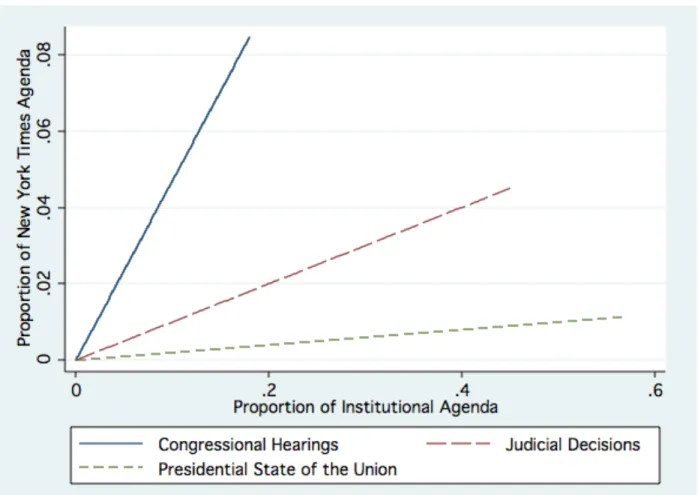
Chapter 3 demonstrates that composition of the U.S. Supreme Court’s docket can affect the types of political issues the general public is exposed to through news coverage. I show that the Court’s ability to act as an agenda setter actually surpasses that of the
presidency, which appears to be a more reactive institution. This agenda-setting ability is particularly important in constitutional issue areas where the judiciary is more likely to act as a policy venue.
power, as well as its influence over the American policy making process.
Chapter 5, further, uses data on interest group activity before the U.S. Supreme Court and registered lobbyists before the U.S. Senate and House of Representatives to show that groups make calculated decisions about how to allocate their lobbying resources. These decisions are affected by a number of factors, including each branch’s overall agenda composition. The findings of this analysis provide further evidence that the types of cases the Court decides to decide can have significant policy implications, both in the courts and in the federal government.
Finally, Chapter 6 brings together the findings of the previous four analyses and discusses the broader implications of this theory. It contains a discussion of what the
CHAPTER 2
EXPLAINING HOW COURTS AFFECT MEDIA ATTENTION TO JUDICIAL BUSINESS
One way the judgments of the judiciary set the agenda of other political actors is by deciding to decide cases that attract the attention of the news media. The ability to affect the agenda of the news media is significant for the normally secretive judiciary, which needs a conduit to reach out to the public. In many ways, the media acts as this filter through which citizens get their information about government and politics, and especially the courts. To most citizens, if political issues are not placed on the policy agenda through media coverage, they do not exist. And, if citizens are not aware of issues, they are unable to demand further political change, whether through direct lobbying techniques or by being part of organized interest activity that seeks to influence public policy.
In this chapter, I use evidence from state capital newspapers to examine how courts affect media coverage of judicial dockets and decisions. I find that, by taking cases where they can influence public policy and issuing opinions with particular characteristics, the judiciary can increase media attention to its business. These results hold true even after controlling for a broad range of environmental factors such media characteristics, judicial selection system, and divided government. This conclusion suggests that judges and justices may have greater agenda-setting power than many commentators have suggested.
Theoretical Foundation
cameras in the courtroom and sunshine on its conference process, have created a perception that the judiciary as a whole desires very little media attention to its business. But, this perception is not entirely true. Even the high Court has broken its shroud in some cases: Individual reporters have been given significant access to the inner workings of the Court (e.g. Toobin 2007, Woodward and Armstrong 1979), and a prestigious press corps that has included the likes of Linda Greenhouse, Joan Biskupic, and Nina Totenberg carefully report the Court’s landmark decisions.
Lower courts provide a more frequent avenue for judicial transparency. These
tribunals generally provide much greater access to the media and the public than the Supreme Court, and have been the focus of many television trials. Moreover, much of the daily
coverage of many local news sources, for example, focuses on the activities of the judicial system, broadly defined. Stories of murders, thefts, and even high profile divorce cases are extremely common. Whether citizens acknowledge it or not, each of these stories has a large judicial component, beginning with police officers and district justices and moving upwards through the judicial system to encompass district attorneys, county judges, lawyers, and any number of other policy actors.
In fact, it is far from an exaggeration to say that the judiciary needs media coverage for a number of reasons.2 First, the courts rely on news outlets to inform citizens about the implications of their often technical decisions. Reporters can reduce complex legalese to language that is comprehensible to the average citizen and make these people understand how a decision may affect their life.
2
Second, courts can use the media as a means of providing transparency to (Vanberg 2005), and in some ways, lobbying the public, who can, in turn, pressure their elected
representatives to implement policies that are consistent with judicial decisions (Staton 2006, 2010). This technique may be particularly important when a court knows that its viewpoint is consistent with public opinion. It may also be important for judges to reach out to citizen lobbyists because courts lack the ability to enforce their decisions and often require
cooperation from the legislative and executive branches of government.
Finally, it is only with media coverage and a public understanding of the importance of the courts’ work that the judiciary can maintain its institutional prestige and aim to influence public policy (Greenhouse 1996, Baum 2006). This allows the judiciary to maintain power as an institution, even without the ability to enforce their decisions (McCubbins, Noll, and Weingast 1987, Carrubba and Rogers 2003).
Avenues of Judicial Influence
The courts have a vested interest in using the media to present at least some of their decisions to the public. However, this may be a strategic process where all cases are not viewed by the justices as equally important. Accordingly, justices and judges may take steps to increase the visibility of some issues and cases and decrease the visibility of others. These actions may be taken throughout the judicial process. Here, I focus on case selection and opinion writing as two key stages where judges can take actions that may affect media coverage of the courts.
Case Selection
States Supreme Court, for example, which hears only about 75 of the nearly 10,000 cases presented to it each year. State supreme courts in forty states also have somewhat
discretionary dockets. The remaining ten state supreme courts have very limited discretion (National Center for State Courts 2009).3
A discretionary docket allows the judges seated on a given court significant latitude to bring new issues into the public eye or to avoid issues they do not want to address. Thus, when a court is presented with a policy issue in need of resolution, it may consider how deciding to decide that case—or offering a particular final decision—may affect the attention of the media and other policymakers. In some cases (such as the issues of enforcement discussed earlier), attracting the attention of these other actors and putting the issue on the public agenda may be at least a tangential concern for judges and justices.
Alternately, justices and judges’ decisions about which cases to consider may result in keeping issues off the political agenda. By deciding not to decide cases that would be likely to attract media attention or focus on controversial issues (like the United States
Supreme Court with gay marriage), a court can assert negative agenda control. Such a device may be particularly useful when the court wants to maintain its public goodwill and remain outside the scope of conflict until the political climate is more favorable.
As courts choose cases to decide, they are doubtless aware that the stakes are higher for their decisions in some types of cases than others. For example, recall from Chapter 1 that, as a result of a variety of agenda-setting processes, the judiciary should be more likely to act as a policy venue and have a lasting impact on public policy in some types of cases than others. Among these are constitutional cases, where the courts are given great latitude
3The states with limited discretion are Maine, Mississippi, Montana, Nevada, North Dakota, Rhode Island,
to interpret the meaning of that document and adapt its provisions to modern America. Because the courts have significant power to influence the course of public policy in these cases, they may be more likely to attract media attention in the first place. Thus, judges and justices on discretionary courts must be particularly mindful when deciding to decide these cases.
Opinion Writing
Judges on both courts of discretionary and mandatory jurisdiction may also alter the media attention paid to their decisions during the opinion writing process. By taking steps to make their decisions appear more (or less) formal or narrower (or broader) in scope, judges and justices can attract varying degrees of media attention. For example, in a study of television news coverage of U.S. Supreme Court decisions, Slotnick and Segal (1998)
showed that opinion characteristics were significant predictors of media attention. Decisions that overruled a lower court, altered a precedent, or were decided by a small margin (e.g. 5-4) were more likely than other cases to receive coverage. The decision date, too, was
significant. Decisions handed down closer to the end of the Court’s term were more likely to receive coverage, perhaps because media outlets plan to devote greater attention to the Court at that time.
This suggests that a court wanting to draw attention to a policy issue would be
unlikely to issue an important decision as a per curiam opinion on a busy news day.4 Instead, such decisions should be handed down during a slower point in the news cycle, and with a signed opinion. In contrast, a court that wanted to conceal its decision in a relatively controversial case would do well to reach a unanimous conclusion and issue an unsigned
4This was perhaps the case with the Supreme Court’s decision in Roe v. Wade (1973), which was decided in
mid-January. Coincidentally, this was also the day that former President Lyndon Baines Johnson died, making
opinion.
Why States?
The analysis that follows considers the relationship between courts and the media with specific reference to U.S. state supreme courts. The decision to use data on state supreme court decisions rather than the United States Supreme Court may, at first seem a peculiar one. But, for a number of reasons, it is not only a pragmatic decision, but also one that enriches the test of the theory in a way that national level data could not.
First, applying the foregoing theory to state supreme courts demonstrates its universality. The theory discussed in this dissertation is a theory of judicial power, not an exclusive theory of the U.S. Supreme Court’s power. Testing it in state governments clearly demonstrates this point.
Second, testing this theory in state supreme courts demonstrates the wide array of cases and issues on which the courts may act as agenda setters. State supreme courts are the courts of last resort for a large proportion of cases handled by the U.S. judicial system. Only a fraction of state cases reach the U.S. Supreme Court (and those must involve a federal issue); this body decides fewer than 100 cases each year. Therefore, most of the nation’s judicial business is conducted in state and other federal courts.
Last, studying state supreme courts also enables a much more robust test of how the political environment affects the courts’ ability to act as an agenda setter. A study of state supreme courts, for example, can account for the varying institutional structures of the media, the judiciary, and the state government. A comprehensive test such as this is nearly
Controlling for these variations is especially important because previous research on the media and the judiciary demonstrates that the political environment may temper the amount of coverage received by judicial decisions. For example, scholars have found that media outlets with greater circulation and resources are more likely to cover the courts than those with lesser resources (Hale 2006). Multiple news outlets in a city, especially in the case of newspapers, may also promote additional coverage of local issues (Schaffner and Wagner 2006). The competition that results over readership and profits at a time that many newspapers are in danger of collapse may drive these outlets to pay more careful attention to political issues than under other circumstances.
Media ownership may also affect the type of coverage received by the courts; outlets that are locally owned may rely less on national news staff and more on reporters within the community, leading to greater coverage of local issues. In an analysis of media coverage of judicial elections, for example, Schaffner and Diascro (2007) found that locally owned newspapers provided twice the coverage of state high court contests than their chain-owned counterparts.
In addition, the accountability of the judiciary may also affect the likelihood that cases receive coverage. In the American states, this means that, holding the size of a court’s docket and prestige constant, decisions by elected judges may be more newsworthy than those made by appointed judges. This is especially true in years where judges on that court are facing reelection. In these cases, it becomes increasingly more important that citizens are aware of the issues that judges consider, as well as decisions made by incumbent judges while serving on the court.
new idea. Scholars have long examined how judicial selection systems affect judges’ decisions (Hall 1987, Hall 1992, Brace and Hall 1993, Brace and Hall 1995, Hall 1995, Brace, Hall, and Langer 1999) and considered how selection systems and other institutional factors affect the presence and quality of challengers in judicial elections (Bonneau and Hall 2003). It should, therefore, be unsurprising that such factors would also influence courts’ relationships with the media.
Finally, other features of state governments, particularly their partisan composition, may also affect courts’ ability to attract media attention. As noted in Chapter 1, in times of divided government, the courts’ ability to act as a policy venue on certain issues may fluctuate. In addition, in times of divided government the contentiousness between the governor and the legislature may be such an engaging story that it makes covering the courts a less interesting story.
Hypotheses
This theory of the judiciary’s ability to set the media’s agenda leads to several
hypotheses about media coverage of the courts. These affect both the probability that a given case will receive coverage (breadth of coverage) and how much coverage that case will receive (depth of coverage). Both of these concepts measure a court’s ability to put an issue on the public agenda. The breadth of coverage provided by the media taps into the scope of issues a court’s decisions can expose to the public, while the depth of coverage is a gauge of how well the courts can make these issues “stick” in a crowded news environment.
Case Selection and Public Policy
by the judiciary is the difference between constitutional and non-constitutional decisions. Although the judiciary decides far fewer constitutional than non-constitutional cases, courts have much broader latitude to influence public policy in constitutional cases than in other cases. Therefore, for the purposes of this study, constitutional cases should be more likely to receive more coverage than their non-constitutional counterparts.
A court’s ability to influence public policy, however, is certainly more nuanced. Within the category of constitutional issues, for example, some judicial decisions should be particularly likely to attract media attention. Death penalty cases are one example where the judiciary’s broad latitude in decision-making is perceived to have a significant impact on society. In these cases, judges make determinations that affect public safety, and literally choosing between life and death. The stakes are high in these cases, and the courts’ role is large. Accordingly, courts should attract more attention in death penalty cases than other cases.
In contrast, courts may have particularly limited power to make lasting policy
decisions in some non-constitutional issue areas. Torts, for example, are highly technical and heavily regulated by executive branch regulations and legislation. Most tort decisions are also narrow in scope and affect only a small group of citizens. Thus, most judicial decisions regarding torts should attract relatively little media attention.
Opinion Characteristics
judges or justices of the court send a message about the case’s political or social significance. If a case is truly significant, it is unlikely that judges will dismiss it with a per curiam
decision or without extended discussion. Therefore, signed opinions should receive more media coverage than their unsigned counterparts.5
Political Environment
As the theory postulates, courts’ ability to influence media coverage through case selection and opinion writing should be affected by the political environment in which both the courts and the media operate. The media’s capacity to provide coverage, as well as the economic pressures of the community, may limit or enhance coverage. Newspapers with greater circulation and a local owner, as well as competition within the city should, for example, provide more comprehensive news coverage than in other cases. A judicial
election should put the courts on the political agenda more than in other years. And, divided government is likely to create such a contentious political environment in state government that news outlets shift resources away from the judiciary, reducing coverage of the courts’ decisions.
Data and Methods
This analysis relies on two dependent variables assembled using state capital
newspapers’ coverage of their own high courts. It also includes a series of independent and control variables that capture variations in judicial decisions and the political environments in which they are made. These variables, along with the models used to conduct these inquiries are described in greater detail in the following sections.
5
Dependent Variables
This analysis employs two dependent variables—a dummy variable that indicates whether or not a case received coverage in its own state capital newspaper and a count variable indicating how many times each case was discussed in its own state capital paper.6 Using two dependent variables allows me to consider two separate but related ideas: whether cases received any coverage (breadth of coverage) and the amount of coverage received by each case (depth of coverage). As previously discussed, considering both of these dependent variables provides a more nuanced impression of how judges and justices are able to set the media’s agenda through their case selection and opinion writing.
Both the binary and count variables were created using state supreme court coverage from calendar year 1998. I used 1998 because it was the most recent year available in the Brace and Hall (2002) State Supreme Court Data Project, a comprehensive database of state supreme court decisions from all fifty states between 1995 and 1998. All states whose largest circulation state capital newspaper was archived in Lexis-Nexis Academic Universe for 1998 were included in the analysis.7 This led to the inclusion of twenty states and papers,
6
I could also have chosen to use the largest circulation state papers (see Wilhelm and Vining 2009), but chose to use state capital papers for several reasons. First, even among largest circulation papers, there would be variation in size and, therefore, resources available to cover the courts (the largest circulation paper in
Wyoming, the Wyoming Tribune Eagle, is still very different from the New York Times). Second, using largest circulation papers would introduce another kind of variation—distance from the state capital—that could also affect news coverage of state supreme courts.
7
The states and papers included in this analysis are: Arkansas ([Little Rock] Arkansas Democrat Gazette), Colorado (Denver Post), Georgia (Atlanta Journal-Constitution), Illinois ([Springfield] State Journal Register), Kansas (Topeka Capital Journal), Louisiana (The [Baton Rouge] Advocate), Massachusetts (Boston Globe), Maryland (The [Annapolis] Capital), North Carolina ([Raleigh] News and Observer), North Dakota (Bismarck Tribune), New Mexico (Santa Fe New Mexican), New York ([Albany] Times-Union), Ohio (Columbus Dispatch), Rhode Island (Providence Journal), Texas (Austin American Statesman), Utah (Salt Lake Tribune), Virginia (Richmond Times-Dispatch), Wisconsin ([Madison] Wisconsin State Journal), West Virginia
and a total of 3,012 cases.
To identify whether or not a case received news coverage as well as how much coverage a case received, I searched the 1998 Lexis-Nexis Academic Universe archives of each state capital newspaper using the over-inclusive term “supreme court.”8 All stories identified by the search engine were collected and read by a single coder to verify that they related to that state’s highest court and not the United States Supreme Court or the supreme court of another state. If the story was appropriate, the case(s) discussed in its text were identified using characteristics such as the plaintiff, defendant, or opinion author. These characteristics were then matched to case characteristics in the Brace and Hall State Supreme Court Data Project.
After identification, cases were coded on each of the variables. Cases were coded 1 on the news coverage variable if they received any attention in the media and 0 otherwise. Cases were also assigned a value for the news count variable, which indicated how many total stories mentioned that case. Overall, 16 percent of cases decided by state supreme courts in 1998 received coverage in state capital newspapers. Of these cases, 77 percent were discussed only once. The remaining 23 percent of cases received multiple mentions (ranging from two to sixteen articles). Generally speaking, scandals in government, death penalty cases, and school finance decisions received the most attention.
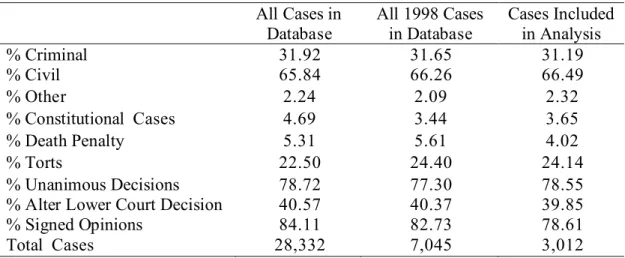
There is every reason to expect that the twenty-state sample used in this analysis is a representative sample of state supreme court business. Moreover, it appears that 1998 is a rather average year in state supreme court business. As shown in Table 2.1, the percentage of criminal and civil cases is relatively consistent across all cases included in the Brace and
8Most decision dates are far enough removed from the end of the year (judges like to celebrate December
Hall Data Project, all cases decided in 1998, and the cases included in the analysis. This pattern holds true for a number of other case characteristics, including whether the decision concerned a constitutional issue, was unanimous, or altered a lower court decision.
Independent Variables
The primary independent variables of interest included in this model relate to the issue area of the case and the characteristics of the courts’ final opinions. The paragraphs that follow consider the measurement of each of these in turn.
Issue Variables
The courts’ ability to affect news coverage by choosing to hear a case where it may influence public policy is measured using a binary variable that separates constitutional and non-constitutional cases. This has been chosen as a proxy variable and will be used
throughout the dissertation as a basic measure of the judiciary’s ability to act as a policy venue.
For the purpose of this analysis, a constitutional case is any case that concerns either a state or federal constitutional issue. These cases are combined into one variable to eliminate concerns about collinearity. Because the federal and state constitutions include many of the same provisions, many cases that related to a state constitutional issue also concerned a federal constitutional issue, and vice versa. In fact, the Brace and Hall databases’ values for whether a case concerned a state constitutional issue and a federal constitutional issue matched 97 percent of the time. Cases concerning constitutional issues are coded 1 and were present in approximately 4 percent of cases.9
9
This percentage is much lower than the percentage of constitutional cases adjudicated by the U.S. Supreme Court. This is likely the result of the jurisdiction of state supreme courts, which requires courts in many states to hear and dispose of a much greater number of mandatory jurisdiction cases (which are often not
The models also include two additional independent variables measuring specific policy areas where the courts’ ability to influence public policy may be particularly high or low. First, a binary variable is used to indicate those cases where the court either considered or imposed the death penalty; this was the case in 4 percent of decisions. As discussed in the hypotheses, death penalty cases are representative of a particular class of constitutional cases where the courts are particularly likely to make decisions with significant policy
implications. These cases may, therefore, also be more likely to attract media attention. Second, the models also include a measure of whether the case concerned a tort. As discussed in the hypotheses, tort cases are representative of a class of statutory decisions where courts have limited ability to influence public policy and thus, these decisions should be especially unlikely to receive news coverage. Tort cases include any cases that Brace and Hall (2002) classified as falling under the general issue category of civil government or civil private torts. Examples include employee injury, workers’ compensation, professional malpractice, and libel cases. Nearly 25 percent of cases fit these criteria; these cases are coded 1.
Opinion Characteristics
0 otherwise. For more descriptive statistics on these variables, see Table 2.1. Controlling for the Political Environment
Both the binary and count models include several controls for the political environment, which may alter judges’ ability to affect media coverage about their court. These variables fall into three major categories: media characteristics, judicial characteristics, and divided government.
Media Characteristics
The first three environmental factors relate to the characteristics of the media.
Information on each of these variables was collected from the 1998 edition of the Editor and Publisher International Year Book (Editor and Publisher 1998). First, newspaper circulation is a continuous variable that measures each paper’s average weekday sales. The circulation of the newspapers included in this analysis ranges from nearly 17,000 to almost 477,000. The average circulation of papers included in this analysis is approximately 160,000 copies per day.
Second, newspaper ownership is a binary variable that divides newspapers into two categories: those published by media conglomerates (coded 0 in the analysis) and those that are locally owned and operated (coded 1 in the analysis). Overall, five of the twenty state capital newspapers included in this study were locally owned. This accounted for
approximately 25 percent of all cases.
Judicial Characteristics
The models also control for two characteristics of the judiciary. The first of these judicial characteristics is a binary variable indicating whether a state held an election for its supreme court in 1998. States that held an election are coded 1; all other states are coded 0. Of the states included in this sample, five held elections in 1998. Four of these states held partisan elections, and one held a non-partisan election.10 Just over 30 percent of cases were decided in states holding elections in 1998.11
Each state high court’s caseload is considered by using a binary variable measuring whether the court has a discretionary docket. I use the discretionary docket variable for two reasons. First, courts with discretionary dockets generally consider fewer cases than their counterparts with mandatory jurisdiction. Second, a discretionary docket allows its judges greater latitude over the cases they choose to consider. This, in turn, empowers the court to make a greater (or lesser) number of judgments that may attract media coverage. This variable is coded 1 for cases decided in states where the court has largely discretionary jurisdiction and 0 otherwise. Of the states included in this analysis, fifteen had discretionary dockets. These states accounted for almost 80 percent of the cases in this study.12
Divided Government
Finally, the models consider whether a state had divided government in 1998.
10
I also tested other models employing more nuanced measures of judicial selection. The results of these models were substantively similar to those shown here.
11
All cases considered in states that held elections in 1998 were coded 1, regardless of it the coverage was before or after the election. This is done for a number of reasons. First, defining an endpoint for election coverage would also require defining a beginning, and such a definition would be arbitrary, and likely vary widely across states. Second, nuanced coding of pre- and post election coverage of cases would have been quite difficult on the count variable.
12
Divided government is defined as having a governor and at least one house of the state legislature controlled by different political parties. States with divided control are coded as 1 and unified states are coded as 0. Fourteen of the twenty states included in this analysis had divided government, accounting for 66 percent of cases.
Model Estimation
The model considering the court’s affect on the breadth of news coverage is estimated using probit estimation. Probit is a maximum likelihood estimator appropriate for use with binary response variables. The model predicts the probability of an event—in this case, newspaper coverage of a state supreme court decision—occurring in the absence or presence of particular independent variables. The probit model is based on the normal distribution and assumes an error term with a variance of one.
The model estimating the courts’ affect on the depth of news coverage is estimated using an event count model, specifically negative binomial regression. I choose to use negative binomial regression rather than a Poisson model because the negative binomial model accounts for (by estimating an additional parameter) overdispersion, or greater variance than might be expected given the mean of the data. I expect that overdispersion could be cause for concern in this model, given the large number of observations that receive no coverage.13 In addition, the negative binomial model also accounts for a potential
violation of the assumption of conditional independence of observations, or where the
occurrence of one event makes another event more or less likely. In this case, once a reporter has put the resources into covering a case at one stage of the judicial process (for example,
13
oral argument) it is more likely that a paper might choose to follow up on that story later in the process (perhaps on decision day).
The models used in this paper also employ robust standard errors. Robust standard errors are generally used when there is a small departure from the fundamental assumptions of the model. In this case, the assumption of conditional independence of observations has likely been violated. There are multiple case observations from each of the twenty states, and it is likely that the residuals for observations within each state will be correlated.
Findings: Breadth of Coverage
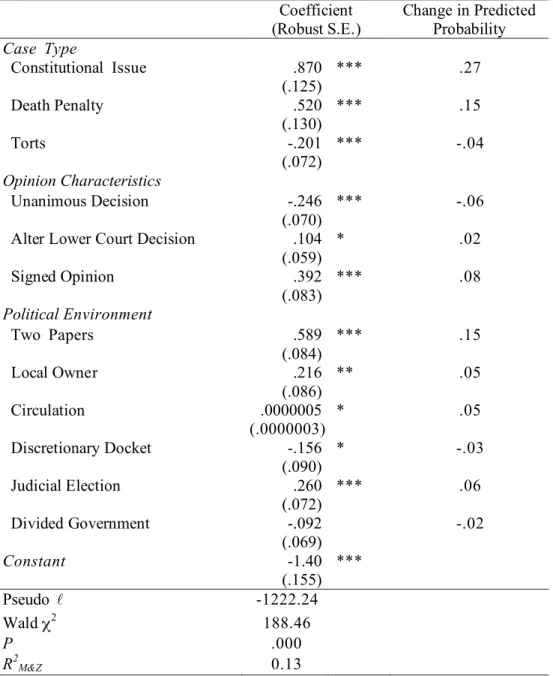
The model of news coverage shown in Table 2.2 demonstrates support for most of the hypotheses regarding the breadth of news coverage of state supreme courts. The results of this model, therefore, indicate dramatic differences in the likelihood of cases receiving coverage based on their characteristics. By deciding to decide certain types of cases or crafting opinions that have particular identifying features, judges can influence the visibility of courts as a whole, as well as specific political issues.
First, consider the courts’ ability to set the media’s agenda by deciding to decide particular types of cases. I postulated that the courts would attract greater media attention in cases where they acted as policy venues; this hypothesis received strong support.
Constitutional cases were 27 percent more likely to receive media attention than their non-constitutional counterparts. This is the largest substantive difference seen in the probit model, and almost twice as large as the next largest effect. Clearly, issue area and judicial discretion matter for attracting at least a minimal level of media attention.
were 15 percent more likely than other cases to receive news coverage. And, tort cases were 4 percent less likely than other cases to receive news coverage.
It also appears that courts can influence the probability of a case receiving news coverage by crafting opinions with particular characteristics. Unanimous decisions, for example, were 6 percent less likely than other cases to receive news coverage. Signed opinions and decisions that altered a lower court’s verdict increased a case’s predicted probability of news coverage by 8 percent and 2 percent, respectively.
Importantly, these effects for issue area and opinion characteristics hold true even in the presence of controls for political environment. Media characteristics had particularly significant effects. Cases decided in capital cities with two major daily newspapers, for example, were 15 percent more likely to receive news coverage than those decided in a capital city with one paper. And, cases decided in cities with higher circulations and locally owned papers were both about 6 percent more likely to receive news coverage than cases decided in cities with lower circulation newspapers.
Judicial characteristics were also statistically and substantively important. Both the variable indicating whether a state held a judicial election in 1998 and the control for whether the court had a mandatory or discretionary docket were significant predictors of whether a case received coverage. Cases decided in states that held elections in 1998 were 6 percent more likely to receive news coverage, while cases decided in states with discretionary dockets were 3 percent less likely to receive news coverage.
Findings: Depth of Coverage
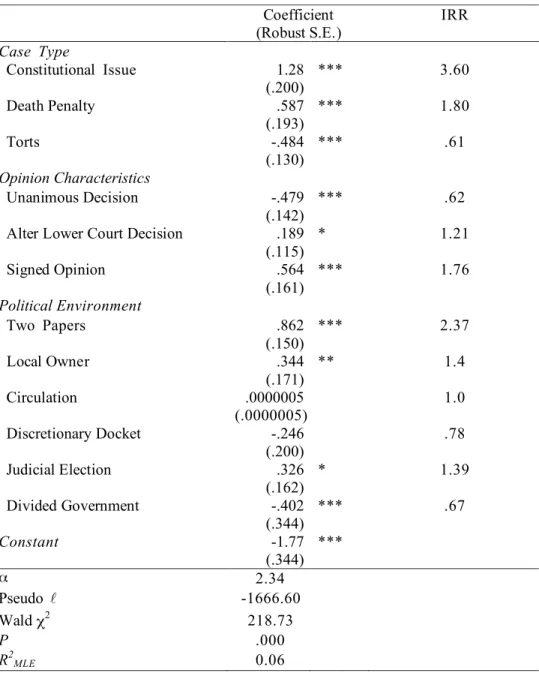
agenda. The issue area of the case is again the most important predictor of how much coverage a case received; cases concerning constitutional cases receive 360 percent more coverage than non-constitutional cases. Death penalty cases also received an increased quantity of coverage, about 180 percent more than other cases. Torts, in contrast, received 39 percent less coverage than other cases.
The courts’ ability to affect media coverage by crafting judicial opinions with particular characteristics also persisted in this model. Unanimous decisions received 38 percent less coverage than other cases. And, cases decided with signed opinions received 176 percent more coverage than their unsigned counterparts.
And, once again, the political environment also influenced the courts’ ability to act as an agenda setter. Cases decided in cities with two newspapers received 237 percent more coverage than cases decided in one-paper cities. Similarly, cases decided in cities with locally owned papers received 140 percent more coverage. And cases decided in states with divided government received 33 percent less coverage than cases decided in states where the same party controlled the executive and legislative branches.
To get an idea of the substantive implications of these findings, consider the
following example. A constitutional case decided with a signed opinion and in a capital city with two newspapers would receive roughly two more stories than a non-constitutional case with an unsigned opinion decided in a one paper city, holding all else constant. Since the mean number of stories mentioning each case is .23, this is a substantial increase in media attention, especially when considering only three variables.
Breadth v. Depth
individual variables observed in each of the models, for example, fluctuates very little. Moreover, both models provide persuasive evidence that, even after controlling for the political environment, judges have some ability to affect the type of information citizens receive about their courts. Whether by choosing to decide cases that address (or do not address) certain issues or crafting their opinions to meet particular characteristics, judges are active participants in the agenda-setting process. This is true in both courts with
discretionary and non-discretionary dockets; the models indicate only small differences across these two types of courts (discussed in greater detail below).
In both models, constitutional cases, death penalty cases, and having two papers in a city have the greatest effect on the news coverage received by a case. The substantive impacts of each of these predictors cannot be underestimated. The effects of each of these variables on judges’ ability to set the media’s agenda are considered further in the discussion section of this chapter.
The circulation of the newspaper, having a discretionary docket, and the presence of judicial elections appear to be more important predictors of whether a case receives coverage at all than how much coverage that case will receive. All of these predictors have modest statistically significant effects in the news coverage model. However, only judicial elections remain significant in the count model. These are reasonable findings; one might expect circulation to affect a paper’s ability to cover a broad number of issues before it affected a paper’s ability to cover the same issue in depth. Elections may bring to light more issues in passing than in other cases. And, discretionary courts may consider fewer cases of interest in a given year (perhaps in an exercise of negative agenda control).
depth of coverage a case will receive than the breadth of the media’s attention to the judiciary. This suggests that individual judicial decisions may receive more intensive attention from the media when conflict between the governor and the legislature is lower. The cause of this phenomenon is not immediately clear. It may be that unified control frees up news space or is more likely to make the court a controversial figure than under divided government.
Discussion
The findings of this analysis provide support for the broad contention that judges can play a role in shaping the agenda of the media. They can do this in two key ways. First, by deciding to decide cases concerning certain issue areas where the court is more (or less) likely to influence public policy (act as policy venues) a court can attract attention to a broader (or narrower) array of judicial decisions and garner more (or less) in-depth coverage of the issues they decide. Or, judges can craft their decisions to conform to certain
characteristics (i.e. unanimous decision, unsigned opinion) that make them more or less appealing to the media. These characteristics also affect both the breadth and the depth of the media’s coverage, and are conditioned by the political environment in which the court operates.
The Judges’ Role
latitude to keep issues off the public agenda by deciding not to decide particular cases and issues.
For example, by repeatedly becoming involved in the battle over school funding, the Ohio Supreme Court has helped to keep an important political issue on the public agenda and tried to assure equality for all children. One exhibit of the court’s influence can be seen in the wake of its 1997 decision, just one in a series of battles between the court and the Ohio legislature. Although the court did not even consider the issue in 1998, it was mentioned in more stories than any other Ohio Supreme Court decision during that year. One reason why this case was followed so closely was likely its reaching impact on both public policy and a large number of Ohio residents. But, if the court had not decided to get involved in this battle, the window of opportunity would likely have closed on this concern.14
The characteristics of the court’s opinion in a case had somewhat more modest effects on the breadth and depth of the coverage received by the judiciary than issue area.
Nevertheless, the persistence of these effects suggests that judges are able to affect the media’s coverage throughout the judicial process, and empowers judges and justices with a much greater ability to take actions to influence the media’s agenda than is often accorded to officers of the court.
One example of a case that may have garnered additional attention because of the characteristics of the opinion—non-unanimous, signed, altering a lower court decision—may be the Colorado Supreme Court case of Bayer v. Crested Butte (1998). This case asked the narrow question of which of two Colorado transportation laws governed ski lift maintenance during the winter season. Had the judges of the court agreed and/or issued an unsigned
14Of course, this action also had benefits for the court, which clearly increased its visibility with the general
opinion, this case would likely have received only limited attention in trade publications for ski resorts. Instead, it was one of the 16 percent of cases that received coverage—and in multiple stories, at that!
Environmental Effects
The model also shows that judges’ decisions must be contextualized within the larger political system. Although judges may have some control over which cases are covered by the media and how often, this varies with the characteristics of the media and the courts, as well as with the partisan control of the state. Several of these characteristics merit special consideration because of trends present in modern politics.
First, consider news media ownership and publication. In the past, it was common practice for most medium and large cities to have two newspapers. In many cases, one of these papers was published in the morning and the other was published in the afternoon. For example, before their merger in 1991, the city of Little Rock had the Arkansas Gazette, which was published in the morning, and Arkansas Democrat, which was published in the afternoon for most of its history. Local families or individuals also owned many of these newspapers. But the numbers of both locally owned newspapers and two newspaper cities have steadily declined over the last several decades (Editor and Publisher 1998). In a very recent and visible case, for example, one of the few remaining two paper cities, Denver, Colorado, lost its second paper, the Rocky Mountain News, on February 27, 2009. Today, the Denver Post is the only daily newspaper published in the Denver metropolitan area. And, it seems that every time we turn around, we hear stories of yet another newspaper up for sale or struggling to survive.15
15