An Open-Source Package for Recognizing Textual Entailment
Milen Kouylekov and Matteo Negri FBK - Fondazione Bruno Kessler Via Sommarive 18, 38100 Povo (TN), Italy
[kouylekov,negri]@fbk.eu
Abstract
This paper presents a general-purpose open source package for recognizing Tex-tual Entailment. The system implements a collection of algorithms, providing a con-figurable framework to quickly set up a working environment to experiment with the RTE task. Fast prototyping of new solutions is also allowed by the possibil-ity to extend its modular architecture. We present the tool as a useful resource to ap-proach the Textual Entailment problem, as an instrument for didactic purposes, and as an opportunity to create a collaborative en-vironment to promote research in thefield.
1 Introduction
Textual Entailment (TE) has been proposed as a unifying generic framework for modeling lan-guage variability and semantic inference in dif-ferent Natural Language Processing (NLP) tasks. The Recognizing Textual Entailment (RTE) task (Dagan and Glickman, 2007) consists in deciding, given two text fragments (respectively called Text - T, and Hypothesis - H), whether the meaning of
Hcan be inferred from the meaning ofT, as in:
T: ”Yahoo acquired Overture” H: ”Yahoo owns Overture”
The RTE problem is relevant for many different areas of text processing research, since it repre-sents the core of the semantic-oriented inferences involved in a variety of practical NLP applications including Question Answering, Information Re-trieval, Information Extraction, Document Sum-marization, and Machine Translation. However, in spite of the great potential of integrating RTE into complex NLP architectures, little has been done to actually move from the controlled scenario
pro-posed by the RTE evaluation campaigns1to more practical applications. On one side, current RTE technology might not be mature enough to provide reliable components for such integration. Due to the intrinsic complexity of the problem, in fact, state of the art results still show large room for im-provement. On the other side, the lack of available tools makes experimentation with the task, and the fast prototyping of new solutions, particularly dif-ficult. To the best of our knowledge, the broad literature describing RTE systems is not accompa-nied with a corresponding effort on making these systems open-source, or at least freely available. We believe that RTE research would significantly benefit from such availability, since it would allow to quickly set up a working environment for ex-periments, encourage participation of newcomers, and eventually promote state of the art advances.
The main contribution of this paper is to present the latest release of EDITS (Edit Distance Textual Entailment Suite), a freely available, open source software package for recognizing Textual Entail-ment. The system has been designed following three basic requirements:
Modularity. System architecture is such that the overall processing task is broken up into major modules. Modules can be composed through a configuration file, and extended as plug-ins ac-cording to individual requirements. System’s workflow, the behavior of the basic components, and their IO formats are described in a compre-hensive documentation available upon download.
Flexibility. The system is general-purpose, and suited for any TE corpus provided in a simple XML format. In addition, both language depen-dent and language independepen-dent configurations are allowed by algorithms that manipulate different representations of the input data.
1TAC RTE Challenge:http://www.nist.gov/tac
EVALITA TE task:http://evalita.itc.it
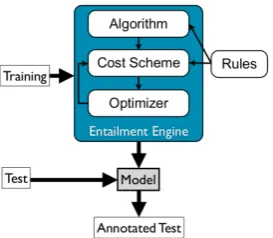
Figure 1: Entailment Engine, main components and workflow
Adaptability. Modules can be tuned over train-ing data to optimize performance along several di-mensions (e.g. overall Accuracy, Precision/Recall trade-off on YES and NO entailment judgements). In addition, an optimization component based on genetic algorithms is available to automatically set parameters starting from a basic configuration.
EDITS is open source, and available under GNU Lesser General Public Licence (LGPL). The tool is implemented in Java, it runs on Unix-based Operating Systems, and has been tested on MAC OSX, Linux, and Sun Solaris. The latest release of the package can be downloaded from http: //edits.fbk.eu.
2 System Overview
The EDITS package allows to:
• Create an Entailment Engine (Figure 1) by defining its basic components (i.e. algo-rithms, cost schemes, rules, and optimizers);
• Train suchEntailment Engineover an tated RTE corpus (containing T-H pairs anno-tated in terms of entailment) to learn aModel;
• Use theEntailment Engineand theModelto assign an entailment judgement and a confi -dence score to each pair of an un-annotated test corpus.
EDITS implements a distance-based framework which assumes that the probability of an entail-ment relation between a given T-H pair is inversely proportional to thedistancebetween T and H (i.e.
the higher the distance, the lower is the probability of entailment). Within this framework the system implements and harmonizes different approaches to distance computation, providing both edit dis-tance algorithms, and similarity algorithms (see
Section 3.1). Each algorithm returns a normalized distance score (a number between 0 and 1). At a training stage, distance scores calculated over an-notated T-H pairs are used to estimate a threshold that best separates positive from negative exam-ples. The threshold, which is stored in aModel, is used at a test stage to assign an entailment judge-ment and a confidence score to each test pair.
In the creation of a distance Entailment Engine, algorithms are combined with cost schemes (see Section 3.2) that can be optimized to determine their behaviour (see Section 3.3), and optional ex-ternal knowledge represented asrules(see Section 3.4). Besides the definition of a single Entailment Engine, a unique feature of EDITS is that it al-lows for the combination of multiple Entailment Engines in different ways (see Section 4.4).
Pre-defined basic components are already pro-vided with EDITS, allowing to create a variety of entailment engines. Fast prototyping of new solu-tions is also allowed by the possibility to extend the modular architecture of the system with new algorithms, cost schemes, rules, or plug-ins to new language processing components.
3 Basic Components
This section overviews the main components of a distance Entailment Engine, namely: i) algo-rithms, iii) cost schemes, iii) the cost optimizer, andiv)entailment/contradiction rules.
3.1 Algorithms
Algorithms are used to compute a distance score between T-H pairs.
EDITS provides a set of predefined algorithms, including edit distance algorithms, and similar-ity algorithms adapted to the proposed distance framework. The choice of the available algorithms is motivated by their large use documented in RTE literature2.
Edit distance algorithmscast the RTE task as the problem of mapping the whole content of H into the content of T. Mappings are performed as sequences of editing operations (i.e. insertion, deletion, substitution of text portions) needed to transform T into H, where each edit operation has a cost associated with it. The distance algorithms available in the current release of the system are:
2Detailed descriptions of all the systems participating in
• Token Edit Distance: a token-based version of the Levenshtein distance algorithm, with edit operations defined over sequences of to-kens of T and H;
• Tree Edit Distance: an implementation of the algorithm described in (Zhang and Shasha, 1990), with edit operations defined over sin-gle nodes of a syntactic representation of T and H.
Similarity algorithmsare adapted to the ED-ITS distance framework by transforming measures of the lexical/semantic similarity between T and H into distance measures. These algorithms are also adapted to use the three edit operations to support overlap calculation, and define term weights. For instance, substitutable terms in T and H can be treated as equal, and non-overlapping terms can be weighted proportionally to their insertion/deletion costs. Five similarity algorithms are available, namely:
• Word Overlap: computes an overall (dis-tance) score as the proportion of common words in T and H;
• Jaro-Winkler distance: a similarity algorithm between strings, adapted to similarity on words;
• Cosine Similarity: a common vector-based similarity measure;
• Longest Common Subsequence: searches the longest possible sequence of words appearing both in T and H in the same order, normaliz-ing its length by the length of H;
• Jaccard Coefficient: confronts the intersec-tion of words in T and H to their union.
3.2 Cost Schemes
Cost schemes are used to define the cost of each edit operation.
Cost schemes are defined as XMLfiles that ex-plicitly associate a cost (a positive real number) to each edit operation applied to elements of T and H. Elements, referred to as A and B, can be of dif-ferent types, depending on the algorithm used. For instance, Tree Edit Distance will manipulatenodes
in a dependency tree representation, whereas To-ken Edit Distance and similarity algorithms will manipulatewords. Figure 2 shows an example of
<scheme>
<insertion><cost>10</cost></insertion> <deletion><cost>10</cost></deletion> <substitution>
<condition>(equals A B)</condition> <cost>0</cost>
</substitution> <substitution>
<condition>(not (equals A B))</condition> <cost>20</cost>
</substitution> </scheme>
Figure 2: Example of XML Cost Scheme
cost scheme, where edit operation costs are de-fined as follows:
Insertion(B)=10- inserting an element B from H to T, no matter what B is, always costs 10;
Deletion(A)=10 - deleting an element A from T, no matter what A is, always costs 10;
substitution(A,B)=0 if A=B- substituting A with B costs 0 if A and B are equal;
substitution(A,B)=20 if A!=B - substituting A with B costs 20 if A and B are different.
In the distance-based framework adopted by EDITS, the interaction between algorithms and cost schemes plays a central role. Given a T-H pair, in fact, the distance score returned by an al-gorithm directly depends on the cost of the opera-tions applied to transform T into H (edit distance algorithms), or on the cost of mapping words in H with words in T (similarity algorithms). Such interaction determines the overall behaviour of an Entailment Engine, since distance scores returned by the same algorithm with different cost schemes can be considerably different. This allows users to define (and optimize, as explained in Section 3.3) the cost schemes that best suit the RTE data they want to model3.
EDITS provides two predefined cost schemes:
• Simple Cost Scheme - the one shown in Fig-ure 2, settingfixed costs for each edit opera-tion.
• IDF Cost Scheme - insertion and deletion costs for a wordware set to the inverse doc-ument frequency of w (IDF(w)). The sub-stitution cost is set to 0 if a word w1 from T and a word w2 from H are the same, and IDF(w1)+IDF(w2) otherwise.
3For instance, when dealing with T-H pairs composed by
In the creation of new cost schemes, users can express edit operation costs, and conditions over the A and B elements, using a meta-language based on a lisp-like syntax (e.g. (+ (IDF A) (IDF B)), (not (equals A B))). The system also provides functions to access data stored in hashfiles. For example, the IDF Cost Scheme accesses the IDF values of the most frequent 100K English words (calculated on the Brown Corpus) stored in a file distributed with the system. Users can create new hashfiles to collect statistics about words in other languages, or other information to be used inside the cost scheme.
3.3 Cost Optimizer
A cost optimizer is used to adapt cost schemes (ei-ther those provided with the system, or new ones defined by the user) to specific datasets.
The optimizer is based on cost adaptation through genetic algorithms, as proposed in (Mehdad, 2009). To this aim, cost schemes can be parametrized by externalizing as parameters the edit operations costs. The optimizer iterates over training data using different values of these param-eters until on optimal set is found (i.e.the one that best performs on the training set).
3.4 Rules
Rules are used to provide the Entailment Engine with knowledge (e.g. lexical, syntactic, semantic) about the probability of entailment or contradic-tion between elements of T and H. Rules are in-voked by cost schemes to influence the cost of sub-stitutions between elements of T and H. Typically, the cost of the substitution between two elements A and B is inversely proportional to the probability that A entails B.
Rules are stored in XML files called Rule Repositories, with the format shown in Figure 3. Each rule consists of three parts: i) a left-hand side, ii) a right-hand side, iii) a probability that the left-hand side entails (or contradicts) the right-hand side.
EDITS provides three predefined sets of lexical entailment rules acquired from lexical resources widely used in RTE: WordNet4, Lin’s word sim-ilarity dictionaries5, and VerbOcean6.
4http://wordnet.princeton.edu
5http://webdocs.cs.ualberta.ca/ lindek/downloads.htm 6http://demo.patrickpantel.com/Content/verbocean
<rule entailment="ENTAILMENT"> <t>acquire</t>
<h>own</h>
<probability>0.95</probability> </rule>
<rule entailment="CONTRADICTION"> <t>beautiful</t>
<h>ugly</h>
<probability>0.88</probability> </rule>
Figure 3: Example of XML Rule Repository
4 Using the System
This section provides basic information about the use of EDITS, which can be run with commands in a Unix Shell. A complete guide to all the pa-rameters of the main script is available as HTML documentation downloadable with the package.
4.1 Input
The input of the system is an entailment corpus represented in the EDITS Text Annotation Format (ETAF), a simple XML internal annotation for-mat. ETAF is used to represent both the input T-H pairs, and the entailment and contradiction rules. ETAF allows to represent texts at two different levels: i) as sequences of tokens with their asso-ciated morpho-syntactic properties, or ii)as syn-tactic trees with structural relations among nodes.
Plug-ins for several widely used annotation tools (including TreeTagger, Stanford Parser, and OpenNLP) can be downloaded from the system’s website. Users can also extend EDITS by imple-menting plug-ins to convert the output of other an-notation tools in ETAF.
Publicly available RTE corpora (RTE 1-3, and EVALITA 2009), annotated in ETAF at both the annotation levels, are delivered together with the system to be used asfirst experimental datasets.
4.2 Configuration
The creation of an Entailment Engine is done by defining its basic components (algorithms, cost schemes, optimizer, and rules) through an XML configurationfile. The configurationfile is divided in modules, each having a set of options. The fol-lowing XML fragment represents a simple exam-ple of configurationfile:
<module alias="distance"> <module alias="tree"/> <module alias="xml">
value="IDF_Scheme.xml"/> </module>
<module alias="pso"/> </module>
This configuration defines a distance Entailment Engine that combines Tree Edit Distance as a core distance algorithm, and the predefined IDF Cost Scheme that will be optimized on training data with the Particle Swarm Optimization algorithm (“pso”) as in (Mehdad, 2009). Adding external knowledge to an entailment engine can be done by extending the configurationfile with a reference to a rulesfile (e.g. “rules.xml”) as follows:
<module alias="rules"> <option name="rules-file"
value="rules.xml"/> </module>
4.3 Training and Test
Given a configurationfile and an RTE corpus an-notated in ETAF, the user can run the training
procedure to learn a model. At this stage, ED-ITS allows to tune performance along several di-mensions (e.g. overall Accuracy, Precision/Recall trade-off on YES and/or NO entailment judge-ments). By default the system maximizes the over-all accuracy (distinction between YES and NO pairs). The output of the training phase is a model: a zip file that contains the learned threshold, the configuration file, the cost scheme, and the en-tailment/contradiction rules used to calculate the threshold. The explicit availability of all this in-formation in the model allows users to share, repli-cate and modify experiments7.
Given a model and an un-annotated RTE corpus as input, the test procedure produces a file con-taining for each pair: i)the decision of the system (YES, NO),ii)the confidence of the decision, iii)
the entailment score,iv)the sequence of edit oper-ations made to calculate the entailment score.
4.4 Combining Engines
A relevant feature of EDITS is the possibility to combine multiple Entailment Engines into a sin-gle one. This can be done by grouping their def-initions as sub-modules in the configuration file. EDITS allows users to define customized combi-nation strategies, or to use two predefined com-bination modalities provided with the package,
7Our policy is to publish online the models we use for
[image:5.595.309.532.62.178.2]par-ticipation in the RTE Challenges. We encourage other users of EDITS to do the same, thus creating a collaborative envi-ronment, allow new users to quickly modify working confi g-urations, and replicate results.
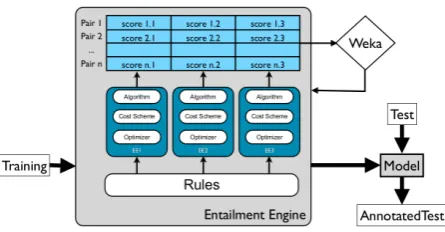
Figure 4: Combined Entailment Engines
namely: i) Linear Combination, and ii) Classi-fier Combination. The two modalities combine in different ways the entailment scores produced by multiple independent engines, and return a final decision for each T-H pair.
Linear Combinationreturns an overall entail-ment score as the weighted sum of the entailentail-ment scores returned by each engine:
scorecombination= n
!
i=0
scorei∗weighti (1)
In this formula, weighti is an ad-hoc weight parameter for each entailment engine. Optimal weight parameters can be determined using the same optimization strategy used to optimize the cost schemes, as described in Section 3.3.
Classifier Combination is similar to the ap-proach proposed in (Malakasiotis and Androut-sopoulos, 2007), and is based on using the entail-ment scores returned by each engine as features to train a classifier (see Figure 4). To this aim, ED-ITS provides a plug-in that uses the Weka8 ma-chine learning workbench as a core. By default the plug-in uses an SVM classifier, but other Weka algorithms can be specified as options in the con-figurationfile.
The following configuration file describes a combination of two engines (i.e. one based on Tree Edit Distance, the other based on Cosine Similarity), used to train a classifier with Weka9. <module alias="weka">
<module alias="distance"> <module alias="tree"/> <module alias="xml">
<option name="scheme-file" value="IDF_Scheme.xml"/> </module>
</module>
8http://www.cs.waikato.ac.nz/ml/weka
9A linear combination can be easily obtained by changing
<module alias="distance"> <module alias="cosine"/>
<module alias="IDF_Scheme.xml"/> </module>
</module>
5 Experiments with EDITS
To give an idea of the potentialities of the ED-ITS package in terms offlexibility and adaptabil-ity, this section reports some results achieved in RTE-related tasks by previous versions of the tool. The system has been tested in different scenarios, ranging from the evaluation of standalone systems within task-specific RTE Challenges, to their inte-gration in more complex architectures.
As regards the RTE Challenges, in the last years EDITS has been used to participate both in the PASCAL/TAC RTE Campaigns for the En-glish language (Mehdad et al., 2009), and in the EVALITA RTE task for Italian (Cabrio et al., 2009). In the last RTE-5 Campaign the result achieved in the traditional “2-way Main task” (60.17% Accuracy) roughly corresponds to the performance of the average participating systems (60.36%). In the “Search” task (which consists in finding all the sentences that entail a given H in a given set of documents about a topic) the same configuration achieved an F1 of 33.44%, rank-ing 3rd out of eight participants (average score 29.17% F1). In the EVALITA 2009 RTE task, EDITS ranked first with an overall 71.0% Accu-racy. To promote the use of EDITS and ease ex-perimentation, the complete models used to pro-duce each submitted run can be downloaded with the system. An improved model obtained with the current release of EDITS, and trained over RTE-5 data (61.83% Accuracy on the “2-way Main task” test set), is also available upon download.
As regards application-oriented integrations, EDITS has been successfully used as a core com-ponent in a Restricted-Domain Question Answer-ing system within the EU-Funded QALL-ME Project10. Within this project, an entailment-based approach to Relation Extraction has been defined as the task of checking for the existence of en-tailment relations between an input question (the
text in RTE parlance), and a set of textual realiza-tions of domain-specific binary relations (the hy-potheses in RTE parlance). In recognizing 14 re-lations relevant in the CINEMA domain present in a collection of spoken English requests, the system
10http://qallme.fbk.eu
achieved an F1 of 72.9%, allowing to return cor-rect answers to 83% of 400 test questions (Negri and Kouylekov, 2009).
6 Conclusion
We have presented the first open source package for recognizing Textual Entailment. The system offers a modular, flexible, and adaptable working environment to experiment with the task. In addi-tion, the availability of pre-defined system confi g-urations, tested in the past Evaluation Campaigns, represents a first contribution to set up a collabo-rative environment, and promote advances in RTE research. Current activities are focusing on the de-velopment of a Graphical User Interface, to further simplify the use of the system.
Acknowledgments
The research leading to these results has received funding from the European Community’s Sev-enth Framework Programme (FP7/2007-2013) un-der Grant Agreement n. 248531 (CoSyne project).
References
Prodromos Malakasiotis and Ion Androutsopoulos 2007.Learning Textual Entailment using SVMs and String Similarity Measures. Proc. of the ACL ’07 Workshop on Textual Entailment and Paraphrasing.
Ido Dagan and 0ren Glickman 2004. Probabilistic Textual Entailment: Generic Applied Modeling of Language Variability. Proc. of the PASCAL Work-shop on Learning Methods for Text Understanding and Mining.
Kaizhong Zhang and Dennis Shasha 1990. Fast Al-gorithm for the Unit Cost Editing Distance Between Trees.Journal of Algorithms. vol.11.
Yashar Mehdad 2009. Automatic Cost Estimation for Tree Edit Distance Using Particle Swarm Optimiza-tion.Proc. of ACL-IJCNLP 2009.
Matteo Negri and Milen Kouylekov 2009. Question Answering over Structured Data: an Entailment-Based Approach to Question Analysis. Proc. of RANLP-2009.
Elena Cabrio, Yashar Mehdad, Matteo Negri, Milen Kouylekov, and Bernardo Magnini 2009. Rec-ognizing Textual Entailment for Italian EDITS @ EVALITA 2009Proc. of EVALITA 2009.