
Aspect-Based Properties
A thesis submitted to the
University of Dublin, Trinity College,
in fulfilment of the requirements for the degree of
Doctor of Philosophy (Computer Science).
Donal Lafferty
Distributed Systems Group,
Department of Computer Science,
Trinity College, University of Dublin.
D
ECLARATIONI, the undersigned, declare that this work has not previously been submitted as an exercise
for a degree at this or any other University, and that, unless otherwise stated, it is entirely
my own work.
________________________________
Donal Lafferty,
P
ERMISSION TOL
END AND/
ORC
OPYI, the undersigned, agree that the Trinity College Library may lend and/or copy this thesis
upon request.
________________________________
Donal Lafferty,
A
CKNOWLEDGEMENTSFront and centre:
Special thanks to Prof Vinny Cahill for forcing me to see the big picture, but also for giving me the time and breathing space to draw a box around an idea and to fill it in.
Behind me all the way:
My dearest love to Irenee Daly for her patience and consideration during the writing of this thesis and for seeing to a sense of self-confidence for myself.
The Family Crew:
Mom and dad, thanks for taking a big chance on this research thing. The investment and patience really made it possible, but let me not forget Kate, who provided me with sensibility in the later stages.
The Lads and Ladies:
In fairness, researching with the Distributed Systems Group is a life style choice; however, I would like to point out some people who really made an impression during my stay: Tim Walsh, Raymond Cunningham, Jean-Marc Seigneur, Stefan Weber, Jim Dowling, Johan Andersson
Of course, the atmosphere would not have been as much fun without these characters old and new: Sean "Hit me baby one more time" Blanchfield, Tilman "Dr. T" Schaefer, Mads "Madsarati" Haahr, John "JFK" Keeney, Andronikos "Open Source" Nedos, Sergey "The Smoking Man" Tsvetkov, Simon "Pub Crawl!" Dobson, Kulpreet "Mr TB" Singh, Anthony "Kildare" Harrington, Liz "The Republican" Gray, Gregor "The German" Gaertner, Elizabeth "Full of Personality" Drew, Rene "Be my Valentine" Meier, Barbara "Marathon" Hughes, Peter "Crazy Hair" Barron, Vinny "Street Figher" Reynolds, Greg "Quiet Man" Biegel, Elisa "Hilarious" Baniassad, Joerg "Dancing Man" Abendroth, Bartosz "The Overlord" Biskupski, Dave "Sideshow Bob" Gregg, Cormac "Free Concert Tickets" Driver, Andrew "Vodka Bar" Jackson, Shiu "Chewy" Lun Tsang, Daire "The Medatator" O'Broin, Domink "The Running Man" Dahlem, Ivana "Bosnians rule!" Dusparic, Elizabeth Daly, Melanie Bouroche, Lotte "Shutup Tim!" Nickel, Jan "Unforgiven" Sacha, David "Smiling Dave" McKitterick, Andrew "Remote-" Edmonds, Colin "Tall Man" Harris, Stephen "Shinner" Farrell, Ryan "Who?" van Roode, Rita McGuinness, Chen "No Proxies" Yong, Melanie "Microwave" Bouroche, Aline "En Francais" Senart, Malika "Bad Education" Boulkenafed, Daniel "Mr. Carribean" Molinard, Alan "TinTin" Gray, Kari "I’m Married" Schougaard, Marco “Dancing Man” Killijan.
Summary
Component frameworks are said to support contextual composition when crosscutting functionality is bound to component instances by declarative selection of context properties, rather than through direct connections, such as method invocation, or derivation mechanisms, such as inheritance. Using contextual composition, component framework services such as synchronization, security and transaction support are bound to component instances via method interception. Here, the term component instance is an abstraction for whatever unit of interaction is used to access software component functionality be it an interface, an object or a set of objects. The mechanism for declarative selection can range from deployment descriptors, used with EJB Containers, to attribute-based annotations to source, used with CLR contexts of the .NET Framework.
Contextual composition frameworks suffer from the lack of tailorability problem as well as the preplanning problem. Contextual composition is employed in a range of component frameworks including MTS contexts, EJB containers, COM+ contexts, CCM containers, and CLR contexts. The lack of tailorability problem arises because the context properties available are either fixed or extensible in an ad hoc manner. The preplanning problem arises because accessing context properties constrains component architecture. Binding to context properties involves exposing component functionality as instance methods and supplying significant prerequisite composition infrastructure.
Aspect-oriented programming (AOP) addresses the problems of contextual composition, but AOP solutions are difficult to adopt as they introduce language dependencies and suffer problems with reusability. AOP offers language extensions that provide a linguistic means of implementing new crosscutting concerns encapsulated in aspects. An emphasis on noninvasive binding means AOP places fewer restrictions on component architecture, but relying on language extensions forces components to align to a single language for interoperability. Furthermore, reusability involves the customization of an aspect, which is much more complex than declarative mechanisms used with contextual composition such as attribute-based property selection.
This thesis introduces aspect-based properties, which avoid the restrictions of context properties, provide language-independence and simplify reuse. Aspect-based properties are implemented by aspects with pointcut-advice semantics, and composition is the responsibility of the aspect weaver rather than the components being composed. The underlying aspect model is language-independent in that it allows aspects and components to be written in a variety of languages and freely intermixed. Aspect-based properties use attribute-based property selection to allow reuse without the need to customise an aspect.
Contents
Chapter 1 Introduction...1
1.1 Crosscutting using Contextual Composition ...3
1.1.1 The Problem with Crosscutting Concerns ...4
1.1.2 Decoupling with Context Properties...7
1.1.3 Limits to Contextual Composition...9
1.2 Solution Domain ...11
1.3 Thesis Contribution...12
1.4 Orthogonal Issues ...13
1.5 Evaluation Criteria ...14
1.6 Thesis Overview ...15
1.7 Summary ...15
Chapter 2 State of the Art ...17
2.1 Principles of Aspects ...19
2.1.1 Aspects...19
2.1.2 Aspect Model ...21
2.1.2.1 Join Point Model...22
2.1.2.2 Means of Identifying Join Points ...24
2.1.2.3 Means of Modifying Join Point Semantics...25
2.1.3 Obliviousness...26
2.2 Canonical Aspect-Oriented Mechanisms...30
2.2.1 Pointcut-Advice Model...32
2.2.1.1 Background ...32
2.2.1.2 Overview...32
2.2.1.3 Join Point Model...33
2.2.1.4 Means of Identifying Join Points ...34
2.2.1.5 Means of Modifying Join Point Semantics...39
2.2.1.6 Analysis ...40
2.2.2 Class Composition in MDSOC...41
2.2.2.1 Background ...41
2.2.2.2 Overview...42
2.2.2.3 Join Point Model...43
2.2.2.4 Means of Identifying Join Points ...44
2.2.2.6 Analysis ...45
2.2.3 Aspect-Oriented Open Class Composition ...46
2.2.3.1 Background ...46
2.2.3.2 Overview...46
2.2.3.3 Aspect Model ...48
2.2.3.4 Analysis ...49
2.2.4 Object Graph Traversal...49
2.2.4.1 Background ...49
2.2.4.2 Overview...50
2.2.4.3 Join Point Model...50
2.2.4.4 Means of Identifying Join Points ...50
2.2.4.5 Means of Modifying Join Point Semantics...51
2.2.4.6 Analysis ...52
2.2.5 Superimposition of Composition Filters...52
2.2.5.1 Background ...52
2.2.5.2 Overview...52
2.2.5.3 Join Point Model and Means of Identifying Join Points...53
2.2.5.4 Means of Modifying Join Point Semantics...54
2.2.5.5 Analysis ...56
2.2.6 Summary ...56
2.3 Constraints Component-Oriented Applications Place on Weaving...57
2.4 Summary ...60
Chapter 3 Programming in terms of Aspect-Based Properties...62
3.1 Roles and Products...63
3.1.1 Aspect-based Property Writer...64
3.1.1.1 Architecture of Aspect-Based Properties...65
3.1.1.2 Attribute Types ...72
3.1.2 Component Writer ...75
3.1.2.1 Attributed Components...75
3.1.3 Application Integrator...78
3.1.3.1 Using Attributed Components and Aspect-Based Properties Only ...79
3.1.3.2 Using Custom Crosscutting ...81
3.1.4 Application Deployer...84
3.1.5 Programming Model Summary ...85
3.2.1 The Join Point Model...87
3.2.2 Means of Identifying Join Points ...88
3.2.2.1 Name-based Crosscutting ...93
3.2.2.2 Implementation-based Property-based Crosscutting ...94
3.2.2.3 Attribute-based Property-based Crosscutting ...96
3.2.3 Means of Modifying Join Point Semantics...97
3.3 Summary ...105
Chapter 4 Implementation ...106
4.1 Exploiting CLI Architecture for Aspect-Based Properties ...107
4.1.1 Defining Attribute Types with Custom Attributes ...111
4.2 XML Schema Design...112
4.2.1 BNF to XML Schema Conversion Rules ...113
4.2.1.1 BNF Alternatives become choice Selections...113
4.2.1.2 Production Expressions become sequence Selections ...114
4.2.1.3 Optional Items...114
4.2.1.4 Keywords become Empty Tags ...114
4.2.1.5 Remove Terminal Tokens for Delimiting Text ...115
4.2.1.6 Dealing with Informational Non-Terminal Tokens ...116
4.2.1.7 Unary and Binary Operators are Tags ...116
4.2.2 XML Summary ...117
4.3 Weaving Library ...117
4.3.1 Weaving Library APIs ...118
4.3.1.1 TCD.CS.DSG.WeaveDotNet...118
4.3.1.2 TCD.CS.DSG.Weave.Reflect.IAspect...119
4.3.2 Weaver Architecture ...119
4.3.2.1 Code Generation Architecture ...120
4.3.2.1.1 Join Point Types Expressed in CIL... 123
4.3.2.2 Aspect Modelling Architecture...125
4.3.3 Runtime Support ...127
4.3.3.1 Binding Advice to Join Points ...127
4.3.3.1.1 Determining Advice Invocation Details ... 128
4.3.3.1.2 Exposing Join Points for Invocation by Around Advice ... 130
4.3.3.2 Implementing cflow Semantics...132
4.3.3.2.2 Design Considerations for cflow Matching ... 134
4.3.3.2.3 Designing Runtime cflow Checks ... 135
4.3.3.2.4 Difficulties with Logical Not Due to cflow... 136
4.3.3.3 Implementing the IAspect Interface ...138
4.3.3.3.1 Designing the Proceed Method for Around Advice ... 138
4.3.4 Limits to the Weaving Library...141
4.3.4.1 Weaving API...141
4.3.4.2 Aspect Model Limits ...142
4.3.4.3 Unsupported opcodes...143
4.4 Integrating with the Execution Environment...144
4.5 Summary ...144
Chapter 5 Evaluation ...146
5.1 Migration Path Feasibility ...148
5.1.1 Language-Independent Composition ...149
5.1.1.1 Verifying Language-Independence with Custom Crosscutting...150
5.1.1.2 Problems with Language-Independent Custom Crosscutting...155
5.1.2 Reuse with Attribute-based Property Selection ...159
5.1.2.1 Evaluating Attribute-based Property Selection...159
5.1.2.2 Advantages and Disadvantages of Attribute-based Property Selection..162
5.2 Aspect-Based and Context Crosscutting Functionality Compared...164
5.2.1 Qualitative Comparison ...165
5.2.1.1 Profiling Implemented with CLR Contexts and Aspect-Based Properties165 5.2.1.2 Advantages of Aspect-Based Properties over Context Properties...170
5.2.2 Overhead Performance Comparison ...171
5.2.2.1 Comparison of Logging Functionality...171
5.2.2.2 Comparison of Intercession Mechanism...173
5.2.3 Improving Legacy Component Performance...174
5.3 Usability Issues with the Programming Model...177
5.4 Summary ...178
Chapter 6 Conclusion ...180
6.1 Thesis Overview ...181
6.2 Thesis Contribution...184
6.3 Future Work ...185
6.3.1 Upgrading the Weaver Implementation...185
6.3.3 Looking at a Hybrid Crosscutting Mechanism ...186
6.3.4 Exploring New Ways of Expressing crosscutting Functionality ...187
Appendix A – Aspect-Based Property XML Schema ...188
List of Figures
Figure 1.1: Example of tangling of synchronization functionality for data consistency in a
C# class modeling rational numbers... 5
Figure 1.2: Subtype of class Rational with incorrect synchronization. Avoiding such errors prevents independent deployment of software components. ... 7
Figure 1.3: Use of Synchronization attribute available in CLR contexts [Mic'04b]. . 9
Figure 1.4: C# source for class Time component annotated with its thread safety requirements... 10
Figure 2.1: Tangled implementation of logging crosscutting behaviour... 20
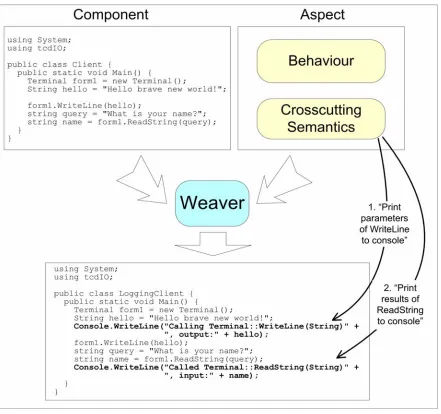
Figure 2.2: Visualization of weaver... 21
Figure 2.3: Visualization of crosscutting types. ... 23
Figure 2.4: Examples of join points for a pointcut-advice aspect-oriented mechanism (source in C#). ... 24
Figure 2.5: Components oblivious (bottom) and aware (top) of crosscutting written in C# and annotated with compiled code sizes for the Main method... 27
Figure 2.6: New I/O program requiring revised crosscutting semantics to log console access. ... 29
Figure 2.7: Details of class Terminal implementation. ... 29
Figure 2.8: Java source code samples for select join point types presented in Table 2.2... 34
Figure 2.9: Example of logical combination of primitive pointcut designators from Table 2.3. ... 35
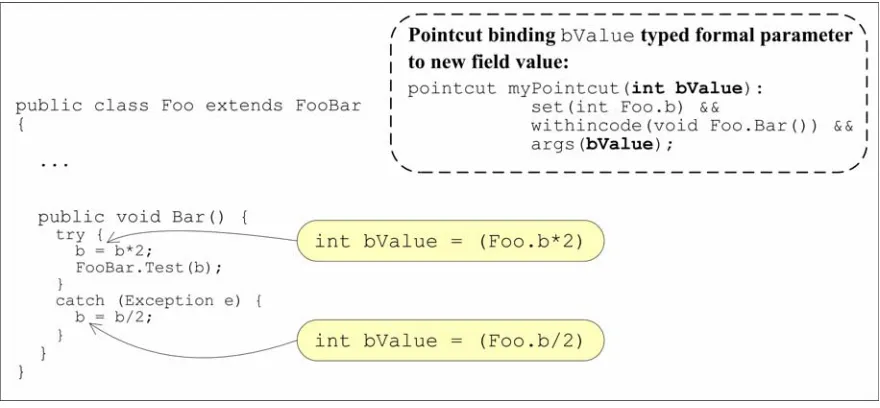
Figure 2.10: Sample use of typed formal parameter in a pointcut... 36
Figure 2.11: Example of execution flow-based join point selection with cflow. ... 38
Figure 2.12: Example advice declaration. ... 39
Figure 2.13: Example specification around advice written in AspectJ... 40
Figure 2.14: Class modeling rational numbers. ... 44
Figure 2.15: Subtype of class Rational with an added mathematical operation... 44
Figure 2.16: Concern mapping that divides the class Rational in Figure 2.14 and BetterRational in Figure 2.15 along feature boundaries... 45
Figure 2.17: Hypermodule constructed from concerns defined in Figure 2.16. ... 45
Figure 2.18: AspectJ source for inserting doubly linked list functionality into a class Foo. ... 49
Figure 2.20: Example of superimposition of a filter modules on an object, based on details
in [Car'01, Ber'04a]. ... 53
Figure 2.21: Logging concern written in ConcernJ taken from TRESE Composition Filters
website [TRE'04]. ... 54
Figure 2.22: “Three ways of hooking into Java’s Class Loader Architecture”, a graphical
representation of load-time transformation implementation options taken from
[Kni'01b]. ... 60
Figure 3.1: Development roles in which aspect-based properties are written and exploited
for application development. ... 64
Figure 3.2: Products produced by the aspect-based property writer role and their
consumers. ... 64
Figure 3.3: Architecture of an aspect-based property... 65
Figure 3.4: Sample aspect-based property crosscutting specifications and behaviour
implementation. ... 68
Figure 3.5: Examples of strong obliviousness with name-based and property-based
crosscutting. ... 69
Figure 3.6: Attribute-based crosscutting equivalent Figure 3.5 and required constructor
annotation... 70
Figure 3.7: Overview of a crosscutting specification in the context of an aspect-based
property... 71
Figure 3.8: Sample attribute type implementation for the CLI... 74
Figure 3.9: Sample API specification for an attribute type. ... 74
Figure 3.10: Overview of products produced and consumed by the component writer role.
... 75
Figure 3.11: Attribute component of Figure 3.7 updated to include the attribute type’s
namespace... 76
Figure 3.12: Overview of products produced and consumed by the application integrator
role. ... 79
Figure 3.13: Overview of language-independent AOP. ... 81
Figure 3.14: Sample of custom crosscutting used to attributed-based crosscutting of Figure
3.7. ... 83
Figure 3.15: Overview of products required and produced by application deployer role. . 84
Figure 3.16: Overview of roles and products of development involving aspect-based
properties. ...86
Figure 3.18: Overview of XML-based declaration and binding of typed formal parameters.
... 91
Figure 3.19: Categorization of crosscutting specification according to implementation dependency. ... 92
Figure 3.20: Overview of XML type patterns and signatures used for name-based crosscutting. ... 93
Figure 3.21: Name-based and property-based alternatives for selecting join points corresponding to the execution of a class Foo constructor with a single argument. ... 94
Figure 3.22: Sample of custom crosscutting with implementation-based property-based crosscutting. ... 95
Figure 3.23: XML used to specify signatures or type patterns in terms of attribute types. 96 Figure 3.24: Attribute-based crosscutting used with aspect-based properties... 97
Figure 3.25: XML syntax for before advice. ... 98
Figure 3.26: XML syntax for the variations of after advice. ... 99
Figure 3.27: XML syntax for around advice. ... 100
Figure 3.28: Example of before advice in the context of a complete aspect-based property. ... 100
Figure 3.29: Overview of advice behaviour implementation. ... 102
Figure 3.30: IAspect interface that provides language-independent access to Proceed and reflection APIs exploited by advice. ... 103
Figure 3.31: Around advice alternative to advice in Figure 3.28. ... 103
Figure 3.32: Use of runtime libraries for reflection and proceeding from around advice. ... 104
Figure 4.1: Common Language Infrastructure overview... 107
Figure 4.2: Examples of call and field join points in CLI opcodes of a simple method. . 109
Figure 4.3: Declaration of custom attribute type for storing developer details (example written in C#). ... 111
Figure 4.4: Use of custom attribute declared in Figure 4.3 and corresponding assembly instructions... 112
Figure 4.5: Weaving interface for prototype weaving library. ... 118
Figure 4.6: Prototype weaver’s specification for the IAspect interface. ... 119
Figure 4.7: Dynamic assembly as modelled by the System.Reflection.Emit library... 121
Figure 4.9: JoinPoint class hierarchy. ... 123
Figure 4.10: Aspect modelling and join point matching architecture... 126
Figure 4.11: Back tracing advice parameters to join point context variables (crosscutting specifications written in AspectJ-like syntax for clarity). ... 128
Figure 4.12: Visualisation of invocation of different categories of advice for an execution join point. ... 131
Figure 4.13: Successful application of naïve join point matching... 137
Figure 4.14: Unsuccessful application o f naïve join point matching. ... 137
Figure 4.15: Prototype implementation of IAspect interface in Figure 4.6... 138
Figure 4.16: Join point execution context cache updates during around advice execution. ... 139
Figure 4.17: Failure with using single cache for join point context variables when around advice is applied to advice execution. ... 140
Figure 5.1: C# source algorithm to enumerate Fibonacci series elements. ... 150
Figure 5.2: Implementation of logging behaviour written in SML.NET... 151
Figure 5.3: A pointcut identifying method execution join points to which logging is applied...152
Figure 5.4: Before that applies logging before join point execution. ... 153
Figure 5.5: After advice that applies logging after join point execution. ... 153
Figure 5.6: Crosscutting specification for logging with SML.NET type implementing logging in bold. ... 157
Figure 5.7: SML.NET implementation of application to calculate Fibonacci Series elements. ... 157
Figure 5.8: Ildasm view of types contained in assembly written in SML.NET source in Figure 5.7. ... 158
Figure 5.9: Contrast between crosscutting semantics produced by an application integrator (top) and an aspect-based property writer (bottom)... 160
Figure 5.10: Implementation of attribute type for accessing logging provided by an aspect-based property... 160
Figure 5.11: Fibonacci series enumerator annotated with attributes to identify methods for logging. ... 161
Figure 5.12: SML.NET implementation of Figure 5.7 updated to exploit custom attributes. ... 163
Figure 5.14: Context attribute to bind a profiling property to a context-bound object... 167
Figure 5.15: A context property that implements profiling using the message sink of
Figure 5.13. ... 167
Figure 5.16: Application of context profiling to weaver profiling via a wrapper class.... 168
Figure 5.17: Method implementing behaviour of advice execution time profiling... 168
Figure 5.18: Pointcut to associate method call profiling with the ProfileAllCalls attribute. ... 169
Figure 5.19: Advice to associate join points in the TimeCalls with around advice of Figure 5.17. ... 169
Figure 5.20: Fibonacci algorithm implemented as mutually recursive singleton objects that
is used for performance comparisons. ... 172
Figure 5.21: Execution times for algorithm of Figure 5.20 with context and aspect-based
logging. ... 172
Figure 5.22: Empty methods that will be influenced by aspect-based properties and
context properties... 173
Figure 5.23: Implementation of memoization aspect behaviour written in C#. ... 175
Figure 5.24: Custom pointcut to select Fibonacci method for memoization and expose
input argument. ... 176
Figure 5.25: Advice statement to apply memoization to pointcut specified in Figure 5.25.
... 176
Figure 6.1: Overview of roles and products of development involving aspect-based
List of Tables
Table 2.1: Categorization of dynamic join points... 23
Table 2.2: Join point types distinguished in the AspectJ Pointcut-Advice aspect model... 34
Table 2.3: Designators specified with a signature or type pattern... 35
Table 2.4: Designators that can expose execution context with typed formal parameters. 36 Table 2.5: Designators specified with a pointcut... 37
Table 3.1: Join point types available with aspect-based properties. ... 88
Table 3.2: Primitive pointcut designators available with aspect-based properties. ... 89
Table 3.3: Logical operations for combining primitive pointcut designators... 89
Table 4.1: Metadata tables that can have custom attributes applied to their elements [Lid'02]. ... 111
Table 5.1: Combinations of component and aspect woven according to implementing language. ... 154
Table 5.2: Weave times for combinations of components and aspects written in a variety of languages. ... 155
Table 5.3: Mapping between CLI (.NET) types and C# / SML.NET equivalents, taken from [Ken'03]... 156
Table 5.4: Contrast of execution times for attribute-based and noninvasive selection of logging. ... 162
Table 5.5: Profiling using context property with aspect-based property results below in parentheses... 170
Table 5.6: Execution overhead of intercession mechanism of context properties and aspect-based properties when applied to methods of Figure 5.22. ... 174
Chapter 1 Introduction
“Get to the point.”
–Attributed to Tim Walsh
Component frameworks are said to support contextual composition when crosscutting
functionality is bound to component instances by declarative selection of context
properties, rather than through direct connections, such as method invocation, or derivation
mechanisms, such as inheritance [Szy'02]. Using contextual composition, component
framework services such as synchronization, security and transaction support are bound to
component instances via method interception. The term component instance [Szy'02] is not rigorous, and in practice a component instance can range from an interface of static
functions to an object to a set of objects. The commonality is that these elements form the
basis of the API from which component functionality is accessed. The mechanism for
declarative selection can range from deployment descriptors, used with EJB Containers
[DeM'03], to attribute-based annotations to source, used with CLR contexts that are
available with the .NET Framework [Mic'04b] implementation of the Common Language
Infrastructure (CLI) specification [Ecm'03b].
Contextual composition frameworks suffer from the lack of tailorability problem [Pic'03] as well as the preplanning problem [Tar'99, Cli'00]. Contextual composition is employed in a range of component frameworks including MTS contexts [Gra'97], EJB containers
[DeM'03], COM+ contexts [Edd'99], CCM containers [OMG], and CLR contexts
[Mic'04b]. Such component frameworks are sometimes referred to as container models
[Pic'03, Coh'04]. The lack of tailorability problem, or tailorability problem, arises because
many cases, the functionality available as context properties is fixed as in the case of MTS
context [Szy'02], COM+ contexts [Szy'02], CCM containers [Duc'02] and standard EJB
containers [Szy'02]. Extensibility is available with CLR contexts [Shu'02, Szy'02] and
non-standard extensions to EJB [jBo'01, Pic'03]; however, these programming models are
idiom-based, and this makes them difficult to use [Pic'03]. The preplanning problem arises
because accessing context properties constrains component architecture. Binding to
context properties involves exposing component functionality as instance methods and
supplying significant prerequisite composition infrastructure. For example, EJB [DeM'03]
requires the specification of several interfaces to describe which instance methods will be
exposed by a container, and CLR contexts place inheritance restrictions on types bound to
context properties [Shu'02, Szy'02].
This thesis introduces aspect-based properties, which use AOP to avoid the restrictions of context properties, but avoid barriers to adoption by providing language-independence and
simplifying reuse. Aspect-based properties are implemented by aspects with
pointcut-advice semantics [Kic'01b, Kic'01a, Mas'03], which provide a well-structured
programming model for writing custom properties [Coh'04] and are shown in this thesis
not to interfere with component architecture. Aspect-based properties avoid making
component interoperability language dependent by adopting a language-independent AOP
model [Laf'03], in which aspect-based properties and the components to which they are
applied can be written in a variety of languages and freely intermixed.
Language-independent AOP meets adoption criteria that requires AOP solutions not make existing
component programming technologies [Coh'04] obsolete, and language-independent AOP
is consistent with the language-independent nature of component-oriented programming
[Szy'02]. Aspect-based properties address reusability by supporting attribute-based
property selection [Shu'02, Szy'02]. We argue that the use of attribute types for property
selection is consistent with the noninvasive properties of AOP by avoiding the need to
modify component implementation, and we show that doing so allows reuse without the
need to write new aspect code. Avoiding the need to learn how to revise crosscutting
semantics also meets adoptability criteria, because it allows the component programmer to
access aspect-based properties with existing knowledge.
The claims above are verified with an aspect weaver implemented for the CLI. This
weaver allows the language-independent properties of aspect-based properties to be
variety of languages and freely intermixed and showing that attribute-based property
selection can be used regardless of component implementation language. Attribute-based
property selection demonstrates the ability to reuse aspects without having to modify their
crosscutting specifications. The weaver is also used to compare aspect-based properties
with equivalent functionality written as context properties using CLR contexts, as CLR
contexts are also implemented for the CLI. In this comparison, we note that the
pointcut-advice mechanism offered by aspect-based properties provides better tailorability than
CLR contexts, because the mechanism’s join point model offers a richer set of execution
points at which it can influence application semantics. Furthermore, the aspect weaver
avoids the architecture restrictions that cause the preplanning problem associated with
context properties. Finally, the execution overhead of aspect-based properties is an order
of magnitude lower than that of CLR contexts.
In the remainder of this chapter, we focus on the contribution that aspect-based properties
make to the area of composing software components and crosscutting concerns. The
following section starts with an examination of the problem of composing crosscutting
functionality with software components, and then explains how context properties provide
only a limited solution to the difficulties faced. The next section outlines our strategy for
improving on contextual composition. Next, we describe how aspect-based properties
provide a novel solution to these requirements. Since this thesis limits its scope to
introducing a new aspect-oriented programming technology and comparing it to contextual
composition, we take another section to point out what falls outside the scope of our
investigation. Following this, we outline the evaluation criteria that must be met to justify
the value of aspect-based properties. We conclude this chapter with an overview of the
remainder of the thesis.
1.1 Crosscutting using Contextual Composition
Typically, crosscutting functionality introduces tangling [Lop'97], which we can
demonstrate to adversely affect the independent deployment and third-party composition
characteristics of software components. Contextual composition solves these problems by
avoiding the need to bind crosscutting functionality with tangling. However, the
applicability of contextual composition is limited by the lack of tailorability problem and
implementing crosscutting concerns, the solution that contextual composition provides,
and problems with this solution.
1.1.1 The Problem with Crosscutting Concerns
The problem with crosscutting concerns is that they conflict with the distributed nature of
software component development and use. Software components emphasise deployment
and composition characteristics that allow components provided by one organisation to be
combined with components of another by a third-party unrelated to either organisation
[Szy'02]. Unfortunately, crosscutting concerns introduce tangling [Lop'97] in which the proper binding of two different functionalities requires that their implementations become
interlaced. As we will see in this section, tangling integrates a crosscutting concern with
the implementation of affected components, and this introduces problems for third-party
composition and independent deployment of components.
By definition, software components emphasise an architecture that supports independent
deployment and third-party composition of software components. We draw our definition
of software components from the area of component-oriented programming, which states
that
“A software component is a unit of composition with contractually specified
interfaces and explicit context dependencies only. A software component can be
deployed independently and is subject to composition by third parties.” [Szy'02]
Independent deployment implies that components will be distributed as separate
self-contained entities. This requires that their interactions with other software components as
well as their environment must be narrowly specified in terms of what the software
component requires for proper functionality as well as what functionality that software
component provides. Third-party composition implies a lack of complete knowledge about
the components involved in composition. Specifically, “a third party is one that cannot be
expected to have access to the construction details of all the components involved.”
[Szy'02]
Programming paradigms usually leave the encapsulation of crosscutting concerns
unaddressed [Tar'99], and so the implementation of these concerns becomes tangled with
other functionality in an application. Crosscutting concerns correspond to functionality
Figure 1.1: Example of tangling of synchronization functionality for data consistency in a C# class
modeling rational numbers.
In object-oriented programming, for instance, crosscutting concerns are “properties or
areas of interest” [Elr'01] that normally defy object-oriented modelling [Boo'94], because
their implementation does not align to class boundaries. Thus, conceptually simple
crosscutting concerns, such as tracing during debugging or synchronization for data
consistency, lead to tangling in which code statements addressing a crosscutting concern
become interlaced with those addressing other concerns within the application. Indeed, the
implementation of synchronization for data consistency provides a particularly good
example of tangling due to the difficulty in encapsulating the implementation of data
synchronization requirements [Mat'93, Ber'99]. A simple instance of this problem is
shown in Figure 1.1, which contains a class Rational that models rational numbers.
The class is written in C#, and it contains methods to calculate the addition of rational
numbers and to convert a rational number to a string. Within these methods, code
operating on object data is interleaved with code for data consistency, which is highlighted
in the figure. Rational number manipulation is well encapsulated as the addition and string
generation methods are limited to manipulating data within Rational object boundaries.
In contrast, data consistency requirements are decided on an application-wide basis. The
application besides class Rational in the same way, and so the implementation of data
consistency is said to crosscut the classes of an application.
With respect to third-party composition, the difficulty with tangling is that it introduces the
need to modify the implementation of a component being composed. Take the example of
class Rational in Figure 1.1, where synchronization characteristics were inserted into
the bodies of methods Add and ToString. Such changes would require an application
developer to have access to construction details in order to modify the component’s
implementation. However, such a requirement violates the notion of third-party
composition in which the composer need not have access to component construction
details to perform composition.
With respect to independent deployment, the difficulty with tangling is that it forces
components to be deployed as sets rather than independently. At issue is the inability to
distribute a tangled crosscutting concern independent of the components it affects. Being
partly a module [Szy'02], components should be separate units of compilation [Car'97,
Fin'98], but tangled functionality cannot be separately compiled. Thus, it is not possible to
separate tangled functionalities along software component boundaries. So, the
implementation of a crosscutting concern is not contained in a single component, but rather
in each of the components with which it is tangled. Take the example of distributing data
synchronization. Using object-oriented composition mechanisms, data synchronization
must be tangled with the components it affects [Mat'93, Ber'99]. The deployment of this
crosscutting functionality then requires that the components containing its implementation
be distributed together, because when the implementation of a crosscutting concern is
broken up along component boundaries it is possible to introduce errors. For instance,
errors in data synchronization are introduced when subtypes of class Rational use their
own implementation for synchronization. Take the subtype BetterRational in Figure
1.2. Although both class Rational and class BetterRational use monitors, the
supertype locks on object instances, while the subtype locks on a separate class-wide
object. Thus, the critical sections of Sub and Add are not mutually exclusive for instances
of type BetterRational. This would not be the case were the implementation of
synchronization consistent in the two types. Guaranteeing such consistency is a matter of
using the same synchronization implementation, but doing so no longer allows
Figure 1.2: Subtype of class Rational with incorrect synchronization. Avoiding such errors
prevents independent deployment of software components.
1.1.2 Decoupling with Context Properties
The use of context properties avoids deployment and third-party composition constraints
that tangled crosscutting concerns place on components. Context properties are
crosscutting concerns implemented by a component framework and composed with
component instances with a method interception mechanism. In particular, contextual
composition involves binding crosscutting functionality to component instances by
declarative selection of context properties, rather than using direct connections, such as
method invocation, or derivation mechanisms, such as inheritance [Szy'02]. For example,
in container models [Pic'03, Coh'04] context properties correspond to container services
bound by a deployment descriptor. Previously, binding crosscutting concerns involved
tangling crosscutting functionality with component implementation; however, the
contextual composition avoids the need for tangling, which simplifies third-party
composition. In these cases, the crosscutting concerns would be distributed with the
affected components. However, having the component framework implement crosscutting
concerns allows the crosscutting concerns to be addressed consistently across an
application without the need for the application’s constituent components to come form the
same organisation. This simplifies independent deployment.
Contextual composition uses message interception to compose crosscutting functionality
with component instances. In the case of EJB, “contextual composition works by placing a
hull around instances and intercepting communication from and to that instance” [Szy'02],
and a similar approach is taken in other implementations of contextual composition such as
CLR contexts. The interception mechanism is then used to bind object instances to
services and resources such as synchronization and transactional properties. For example,
and class BetterRational of Figure 1.2 can be addressed by a context property. Upon
interception of an Add, Sub, or ToString invocation, the context property should create a
critical section by obtaining locks on object instance and method parameters before
forwarding the invocation to the destination method. After the method completes, the
context property should release the locks.
The declarative means by which context properties are bound to component instances
varies according to the component framework implementing contextual composition. The
mechanism for declarative selection can range from deployment descriptors, used with EJB
containers [DeM'03], to attribute-based property selection, used with CLR contexts
[Mic'04b]. Deployment descriptors identify context property requirements of component
instances separate from the component implementation. For example, the context
properties of an EJB are described in XML with tags that cross-reference types and type
members implemented by a component with the context properties required. In contrast,
CLR contexts use attributes to make the association between type implementation and
context properties. Attributes [Ecm'03b], also called annotations [Blo'03], are a programming-language mechanism for associating additional information with the
metadata descriptions of types and their members. Types or type elements become
associated with a context property when their implementation is annotated with an attribute
corresponding to the context property. This approach is sometimes referred to as attributed
programming [Shu'02]. Whether context property selection is by deployment descriptor or
by attribute, composing the component implementation to that of the context property is
deferred until or after deployment. For example, EJB components are composed with
context properties at deployment time typically through code generation [Szy'02]. With
CLI, context properties are composed at runtime when objects are instantiated [Szy'02].
By deferring composition with the context property at least until deployment, a component
can avoid explicitly addressing the corresponding crosscutting concerns in its
implementation [Pic'03]. The Synchronization attribute highlighted in Figure 1.3
provides an example of a context property available in the Microsoft .NET implementation
of the CLI. This attribute allows a class to define the synchronization characteristics of its
objects. The use of this attribute in Figure 1.3 limits the execution of class
SampleSynchronized methods to one thread at any given time. The figure also highlights
the need to inherit from ContextBoundObject in order to use the context property, which
Figure 1.3: Use of Synchronization attribute available in CLR contexts [Mic'04b].
1.1.3 Limits to Contextual Composition
Unfortunately, the use of contextual composition to address crosscutting concerns is
limited by the lack of tailorability problem [Pic'03] as well as the preplanning problem
[Tar'99, Cli'00]. Lack of tailorability is an issue, because of the great difficulty in creating
context properties to suit the crosscutting functionality required by a component.
Preplanning is an issue, because even the most recent contextual composition frameworks,
such as EJB and CLR contexts, constrain component architecture to suit the contextual
composition mechanism [Shu'02, Coh'04].
Although the preplanning problem originates with design patterns, the same difficulties are
faced by components wishing to exploit contextual composition. The preplanning problem
was observed in the context of design patterns [Gam'94], where it was noted that although
the use of patterns allowed for adaptability, they could only be applied if the need for such
adaptation was identified during design. We can extend the preplanning problem to
contextual composition by observing that the use of context properties by a software
component influences the class and object structure implemented by the component, which
is also known as the component’s architecture [Boo'94]. The underlying difficulty is that
contextual composition does not provide a sufficiently general mechanism for binding
crosscutting functionality to component instances. For instance, with CLI software
components, the class exploiting CLR contexts faces strict inheritance requirements, and
so class SampleSynchronized of Figure 1.3 was forced to inherit from class
ContextBoundObject. Likewise, EJB components must implement an interface
appropriate to the bean type [Rom'02] along with extensions to the EJBHome and
EJBObject interfaces to allow component instance functionality to be accessed from
outside the container. Also, the binding mechanism used in contextual composition
activated by messages passing between objects. Thus, intra-object activities such as data
access and recursive calls cannot be influenced. In addition to constraining component
architecture, these requirements prevent context properties from being used to address
crosscutting concerns that are only spotted when the components of an application are
assembled. For instance, performance concerns sometimes appear when the final
application is composed that can only be solved with result caching described as method
memoization [Men'97]; however, by this time it is too late to change component
architecture to allow composition with a memoization context property.
Figure 1.4: C# source for class Time component annotated with its thread safety requirements.
The lack of tailorability problem [Pic'03] refers to the inability to extend the set of context
properties available to suit the crosscutting functionality required by a component.
Specifically, the set of context properties available with MTS, COM+, EJB, and CCM
component frameworks is fixed [Szy'02, Pic'03]. Extensibility is available to a limited
extent with CLR contexts [Shu'02, Szy'02], but in practice this programming model is ad
hoc rather than structured. Unlike other technologies for manipulating crosscutting
concerns, such as aspect-oriented programming (AOP) [Elr'01], contextual composition
mandates no structured operations for generating or manipulating a crosscutting view of an
application. Take for example the synchronization requirements for class Time in Figure
1.4. The class requires two synchronization policies depending on whether one or two
objects of type Time are being manipulated. Since the class is written in a CLI-based
implement these policies with a context property. While the framework provides an
implementation of a monitor to define critical regions, there are is no obvious mechanism
for obtaining an object reference from within a context property’s implementation for the
monitors to lock.
1.2 Solution Domain
Our interest is in overcoming the limits of contextual composition, while retaining its
benefits. Such work has been undertaken in the area of aspect-oriented programming
(AOP), which recognises context properties as a form of aspect [Kim'02]. In particular,
AspectJ2EE [Coh'04] has addressed the lack of tailorability problem with an AOP-based
programming model for creating new container services for EJB. An aspect [Kic'97] provides a unit of encapsulation that couples the behaviour of a crosscutting concern with a
join point specification detail where in component code the behaviour is to be applied. In
the context of AOP, components [Kic'97] correspond to units of well-encapsulated behaviour, be they source code or binaries. The aspects and components of an application
are composed, or woven, to produce a single program. This composition is specified in terms of aspect-oriented composition mechanisms [Elr'01]. The use of AOP for contextual
composition is contingent on the ability to defer composition of components and aspects at
least until deployment time [Pic'03]. This avoids problems with independent deployment
that we observed in section 1.1.3 when the implementation of a crosscutting concern is
composed with components before they are deployed.
While AOP has been shown to be capable of tackling the lack of tailorability problem,
AOP-based alternatives to contextual composition do not eliminate the preplanning
requirements imposed, and the use of AOP introduces language dependencies and
reusability problems. Recall that AspectJ2EE [Coh'04] avoids lack of tailorability in the
context of the EJB container model [Coh'04]. Despite the advances available with
AspectJ2EE, only Java classes meeting EJB architectural constraints can access context
properties. Another difficulty is that AOP has traditionally been a programming language
mechanism [Elr'01], and so its use implies the adoption of a particular language. In
contrast, the language-independent characteristics of components [Szy'02] suggest that
component interoperability should not be language dependent. As we will see in the next
implementation. The need to rewrite an aspect is problematic, as an alternative to context
properties should not add new complexity to the selection of crosscutting functionality.
1.3 Thesis Contribution
This thesis proposes a solution to the problems identified with contextual composition and
AOP in the form of aspect-based properties. Aspect-based properties are an alternative to
context properties in which crosscutting functionality is modelled with aspects
implemented with a pointcut-advice mechanism. The key characteristics of aspect-based properties are:
• A pointcut-advice mechanism for defining aspects • Load-time weaving of aspects with components • Language-independence
• Support for attribute-based property selection
Each of these characteristics plays a role in allowing aspect-based properties to replace
context properties. The pointcut-advice (PA) mechanism allows new crosscutting
functionality to be written that can be bound to a richer set of execution points than
contextual composition offers, which allows aspect-based properties to address the
tailorability problem. While choosing the pointcut-advice mechanism is consistent with its
success in implementing context properties in the past [Pic'03, Coh'04], the decision to use
this mechanism is based on an analysis of aspect-oriented mechanisms presented in
Chapter 2. This analysis noted the PA mechanism to be easier to conceptualise, to offer
finer grained crosscutting and to offer better performance. The use of a load-time weaver
to compose aspects with components removes the burden of providing support for
composition from the software component. Thus, the component inheritance and interface
constraints imposed by contextual composition that cause the preplanning problem are
avoided. Furthermore, weaving at load-time allows composition of aspect-based properties
and components to be deferred until after deployment for consistency with
component-oriented programming requirements. Language-independence involves allowing aspects
and components to be written in a variety of languages and freely intermixed, regardless of
how aspect-based properties are selected. Such characteristics allow aspect-based
properties to retain the language-independent nature of component-oriented programming.
properties. Attribute-based property selection provides a simple means of aspect-based
property reuse that avoids the need to revise the crosscutting specification of the aspect.
This thesis makes secondary contributions specifically to AOP in the areas of
language-independence and the use of attributes. Although AOP technology has been applied to the
composition of software components [Coh'04], these technologies have not been
demonstrably language-independent in the sense that components and aspects can be
implemented in a variety of languages and freely intermixed [Laf'03]. With aspect-based
properties we see the first example of an AOP technology that demonstrates
language-independence. Also, this thesis addresses reusability with attribute-based property
selection. A reuse strategy should decouple aspect binding from aspect implementation so
that components can be associated with aspects at deployment time [Pic'03]. Current
strategies for reuse of aspects involve providing revised crosscutting specifications. For
instance, pointcut-advice mechanisms propose abstract pointcuts [Pic'03, Ras'03, Coh'04]
even in systems that allow crosscutting in terms of attributes [Bon'04a]. This thesis
addresses reuse with attributes by identifying how they can be used in a fashion consistent
with the noninvasive nature of AOP. Specifically, we argue that the use of attributes
adheres to the noninvasive emphasis of AOP, as attributes do not actually modify the
implementation of component types.
1.4 Orthogonal Issues
This thesis does not address the implementation of existing context properties with
aspect-based properties. Work in [Coh'04] has demonstrated the ability for aspects with
pointcut-advice semantics to be used to implement EJB container properties, but in our presentation
of aspect-based properties we have not attempted to implement a series of existing context
properties for aspect-based properties.
This thesis does not touch on aspect frameworks. Work in [Ras'03] describes a framework
for persistence consisting of several aspects. The need to use multiple aspects to properly
model crosscutting concerns such as persistence is not dealt with in our work on
aspect-based properties.
Finally, we leave the issue of mediating the composition of different crosscutting concerns
adversely affect the others, is an issue in contextual composition, referred to as the
composability problem [Szy'02], as well as aspects [Kni'01a] to which aspect-based
properties make no contribution.
1.5 Evaluation Criteria
The evaluation should determine if aspect-based properties are realistic to adopt for
component-oriented programming. Adoption is an issue of whether programmers can
realistically migrate from context properties to a programming model involving
aspect-based properties. Adoption requires that users not have to abandon existing programming
techniques [Coh'04]. We understand this to mean that developers should not have to
abandon the programming languages that they current use to implement components to
take advantage of aspect-based properties, nor should the developer have to abandon
existing components. This is a matter of ensuring that aspect-based properties properly
support language-independence, and that crosscutting specifications can, if necessary, be
tailored to existing components. Since AOP is a reasonably novel approach [Elr'01], we
can expect that existing programmers do not have a strong knowledge of AOP
mechanisms, and so a second facet of adoption is whether aspect-based properties can be
used without the need to modify an aspect. This is a matter of demonstrating the
attribute-based property selection of aspect-attribute-based properties is available in a manner consistent with
language-independence.
The second evaluation problem is to determine if aspect-based properties make tangible
improvements on contextual composition. The tangible benefits of aspect-based properties
concern their ability to solve the preplanning and tailorability problems. With respect to
preplanning, we want to see that aspect-based properties place less design constraints on
software components than context properties. This comparison should involve a simple
example, in which custom crosscutting functionality is written for a software component
both as a context property and as an aspect-based property. This comparison requires a
component framework that provides a mechanism for writing new context properties such
as CLR contexts do for the CLI. With respect to tailorability, a minimal test is to illustrate
that custom aspect-based properties can be written. A more interesting test is to illustrate
that custom aspect-based properties can address problems beyond the scope of context
properties. Since AOP originated in part to lower application execution times [Kic'97], we
time of an application. Also, we would like to see aspect-based properties not introduce
any more execution overhead than context properties, and ideally for them to introduce
less.
1.6 Thesis Overview
The remainder of this thesis provides a grounding in aspect-oriented technology and
characterises aspect-based properties. Chapter 2 reports on the state of the art in AOP
starting with an introduction to important AOP terminology, which is followed with the
taxonomy of the principle aspect-oriented mechanisms. Finally, the implementation issues
with software component weaving are summarised. Chapter 3 presents aspect-based
properties in the context of their programming model. The programming model is first
presented in terms of the developer roles involved with using aspect-based properties for
application development and the products of these roles. Next, the chapter focuses on the
aspect model used to implement crosscutting functionality with aspect-based properties in
which crosscutting specifications are written in XML and behaviour implemented with a
component type. Chapter 4 provides implementation details for a prototype weaver, called
Weave.NET, that supports aspect-based properties for the CLI component platform. This
chapter provides details on why the CLI platform was targeted, how the XML schema for
crosscutting specifications was devised, how the weaving APIs are implemented, and how
they are integrated with the execution environment to provide load-time weaving. Chapter
5 evaluates aspect-based components based on the criteria described in section 1.5.
Chapter 6 summarises the thesis and its contributions, and then it points out future avenues
of research.
1.7 Summary
In this chapter we introduced contextual composition as a declarative means of binding
crosscutting functionality with components. Contextual composition suffers from the lack
of tailorability problem in that the set of context properties is difficult if not impossible to
extend. The preplanning problem is another issue, and it refers to the inability to use
context properties without influencing component architecture. These issues can be solved
with aspect-oriented programming (AOP). However, aspect-based properties are required
to overcome language dependency and reusability issues with AOP technology.
support for attribute-based property selection and a load-time weaving architecture.
Evaluation criteria will concern the adoptability of aspect based properties and their ability
Chapter 2 State of the Art
“Originality is the fine art of remembering what you hear, but forgetting where you
heard it”
–Laurence Peter
This chapter surveys the aspect technology used to address crosscutting concerns in
software. In our analysis, we find that among the canonical aspect-oriented mechanisms, it
is the pointcut-advice mechanism that best addresses the tailorability and preplanning
problems with contextual composition. A pointcut-advice mechanism allows the aspect to
directly influence execution with fine-grained aspects, and its use does not impose
restrictions on the programming model for components. Unfortunately, the reuse strategies
for aspect-oriented mechanisms rely on being able to customise the aspect, whereas reuse
of a context property leaves the property unchanged. Also, interoperability is at the
language level, leaving aspect users to define their component to suit the aspect-oriented
language. As for retaining the independent deployment characteristics of components, we
find load-time weaving can address the need to keep crosscutting functionality separate
until after deployment without the need to consider the implementation language of
components or aspects.
To provide an in-depth understanding of AOP, we describe the canonical AOP
mechanisms in terms of their aspect model rather than simply looking at the operations
these mechanisms make available for expressing aspects. An aspect model describes the
crosscutting semantics of an aspect technology in terms of its join point model, its means
of identifying join points and its means of modifying application semantics at these join
points [Kic'01a]. A join point model specifies the elements of an application to which an
individually, and to create these sets there must be some means of identifying join points.
Finally, manipulating the sets of join points requires a means of modifying application
semantics on a set-wide basis. In contrast, we view aspect-oriented mechanisms as the
abstractions used to express an aspect. Whereas mechanisms define operations with which
an aspect is implemented, an aspect model provides details on the semantics of aspects and
an insight into how the operations provided by the mechanism are to be used.
We have identified five canonical aspect-oriented mechanisms, which are as follows:
• The pointcut-advice (PA) mechanism exemplified by the work of the AspectJ Team
[Asp'00]
• Class composition exemplified by the work of the MDSOC Project [IBM'00a] • Object-graph traversal exemplified by the work of the Demeter Project [Lie'00] • Open class composition, which originated with mixins [Moo'86], but is exemplified
by the inter-type declaration semantics of AspectJ
• Composition Filters (CF) object model extensions available with tools such as
ComposeJ [Car'01]
The first four mechanisms were identified as aspect-oriented in work to develop a
definition of what makes a modular crosscutting mechanism aspect-oriented [Mas'03]. The
CF Model appears frequently as a prominent aspect-oriented mechanism in AOP
community literature, such as [Ber'01]. The CF mechanism is also of interest in that it
provides a tailorability mechanism to similar context properties in that it relies on method
interception and offers to avoid the preplanning problem with contextual composition.
The rest of this chapter establishes the fundamentals of aspect technology, critiques the
five canonical mechanisms, and examines implications of component composition for
weave time. In section 2.1, we clarify what is understood to be an aspect and an aspect
model. Also, the concept of obliviousness is examined along with it consequences for the
reusability of aspects and the complexity of component maintenance. Section 2.2 provides
an overview of AOP mechanisms and current approaches to language-independence. Each
AOP mechanism is then discussed in-depth. Background details summarise the
technology’s origins and goals. The mechanism is characterised in terms of the underlying
aspect model, and where possible programming details are provided. The mechanism is
analysed for its usefulness in solving the problems of context properties, providing
requirements component composition places on aspect weavers and we characterise a
common solution to these issues in the form of load-time weaving.
2.1 Principles of Aspects
In section 1.2, the aspect was presented as a unit of encapsulation motivated by the need to
avoid software engineering problems surrounding tangling. So far, we have mentioned
five mechanisms with aspect-oriented characteristics. What these technologies share is the
ability to implement functionality that crosscuts an application in a well-encapsulated
manner. What differentiates these technologies is what elements of the application are
crosscut and how crosscutting functionalities are implemented. These details are given by
the aspect model of a mechanism. The aspect model describes the semantics underlying a
mechanism. With the model in mind, it is possible to exploit a particular AOP mechanism
for writing aspects. These aspects address tangling based on the component to which they
are applied being oblivious to the application of the aspect. Obliviousness separates
implementation of the aspect and component by dictating that aspect-related artefacts
should not be placed in the component implementation.
In the following subsections, we go into detail on aspects. First, we characterise aspects
and point to the common characteristics of aspect-oriented technologies. Next, we
examine the concept of an aspect model in greater detail. The constituent elements are
discussed one by one with the aid of an example based on the PA aspect-oriented
mechanism. Finally, we look at the consequences of obliviousness for the specification of
an aspect’s crosscutting semantics.
2.1.1 Aspects
At first glance the notion that aspects allow the encapsulation of crosscutting concerns may
seem paradoxical. Recall from section 1.2 that an aspect [Kic'97] provides a unit of encapsulation that couples the behaviour of a crosscutting concern with a join point
specification that details where in component code the behaviour is to be applied. It would
appear contradictory that an aspect can encapsulate crosscutting concerns if crosscutting
concerns by definition cannot be encapsulated. This apparent contradiction is referred to in
from the point of view of this primary decomposition paradigm that crosscutting concerns
are observed. For example, in OO systems data is encapsulated along object boundaries,
and we tend to think of such systems in terms of their objects. However, the data hiding
properties of object boundaries would hinder the implementation of functionality such as
persistence, which requires direct access to the data of multiple objects and multiple types
of objects. In solutions for persistence based on aspects [Soa'02, Ras'03], persistence is
still a crosscutting concern, because persistence still crosscuts the data hiding boundaries
of objects in the application. Similarly, the aspectual paradox is resolved by considering
that the mechanisms proposed by AOP allow the manipulation of arbitrary sets of program
elements, such as data members of objects, and these program elements are normally
encapsulated separately with other units of decomposition such as object boundaries in
object-oriented programming. From this view, AOP can be seen as breaking the “tyranny
of the dominant decomposition” [Tar'99] paradigm of a particular programming language.
Figure 2.1: Tangled implementation of logging crosscutting behaviour.
Aspects eliminate tangling by supporting modular crosscutting. For our purposes, modular
crosscutting describes the ability of an aspect to specify, in a well encapsulated fashion, its
bindings to the final application. This final application is generated when a weaver
combines any number of programs together to create a single combined computation
[Mas'03]. Take the example of Figure 2.1 in which logging calls are inlined with the
implementation of a simple I/O program. In contrast, Figure 2.2 separates logging calls
from the I/O program by placing them in an aspect. This requires the aspect include
logging behaviour as well as specifications for its integration with the final application. In
Figure 2.2, these semantics are interpreted by the weaver, and they result in a program with
behaviour identical to that of the tangled original. In this case, crosscutting is modular
Figure 2.2: Visualization of weaver
2.1.2 Aspect Model
The concept of an aspect model introduces a structured means of describing a particular
aspect-oriented mechanism. The defining elements of an aspect model correspond to the
characteristics that allow an aspect-oriented mechanism to crosscut an application. For
these elements, we turn to an investigation into the commonality among recognised
aspect-oriented mechanisms discussed in [Mas'03]. This investigation “produces a clear three part
characterization of what is required to support crosscutting structure: a common frame of
reference that two (or more) programs can use to connect with each other and each provide
their semantic contribution.” [Mas'03] This statement can be confusing to readers, as the
three parts that characterise the crosscutting nature of an aspect-oriented mechanism are
not presented in enumerated form. The first part of the characterization is the “common
frame of reference”, which allows aspects to refer to elements of the final application,
aspect model, this common frame of reference corresponds to a join point model, which identifies the possible connection points that an aspect can potentially exploit to influence
the final application. Thus, the join point model corresponds to the “common frame of
reference” referred to by an aspect in its crosscutting specification. The second element of
the characterisation is a description of how the aspect-oriented mechanism refers to
program elements. In terms of an aspect model, this second element is the means of identifying join points, which gives an aspect mechanism its ability to “connect” to the final application. The third element is a description of what can be done by an aspect to
program elements in the final application in order to make a “semantic contribution”. In
terms of an aspect model, this third element is the means of modifying join point semantics
that an aspect-oriented mechanism provides.
The following subsections elaborate on the function of each element of an aspect model.
To make our description concrete, we map the functionality of a pointcut-advice (PA)
mechanism to aspect model elements. This analysis of a PA mechanism is cursory, and a
more in-depth explanation is presented in section 2.2 when the canonical PA mechanism
implemented by AspectJ is analysed.
2.1.2.1 Join Point Model
A crosscut can be thought of as an arbitrary collection of potentially unrelated program
elements. By unrelated, we mean that there is no existing grouping by which we can
manipulate these program elements from a single point. Take the example of a set of types
in an object-oriented language supporting inheritance. If the types in the set are all
subtypes of a common class, adding fields or methods to all types in the set is a matter of
making changes to the common super-type. Using this single point of change is visualised
on the left-hand side of Figure 2.3, where modifications to all types correspond to a change
to one class. For types not related by inheritance, the modification involves multiple po




![Figure 2.19: Simple adaptive method taken from [Orl'01].](https://thumb-us.123doks.com/thumbv2/123dok_us/912586.603912/68.595.94.542.237.460/figure-simple-adaptive-method-taken-orl.webp)
![Figure 2.20: Example of superimposition of a filter modules on an object, based on details in [Car'01, Ber'04a]](https://thumb-us.123doks.com/thumbv2/123dok_us/912586.603912/70.595.139.499.124.390/figure-example-superimposition-filter-modules-object-based-details.webp)
![Figure 2.21: Logging concern written in ConcernJ taken from TRESE Composition Filters website [TRE'04]](https://thumb-us.123doks.com/thumbv2/123dok_us/912586.603912/71.595.105.540.182.575/figure-logging-concern-written-concernj-composition-filters-website.webp)
![Figure 2.22: “Three ways of hooking into Java’s Class Loader Architecture”, a graphical representation of load-time transformation implementation options taken from [Kni'01b]](https://thumb-us.123doks.com/thumbv2/123dok_us/912586.603912/77.595.180.460.60.345/figure-loader-architecture-graphical-representation-transformation-implementation-options.webp)
