An!Approach!to!Modelling!Learner!Cognition!for!
Technology!Enhanced!Learning!
! ! ! ! ! ! ! ! ! !
A!thesis!submitted!to!the!
University*of*Dublin,*Trinity*College* for!the!degree!of!
Doctor*of*Philosophy* 2013!
* * * * * *
Victoria*Macarthur*
Knowledge!and!Data!Engineering!Group! Department!of!Computer!Science!and!Statistics!
Trinity!College! Dublin!
! !
Declaration!and!Online!Access!
I"declare"that"this"thesis"has"not"been"submitted"as"an"exercise"for"a"degree"at"this"or" any"other"university"and"it"is"entirely"my"own"work."
"
I"agree"to"deposit"this"thesis"in"the"University’s"open"access"institutional"repository"or" allow"the"library"to"do"so"on"my"behalf,"subject"to"Irish"Copyright"Legislation"and"Trinity" College"Library"conditions"of"use"and"acknowledgement."
__________________
Summary!
!In! adaptive! Technology! Enhanced! Learning! (TEL)! systems,! the! changing! nature! of! learners’! actions,! responses,! and! characteristics! are! modelled.! This! information! is! assessed! and! traced! in! order! to! reason! about! the! state! of! the! learner! and! provide! suitable!personalised!content!or!support.!Metacognitive!and!selfMregulatory!strategies! are! now! being! addressed! by! these! TEL! systems.! This! is! motivated! by! the! goal! of! supporting! learners! to! become! proMactive,! adaptive,! and! improve! their! educational! outcomes.! However,! research! in! this! area! does! not! yet! adequately! address! the! modelling! of! metacognition.! This! thesis! contributes! a! method! for! the! modelling,! tracing,! and! subsequently! fostering! cognitive! competencies! alongside! a! TEL! environment.!The!focus!is!on!regulatory!metacognitive!strategies!that!are!antecedent! to!positive!lifelong!learning.!
!
The! first! component! of! this! thesis! describes! an! analysis! of! psychological! and! pedagogical!theories!of!learning,!cognition!and!metacognition.!Theories!of!cognition! and! metacognition! are! analysed! in! order! to! underpin! an! alternative! approach! to! modelling!cognition.!An!analysis!of!the!state!of!the!art!adaptive!TEL!systems!is!also! undertaken! in! order! to! understand! their! features,! benefits! and! limitations.! This! includes!an!examination!of!the!application!of!pedagogical!and!psychological!theories! to! model! and! foster! cognition! and! metacognition,! analysis! of! user! modelling! for! adaptation,! distribution! of! adaptive! TEL! technologies! as! services,! as! well! as! an! examination!of!TEL!environments!that!provide!metacognitive!supports.!
!
undertaken! by! learners! when! engaged! in! academic! reading.! These! models! are! activated!and!acted!upon!in!a!manner!analogous!to!schema!theory,!a!theory!of!how! knowledge! is! encoded! and! applied! in! human! memory.! ETTHOS! is! manifest! in! the! Goby! service! as! a! testMbed! system! with! which! to! analyse! the! educational! outcomes,! and!suitability!of!the!structure!and!approach!taken.!!
!
This! work! advances! the! state! of! the! art! by! building! on! the! modelling! and! support! features! characteristic! of! adaptive! TEL.! ETTHOS! contributes! a! novel,! applied,! and! evaluated! approach! that! describes! the! decomposition! of! the! necessary! models! and! processes! required! in! a! cognitive! modelling! service.! An! assessment! of! the! baseline! model!compared!to!the!Goby!participants!revealed!that!the!two!groups!were!on!par,! indicating!that!the!baseline!model!was!an!accurate!representation!of!the!community.! The!accuracy!of!modelling!afforded!by!ETTHOS!in!the!Goby!service!was!mixed!with! agreement! reported! for! approximately! half! of! the! factors.! Analysis! revealed! that! participants,!particularly!those!with!lower!prior!knowledge,!were!motivated!to!reflect! on! and! alter! their! metacognitive! responses,! seeing! Goby! as! an! everMpresent! tutor.! Although! there! was! no! change! in! regulatory! metacognition! directly! after! the! Goby! experiment,! there! was! an! increase! in! learning! gain! reported.! While! it! is! difficult! to! generalise!the!learning!gain!results!because!of!the!size!of!this!subset!of!participants,! this! points! to! the! benefits! of! future! use! and! evaluations! of! the! ETTHOS! model.! Subsequent!to!this!evaluation,!this!thesis!concludes!with!a!reflection!on!the!research! objectives!and!makes!suggestions!for!future!work.!!
!
Acknowledgements!
!
There!are!so!many!people!who!have!helped!to!make!this!thesis!possible!and!whom!I! would! like! to! thank.! Owen! Conlan! has! been! a! most! inspiring! supervisor.! It! was! he! who!steered!me!in!the!direction!of!adaptive!technology!enhanced!learning!back!when! I!was!an!MSc!student!who!was!interested!in!cognition!and!the!Internet.!His!wisdom! and!guidance!has!made!the!PhD!process!a!wonderful!learning!experience.!!
!
Doing!a!PhD!is!a!long!and!sometimes!selfish!process!that!whisks!you!away!for!days,! weeks,! or! months! at! a! time.! I! could! not! have! made! it! through! without! the! support! from!my!family!and!friends.!It!would!have!been!a!lot!longer!and!a!very!lonely!process! if!I!didn’t!have!Nick!Grey!at!my!side.!His!love,!support,!and!impeccable!logic!helped! me! to! reason! my! way! out! of! many! research! pickles.! He! has! endured! my! geek! talk,! working!weekends,!and!dragged!me!out!of!bed!when!I!needed!to!get!back!to!work.! Thanks! to! Sheila! for! opening! her! home! to! me.! Her! endless! optimism! and! stylish! outlook!on!life!was!always!a!welcome!break.!!
!
I!owe!so!much!to!my!family!M!Dad!and!Charlotte!thanks!for!the!persistent!belief!that!I! would!finish!–!a!Macarthur!is!nothing!if!not!stubborn!and!good!at!getting!things!done!! My! Aunty! Mary! was! been! a! rock! through! hard! times! and! helped! me! to! stop! to! celebrate!the!good!ones.!Nana!and!Bill,!combined!you!were!two!in!a!million!M!I!only! wish!you!could!have!seen!me!finish.!I!have!a!few!special!close!friends!of!many!years! who!have!provided!endless!support.!We’ve!ended!up!together!in!Dublin!and!you!were! all!helpful!in!so!many!ways!–!thanks!Ashling,!Barry,!Caoilte,!Gráinne,!Helen,!Kiera,!and! Laura.!!
!
and!always!put!a!smile!on!my!face.!Eileen!and!Ashling!have!been!astute!reviewers!and! helped!to!refine!the!syntax!and!formatting!in!my!thesis.!!
!
The! National! College! of! Ireland! (NCI)! is! also! due! thanks! –! to! the! faculty,! associated! faculty,!and!of!course!the!students.!NCI!greatly!influenced!my!research!by!instilling!a! studentMcentric!approach!and!I!have!had!so!many!thoughtMprovoking!discussions!on! the!possibilities!of!web!technologies!and!learning.!Special!thanks!goes!to!the!students! for!whom!I!was!programme!director!M!BSHCE,!BSHBISE,!and!HCCE,!especially!those! who!put!up!with!my!pestering!to!complete!surveys!and!experiments!–!without!you! this!thesis!would!not!have!been!possible.!!!
!
Finally,!I!would!like!to!express!my!gratitude!to!the!Irish!Research!Council!for!Science,! Engineering!and!Technology!for!partially!funding!the!research!detailed!in!this!thesis.! !
Abstract!
Table!of!Contents!
CHAPTER(1( INTRODUCTION(...(1( 1.1! MOTIVATION!...!1! 1.2! RESEARCH!QUESTION!...!6! 1.3! RESEARCH!AIMS!AND!OBJECTIVES!...!6! 1.4! CONTRIBUTION!...!7! 1.5! RESEARCH!APPROACH!...!10! 1.6! DEFINITION!OF!TERMS!...!11! 1.7! THESIS!ROADMAP!...!13! CHAPTER(2( METACOGNITION(AND(LEARNING(...(15( 2.1! INTRODUCTION!...!15! 2.2! THE!ROLE!OF!COGNITION!AND!METACOGNITION!IN!LEARNING!...!16! 2.3! LEARNING!AND!COGNITION!...!19!2.3.1! Constructivist/Learning/.../20!
2.3.2! Schemata/–/Our/Mental/Models/.../21!
2.3.3! Declarative,/Procedural/and/Metacognitive/Knowledge/.../24!
2.3.4! Processing/Information/in/the/Learning/Environment/.../26!
2.3.5! Cognitive/Strategies/for/Reading/.../27!
2.3.6! Psychosocial/Aspects/of/Learning/.../29!
2.3.7! Conclusion/.../31!
2.4! METACOGNITION!...!32!
2.4.1! Metacognition/Background/.../33!
2.4.2! Metacognition/as/a/Component/of/SelfPRegulated/Learning/.../35!
2.4.3! TwoPComponent/Model/of/Metacognition/.../37!
2.4.4! Supporting/the/Development/of/Metacognition/.../41!
2.4.5! Measuring/and/Modelling/Metacognition/.../43!
2.4.6! Metacognition/and/Psychometrics/.../45!
2.4.7! Conclusion/.../49!
2.5! CONCLUSION!...!50!
CHAPTER(3( COGNITION(AND(METACOGNITION(IN(TECHNOLOGY(ENHANCED( LEARNING(ENVIRONMENTS(...(54(
3.1! INTRODUCTION!...!54!
3.2! COGNITION!AND!METACOGNITION!IN!TEL!...!55!
3.2.1! Supporting/Metacognition/with/TEL/Environments/.../55!
3.2.2! What/are/Adaptive/TEL/Environments?/.../55!
3.2.3! Metacognition/in/Technology/Enhanced/Learning/.../58!
3.2.4! Design/of/TEL/to/Support/Cognition/and/Metacognition/.../61!
! Emulating!the!Human!Tutor!...!62! 3.2.4.1 ! Declarative,!Procedural!and!Metacognitive!Knowledge!Support!...!62! 3.2.4.2 ! Decomposition!of!Strategies!and!Knowledge!into!Components!...!63! 3.2.4.3 ! Supports!in!the!TEL!Environment!...!64! 3.2.4.4 ! Dealing!with!Individual!Differences!...!65! 3.2.4.5 3.2.5! Conclusion/.../66!
3.3! USER!MODELLING!AND!ADAPTATION!...!67!
3.3.1! The/User/Modelling/Adaptation/Loop/.../68!
3.3.2! User/Modelling/and/Adaptation/Characteristics/.../71!
! Dynamic!and!Static!User!Models!...!71! 3.3.2.1 ! Explicit!and!Implicit!Mechanisms!for!updating!User!Models!...!71! 3.3.2.2 ! Adaptation!OnYTheYFly!or!PreYSetup!...!72! 3.3.2.3 ! Timing!of!the!Support!...!72! 3.3.2.4 ! Type!of!Support!Target!...!73! 3.3.2.5 3.3.3! Distribution/of/Adaptive/and/Modelling/Services/.../73!
3.3.4! Conclusion/.../76!
3.4! METACOGNITION!IN!TEL!ENVIRONMENTS!...!77!
3.4.1! Scaffolding/Metacognition/through/Dialog/.../84!
3.4.2! Reflection/and/Open/Learner/Models/.../87!
3.4.3! Reflection/Before/and/After/the/Learning/Task/.../91!
FIGURE!6.11!Y!SAMPLE!BAR!CHART!FIGURE!...!213!
FIGURE!6.12!Y!WERE!YOU!MOTIVATED!BY!THE!POPUP!CONTENT?!...!215!
FIGURE!6.13!Y!DID!THE!GOBY!PROMPTS/QUESTIONS!HELP!YOU!WHILE!LEARNING?!...!216!
FIGURE!6.14!Y!DID!YOU!THINK!ABOUT!THE!PROMPTS!AND!QUESTIONS?!...!216!
FIGURE!6.15!Y!DID!THE!PROMPTS!AND!QUESTIONS!HELP!ORGANISE!YOUR!TIME?!...!217!
FIGURE!6.16!Y!WERE!THE!PROMPTS!AND!QUESTIONS!RELEVANT!TO!LEARNING!SQL?!...!219!
FIGURE!6.17!Y!WERE!THE!PROMPTS!AND!QUESTIONS!RELEVANT!TO!LEARNING!CS?!...!219!
FIGURE!6.18!Y!WERE!THE!PROMPTS!AND!QUESTIONS!RELEVANT!TO!THE!RIGHT!SECTION?!...!220!
FIGURE!6.19!Y!WERE!THERE!MANY!TIMES!WHERE!THE!PROMPTS/QUESTIONS!WERE!NOT!RELEVANT?!...!221!
FIGURE!6.20!Y!DID!YOU!FEEL!AS!THOUGH!THE!GOBY!INTERACTIONS!WERE!MORE!RELEVANT!OVER!TIME?!...!222!
FIGURE!6.21!Y!WOULD!GOBY!BE!USEFUL!WHILE!LEARNING!OTHER!CS!MODULES?!...!222!
FIGURE!6.22!Y!WOULD!GOBY!BE!USEFUL!FOR!OTHER!DOMAINS?!...!223!
FIGURE!6.23!Y!DID!YOU!FEEL!THAT!THE!GOBY!PROMPTS!ADDED!TO!THE!WORKLOAD?!...!225!
FIGURE!6.24!Y!DID!YOU!FEEL!THAT!THE!GOBY!QUESTIONS!ADDED!TO!THE!WORKLOAD?!...!225!
FIGURE!6.25!Y!DID!YOU!FEEL!THAT!THE!GOBY!PROMPTS!INTERRUPTED!THE!FLOW!OF!THE!WORK?!...!226!
FIGURE!6.26!Y!DID!YOU!FEEL!THAT!THE!GOBY!QUESTIONS!INTERRUPTED!THE!FLOW!OF!THE!WORK?!...!227!
FIGURE!6.27!Y!DID!INTERACTIONS!WITH!THE!GOBY!POPUP!BOX!ADD!TIME!TO!THE!LEARNING!TASK?!...!227! !
Abbreviations!
16PF! 16!Personality!Factor!psychometric!inventory! ACTYR! Adaptive!Control!of!Thought!–!Reflection!model! AD! Anderson!Darling!
ADAPT2! Advanced!Distributed!Architecture!for!Personalised!Teaching!&! Training!
AEH! Adaptive!Educational!Hypermedia!! AES! Adaptive!Educational!Systems! AH!! Adaptive!Hypermedia!
AHS! Adaptive!Hypermedia!Systems! AI! Artificial!Intelligence!
AIED! Artificial!Intelligence!in!Education! AJAX! Asynchronous!JavaScript!and!XML!! aLFanet! Active!Learning!For!Adaptive!interNET! APeLS! Adaptive!Personalised!eLearning!Service! API! Application!Programming!Interface! AWS! Adaptive!Web!Systems!
CA! Concrete!Articulation!
CALMsystem!Conversational!Agent!for!Learner!Modelling!system! CBM! ConstraintYBased!Modelling!
CBR! CaseYBase!Reasoning! CSS! Cascading!Style!Sheets! CTAT! Cognitive!Tutor!Author!Tools!
DB! Database!
DBMS! Database!Management!System! DOM! Document!Object!Model! ECA! EventYConditionYAction!
EER! Enhanced!Entity!Relationship!modelling! EMT! Expectation!and!Misconception!Tailored!dialog! EOL! Ease!Of!Learning!
ETTHOS!! Emulating!Traits!and!Tasks!in!HigherYOrder!Schemata! FOK! Feeling!Of!Knowing!
HTTP! HyperText!Transfer!Protocol!
IEEE! Institute!of!Electrical!and!Electronics!Engineers!
!
iSTART! Interactive!Strategy!Trainer!for!Active!Reading!and!Thinking! ITS! Intelligent!Tutoring!Systems!
JOL! Judgment!Of!Learning!
JSP! JavaServer!Pages!
LISP! LISt!Processing!
LMS! Learning!Management!System!
LO! Learning!Object!!
LOM! Learning!Object!Metadata! MAD! MultiYAttribute!Decision!engine! MAI! Metacognitive!Awareness!Inventory! MAUT! MultiYAttribute!Utility!Theory!
MARSI! Metacognitive!Awareness!of!Reading!Strategies!Inventory! MSLQ! Motivated!Strategies!for!Learning!Questionnaire!
NCI! National!College!of!Ireland!
OLM! Open!Learner!Model!
OOP! ObjectYOriented!Programming!
PAT! PUMP!Algebra!Tutor!
PUMP! Pittsburgh!Urban!Mathematics!Project! SaaS! Software!as!a!Service!
SOA! Service!Oriented!Architecture! SQL! Structured!Query!Language! SRL!! SelfYRegulated!Learning! SUS! System!Usability!Scale!
TA! Teachable!Agent!
TCD! Trinity!College!Dublin!
TEL! Technology!Enhanced!Learning! TMS! Teachers’!Metacognition!Scale!
UI! User!Interface!
UM! User!Model!
UML! Unified!Modelling!Language!
VARK! Visual,!Auditory,!Read/Write,!Kinaesthetic! XHTML! eXtensible!Hypertext!Markup!Language! XML! eXtensible!Markup!Language!!
XMLYRPC! XML!Y!Remote!Procedure!Call! !
!
Chapter!1
Introduction!
!1.1
Motivation((
Throughout! the! course! of! our! lives,! we! accumulate! knowledge,! often! pursuing! selfY development! through! traditional! and! distance! education! channels.! This! process! of! lifelong!learning!enables!us!to!adapt!to!our!circumstances!and!remain!competitive!in! the!economy!(Coffield!et!al.,!04).!Lifelong!learning!can!take!many!forms.!It!might!be!in! the! traditional! classroom! environment,! on! the! job! training,! via! distance! or! blended! learning,! or! using! webYbased! learning! environments.! However,! we! cannot! simply! attend!course!after!course.!!Instead,!we!need!to!be!equipped!with!competencies!that! help! us! to! engage! successfully! in! learning,! encode! new! knowledge! and! skills,! and! adapt!to!new!situations!and!challenges.!
!
Learner! autonomy,! selfYregulation,! and! more! specifically,! metacognition! are! crucial! skills!that!enable!us!to!learn!from!experience,!adapt!to!the!environment,!and!respond! to!cultural!or!social!contexts!(Ku!&!Lo,!10;!Pintrich!et!al.,!00;!McNamara!&!Magliano,! 09;! Fischer! &! Scharff,! 98).! Development! of! these! higherYorder! cognitive 1! competencies! is! antecedent! of! positive! lifelong! learning! (Finley,! Tullis! &! Benjamin,! 10),!and!numerous!studies!have!reported!learning!outcomes!such!as!knowledge!gains! and!improved!ability!to!learn!(e.g.!Azevedo!&!Witherspoon,!09;!Colineau!&!Paris,!10;! Bednall! &! Kehoe,! 11;! Samsonovich! et! al.,! 10;! Koedinger! et! al.,! 09).! Metacognitive! ability! is! an! important! component! of! selfYregulation! that! enables! us! to! engage! in! reflective!thinking,!and!comprises!of!our!ability!to!reason!about!our!own!cognition2,! knowledge,! and! the! strategies! that! we! have! available! to! us! (Flavell,! 79;! Brown,! 78;! Schraw!&!Dennison,!94;!Tobias!&!Everson,!00;!Magno,!10).!Metacognitive!ability!is!a! precursor!to!successful!prediction!of!performance,!assessing!knowledge!or!lack!of!it,! and! efficiently! allocating! cognitive! resources! and! time! (Gagné! &! Glaser,! 87).! Traditionally,! educators! have! been! seen! as! metacognitive! professionals! who! can!
!!!!!!!!!!!!!!!!!!!!!!!!!!!!!!!!!!!!!!!!!!!!!!!!!!!!!!!!
1!HigherYorder!competencies!are!complex!skills!that!are!developed!through!the!expansion!and! incorporation!of!previously!learned!skills.!For!example,!to!respond!critically!to!a!text,!we!must!first! learn!strategies!to!understand!words!and!text.!
incorporate! scaffolds! or! learning! into! the! curriculum! that! can! support! learners’! cognitive! and! metacognitive! abilities! (Duffy! et! al.,! 09;! Wilson! &! Bai,! 10).! Now,! Technology! Enhanced! Learning! (TEL)! developers! and! researchers! are! starting! to! combine! the! learning! objectives! of! the! curriculum! with! strategies! to! support! these! skills!(Koedinger!et!al.,!09;!Samsonovich!et!al.,!10;!Brusilovsky!et!al.,!10;!Ley!et!al.,!10).! !
Adaptively!supporting!learners’!cognitive!needs!while!they!engage!with!TEL!systems! has! proven! merit! because! these! environments! can! accommodate! the! role! that! was! traditionally! provided! by! the! human! educator! (Anderson! et! al.,! 84;! Anderson! et! al.,! 95;!Azevedo,!Moos,!Johnson,!et!al.,!10;!Brusilovsky,!04;!Conlan!&!Wade,!04;!De!Bra!&! Pechenizkiy,! 09;! Kay,! 08).! For! example,! increase! in! learning! gains,! motivation,! and! engagement! can! result! from! altering! course! content! depending! on! the! learner’s! ability! (e.g.! a! novice! at! SQL! may! be! provided! with! hints! on! how! to! solve! an! introductory!problem)!or!by!providing!supplementary!material!and!scaffolds!to!help! them!to!practise!a!difficult!task!(e.g.!the!same!novice!may!be!provided!with!related! examples!if!they!are!struggling!with!an!introductory!problem).!Adaptive!TEL!systems! use! mechanisms! for! user! modelling! with! the! functionality! to! carry! out! intelligent! adaption! reasoning! to! deliver! a! personalised! educational! experience! that! helps! a! learner!to!achieve!learning!objectives!(Brusilovsky,!01;!Knutov,!De!Bra!&!Pechenizkiy,! 09;! Graesser,! Conley! &! Olney,! 10).! These! educational! systems! incorporate! psychological! and! pedagogical! theory3!with! technological! approaches! in! order! to! detect,! trace,! model,! and! foster! learner! ability! and! cognition! (Azevedo,! Moos,! Witherspoon,! et! al.,! 09;! Graesser! &! McNamara,! 10;! Ritter! et! al.,! 07;! Ohlsson! &! Mitrovic,!07;!Ruiz!et!al.,!08).!This!means!that!TEL!addresses!the!needs!of!the!learner! as!an!individual!by!monitoring!and!supporting!their!knowledge,!skills,!and!cognitive! ability!(Azevedo,!Moos,!Johnson,!et!al.,!10;!Graf!&!Ives,!10;!Brusilovsky!&!Millán,!07).! !
However,! current! adaptive! TEL! environments! do! not! yet! sufficiently! support! the! modelling!and!acquisition!of!the!metacognitive!and!selfYregulatory!skills!that!enable! us!to!become!autonomous!learners!and!contribute!to!the!knowledgeYbased!economy.! In! order! to! become! proYactive! and! adaptive! citizens! we! need! cognitive! support!
!!!!!!!!!!!!!!!!!!!!!!!!!!!!!!!!!!!!!!!!!!!!!!!!!!!!!!!!
services! that! can! directly! model! and! foster! these! cognitive! competencies.! TEL! environments!that!support!metacognition!or!selfYregulation!often!do!so!indirectly!or! by! modelling! learner! cognition! (such! as! their! domain! knowledge).! For! example,! by! engaging!with!the!learner!through!dialog!to!encourage!selfYregulation!(Ley!et!al.,!10),! or! by! using! Open! Learner! Models! (OLM)! (Brusilovsky! et! al.,! 10),! which! enable! the! learner!to!reflect!on!the!systems!assessment!and!visual!reification!of!their!progress.! !
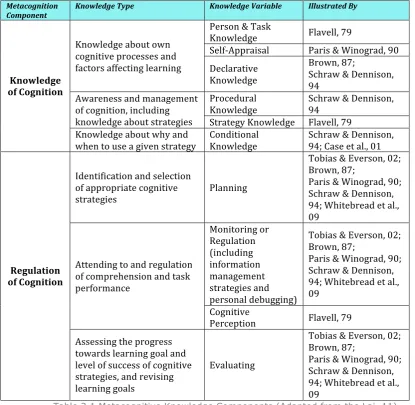
Some! TEL! environments! do! measure! the! learners’! metacognition! at! explicit! points! during!the!learning!activity,!by!using!measures!such!as!‘Feeling!Of!Knowing’!(FOK)!to! assess!how!well!a!learner!can!evaluate!their!successes!in!a!learning!task.!These!can!be! useful! for! the! learner,! but! are! not! sufficient! for! describing! the! cognitive! traits! in! a! measurable!way!that!can!be!tracked!by!a!learning!system.!!Metacognition!is!a!complex! construct,! that! comprises! more! than! the! ability! to! judge! learning.! Rather,! it! can! be! described! as! a! multiple! component! model.! Metacognitive!knowledge! of/ our/ own/ cognition! can! be! declarative! as! well! as! procedural! –! this! means! that! we! have! an! understanding!of!our!cognitive!capabilities!and!strategies.!Metacognitive!regulation!of/ cognition!can!encompass!strategies!such!as!planning,!comprehension!and!evaluation! of!the!approach!we!take!when!engaged!with!a!task!or!problem!to!be!solved.!!
!
While! there! has! been! research! on! modelling! these! metacognitive! regulatory! strategies! directly! ! (e.g.! Koedinger! et! al.,! 09),! the! supports! provided! are! tightly! coupled! with! the! learning! experiences.! The! assessment! of! learner! metacognition! is! often! carried! out! through! algorithmic! and! intelligent! reasoning! that! is! tied! to! the! specific! tasks! in! the! learning! environment.! This! means! that! the! metacognitive! supports! provided! cannot! be! separated! from! the! learning! environment.! However,! these!services!need!to!be!able!to!transfer!and!transport!cognitive!user!profiles!from! one!learning!environment!to!the!next!to!enable!continuous!progression!of!the!model! and!the!related!support.!
!
Sosnovsky! &! Shcherbinina,! 05;! Sosnovsky! et! al.,! 09;! Kay! et! al.,! 06).! These! systems! gather!a!large!amount!of!noisy!data!and!it!can!be!difficult!to!handle!the!aggregated! user! data,! but! they! can! supply! user! information! to! multiple! adaptive! systems! (Sosnovsky! et! al.,! 09;! Berkovsky,! Heckmann! &! Kufilk,! 09).! These! types! of! cognitive! models! provide! a! useful! mechanism! with! which! to! create! OLMs! to! promote! metacognition!through!reflection.!However,!the!centralised!user!modelling!approach! has!not!yet!been!harnessed!to!explicitly!model!metacognition.!
!
The!research!presented!here!is!motivated!by!the!need!to!further!improve!the!state!of!
the! art! modelling! and! support! of! abstract! cognitive4!aspects! of! a! learner.! Current!
technological! approaches! need! to! change! in! response! to! the! needs! of! the! lifelong! learner!(Bull!&!Kay,!08).!Central!to!this!is!the!development!of!supports!for!cognitive! competencies!that!can!enable!learners!to!become!selfYregulated!and!autonomous!as! well! as! the! progression! towards! developing! a! lifelong! cognitive! model.! This! work! aims! to! begin! addressing! the! requirements! of! lifelong! user! modelling.! The! lifelong! user!model!needs!to!be!discrete!and!separate!from!the!TEL!system!(rather!than!being! tightly!coupled!within!the!learning!environment),!while!working!in!symbiosis!with!it! in!order!to!promote!positive!cognitive!skills.!In!particular,!metacognitive!aspects!of! the! learner,! such! as! planning,! information! management! strategies! and! comprehension! are! key! factors! that! have! been! identified! in! successful! learners.! In! order!to!foster!these!skills!alongside!TEL!systems,!it!is!necessary!to!define!a!model! that!can!describe!these!components!of!metacognition.!
!
Although!there!is!much!work!on!supporting!metacognition!and!selfYregulation,!there! is!no!agreement!on!how!to!model!and!foster!learner!metacognition!in!a!manner!that! can!be!implemented!as!a!service!to!work!alongside!TEL!environments.!There!is!still!a! need!to!improve!the!current!learning!services!that!are!being!delivered!to!better!suit! the!modelling!and!fostering!of!selfYregulatory!and!metacognitive!facets!of!the!learner.! The! advancement! of! approaches! taken! to! deliver! personalised! support! for! lifelong! learning!is!especially!important!(Bull!&!Kay,!08).!!
!
!!!!!!!!!!!!!!!!!!!!!!!!!!!!!!!!!!!!!!!!!!!!!!!!!!!!!!!!
4!This!includes!latent!processes!undertaken!by!a!learner!that!are!not!directly!observable.!For!example,!
There! are! two! challenges! that! must! be! addressed:! first,! how! can! we! model! the! cognitive! competencies! that! are! antecedent! to! lifelong! learning,! in! particular! those! that!are!complementary!to!their!curriculum.!This!means!providing!a!mechanism!with! which! to! model! and! measure! learner! metacognition! and! the! components! of! metacognition!that!are!complimentary!to!learning.!The!second!is!how!can!we!create!a! user!model!that!could!travel!and!grow!with!the!learner?!This!means!overcoming!the! tight!coupling!between!the!learning!environment!and!the!metacognitive!supports!so! that! these! two! facets! can! be! separate,! yet! work! together! effectively.! This! indicates! that!it!should!interoperate!across!a!range!of!learning!environments!and!be!applied!to! a!number!of!cognitive!traits.!Thus,!the!first!step!that!needs!to!be!taken!is!to!develop!a! model! of! abstract! cognition! that! provides! a! mechanism! with! which! to! provide! measurements!for!metacognitive!strategies!as!well!as!ensuring!that!this!model!can!be! logically!discrete!from!a!learning!system.!The!changing!nature!of!cognition!needs!to! be! addressed! and! the! psychological! and! pedagogical! learning! theories,! which! underpin!TEL!research,!examined!in!order!to!inform!how!this!type!of!support!should! be!implemented.!It!is!essential!that!such!a!user!model!is!developed!that!is!both!useful! and! actionable! in! order! to! successfully! model! and! support! facets! of! a! learner’s! metacognition.!
!
1.2
Research(Question(
This!thesis!proposes!an!approach!to!modelling!cognitive!aspects!of!a!learner!that!can! augment!Technology!Enhanced!Learning.!The!research!question!posed!in!this!thesis! is:/!
How/ and/ to/ what/ extent/ can/ the/ cognitive/ aspects/ of/ a/ learner/ be/ modelled/to/support/learning/with/TEL?/
/
In! order! to! limit! the! scope! of! the! research,! metacognition! has! been! identified! as! a! suitable!candidate!skill!as!it!is!complementary!to!learning.!In!answering!the!research! question,!the!following!goals!are!addressed!Y!(i)!an!appropriate/design!for!a!cognitive! model!that!is!separate!while!still!aligned!with!TEL!systems;!that!this!model!will!result! in!(ii)!educational/benefits!for!knowledge!gain!and!cognitive!awareness;!and!describe! (iii)! an!architectural/ approach/to! integrate! this! model! with! a! TEL! system! for! a! successful!learning!experience.!!
1.3
Research(Aims(and(Objectives(
The! aims! of! this! research! are! to! analyse! the! activities,! principles! or! features,! and! theories!that!underpin!TEL!systems!that!model!and!support!learner!cognition.!This! analysis! guides! the! formalisation,! implementation,! and! evaluation! of! a! model! of! learner! cognition,! which! can! be! incorporated! into! a! discrete! cognitive! support! service.! The! motivation! is! to! advance! the! state! of! the! art! modelling! of! learner! cognition! in! TEL;! promote! positive! metacognitive! support! in! TEL! by! delivering! a! cognitive!support!as!a!service!that!can!work!with!a!separate!TEL!service;!and!shape! the!future!of!lifelong!user!modelling.!!
!
In!pursuit!of!these!aims,!four!objectives!were!identified:!
2. Formulate! a! set! of! requirements! to! inform! the! design! of! a! model! of! learner! cognition! that! can! be! implemented! in! a! service! that! delivers! metacognitive! support.!
3. Provide!a!high!quality,!innovative,!and!supportive!approach!to!modelling!learner! metacognition.!
4. Evaluate! the! extent! of! the! success! of! this! approach! within! a! real! system,! and! thereby! assess! its! effectiveness! to! model,! track,! and! foster! learner! cognition.
1.4
Contribution((
The!primary!contribution!of!this!work!is!the!ETTHOS!(Emulating!Traits!and!Tasks!in! HigherYOrder! Schemata)! model,! which! provides! a! mechanism! with! which! to! model,! trace,! and! foster! cognitive! strategies! that! are! complementary! to! learning.! The! main! success! of! this! model! is! that! it! provides! a! method! with! which! to! describe! abstract! cognition!in!a!traceable!way!that!is!realisable!in!a!cognitive!support!service!that!can! work!alongside!a!TEL!environment.!!
!
as!a!tool!for!modelling!learner!metacognition!as!a!service!and!the!potential!to!explore! the!use!of!richer!metacognitive!supports.!
!
A!number!of!relevant!publications!have!arisen!out!of!this!research:!
• Macarthur,! V.,! &! Conlan,! O.! (2008).! HigherYOrder! Cognition! in! Personalised! Adaptive!eLearning.!International/Workshop/on/Cognitive/Aspects/in/Intelligent/and/ Adaptive/WebPbased/Educational/Systems,/at/ICCE08.!Taiwan.!
o This!early!workshop!paper!describes!the!need!for!supporting!higherYorder! cognitive! strategies! as! a! thirdYparty! service! that! will! work! with! TEL! services! in! order! to! compliment! the! learning! experience.! The! learning! service! is! responsible! for! delivering! domain! knowledge,! whereas! the! cognitive!support!service!helps!with!‘learning!to!learn’.!
• Macarthur,! V.,! &! Conlan,! O.! (2009).! Using! Psychometric! Approaches! in! the! Modelling!of!Abstract!Cognitive!Skills!for!Personalisation.!Lifelong/User/Modelling/ Workshop,/at/UMAP2009.!Trento,!Italy.!
o This! paper! addresses! the! issue! of! modelling! of! abstract! cognition! by! presenting! the! highYlevel! components! of! the! ETTHOS! model.! The! use! of! psychometric!inventories!as!a!mechanism!to!codify!the!learner’s!cognitive! model!is!presented!and!the!need!for!a!task!model!identified.!
• Macarthur,! V.,! &! Conlan,! O.! (2010).! Modelling! HigherYOrder! Cognitive! Skills! in! Technology!Enhanced!Distance!Learning.!In/Proceedings/of/the/IEEE/International/ Conference/on/Distance/Learning/and/Education/(ICDLE/2010).!Puerto!Rico,!USA.!
o This! paper! addresses! the! issue! of! lifelong! learning! skills! such! as! metacognition! and! selfYregulation.! A! number! of! considerations! for! developing!cognitive!modelling!service!with!ETTHOS!are!discussed.!!
• Moore,! A.,! Macarthur,! V.,! &! Conlan,! O.! (2011).! Core! Aspects! of! Affective! Metacognitive!User!Models.!Workshop/on/Augmenting/User/Models/with/Real/World/ Experiences/ to/ Enhance/ Personalization/ and/ Adaptation,/ at/ UMAP2011.! Girona,! Spain.!
o Metacognitive!and!affective!aspects!of!a!learner's!cognitive!repertoires!are! addressed!in!this!paper.!The!content,!form!or!structure,!and!source!of!the! model!are!analysed!in!the!context!of!current!state!of!the!art!approaches.!
Schemata.!Workshop/ on/ Augmenting/ the/ Learning/ Experience/ with/ Collaborative/ Reflection,/at/ECPTEL2011.!Palermo,!Italy.!
o The!trait,!task,!and!mapping!components!of!ETTHOS!are!discussed!in!this! paper! in! the! context! of! a! cognitive! support! service.! This! paper! makes! suggestions!for!the!future!use!of!community!models!to!initialise!the!learner! model! and! for! visualising! the! modelling! data! to! prompt! individual! and! collaborative!reflection.!
• Moore,! A.,! Macarthur,! V.,! &! Conlan,! O.! (2012).! Core! Aspects! of! Affective!
Metacognitive! User! Models.!Lecture/ Notes/ in/ Computer/ Science,/ Advances/ in/ User/ Modelling/Perspectives,/Selected/papers/from/UMAP/2011/workshops./Springer.!
o This!chapter!is!an!extended!version!of!the!previous!workshop!paper!of!the! same! title.! It! expands! on! the! content,! form,! and! source! requirements! for! modelling!affective!and!metacognitive!aspects!of!the!learner.!
• Macarthur,!V.!&!Conlan,!O.,!(2012).!Addressing!the!Challenges!of!Survey!Fatigue!
for! LifeYLong! User! Modelling:! Initialising! Baseline! Models! Using! Community! Psychometric! Values.! In!2012/ IEEE/ 12th/ International/ Conference/ on/ Advanced/ Learning/Technologies.!Rome,!Italy.!
o This! paper! addresses! the! use! of! psychometric! inventories! to! create! baseline!models,!which!may!provide!a!solution!to!survey!fatigue.!!
• Moore,!A.,!Conlan,!O.!&!Macarthur,!V.,!2012.!SRL!Tasks!and!Activities!as!a!Model!of!
Cognitive! Behaviour! within! ETTHOS.! In! International/ Workshop/ on/ Enabling/ Successful/SelfPRegulation/in/OLEs/at/ICALT/2012.!Rome,!Italy.!
o This!workshop!paper!describes!how!ETTHOS!can!be!extended!to!support! selfYregulated!learning!tasks.!
• Macarthur,!V.,!Moore,!A.!&!Conlan,!O.,!(2013).!SelfYRegulation,!Metacognition!and!
Emotion! in! Technology! Enhanced! Learning! Environments.! In! J.! Jovanovic! &! Raymond! Chiong,! Eds.! Technological/ and/ Social/ Environments/ for/ Interactive/ Learning.!Santa!Rosa,!CA,!USA.!(In!press):!Informing!Science!Press.!
o This! book! chapter! provides! a! synthesis! of! the! literature! and! underlying! theories! for! designing! adaptive! systems! that! address! selfYregulation,! metacognition!and!emotion.!
1.5
Research(Approach(
The!research!process!undertaken!that!is!described!in!this!thesis!comprises!of:!
• An! initial! review! of! the! pedagogical! and! psychological! theories! of! learning! and!
cognition.!In!particular,!this!focuses!on!the!role!of!metacognition!in!learning!and! the!nature!of!the!learning!theories!within!which!this!concept!has!grounding.!!
• A! review! of! TEL! literature! details! an! analysis! of! current! state! of! the! art!
approaches!in!user!modelling,!adaptation!and!personalisation,!and!outlines!their! benefits!and!limitations!in!order!to!inform!the!requirements!needed!to!develop!a! loosely! coupled! metacognitive! user! model.! In! particular,! this! review! focuses! on! existing! approaches! to! designing! adaptive! systems! that! address! cognitive! and! metacognitive!modelling.!
• The!analysis!of!the!literature!informed!the!design!of!a!novel!approach!to!satisfy!
the! requirements! for! developing! a! loosely! coupled! metacognitive! user! model.!! Requirements!include!both!desired!characteristics!from!current!systems!as!well! as! requirements! to! overcome! problems! with! these! systems.! Based! on! these! requirements,! the! ETTHOS! model! and! approach! for! implementing! it! was! designed.!
• A!test!system!was!implemented!with!a!userYcentric!design!approach!in!order!to!
ratify!the!model.!A!number!of!evaluations!were!carried!out!to!inform!the!metrics! and!testing!of!the!system.!The!first!evaluation!surveyed!participants!in!the!target! population’s!metacognitive!awareness.!A!number!of!controlled!experiments!were! carried!out!on!the!system!in!situ!to!assess!the!modelling!approach,!and!to!evaluate! the!benefit!to!the!learner!of!incorporating!such!a!model!with!a!TEL!system.!
• Finally,!the!conclusion!from!the!analysis!of!these!results!supports!the!claim!that!
metacognition! can! be! modelled! separately! from! a! learning! system! and! be! beneficial! to! learners.! The! contributions! and! limitations! of! this! approach! are! discussed!in!order!to!stimulate!future!work.!
(
1.6
Definition(of(Terms(
Table!1.1!below!provides!definitions!of!the!key!terms!that!are!referred!to!throughout! this!thesis:!
Cognition/ Cognition! refers! to! the! mental! activities! and! functions! through! which! human! beings! acquire! and! process! knowledge! including:! perception,! learning,! memory,! reasoning,! and! thought.! This! utility! is! mediated! by! biological,! mental,! emotional,! and! social! influences! (Bandura,!91;!Vygotsky,!78).!
Constructivism/ Constructivism!can!be!described!as!an!approach!to!learning! in! which! learners! are! provided! the! opportunity! to! construct! their! own! sense! of! what! is! being! learned! in! the! context!of!their!current!and!past!knowledge!(Harris!et!al.,! 96;! Bruner,! 86;! Bruner! 90)./! Constructivism! is! closely! related! to! selfPregulated/ learning! and! metacognition! theories!because!in!creating!understanding!of!information! and! strategies,! learners! are! required! to! monitor! and! regulate!their!own!thinking!!(Gunstone,!94;!Case!et!al.,!01).!
HigherPOrder/ Cognition/
Describes! a! set! of! complex! skills! that! are! developed! through! the! expansion! and! incorporation! of! previously! learned! skills.! ! Metacognition,! critical! thinking,! and! social! cognition! are! examples! of! processes! that! control! the! regulation! of! learning! and! thinking! and! are! considered! examples!of!higherYorder!cognition!(Magno,!10).!
Metacognition/ Metacognition!(Flavell,!79;!Brown,!78;!Schraw!&!Dennison,! 94;! Tobias! &! Everson,! 00)! refers! to! the! complementary! psychological! functions! that! actively! monitor! and! consequently!regulate!cognitive!processes!according!to!the! current! state! of! an! individual.! It! is! viewed! as! a! core! component!of!selfYregulated!learning,!which!is!responsible! for! controlling,! monitoring! and! regulating! cognitive! strategies! in! order! to! meet! the! goals! of! the! learner! (Zimmerman,! 89).! ! This! is! commonly! described! as! cognition/about/cognition,!or!thinking/about/thinking.!
(
! ! ! ! ! ! !
experiences,! contexts,! and! outcomes! (Beetham! &! Sharpe,! 07).! It! traditionally! had! an! etymological! connection! with! children,!however!contemporary!use!of!the!term!refers!to! learning!and!teaching!as!lifelong!(Beetham!&!Sharpe,!07).!
Psychometric/ Inventories/
Psychometric!tests!are!standardised!measurement!systems! and! inventories! that! are! used! to! evaluate! or! examine! cognitive!functions.!
Schemata/ Schemata!(Piaget!29;!Anderson,!77;!Anderson,!84;!Bartlett,! 32;!Rumelhart!80;!Ibrahim!et!al.,!03;!Derry,!96)!are!models! (e.g.! a! process! or! information! sets)! that! are! applied! to! interpret! events! and! solve! problems.! They! can! be! understood!as!structured!chunks!or!packages!of!knowledge! that!are!organised!into!an!overall!framework!of!knowledge! that! influence! how! people! comprehend! tasks! or! solve! problems.!
SelfPRegulated/ Learning/(SRL)/
SRL! is! the! process! whereby! learners! deploy! strategies! to! respond! to! (and! subsequently! regulate)! their! current! status!within!a!learning!task.!Through!selfYassessment!and! practice! of! regulatory! strategies,! they! can! become! autonomous!and!improve!their!understanding!of!both!the! learning! material! as! well! as! their! own! cognitive! abilities! (Schraw! et! al.,! 06;! Graesser,! D’Mello! &! Person,! 09;! Zimmerman,!94).!
1.7
Thesis(Roadmap(
This!thesis!is!organised!as!follows:!
Chapter(2(–Metacognition(and(Learning(
This! chapter! examines! theories! of! learning,! cognition,! and! metacognition! and! provides! background! to! the! learning! theories! applied! in! adaptive! TEL! environment! development.!Metacognition!is!of!particular!interest!because!it!is!a!cognitive!skill!that! is! complementary! to! learning! with! TEL.! This! chapter! explores! the! role! of! metacognition!in!learning!and!the!nature!of!the!learning!theories!within!which!it!has! implications! and! grounding.! It! also! provides! the! background! to! the! psychological! theories!that!have!been!harnessed!in!the!development!of!the!ETTHOS!model.!!
Chapter(3(–Cognition(and(Metacognition(in(Technology(Enhanced(Learning( Environments(
This! chapter! reviews! the! adaptive! TEL! environments! that! address! cognitive! and! metacognitive! modelling.! A! review! is! carried! out! to! examine! how! TEL! systems! harness!learning!theories!to!support!learning!and!to!analyse!the!features!as!well!as! examination!of!the!functions!of!user!modelling!and!adaptation!used!in!personalising! learning! experiences.! TEL! environments! that! support! metacognitive! aspects! of! learners!are!specifically!addressed!to!assess!the!current!mechanisms!and!limitations! in!the!state!of!the!art.!
Chapter(4(–(Design((
activities! is! provided,! including! the! approach! necessary! to! implement! the! architecture.!!
Chapter(5(–(Implementation((
Chapter! 5! outlines! how! the! architecture! was! implemented! in! a! testYbed! system! in! order! to! evaluate! its! appropriateness.! ! The! prototype! implementation! is! called! the! Goby! system.! This! system! was! integrated! with! the! APeLS! learning! environment! (Conlan!&!Wade,!04;!O’Keefe!et!al.,!06).!A!brief!overview!is!included!which!outlines! the!technological!decisions!and!the!userYcentric!design!process!that!was!taken.!
Chapter(6(–(Evaluation(
The!evaluation!chapter!provides!an!in!depth!discussion!of!the!experimentation!and! analysis!undertaken!in!order!to!ratify!the!proposed!modelling!solution!introduced!in! the!design!chapter.!This!chapter!verifies!that!ETTHOS!can!be!considered!as!a!suitable! model!to!technologically!represent!learner!cognition.!The!results!from!early!studies! are!used!to!inform!the!baseline!user!model,!and!each!of!the!evaluations!on!the!model! in!situ/are!presented!and!findings!discussed.!The!most!significant!set!of!evaluations! were! carried! out! on! the! Goby! service,! in! order! to! assess! the! modelling! accuracy,! metacognitive! support,! and! learner! knowledge! gain.! Supporting! qualitative! and! quantitative! analysis! is! presented,! along! side! analysis! of! the! learners’! log! data! and! critical!analysis!of!ETTHOS.!
Chapter(7(–(Conclusion(
Chapter!7!summarises!the!contributions!of!this!thesis,!discusses!the!successes!and! limitations!of!the!work,!and!makes!suggestions!for!future!work.!
Chapter!2
Metacognition!and!Learning
2.1
Introduction(
This!chapter!addresses!the!major!psychological!and!pedagogical!underpinnings!of!the! work! presented! in! this! thesis.! Adaptive! TEL! environments! offer! new! ways! of! presenting!course!material!and!learning!support!that!are!adaptive!and!personalised! for!each!individual!learner.!In!order!to!model!the!learner’s!cognitive!strategies!when! engaged!in!academic!reading,!substitute!the!traditional!tutor!with!intelligent!system! support,! and! represent! learner! metacognition! in! a! technical! model,! it! is! first! important!to!have!an!understanding!of!the!psychological!theories!within!which!these! concepts!have!significance!and!grounding.!
!
This! chapter! opens! with! an! introduction! to! the! concepts! of! cognition! and! metacognition!and!their!role!in!learning!and!successful!development.!There!are!two! main! components! of! this! chapter! –! the! first! includes! a! discussion! of! cognition! and! learning! which! is! necessary! to! describe! the! cognitive! strategies! and! mental! models! that! influence! the! ETTHOS5!model! as! well! as! understand! the! learning! theories! and! instructional!strategies!that!can!be!harnessed!when!implementing!ETTHOS!in!a!TEL! environment.! This! includes! a! discussion! on! how! we! represent! our! internal! mental! models,! knowledge! and! cognitive! processing,! cognitive! strategies! for! academic! reading,! and! theories! of! learning! as! an! individual! and! through! social! interactions.! Secondly,! a! discussion! of! metacognition! is! included! which! analyses! its! components,! its! importance! for! reading,! and! strategies! for! supporting! and! modelling! metacognition.! The! chapter! ends! with! a! summary! of! the! aspects! of! cognitive! strategies,! metacognitive! modelling,! and! mental! model! theory! from! which! the! ETTHOS!model!draws.!!
!
!!!!!!!!!!!!!!!!!!!!!!!!!!!!!!!!!!!!!!!!!!!!!!!!!!!!!!!!
2.2
The(Role(of(Cognition(and(Metacognition(in(Learning(
As!individuals,!we!are!continually!learning!–!to!be!successful!within!the!culture!and! environment! in! which! we! live! as! well! as! within! our! individual! context! we! must! acquire!a!rich!repertoire!of!knowledge!and!intellectual!skills.!The!intellectual!ability! to!be!proactive!and!adaptive!is!regarded!as!crucial!for!successful!lifelong!performance! (Fischer! &! Scharff,! 98).! These! skills! comprise! of! learner! autonomy,! selfYregulation,! and!metacognition,!so!that!we!can!learn!from!experiences,!adapt!to!the!environment! and!respond!to!cultural!or!social!contexts!(Ku!&!Lo,!10;!Pintrich!et!al.,!00;!McNamara! &!Magliano,!09;!Fischer!&!Scharff,!98).!!
!
Cognitive/ theories! of! learning! posit! that! learning! involves! conscious! and! reasoned! thinking! processes,! the! use! of! cognitive! strategies,! and! deliberate! application! of! learning! strategies.! Cognition! is! a! broad! construct! used! to! describe! our! internal! (mental)! processes! and! functions! –! it! refers! mental! behaviours! such! as! thinking,! reasoning,! learning,! selfYreflection,! adaptation,! insight,! social! strategies,! organisational! behaviours! and! beliefs! (Sternberg! &! Sternberg,! 09).! Our! cognition! is! malleable,! meaning! that! knowledge! and! strategies! can! be! acquired,! shaped! and! increased!through!various!types!of!interventions!(Jensen,!09).!Cognitive/strategies/are! mental! functions! called! upon! to! attend! to,! acquire,! process,! represent,! and! recall! information,!whereas!learning/strategies!are!specific!cognitive!strategies!that!learners! use! to! enhance! comprehension,! learning,! and! retention! of! information.! Successful! students! characteristically! possess! numerous! learning! strategies! of! great! variety! (Bednall!&!Kehoe,!11)!and!better!students!report!a!larger!range!than!less!proficient! students!(Zimmerman,!89).!!
!
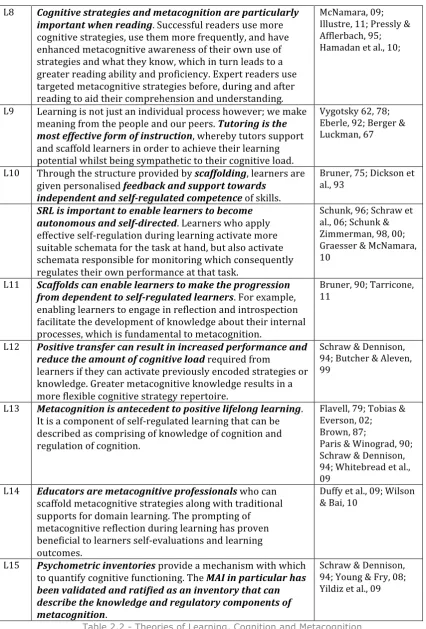
Metacognition,!in!particular,!is!an!essential!higherYorder!thinking6!skill!that!supports! learning! because! it! enables! learners! to! engage! in! reflective! thinking,! become! more! aware! of! their! learning! strategies! and! gain! control! over! how! they! acquire! new! knowledge!and!skills.!Metacognition!(Flavell,!79;!Brown,!78;!Schraw!&!Dennison,!94;! !!!!!!!!!!!!!!!!!!!!!!!!!!!!!!!!!!!!!!!!!!!!!!!!!!!!!!!!
Tobias!&!Everson,!00;!Magno,!10)!is!about!knowing!what!you!know,!knowing!what! you! need! to! know,! and! knowing! how! to! actively! regulate! your! approach! to! a! task.!! This!is!commonly!described!as!cognition/about/cognition,!or!thinking/about/thinking.// /
What!is!the!difference!between!cognition!and!metacognition?!Cognition!comprises!of! the!processes!and!strategies!that!are!activated!to!solve!a!problem!or!complete!a!task.! In! contrast,! metacognition! is! the! knowledge! and! awareness! of! processes! and! the! monitoring! and! control! of! such! knowledge! and! strategies! (Tarricone,! 11).! Not! only! does!this!encompass!knowledge!of!your!own!thoughts,!it!refers!to!knowledge!of!the! cognitive! factors! that! underlie! your! own! thinking.! This! means! that! two! processes! occur! simultaneously! in! a! learner! as! they!monitor! their! progress! as! they! learn! and! make!changes!or!regulate!their!cognitive!and!learning!strategies!if!they!perceive!that! they!are!not!on!the!path!to!achieving!their!learning!goals./!
!
Zimmerman,! 98;! Graesser! &! McNamara,! 10;! Chase! et! al.,! 09;! Tarricone,! 11;! Illustre,! 11;!Afflerbach,!02;!Hamadan!et!al.,!10;!Shunk,!94).!
/
In!developing!the!ETTHOS!model!of!learner!cognition!that!can!work!alongside!a!TEL!
environment7!two!aspects!of!learner!cognition!are!represented!–!the!first!is!learners’!
metacognition! (traits)! and! second! are! the! cognitive! strategies! that! they! undertake! (tasks)!at!different!stages!in!the!learning!environment.!This!is!because!ETTHOS!has! been!created!to!describe!a!metacognitive!model,!which!can!be!used!in!the!design!of!a! metacognitive! modelling! and! support! service! (Goby)! that! is! loosely! coupled! with! a! TEL!environment!(APeLS).!This!means!that!the!two!services!are!delivered!in!the!form! of! a! mashup! web! application,! which! delivers! SQL! learning! alongside! metacognitive! modelling!and!support.!In!developing!such!a!service!it!has!been!necessary!to!examine!
both! ‘learning/ and/ cognition’! and! metacognition.! This! chapter! investigates! the!
attributes! of! learning! and! cognition! in! order! to! examine! the! psychological! and! pedagogical! theories! that! influence! the! design! of! TEL! environments,! inform! the! design!of!a!cognitive!model,!and!the!primary!content!of!that!model.!Metacognition!is! explored!in!greater!depth,!as!it!is!the!construct!that!is!to!be!supported!by!ETTHOS.! This!means!examining!its!background,!its!role!as!a!component!of!selfYregulation,!the! components! of! metacognition! (knowledge! and! regulation! of! cognition),! and! the! questions!that!arise!when!supporting!and!measuring!metacognition.!!
!!!!!!!!!!!!!!!!!!!!!!!!!!!!!!!!!!!!!!!!!!!!!!!!!!!!!!!!
2.3
Learning(and(Cognition(
Cognitivism/or/ cognitive/ science/is! a! general! approach! to! psychology! and! pedagogy! that! is! concerned! with! our! mental! functions,! belief! systems,! and! social! behaviour8.! From! this! perspective,! learning! and! mental! functioning! is! not! just! a! process! of! observed! events! and! behaviours! –! instead! mental! strategies,! processes! and! knowledge! also! have! a! role! to! play! in! how! knowledge! and! skills! are! acquired.! The! cognitive/ learning/ perspective! (Piaget! &! Inhelder,! 73)! involves! transformation! of! information!from!the!environment!or!domain!into!new!or!refined!knowledge!that!is! stored! by! the! learner.! Cognitive! learning! theories! are! comprised! of! ideas! of! how! individuals!process!information,!attention,!memory,!thinking!and!cognitive!processes.! The!social/cognitive/perspective/(Vygotsky,!78;!Vygotsky,!62;!Langer!&!Applebee,!86;! Bandura,! 91;! Bandura,! 97)! examines! the! process! of! how! individuals! learn! from! observing! others! in! the! context! of! their! environment! or! culture.! The!constructivist/ learning/ perspective! (Harris! et! al.,! 96;! Jonassed,! 91;! Gagné,! 65)! draws! from! both! cognitive! and! socioYcognitive! theories,! with! the! key! focus! on! how! knowledge! is! constructed! by! the! individual! –! from! this! perspective,! the! acquisition! of! knowledge! structures!requires!active!learning!towards!their!learning!goals.!!This!development!of! their! knowledge! and! strategy! repertoire! is! unique! and! idiosyncratic! to! the! learner! because! prior! understanding! impacts! the! learning! process! (von! Glasersfeld,! 90;! Tarricone,!11;!Brown,!87).!Metacognition!is!an!important!construct!in!constructivist! learning! because! in! building! meaning! from! their! learning! environment! and! responding!to!learning!tasks,!learners!are!required!to!monitor!and!regulate!their!own! thinking!(Curwen!et!al.,!10;!Pressley,!02).!
!
This!section!will!examine!the!psychological!and!pedagogical!theories!of!learning!and! cognition! that! have! influenced! both! metacognitive! theory! and! the! development! of! instructional! strategies! that! inform! TEL! research.! Having! established! that!
!!!!!!!!!!!!!!!!!!!!!!!!!!!!!!!!!!!!!!!!!!!!!!!!!!!!!!!!
8!The!cognitive!movement!(Piaget!&!Inhelder,!73;!Vygotsky,!78;!Vygotsky,!62;!Langer!&!Applebee,!86)!
was!a!progression!from!the!behavioural!psychology!approach/and!can!be!described!as!the!study!of! how!people!learn,!structure,!store!and!use!knowledge!(Miller,!56;!Lutz!&!Huitt,!03).!Behaviourist! psychologists!(Skinner,!45;!Skinner,!38;!Watson,!13;!Pavolv,!27)!take!the!approach!that!objective! psychology!can!only!be!carried!out!on!observed!behaviour!in!individuals.!The!focus!of!behaviourism!is! on!how!stimuli!leads!to!observed!responses!(e.g.!an!environmental!event!such!as!a!pin!prick!to!the! finger!results!in!an!overt!reaction!when!the!individual!quickly!moves!their!hand!away).!The!
constructivism! is! closely! related! to! selfYregulation/and! metacognition! theories! and! that! there! are! two! influencing! paths! to! constructivism! (both! cognitive! and! social! cognitive),!this!section!first!addresses!the!cognitive!theories.!After!an!examination!of! schema!theory!as!a!mechanism!with!which!to!describe!how!we!represent!knowledge! as! mental! models,! it! inspects! the! types! of! knowledge! we! can! possess! (declarative,! procedural,!metacognitive),!the!influences!on!how!we!process!information!to!create! unique! and! idiosyncratic! knowledge! (through! practice,! reinforcement,! and! with! limited! cognitive! load! resources),! and! specifically! examines! the! cognitive! strategies! we! engage! in! when! reading.! Social! cognitive! theories! of! learning! are! subsequently! examined!as!the!roles!of!the!traditional!tutor!(such!as!scaffolding!the!learner!in!order! achieve! learning! goals! that! are! beyond! their! immediate! ability! and! to! become! autonomous! and! selfYregulated)! are! often! emulated! in! TEL! environments.! It! concludes! by! suggesting! that! although! we! possess! individual! differences! in! our! knowledge!and!cognitive!approaches,!the!application!of!social!theories!of!learning!is! an!important!tool!when!designing!instructional!strategies.!
2.3.1 Constructivist(Learning((
Constructivism! can! be! described! as! an! approach! to! learning! in! which! learners! are! provided!with!the!opportunity!to!construct!their!own!sense!of!what!is!being!learned! based!on!their!current!and!past!knowledge!(Harris!et!al.,!96;!Bruner,!86;!Bruner!90)./ Constructivism! is! a! theory! of! learning! that! describes! how! individuals! construct! meaning!and!acquire!knowledge!and!supports!the!belief!that!learners!construct!new! ideas!or!concepts!that!are!influenced!by!existing!knowledge,!social!interactions!and! motivation.! Constructivism! is! closely! related! to! selfPregulated/ learning! and! metacognition! theories! because! in! creating! understanding! of! information! and! strategies,! learners! are! required! to! monitor! and! regulate! their! own! thinking!! (Gunstone,! 94;! Case! et! al.,! 01)./Constructivist! views! of! learning! require! learners! to! consciously! undertake! an! informed! and! selfYregulated! approach! to! recognising,! evaluating! and! deciding! whether! to! reconstruct! their! existing! mental! models! and! beliefs! and! respond! to! their! environment! (Gunstone,! 94;! Perkins,! 91;! Jonassen,! 99;! Harris!&!Graham,!94;!Driscoll,!05).!
There!are!a!number!of!core!principles!that!are!common!among!most!constructivismY based! approaches! to! instruction! (Sjøberg,! 07;! Taber,! 06;! Harris! et! al.,! 94;! Jonassed,! 91):!!
• Learning! is! something! engaged! in! by! the! learner! to! enable! them! to! actively! construct!knowledge!rather!than!simply!passively!receiving!the!information.!
• Learning! is! influenced! by! prior! knowledge! –! learners’! schemata! that! influence! learning! can! be! wellYdeveloped! and! difficult! to! change! or! may! be! ad! hoc! or! unstable.!
• Learners!have!their!own!individual!viewpoint,!however!they!also!share!common! patterns!in!their!ideas!that!are!socially!and!culturally!accepted.!
• Knowledge!is!represented!as!conceptual!schema!structures!that!can!be!modelled! and!described.!!
• Learners!construct!their!knowledge!through!interaction!with!their!environment,! social!setting,!cultural!and!linguistic!environment.!!
There!are!two!main!paths!towards!constructivism9!Y!cognitive!psychology!and!socioY
cognitive! psychology./With! his! contributions! to! cognitive! development,! ideas! of! higherYorder!cognitive!development!in!the!formal!operation!stage,!and!schema!theory! from! adolescence,! Piaget! is! often! accredited! with! being! the! driving! force! behind! cognitive! (or! individual)! constructivism,! while! Vygotsky’s! focus! on! the! social! and! collaborative! nature! of! learning! has! been! accredited! with! influencing! the! development!of!social!constructivism!(Sjøberg,!07).!
2.3.2 Schemata(–(Our(Mental(Models(
Piaget! described! cognitive! development! as! being! initially! facilitated! by!schemas! or! mental! models.! Schemata! (Piaget! 29;! Anderson,! 77;! Anderson,! 84;! Bartlett,! 32;! Rumelhart!80;!Ibrahim!et!al.,!03;!Derry,!96)!are!models!(e.g.!a!process!or!information! sets)!that!are!applied!to!interpret!events!and!solve!problems.!They!can!be!understood! as! structured! chunks! or! packages! of! knowledge! that! are! organised! into! an! overall! framework! of! knowledge! that! influences! how! people! comprehend! tasks! or! solve! problems.! Schemata! are! organised! patterns! of! behaviour! or! mental! representations!
!!!!!!!!!!!!!!!!!!!!!!!!!!!!!!!!!!!!!!!!!!!!!!!!!!!!!!!!
9!There!are!numerous!philosophical!differences!in!constructivism!theories!including!cognitive! constructivism,!radical!constructivism,!social!constructivism,!cultural!constructivism!and!
that! organise! knowledge,! skills! and! rules,! and! are! used! to! understand! and! interact! with!the!world.!!
!
The!development!and!acquisition!of!successful!models!rely!on!the!learner!engaging!in! a!range!of!learning!scenarios.!Materials!within!schemata!are!related!to!one!another;! concepts!that!commonly!coYoccur!in!a!particular!context!are!related!to!each!and!can! influence!perceptions!or!expectations.!!Through!learning!from!our!environment,!we! construct! and! reconstruct! unique! and! idiosyncratic! meaning! in! response! to! our! world.!Schemata!are!activated!in!order!to!understand!new!events!or!solve!problems! (Rumelhart,!80;!Derry,!96).!A!schema!will!be!activated!into!consciousness!(into!our! shortYterm! memory)! if! the! information! perceived! can! provide! a! suitable! trigger! or! schema!signal.! This! means! that! further! information! can! be! accessed! in! order! to! complete! the! picture.! Cognitive! development/occurs! through! three! processes! of! equilibration:! the!assimilation,/ restructuring/and!accommodation/of! knowledge! and! strategies!(Piaget!&!Inhelder,!73;!Rumelhart,!80).!
!
As! a! learner! assimilates! (accretion)! or! transforms! information! from! their! environment,!they!position!it!within!their!own!existing!mental!models.!This!process!is! particularly! important! for! children! who!organise,! group! and! combine! knowledge! about!their!experiences!into!categories.!This!organisation!provides!them!with!ways!of! describing!how!the!world!works.!In!response!to!understanding!a!new!event,!current! schemata! can! be! expanded,! so! that! new! information! is! remembered.! For! example,! they! may! combine! their! schemas! for! dogs! and! horses! into! a! larger! scheme! for! mammals!that!breathe!oxygen.!
!
schema!may!be!required!in!order!to!replace!an!old!one.!This!might!mean!that!some! aspects! of! the! old! schema! are! incorporated,! but! the! model! as! a! whole! is! more! representative! of! the! real! world.! This! is! demonstrated! by! the! way! that! new! understanding!can!be!developed!by!analogy.!!
!
A! learner’s! ability! to! control! their! model! is! limited! Y! it! is! difficult! to! build! new! strategies! and! control! the! development! of! successful! models.! This! is! because! our! mental! processing! capabilities! are! limited! and! our! mental! models! and! are! often! incomplete! (Norman,! 83)! because! the! experiences! and! stimuli! processed! are! never! sufficient! to! completely! convey! the! world.! Concepts! (declarative! knowledge),! and! strategies!(procedural!and!conditional!knowledge)!are!not!necessarily!as!accurate!or! precise! as! a! problem! requires! (Norman,! 83).! However,! this! generalisation! is! useful! because!a!learner!can!reuse!or!transfer/their!strategies!across!a!variety!of!contexts.! The!matching!between!the!environment!and!schema!memory!is!quite!powerful,!since! one!concept!can!trigger!another!(Norman,!83).!In!this!context,!prior!knowledge!and! skills! can! facilitate! and! enhance! the! transfer! of! learning! across! domains! and! environments.!!
!
Schema!signals!can!be!introduced!into!a!learning!scenario.!Since!learners!can!rely!on! schema!signals!to!provide!a!basis!for!reasoning,!there!are!instructional!implications! for! the! educator! who! has! the! role! of! activating! learners’! prior! knowledge! or! appropriate! schemata.! ! Signals! help! the! learner! to! activate! prior! knowledge,! often! highlight! important! segments,! and! activate! suitable! encoding! strategies! (Derry,! 96;! Ibrahim!et!al.,!03).!Potentially!this!also!means!challenging!preconceptions,!in!order!to! restructure!or!redefine!them.!Establishing!meaningful!learning!scenarios!can!improve! learners’!abilities!to!regulate!learning!and!thought!processes!(Derry,!96).!!
!
to! play! in! cognitive! constructivism,! whereby! our! mental! models! are! used! to! make! sense!of!our!experiences!(Derry,!96).!From!the!cognitive!constructivist!perspective,! learners! actively! engage! their! cognitive! structures! in! schema! building! when! processing!information!from!their!environment.!!
!
By! reflecting! on! our! experiences,! engaging! with! our! environment! through! inquiry,! and!learning!through!experience,!we!can!actively!construct!our!own!understanding!of! our! environment! (Bruner,! 90).! This! is! because! knowledge! is! constructed! in! our! schemata!in!unique!and!idiosyncratic!ways!rather!than!being!simply!reproduced!(von! Glasersfeld,!90;!Tarricone,!11;!Brown,!87;!Aleven,!McLaren,!Roll!et!al.,!10)./When!we! encounter!something!new,!we!construct!new!understanding!and!knowledge,!through! experiencing! things! and! reflection! on! these! and! prior! experiences.! This! means! that! we! may! need! to! reconcile! new! knowledge! or! experiences! with! previous! ideas,! and! that! our! schema! may! be! updated,! discarded,! or! new! information! identified! as! irrelevant.! Learning! requires! us! to! adjust! our! mental! models! to! accommodate! new! experiences! and! derive! new! meaning! from! our! environment! and! cumulative! experience!(Bednar!et!al.,!92).!/Over!time,!individuals!develop!sophisticated!internal! representations!of!the!world!around!them,!and!gain!control!of!their!own!learning!and! thinking! approaches! thereby! becoming! capable! of! complex! interactions! between! thought! and! behaviour! (Williams! &! Atkins,! 09;! Schraw! et! al.,! 06;! Zimmerman,! 89;! Vygotsky,!78;!Piaget,!83)./
2.3.3 Declarative,(Procedural(and(Metacognitive(Knowledge(
Knowledge/refers!to!the!set!of!understanding!or!body!of!information!possessed!by!an! individual! that! is! innately! available! or! experientially! acquired10!(Chomsky,! 84).! Successful!learning!depends!on!a!range!of!individual!influences!that!can!change!with! cognitive! development! or! through! instruction,! including! levels! of! declarative,! procedural! knowledge! and! metacognitive! skill! (Zimmerman,! 89;! Pressley,! 87;! Graesser!et!al.,!10;!Zimmerman,!89).!!
!
!!!!!!!!!!!!!!!!!!!!!!!!!!!!!!!!!!!!!!!!!!!!!!!!!!!!!!!!
10!The!concepts!of!memory!and!knowledge!are!closely!connected,!with!the!terms!often!used!
Declarative/knowledge!(knowing!that,!factual!knowledge)!is!factual!knowledge!about! our!world!(Zimmerman,!89;!Siegler,!82;!Dienes!&!Perner,!99;!Anderson,!83).!This!is! the!type!of!information!that!an!individual!can!communicate!to!others!through!explicit! statements!(or!declarations)!about!the!content!or!material.!This!is!synonymous!with! explicit/memory,! whereby! an! individual! is! consciously! aware! of! material! previously! presented!and!can!recall!it!or!recognise!it!against!alternatives!(Dienes!&!Perner,!99)11.! Procedural/knowledge!(or!knowing!how,!practical!knowledge)!is!often!learned!in!this! fashion! because! it! is! nonYdeclarative! knowledge! that! is! in! the! form! of! skills! and! cognitive! strategies! (Dienes! &! Perner,! 99;! Anderson,! 83).! Procedural! knowledge/is! organised! around! the! conditions! and! actions! needed! to! complete! a! task! or! solve! a! problem.! This! includes! operational! knowledge! that! is! used! to! guide! our! behaviours! when! we! engage! in! tasks,! guide! us! to! solve! problems,! and! make! decisions! (Zimmerman,!89;!Dienes!&!Perner,!99).!!
!
Metacognitive/ knowledge! has! both! procedural! and! conditional! qualities! (Schraw! &! Dennison,!94;!Schraw!et!al.,!06).!This!is!because!it!comprises!of!knowledge!about!our! internal! cognitive! strategies! as! well! as! strategies! for! regulating! our! approaches! towards! completing! goals.! Knowledge! can! be! considered! as! metacognitive! if! it! is! actively! used! in! a! strategic! manner! in! order! to! achieve! a! goal.! For! example,! selfY regulated! learners! employ! strategic! planning! to! guide! their! efforts! when! solving! a! problem.!Their!plans!may!change!over!time!as!they!assess!feedback!from!the!task!at! hand!as!well!as!by!assessing!how!well!they!have!implemented!the!plan!(Zimmerman,! 89).!Metacognitive!and!cognitive!knowledge!can!overlap,!because!the!same!strategy! can! be! used! in! multiple! ways.! ! For! instance,! a! learner’s! ability! to! engage! in! metacognitive! decisionYmaking! requires! the! learner! to! assess! the! effects! of! their! learning! strategies! and! metacognitive! processes! on! their! progression! towards! a! learning!goal.!SelfYquestioning!may!be!employed!while!reading!as!a!way!of!obtaining! information!(cognitive)!or!as!a!way!to!monitor!comprehension!(metacognitive)!(Yang! et!al.,!09).!
!!!!!!!!!!!!!!!!!!!!!!!!!!!!!!!!!!!!!!!!!!!!!!!!!!!!!!!!
11!Not!all!knowledge!is!available!to!consciousness.!The!process!of!learning,!which!happens,!
2.3.4 Processing(Information(in(the(Learning(Environment(
In! cognitive! theories! of! learning! and! psychology,! knowledge! is! viewed! as! symbolic,! mental!models!that!are!stored!in!our!mind.!Learning!processes!have!been!described! in!a!general!processing!model!where!knowledge!is!created!by!the!individual!rather! than!discovered.!The!Information/Processing!theory!(Miller,!03;!Ashcraft,!94;!Gaines!&! Shaw,! 03;! Proctor! &! Vu,! 06)! of! cognitive! development! describes! individual! functioning! and! thought! in! a! manner! analogous! to! computer! processes.! Input! information! (or! information! that!perceived! by! the! learner)! is!processed/(encoded),! stored! (in! memory)! and!retrieved.! Just! as! a! computer! has! limited! processing! power! and!memory!capabilities,!so!too!does!our!mind.!Our!cognitive/load!is!limited!–!this!is! because! the! capacity! of! sensory! and! working! memory! is! limited,! meaning! that! cognitive!strategies!need!to!be!used!in!order!to!make!better!use!of!the!resources!(e.g.! rehearsal! or! chunking)! (Sweller,! 04;! Chandler! &! Sweller,! 91;! Bendall! &! Kehoe,! 11;! Ohlsson! &! Mitrovic,! 07).! The! introduction! of! too! much! information,! or! too! many! problem! tasks! to! be! solved! simultaneously! during! a! learning! task! results! in! the! learner! being! unable! to! process! this! information! (known! as! cognitive! overload)! (Chandler! &! Sweller,! 91;! Bendall! &! Kehoe,! 11).! The! capacity! limitations! of! working! memory! ensure! that! alterations! to! our! longYterm! memory! are! slight.! From! an! instructional! perspective,! it! is! important! for! students! to! be! given! the! chance! to! practice! or! reiterate! new! knowledge! and! abilities! to! ensure! that! learning! occurs! (Sweller,! 04).! Learning! is! strengthened! through! practice.! Through! repetition,! behaviour!is!reinforced!and!over!time!these!skills!can!become!automatic!(Vygotsky,! 62),!which!means!that!more!cognitive/resources!are!available!to!the!learner.!!
!
dissimilar,!it!is!more!difficult!to!transfer!abilities!even!if!the!principles!learned!in!one! situation!could!be!applied!to!another.!!
2.3.5 Cognitive(Strategies(for(Reading(
The! process! of! understanding! texts! requires! the! reader! to! actively! construct! a! representation! of! the! information! through! numerous! processes! (e.g.! inference! making,! noting! connections)! (Pressly! &! Afflerbach,! 95;! Jones! et! al.,! 87;! Wiliams! &! Burden,!97;!Brown!&!Paliscar,!84).!Success!when!learning!in!a!range!of!subject!areas! is! very! much! dependent! on! the! efficiency! and! effectiveness! of! learners’! comprehension! of! reading! materials! and! related! resources! (McNamara,! 09;! Illustre,! 11;! Pressly! &! Afflerbach,! 95).! Reading! material,! including! text,! prose! and! related! tables!and!figures!are!a!major!source!of!information!for!students,!whether!they!are!in! the!form!of!textbooks,!related!course!material!(such!as!journals,!articles,!etc.),!online! content! or! other! independently! researched! material./ An! understanding! of! the! cognitive!strategies!for!reading!is!important!in!the!context!of!this!research,!because!in! modelling!learner!metacognition,!the!research!model!will!also!represent!the!general! stages!undertaken!by!the!learner!when!reading!academic!text!online12.!
!
The!skilled!reader!employs!an!extensive!repertoire!of!cognitive!tasks!and!activities.! Reading!can!be!characterised!as!constructively!responsive!(Pressly!&!Afflerbach,!95).! This!means!that!successful!readers!actively!construct!knowledge!as!they!interact!with! and!respond!to!new!information!that!is!presented!to!them!while!reading.!!Reading!a! piece!of!academic!work!incorporates!text,!examples,!diagrams!and!sample!solutions! (Pressly! &! Afflerbach,! 95).! Expert! readers! employ! similar! thought! processes! to! learning,!mathematics!and!problem!solving!(Rules,!06)!–!for!example!activating!prior! knowledge,! setting! reading! goals,! monitoring! comprehension! and! employing! strategies.!Expert!readers!possess!metacognitive!knowledge!about!reading!strategies,! meaning! that! they! are! aware! of! their! strategies! and! can! employ! them! in! the! right! context!(Pressley!&!Gaskins,!06).!!
!
!!!!!!!!!!!!!!!!!!!!!!!!!!!!!!!!!!!!!!!!!!!!!!!!!!!!!!!!
12!A!general!model!of!cognitive!strategies!for!reading!will!be!used!in!the!ETTHOS!model!to!
Pressly! and! Afflerbach! (1995)! have! published! an! extensive! model! of! reading! protocols.!The!result!of!protocol!analysis!carried!out!on!38!primary!research!studies! is!a!comprehensive!list!of!the!cognitive!activities!undertaken!by!the!successful!reader.! They!have!summarised!cognitive/strategies!undertaken!while!responding!to!reading! academic!text!through!a!survey!of!selfYreport!literature!from!diverse!disciplines!and! reporting! standards! (Pressley! &! Afferlbach,! 95).! Seven! main! categories! of! task! emerge!from!the!protocol!analysis;!an!overview!of!these!is!outlined!below:!!!
1. Before/ the/ task! –! Good! readers! plan! before! beginning! a! text! in! order! to! construct! goals.! This! might! involve! skimming! the! text! in! order! to! note! structural!characteristics!that!point!to!important!information!or!to!determine! what!to!ignore.!
2. Salient/ behaviours/ during/ initial/ reading! –! Initially! the! reader! might! read! a! chunk! of! content! from! front! to! back,! focusing! on! the! important! components,! repeating!if!necessary!or!pausing!to!reflect!on!the!text.!
3. Identifying/ important/ information! –! Readers! look! for! information! that! is! relevant! to! their! goal! or! the! learning! goals.! Information! can! be! perceived! as! novel,!or!important,!or!dismissed!if!it!is!does!not!fit!with!their!goal.!
4. Conscious/ inference/ making! –! Readers! incorporate! the! knowledge! they! have! gathered!while!reading!with!their!own!mental!models!or!schemas!by!relating! prior!knowledge,!their!goals,!and!new!information.!
5. Integrating/ different/ parts! –! In! order! to! construct! meaning! out! of! new! information,!readers!need!to!be!able!to!make!inferences!across!disparate!parts! of!the!text.