Mapping ergonomics application to improve SMEs working condition
in industrially developing countries: a critical review
In industrially developing countries (IDC), small and medium enterprises (SMEs) account for the highest proprotion of employment. Unfortunately, the working conditions in SMEs are often very poor and expose employees to a potentially wide range of health and safety risks. This paper presents a
comprehensive review of 161 articles related to ergonomics application in SMEs, using Indonesia as a case study. The aim of this paper is to investigate the extent of ergonomics application and identify areas that can be improved to promote effective ergonomics for SMEs in IDC. The most urgent issue found is the need for adopting participatory approach in contrast to the commonly implemented top-down approach. Some good practices in ergonomics application were also revealed from the review e.g. a multidisciplinary approach, unsophisticated and low-cost solutions, and recognising the importance of productivity. The review also found that more work is still required to achieve appropriate cross-cultural adaptation of ergonomics application.
Keywords: industrial ergonomics, health and safety, small and medium enterprises, industrially developing countries, intervention effectiveness Practitioner summary: Despite continuous efforts in addressing ergonomics issues in SMEs of industrially developing countries, workers are still exposed to poor work conditions. We reviewed factual based evidence of current
ergonomics application to inform future strategies of ergonomics in IDC, using Indonesia as a case study.
Introduction
The role of SMEs as the major source of present and future employment in all countries
has been recognised. However, due to their limited resources and technical capacity,
SMEs are also more prone to occupational hazards and risks than large enterprises.
This situation is worsened in industrially developing countries since SMEs are
commonly overlooked by formal safety and health legislation. Unsurprisingly, the
employment, and unsanitary working conditions (Hil, 2002) which then result in low
levels of productivity, often poor-quality products, and generally serving small,
localized markets. While there have been efforts by International Labour Organisation
(ILO) to overcome this situation e.g. Kawakami et al. (2005); Krungkraiwong et al.
(2006), the contribution of the regional researchers through ergonomics application
towards their efforts was unclear. Few studies, if any, attempt to chart and investigate
the contribution of regional researchers in supporting the the application of ergonomics
in SMEs; and use this information as a roadmap to guide future research.
Ergonomics in Indonesia was begun with the establishment of the Indonesian
Ergonomics Society (PEI) in 1987. It was founded to support the implementation of
ergonomics methods and approaches by academics, researchers and industrial
practitioners. Much effort has been applied to improve working conditions at
Indonesian SMEs through ergonomics application (Wignjosoebroto, 2007). However,
despite this effort, the annual report of the National Employment Accident Insurance
Program (Jamsostek, 2011) showed a steady increase of number of accidents occurring
in work places. Furthermore, it was also reported that most of these accidents occurred
in SMEs (Trihandoyo et al., 2001). The small impact of ergonomics in reducing
work-related accidents in Indonesian SMEs suggests the possibility that contribution of the
regional ergonomics researchers may not be effective. Therefore, reflection and
evaluation based on current and factual ergonomics applications in Indonesian SMEs
are needed. This will assist in mapping ergonomics application to date and identifying
areas that need to be improved in order to achieve the ultimate goal i.e. a decrease in
work accidents in Indonesian SMEs.
The main objective of this paper is to review and analyse the extent of
identify its direct impact. This paper also aims to identify gaps in the ergonomics
application in improving SMEs working conditions and providing recommendations for
future research and area of improvements. To the extent of the authors’ knowledge, this
paper is the first paper that provides a thorough review of the ergonomics application
for SMEs in industrially developing countries (IDC) based on factual evidence. While
existing papers such as Kawakami et al. (1999), O’Neill (2000), Nuwayhid (2004), etc.,
also discuss the ergonomic applications in developing countries, they were commonly
based on theoretical views and did not specifically address SMEs in a wider context.
This paper begins by describing how studies that were included in the review
were identified and how they were analysed. Next, the results of the review and
analysis are explained in detail. The last section of the paper discusses recurrent issues
or phenomenon from the reviewed studies and identifies emerging issues and future
research questions that need to be addressed to advance the ergonomics application in
Indonesian SMEs. This paper’s main contribution lies on the identification of gaps and
how to address these gaps through recommendation for future research. Although this
paper is limited to reviewing the application of ergonomics in Indonesian SMEs, it is
highly likely that the findings will also be applicable for other IDC.
Methods
The articles included in this review were primarily identified from articles that are
freely available online from Ei Compendex, Scopus, Indonesian Scientific Journal
Database (ISJD) and Google Scholars from 2000 to May 2013. The search was not
limited to publications with English-language communications as many of the published
articles are in Indonesian. The term “ergonomics” and its Indonesian equivalences i.e.
“ergonomi”, “ergonomika”, “ergonomis”, were used to perform the search. “Human
search term. In addition to this, accessible hard copies of national conference
proceedings (organised by the Indonesian Ergonomics Society in 2004, 2007 and 2013)
and international conference proceedings (organised by the South East Asian
Ergonomic Society in 2000 and 2008; and South East Asian Network Ergonomics
Society in 2012) were also included. Only articles that reported ergonomics
applications related to improving SMEs working conditions were included. SME
terminology such as ”industri rumah tangga” (household industry), “industry kecil”
(small industry), “usaha kecil dan menengah” (small and medium business) were used.
The number of employees of an SME was used to identify whether or not a study was
related to an SME, according to Statistic Indonesia (Saputra and Rindrasih, 2012). An
industry with less than five employees is considered a household industry (micro), five
to nineteen employees is considered a small industry, and those with twenty to
ninety-nine employees are considered a medium industry.
For each study, we identify four themes as follows:
(1) Sector of the SMEs. The sector categorisation given by Indonesian Statistic
Centre Bureau (Badan Pusat Statistik, 2008) was adopted for the purpose of this
paper. There are 8 sectors of SMEs: i) agriculture, forestry, husbandry and
fisheries; ii) mining; iii) processing industry; iv) electricity, gas and water; v)
construction; vi) trade, hotels and restaurants; vii) transportation and
telecommunication; viii) finance and leasing; ix) services.
(2) Domain of ergonomics applications. The domain categorisation given by the
International Ergonomics Association (International Ergonomics Association,
2013) was adopted. There are three main domains of ergonomics application: i)
physical ergonomics – concerning with the relationship between physical
working postures, materials handling, workplace layout, safety and health; ii)
cognitive ergonomics – concerning with the mental processes and encompassing
topics such as mental workload, work stress, training; and iii) organisational
ergonomics – concerning with the optimisation of a sociotechnical system and
encompassing topics such as work design, design of working times,
participatory design.
(3) Chosen ergonomics method(s). Ergonomics method(s) that were used in the
reviewed studies, commonly adopted ergonomics method(s), and evidence of a
multidiscipline approach were identified.
(4) Reported outcome. The final outcome of each study and its level of contribution
to the wider knowledge of ergonomics such as validation of a new
method/framework were identified.
Results
Figure 1 provides a flow chart documenting the results of the study selection process
which resulted in the inclusion of a total of 161 articles in this review. 124 articles were
obtained from the systematic search encompassing publications in the form of journal
articles, conference articles, master theses, dissertations and technical report. An
additional 37 articles were extracted from hard copies of national conference
proceedings (organised by the Indonesian Ergonomics Society in) and international
conference proceedings (organised by the South East Asian Ergonomic Society and
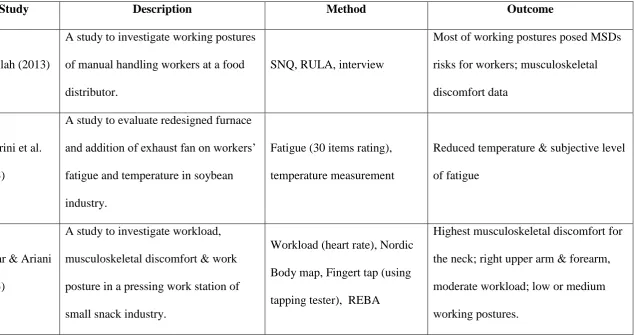
South East Asian Network Ergonomics Society). Appendix 1 provides an overview of
all of the reviewed studies. It has to be noted that the list of studies in this review is not
necessarily exhaustive since this review was primarily limited to full text scientific
Figure 1. The results of the study selection process
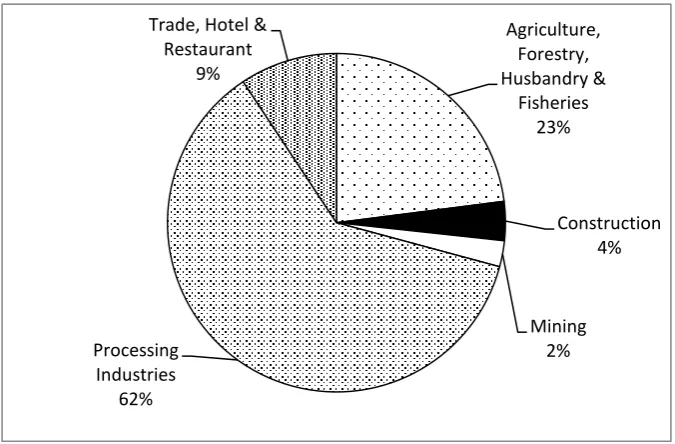
Figure 2 shows the proportion of sectors in which the ergonomics investigations
were applied. Two sectors i.e. Processing Industries and Agriculture, Forestry,
Husbandry & Fisheries, were the areas in which ergonomics were most commonly
applied. This is then followed by: Trade, Hotel and Restaurants; Constructions and
Mining. With respect to domain of ergonomics application, the highest application is in
the Physical Ergonomics domain (145 studies), followed by Organisational Ergonomics
domain (17 studies). None of the reviewed articles falls in the Cognitive Ergonomics
[image:6.595.84.422.469.691.2]domain. The following subsections will report the details in each domain.
Figure 2. Sectors of ergonomics application in Indonesia
Screening 1 Search terms results: 2126 articles Screening 2 Exclusion of articles not related to ergonomics, duplicates removal: 223 articles Screening 3 Exclusion of articles not related to SMEs organisation: 124 articles Accessible local and regional conferences: 37 articles Agriculture, Forestry, Husbandry & Fisheries 23% Construction 4% Mining 2% Processing Industries 62%
Trade, Hotel & Restaurant
9%
Ergonomics application in physical ergonomics domain
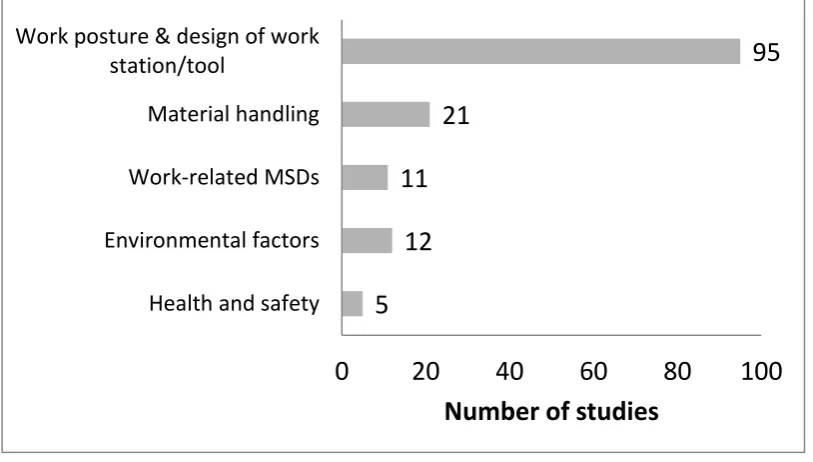
The proportion of ergonomics issues that were addressed in the physical ergonomics
domain is shown in Figure 3. Working posture and design of work stations/tool was the
most frequently addressed ergonomics issues in this domain. Most of the studies in this
category were mainly aimed to redesign and evaluate work stations/tools in order to fit
anthropometry dimensions of Indonesian workers and/or promote better working
postures. None of the studies related to redesigning work stations/tools indicated any
involvement of employees and employers during the redesign process. There was also
no indication either in communicating the positive results of the implementation to
employees or employers. Interestingly, some of the studies (e.g. Ilman et al., 2012;
Kristanto and Sugiantoro, 2012; Apriyandhi, 2012; Achiraeniwati & Rejeki, 2010)
implied the need for employers and employees to take more active roles in addressing
issues related to work postures.
Material handling and work related MSDs are the next issues that were
commonly addressed. Most of the studies in material handling were mainly aimed to
evaluate existing working conditions and provide recommendations related to lifting
tasks through widely adopted methods such as the Revised NIOSH (National Institute
for Occupational Safety and Health) lifting equation (NIOSH, 1994). A similar widely
adopted method i.e. Nordic Standardized Questionnaire (Kuorinka et al., 1997) was also
commonly applied in studies of work-related MSDs. Surprisingly, environmental
factors did not receive much attention, despite the fact that most of the tasks in SMEs
Figure 3. Ergonomics issues that were addressed in physical ergonomics domain
There is a noticeable trend of approaches in which existing or redesigned work
stations and tools were evaluated. The three approaches that stood out as the most
common methods to evaluate work station/tools were: i) work load; ii) working posture;
and iii) productivity. Each will be discussed in details in the following:
(1) Most of the studies utilised heart rate measurement to classify physical
workload; most authors cited its practicalities as their main reason of use. A
table that provides the relationship between physical work load, heart rate and/or
energy consumption such as Åstrand and Rodahl (1986) and Sanders and
McCormick (1987) were found to be commonly used to classify the physical
workload. There is a major drawback associated with the use of heart rate is
related to the susceptibility of an increase caused by other factors such as
psychological, environmental, and emotional (Roscoe, 1992). This means that
these factors need to be taken into account while collecting and interpreting the
measurement results, especially when they cannot be controlled e.g. when
measurements are performed in a real work setting. Unfortunately, despite the
5
12
11
21
95
0
20
40
60
80
100
Health and safety Environmental factors Work-related MSDs Material handling Work posture & design of work
station/tool
fact that most of the reviewed studies collected heart rate measurements in a real
work setting, only a few of the studies acknowledged the possible effects of
some of these external factors e.g. Tirtayasa et al. (2003), Ariati & Dewantara
(2011), Widana (2012). Another issue with the use of heart rate to classify work
load is the fact that the heart rate depends on the nature of the work i.e. whether
the work is static, involving only a small number of muscles (Grandjean and
Kroemer, 1997). Therefore, ideally, the heart rate measurement is accompanied
by direct measurement of oxygen consumption whenever possible. Based on the
review, there was only one study that adopted this approach i.e. Fatah et al.
(2011). The review also found that, in order to increase the accuracy of the heart
rate measurement to predict the energy consumption, some studies e.g. Dewi
(2011), Ernawan (2000), Sulistyosari (2010), Akbar (2008) incorporated step
test results to provide baseline measurement of the workload. This was done in
recognition that maximal aerobic power varies greatly from one person to
another i.e. a work load that is fairly easy for one worker may be quite
exhausting for another (Roscoe, 1992). Therefore, the work load was analysed
based on the individual’s maximal aerobic power and the ratio between load and
power was assessed individually (Rodahl, 1989).
(2) RULA (McAtamney & Corlett, 1993), REBA (Hignett & McAtamney, 2000)
and OWAS (Karhu et al., 1977) were found to be the most commonly applied
methods in assessing working posture, respectively. When direct assessment of
the redesigned work place layout or tool design are not feasible, some studies
utilised ergonomics digital human modelling such as Jack (Siemens PLM
Software, 2013), ManneQuinPRO (NexGen Ergonomics, 2013) to aid the
and Putro (2009). In one particular study by Muslim et al. (2012) a mannequin
was created based on partial data of a worker and was then used to assess the
digital work place layout. Although this approach is accommodated by the
software, this approach should be adopted with care as data that were not
supplied were interpolated based on US Army data (Blanchonette, 2010). This,
in the end, may lead to an inaccuracy of the simulation results (Oudenhuijzen et
al., 2000).
(3) Based on the review findings, productivity measurements were always applied
as part of an evaluation of work place layout and tools design/redesign. The
most common measure of productivity was the number of product outputs that
was calculated based on a time study (Taylor, 1911). In addition to this, a few
studies also used motion study (Gilbreth & Gilbreth, 1917) investigation to
demonstrate the potential improvement in productivity e.g. Rohman (2008),
Dewi (2011). Both methods are part of Industrial Engineering methodologies.
The inclusion of these methods as part of ergonomics studies is likely due to the
fact that ergonomics is mostly introduced as part of syllabus in Industrial
Engineering major in Indonesia.
Ergonomics application in organisational ergonomics domain
As previously mentioned, organisational ergonomics is comparatively less popular than
physical ergonomics. The review revealed that the main issue addressed in
organisational ergonomics is improvement of work design; with a so called “total
ergonomics approach” (Manuaba, 2006) cited as the most common method in some
studies i.e. Sudiajeng et al. (2007), Purnomo et al. (2007), Oesman & Adiatmika (2007),
Oesman & Adiatmika (2008), Purnawati (2008), Adiatmika (2009) and Josephus
with consideration to six criteria i.e. technical, economic, ergonomic, socio cultural,
energy consumption and environment. While analysing each criteria, a so called “SHIP
(Systemic, Holistic, Interdisciplinary and Participatory)” approach is applied. This
approach emphasises involvement of stakeholders (employers, employee, etc.) during
the process. This is notably different than the application of ergonomics in physical
ergonomics in which stakeholders acted passively. Another issue that is addressed in
this domain is modelling the ideal working conditions by considering each aspect of a
sociotechnical system i.e. Purnomo & Ferdianto (2011).
Outcome of ergonomics application
The outcome of ergonomics application, irrespective of sectors and domains, seem to
suggest that application of ergonomics affects productivity positively; providing further
support to similar findings (e.g. Mirka et al., 2003; Yeow and Sen, 2006). However,
most of the productivity was measured in a short duration while putting the workers
under direct observation of the researchers. There is a risk that this kind of approach
could result in the unwanted Hawthorne effect (Rothlisberger and Dickson, 1939). This
commonly occurs in a situation where a change proves to be very effective in terms of
productivity because the workforces find themselves in the spotlight and respond
positively to the extra attention they are receiving. The outcome of ergonomics
application also varies from a simple recommendation to a practical intervention which
directly involved real end-users/employees in their original work setting.
All of the reviewed studies were geared towards resolving existing and particular issues
in SMEs. As a result, the contribution of the studies towards the wider knowledge of
ergonomics was limited. However, there was a strong evidence of multidisciplinary
to quantify productivity to evaluate ergonomics intervention, and the inclusion of
ergonomics aspects as part of computer modelling of productivity.
Discussions
The review and analysis of the 161 articles revealed that cognitive ergonomics is the
least applied domain in Indonesian SMEs. It is likely that the low rate of ergonomics
application in this area is due to the utilisation of simple tools at SMEs, shown by
studies such as Sutjana (2000), Bangun (2009), Al-Faruqy (2011), Yusianto (2012), etc.
Therefore, evaluations on cognitive demands while operating these tools are not
necessary. The review also clearly demonstrated that ergonomics application in
Indonesian SMEs is still focused on the physical ergonomics domain. Major issues
addressed in this domain i.e. work layout and tool design, manual handling & work
postures, corresponds to ergonomics issues identified in previous publications e.g. Kogi
& Sen (1987), O’Neill (2000). This suggests that ergonomists in IDC still face the same
basic ergonomics problems even though more than a decade has passed. The review
also revealed that a large proportion of the studies addressed a classic ergonomics
problem related to work layout by providing small-scale, unsophisticated and low-cost
improvement that can be easily administered. This is considered as a positive approach
in promoting the uptake of ergonomics in IDC (Scott & Charteries, 2004; Kogi et al.,
2003), especially where “cost benefiting” is a critical element towards the acceptance of
ergonomics change within a workplace.
The emphasis on productivity is an indicator of awareness and understanding of
ergonomists in Indonesia towards the importance of productivity for SMEs. SMEs
workers’ are often paid based on their productivity, even if that means higher exposure
to MSDs, work related injuries, etc. Unlike many larger businesses or those that operate
concern than their consequences, the loss of productivity. Therefore, demonstrating that
the adoption of ergonomics can actually improve productivity and does not result in
additional expense is essential. Unfortunately, most of the reviewed studies based their
productivity evaluation on a short duration observation and simply extrapolated this
data to predict daily, weekly or monthly productivity. Thus, more efforts are required to
evaluate the long term effectiveness of ergonomics in increasing the productivity. This
can only be easily achieved if both employers and employees are involved from the start
of the ergonomics intervention. Sadly, this is not the case; the review revealed that
most studies adopted a top down approach and simply focused on resolving existing
problems without involving relevant stakeholders such as employees and employers.
This finding suggests that, despite repeated calls for participatory approaches in
ergonomics e.g. Kogi (1995), Shahnavaz (2000), O’Neill (2000), Scott & Charteries
(2004), the implementation of a participatory approach is very limited. Apart from a few
studies such as Oesman & Adiatmika (2008), Josephus (2011), Purnawati (2008),
Adiatmika (2009), most studies did not seem to indicate any effort in establishing
communications with stakeholders prior to and during the ergonomics intervention.
This is certainly detrimental as most of the ergonomics application is aimed to support
engineering controls in promoting health and safety by controlling or eliminating the
hazard at its source. Failure in communicating, educating and encouraging the
employees to adopt safe work practices will certainly impact on the sustainability of the
ergonomics intervention, especially since, as shown from the reviewed studies, the
workers in SMEs are mostly of low level education. Incidentally, a recent study by Bao
et al. (2013) specifically identified participation of stakeholders as the key to a
The review findings also suggest that issues related to technology transfers to
IDCs (Abeysekera & Shahnavaz, 1987; Shahnavaz, 1989) were not yet a prominent
ergonomics issue in Indonesian SMES. This was likely due to the fact that most of
Indonesian SMEs used either traditional or low level technology tools that can be
accommodated locally. An initiative by the Indonesian government, managed by
Indonesian Institute of Science (LIPI), has certainly played a key role in this. An
example of the Indonesian Institute of Science’ initiatives is IPTEKDA
(Implementation and Utilisation of Science and Technology) which encourages
researchers from local universities and research institutes to take active roles in
supporting SMEs through invention and implementation of low level technology tools.
The initiative, which has gone on for the last 15 years, requires the researchers to work
closely with the small and medium enterprise and solve their problems. A reflection on
the initiative revealed that at least 75% of the technologies are suitable, well received
and used sustainably by SMEs (Brojonegoro and Darwin, 2006).
The Indonesian government has put emphasis on the implementation of
occupational health and safety for larger businesses. In fact, Indonesia is one of the
Asian countries that has a comprehensive regulation and auditing mechanism on
occupational health and safety, especially for high risk domains. Unfortunately, the
same level of attention has not yet been given to SMEs. One of a few government
initiatives related to SMEs is the formation of Advisory Team on Occupational Health
and Safety (Panitia Pembina Keselamatan dan Kesehatan Kerja), which is intended to
improve the enforcement of health and safety at work for SMEs with more than 50
employees. Unfortunately, this initiative was rarely followed and even if it was, it was
a mere formality (Topobroto, 2002). Furthermore, the limit imposed on the minimum
contrary, the Indonesian Statistic Centre Bureau (Badan Pusat Statistik, 2006) reported
that 84.47% of the Indonesian workforce was employed in SMEs with less than 50
employees, leaving the majority of the Indonesian workforce uncovered by health and
safety legislation. Expansion of the coverage of policy and better enforcement of the
policy could potentially improve the uptake of ergonomics application in Indonesia by
stakeholders. To complicate matters, there is also evidence of poor implementation and
enforcement of health and safety law by Indonesian government which contributes
further to lax attitude with respect to health and safety issues in SMEs (Sutjana, 2006).
Several studies (e.g. Sinclair and Cunningham, 2013; Levinne et al., 2012; Haviland et
al., 2010) have shown that enforcement of health and safety through inspection and
penalties reduced work related incidents to a certain extent. Yani’s (2006) finding also
showed that SME workers’ knowledge in occupational health and safety is more limited
than those working in the larger business. The lack of knowledge, mainly due to low
literacy and socio economic level furthers ignorance towards aspects and rights of
health and safety at work. Thus, unsurprisingly, Markkanen (2004) has called for
shifting the attention on occupational health and safety from workers in larger industries
to workers in SMEs. Indonesian ergonomists could play an important role in this area
by ensuring that they do not simply solve SMEs’ ergonomics problem, but also involve
the stakeholders (both SMEs owners and workers) during the process as a means to
raise their awareness and educate them on some aspect of occupational health and
safety.
The review indicated that there was evidence of multidisciplinary approaches to
address ergonomics issues, especially with respect to industrial engineering. The
multidisciplinary approach is largely contributed by Indonesian universities which
engineering, public heath, occupational medicine. The inclusion of ergonomics in
various disciplines will likely be beneficial in the future as this means that there are
more “change agents” that can introduce and promote ergonomics in developing
countries.
Another aspect that can be observed from the review is the type of ergonomics
methods that were used. Most of the studies have used well known and established
methods which have been validated, used worldwide, and are not likely to be affected
by geography e.g. RULA, OWAS, REBA, and the NIOSH lifting equation. However,
there were also a large number of studies that adapted SNQ without indicating whether
or not the cross-cultural adaptation was assessed according to the internationally
recommended methodology i.e. translation, back-translation; committee review, and
pre-testing. A similar comment also applies to work fatigue questionnaire that was
established by Research Committee in Industrial Fatigue – Japan (1969). There is also
evident of inappropriate use of tools i.e. some studies attempted to utilise tools such as
SNQ to show that the new design of tools or work place layout can potentially reduce
MSDs whilst SNQ is likely to be inappropriate in assessing MSDs in such a short time.
Overall, in terms of methodologies, apart from the total ergonomics/SHIP approach by
Manuaba (2006), it is argued that the ergonomics application in Indonesia has showed
little contribution to the wider knowledge of ergonomics.
Based on the results of the review and discussions, several points that could be
adopted by Indonesian ergonomists, and possibly other IDC’s ergonomists, to improve
working condition in SMEs are identified:
(1) Adoption of participatory approach. The steady increase of work related
accidents despite continuous application of ergonomics suggests that current
employers and employees from the process; thus wasting an opportunity to
educate them regarding safe working practices and instil ownership on the
ergonomics changes. In contrast, a participatory or bottom-up approach enables
addressing ergonomics while simultaneously raising the awareness of safe
working practices for both SMEs owners and workers. Indonesian universities
could potentially play a key role to encourage the adoption of participatory
approach by putting more emphasis on participatory ergonomics.
(2) More initiatives to encourage creation of local technology and tool for SMEs.
Unlike larger businesses, this review found that technology transfer was not
(yet) a big problem in SMEs. This was due to the fact that most of the tools and
technology used by SMEs can be accommodated locally. Although it is unclear
how much Indonesian ergonomists’ role is in this area, it is important that they
continuously getting involved.
(3) Appropriate adaptation and modification of ergonomics tools. Having an
appropriate adaptation and modification of ergonomics tools will definitely be
beneficial in the future. For instance, by having an appropriate adaptation of
SNQ, MSDs data from different studies can be compared and contribute towards
documenting work related MSDs in Indonesian SMEs. A step towards
adaptation and modification of ergonomics tools for Indonesian has been started
by Widyanti et al (2013).
Conclusions
It is evident from the review that there are still issues that need to be addressed related
to ergonomics application in Indonesian SMES. The most urgent issue is the need for
adopting participatory approach as part of resolving ergonomics issues at work place.
studies heeded this call. Ironically, most of the studies cited the need for more active
roles from employers and employers in addressing some of the ergonomics problem.
Some good practices in ergonomics application were also revealed from the review e.g.
multidisciplinary approach, unsophisticated and low-cost solution, recognising the
importance of productivity.
References
Abdillah, F. 2013. “Analisis postur kerja dengan metode Rapid Upper Limb Assesment
(RULA) pada pekerja kuli angkut buah di Agen Ridho Illahi Pasar Johar Kota
Semarang.” Jurnal Kesehatan Masyarakat 2(1).
Abdullah, M. A. 2008. “Kekerasan shore karet menentukan keamanan kerja pada
traktor roda dua.” Jurnal Polimeson 8(8): 442-447.
Abeysekera, J.D.A., and H. Shahnavaz. 1987. “Ergonomics of technology transfer.”
International Journal of Industrial Ergonomics 1(4): 265-272.
Achiraeniwati, E., and Y. S., Rejeki. 2010. “Perbaikan fasilitas kerja dengan
pendekatan ergonomi (studi kasus industri rumah tanggal sepatu Cibaduyut: CV
Gerund)”. Paper presented at Seminar Nasional Penelitian dan Pengabdian kepada
Masyarakat, Bandung.
Adiatmika, I. P. G. 2009. “Total ergonomic approach in decreasing quality of fatigue of
metal crafters.” Indonesian Psychological Journal 25(1): 71-78.
Af-Faruqy, A. F. 2011. “Uji beban kerja alat perontok pada tipe pedal berbasis sepeda.”
Dissertation, Bogor Agricultural University.
di industri batik Madura. “ Jurnal Inovasi dan Kewirausahaan 3: 167-171.
Ahmad, 2004. “Kenyamanan dan producktivitas kerja pemakaian rancangan kursi
ergonomis untuk penjahit.” INASEA 5(1): 20-29. in Indonesian
Akbar, A. R. M. 2008. “Pengembangan model produktivitas kerja menggunakan
faktor-faktor ergonomi pada pengolahan tanah pertama areal padi sawah.” Master thesis,
Bogor Agricultural University.
Akbar, G. F., C.S. Wahyuning and Rispianda. 2012. “Rancangan produk alat pedagang
asongan dengan menggunakan metode Ergonomic Function Deployment (EFD).” Reka
Integra, 1(1). Andriyanto, R. 2008. “Identifikasi postur kerja menggunakan metode
OWAS dan analisis konsumsi energi pada proses perontokan padi.” Dissertation,
Muhammadiyah University of Surakarta. Anugrah, G., Rispianda, and Y. Helianty.
2012. “Usulan perbaikan sistem kerja dengan pendekatan 10 physical ergonomics
principles di bengkel sepatu Cibaduyut.” Jurnal Online Institut Teknologi Nasional 2(1).
Anwar, M. A., A. R. Matondang and Anizar. 2013. “Usulan perancangan fasiilitas kerja
pada stasium pemotongan daun pandan untuk mengurangi resiko musculoskeletal
disorders di CV XYZ.” Jurnal Teknik Industri FT USU, 1(2).
Apriyandhi, R. H. 2012. “Perancangan ulang stasiun kerja pemintal benang afval
ditinjau dari aspek ergonomis: studi kasus terhadap kelompok pengrajin Desa Jombor
Klaten.” Dissertation, Muhammadiyah University of Surakarta .
Ariati, N. N., N. M. Dewantara. 2011. “Beban kerja dan mikroklimat ruang kerja perajin
uang gepeng (pis bolong) UD. Kamasan Bali di Desa Kamasan Klungkung.” Jurnal
Arimbawa, I. M. G., I. B. A. Manuaba, I. G. N. Nala and N. Adiputra. 2009.
“Ergonomic redesign of working tools increases performance of traditional coconut oil
makers in the district of Dawan Klungkung”. Institutional repository of Institut Seni
Indonesia.
Arta, A. D., R. D. Astuti and S., Susmartini. 2012. “Perancangan ulang alat mesin
pembuat es puter berdasarkan aspek ergonomi.” Performa 11(2): 135-142.
Aryanto, P. D. 2008. “Gambaran risiko ergonomi dan keluhan gangguan
musculoskeletal pada penjahit sektor usaha informal.” Dissertation, University of
Indonesia.
Åstrand, P., Rodahl, K., 1986. Textbook of work physiology. McGraw-Hill: New
York.
Astuti, R. D., and B. Suhardi. 2007. “Analisis postur kerja manual material handling
menggunakan metode OWAS.” Gema Teknik 1 (10).
Atmanto, I. S. 2011. “Behavioural determinants workers in the use of PPE based on
hazards assessment in foundry company Ceper Klaten.” Paper presented at Seminar
Nasional Sains dan Teknologi ke-2, Semarang, June 15.
Badan Pusat Statistik, 2008. “Berita resmi statistik No. 28/05/Tahun XI: Perkembangan
indicator makro UKM tahun 2008.” Jakarta: BPS.
Bangun, E. S. B. R. 2009. “Usulan fasilitas kerja yang ergonomis pada stasiun
pengupasan di UD Putri Juna.” Dissertation, University of Sumatera Utara (in
Indonesian).
among Nicaraguan coffee harvesting workers.” Ergonomics 56(2): 166-181.
Blanchonette, P. 2010. Jack human modelling tool a review. Victoria: Defence Science
and Technology Organisation.
Brojonegoro, A., and Darwin. 2006. Pemberdayaan UKM Melalui Program Iptekda
LIPI. Jakarta: LIPI Press.
Budiastra, I. N., I. W. A. Wijaya, P. K., Sudiarta. 2000. “Subjective complaints of
clove pickers.” Proceedings of ACPHI/ASEAN Ergonomics.
Dewi, I. 2011. “Analisis ergonomi pada penyiapan lahan sawah lebak menggunakan
alat tradisional tajak di kabupaten banjar kalimantan selatan.” Master thesis, Bogor
Agricultural University.
Dhafir, M. 2002. “Analisis biomekanik, studi gerak dan waktu pada pengoperasin
traktor tangan.” Master thesis, Bogor Agricultural University.
Fatah, G. S. A., P. Aryanti, W. A. Nugroho, and L.C. Hawa. 2011. “Penentuan beban
kerja dan konsumsi oksigen pada pengoperasian alat pengupas kulit ari kedelai
orbapas.” Jurnal Enjiniring Pertanian 9(1): 49-56.
Fitriasari, A. S. 2011. “Perancangan fasilitas kerja untuk mereduksi terjadinya
musculoskeletal disorder.” Dissertation, Diponegoro University.
Fitrihana, N. 2008. “Perbaikan area kerja di industri garmen dengan pendekatan
ergonomi partisipatori dan hubungannya dengan produktivitas dan kualitas.” Master
Thesis, Gadjah Mada University.
on the efficient method to industrial preparedness. New York: Sturgis & Walton
Company.
Grandjean, E., and K. H. E. Kroemer. 1997. Fitting the task to the human: A textbook of
occupational ergonomics. Philadelphia : Taylor & Francis.
Hadiguna, R. A., and M. Monasari. 2006. “Karakteristik ergonomis rancang bangun
wheelbarrow.” Jurnal Teknik Industri 8(1): 82-96.
Hanafi, M., R. D. Astuti, and I. Iftadi. 2011. “Perancangan ulang fasilitas kerja alat
pembuat gerabah dengan mempertimbangkan aspek ergonomi.” Performa 10(1): 11-18.
Hanafie, A., Saripuddin, M., Fadhli, M.,2011. Perancangan mesin perontok padi
(combine harvester) yang ergonomis dengan pendekatan anthropometri. Jurnal Ilmu
Teknik, 6(12): 846-849.
Hanafie, A. 2007. Modifikasi rancangan mesin perontok padi dengan pendekatan
ergonomi-anthropometri. Jurnal Ilmu Teknik 3.
Haslindah, 2007. “Analisis ergonomis dalam perancangan fasilitas kerja untuk proses
perontok padi (thresher) dengan pendekatan biomekanika.” Jurnal Ilmu Teknik, 2(3):
237-244.
Hastuti, R. P., and Sugiharto. 2010. “Hubungan antara sikap kerja duduk dengan gejala
cumulative trauma disorders.” Jurnal Kesehatan Masyarakat 6(1): 8-15.
Hendrick, H. W. 1991. “Ergonomics in organisational design and management.”
Ergonomics 34(6): 743-756.
genteng UD Sinar Mas dengan menggunakan metode Rapid Entire Body Assesment
(REBA). Dissertation, Gunadarma University.
Herdiman, L., R. W. Damayanti, and P. E. Dwi. 2008. “Perancangan lantai produksi
dengan minimisasi waste activity dan perbaikan posisi kerja operator sebagai upaya
meningkatkan efisiensi produksi almari.” Gema Teknik 11(1).
Herianto, A. 2013. “Perancangan alat bantu pengangkut batako yang ergonomis guna
mengurangi resiko musculoskeltal disorder.” Master Thesis, UPN “Veteran”
Yogyakarta.
Hignett, S., and L. McAtamney. 2000. “Rapid entire body assesment (REBA).”
Applied Ergonomics 31(2): 201-205.
Hil, H. 2002. “Old policy challenges for a new administration: SMEs in Indonesia.” In
The role of SMEs in National Economies in East Asia Vol (2), edited by Harvie, C.,
Lee, B-C. Massachusetts: Edwar Elgar Publishing Inc.
Hutagalung, R., and A. Manuaba. 2009. “Improvement of work quality by applying
ergonomic approach increase performance of traditional porters in Badung Market
Denpasar.” Indonesian Journal of Biomedical Sciences, 3(2): 19-26.
International Ergnomics Association, 2013. Accessed 5th of June 2013.
http://www.iea.cc/01_what/What%20is%20Ergonomics.html
Ilman, A., Yuniar, and Y. Helianty. 2012. “Rancangan perbaikan sistem kerja dengan
metode Quick Exposure Check (QEC) di bengkel sepatu X di Cibaduyut.” Jurnal
Online Institut Teknologi Nasional 2(1): 121-129.
Quick Exposure Checklist (QEC) pada perajin gerabah di Kasongan Yogyakarta.”
Jurnal Kesehatan Masyarakat 1(2): 758-766 (in Indonesian).
Ismayenti, L. 2004. “Pengaruh penggunaan alat ergonomis dan perubahan posisi kerja
terhadap kelelahan otot dan produktivitas perajang tembakau di Kecamatan Ngadirejo
dan Bansari Kabupaten Temanggung.” Master Thesis, Gadjah Mada University.
Izzhati, D. N. 2010. “Pengembangan alat pemotong tahu yang ergonomis dengan
menggunakan metode RULA.” In Proceedings of Seminar Nasional Sains dan
Teknologi , I7-11, Semarang: Wahid Hasyim University.
Jamsostek, 2011. “Laporan Tahunan.” Accessed 5th of June 2013.
http://www.jamsostek.co.id/content_file/ar_jamsostek_lores_8812.pdf
Jasman. 2003. “Pengaruh penggunaan kursi dan meja kerja yang ergonomis terhadap
kenyamanan dan produktivitas tenaga kerja industri pembuatan emping melinjo di
Padang Pariaman.” Master Thesis, Gadjah Mada University.
Josephus, J. 2011. “Intervensi ergonomi pada proses penangkapan ikan dengan pukat
cincin meningkatakan kinerja dan kesejahteraan nelayan di Amurang.” Master thesis,
Udayana University.
Kadarusman, A. 2002. “Analisis beban kerja operator mesin polisher ICHI pada proses
penggilingan padi berdasarkan Recommended Weight Limit (RWL) sebagai upaya
peningkatan produktivitas dan keselamatan kerja.” Jurnal Teknologi Industri 6(1):
1-10.
Kalsum, 2007. “Kenyamanan dan produktivitas pembuat sapu ijuk ditinjau dari aspek
11(1): 33-37.
Karhu, O., P. Kansi, I. Kuorinka. 1977. “Correcting working postures in industry: a
practical method for analysis.” Applied Ergonomics 8:199-201.
Kawakami, T., J. M. Batino, and T. T. Khai. 1999. “Ergonomic strategies for
improving working conditions in some developing countries in Asia.” Industrial Health
37: 87-198.
Kawakami T., T. T. Khai, and K. Kogi. 2005. Work improvement in neighbourhood
development (WIND programme): training programme on safety, health and working
conditions in agriculture. Can Tho City: The Centre for Occupational Health and
Environments.
Kogi, K. and K. N. Sen. 1987. “Third world ergonomics.” In International Reviews of
Ergonomics vol (1), edited by D.J. Oborne, 77-118. London: Taylor & Francis.
Kogi, K., T. Kawakami, T. Itani, and J. M. Batino. 2003. “Low-cost work
improvements that can reduce the risk of musculoskeletal disorders.” International
Journal of Industrial Ergonomics 31(2): 179-184.
Kristanto, A., and Y. Arifin. 2012. “Perancangan mesin penyayat bambu secara
ergonomis.” Jurnal Ilmiah Teknik Industri 11(2): 31-37.
Kristanto, A., and R. Manopo, R. 2010. “Perancangan ulang fasilitas kerja pada stasiun
cutting yang ergonomis guna memperbaiki posisi kerja operator sebagai upaya
peningkatan produktivitas kerja.” Jurnal Informatika 4(2): 467-479.
Kristanto, A., and T. Sugiantoro. 2012. “Perancangan ulang mesin amplas kayu profil
Teknik Industri 11(2): 125-135.
Krungkraiwong, S., T. Itani, and R. Amornratanapaitchit. 2006. “Promotion of a
healthy work life at small enterprises in Thailand by participatory methods.” Industrial
Health 44:108-11.
Kuorinka, I., B. Jonsson, A. Kilbom, H. Vinterberg, F. Biering-Sorensen, G. Andersson,
and K. Jorgensen. 1997. “Standardised Nordic Questionnaires for the analysis of
musculoskeletal symptoms.” Applied Ergonomics 18(3): 233-237.
Kurniawan, B., S. Jayanti, Y. Setyaningsih. 2008. “Faktor risiko kejadian Carpal
Tunnel Syndrome (CTS) pada wanita pemetik melati di Desa Karangcengis
Purbalinnga.” Jurnal Promosi Kesehatan Indonesia 3(1): 31-37.
Liquiddanu, E., T. Rochman, A. K. Aji. 2007. “Perancangan alat bantu pengendalian
kualitas shuttle cock secara atribut dan variable dengan pendekatan anthropometri pada
industri kecil di Kelurahan Serengan.” Performa 6(1): 61-71.
Markkanen, P. 2004. Occupational safety and health in Indonesia – working paper 9.
Manila: ILO.
Mardiyanto. 2008. “Analisa postur kerja menggunakan metode Rapid Upper Limb
Assessment (RULA) (studi kasus: home industry pembuatan tahu di Kartasura).”
Dissertation, Muhammadiyah University of Surakarta (in Indonesian).
McAtamney, L., and E. N. Corlett. 1993. “RULA: a survey method for the
investigation of work-related upper limb disorders.” Applied Ergonomics 24(2): 91-99.
Mualim, K. 2002. “Analis faktor risiko yang berpengaruh terhadap keracunan pestisida
Temanggung.” Master thesis, Diponegoro University.
Mulyaningrum, R. A. 2009. “Analisa aktifitas angkat beban ditinjau dari aspek
biomekanika dan fisiologi (studi kasus CV Prima Purwodadi).” Dissertation,
Muhammadiyah University of Surakarta (in Indonesian).
Muslikhatun, H. 2007. “Analisis pengaruh penggunaan stagen pada aktivitas
angkat-angkut di Pasar Legi Surakarta.” Dissertation, Muhammadiyah University of Surakarta.
Muslim, E., B. Nurtjahyo, R. Ardi, 2011. “Analisis ergonomi industri garmen dengan
posture evaluation index pada virtual environment.” Makara Teknologi 15(1): 75-81 (in
Indonesian).
Muslimah, E., I. Pratiwi, and F. Rafsanjani. 2006. “Analisis manual material handling
menggunakan NIOSH equation.” Jurnal Ilmiah Teknik Industri 5: 53-60.
Najamuddin, S. 2006. “Analisis ergonomi pada proses mesin tenun dengan pendekatan
physiological performance.” Jurnal Ilmu Teknik 1(2): 168-178.
Nasir, F. 2001. “Simulasi penentuan posisi kerja optimum pada traktor tangan
menggunakan komputer.” Master thesis, Bogor Agricultural University.
Nasution, H., and Nazlina. 2012. “Perancangan fasilitas kerja untuk mereduksi human
error.” Jurnal Teknik Industri 14(1): 73-82.
Nawawinetu, E. D., and R. Adiyani. 2007. “Stress akibat kerja pada tenaga kerja yang
terpapar bising.” The Indonesian Journal of Public Health 4(2): 59-63.
Netrawati, I.G.A.O. 2010. “Manfaat intervensi ergonomi dalam usaha meningkatkan
NexGen Ergonomics. 2013. “ManneQuinPro.” Accessed 5th of June 2013.
http://www.nexgenergo.com/ergonomics/mqpro.html
NIOSH, 1994. Technical Report No. 94-110: Applications Manual for the Revised
NIOSH Lifting Equation. Cincinnati: Department of Health and Human Services
(NIOSH).
Nisa, A. H. 2010. “Analisis tingkat kebisingan dan pencahayaan di bengkel alsintan
(alat dan mesin pertanian) sederhana dan bengkel alsintan besar.” Dissertation, Bogor
Agricultural University.
Norfiza, and D. Syahputra. 2012. “Perancangan alat pemotong nenas yang ergonomis
untuk meningkatkan produktivitas.” Jurnal Ilmiah Teknik Industri 11(1): 41-50.
Nova, S. 2012. “Perbedaan jarak pandang pekerja canting batik pada beberapa waktu
kerja di kampung batik Semarang.” Jurnal Kesehatan Masyarakat 1(2): 816-827.
Nugroho, W. A. 2008. “Perancangan ulang alat pengupas kacang tanah untuk
meminimalkan waktu pengupasan. “ Dissertation, Muhammadiyah University of
Surakarta.
Nurmianto, E. 2008. “Ergonomic intervention in handicraft producing operation.” In
Proceedings of the 9th Asian Pacific Industrial Engineering & Management Systems
Conference, 1008-1011.
Nurullita, U. 2008. “Analisis aspek faktor lingkungan fisik pada industri tahu di
Kelurahan Jomblang Kecamatan Candi Sari Kota Semarang.” Jurnal Kesehatan
Masyarakat Indonesia 4(2): 98-104.
for social justice.” American Journal of Public Health 94 (1): 1916-1921.
Oesman, T. I., I. P. G. Adiatmika. 2008. “Aplikasi model total ergonomics approach
pada industri kecil-suatu pendekatan praktis. In Proceedings of Seminar Nasional
Aplikasi Sains dan Teknologi, 222-225, Yogyakarta: IST AKRPIND.
O’Neill, D. H. 2000. “Ergonomics in industrially developing countries: does its
application differ from that in industrially advanced countries?.” Applied Ergonomics
31(6): 631-640.
Oudenhuijzen, A., J. Hudson, and G. Zehner. 2000. “Digital human modelling systems:
a procedure for verification and validation using the F-16 crew station.” In Proceedings
of the Human Factors and Ergonomics Society Annual Meeting, 44 (38): 723-726.
Pramana, A. N. 2012. “Analisis postur kerja dengan metode Rapid Upper Limb
Assesment (RULA) pada pekerja di Sajida Laundry Kota Semarang.” Dissertation,
Diponegoro University.
Prastiwi, A. 2008. “Analisis resiko kerja dengan strain index (studi kasus pembuatan
tahu di Desa Purwogondo).” Dissertation, Muhammadiyah University of Surakarta.
Pratiwi, I., E. Muslimah, R. K. Seytojati. 2010. “Perancangan peralatan dan
pengembangan metode kerja pada industri tahu ditinjau dari aspek ergonomi untuk
meningkatkan kapasitas produksi.” Jakarta: Lembaga Ilmu Pengetahuan Indonesia.
Pratiwi, M, Y. Setyaningsih, B. Kurniawan, and Martini. 2009. “Beberapa faktor yang
berpengaruh terhadap keluhan nyeri punggung bawah pada penjual jamu gendong.”
Jurnal Promosi Kesehatan Indonesia, 4(1): 61-67.
pengaruh keadaan lingkungan fsih dan proses produksi terhadap manajemen
pengelolaan K3.” Paper presented at Seminar Nasional Ergonomi IX, Semarang, 18
November.
Purnawati, S. 2008. “Pendekatan ergonomi total untuk mengantisipasi risiko keracunan
pestisida pada petani-petani Bali.” Jurnal Lingkungan Hidup Bumi Lestari 8(2):
154-161.
Purnomo, H., and K. Ferdianto. 2011. Desain sistem kerja pada pengrajin mendong
dengan pendekatan ergonomi makro. In Proceedings of Seminar Nasional Sains dan
Teknologi 2, C12-17, Semarang: Wahid Hasyim University.
Purnomo, H., A. Manuaba, and N. Adiputra. 2007. “Sistem kerja dengan pendekatan
ergonomi total mengurangi keluhan muskuloskeletal, kelelahan dan beban kerja serta
meningkatkan produktivitas pekerja industri gerabah di Kasongan Bantul.” Indonesian
Journal of Biomedical Sciences, 1(3): 19-30.
Purwati, 2012. “Analisis dan perbaikan bentuk fisik kursi kerja operator menjahit
dengan memperhatikan aspek ergonomi (studi kasus pada PD Sonata Jaya).”
Dissertation, Gunadarma University.
Putri, N. T., I. Ichsyan. 2012. “Ergonomics concept implementation in manufacture of
traditional looms (case study: Pandai Sikek traditional looms in West Sumatra).” In
Proceedings of the Asian Pacific Industrial Engineering & Management Systems
Conference, edited by V. Kachitvichyanukul, H.T. Luong, and R. Pitakaso, 1564-1568.
Putro, E., 2009a. “Perbaikan rancangan alat pemotong singkong dengan mekanisme
pedal kaki untuk meningkatkan produksi dengan prinsip ergonomi.” Dissertation,
Putro, F.A. 2009b. “Perancangan ulang gerobak angkut dengan pendekatan
anthropometri (studi kasus di Pasar Klewer Solo).” Dissertation, Muhammadiyah
University of Surakarta.
Rahayu, W. A. 2012. “Faktor-faktor yang berhubungan dengan keluhan
muskuloskeletal pada pekerja angkat-angkut industri pemecahan batu di kecamatan
Karangnongko Kabupaten Klaten.” Jurnal Kesehatan Masyarakat 1(2): 836-844.
Rahmawati, Y., and Sugiharto, 2011. “Hubungan sikap kerja duduk dengan kejadian
cumulative trauma disorder pekerja pengamplasan.” Jurnal Kesehatan Masyarakat 7(1):
8-14.
Ristyowati, T. 2011. “Perancangan fasilitas kerja untuk meningkatkan efisiensi kerja
dengan analisis Rapid Entire Body Assesment (REBA).” Presented at Seminar Nasional
Teknologi Informasi dan Komunikasi Terapan, Semarang, April 16.
Riyadi, 2010. “Keluhan subjektif carpal tunnel syndrome pada pemerah sapi di
Boyolali.“ Dissertation, Muhammadiyah University of Surakarta.
Rochman, T., R. D. Astuti, F. D. Setyawan. 2012. “Perancangan ulang fasilitas fisik
kerja operator di stasiun penjilidan pada industri percetakan berdasarkan prinsip
ergonomi.” Performa 11(1): 1-8.
Rodahl, K. 1989. The physiology of work. London: Taylor and Francis Ltd.
Rohman, A. M. H. 2008. “Studi gerak dan waktu dengan analisi biomekanika pada
proses panen tebu di PG Bunga Mayang Lampung.” Dissertation, Bogor Agricultural
University.
respiration?. “ Biological Psychology 34(2-3): 259-287.
Rothlisberger, F. J. and W. J., Dickson. 1939. Management and the worker.
Cambridge: Harvard University Press.
Sabarudin, 2012. “Analisis beban kerja terhadap resiko cedera pada pedagang jagung
rebus.“ Dissertation, Gunadarma University.
Saputra, E. and E. Rindrasih. 2012. “Participatory planning and village tourism SMEs:
a case study of Bantul Regency Yogyakarta Indonesia.” Geografia Malaysia Journal of
Society and Space 8: 54-64.
Sanders, M. S., E. J. McCormick. 1987. Human factors in engineering design. New
York: McGraw-Hill.
Sari, W. N. 2013. “Hubungan antara sikap kerja duduk dengan keluhan subyektif nyeri
punggung bawah pada pekerja pembuat terasi.” Unnes Journal of Publich Health, 3(2):
40-47.
Sari, E. 2011a. “Analisis dan perancangan ulang leaf trolleys yang memenuhi
kaidah-kaidah ergonomi.” Jurnal Teknik Industri 1(1): 82-101.
Sari, M. P., R. D. Astuti, and I. Iftadi. 2011b. “Perancangan alat bantu pemasangan
stiker gitar untuk mengurangi keluhan dan memperbaiki postur kerja di Tarjo Guitar
Sukoharjo.” Performa 10(2): 119-130.
Sarimurni, and I. Murtopo. 2004. “Analisa penggunaan kursi ergonomi terhadap
menurunnya angka kelelahan perajin batik tulis.” Jurnal Teknik Gelagar 15(1): 51-58.
Software. Accessed 5th of June 2013.
http://www.plm.automation.siemens.com/en_gb/products/tecnomatix/assembly_plannin
g/jack/
Scott, P. A., and J. Charteris. 2004. “Ergonomics in industrially developing countries
(IDCs): socio-cultural perspectives.” In Cultural Ergonomics: 4 Advances in Human
performance and Cognitive Engineering Research, edited by Michael Kaplan, 223-248.
Oxford: JAI Press.
Sena, I. G. A. 2000. “Investigation of sitting work posture of cagcag weaver at Desa
Gelgel Klungkung Bali.” In Proceedings of 4th Asia Pacific Conefrence on Human
Computer Interaction, 423-426, Amsterdam: Elservier.
Setiadi, M. Y., Poerwanto, and Anizar. 2013. “Usulan alat bantu pemindahan batako
untuk mengurangi risiko musculoskeletal disorders di PT XYZ.” Jurnal Teknik Industri
FT USU 1(3): 37-43.
Setiawan, M. N., W. Hariyono, and S. A. Mulasari. 2011. “Penerapan keselamatan dan
kesehatan kerja pada CV. Cipta Mandiri di Kabupaten Kendal.” Jurnal Kesehatan
Masyarakat 5(2): 20-30.
Setyaningrum, R. 2010. “Perhitungan energi expenditur, konsumsi energi dan penilaian
beban kerja pada aktivitas manual material handling.” In Proceedings of Seminar
Nasional Sains dan Teknologi , A45-49, Semarang: Wahid Hasyim University.
Setyaningsih, Y., I. Wahyuni, S., Jayanti. 2010. “Analisis potensi dan upaya
pengendalian risiko bahaya pada pekerja pemecah batu.” Media Kesehatan Masyarakat
Shahnavaz, H. 1989. “Ergonomics: An emerging concept in industrially developing
countries. “ International Journal of Industrial Ergonomics 4(2): 91-100.
Shahnavaz, H. 2000. “Role of ergonomics in the transfer of technology to industrially
developing countries.” Ergonomics 43(7): 903-907.
Simanjutak, R. A. 2008. “Evaluasi kemampuan fisik berdasarkan job severity index
guna keselamatan pekerja.” In Proceedings of Seminar Nasional Aplikasi Sains dan
Teknologi, 238-248, Yogyakarta: IST AKRPIND.
Siska, M., and M. Teza. 2012. “Analisa posisi kerja pada proses pencetakan batu bata
menggunakan metode NIOSH. “ Jurnal Ilmiah Teknik Industri 11(1): 61-70.
Siswiyanti, and S. Luthfianto. 2011. “Beban kerja dan keluhan sistem musculoskeletal
pada pembatik tulis di Kelurahan Kalinyamat Wetan Kota Tegal.” Tegal: Universitas
Pancasakti Tegal.
Siswiyanti, K. Wulandari, J. Ubaidilah, and I. D. Widodo. 2008. “Pengembangan alat
pengasap ikan.” In Proceedings of Seminal Nasional Teknoin , C165-172,
Yogayakarta: Indonesian Islamic University.
Soewarno, A. 2005. “Perbaikan lingkungan kerja kelongsong peluru dengan
menyesuaikan tinggi meja kerja di desa Kamasan Klungkung. “ Jurnal Permukiman
Natah 3(2): 62-10.
Sucipto, E. 2007. “Hubungan pemaparan partikel debu pada pengolahan batu kapur
terhadap penurunan kapasitas fungsi paru.” Master thesis, Diponegoro University.
Sulistyosari, N. 2010. “Kajian pemilihan alternatif penyiangan gulma padi sawah.”
Sundari, K. N. 2010. “Tinjauan ergonomi terhadap sikap kerja petani di Banjar Tengah
Desa Peguyangan Denpasar Utara.” Metris 11(2): 71-76.
Sundari, K. N. 2011. “Sikap kerja yang menimbulkan keluhan muskuloskeletal dan
meningkatkan beban kerja pada tukang bentuk keramik.” Jurnal Ilimiah Teknik Industri
10(1): 42-47.
Surata, I. W., A. Manuaba, N. Adiputra, and D. P. Sutjana. 2011. “Changing body
posture and working system improves workers performance and product quality.”
Indonesian Journal of Biomedical Sciences 5(1): 18-31.
Susetyo, J., T. I. Oes, and S. H. Indonesiani, S. H. 2008. “Prevalensi keluhan subyektif
atau kelelahan karena sikap kerja yang tidak ergonomis pada pengrajin perak.” Jurnal
Teknologi IST AKPRIND 1(2): 141-149.
Susila, I. G. N. 2000. “Work posture and musculoskeletal discomfort of stone carvers.”
In Proceedings of 4th Asia Pacific Conefrence on Human Computer Interaction,
419-422, Amsterdam: Elservier.
Sutjana, I. D. P. 2000a. “Use of serrated sickle to increase farmers productivity.”
Journal of Human Ergology 29: 1-6.
Sutjana, I. D. P. 2000b. “Working accidents among mill operators in small-sized
factories manufacturing home roof tile tiles in Pejaten and Nyitdah Villages Tabanan
Regency Indonesia.” Journal of Occupational Health 42: 91-95.
Suwondo, A., D. Lestyanto, and Yulisnawati. 2008. “Perbedaan tekanan darah pada
pekerja yang terpapar panas di industri.” Jurnal Promosi Kesehatan Indonesia 3(1):
Taufan, B. A., P. A. Wicaksono, and R. Rumita. 2012. “Usulan perancangan fasilitas
kerja untuk mengurangi musculoskeletal disorder pada pekerja pembuat jeli rumput
laut.” Industrial Engineering Online Journal 1(1): 8-15.
Taylor, F. W. 1911. The Principles of Scientifc Management. New York : Harper &
Row.
Tirtayasa, K., I. N. Adiputra, and I. G. G. Djestawana. 2003. “The change of working
posture in Manggur decreases cardiovascular load and musculoskeletal complains
among Balinese.” Journal of Human Ergology 32: 71-76.
Topobroto, H. S. 2002. Policy and condition of occupational safety and health in
Indonesia. Jakarta: ILO.
Trihandoyo, B., H. Trisnowibowo, and W.P. Nugraheni. 2001. “Pelaksanaan program
keselamatan dan kesehatan kerja pada sektor industri dalam kaitannya dengan
produktivitas kerja di kawasan industri Kabupaten Serang.” Media Penelitian dan
Pengembangan Kesehatan, 11(2): 1-13.
Utomo, A. 2012. “Gambaran tingkat risiko ergonomi dan keluhan gangguan trauma
kumulatif pada pekerja Pabrik Rahmat Tempe di Pancoran Jakarta selatan.”
Dissertation, University of Indonesia.
Wahyuni, T. 2013. “Faktor risiko yang berhubungan dengan kejadian konjugtivitis pada
pekerja pengelasan di Kecamatan Cilacap Tengah Kabupaten Cilacap.” Jurnal
Kesehatan Masyarakat 2(1): 241-249.
Wibawa, T. 2009. “Analisis pemindahan material dengan pendekatan recommended
16.
Widana, I.K. 2012. “Redesigning tractors for reduced soil cultivation and increased
productivity in the agricultural sector in Bali Indonesia.” In Ergonomics in Asia:
Development, Opportunities, and Challenges, edited by Shih, Y-C., Liang, S-F. M. ,
31-35. London: CRC Press.
Widharto, Y. 2009. “Pengaruh ergonomi terhadap pengrajin keramik wanita.” Master
thesis, Gadjah Mada University.
Widhyasari, M. P. 2011. “Aspek ergonomi pada aktivitas penangkapan ikan tuna.”
Dissertation, Bogor Agricultural University.
Widyanti, A., A. Johnson, and D. de Waard. 2013. “Adaptation of the rating scale
mental effort (RSME) for use in Indonesia.” International Journal of Industrial
Ergonomics 43: 70-76.
Wignjosoebroto, S., and Sutaji. 2000. “Analisa dan redesain stasiun kerja operasi tenun
secara ergonomis untuk meningkatkan produktivitas.” Paper presented at Seminar
Nasional Ergonomi, Surabaya, August 20.
Wignjosoebroto, S. 2007. “Indonesia ergonomics roadmap: where we are going?.”
Journal of Human Ergology 36(2): 91-98.
Wijaya, A. 2008. “Analisa postur kerja dan perancangan alat bantu untuk aktivitas
manual material handling industri kecil (studi kasus: industri kecil pembuatan tahu di
Kartasura).” Dissertation, Muhammadiyah University of Surakarta.
Wijaya, Y. G. 2011. “Pembuatan alat tanam benih jagung otomatis berbasis
Yahya, M. 2011. “Modifikasi desain alat tenun bukan mesin pada industri pengusaha
kecil tenun sutera di Kabupaten Wajo Sulawasi Selatan.” Jurnal Media Edukasi
Pendidikan Teknologi dan Kejuaran 3(2): 62-68.
Yani, M. 2006. “Keselamatan dan kesehatan kerja di sektor informal.” Paper presented
at Konvensi Nasional Keselamatan dan Kesehatan Kerja, Jakarta, January 11-13.
Yuliani, S., Ekawati, and Hanifa. 2012. “Analisis tingkat risiko ergonomi dan keluhan
musculoskelal disorders pada wanita pemecah batu.” In Proceedings of Seminar
Nasional World Fit for Children, edited by Budiyono, Praba Ginandjar, Lintang Dian
Saraswati, M. Arie Wuryanto, Laksmi Widajanti, 77-84. Semarang : Universitas
Diponegoro.
Yusianto, R. 2012. “Rancang bangun prototipe alat tanam benih jagung ergonomis
dengan tuas pengungkit dan mekanik pembuat lubang.” In Proceedings of the 3rd
Appendix 1 – Articles which were included in the review
Table 1. Summary of articles which were included in the review
No Study Description Method Outcome
1 Abdillah (2013)
A study to investigate working postures
of manual handling workers at a food
distributor.
SNQ, RULA, interview
Most of working postures posed MSDs
risks for workers; musculoskeletal
discomfort data
2
Andarini et al.
(2013)
A study to evaluate redesigned furnace
and addition of exhaust fan on workers’
fatigue and temperature in soybean
industry.
Fatigue (30 items rating),
temperature measurement
Reduced temperature & subjective level
of fatigue
3
Anizar & Ariani
(2013)
A study to investigate workload,
musculoskeletal discomfort & work
posture in a pressing work station of
small snack industry.
Workload (heart rate), Nordic
Body map, Fingert tap (using
tapping tester), REBA
Highest musculoskeletal discomfort for
the neck; right upper arm & forearm,
moderate workload; low or medium
4
Anwar et al.
(2013)
A study to redesign a work station at a
food processing industry to reduce work
related MSDs.
SNQ, REBA, Anthropometry
A concept of the work station that
theoretically reduced the risk of MSDs
5
Dewi &
Velnando
(2013)
A qualitative study on the application of
participatory approach to evaluate
existing working conditions in a
home-industry.
WISH (Work Improvement for
Safe Home) checklist
Priorities for improvement were
identified and low-cost improvements
were proposed.
6 Herianto (2013)
A study to design a tool related to
manual material transportation at a
brick manufacturer.
Anthropometry, REBA, RULA
A concept of manual transportation tool
that theoretically reduced MSDs risk
related to manual material
transportation
7
Kakerissa
(2013)
An experimental study to evaluate new
hoes design with two different heights
(97 & 70 cm).
Energy expenditure (heart
rate), productivity
The higher hoe design increased
productivity and reduced energy
expenditure.
that contributes to low back pain of
workers at traditional weaving
industries.
postures, demography data
collection, work station
measurements
station design showed significant
relationships with low back pain.
9
Nugroho et al.
(2013)
A study to investiagate the relationsip
between mechanical vibration and the
occurrence of CTS on workers in
furniture industry
Virbration measurement, CTS
physical inspection
Odd ratio was 28.5 suggesting that the
risk of having CTS 28.5 higher for those
who operated machine with above
threshold level value
10 Sari (2013)
A qualitative study to establish factors
that contributes to low back pain to
workers at shrimp paste industries.
Observation, interview and
demography data collection
There was a significant relationship
between sitting posture and low back
pain
11
Suarbawa
(2013)
A study to evaluate and redesign casting
work station for workers in a traditional
musical instruments manufacturing.
Workload (heart rate),
musculoskeletal discomfort
(Nordic Body Map), fatigue
(30 items rating), productivity
Lower level of workload (from heavy to
moderate), heart rate lowered by 4,2%,
musculoskeletal discomfort reduced by
64.95%, less perceived fatigue by
25,78%
12 Sudarma (2013)
A study to evaluate and redesign
work-chair and use of computer software on
traditional Balineese music players.
Work load (heart rate), fatigue
(30 items rating), Nordic Body
Map
Lower subjective level of fatigue and
reduced musculoskeletal discomfort
particulary at the neck, back, waist, and
bottom.
13 Sutajaya (2013)
A study to assess workload,
musculoskeletal discomfort and fatigue
before and after work in sculpturing
home industry.
Workload (heart rate), no
information given on how to
obtaine musculoskeletal
discomfort and fatigue
Workload, musculoskeletal discomfort
and fatigue increased by 13.5%, by
41.3%, 46.8%, respectively. Redesign
of aid tools & rest time were
recommended.
14
Sidik & Putri
(2013)
A study to redesign and evaluate power
thresher.
Anthropometry
New design of thresher with discharge
path for collecting process waste (hay).
15
Setiadi et al.
(2013)
A study to design a tool related to
manual material transportation at a
brick manufacturer.
SNQ, biomechanical analysis,
REBA
A concept of manual transportation tool
that theoretically reduced risks related
16 Wahyuni (2013)
A qualitative study to establish factors
that contributes conjunctivitis to
welding workers at various SMEs.
Observation and demography
data collection
Length of exposure posed a greater risk
of conjunctivitis
17 Widana (2013)
A study to evaluate snack and water
provision during short-break for
farmers
Workload (heart rate), own
questionnaire on
musculoskeletal complaint
Level of workload and musculoskeletal
discomfort were lowered by 19.59%
and 31.61%, respectively.
18
Yusuf &
Santiana (2013)
An experimental study to evaluate
ergonomics intervention (new design of
aid tool, work-rest reschedule, use of
PPE) on farmers.
Work load (heart rate), fatigue
(30 items rating), Nordic Body
Map, productivity (cycle-time)
Reduced workload by 10,4%, improved
productivity by 346,4%, less
musculoskeletal discomfort .
19
Agustina &
Maulana (2012)
A study to evaluate working postures of
workers and redesign work tools at a
batik making industry
RULA
A concept of work tools that
theoretically improved working
postures of the workers
20
Akbar et al.
(2012)
An adaptation of QFD (Quality
Function Deployment) with ergonomics
Anthropometry
A concept of hawkers' portable trays