Dependency Parsing as Head Selection
Xingxing Zhang, Jianpeng Cheng and Mirella Lapata Institute for Language, Cognition and Computation
School of Informatics, University of Edinburgh 10 Crichton Street, Edinburgh EH8 9AB
{x.zhang,jianpeng.cheng}@ed.ac.uk, [email protected]
Abstract
Conventional graph-based dependency parsers guarantee a tree structure both during training and inference. Instead, we formalize dependency parsing as the prob-lem of independently selecting the head of each word in a sentence. Our model which we call DENSE (as shorthand for
Dependency Neural Selection) produces a distribution over possible heads for each word using features obtained from a bidirectional recurrent neural network. Without enforcing structural constraints during training, DENSE generates (at
inference time) trees for the overwhelm-ing majority of sentences, while non-tree outputs can be adjusted with a maximum spanning tree algorithm. We evaluate DENSEon four languages (English,
Chi-nese, Czech, and German) with varying degrees of non-projectivity. Despite the simplicity of the approach, our parsers are on par with the state of the art.1
1 Introduction
Dependency parsing plays an important role in many natural language applications, such as re-lation extraction (Fundel et al., 2007), machine translation (Carreras and Collins, 2009), language modeling (Chelba et al., 1997; Zhang et al., 2016) and ontology construction (Snow et al., 2005). De-pendency parsers represent syntactic information as a set of head-dependent relational arcs, typi-cally constrained to form a tree. Practitypi-cally all models proposed for dependency parsing in recent years can be described as graph-based
(McDon-1Our code is available at http://github.com/
XingxingZhang/dense_parser.
ald et al., 2005a) or transition-based (Yamada and Matsumoto, 2003; Nivre et al., 2006b).
Graph-based dependency parsers are typically arc-factored, where the score of a tree is defined as the sum of the scores of all its arcs. An arc is scored with a set of local features and a lin-ear model, the parameters of which can be effec-tively learned with online algorithms (Crammer and Singer, 2001; Crammer and Singer, 2003; Fre-und and Schapire, 1999; Collins, 2002). In or-der to efficiently find the best scoring tree during traininganddecoding, various maximization algo-rithms have been developed (Eisner, 1996; Eisner, 2000; McDonald et al., 2005b). In general, graph-based methods are optimized globally, using fea-tures of single arcs in order to make the learn-ing and inference tractable. Transition-based algo-rithms factorize a tree into a set of parsing actions. At each transition state, the parser scores a candi-date action conditioned on the state of the transi-tion system and the parsing history, and greedily selects the highest-scoring action to execute. This score is typically obtained with a classifier based on non-local features defined over a rich history of parsing decisions (Yamada and Matsumoto, 2003; Zhang and Nivre, 2011).
Regardless of the algorithm used, most well-known dependency parsers, such as the MST-Parser (McDonald et al., 2005b) and the MaltPaser (Nivre et al., 2006a), rely on exten-sive feature engineering. Feature templates are typically manually designed and aim at captur-ing head-dependent relationships which are no-toriously sparse and difficult to estimate. More recently, a few approaches (Chen and Manning, 2014; Lei et al., 2014a; Kiperwasser and Gold-berg, 2016) apply neural networks for learning dense feature representations. The learned fea-tures are subsequently used in a conventional graph- or transition-based parser, or better
signed variants (Dyer et al., 2015).
In this work, we propose a simple neural network-based model which learns to select the head for each word in a sentence without enforc-ing tree structured output. Our model which we call DENSE(as shorthand forDependencyNeural
Selection) employs bidirectional recurrent neural networks to learn feature representations for words in a sentence. These features are subsequently used to predict the head of each word. Although there is nothing inherent in the model to enforce tree-structured output, when tested on an English dataset, it is able to generate trees for 95% of the sentences, 87% of which are projective. The re-maining non-tree (or non-projective) outputs are post-processed with the Chu-Liu-Edmond (or Eis-ner) algorithm. DENSE uses the head selection
procedure to estimate arc weights during training. During testing, it essentially reduces to a standard graph-based parser when it fails to produce tree (or projective) output.
We evaluate our model on benchmark depen-dency parsing corpora, representing four lan-guages (English, Chinese, Czech, and German) with varying degrees of non-projectivity. Despite the simplicity of our approach, experiments show that the resulting parsers are on par with the state of the art.
2 Related Work
Graph-based Parsing Graph-based depen-dency parsers employ a model for scoring possible dependency graphs for a given sen-tence. The graphs are typically factored into their component arcs and the score of a tree is defined as the sum of its arcs. This factorization enables tractable search for the highest scoring graph structure which is commonly formulated as the search for the maximum spanning tree (MST). The Chu-Liu-Edmonds algorithm (Chu and Liu, 1965; Edmonds, 1967; McDonald et al., 2005b) is often used to extract the MST in the case of non-projective trees, and the Eisner algorithm (Eisner, 1996; Eisner, 2000) in the case of projective trees. During training, weight parameters of the scoring function can be learned with margin-based algorithms (Crammer and Singer, 2001; Crammer and Singer, 2003) or the structured perceptron (Freund and Schapire, 1999; Collins, 2002). Beyond basic first-order models, the literature offers a few examples of
higher-order models involving sibling and grand parent relations (Carreras, 2007; Koo et al., 2010; Zhang and McDonald, 2012). Although more expressive, such models render both training and inference more challenging.
Transition-based Parsing As the term implies, transition-based parsers conceptualize the process of transforming a sentence into a dependency tree as a sequence of transitions. A transition sys-tem typically includes a stack for storing partially processed tokens, a buffer containing the remain-ing input, and a set of arcs containremain-ing all depen-dencies between tokens that have been added so far (Nivre, 2003; Nivre et al., 2006b). A de-pendency tree is constructed by manipulating the stack and buffer, and appending arcs with prede-termined operations. Most popular parsers em-ploy an arc-standard (Yamada and Matsumoto, 2003; Nivre, 2004) orarc-eagertransition system (Nivre, 2008). Extensions of the latter include the use of non-local training methods to avoid greedy error propagation (Zhang and Clark, 2008; Huang and Sagae, 2010; Zhang and Nivre, 2011; Gold-berg and Nivre, 2012).
Neural Network-based Features Neural net-work representations have a long history in syn-tactic parsing (Mayberry and Miikkulainen, 1999; Henderson, 2004; Titov and Henderson, 2007). Recent work uses neural networks in lieu of the linear classifiers typically employed in con-ventional transition- or graph-based dependency parsers. For example, Chen and Manning (2014) use a feed forward neural network to learn fea-tures for a transition-based parser, whereas Lei et al. (2014a) do the same for a graph-based parser. Lei et al. (2014b) apply tensor decompo-sition to obtain word embeddings in their syntac-tic roles, which they subsequently use in a graph-based parser. Dyer et al. (2015) redesign com-ponents of a transition-based system where the buffer, stack, and action sequences are modeled separately with stack long short-term memory net-works. The hidden states of these LSTMs are con-catenated and used as features to a final transi-tion classifier. Kiperwasser and Goldberg (2016) use bidirectional LSTMs to extract features for a transition- and graph-based parser, whereas Cross and Huang (2016) build a greedy arc-standard parser using similar features.
as the task of finding for each word in a sentence its most probable head. Both head selection and the features it is based on are learned using neu-ral networks. The idea of modeling child-parent relations independently dates back to Hall (2007) who use an edge-factored model to generatek-best parse trees which are subsequently reranked us-ing a model based on rich global features. Later Smith (2010) show that a head selection variant of their loopy belief propagation parser performs worse than a model which incorporates tree struc-ture constraints. Our parser is conceptually sim-pler: we rely on head selection to do most of the work and decode the best tree directly with-out using a reranker. In common with recent neu-ral network-based dependency parsers, we aim to alleviate the need for hand-crafting feature com-binations. Beyond feature learning, we further show that it is possible to simplify the training of a graph-based dependency parser in the context of bidirectional recurrent neural networks.
3 Dependency Parsing as Head Selection
In this section we present our parsing model, DENSE, which tries to predict the head of each
word in a sentence. Specifically, the model takes as input a sentence of length N and outputs N hhead, dependenti arcs. We describe the model focusing on unlabeled dependencies and then dis-cuss how it can be straightforwardly extended to the labeled setting. We begin by explaining how words are represented in our model and then give details on how DENSE makes predictions based
on these learned representations. Since there is no guarantee that the outputs of DENSEare trees
(although they mostly are), we also discuss how to extend DENSE in order to enforce projective
and non-projective tree outputs. Throughout this paper, lowercase boldface letters denote vectors (e.g., v orvi), uppercase boldface letters denote matrices (e.g., M or Mb), and lowercase letters denote scalars (e.g.,worwi).
3.1 Word Representation
LetS = (w0, w1, . . . , wN) denote a sentence of length N; following common practice in the de-pendency parsing literature (K¨ubler et al., 2009), we add an artificialROOTtoken represented byw0.
Analogously, letA= (a0,a1, . . . ,aN)denote the representation of sentenceS, withai representing wordwi (0≤i≤ N). Besides encoding
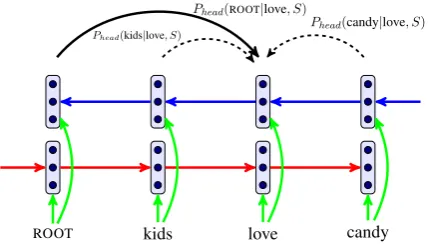
infor-ROOT kids love candy
Phead(ROOT|love, S)
Phead(kids|love, S)
[image:3.595.308.523.65.188.2]Phead(candy|love, S)
Figure 1: DENSEestimates the probability a word
being the head of another word based on bidirec-tional LSTM representations for the two words.
Phead(ROOT|love, S) is the probability of ROOT being the head oflove(dotted arcs denote candi-date heads; the solid arc is the goldstandard).
mation about eachwiin isolation (e.g., its lexical meaning or POS tag), ai must also encode wi’s positional information within the sentence. Such information has been shown to be important in de-pendency parsing (McDonald et al., 2005a). For example, in the following sentence:
ROOT a dog is chasing a cat
the head of the firsta isdog, whereas the head of the secondaiscat. Without considering positional information, a model cannot easily decide whicha
(nearer or farther) to assign todog.
Long short-term memory networks (Hochreiter and Schmidhuber, 1997; LSTMs), a type of re-current neural network with a more complex com-putational unit, have proven effective at capturing long-term dependencies. In our case LSTMs al-low to represent each word on its own and within a sequence leveraging long-range contextual inmation. As shown in Figure 1, we first use a for-ward LSTM (LSTMF) to read the sentence from left to right and then a backward LSTM (LSTMB) to read the sentence from right to left, so that the entire sentence serves as context for each word:2
hFi ,cFi =LSTMF(xi,hFi−1,cFi−1) (1)
hB
i ,cBi =LSTMB(xi,hBi+1,cBi+1) (2) wherexi is the feature vector of wordwi,hFi ∈
RdandcF
i ∈ Rdare the hidden states and mem-ory cells for theith word wi in LSTMF anddis
2For more detail on LSTM networks, see e.g., Graves
the hidden unit size. hF
i is also the representa-tion for w0:i (wi and its left neighboring words) andcF
i is an internal state maintained by LSTMF.
hB
i ∈ RdandcBi ∈ Rdare the hidden states and memory cells for the backward LSTMB. Each to-ken wi is represented byxi, the concatenation of two vectors corresponding towi’s lexical and POS tag embeddings:
xi= [We·e(wi);Wt·e(ti)] (3)
where e(wi) and e(ti) are one-hot vector repre-sentations of tokenwi and its POS tagti;We ∈ Rs×|V| andWt ∈ Rq×|T|are the word and POS tag embedding matrices, where|V|is the vocab-ulary size, s is the word embedding size, |T|is the POS tag set size, and q the tag embedding size. The hidden states of the forward and back-ward LSTMs are concatenated to obtainai, the fi-nal representation ofwi:
ai= [hFi ;hBi ] i∈[0, N] (4)
Note that bidirectional LSTMs are one of many possible ways of representing word wi. Alterna-tive representations include embeddings obtained from feed-forward neural networks (Chen and Manning, 2014; Lei et al., 2014a), character-based embeddings (Ballesteros et al., 2015), and more conventional features such as those introduced in McDonald et al. (2005a).
3.2 Head Selection
We now move on to discuss our formalization of dependency parsing as head selection. We begin with unlabeled dependencies and then explain how the model can be extended to predict labeled ones. In a dependency tree, a head can have multiple dependents, whereas a dependent can have only one head. Based on this fact, dependency pars-ing can be formalized as follows. Given a sen-tenceS = (w0, w1, . . . , wN), we aim to find for each wordwi ∈ {w1, w2, . . . , wn}the most prob-able headwj ∈ {w0, w1, . . . , wN}. For example, in Figure 1, to find the head for the token love, we calculate probabilities Phead(ROOT|love, S),
Phead(kids|love, S), and Phead(candy|love, S), and select the highest. More formally, we estimate the probability of tokenwj being the head of to-kenwiin sentenceSas:
Phead(wj|wi, S) = PNexp(g(aj,ai))
k=0exp(g(ak,ai)) (5)
whereai andaj are vector-based representations of wi and wj, respectively (described in Sec-tion 3.1); g(aj,ai) is a neural network with a single hidden layer that computes the associative score between representationsai andaj:
g(aj,ai) =v>a ·tanh(Ua·aj+Wa·ai) (6)
where va ∈ R2d, Ua ∈ R2d×2d, and Wa ∈ R2d×2d are weight matrices of g. Note that the candidate headwj can be theROOT, while the de-pendent wi cannot. Equations (5) and (6) com-pute the probability of adding an arc between two words, in a fashion similar to the neural atten-tion mechanism in sequence-to-sequence models (Bahdanau et al., 2015).
We train our model by minimizing the neg-ative log likelihood of the gold standard hhead, dependentiarcs in all training sentences:
J(θ) =− 1 |T |
X
S∈T
NS X
i=1
logPhead(h(wi)|wi, S) (7)
where T is the training set, h(wi) is wi’s gold standard head3 within sentence S, and NS the number of words in S (excluding ROOT).
Dur-ing inference, for each word wi (i ∈ [1, NS]) in S, we greedily choose the most likely head
wj(j∈[0, NS]):
wj = arg max wj:j∈[0,NS]
Phead(wj|wi, S) (8)
Note that the prediction for each wordwi is made independently of the other words in the sentence.
Given our greedy inference method, there is no guarantee that predicted hhead, dependenti arcs form a tree (maybe there are cycles). However, we empirically observed that most outputs during inference are indeed trees. For instance, on an En-glish dataset, 95% of the arcs predicted on the de-velopment set are trees, and 87% of them are pro-jective, whereas on a Chinese dataset, 87% of the arcs form trees, 73% of which are projective. This indicates that although the model does not explic-itly model tree structure during training, it is able to figure out from the data (which consists of trees) that it should predict them.
So far we have focused on unlabeled depen-dencies, however it is relatively straightforward to extend DENSE to produce labeled
dependen-cies. We basically train an additional classifier
3Note thath(w
to predict labels for the arcs which have been already identified. The classifier takes as input features [ai;aj;xi;xj] representing properties of the arc hwj, wii. These consist of ai and aj, the LSTM-based representations for wi and wj (see Equation (4)), and their word and part-of-speech embeddings,xi andxj (see Equation (3)). Specifically, we use a trained DENSEmodel to go
through the training corpus and generate features and corresponding dependency labels as training data. We employ a two-layer rectifier network (Glorot et al., 2011) for the classification task.
3.3 Maximum Spanning Tree Algorithms
As mentioned earlier, greedy inference may not produce well-formed trees. In this case, the out-put of DENSE can be adjusted with a maximum
spanning tree algorithm. We use the Chu-Liu-Edmonds algorithm (Chu and Liu, 1965; Ed-monds, 1967) for building non-projective trees and the Eisner (1996) algorithm for projective ones.
Following McDonald et al. (2005b), we view a sentence S = (w0 = ROOT, w1, . . . , wN) as a graph GS = hVS, ESi with the sentence words and the dummy root symbol as vertices and a di-rected edge between every pair of distinct words and from the root symbol to every word. The di-rected graphGS is defined as:
VS={w0 =ROOT, w1, . . . , wN}
ES={hi, ji:i6=j,hi, ji ∈[0, N]×[1, N]}
s(i, j) =Phead(wi|wj, S) hi, ji ∈ES
where s(i, j) is the weight of edge hi, ji
and Phead(wi|wj, S) is known. The problem of dependency parsing now boils down to finding the tree with the highest score which is equivalent to finding a MST inGS(McDonald et al., 2005b).
Non-projective Parsing To build a non-projective parser, we solve the MST problem with the Chu-Liu-Edmonds algorithm (Chu and Liu, 1965; Edmonds, 1967). The algorithm selects for each vertex (excludingROOT) the in-coming edge
with the highest weight. If a tree results, it must be the maximum spanning tree and the algorithm terminates. Otherwise, there must be a cycle which the algorithm identifies, contracts into a single vertex and recalculates edge weights going into and out of the cycle. The greedy inference strategy described in Equation (8)) is essentially a sub-procedure in the Chu-Liu-Edmonds algorithm
with the algorithm terminating after the first iteration. In implementation, we only run the Chu-Liu-Edmonds algorithm through graphs with cycles, i.e., non-tree outputs.
Projective Parsing For projective parsing, we solve the MST problem with the Eisner (1996) gorithm. The time complexity of the Eisner al-gorithm is O(N3), while checking if a tree is projective can be done reasonably faster, with a
O(NlogN)algorithm. Therefore, we only apply the Eisner algorithm to the non-projective output of our greedy inference strategy. Finally, it should be noted that the training of our model does not rely on the Chu-Liu-Edmonds or Eisner algorithm, or any other graph-based algorithm. MST algo-rithms are only used attesttime to correct non-tree outputs which are a minority; DENSE acquires
underlying tree structure constraints from the data without an explicit learning algorithm.
4 Experiments
We evaluated our parser in a projective and non-projective setting. In the following, we describe the datasets we used and provide training details for our models. We also present comparisons against multiple previous systems and analyze the parser’s output.
4.1 Datasets
In the projective setting, we assessed the perfor-mance of our parser on the English Penn Treebank (PTB) and the Chinese Treebank 5.1 (CTB). Our experimental setup closely follows Chen and Man-ning (2014) and Dyer et al. (2015).
For English, we adopted the Stanford basic de-pendencies (SD) representation (De Marneffe et al., 2006).4 We follow the standard splits of PTB, sections 2–21 were used for training, sec-tion 22 for development, and secsec-tion 23 for test-ing. POS tags were assigned using the Stanford tagger (Toutanova et al., 2003) with an accuracy of 97.3%. For Chinese, we follow the same split ofCTB5introduced in Zhang and Clark (2008). In particular, we used sections 001–815, 1001–1136 for training, sections 886–931, 1148–1151 for development, and sections 816–885, 1137–1147 for testing. The original constituency trees in CTB were converted to dependency trees with the
4We obtained SD representations using the Stanford
Dataset # Sentences (%) Projective
English 39,832 99.9
Chinese 16,091 100.0
Czech 72,319 76.9
German 38,845 72.2
Table 1: Projective statistics on four datasets. Number of sentences and percentage of projective trees are calculated on the training set.
Penn2Malt tool.5 We used gold segmentation and gold POS tags as in Chen and Manning (2014) and Dyer et al. (2015).
In the non-projective setting, we assessed the performance of our parser on Czech and German, the largest non-projective datasets released as part of the CoNLL 2006 multilingual dependency pars-ing shared task. Since there is no official develop-ment set in either dataset, we used the last 374/367 sentences in the Czech/German training set as de-velopment data.6 Projective statistics of the four datasets are summarized in Table 1.
4.2 Training Details
We trained our models on an Nvidia GPU card; training takes one to two hours. Model parameters were uniformly initialized to[−0.1,0.1]. We used Adam (Kingma and Ba, 2014) to optimize our models with hyper-parameters recommended by the authors (i.e., learning rate 0.001, first momen-tum coefficient 0.9, and second momenmomen-tum coef-ficient 0.999). To alleviate the gradient exploding problem, we rescaled the gradient when its norm exceeded 5 (Pascanu et al., 2013). Dropout (Sri-vastava et al., 2014) was applied to our model with the strategy recommended in the literature (Zaremba et al., 2014; Semeniuta et al., 2016). On all datasets, we used two-layer LSTMs and set
d=s= 300, wheredis the hidden unit size and
sis the word embedding size.
As in previous neural dependency parsing work (Chen and Manning, 2014; Dyer et al., 2015), we used pre-trained word vectors to initialize our word embedding matrix We. For the PTB ex-periments, we used 300 dimensional pre-trained GloVe7 vectors (Pennington et al., 2014). For the CTB experiments, we trained 300 dimensional
5http://stp.lingfil.uu.se/˜nivre/research/
Penn2Malt.html
6We make the number of sentences in the development
and test sets comparable.
7http://nlp.stanford.edu/projects/glove/
Dev Test
Parser UAS LAS UAS LAS
Bohnet10 — — 92.88 90.71
Martins13 — — 92.89 90.55
Z&M14 — — 93.22 91.02
Z&N11 — — 93.00 90.95
C&M14 92.00 89.70 91.80 89.60
Dyer15 93.20 90.90 93.10 90.90
Weiss15 — — 93.99 92.05
Andor16 — — 94.61 92.79
K&G16graph — — 93.10 91.00
K&G16trans — — 93.90 91.90
DENSE-Pei 90.77 88.35 90.39 88.05
DENSE-Pei+E 91.39 88.94 91.00 88.61
DENSE 94.17 91.82 94.02 91.84
[image:6.595.307.526.61.283.2]DENSE+E 94.30 91.95 94.10 91.90
Table 2: Results on English dataset (PTB with Stanford Dependencies). +E: we post-process non-projective output with the Eisner algorithm.
GloVe vectors on the Chinese Gigaword corpus which we segmented with the Stanford Chinese Segmenter (Tseng et al., 2005). For Czech and German, we did not use pre-trained word vectors. The POS tag embedding size was set toq = 30
in the English experiments,q = 50in the Chinese experiments andq = 40in both Czech and Ger-man experiments.
4.3 Results
For both English and Chinese experiments, we report unlabeled (UAS) and labeled attachment scores (LAS) on the development and test sets; fol-lowing Chen and Manning (2014) punctuation is excluded from the evaluation.
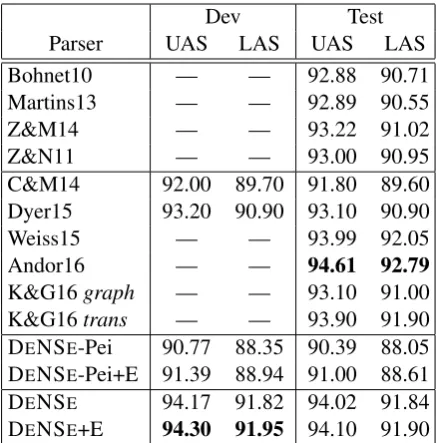
Experimental results on PTB are shown in Ta-ble 2. We compared our model with several recent papers following the same evaluation protocol and experimental settings. The first block in the table contains mostly graph-based parsers which do not use neural networks: Bohnet10 (Bohnet, 2010), Martins13 (Martins et al., 2013), and Z&M14 (Zhang and McDonald, 2014). Z&N11 (Zhang and Nivre, 2011) is a transition-based parser with non-local features. Accuracy results for all four parsers are reported in Weiss et al. (2015).
[image:6.595.87.276.61.133.2]Dev Test
Parser UAS LAS UAS LAS
Z&N11 — — 86.00 84.40
Z&M14 — — 87.96 86.34
C&M14 84.00 82.40 83.90 82.40
Dyer15 87.20 85.90 87.20 85.70
K&G16graph — — 86.60 85.10
K&G16trans — — 87.60 86.10
DENSE-Pei 82.50 80.74 82.38 80.55
DENSE-Pei+E 83.40 81.63 83.46 81.65
DENSE 87.27 85.73 87.63 85.94
DENSE+E 87.35 85.85 87.84 86.15
Table 3: Results on Chinese dataset (CTB). +E: we post-process non-projective outputs with the Eisner algorithm.
PTB CTB
Parser Dev Test Dev Test
C&M14 43.35 40.93 32.75 32.20
Dyer15 51.94 50.70 39.72 37.23
DENSE 51.24 49.34 34.74 33.66
[image:7.595.310.524.60.230.2]DENSE+E 52.47 50.79 36.49 35.13
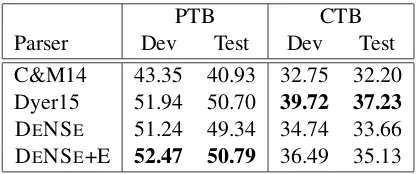
Table 4: UEM results on PTB and CTB.
forward neural network. Although very fast, its performance is inferior compared to graph-based parsers or strong non-neural transition graph-based parsers (e.g., Z&N11). Dyer15 (Dyer et al., 2015) uses (stack) LSTMs to model the states of the buffer, the stack, and the action sequence of a trsition system. Weiss15 (Weiss et al., 2015) is an-other transition-based parser, with a more elabo-rate training procedure. Features are learned with a neural network model similar to C&M14, but much larger with two layers. The hidden states of the neural network are then used to train a struc-tured perceptron for better beam search decod-ing. Andor16 (Andor et al., 2016) is similar to Weiss15, but uses a globally normalized training algorithm instead.
Unlike all models above, DENSE does not use
any kind of transition- or graph-based algorithm during training and inference. Nonetheless, it ob-tains a UAS of 94.02%. Around 95% of the model’s outputs after inference are trees, 87% of which are projective. When we post-process the remaining 13% of non-projective outputs with the Eisner algorithm (DENSE+E), we obtain a slight
improvement on UAS (94.10%).
Kiperwasser and Goldberg (2016) extract
fea-Czech German
Parser UAS LAS UAS LAS
MST-1st 86.18 — 89.54 —
MST-2nd 87.30 — 90.14 —
Turbo-1st 87.66 — 90.52 —
Turbo-3rd 90.32 — 92.41 —
RBG-1st 87.90 — 90.24 —
RBG-3rd 90.50 — 91.97 —
DENSE-Pei 86.00 77.92 89.42 86.48
DENSE-Pei+CLE 86.52 78.42 89.52 86.58
DENSE 89.60 81.70 92.15 89.58
DENSE+CLE 89.68 81.72 92.19 89.60
Table 5: Non-projective results on the CoNLL 2006 dataset. +CLE: we post-process non-tree outputs with the Chu-Liu-Edmonds algorithm.
tures from bidirectional LSTMs and feed them to a graph- (K&G16 graph) and transition-based parser (K&G16trans). Their LSTMs are jointly trained with the parser objective. DENSE yields
very similar performance to their transition-based parser while it outperforms K&G16graph. A key difference between DENSEand K&G16 lies in the
training objective. The objective of DENSEis
log-likelihood basedwithouttree structure constraints (the model is trained to produce a distribution over possible heads for each word, where each head selection is independent), while K&G16 employ a max-margin objective with tree structure con-straints. Although our probabilistic objective is non-structured, it is perhaps easier to train com-pared to a margin-based one.
We also assessed the importance of the bidi-rectional LSTM on its own by replacing our LSTM-based features with those obtained from a feed-forward network. Specifically, we used the 1-order-atomic features introduced in Lei et al. (2014a) which represent POS-tags, modifiers, heads, and their relative positions. As can be seen in Table 2 (DENSE-Pei), these features are less
effective compared to LSTM-based ones and the contribution of the MST algorithm (Eisner) during decoding is more pronounced (DENSE-Pei+E).
We observe similar trends in the Chinese, German, and Czech datasets (see Tables 3 and 5).
Results on CTB follow a similar pattern. As shown in Table 3, DENSE outperforms all
previ-ous neural models (see the test set columns) on UAS and LAS. DENSE performs competitively
[image:7.595.80.285.61.230.2] [image:7.595.77.287.288.375.2]com-a. b.
11 14 17 20 23 26 28 32 38 118 PTB sentence length
89 90 91 92 93 94 95 96
UAS (%)
C&M14 DeNSe+E Dyer15
5 9 14 18 22 26 30 37 49 116 PTB sentence length
80 81 82 83 84 85 86 87 88 89 90 91 92 93
UAS (%)
C&M14 DeNSe+E Dyer15
[image:8.595.71.525.66.234.2]CTB CTB
Figure 2: UAS against sentence length on PTB and CTB (development set). Sentences are sorted by length in ascending order and divided equally into 10 bins. The horizontal axis is the length of the last sentence in each bin.
plex high order decoding algorithm involving cube pruning and strategies for encouraging diversity. Post-processing the output of the parser with the Eisner algorithm generally improves performance (by 0.21%; see last row in Table 3). Again we observe that 1-order-atomic features (Lei et al., 2014a) are inferior compared to the LSTM. Ta-ble 4 reports unlabeled sentence level exact match (UEM) in Table 4 for English and Chinese. In-terestingly, even when using the greedy inference strategy, DENSE yields a UEM comparable to
Dyer15 on PTB. Finally, in Figure 2 we analyze the performance of our parser on sentences of dif-ferent length. On both PTB and CTB, DENSE
has an advantage on long sentences compared to C&M14 and Dyer15.
For Czech and German, we closely follow the evaluation setup of CoNLL 2006. We report both UAS and LAS, although most previous work has focused on UAS. Our results are summarized in Table 5. We compare DENSE against three
non-projective graph-based dependency parsers: the MST parser (McDonald et al., 2005b), the Turbo parser (Martins et al., 2013), and the RBG parser (Lei et al., 2014b). We show the per-formance of these parsers in the first order set-ting (e.g., MST-1st) and in higher order setset-tings (e.g., Turbo-3rd). The results of 1st, MST-2nd, RBG-1st and RBG-3rd are reported in Lei et al. (2014b) and the results of 1st and Turbo-3rd are reported in Martins et al. (2013). We show results for our parser with greedy inference (see DENSE in the table) and when we use the
Chu-Before MST After MST
Dataset #Sent Tree Proj Tree Proj
PTB 1,700 95.1 86.6 100.0 100.0
CTB 803 87.0 73.1 100.0 100.0
Czech 374 87.7 65.5 100.0 72.7
German 367 96.7 67.3 100.0 68.1
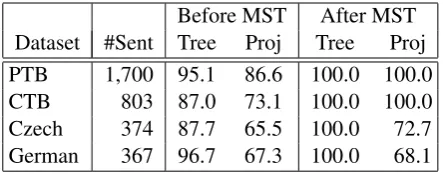
Table 6: Percentage of trees and projective trees on the development set before and after DENSE
uses a MST algorithm. On PTB and CTB, we use the Eisner algorithm and on Czech and German, we use the Chu-Liu-Edmonds algorithm.
Liu-Edmonds algorithm to post-process non-tree outputs (DENSE+CLE).
As can been seen, DENSEoutperforms all other
first (and second) order parsers on both German and Czech. As in the projective experiments, we observe slight a improvement (on both UAS and LAS) when using a MST algorithm. On German, DENSE is comparable with the best third-order
parser (Turbo-3rd), while on Czech it lags behind Turbo-3rd and RBG-3rd. This is not surprising considering that DENSEis a first-order parser and
only uses words and POS tags as features. Com-parison systems use a plethora of hand-crafted fea-tures and more sophisticated high-order decoding algorithms. Finally, note that a version of DENSE
with features in (Lei et al., 2014a) is consistently worse (see the second block in Table 5).
[image:8.595.306.528.308.395.2]ex-amined the extent to which the MST algorithm is necessary for producing dependency trees. Table 6 shows the percentage of trees before and after the application of the MST algorithm across the four languages. In the majority of cases DENSE
out-puts trees (ranging from 87.0% to 96.7%) and a significant proportion of them are projective (rang-ing from 65.5% to 86.6%). Therefore, only a small proportion of outputs (14.0% on average) need to be post-processed with the Eisner or Chu-Liu-Edmonds algorithm.
5 Conclusions
In this work we presented DENSE, a neural
de-pendency parser which we train without a tran-sition system or graph-based algorithm. Experi-mental results show that DENSEachieves
compet-itive performance across four different languages and can seamlessly transfer from a projective to a non-projective parser simply by changing the post-processing MST algorithm during inference. In the future, we plan to increase the coverage of our parser by using tri-training techniques (Li et al., 2014) and multi-task learning (Luong et al., 2015).
Acknowledgments We would like to thank Adam Lopez and Frank Keller for their valuable feedback. We acknowledge the financial support of the European Research Council (ERC; award number 681760).
References
Daniel Andor, Chris Alberti, David Weiss, Aliaksei Severyn, Alessandro Presta, Kuzman Ganchev, Slav Petrov, and Michael Collins. 2016. Globally
nor-malized transition-based neural networks. In
Pro-ceedings of the 54th Annual Meeting of the Associa-tion for ComputaAssocia-tional Linguistics (Volume 1: Long Papers), pages 2442–2452, Berlin, Germany.
Dzmitry Bahdanau, Kyunghyun Cho, and Yoshua Ben-gio. 2015. Neural machine translation by jointly
learning to align and translate. In Proceedings of
the 3rd International Conference on Learing Repre-sentations, San Diego, California.
Miguel Ballesteros, Chris Dyer, and Noah A. Smith. 2015. Improved transition-based parsing by
model-ing characters instead of words with lstms. In
Pro-ceedings of the 2015 Conference on Empirical Meth-ods in Natural Language Processing, pages 349– 359, Lisbon, Portugal.
Bernd Bohnet. 2010. Top accuracy and fast
depen-dency parsing is not a contradiction. InProceedings
of the 23rd International Conference on Computa-tional Linguistics (Coling 2010), pages 89–97, Bei-jing, China.
Xavier Carreras and Michael Collins. 2009. Non-projective parsing for statistical machine translation. In Proceedings of the 2009 Conference on Empiri-cal Methods in Natural Language Processing, pages 200–209, Singapore.
Xavier Carreras. 2007. Experiments with a
higher-order projective dependency parser. In
Proceed-ings of the CoNLL Shared Task Session of EMNLP-CoNLL 2007, pages 957–961, Prague, Czech Re-public.
Ciprian Chelba, David Engle, Frederick Jelinek, Victor Jimenez, Sanjeev Khudanpur, Lidia Mangu, Harry Printz, Eric Ristad, Ronald Rosenfeld, Andreas Stol-cke, and Dekai Wu. 1997. Structure and per-formance of a dependency language model. In
Fifth European Conference on Speech Communica-tion and Technology, EUROSPEECH 1997, Rhodes, Greece.
Danqi Chen and Christopher Manning. 2014. A fast and accurate dependency parser using neural
net-works. InProceedings of the 2014 Conference on
Empirical Methods in Natural Language Processing (EMNLP), pages 740–750, Doha, Qatar.
Yoeng-Jin Chu and Tseng-Hong Liu. 1965. On
shortest arborescence of a directed graph. Scientia
Sinica, 14(10):1396.
Michael Collins. 2002. Discriminative training meth-ods for hidden markov models: Theory and
experi-ments with perceptron algorithms. InProceedings
of the 2002 Conference on Empirical Methods in Natural Language Processing, pages 1–8.
Koby Crammer and Yoram Singer. 2001. On the algo-rithmic implementation of multiclass kernel-based
vector machines. Journal of Machine Learning
Re-search, 2:265–292.
Koby Crammer and Yoram Singer. 2003. Ultracon-servative online algorithms for multiclass problems.
Journal of Machine Learning Research, 3:951–991. James Cross and Liang Huang. 2016. Incremental parsing with minimal features using bi-directional
lstm. InProceedings of the 54th Annual Meeting of
the Association for Computational Linguistics (Vol-ume 2: Short Papers), pages 32–37, Berlin, Ger-many.
Marie-Catherine De Marneffe, Bill MacCartney, Christopher D Manning, et al. 2006. Generat-ing typed dependency parses from phrase structure
parses. InProceedings of LREC, volume 6, pages
449–454, Genoa, Italy.
Chris Dyer, Miguel Ballesteros, Wang Ling, Austin Matthews, and Noah A. Smith. 2015. Transition-based dependency parsing with stack long
Meeting of the Association for Computational Lin-guistics and the 7th International Joint Conference on Natural Language Processing (Volume 1: Long Papers), pages 334–343, Beijing, China.
Jack Edmonds. 1967. Optimum branchings. Journal
of Research of the National Bureau of Standards B, 71(4):233–240.
Jason Eisner. 1996. Efficient normal-form parsing
for combinatory categorial grammar. In
Proceed-ings of the 34th Annual Meeting of the Association for Computational Linguistics, pages 79–86, Santa Cruz, California, USA.
Jason Eisner. 2000. Bilexical grammars and their
cubic-time parsing algorithms. InAdvances in
prob-abilistic and other parsing technologies, pages 29– 61. Springer.
Yoav Freund and Robert E Schapire. 1999. Large margin classification using the perceptron algorithm.
Machine learning, 37(3):277–296.
Katrin Fundel, Robert K¨uffner, and Ralf Zimmer. 2007. Relation extraction using dependency parse
trees. Bioinformatics, 23(3):365–371.
Xavier Glorot, Antoine Bordes, and Yoshua Bengio.
2011. Deep sparse rectifier neural networks. In
In-ternational Conference on Artificial Intelligence and Statistics, pages 315–323, Cadiz, Spain.
Yoav Goldberg and Joakim Nivre. 2012. A dynamic
oracle for arc-eager dependency parsing. In
Pro-ceedings of COLING 2012, pages 959–976, Mum-bai, India.
Yoav Goldberg. 2016. A primer on neural network
models for natural language processing. Journal of
Artificial Intelligence Research, 57:345–420.
Alex Graves. 2012. Supervised Sequence Labelling
with Recurrent Neural Networks. Studies in Com-putational Intelligence. Springer.
Keith Hall. 2007. K-best spanning tree parsing. In
Proceedings of the 45th Annual Meeting of the As-sociation of Computational Linguistics, pages 392– 399, Prague, Czech Republic.
James Henderson. 2004. Discriminative training of
a neural network statistical parser. InProceedings
of the 42nd Meeting of the Association for Compu-tational Linguistics (ACL’04), Main Volume, pages 95–102, Barcelona, Spain.
Liang Huang and Kenji Sagae. 2010. Dynamic pro-gramming for linear-time incremental parsing. In
Proceedings of the 48th Annual Meeting of the Asso-ciation for Computational Linguistics, pages 1077– 1086, Uppsala, Sweden.
Diederik Kingma and Jimmy Ba. 2014. Adam: A
method for stochastic optimization. arXiv preprint
arXiv:1412.6980.
Eliyahu Kiperwasser and Yoav Goldberg. 2016. Sim-ple and accurate dependency parsing using
bidirec-tional LSTM feature representations. Transactions
of the Association for Computational Linguistics, 4:313–327.
Terry Koo, Alexander M. Rush, Michael Collins, Tommi Jaakkola, and David Sontag. 2010. Dual decomposition for parsing with non-projective head
automata. InProceedings of the 2010 Conference on
Empirical Methods in Natural Language
Process-ing, pages 1288–1298, Cambridge, MA.
Sandra K¨ubler, Ryan McDonald, Joakim Nivre, and
Graeme Hirst. 2009. Dependency Parsing.
Mor-gan and Claypool Publishers.
Tao Lei, Yu Xin, Yuan Zhang, Regina Barzilay, and Tommi Jaakkola. 2014a. Low-rank tensors for
scor-ing dependency structures. In Proceedings of the
52nd Annual Meeting of the Association for Compu-tational Linguistics (Volume 1: Long Papers), pages 1381–1391, Baltimore, Maryland.
Tao Lei, Yuan Zhang, Regina Barzilay, and Tommi Jaakkola. 2014b. Low-rank tensors for scoring
de-pendency structures. In Proceedings of the ACL.
Baltimore, Maryland.
Zhenghua Li, Min Zhang, and Wenliang Chen. 2014. Ambiguity-aware ensemble training for
semi-supervised dependency parsing. In Proceedings of
the 52nd Annual Meeting of the Association for Computational Linguistics (Volume 1: Long Pa-pers), pages 457–467, Baltimore, Maryland. Minh-Thang Luong, Quoc V Le, Ilya Sutskever, Oriol
Vinyals, and Lukasz Kaiser. 2015. Multi-task
se-quence to sese-quence learning. InProceedings of the
4th International Conference on Learning Represen-tations, San Juan, Puerto Rico.
Andre Martins, Miguel Almeida, and Noah A. Smith. 2013. Turning on the turbo: Fast third-order
non-projective turbo parsers. InProceedings of the 51st
Annual Meeting of the Association for Computa-tional Linguistics (Volume 2: Short Papers), pages 617–622, Sofia, Bulgaria.
Marshall R. Mayberry and Risto Miikkulainen. 1999. SardSrn: A neural network shift-reduce parser. In
In Proceedings of the 16th International Joint Con-ference on Artificial Intelligence, pages 820–825, Stockholm, Sweden.
Ryan McDonald, Koby Crammer, and Fernando Pereira. 2005a. Online large-margin training of
de-pendency parsers. In Proceedings of the 43rd
An-nual Meeting of the Association for Computational Linguistics, pages 91–98, Ann Arbor, Michigan. Ryan McDonald, Fernando Pereira, Kiril Ribarov, and
Jan Hajic. 2005b. Non-projective dependency
pars-ing uspars-ing spannpars-ing tree algorithms. In
Language Processing, pages 523–530, Vancouver, British Columbia, Canada.
Joakim Nivre, Johan Hall, and Jens Nilsson. 2006a. Maltparser: A data-driven parser-generator for
de-pendency parsing. In Proceedings of LREC,
vol-ume 6, Genoa, Italy.
Joakim Nivre, Johan Hall, Jens Nilsson, G¨uls¸en Eryiˇgit, and Svetoslav Marinov. 2006b. Labeled pseudo-projective dependency parsing with support
vector machines. InProceedings of the Tenth
Con-ference on Computational Natural Language Learn-ing (CoNLL-X), pages 221–225, New York City. Joakim Nivre. 2003. An efficient algorithm for
pro-jective dependency parsing. In Proceedings of the
8th International Workshop on Parsing
Technolo-gies, pages 149–160, Nancy, France.
Joakim Nivre. 2004. Incrementality in determinis-tic dependency parsing. In Frank Keller, Stephen Clark, Matthew Crocker, and Mark Steedman,
edi-tors,Proceedings of the ACL Workshop Incremental
Parsing: Bringing Engineering and Cognition To-gether, pages 50–57, Barcelona, Spain.
Joakim Nivre. 2008. Algorithms for deterministic
in-cremental dependency parsing. Computational
Lin-guistics, 34(4):513–553.
Razvan Pascanu, Tomas Mikolov, and Yoshua Ben-gio. 2013. On the difficulty of training recurrent
neural networks. In Proceedings of the 30th
Inter-national Conference on Machine Learning, pages 1310–1318, Atlanta, Georgia.
Jeffrey Pennington, Richard Socher, and Christopher Manning. 2014. Glove: Global vectors for word
representation. In Proceedings of the 2014
Con-ference on Empirical Methods in Natural Language Processing (EMNLP), pages 1532–1543, Doha, Qatar.
Stanislau Semeniuta, Aliaksei Severyn, and Erhardt Barth. 2016. Recurrent dropout without memory
loss. InProceedings of COLING 2016, the 26th
In-ternational Conference on Computational Linguis-tics: Technical Papers, pages 1757–1766, Osaka, Japan.
David Arthur Smith. 2010. Efficient inference for trees
and alignments: modeling monolingual and bilin-gual syntax with hard and soft constraints and latent variables. Johns Hopkins University.
Rion Snow, Daniel Jurafsky, and Andrew Y Ng. 2005. Learning syntactic patterns for automatic hypernym
discovery. InAdvances in Neural Information
Pro-cessing Systems 17, pages 1297–1304, Vancouver, British Columbia.
Nitish Srivastava, Geoffrey Hinton, Alex Krizhevsky, Ilya Sutskever, and Ruslan Salakhutdinov. 2014. Dropout: A simple way to prevent neural networks
from overfitting. The Journal of Machine Learning
Research, 15(1):1929–1958.
Ivan Titov and James Henderson. 2007. Constituent parsing with incremental sigmoid belief networks. InProceedings of the 45th Annual Meeting of the As-sociation of Computational Linguistics, pages 632– 639, Prague, Czech Republic.
Kristina Toutanova, Dan Klein, Christopher D Man-ning, and Yoram Singer. 2003. Feature-rich part-of-speech tagging with a cyclic dependency network. In Proceedings of HLT-NAACL 2003, pages 173– 180, Edmonton, Canada.
Huihsin Tseng, Pichuan Chang, Galen Andrew, Daniel Jurafsky, and Christopher Manning. 2005. A condi-tional random field word segmenter for Sighan
bake-off 2005. InProceedings of the 4th SIGHAN
work-shop on Chinese language Processing, pages 168– 171, Jeju Island, Korea.
David Weiss, Chris Alberti, Michael Collins, and Slav Petrov. 2015. Structured training for neural
net-work transition-based parsing. In Proceedings of
the 53rd Annual Meeting of the Association for Computational Linguistics and the 7th International Joint Conference on Natural Language Processing (Volume 1: Long Papers), pages 323–333, Beijing, China.
Hiroyasu Yamada and Yuji Matsumoto. 2003. Sta-tistical dependency analysis with support vector
ma-chines. InProceedings of the 8th Workshop on
Pars-ing Technologies, pages 195–206, Nancy, France.
Wojciech Zaremba, Ilya Sutskever, and Oriol Vinyals.
2014. Recurrent neural network regularization.
arXiv preprint arXiv:1409.2329.
Yue Zhang and Stephen Clark. 2008. A tale of two parsers: Investigating and combining graph-based
and transition-based dependency parsing. In
Pro-ceedings of the 2008 Conference on Empirical Meth-ods in Natural Language Processing, pages 562– 571, Honolulu, Hawaii.
Hao Zhang and Ryan McDonald. 2012. Generalized higher-order dependency parsing with cube
prun-ing. InProceedings of the 2012 Joint Conference on
Empirical Methods in Natural Language Process-ing and Computational Natural Language LearnProcess-ing, pages 320–331, Jeju Island, Korea.
Hao Zhang and Ryan McDonald. 2014. Enforcing structural diversity in cube-pruned dependency
pars-ing. InProceedings of the 52nd Annual Meeting of
the Association for Computational Linguistics (Vol-ume 2: Short Papers), pages 656–661, Baltimore, Maryland.
Yue Zhang and Joakim Nivre. 2011. Transition-based dependency parsing with rich non-local features. In