Proceedings of the 55th Annual Meeting of the Association for Computational Linguistics (Short Papers), pages 536–541 Vancouver, Canada, July 30 - August 4, 2017. c2017 Association for Computational Linguistics
Proceedings of the 55th Annual Meeting of the Association for Computational Linguistics (Short Papers), pages 536–541 Vancouver, Canada, July 30 - August 4, 2017. c2017 Association for Computational Linguistics
List-only Entity Linking
Ying Lin1∗, Chin-Yew Lin2, Heng Ji1 1Computer Science Department,
Rensselaer Polytechnic Institute, Troy, NY, USA {liny9,jih}@rpi.edu
2 Microsoft Research, Beijing, China
Abstract
Traditional Entity Linking (EL) technolo-gies rely on rich structures and proper-ties in the target knowledge base (KB). However, in many applications, the KB may be as simple and sparse as lists of names of the same type (e.g., lists of prod-ucts). We call it asList-only Entity Link-ingproblem. Fortunately, some mentions may have more cues for linking, which can be used as seed mentions to bridge other mentions and the uninformative en-tities. In this work, we select the most linkable mentions as seed mentions and disambiguate other mentions by compar-ing them with the seed mentions rather than directly with the entities. Our exper-iments on linking mentions to seven auto-matically mined lists show promising re-sults and demonstrate the effectiveness of our approach.1
1 Introduction
Traditional Entity Linking (EL) methods usually rely on rich structures and properties in the tar-get knowledge base (KB). These methods may not be effective in applications where detailed descrip-tions and properties of target entities are absent in the KB. Consider the following situations:
Disaster Response and Recovery. When a disaster strikes, people rush to the web and post tweets about the damage and casualties. Perform-ing EL to extract key information, such as devas-tated towns and donor agencies, can help us mon-itor the situation and coordinate rescue and recov-ery efforts. Although many involved entities are ∗Part of this work was done when the first author was on an internship at Microsoft Research Asia.
1The data set is available at: http://nlp.cs.rpi.edu/data/ link-only-entity-linking.html
not well-known and usually absent in general KBs, we may be able to acquire lists of these entities from the local government as the target KB.
[image:1.595.309.523.457.628.2]Voice of the Customer. EL also plays an important role in mining customer opinions from data generated on social platforms and e-commerce websites, thereby helping companies better understand the needs and expectations of their customers. However, the target products are often not covered by general KBs. For example, (Cao et al.,2015) tested32names of General Mo-tors car models and only found 4 in Wikipedia. Although some companies may choose to main-tain a comprehensive product KB, it will be much more practical and less costly to provide only lists of product names.
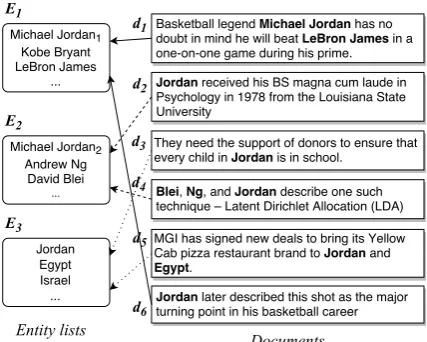
Figure 1: Link mentions to target entities in differ-ent differ-entity lists.
Under such circumstances, we need the ability to perform EL to ad-hoc name lists instead of a comprehensive KB, namely List-only Entity Link-ing. Take Figure1 as an example. For a human reader, it is not difficult to figure out the referent entities of mentions in each document based on
clues such as “basketball” and “LDA”, whereas we will not be able to make such inference without the knowledge of the target entities. However, even if we lack the minimal knowledge (e.g.,Jordanis a country), we are more confident to link mentions ind1,d4, andd5 because they co-occur with other
entities in the same list. We consider such men-tions that we are confident to link as seed men-tions, and use them to construct contextual and non-contextual information of the target entities to enhance entity disambiguation.
Therefore, in this work, we propose to tackle the problem of List-only Entity Linking throughseed mentions. We automatically identify seed men-tions for each list using a two-step method based on the occurrence of entities and similarity be-tween mentions. After that, in the entity disam-biguation phase, we utilize the selected mentions as a bridge between uninformative entities and other mentions. Specifically, we comparing fea-tures of a non-seed mention to those of seed men-tions of its entity candidates to determine which entity it should be linked to.
2 Problem Definition
Given a mentionm and the entityethat it refers
to, we call e the referent entity of m and m the referential mention ofe. In Figure 1, for
exam-ple, Michael Jordan1 is the referent entity of
“Jordan” in documentd6, while “Jordan” in
docu-mentd2is an non-referential mention forMichael
Jordan1.
As Figure 1 shows, in the setting of List-only Entity Linking, there are a set of manu-ally or automaticmanu-ally generated entity lists E =
{E1, E2, ..., El} and a set of documents D =
{d1, d2, ..., dn}. Entities in the same list are
ho-mogeneous and share some common properties. In our experiment, each document di contains a
mentionmi to link. Our goal is to linkmi to its
referent entityei,j ∈Ej or returns NIL if it is
un-linkable to any entities.
3 Approach
Our framework has two modules, entity candi-date retrieval and entity disambiguation as Fig-ure2shows. For a mention “Jordan,” we retrieve two candidate entities, Michael Jordan1 and
Michael Jordan2, from the entity lists. Next,
we select a set of seed mentions for each entity from all documents. To determine the referent
[image:2.595.309.520.100.260.2]en-tity of “Jordan”, we compare it with seed mentions of each candidate instead of the entity itself.
Figure 2: List-only Entity Linking Framework.
3.1 Entity Candidate Retrieval
For each mentionmi, we first locate a set of
en-tity candidatesCi = {ei,j|ei,j ∈ Ej}that it
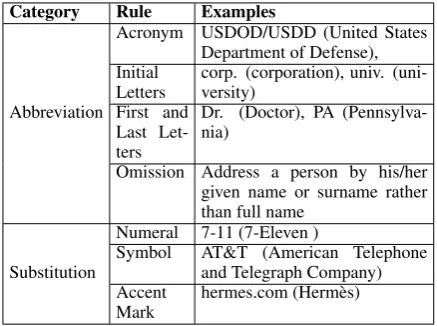
pos-sibly refers to. A mention and its referent entity may have different surface forms (e.g., “BMW” andBayerische Motoren Werke). For this rea-son, we design a set of matching rules to improve the recall as shown in Table1.
Category Rule Examples
Abbreviation
Acronym USDOD/USDD (United States Department of Defense), Initial
Letters corp. (corporation), univ. (uni-versity) First and
Last Let-ters
Dr. (Doctor), PA (Pennsylva-nia)
Omission Address a person by his/her given name or surname rather than full name
Substitution
Numeral 7-11 (7-Eleven )
Symbol AT&T (American Telephone and Telegraph Company) Accent
Mark hermes.com (Hermès)
Table 1: Alternative form matching rules.
3.2 Entity Disambiguation
Next, we proceed to score each candidate ei,j
and determine which onemi should be linked to.
However, we have no knowledge of the target enti-ties except for names and thus can’t directly com-paremi with them. Rather, we propose to bridge
the gap between mentions and entities through
[image:2.595.307.526.437.600.2]Figure 3: Bridging the gap between uncertain mentions and target entities using seed mentions.
We illustrate the idea in Figure3. University of Pennsylvania is retrieved as an entity can-didate for mentions “University of Pennsylvania”, “Penn”, and “Pennsylvania.” We are more confi-dent to link “University of Pennsylvania” indIand
“Penn” indIItoUniversity of Pennsylvania
because other entities in the Universitylist, such as “Harvard” and “MIT,” also appear in the same document. Thus, we select mentions indIanddII
as seed mentions. FromdIanddII, we can extract
both contextual features (e.g., “academic” and “re-search”) and non-contextual features (e.g., the en-tity type isORG). After that, we compare mentions in other documents with the seeds. We link “Penn” in dIII to University of Pennsylvania
be-cause its entity type and context are consistent with the seeds. “Pennsylvania” indIV, however,
[image:3.595.73.291.64.217.2]is not linked because it is recognized as a loca-tion. To capture richer contextual information and minimize the effect of noise, we select more than one seed mention using a two-step approach as fol-lows.
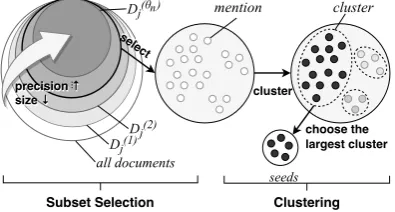
Figure 4: Seed selection.
1. Subset Selection. We assume that if multi-ple names in the same list co-occur within a
docu-ment, they are all likely to be referential mentions of this list, such as “Michael Jordan” and “LeBron James” in d1. Hence, to identify seed mentions
of list Ej, we first narrow the scope down to a
subset D(n)j of documents containing more than nmentions matching names inEj. We gradually
increase thenuntil θ−size ≤ |Dj(n)| ≤ θsize+ . θ−size
andθsize+ are set to50and300in our experiments. 2. Clustering. We expect most mentions in the selected subset are referential of listEj, while in
fact the subset is likely to contain a small number of non-referential mentions. We need to eliminate them from the subset, otherwise they will intro-duce misleading features differing from the real seed mentions, hence hurting the performance of entity disambiguation. To separate referential and non-referential mentions in the selected subset, we make two assumptions: (1) Most mentions in the subset are referential, and (2) Referential mentions should be similar to each other while dissimilar from non-referential ones. Due to the lack of an-notated data, we approach this problem by per-forming clustering, which works in an unsuper-vised fashion. Specifically, we represent features (described later in this section) of each mention as a vector and measure the distance between two mentions using cosine distance. After that, we run the K-means++ algorithm on the subset to separate referential and non-referential mentions, and pick mentions in the largest cluster as seed mentions.
To determine the referent entity of mentionmi,
we calculate the confidence score of linking mi
to ei,j ∈ Ej using the average cosine similarity
betweenmiand seed mentions of listEj:
c(mi, ei,j) = 1
|Sj|
|Sj|
X
p=1
sim(mi, ms), ms∈Sj
whereSj is the seed set ofEj. Lastly, we linkmi
to the candidate with the highest confidence score. In this work, we use the following features.
Entity Type. The entity type of a mention can be inferred from the text and used for dis-ambiguation. For example, if most seed men-tions for theUniversitylist are recognized asORG, while “Harvard” in the sentence “Harvard was born and raised in Southwark, Surrey, England” is tagged asPER, it is unlikely to refer toHarvard University.
[image:3.595.84.282.592.698.2]similar local contexts. We represent textual con-text using the average embedding of words within a window around the mention.
Punctuation. Punctuations preceding or fol-lowing a mention may help resolve ambiguity. For example, “MA” preceded by a comma is possible to refer to a state, since states are usually the last component of an address, such as “Boston, MA”.
4 Experiments 4.1 Data set
In our experiment, the construction of data set consists of two steps: collecting name lists from NeedleSeek2(Shi et al.,2010) and extracting doc-uments from Wikipedia. NeedleSeek is a project aiming to mine semantic concepts from tera-scale data (ClueWeb09) and classify them into a wide range of semantic categories. For example, “KFC” is mined as a concept in the restaurant category, along with key sentences and attributes, such as employee number and founder.
To obtain target name lists, we select 7 se-mantic categories (see Table 2) generated by NeedleSeek as target domains, and take the top concepts in each category as target entities. We manually map each name to its pertinent Wikipedia page as a target entity (e.g., Starbucks
→ enwiki:Starbucks3). Thus, we collect lists containing 139 target entities in total. Note that category names are only for result presentation purpose and not taken as input to our model.
Category Name Examples
[image:4.595.307.527.532.636.2]President Barack Obama, Ronald Reagan Company Microsoft, Apple, Adobe, IBM University Harvard University, Yale University State Washington, Florida, California, Texas Character Gandalf, Aragorn, Legolas, Gimli, Frodo Brand Prada, Chanel, Burberry, Gucci, Cartier Restaurant Subway, McDonald’s, KFC, Starbucks
Table 2: Semantic categories from NeedleSeek.
Next, we derive a data set from Wikipedia articles through wikilinks4, which are links to pages within English Wikipedia. For example, a wikilink [[Harvard University|Harvard]] appears as “Harvard” in text and links to the page enwiki:Harvard_University. Thus, we can consider “Harvard” as a name mention and
2http://needleseek.msra.cn
3enwiki:is short for https://en.wikipedia.org/wiki/ 4https://en.wikipedia.org/wiki/Help:Link
enwiki:Harvard_Universityas its referent en-tity. Consider the following sentences:
∗ ... then left toattend graduate school on a scholarship at
[[Harvard University|Harvard University]]...
∗ On October 6, 2012, [[Allison Harvard|Harvard]]
made an appearance in an episode of...
Because enwiki:Harvard_University is in the Universitylist, the first mention will be con-sidered as referential, whereas the second one is non-referential. We also apply matching rules in Table 1 to obtain more non-referential mentions. After that, we extract sentences around wikilinks as a document.
Category #Referential #Referential
(balanced) #Non-referential President 51,412 14,722 14,818
Company 13,312 3,604 3,642
University 79,285 30,101 30,187
State 86,743 9,602 9,106
Character 729 483 476
Brand 5,138 1,739 1,781
Restaurant 4,261 4,261 4,850
Total 240,588 64,512 61,632
Table 3: Data set stats.
From Table 3, we can see that referential en-tities overwhelm non-referential ones in the ex-tracted corpus. In order to evaluate our model fairly, we perform downsampling to balance refer-ential and non-referrefer-ential mentions, otherwise we can achieve high scores even if we link all mention to the target entities. In the balanced data set, there are11,065unique entities.
4.2 Entity Linking Results
Category RCompleteP F Balanced SubsetR P F
President 94.6 89.9 92.2 87.2 80.4 83.7 Company 86.6 95.8 91.0 90.8 85.1 87.9 University 96.7 96.4 96.5 96.9 92.0 94.4 State 96.2 92.1 94.1 95.0 58.6 72.5 Character 92.5 61.3 73.7 92.8 52.2 66.8 Brand 89.6 90.2 89.9 86.7 83.2 84.9 Restaurant 87.0 81.4 84.1 86.9 88.1 87.5 Overall 95.2 93.4 94.3 93.1 81.6 87.0
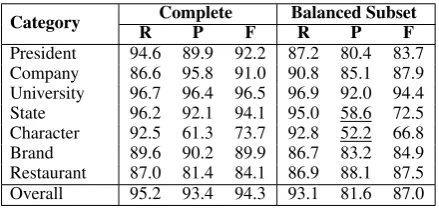
Table 4: Overall performance (%). R, P, and F rep-resent recall, precision, and F1 score, respectively.
As Table 4 demonstrates, our method shows promising results (87.0F1 score) on the balanced data set. Nevertheless, we notice the low linking precisions for entities in the Character andState
high-quality seeds, whereas for theStatelist, fea-tures of referential and non-referential mentions are usually similar. Consider the following sen-tence:
∗She witnessed his fatal shooting when they were together in the President’s Box at Ford’s Theatre on Tenth Street in Washington.
The mention “Washington” refers to “Washington, D.C.”, which has the same entity type, LOCATION, as our target entity “Washington (state)”. In addition, we see no obvious textual clue that indicates whether it refers to the State of Washington or not. Traditional EL approaches usually disambiguate such mentions through collective inference. They link “Ford’s Theatre” and “Washington” to the KB simultaneously. Since there exists an explicit relation between “Ford’s Theatre” and “Washington, D.C.”, these two entities receive high confidence scores and thus are determined as the referents. Unfortunately, we cannot employ the knowledge-rich approach in the List-only Entity Linking scenario.
5 Related Work
In this paper, we define and study the List-only Entity Linking problem based on previous stud-ies on Target Entity Disambiguation (Wang et al., 2012;Cao et al.,2015). The key difference is that they target at the disambiguation of a single list of entities, whereas we focus on entity linking to an arbitrary number of lists. Another similar prob-lem is Named Entity Disambiguation with Link-less Knowledge Bases (LNED) (Li et al.,2016). It assumes that entities are isolated in the “linkless” KB, while each entity still has a description.
Our idea of selecting seed mentions based on co-occurrence is similar to collective inference. Most state-of-the-art EL methods utilize collec-tive inference to link a set of coherent men-tions simultaneously by selecting the most coher-ent set of coher-entity candidates on the KB side (Pan et al.,2015;Huang et al.,2014;Cheng and Roth, 2013; Cassidy et al., 2012; Xu et al., 2012). In this work, without explicit relations between entities in different lists, we only take the co-occurrence of mentions in the same list into con-sideration. Therefore, our method is unable to benefit from the co-occurrence of John Lennon andGive Peace a Chancealthough they are ac-tually strongly connected.
6 Conclusions and Future Work
In this paper, we proposed a novel framework to tackle the problem of List-only Entity Linking. The core of this framework is selecting seed men-tions for each entity list to bridge the gap between mentions and non-informative target entities. Our results show this EL framework works well for this task. At present, in the seed selection step, we simply consider all co-occurring mentions of enti-ties in the same list. In the future, we will employ more precise approaches to choose co-occurring mentions and mine relations between entities in separate lists to improve seed selection and entity disambiguation.
Acknowledgments
This work was supported by the DARPA DEFT No.FA8750-13-2-0041, U.S. DARPA LORELEI Program No. HR0011-15-C-0115, U.S. ARL NS-CTA No. W911NF-09-2-0053, and NSF IIS-1523198. The views and conclusions contained in this document are those of the authors and should not be interpreted as representing the official poli-cies, either expressed or implied, of the U.S. Gov-ernment. The U.S. Government is authorized to reproduce and distribute reprints for Government purposes notwithstanding any copyright notation here on.
References
Yixin Cao, Juanzi Li, Xiaofei Guo, Shuanhu Bai, Heng Ji, and Jie Tang. 2015. Name list only? target entity disambiguation in short texts. In EMNLP.
https://doi.org/10.18653/v1/D15-1077.
Taylor Cassidy, Heng Ji, Lev-Arie Ratinov, Arkaitz Zubiaga, and Hongzhao Huang. 2012. Anal-ysis and enhancement of wikification for mi-croblogs with context expansion. In COLING.
http://aclweb.org/anthology/C12-1028.
Xiao Cheng and Dan Roth. 2013. Relational inference for wikification. In EMNLP.
http://aclweb.org/anthology/D13-1184.
Hongzhao Huang, Yunbo Cao, Xiaojiang Huang, Heng Ji, and Chin-Yew Lin. 2014. Collective tweet wiki-fication based on semi-supervised graph regulariza-tion. InACL.https://doi.org/10.3115/v1/P14-1036.
Xiaoman Pan, Taylor Cassidy, Ulf Hermjakob, Heng Ji, and Kevin Knight. 2015. Unsupervised entity linking with abstract meaning representation. In
NAACL.https://doi.org/10.3115/v1/N15-1119.
Shuming Shi, Huibin Zhang, Xiaojie Yuan, and Ji-Rong Wen. 2010. Corpus-based semantic class min-ing: Distributional vs. pattern-based approaches. In
COLING.http://aclweb.org/anthology/C10-1112.
Chi Wang, Kaushik Chakrabarti, Tao Cheng, and Sura-jit Chaudhuri. 2012. Targeted disambiguation of ad-hoc, homogeneous sets of named entities. InWWW.
https://doi.org/10.1145/2187836.2187934.
Jian Xu, Qin Lu, Jie Liu, and Ruifeng Xu. 2012. NLP-comp in TAC 2012 en-tity linking and slot-filling. In TAC.