Image Edge Detection based on Fusion of Sobel
Declivity Operators and Wavelet Transform
Anjali Gupta1, G. N Verma2, Amandeep Kaur3
1
Research Scholar, SSIET, PTURC, Dera Bassi, Punjab, India
2
Professor, SSIET, PTURC, Dera Bassi, Punjab, India
3
Assistant Professor, SSIET, PTURC, Dera Bassi, Punjab, India
Abstract: Digital image processing plays an important role in the machine vision where there is need of recognizing the object, its position, in which direction it is moving or whether it is changing its position with respect to object or not. So in analysis of image, edge detection is very crucial as it possesses the important data which is useful for gaining knowledge about image pattern. There are many and different edge detection techniques but at the time of detection of complex edges and their localization many techniques are not efficient. In the present research work combined benefits of Sobel operator, declivity operator and wavelet transform are used for detecting the edges of complex images.
Sobel operator is a derivative mask which can be used for detecting edges in the horizontal and in vertical direction. In this operator’s mask coefficients are not fixed. The declivity operator is used to classify high amplitude declivities as edges. These are used specially for edge detection in low contrast images. Wavelet transform has an ability to carry to guess the local regularity of image. For an image edges are singular and are considered as local maxima. In the end optimization is done using image fusion method so that computation time can be saved. The proposed work is compared with other simpler or complex edge detection techniques to show the significance of the proposed technique. The subjective evaluation of the techniques is also done with visual inspection.
Keywords: Image processing, edge detection, sobel operator, declivity operator, wavelet transform
I. INTRODUCTION
Edges present in the digital images have very high contrast values. Since edges often occur at image locations representing object boundaries, edge detection is extensively used in image segmentation when we want to divide the image into areas corresponding to different objects.
The detail of edges is very significant because huge volume of data is omitted while maintaining the identity of digital image. High pass filter or kernel can be used to explore edges of digital images because high frequencies dominate at edges. Both frequency domain kernel as well as an appropriate kernel in the spatial domain can be used for processing. In general it should be implemented in the spatial domain due to better outcomes and less mathematical computational cost.
Usually edge detection process takes three steps
1) Noise reduction, where we try to suppress as much noise as possible, without smoothing away the meaningful edges.
2) Edge enhancement, where we apply some kind of filter that responds strongly at edges and weakly elsewhere, so that the edges may be identified as local maxima in the filter’s output. One suggestion is to use some kind of high pass filter.
3) Edge localization, where we decide which of the local maxima output by the filter meaningful edge is and which are caused by noise.
II.LITERATURE SURVEY
Yi Zhang et al. [1] suggested that the old Sobel edge classification operator has small edge localization perfection, inferior noise and edge observation flow. This research paper focused on these types of problems and proposed an algorithm. The algorithm had combined features of advanced sobel operator as well as canny operator and Laplace of Gaussian (LoG) operator to improve outcomes of edge identification. In the first phase of preprocessing of the input image the morphological smoothing is applied to eliminate the noise and just keep the detailed information of edges.
proposed image fusion method was applied to complete the procedure of edge detection. The outcomes of the research showed that the proposed image fusion procedure had very higher edge detection in comparison to old Sobel operator.
The proposed Sobel operator had also some limitations. First one was that when the aimed objects and background of the concerned object had very fine color closeness to each other then the concerned algorithm did not produce fine results. So it was just useless to completely recognize the boundary of the object and also the location where boundary of different edges were not continuous. So in future work more stress would be given to overcome the above stated problem.
J. Ren et al. [2] processed the images to fetch the edges of different images which in turn can significantly lower the processing of data. Authors proposed algorithm which was utilized to enhance the shortcomings of edge location feature of traditional edge detection Sobel operator. In the concerned proposed method the distribution of gradient at the image edge was a geometrical curve. Each and every geometrical curve was referred with edge width and also with the threshold value. It means there was one to one mapping of threshold value with the width of the edge of an image. It was known that if a proper edge threshold is selected of a particular image then the edge boundary width of objects in an image could be significantly reduced and the thinning of edges feature was there. Prior to the binaryzation process on the image the thinning method was applied where gradient of edge using template of concerned Sobel operator was appeared as the value of intensity of the corresponding pixel. The proposed algorithm had reduced the discontinuity of different edges and also the different noises present in the input images which was not possible in traditional Sobel operator. The proposed algorithm was very simple and could detect efficiently edges of the images. Also the algorithm always calculated different values of threshold and threshold was always optimized. So it was very good segmentation algorithm. Also the detail of the input image was always preserved. So the method was sound in the finding the edges of the different objects in the images. T. Lei et al. [3] proposed that rotation of erosion process as well as dilation process had no effect with the application of different types of filtering operators which were morphological. The operators behaved similarly for the background as well as the foreground of the input image. Also for different types of image like especially in case of multi channel images the application of morphological operator which had dual operations was not significant. So authors proposed a new algorithm which solved this problem. The name of the algorithm was the EC-VSDMF which was abbreviated as vector self-dual morphological filtering operators based on extremum constraint. Here first of all a dual vector morphological operator was constructed using the ordering mechanism of symmetric vector. As the point of view of extremum principle of morphological theory vector sets were optimal so the vectors which had different extrema in the corresponding single channel were significantly suppressed. In the last step when the algorithm was completed then it was applied to the image filtering of the color image. When the proposed method was applied on the images then results obtained had features of old self dual morphological operators. There were also some problems raised in the concerned algorithm. First one was the properties of filtered image like value of hue, saturation and intensity which became very low or very high in reference to input image. The proposed algorithm gave better results in comparison to median filtered results and removed noises significantly along maintaining image detail.
T. Shi et al. [4] proposed a new version of modified Sobel operator with main focused for detection of defects on the surfaces of heavy rail. Authors made up the sensitivity along both x and y axes of given Sobel operator by pushing all the given six templates at other directions like 45°, 135°, 180°, 225°, 270° and 315°. The setup used for performing experiment had CCD cameras and light sources, different computers other image generating systems.
The outcomes of the above experiment showed that the Sobel algorithm showed an exact and efficient location of operators and there was a significant decrease in the inference noises to the defected edges. The algorithm also worked fine with the location and suppression of backfin defects and recovers precise attributes and properties. Authors used neural network for classify different defects had got 24 different sets of characteristic parameters like precision value of .0095 in total one hundred six loops and won the race with the old Sobel algorithm with total three seconds where sobel algorithm had taken nearly one forty six number of steps. Also there was total ten percent rate of improved identification was reported in case of different defects.
III. PROPSED TECHNIQUES AND RESEARCH METHODOLOGY
A. Sobel Edge Detector
Fig. 1: Sobel Operator Masks
From the geometry of mask it is clear that main stress is given to the pixels that are centered on the mask. Due to its simplicity it is the most widely utilized edge detector.
1)Wavelet: From the name of technique it is cleared that wavelet should behave like a wave that should have oscillations. Also in the wave the maximum energy is concentrated at center but this energy is concentrated only for small intervals. So wavelet can be viewed as an limited duration waveform with mean value equal to zero. They are especially useful for simultaneous time and frequency analysis of transient, nonstationary (e.g., structurally time- varying) signals. Wavelets perform better in comparison to Fourier transform because later have no information about time but uses both frequency as well as amplitude of the signal for processing. So without the magnitude of time value it will not be significant for a waveform to generate required information for real life events. Since wavelet sketches graphs both in frequency as well as in time domain so it is widely used in different fields of engineering like digital image processing with computer vision and also for detection of turbulence etc. The wavelets have an important function which is coined as a term known as mother wavelet. This mother wavelet function expands or contracts the input digital signal at different values of different scales. The output signals are easily checked on different scales with low and high values of scale on the idea of high and low frequency.
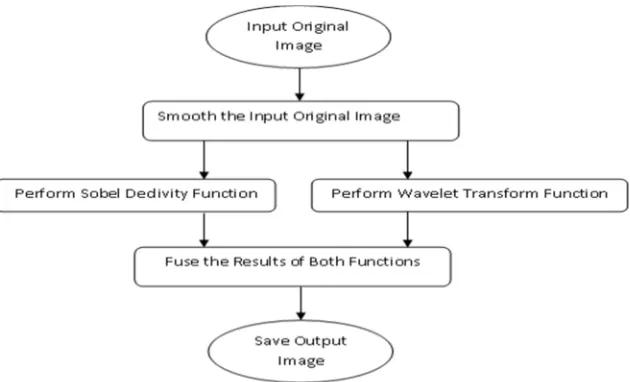
2)Proposed Technique: The hybrid algorithm includes fusion of Sobel declivity operator and Wavelet transform. The specific process is as follows
a) Smoothing the image using filtering
b) Use Sobel declivity operator on smoothed image.
c) Use the wavelet transform on the original image.
d) Fuse both the images.
Fig. 2: Proposed Technique
3)Research Methodology
a) Implement existing techniques in matlab 2016.
b) Implement the new algorithm for image edge detection.
c) Select different image formats for experiments.
d) Compare the results for different types of digital images.
-1 -2 -1
0 0 0
1 2 1
-1 0 1
-2 0 2
-1 0 1
[image:3.612.150.465.434.625.2]IV.RESULTS
(a) (b) (c) (d)
Fig. 3(a, b, c, d): Logo original image and its sobel filtered, wavelet filtered and proposed filtered image
Fig. 4(a, b, c, d): Flower original image and its sobel filtered, wavelet filtered and proposed filtered image
(a) (b) (c) (d)
Fig. 5(a, b, c, d): Potato original image and its sobel filtered, wavelet filtered and proposed filtered image
(a) (b) (c) (d)
[image:4.612.105.511.79.191.2] [image:4.612.104.492.225.329.2] [image:4.612.103.506.359.491.2] [image:4.612.117.512.520.664.2](a) (b) (c) (d)
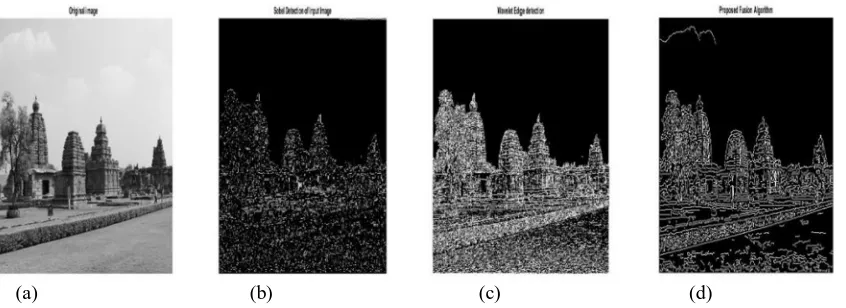
Fig. 7(a, b, c, d): Temple original image and its sobel filtered, wavelet filtered and proposed filtered image
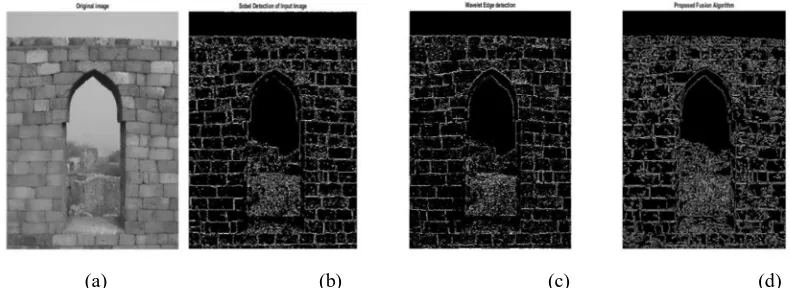
From the results it is cleared that proposed hybrid fusion filter performed better in comparison to sobel declivity operator and wavelet transform for edge detection of digital images.
V. CONCLUSION
From the above described results it is clear that proposed hybrid fusion filter of sobel declivity operator and wavelet transform performs better in comparison to individual sobel and wavelet transform filters. The results obtained from the proposed filter have sharp edges and don’t produce blurring as well as omit details present in the image. While the other techniques sometimes perform under the optimize condition or over the optimize condition. So proposed fusion technique is better in comparison to other two individual techniques for edge detection of digital images.
In the future work more number of techniques can be fused together to get better results in comparison to the proposed techniques. So that maximum amount of edge detection is possible in the image
REFERENCES
[1] Y. Zhang, X. Han, H. Zhang and L. Zhao, “Edge Detection Algorithm of Image Fusion Based on Improved Sobel Operator”, IEEE 3rd Information Technology and Mechatronics Engineering Conference (ITOEC), pp. 457-461, 2017.
[2] J. Ren and X. Zeng, “An Image Segmentation Method of Improved Sobel Operator”, Boletin Técnico, vol. 55, no. 1, pp. 193-199, 2017. [3] T. Lei, Y. Y. Fan and W. W. Luo, “Vector Self Dual Morphological Filter Operator”, Acta Automatica Sinica, vol. 41, no. 5, pp. 1013-1023, 2015.
[4] T. Shi, J. Kong and X. Wang, “Improved Sobel Algorithm for Defect Detection of Rail Surfaces with Enhanced Efficiency and Accuracy”, Journal of Central South University, vol. 23, no. 11, pp. 2867-2875, 2016.
[5] F. Zhao, H. Liu and J. Fan, “A Multi Objective Spatial Fuzzy Clustering Algorithm for Image Segmentation”, Applied Soft Computing, vol. 30(5), pp.48-57, 2015.
[6] D. Gómez, J. Yáñez and C. Guido, “Fuzzy Image Segmentation Based upon Hierarchical Clustering”, Knowledge-Based Systems, vol. 87(10), pp.26-37, 2015.
[7] L. H. Sun, “An Edge Detection Method Based on Improved Sobel Operator”, Advanced Materials Research, vols. 971-973, pp. 1529-1532, 2014. [8] B. Chen, L. Chen and Y. Chen, “Efficient Ant Colony Optimization for Image Feature Selection”, Signal bProcessing, 93(6), pp.1566-1576, 2013.
[9] C. L. Molina, B. De Baets, H. Bustince, J. Sanz and E. Barrenechea, “Multiscale Edge Detection Based on Gaussian Smoothing and Edge Tracking”, Knowledge-Based Systems, 44(5), pp.101-111, 2013.
[10] S. A. Coleman, S. Suganthan and B. W. Scotney, “Gradient Operators for Feature Extraction and Characterisation in Range Images”, Pattern Recognition Letters, vol. 31(9), pp.1028-1040, 2013.
[image:5.612.88.511.94.248.2]