Unsupervised morphological segmentation and clustering with document
boundaries
Taesun Moon, Katrin Erk, and Jason Baldridge Department of Linguistics
University of Texas at Austin 1 University Station B5100 Austin, TX 78712-0198 USA
{tsmoon,katrin.erk,jbaldrid}@mail.utexas.edu
Abstract
Many approaches to unsupervised mor-phology acquisition incorporate the fquency of character sequences with re-spect to each other to identify word stems and affixes. This typically involves heuris-tic search procedures and calibrating mul-tiple arbitrary thresholds. We present a simple approach that uses no thresholds other than those involved in standard ap-plication of χ2 significance testing. A key part of our approach is using docu-ment boundaries to constrain generation of candidate stems and affixes and clustering morphological variants of a given word stem. We evaluate our model on English and the Mayan language Uspanteko; it compares favorably to two benchmark sys-tems which use considerably more com-plex strategies and rely more on experi-mentally chosen threshold values.
1 Introduction
Unsupervised morphology acquisition attempts to learn from raw corpora one or more of the follow-ing about the written morphology of a language: (1) the segmentation of the set of word types in a corpus (Creutz and Lagus, 2007), (2) the cluster-ing of word types in a corpus based on some notion of morphological relatedness (Schone and Juraf-sky, 2000), (3) the generation of out-of-vocabulary items which are morphologically related to other word types in the corpus (Yarowsky et al., 2001).
We take a novel approach to segmenting words and clustering morphologically related words. The approach uses no parameters that need to be tuned on data. The two main ideas of the approach are (a) the filtering of affixes by sig-nificant co-occurrence, and (b) the integration of knowledge of document boundaries when
gener-ating candidate stems and affixes and when clus-tering morphologically related words. The main application that we envision for our approach is to produce interlinearized glossed texts for under-resourced/endangered languages (Palmer et al., 2009). Thus, we strive to eliminate hand-tuned parameters to enable documentary linguists to use our model as a preprocessing step for their manual analysis of stems and affixes. To require a docu-mentary linguist–who is likely to have little to no knowledge of NLP methods–to tune parameters is unfeasible. Additionally, data-driven exploration of parameter settings is unlikely to be reliable in language documentation since datasets typically are quite small. To be relevant in this context, a model needs to produce useful results out of the box.
Constraining learning by using document boundaries has been used quite effectively in un-supervised word sense disambiguation (Yarowsky, 1995). Many applications in information retrieval are built on the statistical correlation between doc-uments and terms. However, we are unaware of cases where knowledge of document boundaries has been used for unsupervised learning for mor-phology. The intuition behind our approach is very simple: if two words in a single document are very similar in terms of orthography, then the two words are likely to be related morphologically. We measure how integrating these assumptions into our model at different stages affects performance.
We define a simple pipeline model. After gen-erating candidate stems and affixes (possibly con-strained by document boundaries), aχ2test based on global corpus counts filters out unlikely affixes. Mutually consistent affix pairs are then clustered to form affix groups. These in turn are used to build morphologically related word clusters, pos-sibly constrained by evidence from co-occurence of word forms in documents. Following Schone and Jurafsky (2000), clusters are evaluated for
whether they capture inflectional paradigms using CELEX (Baayen et al., 1993).
We are unaware of other work on morphology using χ2 tests despite its wide application across many disciplines.1 This may be due to the large degree of noise found in the candidate affix sets induced through other candidate generation meth-ods. The χ2 test has two standard thresholds–a significance threshold and a lower bound on ob-served counts. These are the only manually set parameters we require—and we in fact use the widely accepted standard values for these thresh-olds without varying them in our experiments. This is a significant improvement over other ap-proaches that typically require a number of arbi-trary thresholds and parameters yet provide little intuitive justification for them. (We give examples of these in§3.)
We evaluate our approach on two languages, English and Uspanteko, and compare its per-formance to two benchmark systems, Morfessor (Creutz and Lagus, 2007) and Linguistica (Gold-smith, 2001). English is commonly used in other studies and permits the use of CELEX as a gold standard for evaluation. Uspanteko is an endan-gered Mayan language for which we have a set of interlinearized glossed texts (IGT) (Pixabaj et al., 2007; Palmer et al., 2009). IGT provides word-by-word morpheme segmenation, which we use to create a synthetic gold standard. In addition to evaluation against this standard, Telma Kaan Pixabaj—a Mayan linguist who helped create the annotated corpus—reviewed by hand 100 word clusters produced by our system, Morfessor and Linguistica. Note that because English is suffixal and Uspanteko is both prefixal and suffixal, we use a slightly modified model for Uspanteko.
The approach introduced in this paper compares favorably to Linguistica and Morfessor, two mod-els that employ much more complex strategies and rely on experimentally-tuned language/corpus-specific parameters. In our evaluation, document boundary awareness greatly benefits precision for small datasets, blocking acquisition of spurious af-fixes. For large datasets, global candidate genera-tion outperforms document-aware candidate gen-eration at the task of filtering out spurious stems, but document-aware clustering improves preci-sion. These findings are promising for the applica-tion of this approach to under-resourced languages
1Monson (2004) suggests, but does not actually use,χ2.
like Uspanteko.
2 Unsupervised morphology acquisition
Unsupervised morphology acquisition aims to model one or more of three properties of
writ-ten morphology: segmentation, clustering around
a common stem, and generation of new word forms with productive affixes. Intuitively, there are straightforward, but non-trivial, challenges that arise when evaluating a model. One large chal-lenge is distinguishing derivational from inflec-tional morphology. Most approaches deal with to-kens without considering context. Since inflec-tional morphology is virtually always driven by syntax and word context, such approaches are un-able to learn only inflectional morphology or only derivational morphology. Even approaches which take context into consideration (Schone and Juraf-sky, 2000; Baroni et al., 2002; Freitag, 2005) can-not learn specifically for one or the other.
In addition, the evaluation of both segmentation and clustering involves arbitrary judgment calls. Concerning segmentation, should altimeter and
altitude be one morpheme or two? (The sam-ple English gold standard for MorphoChallenge 2009 provides alti+meter but altitude.) Similar is-sues arise when evaluating clusters of related word forms if inflection and derivation are not distin-guished. Does atheism belong to the same cluster as theism? Where is the frequency cutoff point be-tween a productive derivational morpheme and an unproductive one? Yet, many studies have eval-uated their segmentations and clusters by going over their results word by word, cluster by cluster and judging by sight whether some segmentation or clustering is good (e.g., Goldsmith (2001)).
Like Schone and Jurafsky (2001), we build clus-ters that will have both inflectionally and deriva-tionally related stems and evaluate them with spect to a gold standard of only inflectionally re-lated stems.
3 Related work
There is a diverse body of existing work on unsu-pervised morphology acquisition. We summarize previous work, emphasizing some of its more ar-bitrary and ad hoc aspects.
Keshava and Pitler, 2005; Hammarstr¨om, 2006; Dasgupta and Ng, 2007; Demberg, 2007) use the hypothesis that there is less certainty when pre-dicting the next character at morpheme bound-aries. LSV has several issues that require fine pa-rameter tuning. For example, Hafer and Weiss (1974) counts how many types of characters ap-pear after some initial string (the successor count) and how many types of characters appear before some final string (the predecessor count). A suc-cessful criterion for segmenting a word was if the predecessor count for the second part was greater than 17 and the successor count for the first part was greater than 5. Other studies have similar data specific parameters and restrictions.
MDL and Bayesian models. Minimum descrip-tion length (MDL) models (Goldsmith, 2001; Creutz and Lagus, 2002; Creutz and Lagus, 2004; Goldsmith, 2006; Creutz and Lagus, 2007) try to segment words by maximizing the probability of a training corpus subject to a penalty based on the size of hypothesized morpheme lexicons they build on the basis of the segmentations. While the-oretically elegant, a pure implementation on real data results in descriptions that do not reflect ac-tual morphology. Creutz and Lagus (2005) re-port that, “frequent word forms remain unsplit, whereas rare word forms are excessively split.” In the end, every MDL approach uses probabilisti-cally motivated refinements that restrict the ten-dency of raw MDL to generate descriptions that do not fit linguistic notions of morphology. De-spite the sophistication of the models in this group, there are many parameters that need to be set, and heuristic search procedures are crucial for their success (Goldwater, 2007). Snover et al. (2002) present a Bayesian model that uses a prior distribu-tion to refine disjoint clusters of morphologically related words. It disposes with parameter setting by selecting the highest ranking hypothesis.
Context aware approaches. A word’s mor-phology is strongly influenced by its syntactic and semantic context. Schone and Jurafsky (2000) at-tempts to cluster morphologically related words starting with an unrefined trie search (but with a parameter of minimum possible stem length and an upper bound on potential affix candidates) that is constrained by semantic similarity in a word context vector space. Schone and Jurafsky (2001) builds on this approach, but adds more ad hoc
parameters to handle circumfixation. Baroni et al. (2002) takes a similar approach but uses edit distance to cluster words that are similar but do not necessarily share a long, contiguous substring. They remove noise by constraining cluster mem-bership with mutual information derived semantic similarity. Freitag (2005) uses a mutual informa-tion derived measure to learn the syntactic simi-larity between words and clusters them. Then he derives finite state machines across words in dif-ferent clusters and refines them through a graph walk algorithm. This group is the only one to eval-uate against CELEX (Schone and Jurafsky, 2000; Schone and Jurafsky, 2001; Freitag, 2005).
Others. Some other models require input such as POS tables and lexicons and use a wider range of information about the corpus (Yarowsky and Wicentowski, 2000; Yarowsky et al., 2001; Chan, 2006). Because of the knowledge dependence of these models, they are able to properly induce inflectional morphology, as opposed to the stud-ies cited above. Snyder and Barzilay (2008) uses a set of aligned phrases across related languages to learn how to segment words with a Bayesian model and is otherwise fully unsupervised.
4 Model2
Our goal is to generate conflation sets: sets of word types that are related through either inflec-tional or derivainflec-tional morphology (Schone and Ju-rafsky, 2000). Solving this task requires learning how individual types are segmented (though the segmentation itself is not evaluated). For present purposes, we assume that the affixal pattern of the language is known: whether it is prefixal, suffixal, or both. To simplify presentation, we discuss a model that captures suffixes only. Our approach is a four stage process:
1. Candidate Generation: generate candidate stems and affixes using an orthographically defined data structure (a trie)
2. Candidate Filtering: filter candidate affixes using the statistical significance for pairs of affixes based on their co-occurence counts with shared stems
3. Affix Clustering: cluster significant affix pairs into affix groups
2The code implementing the model is available from
4. Word Clustering: form conflation sets based on affix clusters
The first and last stages are particularly prone to noise, which has necessitated many of the thresh-olds and heuristics employed in previous work. We hypothesize that naturally occuring document boundaries provide a strong constraint that should reduce this noise, and we test that hypothesis by using it in those stages.
Our intuition comes from an observation by Yarowsky (1995) regarding multiple tokens of words in documents. He tabulates the
applicabil-ity of using document boundaries to disambiguate
word senses, which measures how often a given word occurs more than twice in the same docu-ment. For ten potentially ambiguous words, he counts how often they occur more than once in some document and finds that if the words do oc-cur, they do so multiple times in 50.1% of these documents, on average. His counts ignored mor-phological variation, and it is likely the
applica-bility measure would have increased considerably:
if a content word is used more than once in some text, it is likely to be repeated in different syntactic contexts, requiring the word to be inflected or to be derived for a different part-of-speech category.3
For stage one, we build separate tries for each document rather than a trie for the entire corpus. This should reduce the chance that orthographi-cally similar but morphologiorthographi-cally unrelated word pairs lead to bad candidates by reducing the search space for words which share a stem to a local doc-ument. For example, assuage and assume are both likely to occur in a large corpus and suggest that there is a stem assu with affixes -age and -me. They are less likely to occur together in many dif-ferent documents that form the corpus, whereas
assume, assumed, and assuming are. We refer to
this document constrained candidate generation as
CandGen-D, and to the unconstrained generation
(a single trie for all documents) as CandGen-G. For stage four, documents are used to constrain potential membership of words in clusters: all pairs of words in a cluster must have occured to-gether in some document. We refer to document-constrained clustering as Clust-D and the uncon-strained global clustering as Clust-G.
3For example, in just this one paragraph we have
{document,documents}, {measure, measures}, {occur, oc-curs, occuring}, and{word, words}.
4.1 Candidate generation
Given a document or collection of documents, we use tries (prefix trees) to identify potential stems and affixes and collect statistics for co-occurrences between affixes and between affixes and stems.
a
b c
d $
Figure 1 A trieG, like the example
on the right, can be iden-tified with the set of all words on paths from the root to any leaf, in the case of the example figure the set G = {abd, ab$, ac}. (We use $ to denote an empty affix.) Given a trie Gover alphabetL, we de-fine the set of trunks of G
as all paths from the root to a branching point:
Tr(G) ={w∈L+|∃a, b∈L, x1, x2∈L∗ :
a6=b ∧ wax1, wbx2 ∈G}
Also, we define the set of branches of a trunkt ∈
Tr(G)as the paths from its branching points to the leaves:
Br(t, G) ={x∈L+ |tx∈G}
In our example, {a, ab} are the trunks, with
Br(a, G) = {bd, b$, c} and Br(ab, G) = {d,$}. When we use a trie to induce stems and affixes, all induced stems will be trunks, and all induced affixes will be branches.
From a given trie, we induce a set of stem
can-didates and affix cancan-didates. A simple criterion is
used: if a trunk is longer than all of its branches, the trunk is a stem candidate and its branches are affix candidates. So, the set of stem candidates for a trieG, CStem(G), is the set of trunkst∈Tr(G)
such that|t|>|b|for allb∈Br(t,G).
Given a stem candidates∈CStem(G), its set of affix candidates CAff(s,G)is identical to its set of branches. (To talk about the sets of stem and affix candidates for a whole trie G or a set of tries, we write CAff(G), StC(G), CAff, and CStem.) The
count of an affix candidateb∈CAff is the number
of stem candidates with which it occurs:
count(b) =X
G
|{s∈CStem(G)|b∈CAff(s, G)}|
trunk itself). The matching set of affix candidates is CAff(ab, G) ={d,$}, each with a count of one. An affix rule candidate is an unordered pair of affix candidates {b1, b2}. It states that any stem occurring with b1 can also occur with b2. Affix rules implement the assumption that all produc-tive affixes will cooccur with other producproduc-tive af-fixes and that these will form a coherent group. The rule candidates for a given stem candidate s∈CStem(G)are:
CRule(s,G) ={b1, b2} ⊆CAff(s,G)|b16=b2
For example, the single stem candidate ab in Fig. 1 has one rule candidate, {d,$}. We also use
CRule(G)for the rule candidates of a trieGacross all stems, and CRule for the union of rule candi-dates in a set of tries.
The count of a rule candidate r={b1, b2} in a trie is the number of stem candidates it appears with:
count(r) =X
G
|{s∈CStem(G)|r∈CRule(s,G)}|
We also use CAff(s)for the set of affix candidates of stemsacross several tries, and CRule(s)for the set of rule candidates of a stem s across several tries.
Document-specific versus global candidate gen-eration. CandGen-D defines separate tries for
every document in the corpus and induces stem, affix and rule candidates for each document.
CandGen-G instead induces these candidates for
a global trie over all the words in the corpus. From the perspective of the formalism laid out above, the only difference is that CandGen-D has as many tries Gi as there are documents i and CandGen-G has only one G. This simple difference leads to different candidate sets and counts over their occurrences. For example, say two documents contain the pair putt/putts and another contains bogey/bogeys. With
CandGen-D, count($)=3, count(s)=3, and count($, s)=2. For the same documents, CandGen-G would pro-duce count($)=2and count(s)=2since putt/putts would have occurred only once in the global trie.
Also, consider a rare pair such as
aard-vark/aardvarks where each word is found in a
dif-ferent document. The pair would be identified by CandGen-G but not by CandGen-D. The pair would contribute a count of one to count($, s) in
G but not in D. So, CandGen-G can provide better coverage, but it is also more
likely to identify noisy candidates, such as
as-suage/assumed, than CandGen-D.
4.2 Candidate filtering
The sets of candidates CStem,CAff,CRule is
ex-pected to be noisy since the only basis for gener-ating them was strings that share a large portion of their substrings. One way of filtering candidates is to find affix candidates whose co-occurence with other candidates is not statistically significant.
We measure correlation between candidate af-fixes b1, b2 in a candidate rule with the paired χ2 test. By using χ2, we only consider pairwise correlation between affixes, rather than attempting global inference. Global consistency of affix sets is not ensured, and as such the approach is sus-ceptible to the multiple comparisons problem. We still opt for this approach for its simplicity and be-cause global inference is problematic due to data sparseness.
Correlation betweenb1andb2is determined by the following contingency table:4
b1 ∼b1 b2 O11 O12
∼b2 O21 O22
Based on the significance testing, we define the set of valid rules PairRule as those for which theχ2 test is significant at p < 0.05. Thus, affix can-didates not significantly correlated with any other affix in CAff are discarded.
4.3 Affix clustering
The previous stage produces a set of pairs of af-fixes that are significantly correlated. However, inflectional paradigms rarely contain just two af-fixes, so we would like to group together affix pairs into larger affix sets to improve generaliza-tion. We use a bottom up, minimum distance clus-tering for valid affix pairs (rules). We do not as-sume that cluster membership is exclusive. For example, it would not make sense to determine that the null affix -$ can belong to only one cluster. Therefore, we produce non-disjoint affix clusters.
A valid cluster of affixes is a maximal set of af-fixes forming pairwise valid rules: Aff⊆CAff is a
valid cluster of affixes iff
4where O
ed ∼ed ing 10273 21853
∼ing 27120 4119332
(a)χ2= 352678
le ∼le
s 122 132945
∼s 936 4044575
(b)χ2= 239.132
ed ∼ed ing 2651 1310
∼ing 1490 150848
(c)χ2= 65101.6
le ∼le s 20 12073
∼s 198 144008
(d)χ2= 0.631, p= 0.427
Table 1: Affix counts in contingency tables for the valid pair ed/ing and spurious pair le/s according to
CandGen-D in (a) and (b) and according to CandGen-G in (c) and (d). χ2 test values are given under each table. Data is from NYT. Total affix token counts induced through CandGen-D and CandGen-G areN=4178578and N=156299, respectively. A total of 2054 and 3739 affix types were induced for
CandGen-D and CandGen-G, respectively showing that CandGen-G does have better coverage though
it might have more noise.
1. ∀b1, b2 ∈Aff:{b1, b2} ∈PairRule, and
2. If b ∈ CAff with ∀b′ ∈ Aff : {b, b′} ∈ PairRule, thenb∈Aff.
The set of all valid affix clusters is GroupRule. This formulation does not rule out the existence of clusters with affixes in common.
4.4 Word clustering
We next cluster word forms into morphologically related groups. Our model assumes two word forms to be morphologically related iff (1) they oc-curred in the same trie G, (2) they have a trunksin common that is a stem in Stem(G), and (3) their af-fixes under this stemsare members in a common valid affix cluster in GroupRule. Hence a single stemscan be involved in at most|GroupRule| con-flation sets, one for each valid affix cluster. Again, the only distinction between clustering with a global trie (Clust-G) and clustering with several tries from the documents in a corpus (Clust-D) is that the former has only one trie.
We define the conflation set for a given stems∈
Stem and valid affix cluster Aff∈GroupRule as
Wd(s,Aff) ={sb1, sb2|b1, b2∈Aff∧
∃G.s∈Stem(G) ∧ b1, b2∈CAff(s, G)}
One issue that needs clarification is when the candidate generation and clustering stages use dif-ferent strategies, i.e. the models CandGen-D +Clust-G and CandGen-G +Clust-D. This sim-ply means that the statistics, and thus the valid
GroupRule, are derived from either CandGen-D or CandGen-G.
4.5 Induction for languages that are both prefixal and affixal
The above approach would not fit a language that is prefixal and suffixal. Assuming we have
in-duced separate conflation sets over a prefix trie and a suffix trie, we merge clusters between the two if they have at least one word form in common. For-mally, given a set of prefix conflation sets PCS and a set of suffix conflation sets SCS, the final set of conflation sets CS is:
CS={p∪s|p∈PCS, s∈SCS∧ p∩s6=∅}
5 Data
We apply our method on English and Uspanteko, an endangered Mayan language.
Learning corpora. For English, we use two subsets of the NYTimes portion in the Gigaword corpus which we will call NYT andMINI-NYT. NYT in the current study is the complete collec-tion of articles in the New York Times from June, 2002. NYT has 10K articles, 88K types and 9M tokens. MINI-NYT is a subset of NYT with 190 articles, 15K types and 187K tokens.
The Uspanteko text, USP has 29 distinct texts,
7K types, and 50K tokens. The texts are from OKMA (Pixabaj et al., 2007) and the segmenta-tion and labels of the interlinear glossed text anno-tations were checked for consistency and cleaned up (Palmer et al., 2009). All counts are for lower-cased, punctuation-removed word forms.
[image:6.595.76.531.70.129.2]2001; Freitag, 2005), we evaluate on inflectional clusters only, using the CELEX file listing clusters of inflectional variants.5
6 Experiments and evaluation
We outline our evaluation methodology, baselines, benchmarks and results, and discuss the results.
6.1 Evaluation metric
Schone and Jurafsky (2000) give definitions for correct (C), inserted (I), and deleted (D) words in model-derived conflation sets in relation to a gold standard. Their formulation does not allow for multiple cluster membership of words. We ex-tend the definition to incorporate this fact about the data. Letwbe a word form. We writeXw for the clusters induced by the model that containw, and Yw for gold standard clusters containing w. Xw and Yw only count words which occurred in both model and gold standard clusters. Then
C = X
w X
Xw
X
Yw
(|Xw∩Yw|/|Yw|)
I = X
w X
Xw
X
Yw
(|Xw−(Xw∩Yw)|/|Yw|)
D = X
w X
Xw
X
Yw
(|Yw−(Xw∩Yw)|/|Yw|)
Based on these definitions, we formulate preci-sion (P), recall (R), and thef-score (F) as: P =
C/(C+I),R=C/(C+D),F = (2P R)/(P+R).
USP evaluation We use two different means to
evaluate the performance on USP. One is the f-score derived from the above section with re-spect to a standard that was automatically gen-erated from the morpheme segment tiers of the OKMA IGT. We generated the standard by taking non-hyphenated segments as the stem and cluster-ing words with shared stems.
We also had an expert in Uspanteko manually evaluate a random subset (N = 100) of the model output to compensate for any failings in the stan-dard. The evaluator determined a dominant stem for a cluster and identified words which were not related to that stem. We measured accuracy and
5
CELEX does have a second file listing words and their breakup into constituent morphemes for both derivation and inflection, but its use would have required additional process-ing that could introduce errors.
0 10 20 30 40 50 60 70 80 90 100 40
50 60 70 80 90 100
precision
recall
[image:7.595.308.513.64.228.2]mini−NYT NYT Usp−S Usp−P
Figure 2: Precision/recall graph for baseline ex-periments on English, prefix USP(Usp-P) and
suf-fix USP(Usp-S).
full cluster accuracy6 for the expert evaluations (table 4).
We experimented on Uspanteko with three dif-ferent assumptions: (1) it is only prefixal; (2) it is only suffixal; (3) it is both prefixal and suffixal. We applied the assumptions of only prefixal or only suffixal to LINGUISTICA as well. The rele-vant results are given row headers in tables with a corresponding+P(prefix) or+S(suffix).
6.2 Baselines and benchmarks
In a set of baselines, we put words which share the first k characters into the same cluster. We do this for NYT, MINI-NYT, and USP in a pre-fix tree, and for USPin suffix tree (using the lastk
characters). We set the values of0 < k < max, wheremaxis the length of the longest string, and plot the results in a precision-recall graph (Fig. 2). Lowk corresponds to high recall and low preci-sion while highkshows the opposite. The contrast in morphological patterns for each language can also be seen. Because Uspanteko is morpholog-ically complex with suffixes and prefixes, a very simple strategy cannot achieve high recall as op-posed to English where it is possible to retrieve all variants with a simple prefix tree.
We use Linguistica (Goldsmith, 2001) and Mor-fessor (Creutz and Lagus, 2007) as benchmarks. We used the default settings for these programs. Note that comparison with these tools is not
com-6
MINI-NYT NYT
P R F P R F
LINGUISTICA 64.30 93.34 76.15 47.50 88.33 61.77
MORFESSOR 45.2 87.8 59.7 63.6 69.2 66.3
CandGen-D + Clust-G 69.41 91.42 78.91 46.00 79.81 58.36
CandGen-D + Clust-D 83.47 80.36 81.89 59.02 74.50 65.86
CandGen-G + Clust-G 73.44 88.72 80.36 61.81 82.98 70.85
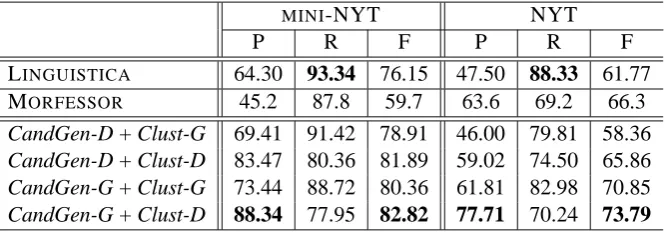
[image:8.595.134.468.62.178.2]CandGen-G + Clust-D 88.34 77.95 82.82 77.71 70.24 73.79
Table 2: Results on English for all models in precision(P), recall(R),f-score(F) for each data set.
pletely fair. Morfessor only generates segmenta-tions. We therefore processed Morfessor output by clustering words by assuming that the longest segment in any segmentation is the stem and eval-uated this instead. Linguistica produces stems and associated suffixes so the clusters naturally follow from this output. However, Linguistica only infers either prefix or suffix patterns.
6.3 Results and discussion
The results on English are in table 2 withχ2 test criteria ofp<0.05and each cell in the contingency table >5. CandGen-G +Clust-D had the bestf -score, and easily beats the benchmarks.
This is different from our expectation that awareness of document boundaries at all stages (i.e., CandGen-D +Clust-D) would show the best results. The discrepancy is especially marked for the larger NYT. One important reason for this is the affix criterion itself: trunks must be longer than branches. Consider again the sample contingency tables in Table 1 that were derived from NYT through CandGen-D and CandGen-G. We had as-sumed at the outset that CandGen-D would be bet-ter able to filbet-ter out noise and would be sparser, but results show the opposite. The reason is that that short words in a global lexicon are more likely to share trunks with longer, unrelated words. This ensures that short word forms rarely generate can-didate affixes. Longer words which are less likely to have spurious long branches generate the bulk of candidate suffixes and stems. This is born out by the stems that were associated with the spuri-ous suffix pair le/s: CandGen-G has cliente, cripp,
crumb, daniel, ender, label, mccord, nag, oval, sear, stubb, whipp. CandGen-D has crumb, hand, need, sing, tab, trick, trip. The word forms that
are associated with le/s through the CandGen-D strategy are crumble/crumbs, handle/hands, . . . .
Compare this with the word forms associated with the search strategy CandGen-G such as
clien-tele/clientes, cripple/crips, . . . . The majority of
them are not common English words; they are most probably proper names such as LaBelle and
Searle. Furthermore, there is no item among the
stems from the CandGen-G search where concate-nating the stems le and s would result in both word forms being a common noun or verb as is the case with the stems from the CandGen-D search where all concatenated word forms are common English words. Though CandGen-G finds spuri-ous stems, the counts for the spurispuri-ous affix pair are suppressed (see table 1) because it is a type count rather than a token count. This results in le/s be-ing properly excluded as a rule. This explains why
CandGen-D has worse precision in general than CandGen-G.
The affix criterion has other minor issues. One is that it ignores the few cases where stems are shorter than affixes, such as the very common words be, do, go.7 Assuming that the longest productive inflectional suffix in English is -ing8, the criterion would correctly find stem candidates for -ing only when the stem is longer than 3 or 4 letters. Another is that the criterion, when combined with CandGen-D, generates candidates from the/them/then/their/these which cooccur fre-quently in documents. This is not an issue when the criterion is applied in CandGen-G.
Nonetheless, results show that when data sizes are small, as with USP (Table 3) andMINI-NYT,
awareness of document boundaries at the candi-date generation stage is beneficial to precision.
7The exclusion of such words in a token based evaluation
as opposed to a type based evaluation would heavily penalize our approach. We are not aware, however, of any prior work in unsupervised morphology that evaluates over tokens.
8with occasional gemination of final consonant such as
P R F
Ca-D + Cl-D 70.51 44.35 54.45
Ca-G + Cl-G 70.00 46.87 56.15
Ca-D + Cl-D +S 88.58 45.21 59.86
Ca-D + Cl-G +S 85.03 44.75 58.64
Ca-G + Cl-D +S 90.34 45.48 60.50
Ca-G + Cl-G +S 84.54 46.03 59.60
Ca-D + Cl-D +P 93.84 47.90 63.42
Ca-D + Cl-G +P 89.94 47.38 62.06
Ca-G + Cl-D +P 95.42 47.89 63.78
[image:9.595.78.286.63.262.2]Ca-G + Cl-G +P 92.03 50.01 64.80 LINGUISTICA +S 81.14 47.60 60.00 LINGUISTICA +P 84.15 52.00 64.28 MORFESSOR 28.12 62.28 38.75
Table 3: Performance of models on automatically generated USP evaluation set. P: Prefix only, S:
Suffix only. If there is no indication ofSorP, it means model attempted to learn both
Acc. FAcc. Avg. Sz.
Ca-G + Cl-G 98.5 79.0 2.94
LINGUISTICA 96.0 85.0 2.64 MORFESSOR 85.3 55.0 4.8
Table 4: Human expert evaluated accuracy (Acc.) and full cluster accuracy (FAcc.) of models on USPand average cluster size in words (Avg. Sz.)
However, it seems that CandGen-G has better cov-erage no matter the size of the corpus, which explains why coupling it with Clust-D produces overall better scores. Clust-D does provide a use-ful added constraint to mere orthographic similar-ity (i.e. shared trunks in a trie).
A worrisome aspect of the results is that perfor-mance degrades for large data sets (this is also true for Linguistica). However, it also hints that this method might work well for under-resourced lan-guages. We surmise that since productive suffixes do not suffer from sparsity, even a small data set provides sufficient evidence to reach reliable con-clusions about the productive morphology of some language. Increasing the size of the data merely increases the counts of spurious affixes and poses problems for a relative simple measure such as theχ2 test. A similar result was shown in Creutz and Lagus (2005) where f-score performance of their segmentation method improved as more data was provided then decreased as the input exceeded
250K tokens in English. Their method showed continued improvement with increased data for Finnish. This hints that more data is beneficial for morphologically complex languages but not for morphologically impoverished languages.
Finally, it is also encouraging that the manual evaluation (Table 4) shows very high accuracy, as judged by a documentary linguist. Both our model and Linguistica perform very well under this eval-uation.
7 Conclusion
We have presented a novel approach to unsuper-vised morphology acquisition that uses a very simple pipeline and does not use any thresholds other than standard ones associated with the χ2 test. The model relies on document boundaries and correlation tests for filtering spurious stems and affixes. The model compares favorably to Linguistica and Morfessor, two models that em-ploy much more complex strategies and rely on fine-tuned parameters. We found that the use of document boundaries is especially beneficial with small datasets, which is promising for the applica-tion of this model to under-resourced languages. For large datasets, global candidate generation outperformed document-aware candidate genera-tion at the task of filtering out spurious stems, but document-aware clustering does improve pre-cision and overall performance.
In this paper we have addressed one aspect of morphology acquisition, segmentation and clus-tering. Extending the approach is straightforward, for example, substituting more sophisticated data structures or statistical tests for the current ones. In particular, we will move from the use of doc-ument boundaries to a flexible notion of textual distance to estimate likelihood of morphological relatedness.
Acknowledgments
References
R. H. Baayen, R. Piepenbrock, and H. van Rijn. 1993.
The CELEX lexical database on CD-ROM.
Linguis-tic Data Consortium, Philadelphia, PA.
M. Baroni, J. Matiasek, and H. Trost. 2002. Unsu-pervised discovery of morphologically related words based on orthographic and semantic similarity. In
ACL ’02 workshop on Morphological and phonolog-ical learning, pages 48–57.
D. Bernhard. 2005. Unsupervised morphological seg-mentation based on segment predictability and word segments alignment. In Proceedings of Morpho
Challenge 2005, pages 18–27.
S. Bordag. 2005. Two-step approach to unsupervised morpheme segmentation. In Proceedings of Morpho
Challenge 2005, pages 23–27.
E. Chan. 2006. Learning Probabilistic Paradigms for Morphology in a Latent Class Model. In ACL
SIG-PHON ’06, pages 69–78.
M. Creutz and K. Lagus. 2002. Unsupervised dis-covery of morphemes. In ACL ’02 workshop on
Morphological and phonological learning-Volume 6, pages 21–30.
M. Creutz and K. Lagus. 2004. Induction of a simple morphology for highly-inflecting languages. In ACL
SIGPHON ’04, pages 43–51.
M. Creutz and K. Lagus. 2005. Inducing the morpho-logical lexicon of a natural language from unanno-tated text. In AKRR ’05, pages 106–113.
M. Creutz and K. Lagus. 2007. Unsupervised models for morpheme segmentation and morphology learn-ing. ACM Trans. Speech Lang. Process., 4(1):3.
S. Dasgupta and V. Ng. 2007. High-performance, language-independent morphological segmentation. In NAACL-HLT, pages 155–163.
V. Demberg. 2007. A language-independent unsu-pervised model for morphological segmentation. In
ACL ’07, volume 45, page 920.
D. Freitag. 2005. Morphology induction from term clusters. In CoNLL ’05.
E. Gaussier. 1999. Unsupervised learning of deriva-tional morphology from inflecderiva-tional lexicons. In
ACL workshop on Unsupervised Methods in Natu-ral Language Learning.
J. Goldsmith. 2001. Unsupervised learning of the morphology of a natural language. Comp. Ling., 27(2):153–198.
J. Goldsmith. 2006. An algorithm for the unsupervised learning of morphology. Natural Language
Engi-neering, 12(04):353–371.
S.J. Goldwater. 2007. Nonparametric Bayesian
mod-els of lexical acquisition. Ph.D. thesis, Brown
Uni-versity.
M.A. Hafer and S.F. Weiss. 1974. Word Segmentation by Letter Successor Varieties. Information Storage
and Retrieval, 10:371–385.
H. Hammarstr¨om. 2006. A naive theory of affixation and an algorithm for extraction. In ACL SIGPHON
’06, pages 79–88, June.
S. Keshava and E. Pitler. 2005. A simpler, intuitive approach to morpheme induction. In Proceedings of
Morpho Challenge 2005, pages 28–32.
C. Monson. 2004. A framework for unsupervised nat-ural language morphology induction. In
Proceed-ings of the Student Workshop at ACL, volume 4.
Alexis Palmer, Taesun Moon, and Jason Baldridge. 2009. Evaluating automation strategies in language documentation. In Proceedings of the NAACL HLT
2009 Workshop on Active Learning for Natural Lan-guage Processing, pages 36–44, Boulder, CO.
T.C. Pixabaj, M.A. Vicente M´endez, M. Vicente M´endez, and O.A. Dami´an. 2007. Text collections in Four Mayan Languages. Archived in The Archive of the Indigenous Languages of Latin America.
P. Schone and D. Jurafsky. 2000. Knowledge-free in-duction of morphology using latent sematic analysis. In CoNLL-2000 and LLL-2000.
P. Schone and D. Jurafsky. 2001. Knowledge-free induction of inflectional morphologies. In NAACL
’01, pages 1–9.
M.G. Snover, G.E. Jarosz, and M.R. Brent. 2002. Un-supervised learning of morphology using a novel di-rected search algorithm: taking the first step. In ACL
’02 workshop on Morphological and phonological learning, pages 11–20.
B. Snyder and R. Barzilay. 2008. Unsupervised multi-lingual learning for morphological segmentation. In
ACL ’08.
D. Yarowsky and R. Wicentowski. 2000. Minimally supervised morphological analysis by multimodal alignment. In ACL ’00, pages 207–216.
D. Yarowsky, G. Ngai, and R. Wicentowski. 2001. Inducing multilingual text analysis tools via robust projection across aligned corpora. In HLT ’01.