* To whom all correspondence should be addressed. E-mail: [email protected]
Effective Dose Reduction Through Ventilation Scheme: Design
Philosophy in Prototype Fast Breeder Reactor - A Case Study
Vidhya Sivasailanathan1, Prabhat Kumar1 and N. Manoharan2
1Bharatiya Nabhikiya Vidyut Nigam Limited, Kalpakkam - 603 102, India. 3Research and Development Division AMET University, Kanathur - 603 112. Chennai.
doi: http://dx.doi.org/10.13005/bbra/1396
(Received: 15 August 2014; accepted: 10 October 2014)
Radiation has become inseparable part of the living environment contributing as cosmic rays, terrestrial radiation, fall-out from earlier nuclear accidents and testing, the increased use of diagnostic radiology etc., Since early ages of time, the homosapiens have lived with natural radiation and his system has been adapted for the surrounding radiation and its effects. But still, radiation and its effects gain attraction in the minds of the general public because of the baseless panic registered through passage of time regarding the uncertainties associated with the consequences of radiation and the knowledge inadequacy on handling of the same. Operating nuclear power plants are preferably considered as the elemental portal to elucidate the effects of radiationas a fairly large quantity of radioactive materials are being used as fuel in the reactors. The main reason of the so called menace is because of the strong reason that radiation is non-sensory. Only instruments can detect the presence of radioactivity and measure the level of the radiation field. The dose reduction techniques in the occupational environment involve three major concepts: 1. Time 2. Distance and 3. Shielding. Apart from these control measures and though there are various other protective measures to protect from contamination by using protective clothing, respirators, etc., the dose reduction scheme has to be built in the design of the nuclear power reactor. The intensive practice and strict compliance to the radiation protection aims at bringing the exposure level As Low As Reasonably Achievable (ALARA). The paper brings out the features of ventilation methodology adopted in the prototype fast breeder reactor and the effective identification of radiological zoning to contain the contamination. The paper also tries to justify that the appropriate design strategyhelps in effective dose reduction in operating nuclear power plants.
Key words: ALARA, non-sensory, shielding, ventilation methodology, radiological zoning, contamination
Prototype Fast Breeder Reactor (PFBR) is a sodium cooled pool type reactor which is currently under construction in Kalpakkam. PFBR uses Uranium Oxide and Plutonium Oxide (MOX) as the fuel. The layout of the plant consists of two main buildings viz., the Nuclear Island and the
PFBR have been fabricated in the Site Assembly Shop (SAS) which is located within the premises of PFBR site.
During the fission reaction inside a reactor, fission fragments are also released along with energy. The energy associated with a fission reaction is almost equal to 200Mev. The daughter nuclides thus formed from a fission reaction
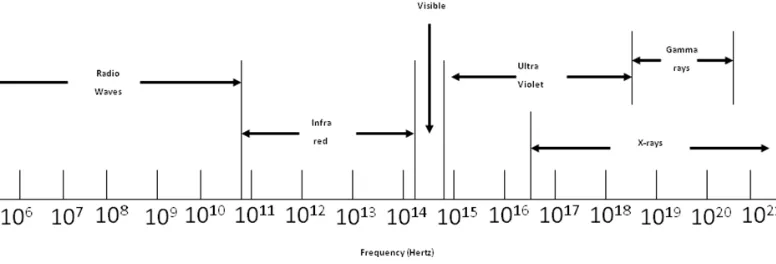
possesses more energy than the energy of normal state will reach an excited state. In an attempt to retain to ground state, the nuclides would release the extra energy by emitting a gamma photon. The gamma rays which are emitted from the nucleus of a radionuclide are the electromagnetic radiation having the highest frequency. It is also more energetic because of the high frequency.
Fig. 1. Electromagnetic spectrum (the higher the frequency, greater the energy)
The high energy gamma photon which interacts with the materials of the reactor may lead to production of radioactive isotopes of the materials. The excess energy of the radioactive isotopes release the gamma radiation. The radioactive isotope gains the importance based on the half life of the nuclide. The value of half life of a radio nuclide indicates the activity decay of that nuclide.
The elements which are used as the material for the manufacture of components of the reactor, other system materials like coolant, moderator etc., used in the reactor become important source materials for interaction of gamma radiation. So it becomes a mandate that while operating a reactor, the activity should not be released outside the reactor. The responsibility of the reactor operating personnel is to protect the public and environment without causing any abnormalities in their routine activities besides producing power from a nuclear reactor.
Dose Reduction Programme in a Nuclear Power Reactor
There are many natural sources which are contributing to the external and internal exposure of radiation to the mankind. Cosmic rays, terrestrial radiation, fall out from earlier nuclear accidents and
testing etc., are some of them to mention here. This will add to the radiation strength of the background dose. Demographically, there are places in India and abroad where the background radiation is comparatively high with other states. But the livelihood does not make any change with rest other areas.
As far as operating a nuclear power reactor is concerned, it becomes necessary that it must not release any kind or quantum of radiation which may likely to add up or make an escalation in the existing background radiation of the particular region. The radiation protection measures should be practiced to keep all the active sources As Low As Reasonably Achievable (ALARA).
continuous exposure of radiation for a working life of 50 years of an occupational worker is considered to arrive at the calculation of average annual dose. Considering 1Sievert as the lifetime dose* of an occupational radiation worker for a work life of 50 years, ICRP has recommended the dose limit of 20milli Sievert (mSv) for a year. It also suggests that the dose rate of a worker shall not exceed the value of 100mSv for a period of 5 years. The period of 5 years is assumed for calculation of threshold value taking into consideration of the practical difficulty to comply with regulatory requirement and working level flexibility. The Atomic Energy Regulatory Board (AERB) of our country has also fixed the dose limit as 20 mSv as the maximum exposure limit to an occupational worker for a year following the ICRP guidelines. However, the threshold value of 20mSv does not limit or a boundary line of any adverse effects on human body due to exposure to ionizing radiation.
Prototype Fast Breeder Reactor (PFBR) is locating in the place where the multi units of Department of Atomic Energy are already operational. Hence it becomes mandatory, that the dose release has to be apportioned among the plants in such a way that the permissible limit of the dose value to the public shall not be exceeding the limits recommended by the Regulators. The apportioned dose value of PFBR is 100 micro Sievert including both air and water route of dose release during normal operation of the reactor.
The radiation protection measures in a nuclear power plant start from the layout design. It further extends to, as the selection of material for the manufacture of the reactor core components, selection of coolant, moderator, ventilation scheme and the zoning philosophy. The fission products and the corrosion products which are formed during reactor operation are the major source of radioactivity in a reactor.
As far as the material selection for components of a reactor is concerned, activation of cobalt based alloys that are used as the hardfacing material resulted in high dose rates during handling, maintenance and decommissioning activities in vintage reactors. The systematic study to replace Cobalt based alloy stellite revealed that the corroded or worn out particle could travel to neutron field. As an
outcome of the studies, Chromium nitriding and Nickel based alloy-Colmonoy have now been recommended as hardfacing materials.
Radiation Protection and Zoning Philosophy
Separating the areas in the reactor into different zones based on the activity level helps avoid the spread of contamination into environment and to contain the activity within the building. The classification of zoning philosophy adopted in Prototype Fast Breeder Reactor is as follows.
Zone 1 (white) : This is a clean area where there is no contamination and the activity level is less than 1 micro Sievert per hour – control building, electrical building
Zone 2 (Green): This area has no activity as such but prone to contamination due to higher zones-Change rooms, access corridors
Zone3(Amber): These are controlled access areas, which contain sources of contamination during reactor operation. During other times, sources of contamination may not be present.
Zone 4 (Red): This is the area that contains sources of contamination at all times. The areas are accessible only after the removal of source of contamination or radioactive decay. Normally they are not accessible.
The contamination spread is controlled and the activity is contained by creating the rubber areas while crossing the lower zones to higher zones and vice versa. The rubber areas are provided based on the zoning classification of areas.
Contamination Control – Design and Human habits
Buildings are situated in the same building on a common raft. This design of building helps the movement of contaminated equipment, spent fuel subassembly etc., and facilitate the decontamination, washing and maintenance of the core components by shifting them within small confined area.
The aim of radiation protection measures and the best ALARA practices focus on the reduced internal and external exposure to ionizing radiation to an occupational worker. The internal exposure is caused by inhalation, ingestion or injection processes. The contamination can also occur by habitual actions of hand to face contacts; this relates to the habit of someone who always wipes his hand on dress, itching feeling on nose tempting to rub off, stretching the earlobes, scratching legs against floor or wall etc.,.
However, the inhalation depends upon the Derived Air Concentration (DAC) in the high active areas. The DAC value describes the quantity of radioactive particles that are present in air (sodium aerosol, particulates, iodine etc.,) which could be inhaled and reaches the internal organ to start giving internal radiation to human. The required air changes to enable the fresh air supply in such active areas are done through the ventilation system.
Ventilation Philosophy as a Radiation Protection Measure
The ventilation scheme is another pivotal concept through which the contribution of activity leak could be minimized. In Prototype Fast Breeder Reactor, there are many advantages envisaged in the system which makes it distinguished from earlier reactors in the country. PFBR does not use water or heavy water for either coolant or moderator purpose. Use of both water and heavy water enhances the formation of tritium, an isotope of Hydrogen. Tritium has the disadvantage of penetrating through skin and via inhalation as vapour. On the cost side also, if we see, heavy water is on the higher side.
PFBR uses sodium as its coolant and being fast breeder reactor no moderator is required to thermalise the neutron to enhance the fission reaction. The reactive products arising out of Sodium 21 (Na-21) are Na-22 (n,2n reaction) and Na-24 (n,³ reaction). Na-24 has the half life of 15 hours and Na-22 has the half life of 2.4 years. The
Ar-41 which is coming out of cover gas leak is another source of activity from RCB.
The ventilation scheme needs to be carefully designed whenever the activity becomes airborne. As in every reactor in the country, PFBR has its ventilation system designed in such a way that air flows from low radioactive zone to high radioactive zone as once through ventilation system. The air that flows from the lower radioactive zone to higher radioactive zone is collected at RCB and is allowed to pass through ducts. The contaminated air passes through various filters and finally discharged through the ventilation stack to the environment.
As a good practice, the concentration of the radionuclide in air is maintained as 1/10th of its
Derived Air Concentration (DAC) complying with regulatory requirement. In freely accessible areas, the air is recirculated as the airborne activity is almost nil. Reactor Containment Building (RCB) is operated at a negative pressure in order to prevent leakage of potentially active air to outside. RCB will be automatically isolated in case of radiation accident. All cells containing radioactive materials are provided with automatic closing arrangements with dampers. The dampers close automatically if increase in radioactivity is sensed by detectors and consequently the activity is bottled up inside Reactor Containment Building (RCB).
Ventilation in Active and inactive buildings
In PFBR, the active buildings include Reactor Containment Building, Fuel Building, Steam Generator Building, Rad Waste Building and Change room and are provided with ‘once through ventilation’ to reduce spread of contamination and radioactivity with the direction of air flow from low radioactive zone to high radioactive zone areas. The fresh air supply will be maintained by compressed air system and chilled air system.
In non active buildings, like control building, electrical building, turbine building, service building and back up control room are not necessarily provided with exhaust air filtering system.
Stack Monitoring system
The function of ventilation system completes at the Stack of the operating power plant through which the gaseous effluents are discharged. The stack discharge limit for PFBR is estimated using the standardized methodology, wherein the
input parameters are chosen conservatively in order to minimize the dose rate at the site boundary. The annual average meterological data observed at Kalpakkam site for the period of over a decade was obtained from Environmental Survey Laboratory, Kalpakkam are used in the estimation. The discharge limits are upper bound values of the radioactivity that, if released would result in a dose corresponding to the apportioned limit for air route for PFBR for the general public residing near the site boundary (1.5km).
Fig. 2. Schematic drawing of function of stack monitoring system
other radio nuclides are envisaged to be released in relatively lower limits which in turn render to the public; the dose less than that of the dose limit recommended by ICRP as well as Atomic Energy Regulatory Board (AERB).
Concluding Remarks
Feed backs from previous global radiological events will benefit the scientific community to be knowledged of over exposures and save adequate person hours for productive works in every nuclear power plant.
Systematic dose investigation with appropriate ALARA practices, adopting sound root cause analysis have resulted in near zero ‘over exposures’ in nuclear power plants. Ample information on job planning, mock-ups, proper execution of jobs in radioactive areas with ‘Just in Time briefs’, good access control, safe engineered layout and administrative procedures adhering the radiation protection culture and sharing of operating experience will lead to a safe work place at all costs.
The spread of contamination is being controlled by applying the appropriate ventilation design when the activity becomes airborne. The direction of air flow from low radioactive zone to high radioactive zone prevents the contaminated particulates / sodium aerosols from being entered into the outside environment. Thus the contamination is confined inside the reactor and is released through stack after passing through the filters.
The release of gases through stack is being monitored and checked for reducing the lower activity release to the atmosphere. The dampers provided in the ventilation ducts would sense the existence of any excess activity inside the reactor building and would get closed automatically to contain the activity inside the building preventing leak to outside area of the reactor building.
The design of the building, good engineering practices, operating friendly tools, use of easy to decontaminate tools, proper floor / wall paintings, avoiding spread of loose spare parts / contaminated solid wastes, careful collection and
safe disposal of solid and liquid waste generated, provision of rubber stations, avoiding onlookers during critical jobs, mock ups and training, supervision of Health Physics personnel, regular ALARA pratices etc., also contribute to the reduced dosimetry as a part of radiation protection measures. Above all, only the minimum or the permissible limit of radio activity is released by applying appropriate radiation protection procedures and ventilation philosophy in Prototype Fast Breeder Reactor (PFBR). By adopting all the above cited features, the activity release is going to be very insignificant to the environment and the value shall be even below the design value of release as estimated, when PFBR becomes operational in the near future.
ACKNOWLEDGEMENTS
The author acknowledges the Management for pursuing the studies related to the topic. The author also wants to acknowledge the continuous support, guidance and encouragement extended by the author in bringing out the paper in a good shape.
REFERENCES
1. AERB Safety Criteria for Design of Prototype Fast Breeder Reactor, April 1990.
2. AERB Safety Guide, Code of practice on safety in Nuclear Power Plant Siting
3. R.Venkatesan et al, Stack design: radiological considerations, PFBR/01150/DN/1002/R-1 2002.
4. Evolution of ICRP recommendations 1977, 1990 and 2007
5. IAEA Regional Basic professional training course on radiation protection, 1998
6. International Atomic Energy Agency, Basic safety standards for Radiation Protection (1982 Edition), Safety Series No.9, IAEA, Vienna, 1982.