DOI: 10.14738/abr.510.3761.
Moyers, C. G. P., Encinas, A. R., & Soto, A. N. V. (2017). Fair Trade, an Alternative Integration Process: Case Study of Etchohuaquila, Navojoa, Sonora. Archives of Business Research, 5(10), 180-194.
Fair Trade, an Alternative Integration Process: Case Study of
Etchohuaquila, Navojoa, Sonora.
Carlos German Palafox Moyers
PhD in Economic Sciences and Researcher-Professor Fulltime. Economics Department, University of Sonora.
Boulevard Luis Encinas and Rosales, Col. Centro. Hermosillo, Sonora, Mexico
Alexandra Robles Encinas
Bachelor’s Degree Student on International Business and Trade. Economics Department, University of Sonora.
Boulevard Luis Encinas and Rosales, Col. Centro. Hermosillo, Sonora, Mexico
Andrea Nohemi Villegas Soto
Bachelor’s Degree Student on International Business and Trade. Economics Department, University of Sonora.
Boulevard Luis Encinas and Rosales, Col. Centro. Hermosillo, Sonora, Mexico
ABSTRACT
Economic integration, which took place through the North American Free Trade Agreement (NAFTA) is creating winners and losers in our country. The winners are the transnational corporations and the large private agricultural producers; the losers are the indigenous communities, peasantry, cooperatives, and the small and medium-sized farmers in the areas which are the most poor of the country. The objective of this study is to analyze to the social producers, which are grouped in an area of common land called “Ejido Etchohuaquila”, located in the municipality of Navojoa, Sonora Mexico which has been integrated to Fair Trade as an alternative markets, producing organic products. In addition to this study, we analyze the protocols that were fulfilled for joining this network. Furthermore we assess the community development in terms of social welfare and social cohesion, also we highlights the progress of this community that was one of the communities most impoverished region, without access to development before to become a member of the international circuit.
Keywords: fair trade, organic products, social and solidarity economy, sonoran agriculture, alternative markets, area of common land.
INTRODUCTION
The economic integration, carried out through the North American Free Trade Agreement (NAFTA), includes: Mexico, United States and Canada. This integration is generating winners and losers in our country. The winners’ side is formed by the transnational corporations and big private producers; on the losers’ side we can find indigenous communities, peasant groups, cooperatives, and small and medium producers in the poorest regions of the country.
the commercial circuit but also in the productive sector. Fair Trade is a concrete contribution to the fight against poverty, marginalization, social exclusion, climate changes and global economic crises.
The World Bank reports that more than 1 billion people still live on $1.25 a day or below the same (World Bank). The World Trade Organization (WTO) argues that trade must benefit the most vulnerable people and provide sustainable livelihoods by developing opportunities, especially for small producers and the people in disadvantage. The recurrent global economics crises as well as the persistent poverty in vast regions of the world confirm the need to implement a fair, supportive, and sustainable economy both locally and globally.
Fair Trade is the answer. In addition, it seeks the production of organic agricultural goods or, in this case, the care of the land as the central axis in agricultural activity. This process of alternative integration draws on experiences at the global level, such as Germany, Spain, France in the European Union, as well as the United States, Brazil, Argentina and Mexico. In the latter the experiences of Fair Trade are presented, in the great majority, in the southern region of the country, mainly in Oaxaca, Chiapas, Veracruz, among others. The products that excel, based on Fair Trade include the following: coffee and sugar, among others (Palafox 2014). In the Northern Region, there is no culture and experiences about fair trade, because of its productive vocation, since its private export agriculture that is developed in the states of Sonora, Sinaloa, Chihuahua and Baja California. However, both private and social producers have been identified in Sonora.
The objective of this work is to analyze the social producers, grouped in the collective community: Etchohuaquila, located in the municipality of Navojoa, which has been integrated to the Fair Trade. In addition to reviewing the protocols and principles that were fulfilled to be integrated into the Fair Trade network, and assessing the evolution of the community in terms of social welfare and social cohesion, which highlights the progress of this community, which was one of the communities in the region, without a clear development path before joining the international circuit. Once analyzed, both the protocols that are required to be part of Fair Trade, and the measurement of positive impacts on the collective Ejido community, will seek their replication in the communities of the region and in the future to design a comprehensive development policy Community level. The community of Etchohuaquila organized its production process, in a highly unfavorable environment, where there was no access to the water intake through irrigation channels, there was no guarantee for obtaining credits, in addition there was no minimum financial resource for the purchase of the most basic inputs for the work: it makes it a worthy space for the reflection and the case study of this organization.
The research questions are the following:
Is there a single integration process (NAFTA) like the one that has been adopted in this globalization process?
Will there be another way of integration, centered on the harmonious development of the human being and the care of the environment?
These questions lead us to the following hypothesis:
The structure of the work is divided into several sections: The first section will address the theoretical and methodological aspects, as well as the experiences on Fair Trade. At this point it is important to emphasize that fair trade does not have a consolidated theoretical body, such as that of classical integration models, like David Ricardo's model; the one of Specific Factors; the one of Heckscher-Ohlin under perfect competition, as well as imperfect competition, where monopolies and monopoly competition are located. The Fair Trade theory is a model without a finished theoretical structure; however, successful experiences have been presented, which will allow the construction of a theoretical body finished and consolidated in the near future.
In the second section, the protocols and principles necessary for a community to enter the Fair Trade circuit are developed.
The third presents the most important data and information of the town of Etchohuaquila, to show the situation before and after joining the Fair Trade circuit. In this section an interview made by journalist Manuel Robles of Proceso magazine is annexed, on August 21st, 1991, to some inhabitants of the village of Etchohuaquila in relation to pitcher Fernando Valenzuela and the life of the population. Finally, we present the conclusions to which this work has been carried out.
FIRST HEADLAND Literature Review
Theories on International Trade
The theoretical foundations of the research are supported in two great strands. On one hand, there are the Classical Theories of International Trade with a theoretical background that have been developed in the last two centuries, whose scientific theoretical impetus was David Ricardo (1876). On the other hand, the incipient Fair Trade Theories that are supported in the Theories of the Solidary Social Economy headed by Coraggio (2006).
The theoretical support of International Trade is based on the Classical Theory of Work Value, developed by David Ricardo in his book "Principles of Political Economy and Taxation" (1817). This scientific approach focuses on the comparative advantages obtained in the production of a good in a given country; these advantages allow the development of international trade between nations (Krugman and Wells, 2006).
Thus, in the last years the world economy has been characterized by a market economy, and according to Adam Smith, in his book "The Wealth of Nations" (1776, 2001), there is an invisible hand, pursuing only the self-interest, ends up getting what interests society as a whole. The Classical Theories of International Trade highlight two theoretical phases of analysis. In the first phase (perfect competition), the pattern of international trade arises through the export of manufactured goods from developed to underdeveloped countries and the export of raw materials from developing to industrialized countries, so specialization and integration was determined by the technology and natural conditions of each country. This phase corresponds to that of a capitalism that is poorly developed in technological terms, through decreasing returns to scale or rising costs.
structures and monopolistic competences, and on the other hand, new industrial districts or clusters in both spaces (Robinson, 1969) (see Chart 1).
Graph 1: Scheme of the process of globalization in the market economy and its processes of economic integration
Source: Self made
Theories of Fair Trade
The second theoretical aspect is the called Fair Trade Theory whose basis is Social Theory and Solidarity Theory, specifically Social Capital. According to the theorists Bourdieu (1980, 1997), Coleman (1990) and Putman (1993), Social Capital is the aggregate of present or potential resources, which are related to the possession of an enduring network of relations more or less institutionalized knowledge and mutual recognition, in other words: membership in a group that gives each of its members a social support, a credential that allows them to accredit each other's benefits in the various senses of the word. (Palafox, et al., 2012).
In addition, it is important to consider the approaches of the international organizations on Social Capital and Social Cohesion, in which the United Nations Development Program (UNDP) stands out; the Economic Commission for Latin America and the Caribbean (ECLAC); the Inter-American Development Bank (IDB), as well as the World Bank (WB), where the essential part of the theory rests on enduring networks between groups, with social support consistent with their solidarity and social cohesion.
The rising performances appear; Fordism, toyotism where the trading patterns in manufacturing.
And in raw materials such as in developed countries as well as in developing
countries (specializatiion and clusters)
World efficient markets
Modern International Trade
International Division of Work:
Developing countries, pattern of trade, exports of raw materials.
Industrialized countries, trade of manufacturing exportations.
Traditional International Trade
Process of Economic Integration
Imperfect Competition
Perfect Competition Market Economy
Under this perspective of the theoretical analysis, Solidary Social Economy is a key element of Social Capital, which extends the possibility of contributing to regional economic development. Thus, Mutuberría (2003) comments that in recent years, a series of practices and discourses associated to the concept of Solidary Social Economy have been used in several regions of the world, as in the case of Canada (Montero, 2003), Mexico (Otero, 2006), Ecuador (Coraggio, 2009), Peru (Cotera, 2009), Argentina (Aguirre, 2008, Coraggio, 2010), Nicaragua (Fardiño, 2010) and Spain (Emmaus Social Foundation, 2010). The conceptualization of Solidary Social Economy is considered, in this analysis: the key factor in the construction of Social Capital, which makes possible the contribution to regional and local economic development.
These practices and forms of entrepreneurship, from a microeconomic perspective, are grouped in: small neighborhood experiences; community kitchens; women's groups; fairs and barter exchanges in some marginalized indigenous and urban communities. As Caracciolo and Foti (2003) point out: family enterprises and street workers have not yet had the opportunity to bring their interests closer together, and with other social sectors in the way of organizing, and thus be more consistent and efficient in their defense. However, they must also be considered within the social economy, since they depend on their own effort and work to get ahead.
Graph 2: Scheme of the process of globalization and the social economy of solidarity and its process of economic integration
Source: Self made
Fair Trade. An unconventional type of commercial exchange
In recent years, Fair Trade has been a marketing alternative for products and handicrafts from: producer organizations, families, workshops and cooperatives in Latin America, Africa and Asia. This trade alternative has been the answer to the problems of many small producers in these countries in order to place their products on the world market.
In this way, the concept of Fair Trade and what would translate into a practice of nonconventional or alternative trade, arose from the widening gaps of uneven development between North and South.
For Ceccon (2008), the beginnings of Fair Trade were born with the Alternative Trade Organizations (ATOS), which began operating in the 1940s in the United States and Europe. In the 1960s, in the United Kingdom, OXFAM stores were established in the United Kingdom through the sale of Chinese refugee handicrafts, which in 1964 were to be established as the first importer of Fair Trade in the Netherlands (Belgium and Holland) with the name of: World Fair Trade Organization (WFTO).
Process of Globalization
Social Solidary Economy
Efficient markets
Exports of products through fair trade
Merchandising Producers’ federations, social
enterprises and cooperatives
Fairs, trades and informal market Merchandising
Neighborhood experiences, community dinners, groups of women and
microenterprises
Economic Integration Processes
Micro Part Macro
On the other hand, in Holland with the foundation in 1959 of the Agency: Aid and Development of the Catholic Youths, the ideological principles of the movement were spread, which contributed to the expansion of Fair Trade. Later in 1967, there would be created in this country two marketing organizations: The Alternative Trade Oraganisatie and Stichting Ideele (Lara, 2000).
Finally, in Spain, civil society would develop an information mechanism towards what Fair Trade is and the importance of the informed consumer towards the products they buy so that, in this way, the marketing mechanisms of products from Latin America, Asia and Africa to Europe could be carried out (De la Torre, 2004).
Fair Trade, according to various authors, is a fair and equitable trade that constitutes an alternative proposal to conventional international trade, based on guaranteeing to the producers of the south a fair compensation for their work and for the community (Inter-American Institute of Cooperation for Agriculture, 2007). Other authors see Fair Trade as a strategy in the fight against poverty, since the concentration of wealth and the capacity to achieve development goals distanced the North of the South (Church, Jaime and Castillo 2004, Watkins and Flower, 2002).
Fair Trade is promoted by various non-governmental organizations, that is to say, it derives from the movements of civil organizations that are born in Europe, and whose main motto is to pursue a work with dignity, respecting the human rights, the rejection to the child exploitation, the equality between men and women, and the process of being both the relationship between producers and distributors and consumers. Likewise, Stiglitz and Charlton (2006) developed a commercial strategy that allows the poorer countries of the world to trade more freely and more justly.
The authors consider that developing countries must obtain a higher valuation of natural resources under their soil, and apply a social entrepreneurship, under the scheme of a "Fair Trade" that seeks self-sustainable and business-viable alternatives to meet social needs of the society.
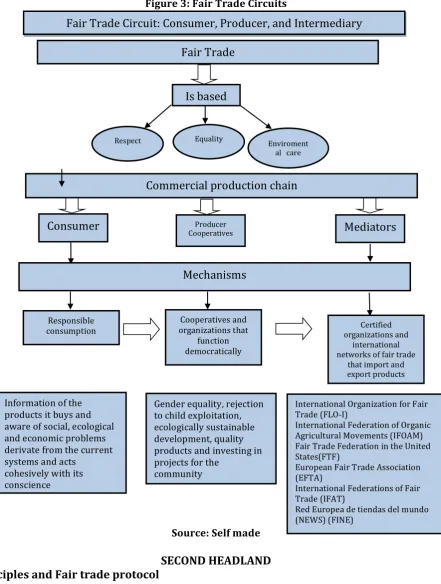
Figure 3: Fair Trade Circuits
Source: Self made
SECOND HEADLAND Principles and Fair trade protocol
In this section are developed: the principles and required protocols for a society to enter the Fair trade circuit.
Before to develop the protocols is important to highlight the 10 principles governing the Fair trade: opportunity for disadvantaged producers; transparency and y responsibility; fair business practices, fair price; not child labor and forced labor; not discrimination; freedom gender; freedom of association; good terms of work; develop of opportunities and capacities; promotion to Fair trade.
The Fair trade is a strategy to alleviate poverty and sustainable development. The objective is Fair Trade Circuit: Consumer, Producer, and Intermediary
Fair Trade
Is based on
Respect Equality Enviroment
al care
Commercial production chain
Consumer Producer Mediators
Cooperatives
Mechanisms
Responsible
consumption organizations and Certified
international networks of fair trade
that import and export products
Cooperatives and organizations that
function democratically
Information of the products it buys and aware of social, ecological and economic problems derivate from the current systems and acts
cohesively with its conscience
International Organization for Fair Trade (FLO-I)
International Federation of Organic Agricultural Movements (IFOAM) Fair Trade Federation in the United States(FTF)
European Fair Trade Association (EFTA)
International Federations of Fair Trade (IFAT)
Red Europea de tiendas del mundo (NEWS) (FINE)
Gender equality, rejection to child exploitation, ecologically sustainable development, quality products and investing in projects for the
to create opportunities for producers who are in economic disadvantage or marginalized by the conventional trading system.
The Fair trade requires management of organizations and transparent trade relations. The organizations of Fair trade encourage participation of their employees, members or producers by the collective process to make decisions, and/or formal and informal.
The organizations of Fair trade, trade taking into account social welfare, economic y environment of marginalized producers and do not maximize their profits at their expense. They maintain long-term relationships based on: solidarity, trust and mutual respect that contribute to the promotion and growth of Fair trade. Payments are made in advance in the pre-harvest and pre-production phases. Fair trade recognizes, promotes and protects the cultural identity and traditional knowledge of producing families, as reflected in their craft designs and food products.
A Fair Price, in the local or regional context is one that has been agreed through dialogue and participation. It not only covers production costs but also allows for socially fair and environmentally responsible production. It offers a fair payment to producers, takes into consideration the principle of equal pay for equal work, both women and men. Those who trade fairly ensure timely payment to their partners and, where possible, support farmers to gain Access to financing in the previous phases of growing and harvesting. Fair trade organizations offer training to their producers to establish a fair price for their products.
Fair trade organizations respect the United Nations Convention on the Rights of the Child, as well as local and country laws on child labor. They also ensure that there is no labor exploitation during production processes.
Fair trade organizations exercise control to: if there is participation of children in the production processes of articles, it does not adversely affect their welfare and safety or interfere with their education.
Fair trade organizations do not discriminate: in recruitment process, remuneration, access to training, promotion, and termination or retirement by race, caste, nationality, religion, disability, gender, sexual orientation, membership of organizations, political affiliation, age, legal status or HIV/AIDS.
Fair trade organizations respect and promote the right of their workers to partner in trade unions or any other form of association and collective bargaining.
Fair trade means that the work of women is valued and rewarded. Fair trade organizations offer development opportunities to women and take into account their social, health and safety needs, when they are pregnant or breastfeeding.
Fair trade seeks to maximize the impact on the development of producing families. Both producer organizations and importing organizations are involved in the process of developing knowledge and skills of producers and the entire Fair trade chain.
Fair trade organizations raise awareness about Fair trade and the possibility of a bigger justice in world trade. They offer customers information about the organization, its products and under what conditions are manufactured, always respecting the ethical codes of advertising and marketing.
Fair trade actively promotes better environmental practices and responsible production methods. These practices include the use of sustainable raw materials, waste management, organic farming and the sustainable use of packaging.
Certified products, such as Fair Trade Certified offer the rigorous social and environmental guarantees that many retailers and buyers demand today. Fair trade empowers consumers to support producers and farm workers, and this will have a positive impact on agricultural communities through their daily purchases.
The Fair trade certification model is designed to ensure fair trade practices at all levels of the supply chain. To sell your product certified by Fair Trade Certified, you must become a certified Fair Trade producer. When requesting and successfully completing the certification process, including a rigorous audit conducted by SCS (Scientific Certification Systems, Inc., is a trusted company, leader in certifications, audits, testing and elaboration of external standards in matters of environment, sustainability and food quality), and producers will gain this distinctive recognition. Fair Trade USA partnered with SCS because of the proven experience as well as its track record in innovation in the world of certification. SCS is a globally recognized certification body; as well as a standards developer with almost three decades of experience. SCS and Fair Trade USA share the common goal of helping businesses and consumers support workers and communities around the world while protecting the environment.
Scientific Certification Systems, Inc, like Flocert, is the exclusive partner of Fair Trade USA, through this partnership, expanding common goals of helping businesses and consumers to support workers and communities around the world; while protecting the environment. When requesting and successfully completing the Fair trade certification process, a rigorous audit by SCS is included in order to obtain this distinctive recognition.
PROCESS OF CERTIFICATION
The steps to obtain the Fair trade certification are described below:
The certification typically takes two to three months to complete, depending on the performance of the operation seeking certification.
1. Request, fill and send the application form to SCS at [email protected]
with a copy for Fair Trade USA ([email protected]).
2. Authorize the proposal. When the application is approved, SCS issues a work order and
an Evaluation Services Agreement.
3. Schedule the Audit. SCS provides an audit plan and requests the documents before
scheduling the on-site audit.
4. Submit to the audit. The on-site audit includes review of documents, interviews with
workers and field observations. Findings are reported at the closing meeting. Audit report is submitted within 20 business days.
Corrective Action Plans (PACs) within 30 days. PACs provide clear evidence that an implementation has occurred.
6. Decision, SCS issues certification decision based on PACs prepared by client.
7. Certification. SCS provides a Fair trade certification registration number, a certificate
and the label to be applied to the product. Certificates are valid for 3 years, and surveillance audits are performed annually. 2000 Powell Street, Ste. 600, Emeryville, CA 94608 USA | +1.800.326.3228 main | +1.510.452.8001
Source: www.scsglobalservices.com/es/certificacion-de-comercio-justo
THIRD HEADLAND Case study
Etchohuaquila is a small town in the municipality of Navojoa in the State of Sonora, Mexico. It i located approximately 560 km from the border with the United States. He became known around the world for being the birthplace of Fernando Valenzuela (El Toro), who was pitcher of great baseball leagues for the most part with Los Angeles Dodgers in the eighties. It is a town located between the municipalities of Navojoa and Cajeme whose main activities are the agriculture and sale of regional dishes.
A part of the interview made by journalist Manuel Robles of Proceso magazine on August 21, 1991, is annexed to some inhabitants of village of Etchohuaquila in relation to pitcher Fernando Valenzuela and the life of the population. The article is called; HUNGER, THIRST AND DEBTS AFFLICT TO ETCHOHUAQUILA, THAT DOES NOT WANT TO NEVER HEAR OR SPEAK OK “THE TORO”.
The inhabitants of this region had put their illusions in the sporting character of great leagues of baseball Fernando Valenzuela, nevertheless the dream is finished and now no one wants to hear about him.
In the midst of a devastating panorama of houses of adobe, Wood and cardboard, in which entire families are crowded, bitterly points out the second cousin of Fernando Valenzuela “everything is in promises”. Narrates “nobody wants to speak or hear more of this character before the pressing situation of an indebted and unaccredited land. Apart from the fact that nothing has been planted, the bank is killing us and the situation is getting worse and worse, and in their desperation the shareholders have requested the help of president Carlos Salinas de Gortari, before the useless efforts made before the state government.
“Last year, on two occasions, the shareholders traveled to Mexico City to ask president Salinas de Gortari for irrigation water for the town, which allowed them to expand their crops, currently only 150 of the 3,122 hectares of land, main cause, they say, of the backwardness of the population.
He also points out that in a letter which they say delivered at the National Palace on January 9, 1990, the peasants asked to share with them the water flow that gives other lands in the area Alvaro Obregon dam, 59 houses for them and one more for rural teachers, who have nowhere to sleep. A shareholder finishes pointing out “We are in crisis”.
The inhabitants of Etchohuaquila – named after a cactus that abounds in the region – were sure that the people would cease to be the poorest of the municipality and the state. They imagined they would have access roads, streets, water, mercurial light and even a baseball stadium for 1,500 people, who would carry the name of its hero: Fernando Valenzuela. The illusion ended; there was never asphalted road, no traced streets, no mercurial light, much less a stadium.
The author’s appreciation of the region is that “the land looks like a lifeless village abandoned to its fate and suffocated by the heat, which at this time of the year becomes 40 degrees Celsius. The place is reached by a gap of four kilometers long that begins in Foundry, a delegation of the municipality of Navojoa, to one side of the highway Obregón City-Navojoa. However it has some public services, such as electricity and running water, but its inhabitants complain that water causes disease, mainly children.
“We are really fucked, we do not have help of nobody, neither of the government nor of” “El Toro”, says Félix Muñoz, briefcase in hand.
He explains that his efforts to obtain irrigation water for the population have failed, and that a well has to be drilled, whose equipment costs 490 million pesos. He adds that the credit has been requested from various institutions, such as Banrural, Fund of Guarantee and Promotion for Agriculture, Livestock and Poultry (FIRA) and until the Pronasol,
“this year, due to the outstanding debt that they have with Banrural, for 185 million pesos, which has resulted in other problems. He mentions, for example, the fact that the bank did not grant them the credits of loan for the planting of maize, because they have their “wallet expired” and that their debt grew 22 to 40 million pesos, due to default interest “No there are no tortillas here, “complains the land representative, who insists that the main problem of the people is the lack of water to cultivate the land”.
Actually it has a total population 633 inhabitants, 328 are men and 305 are women. The age of the population is divided into 240 minors and 393 adults, of whom 57 are older than 60 years. In addition 284 people are indigenous households and 107 people from 5 years and older speak only the indigenous language. The majority of the population (628 people) has medical attention and is affiliated to the Mexican Social Security Institute.
In the village there are a total of 160 households of which 136 have homes, 86 have a dirt floor and approximately 23 have a single room. Besides, 121 of the total households have sanitary installations, 134 are connected to the public water supply and 132 have access to electricity. In the village there are 30 illiterates of 15 years and over and four young people between the ages of 6 and 14 do not attend school. Of 15 year old of young people of that population: 23 people do not have education, 260 have incomplete education. Also 115 have a basic education and 38 have finished the college. Only 41 young people between the ages of 15 and 24 have attended to school. So the average schooling of the population is 6 years.
The agricultural vocation of the region
Bio space
creation of micro economies in localities, but above all, complying with the basic principles of Fair trade. The objective is to contribute to the development of the country, mainly generating jobs among the indigenous mayos and therefore foreign exchange rate for Mexico and Sonora, and improve the quality of life of these people.
The Land structure is made up of three social agribusiness companies UCA Biosphere of Etchohuaqulia
UCA Horti Park
(3) Asparagus Etchohaquila
There are eight shade mesh nets with twenty-six hectares for the production of organic vegetable gardens; also a plant for the packaging of organic vegetable gardens and the establishment of one hundred hectares of planting of asparagus.
This social Project has benefited 23 populations of the Mayan ethnic group:
25 workers in Bacapaco, 73 in Buaraje, 24 in Camoa, 15 in Musuabampo, 6 in Chirojobampo, 48 in Cohuirimpo, 16 in Ej. M. La Madrid, 6 in El Recodo, 20 in El Sanial, 18 in El Siviral, 294 in Etchohuaquila, 90 in Etchoropo, 8 in Fundición, 82 in Guadalupe de Juárez, 14 in La Escalera, 27 in Los Buidbores, 39 in Masiaca, 37 inMoroncarit, 74 in Rancho Camargo, 6 in Rancho del Padre, 38 in Santa María del Buaraje, 77 in Sifón and 7 in Tesia. In total 1,044 members.
Size of the company.
26 acres of shadow mesh home. 8 Organic crop ships.
Production program.
The production includes the following products: Tomatoe (Ball and Rome), Cherry in Cluster, Grape, Bell Pepper, Cucumber, Bean, Baby blue, Pea, Mini bell, Prolific Habanero.
Total production, in 2013, amounted to 150,000 boxes. In 2014 increased to 300,000 boxes. Annual sales are $56 million pesos.
The process of packing and cutting vegetable gardens generates 500 jobs in the high season, which covers the period from January to March, where 3 to 5 thousand boxes of the different products are produced daily. In the months of June to September, it is called as low season and work on average 100 people in packing and cutting, which substantially decreases the work. In addition, 90 percent of the workforce is women; since by the type of product its handling requires a delicate treatment.
Regarding the commercialization, there was a contract for the production and commercialization of organic vegetable gardens with the company: “Organic of the Cape”. The contract signing contemplated the company’s contribution: the amount of $880,000, the delivery of seeds and organic inputs amounting to a total of $1.3million. Nowadays the commercialization of the products is done through the company: “Fair trade”, which is in charge of distributing an average of 240 thousand boxes to the different markets.
Talking about prices, they vary internationally because they are organic products: in the case of tomatoes, their price varies from 16 to 24 dollars the box, but the base is 20 dollars per box; however, there are other products whose price is above $35 per box. So, the total of the production is destined to the export market, reason why it counts on the certification of the United States, and is at the same time Protection to the Worker; the products are labeled “Puimos Lab. Fair Trade”. This accomplishment implies grater benefits for the workers, since the commercialization company grants economic resources to guarantee that it counts on better services and decent spaces in its work.
Since 2014, in which the workers were certified, they integrated a Committee to determinate how and in what will be applied the resources obtained, amounting to 35 thousand dollars.
In the options are: the installation of clinic-hospital, gymnasium, sports areas, housing areas, scholarships to the children of the workers; as well as other alternatives.
CONCLUSIONS
Although the trade agreement in Mexico has increased total exports benefiting certain sector of the economy since the country is the second largest exporter of cars in Latin America, only below Brazil; exports from the aerospace industry increased by 140% in the last 5 years; is the world’s sixth exporter of medical, surgical, dental and veterinary tools and equipment; is the number one exporter of flat screens; is the world’s number one producer of organic coffee; is the second producer of onions, chickpeas and tomatoes; is the number one exporter of refrigerators and third exporter of vacuum cleaners.
On the other hand has generated large losers, especially the agricultural sector that has not been able to integrate into the global production process. For example, there has been a notable increase in agrifood imports. In 1995 we imported from the United States $3.254 billion dollars and we export $3.85 billion dollars of these products. In the first decade of the
21st century, our imports soared to 7,145 million dollars and our exports amounted to 5
thousand 267 million. If our agrifood balance with the United States in 1995 exceeded 581 million dollars, it became deficit for 5 148 148 million.
Since NAFTA began, Mexico has provided $78 billion dollars’ worth of food.
In Mexico, where one of every four people lives in rural areas, there is a lacerating reality: most of the people living there are poverty and a large number of them are living in extreme poverty. This situation is particularly dramatic among indigenous peoples.
In 1990, the average annual import to Mexico of the ten basic crops (maize, beans, wheat, sorghum rice, etc.) was 8.7 million tons. For the year 2000 reached 18.5 million tons, 112 percent increase. Of maize the most we imported before the treaty were 2.5 million tons, in 2001 we already imported 6 million 148 thousand tons.
Currently, Mexico imports 95 percent of soybeans and dependence on rice reaches 58.5 percent, wheat at 49 percent, maize at 25 percent. We also import 40 percent of the meat we consume.
All of this has further impoverished the inhabitants of the Mexican countryside. Of the 8.2 million Mexican working in it, the majority are in extreme poverty, according to Sedesol. Two out of three people living in the countryside are indigent. In 1992, 35.6 percent of the rural population was in food poverty, today to 2016, it is 52.4 percent. In 1992, 41.8 percent were in poverty of skills, now 50 percent.
Bibliographic References
Bourdieu, P., (1980; 1997), “Capital cultural, escuela y espacio social”. Madrid, siglo veintiuno. Coleman, J., (1990), “Foundations of Social Theory”. USA, Harvard University Press.
Coraggio, J., (2006), “Informe de distribución de la riqueza y la asociación público-privado en la economía social”. Buenos Aires, Instituto de Estudios y Acción Social.
Krugman, P. y R. Wells, (2006), Macroeconomía; introducción a la economía. Barcelona, Reverte.
Mutuberría, V., (2003), “El debate en torno a la Economía Social; discusiones fundamentales desde la perspectiva de los países centrales y la perspectiva de los países de la periferia”. En Mutuberría (ed). X encuentro internacional de economistas sobre globalización y problemas del desarrollo, organizado por ANEC, 3-7 de marzo del 2003, La Habana, Cuba.
Palafox
Putnam, R., (1993), “The prosperous community: social capital and public life”, USA, The American Prospect. No. 13. Ricardo, D., (1817), “Principios de Economía Política y Tributación”. Londres, John Murray.