ISSN: 2231-5381 http://www.ijettjournal.org
Page 204
Energy Holes Avoiding Techniques in Sensor Networks: A survey
Rohini Sharma #
#
Research Scholar
School of Computer & System Sciences, Jawaharlal Nehru University, New Delhi, India.
Abstract— This paper describes the concept of energy holes in
sensor networks, their effects on network lifetime and various techniques to avoid them. The lifespan of sensor networks finish in short duration due to the presence of energy holes. A comparative study of strength and shortcoming of various techniques for combating energy holes problem has been discussed which shows that none of energy balanced protocol completely removes the energy holes from the sensor network. A non-uniform distribution of nodes towards the sink improves network lifespan.
Keywords— Energy holes, Wireless sensor networks, uneven
energy consumption.
I. INTRODUCTION
With the enhancement in MEMS technologies, a large number of low priced sensor nodes are possible in an area. A sensor mote can be used to measure a specific phenomenon in the monitored area e.g. temperature, pressure, humidity etc. A wireless sensor network (WSN) [1] consists of a large amount of sensors and an information receiving hub known as sink. WSN are used in a variety of applications like traffic monitoring, environment supervision and health monitoring [2]. Sensor networks interrelate with outer world via a sink node. Sensor nodes are limited battery powered and have a fixed transmission range. As a node can transmits only up to a fix number of hops, nodes use multi-hop forwarding to transmit data towards the sink node. Due to fix transmission range of nodes, nodes near the sink have to transmit more data as compared to other nodes, an energy imbalance problem known as energy hole emerges near the sink [3]. This paper compares the different existing techniques to reduced energy holes problem. Fig. 1 explains a wireless sensor network scenario.
II. RELATED WORK
Ahmed et al. have done a survey on holes problems in WSNs. However they are not specific about energy holes and holes removing mechanisms [4]. Jabeur et al. have given a cause effect solution perspective to all types of sensor holes [5]. Authors have provided effects of holes on network and described some existing approach to prevent, avoid, detect and repair holes. Khan et al. have described challenges in detecting holes in network [6]. Fang et al. have proposed method to locate and bypass holes in network [7]. Due to energy holes network dies quickly. Authors in [8] show that because of energy holes 90% energy of network remains unused. Forgoing research shows that energy depletion near the sink is more and presence of energy hole in network leads to earlier death of network. Network lifespan is determined by feeblest node in network while spatial and temporal are the important features of network lifetime. In this work, detailed
analysis of available techniques in the literature has been summarized.
Fig. 1 An example of wireless sensor network
III.ENERGY HOLES
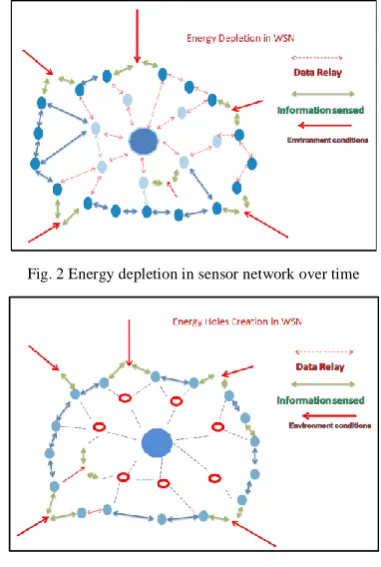
Energy Holes can be of two types, one in outer area and other near the sink node depending on the type of transmission. If direct transmission [9] is used nodes which are far off the sink node needs more transmission power to transmit their data to sink node and therefore deplete their energy faster as compared to nodes near the sink. However in case of multi-hop communication energy holes appears near the sink node. Nodes near the sink node carry heavy traffic as compared to other nodes. With time battery power of nodes start depleting as shown in Fig. 2 and Fig. 3.
Fig. 2 Energy depletion in sensor network over time
ISSN: 2231-5381 http://www.ijettjournal.org
Page 205
IV.ENERGY MODEL USED IN WSN
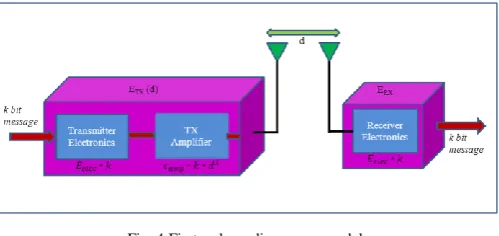
First order radio energy model [10] has been used in many protocols to determine energy efficiency of the protocol as shown in Fig. 4. According to first order radio model depletion of energy in transmission depends on the distance between transmitter and receiver sensors as shown in Eq. 1.
o 4 tworay elec o 2 fmp elec TX d d , d ε s E s d d , d ε s E s ) d , s (
E (2)
Where ETX is the energy consumed in transmission. It
depends on the distance between transmitter sensor and receiver sensor.
Fig. 4 First order radio energy model
If distance is less than cross over point d0 [10] free space
model (d2) is used else multiple-path fading channel model (d4) is used. Energy consumed in receiving is given by Eq. 2.
s E ) k (
ERX elec (3)
𝐸elec is the radio energy dissipation, used to activate the transmitter and receiver circuit board.
𝜀mp and 𝜀tworay are amplifier energies, the energy required by power amplification to achieve an acceptable bit-error rate in the two models.
s is the size of data packet.
V. ANALYSIS OF EXISTING ENERGY HOLES REMOVING
TECHNIQUES
A. Clustering Based Techniques
LEACH [10] is a well-known energy balancing protocol in WSNs. In LEACH sensor nodes are clustered in to cluster members and cluster heads. Cluster heads receive data from members, aggregate it and transmit to the sink. To reduce energy depletion of cluster head, it is changed at every round. A senor node can turn out to be a CH just once in an epoch and sensor nodes not selected as a Cluster Head in present round have a chance to become cluster head in next round. However there is no uniform distribution of cluster heads in LEACH. There is a possibility that nodes in an area not covered by any CH may lead to higher energy depletion and therefore creates energy holes. LEACH is a good energy balancing protocol but it does not provide the solution for energy holes. Fig. 5 shows a cluster formation process in which some nodes are not covered by any cluster head; hence these nodes will deplete power quicker than other nodes in network, leading to energy holes.
Fig. 5 Cluster formation process for 100 sensor nodes
Rasheed et al. have proposed energy efficient hole removing mechanism [11]. They have used sleep and awake mechanism to save energy of sensors. Further they have calculated a threshold energy required for transmission. If nodes’ energy falls below threshold value, nodes do not transmit and goes to sleep state. Nodes far off the sink increases sleep probability. As some nodes are always in sleep mode they can rest and activate when energy of other nodes depleted. However distribution of sleep nodes is not uniform over the network. It is possible that some nodes are in sleep mode and some have depleted their energy near the sink node. Now network will not work. Author in [12] has used a cluster tree repair mechanism to combat holes problem. In order to choose CHs with higher energy, the parameter of cluster head selection is built on the fraction between the average remaining energy of neighbour sensors and the remaining energy of the sensor itself. Bencan et al. have proposed an Energy-Heterogeneous Clustering Scheme to Avoid Energy Holes. This scheme allows the initial energy of the sensors to be diverse with the distance to sink. The nodes nearer to sink have more energy [13].
B. Non-Uniform Node Distribution Techniques
ISSN: 2231-5381 http://www.ijettjournal.org
Page 206
relational to (k+1-i), where k is the optimum number ofcoronas. Lian et al. have proposed a non-uniform technique [18] to improve data capacity of the network. Node relays are added to network to improve data received by the sink. They have also used sleep based scheduling to preserve energy in the network. Advantages of non-uniform strategies are improved network lifetime, improved residual energy ratio and better data delivery ratio but this strategy has disadvantages also for example it incurs some cost in terms of the total number of nodes because more number of nodes has to be deployed near the sink and it can leads to unbalanced energy depletion.
Fig. 6 Corona based non-uniform node distribution strategy for sensor nodes
C. Mobility Based Techniques
Cardei et al. have taken higher node density in region nearer to the sink [19]. They have proposed a movement aided sensor arrangement with the purpose of fulfilling the density requirements according to the distance of sensors from the sink. Marta et al. have used the concept of multiple mobile sinks that changes their location when the neighbouring nodes’ power becomes low [20]. So sinks always move to an area of high energy zone. Fig. 7 shows the movement of sinks from lower energy regions to higher energy regions. Advantages of this approach are good energy utilization and improved network lifetime. But shortcoming of this approach is that sinks must be interconnected all the time.
D. Region Based Techniques
Zhang et al. have divided the sensing field in to several regions and placed more sensors in the areas nearer to the sink. They have examined the spatially unbalanced energy consumption of the region based routing scheme [21]. Advantage of this approach is that it does not required energy information hence there is no influence of energy information synchronization on the performance of network. Disadvantage of the approach is that nodes which are out of communication range uses multi-hop and if a node in its multi-hop path dies, it can’t further communicate as no information about energy level of nodes. Nadeem et al. have also divide the region in to multiple region and used dual communication technique in sink region and cluster region. They have used gateway node to assist transmission between cluster heads and the sink [22]. This approach reduces transmission distance between node and the sink but it increase cost of gateway node deployment
as gateway node is rechargeable. It is not good in situation where gateway node cannot be recharged e.g. in mine area.
Fig. 7 Movement of sinks to maintain energy balance in monitored region
E. Transmission Based Techniques
Jia et al. have proposed a pixel based transmission mechanism to avoid holes. Information for any pixel in the target zone is sent just the once and thus reducing transmission of duplicate messages [23]. This approach solves the energy unbalanced consumption problem of non-uniform node distribution method. Disadvantage of this approach is that each node must be aware of its location. Quang et al. have proposed a transmission range adjustment technique for holes problem [24]. This approach adjusts the transmission range of sensors based on residual energy and their distance from the sink. But this requires calculation at every round.
F. Optimization Based Techniques
Feng et al. have proposed a particle swarm optimization based routing algorithm to avoid energy holes [25].The advantage of this approach is that it gives a generalized process of balanced energy consumption, it is topology independent. However this approach is not applicable to hierarchical network structure. Liao et al. have proposed an ant colony optimization based approach to combat energy holes problem [26]. They have proposed a sweep-based mechanism to move the sensors as requested, further they transformed the placement problem into the multiple knapsack problem. Son et al. have proposed ACO algorithm to solve holes problem by balancing the traffic of data transmitted in the optimum route with transition probability. ACLR practices nodes remaining energy in transition probability to way data packets in a more energy-efficient method [27].
G. Genetic Algorithm Based Techniques
ISSN: 2231-5381 http://www.ijettjournal.org
Page 207
networks. Drawback of this approach is that there is a no coreoptimization device and this approach does not consider multi path routing.
H. Node Deployment Technique:
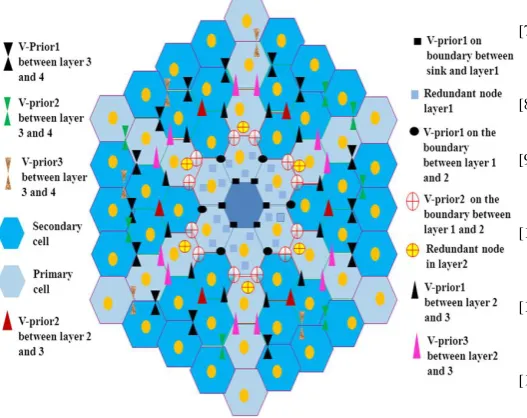
There exist some deployment strategies where location of nodes is fixed. There is no random distribution of nodes like in clustering based protocols. Halder et al. have given a deployment strategy where location of nodes is predetermined [30]. They have divided Network coverage area is into systematic hexagonal cells and layers. The cells of the layer are further categorized in to primary and secondary cells. This approach has improved network lifetime but lacks of flexibility as nodes location is fixed. Fig. 8 gives the complete process scenario.
Fig. 8 Predetermined location of sensors in hexagonal cells and layers
VI.CONCLUSIONS
This paper presents a survey on techniques used for reducing energy holes problem in wireless sensor networks. It has been concluded that among all techniques Non-uniform distribution strategy has been most effective technique. However any of the technique is not capable to completely removing the holes from the network. Non-uniform distribution energy has improved network lifespan and data delivery ratio but it is costly. Clustering techniques provides fair load balancing but some region may remain uncovered. By using different probability distributions for nodes deployment network lifetime can be maximized. An energy holes removing method must consider spatial-temporal aspects for nodes deployment.
ACKNOWLEDGMENT
Rohini Sharma is thankful to the Council of Scientific and Industrial Research, Human Resource Development Group, India for providing necessary fellowship.
REFERENCES
[1] I. F. Akyildiz, W. Su, Y. Sankarasubramaniam, and E. Cayirci, “A survey on sensor networks,” IEEE Commun. Mag., vol. 40, pp. 102– 114, August 2002.
[2] D. Puccinelli, M. Haenggi, “Wireless sensor networks: applications and challenges of ubiquitous sensing,” IEEE Circuits Syst. Mag., vol. 5, pp. 19-31, Sep 2005.
[3] S. Olariu and I. Stojmenovic, “Design Guidelines for Maximizing Lifetime and Avoiding Energy Holes in Sensor Networks with Uniform Distribution and Uniform Reporting,” in Proc. IEEE INFOCOM’ April 2006, pp. 1-12.
[4] N. Ahmed, S.S. Kanhere, and S. Jha, “The holes problem in wireless sensor networks: a survey,” in Proc. SIGMOBILE Mobile Computing and Communications Review 2005, 2009, pp. 4–18.
[5] N. Jabeur, N. Sahli, I.M. Khan, “Survey on Sensor Holes: A Cause-Effect-Solution Perspective,” in Elsevier Proc. 8th International Symposium on Intelligent Systems Techniques for Ad hoc and Wireless Sensor Networks (IST-AWSN) 2013, pp. 1074 – 1080.
[6] I. Khan, H. Mokhtar, and M. Merabti, “An overview of holes in wireless sensor networks,” in Proc. of the 11th Annual Postgraduate Symposium on the Convergence of Telecommunications, Networking and Broadcasting, June 2010.
[7] Q. Fang, J. Gao, and L.J. Guibas. “Locating and bypassing routing holes in sensor networks”, in Proc. INFOCOM 2004. 23th Annual Joint Conference of the IEEE Computer and Communications Societies, vol.4, March 2006, pp.2458-2468.
[8] J. Li, P. Mohapatra, “An analytical model for the energy hole problem in many-to-one-sensor networks,” in Proc. IEEE Vehicular Technology conference vol. 62, Sep 2005, pp. 2721.
[9] T.J. Shepard, “A channel access scheme for large dense packet ratio networks,” in Proc. ACM SIGCOMM Conf. on Appl., technologies, architectures, and protocols for computer communications, Sep 1996, pp. 219-230.
[10] W. B. Heinzelman, A. P. Chandrakasan, and H. Balakrishnan, “Energy-efficient communication protocol for wireless microsensor networks,” in Proc. of the 33rd Hawaii International Conference on system sciences(HICSS), January 2000.
[11] M. B. Rasheed, N. Javaid, Z. A. Khan, U. Qasim and M. Ishfaq, "E-HORM: An Energy Efficient Hole Removing Mechanism in Wireless Sensor Networks," in 26th IEEE Canadian Conference on Electrical and Computer Engineering (CCECE), 2013.
[12] Ganesan. T, “Cluster Head Load Balance and Achievement of Maximum Lifetime by Energy Awareness of WSNs,” International J. Comp. Sci. Eng. Technol., vol. 4, 10 Oct 2013.
[13] G. Bencan , J. Tingyao , X. Shouzhi , and C. Peng, “An Energy-Heterogeneous Clustering Scheme to Avoid Energy Holes in Wireless Sensor Networks,” Int. J. Distri. Sens. Netw. 2013, Article ID 796549. [14] X. Wu, G. Chen, and S.K Das, “On the Energy Hole Problem of
Nonuniform Node Distribution in Wireless Sensor Networks,” in Proc. Mobile Adhoc and Sensor Systems (MASS), IEEE 2006 ,pp. 180-187. [15] X. Wu, G. Chen, and S. K. Das, “Avoiding energy holes in wireless
sensor networks with nonuniform node distribution,” IEEE Trans. Parall. Distrib. Sys., vol. 19, pp.710-720, May 2008.
[16] G. Ma, and Z. Tao, “A Nonuniform Sensor Distribution Strategy for Avoiding Energy Holes in Wireless Sensor Networks,” Int. J. Distrib. Sens. Netw. vol. 2013, Article ID 564386, 14 pages,2013.
[17] A. Pathak, Zaheeruddin, D.K.Lobiyal, “ Maximization the lifetime of wireless sensor network by minimizing energy hole problem with exponential node distribution and hybrid routing,” IEEE, Engineering and Systems (SCES), Students Conference, march 2012, pp. 1-5. [18] J. Lian, K. Naik, and G. Agnew,” Data capacity Improvement of
wireless sensor networks using Non-uniform sensor distribution,” Int. J. Distrib. Sens. Netw., vol. 2, pp.121-145, June 2006.
[19] M. Cardei, Y. yang, and J. Wu, “Non-uniform sensor deployment in mobile wireless sensor networks,” in IEEE International Symposium on a World of Wireless, Mobile and Multimedia Networks, (WoWMoM’08), June, 2008.
ISSN: 2231-5381 http://www.ijettjournal.org
Page 208
[21] X. Zhang, Z. Da Wu, “The balance of routing energy consumption inwireless sensor networks,” J. Parallel Distrib. Comput., vol 71, pp.1024-1033, April 2011.
[22] Q. Nadeem , M.B. Rasheed, N. Javaid, Z.A. Khan, Y. Maqsood, and A.Din, “M-GEAR: gateway-based energy-aware multi-hop routing protocol for WSNs,” in IEEE International Conference on Broadband and Wireless Computing, Communication and Applications (BWCCA), Oct. 2013, pp.164-169.
[23] J. Jia, J. Chen, X. Wang, and L. Zhao, “Energy-Balanced Density Control to avoid Energy Hole for Wireless Sensor Networks,” Int. J. Distrib. Sens. Netw. vol. 2012, Article ID 812013, 10 pages, 2012. [24] V. Tran-Quang, T. Miyoshi, “A transmission range adjustment
algorithm to avoid energy holes in wireless sensor networks,” in IEEE 8th Asia-Pacific Symposium on Information and Telecommunication Technologies (APSITT), June 2010, pp.1-6.
[25] L. An-Feng, M.A. Ming, C. Zhi-Gang, and GUI Wei-hua, “Energy-Hole Avoidance Routing Algorithm for WSN,” in IEEE fourth International Conference on Natural Computation. 2008.
[26] W. Liao, S. Kuai, M. Lin, “An Energy-Efficient Sensor Deployment Scheme for Wireless Sensor Networks Using Ant Colony Optimization Algorithm,” Wireless Personal Communications, Springer, Feb 2015. [27] Z. Son, M. H. Shon, M. Kim, and H. Choo, “An Energy Efficient Hole
Detour Scheme Using Probability Based on Virtual Position in WSNs,” Int. J. Softw Eng Appl, vol. 6, No. 3, July, 2012.
[28] L. An-Feng, M. Ming, C. Zhi-Gang, and G. Wei-hua, “A global optimal energy-hole avoidance routing algorithm for WSN,” in Control and Decision Conference, CCDC 2008.
[29] L. An-Feng, M. Ming, C. Zhi-Gang, and G. Wei-hua, “A Multi-Path Energy Hole Avoidance Routing Algorithm for WSN Based on GA,” in Wireless Communications, Networking and Mobile Computing, WiCOM '08, 4th International Conference, Dalian.