
Article
Three-Dimensional Modeling Interaction of Shock
Wave
with
Fin
at
Mach
5
AmjadA.Pasha
Department of Aeronautical Engineering, King Abdul Aziz University, Jeddah-21589, Saudi Arabia; [email protected]
Abstract: The three-dimensional single fin configuration finds application in an intake
1
geometry where the cowl-shock wave interacts with the side-wall boundary-layer. Accurate
2
numerical simulation of such three-dimensional shock/turbulent boundary-layer interaction flows,
3
which are characterized by the appearance of strong crossflow separation, is a challenging
4
task. Reynolds-averaged Navier-Stokes computations using the shock-unsteadiness modified
5
Spalart-Allmaras model is carried out at Mach of 5 at large fin angle of 23◦. The computed results
6
using the modified model are compared to the standard Spalart-Allmaras model and validated
7
against the experimental data. The focus of work is to implement the modified model and to study
8
the flow physics in detail in the complex region of swept-shock-wave turbulent boundary-layer
9
interaction in terms of the shock structure, expansion fan, shear layer and the surface streamlines.
10
The flow structure is correlated to the wall pressure and skin friction in detail. It is observed that the
11
standard model predicts an initial pressure location downstream of the experiments. The modified
12
model reduces the eddy viscosity at the shock and predicts close to the experiments. Overall, the
13
surface pressure using modified model is predicted accurately at all the locations. The skin friction
14
is under predicted by both the models in the reattachment region and is attributed to the poor
15
performance of turbulence models due to flow laminarization.
16
17 Keywords: high speed flows; shock wave; turbulent boundary layer; shock-unsteadiness; separation bubble; turbulence modeling; single fin
18
Nomenclature 19
b′1 = shock-unsteadiness damping parameter Cf = skin friction coefficient
c′b
1 = shock-unsteadiness parameter
M1n = upstream Mach number normal to shock
y+2 = wall-normal distance to the nearest point in wall coordinates δ0 = boundary-layer thickness upstream of interaction
µT = eddy viscosity
ν = kinematic molecular viscosity ˜
ν = modified turbulent kinematic viscosity subscripts
0 = stagnation condition
n = normal to shock wave
w = wall condition
∞ = freestream condition
abbreviation
CFL = CourantFriedrichsLewy
SA = Spalart-Allmaras
20
1. Introduction 21
The most fundamental three-dimensional shock/boundary-layer interaction is generated on a 22
single fin configuration. It consists of a flat plate with a sharp fin mounted perpendicular to it. The 23
oblique shock wave generated by the fin interacts with the turbulent boundary layer on the plate and 24
results in flow separation. The three-dimensional vortical flow thus generated alters the inviscid flow 25
pattern. Additional shock waves, expansion regions and free shear layers are generated that result 26
in a complex flow in the interaction region. Practical applications of single fin configuration include 27
scramjet inlets, where the oblique shock generated by the cowl interacts with the side wall boundary 28
layer. 29
The single fin shock boundary-layer interaction flows are characterized by localized regions 30
of increased pressure, skin friction and heat transfer rate. Prediction of these surface properties is 31
important in the design of scramjet inlets. In addition, the flow distortion caused by the interaction 32
can degrade the performance of these inlets significantly. Therefore the aerodynamic loads generated 33
from these interactions play a significant role in the structural integrity of hypersonic vehicle [1,2]. 34
Computational fluid dynamic approach is a useful tool to understand the complex three-dimensional 35
flow pattern in these shock-wave/boundary-layer interactions and to predict its influence on the 36
wall data. The direct numerical simulation and large eddy simulation demand a large number of grid 37
points at high Reynolds number flows leading to large computational resources and computational 38
times to capture the fine features of shock-wave/turbulent boundary-layer interaction cases [3]. As 39
an engineering approach, Reynolds-averaged Navier-Stokes (RANS) method is applied in the present 40
work along with one-equation turbulence models to compute these flowfields. 41
Experiments and computations were carried by many authors [4–9] for single fin geometry. 42
Panaras [9] computed using RANS code for deflection angle of β = 20◦ and M∞ = 3.0. The wall 43
pressure data was improved using modified Baldwin-Lomax model compared as to the standard 44
Baldwin-Lomax model. Edwards et al. [6] studied the performance of four different one-equation 45
turbulence models forM∞ =8 andθ= 15◦. Among them the standard Spalart-Allmaras model has 46
shown to predict the surface properties close to the experiments. Thivet [8] computed three different 47
single fin configuration cases withM∞ =3,θ= 15◦,M∞ =4,θ= 20◦and M∞ =4,θ= 30.6◦, using 48
the standard and modifiedk-ω models. The prediction of secondary vortex region was improved 49
using modifiedk-ωmodel, hence improving the wall data in this region. The review articles [10–15] 50
discusses different single fin configurations flow physics and wall data in detail. 51
The shock-unsteadiness modified Spalart-Allmaras model of Sinha et al. [16] has shown potential 52
in improving separation bubble prediction in two-dimensional supersonic compression corner flows 53
and axisymmetric hypersonic cone-flare flows [17]. In this paper, an attempt is made to extend this 54
model to three-dimensional single fin configuration flows and study the flowfield in detail. First, 55
the test case is described, which is followed by the simulation methodology. Next, the flowfield 56
is explained for the strongest shock strength case with fin deflection angle of 23◦and M∞= 5 using 57
modified Spalart-Allmaras model. Next, the computed wall pressure and skin friction using modified 58
model [16] and the standard model [18] is compared with the experimental results [19]. 59
2. Test case 60
The schematic of the single fin configuration used in the experiments of Schulein [19] is shown 61
in Figure1. The fin is inclined with a deflection angle ofθ= 23◦ to the flow direction at M∞ = 5. 62
The stagnation temperature ofT0 =410 K and stagnation pressureP0=2.12 MPa were taken in the 63
reservoir of the Ludweig tube experimental facility. A fin of height = 100 mm normal to the flat plate 64
is taken. The fin tip is placed at a distance of 286 mm downstream of the flat plate edge. Both the 65
flat plate and fin wall are maintained under the isothermal condition of 300 K. The flow is turbulent, 66
upstream of the interaction region with a unit Reynolds number ofRe1∞= 37×106m−1. Wall data 67
like pressure, skin friction and heat transfer rates were measured at different cross sections in the 68
boundary-layer properties were measured on the flat plate at a distance of 20 mm upstream of the 70
fin tip. The boundary layer thicknessδ of 3.8 mm, displacement thickness = 1.6 mm, momentum 71
thickness = 0.16 mm and skin frictionCf = 1.35×10⁻³is measured.
72
Single−Fin
Fin−tip
z x
y o
Flat−plate wave
Inviscid shock
Fin wall
23
Turbulent boundary
layer
82 mm 92 mm 102 mm 122 mm 142 mm 152 mm 162 mm 182 mm
Sections
Deflection angle,θ
Flow
Origin
Figure 1.Three-dimensional single fin configuration with fin mounted on the flat plate. The surface
measurements [19] were taken along the dashed lines.
Flat−plate Fin−wall
Exit Top
k
23
j i o
k
Flow
Inlet
Extrapolation
Figure 2.Computational domain with appropriate boundary conditions.
3. Simulation methodology 73
The three-dimensional Reynolds-averaged Navier-Stokes equations [20] are taken in the 74
numerical simulations. The turbulence model equations are fully coupled to the mean flow 75
equations. The shock-unsteadiness modified Spalart-Allmaras model of Sinha et al. [16] and its 76
standard version [18] is used for calculating the eddy viscosity. A compressible correction to 77
standard Spalart-Allmaras model has been proposed by Catris et al. [25] by modifying the diffusion 78
laws in the turbulence model, but this strategy complicates the numerical implementation for 79
where the inviscid fluxes are computed using a modified low-dissipation form of the Steger-Warming 81
flux-splitting approach. The method is second-order accurate both in stream wise and wall-normal 82
directions. The viscous fluxes and the turbulent source terms are evaluated using central difference 83
method. More details of the numerical method are given in Ref. [21]. The code is capable of 84
running on parallel machines and has been used successfully in several supersonic and hypersonic 85
applications [16,17,22,23]. 86
The shock-unsteadiness modified Spalart-Allmaras model of Sinha et al. [16] accounts for the effect of unsteady shock motion in a steady mean flow. The shock-unsteadiness correction is achieved by adding a source term of the form−c′b
1ρ¯ν˜Sii in the transport equation for ¯ρν˜, where ¯ρ is mean density ˜ν is modified turbulent kinematic viscosity, Sii is mean dilatation and shock-unsteadiness
parameter
c′b1 = 4
3(1−b ′
1)−
2 3c
′
ϵ1. (1)
Note that this additional term is effective only in regions of strong dilatation and therefore does not alter the standard Spalart-Allmaras model [18] elsewhere. Here, b′1 is model parameter andc′ϵ1 =
1.25+0.2(M1n−1). The model parameterb′1represents the coupling between the unsteady shock motion and the upstream velocity fluctuations, and is given by,
b1′ =max
[
0, 0.4
(
1−e1−M1n
)]
(2)
It is zero for subsonic flows without shock waves and it reaches an asymptotic value of 0.4 for high 87
Mach numbers. The detailed formulation of shock-unsteadiness modified Spalart-Allmaras model 88
and its implementation for two-dimensional compression corner and axisymmetric cone-flare flows 89
at supersonic and hypersonic Mach numbers is presented in Refs. [16,17]. In the current work, 90
the modification is applied to the three-dimensional flows which are more difficult to simulate as 91
compared to their counterpart two-dimensional flows. 92
The computational domain and boundary conditions for three-dimensional single fin 93
configuration are identified in Figure 2. The freestream conditions taken in the simulations are 94
T∞ = 68.3 K and p∞ = 4008.5 Pa. At the fin wall and flat plate, a constant wall temperature of 95
300 K and no-slip velocity condition is applied. An extrapolation boundary condition is assigned at 96
top and exit planes. The freestream and wall boundary conditions for the turbulence model variables 97
are taken as ˜ν∞= 0.1ν∞and(νT)w=0. Inlet profiles for the computations are obtained from separate
98
two-dimensional flat plate simulation at the freestream and wall boundary conditions identical to 99
those listed above. The value of the momentum thickness reported in the experiments [19] is matched 100
to obtain the mean flow and the turbulence profiles at the inlet boundary of the computational 101
domain. 102
A single-block grid is generated using a code and a careful grid refinement study is performed 103
by systematically varying the number of grid points in each direction, as well as refining the cell size 104
in critical regions. The origin is taken at a tip of the single fin and the grid is stretched exponentially 105
in the upstream and downstream directions of origin with initial grid size of 1×10⁻⁴m. A structured 106
mesh with exponential stretching normal to the plate and fin walls are used to span the computational 107
domain. Wall pressure and skin friction coefficient are found to be sensitive to the computational 108
mesh and are used to identify a grid converged solution. First, the number of points in the wall 109
parallel direction is refined and it is observed that among the three grids, the 100×110×110, 110
140×110×110, and 200×110×110, the last two grids match. Next, 140×110×110 grid is taken 111
and only the distance of the first cell center from the wall is successively reduced by halve-times from 112
its initial value of 2×10⁻⁶m. Wall pressure andCf variation indicate that 1×10⁻⁶m is sufficient for
113
an accurate solution. They+2 varies between 0.06 in the undisturbed boundary-layer o a maximum 114
value ofy+2 <0.6 in the shock/boundary-layer interaction region. This value of they+2 is sufficient 115
wall-normal direction, especially at the reattachment region. In the next step, using 140×110×110 117
grid, the number of points in the transverse direction is increased. It is observed that variation in wall 118
pressure and skin friction for 140×160×110 and 140×200×110 is less than 3%. Finally, the number 119
of points in the flat plate normal direction is increased to arrive at the 140×160×160 grid. Surface 120
properties variation shows that further refinement to 140×160×200 grid points yields less than 2% 121
variation in wall pressure and skin friction. A converged grid of 140×160×160 is obtained with 140 122
points along the streamwise direction, 160 points transverse to the flow and 160 points normal to the 123
plate. 124
In the present computations, a CFL of 0.05 is used at the beginning and it is gradually increased 125
to 10 in the first 3500 iterations. It is further increased to 100 at 6000 iterations and to 1000 at 8000 126
iterations. A maximum CFL of 5000 is used after 10000 iterations. The corresponding time steps 127
vary from 2×10⁻¹² sec for the initial iterations to 2×10⁻⁵sec at steady state solution. It takes 190 128
cpu-hours to reach the steady state solution in 30,000 iterations. 129
4. Flow physics 130
In this section, the computed results using modified Spalart-Allmaras model are discussed. An 131
isometric view of the flow solution for the fin is shown in Figure3. The pressure contours are taken 132
at two x-sections of 92 and 182 mm to identify the shock structure. The flow pattern is indicated by 133
the streamlines taken in the cell adjacent to the flat plate and behave similarly to the skin friction 134
lines. A planar shock-wave generated by the fin interacts with the turbulent boundary-layer on the 135
plate. It separates the boundary-layer and results in the formation of the separation shock. The flow 136
separates at the primary separation line S1 and attaches at the primary reattachment line R1 near the 137
fin wall. The streamlines converge at separation line S1 and the fluid moves upwards normal to the 138
plate and then turns in a counter clockwise direction to form a helical flow as shown in Figure4. Two 139
stream surfaces originating atz/δ0= 0.8 andz/δ0= 0.25 are shown, wherezis the normal distance 140
from the plate andδ0is the undisturbed boundary-layer thickness. The fluid impinges on the plate at 141
the reattachment line from the top, making the streamlines diverge in either direction. The inviscid 142
X
Y Z
12 10 7 4 1
Fin-tip
(origin)
Fin-wall
Reattachment
line (R1)
Planar
shock
Separation
line (S1)
p/p
∞Separation
shock
Flat-plate
Figure 3. Flow solution in a single fin shock/boundary-layer interaction in terms of the computed
surface streamlines on the plate. The shock structure is shown by pressure contours at x-sections = 92 mm and 182 mm.
X Y Z
Fin wall
Streamline surfaces Separation
shock
Reattachment line
z/δ0= 0.25 z/δ0= 0.8
Vortex core
Separation line Pressure
contours
Figure 4.Computed stream-surfaces starting atz/δ0= 0.8 andz/δ0= 0.25 showing vortex region, and
Figure 5.Computed stagnation pressure contours at x-section = 122 mm.
1.5
2.3 2.3
2.5 2.6
2.6 2.5
2.6
3.9 2.8
4.9 4.4 4.1
2.4
2.9
3.7 3.3 3.1
3.4 3.0 3.0 3.0
3.0
3.2 2.8
2.8
3.6 2.6
3.4
3.3
y/x
z/
x
0.5 0.6 0.7 0.8 0.9
0 0.1 0.2
0.3 3.8
2.5 1.3 0.1 M
Separation shock Triple point Expansion
region
Shear-layer
5.0
Fin vortex
Rear shock Inviscid shock
Figure 7.Enlarged region of computed Mach contours at x-section = 122 mm.
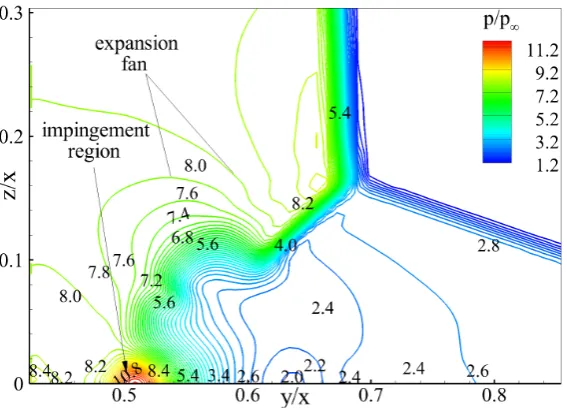
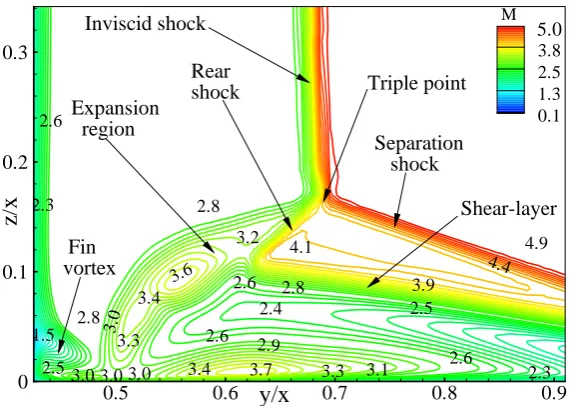
The computed stagnation pressure contours in Figure5indicate that an inviscid shock bifurcates 144
and forms a separation shock and a rear shock, and results in the formation of lambda structure in a 145
cross plane perpendicular to the freestream flow direction. The shear-layer is formed over the vortex 146
region, which emanates from the separation point. It interacts with the rear shock-wave and then 147
rolls up and turns back to form a tongue. An entropy layer is generated from the triple point of the 148
intersection of three shock waves and a set of compression and expansion waves are formed between 149
the shear layer and the slip line (see Figure7). A secondary flow separation region was observed in 150
the experiments [19], whereas in the present computation, it is not predicted. The computed pressure 151
contours in Figure6indicate that an expansion fan is generated when the rear shock-wave reflects 152
from the shear layer. The computed Mach contours in Figure7 shows that a type-IV shock-shock 153
interaction [24] is observed at the triple point. An alternate increase and decrease in Mach contours in 154
the region between shear layer and jet represents the weak compression and expansion waves. The 155
flow remains supersonic in the separated region. Small subsonic pockets are observed near the corner 156
region of fin wall and plate. The impingement of the supersonic jet (entropy layer) emanating from 157
the triple pointof shock-shock interaction results in peak values of pressure as indicated in the region 158
marked in Figure6. A small fin-vortex is formed when the fluid coming from the inviscid region 159
interacts with fin wall and turns in the clockwise direction, as viewed from the downstream direction. 160
Similar, corner-vortex was observed in the vapor screen images of the experiments [4]. The schematic 161
5. Comparison of computed wall data with experiments 163
Figure 8.Computed pressure contours overlapped with wall pressure at x-section = 122 mm.
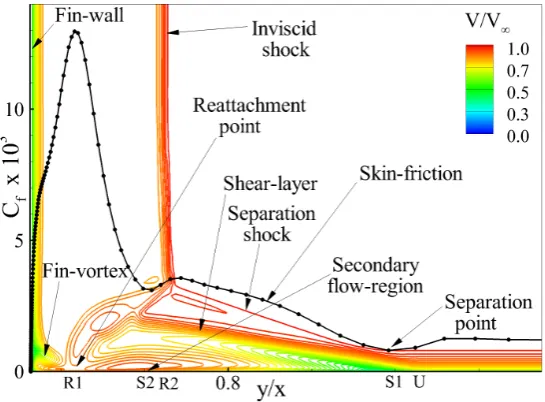
Figure 9.Computed speed contours overlapped with skin friction coefficient at x-section = 122 mm.
Figures8and 9 shows the computed pressure and speed contours, overlapped with the wall 164
pressure and skin friction on the flat plate at x-section = 122 mm. The distance along the y-axis is 165
normalized with the corresponding x-section distance measured from the fin tip. The surface data 166
is taken along the dashed lines as shown in Figure 1. The wall pressure remains constant in the 167
undisturbed boundary-layer before the interaction region. The separation shock affects the upstream 168
flow at the point of influence U and the wall pressure rises effectively across the separation shock 169
at primary separation point S1. It remains constant in the separated vortex flow and rises to peak 170
values at primary reattachment R1. The wall pressure then decreases away from the reattachment 171
region and rises near the fin-plate junction. The skin friction does not vary significantly in the 172
unperturbed boundary-layer before the region of influence U. The boundary-layer is compressed 173
friction. The skin friction reaches a peak value at the reattachment point R1 due to the high values of 175
the velocity gradient, hence shear stress. 176
Figure 10.Comparison of computed wall pressure at x-section = 152 mm with experiments [19] using
standard Spalart-Allmaras (SA) model [18] and modified Spalart-Allmaras model [16].
Figure 11.Comparison of computed skin friction at x-section = 122 mm with experiments [19] using
standard Spalart-Allmaras (SA) model [18] and modified Spalart-Allmaras model [16].
Figure10indicates that at x-section = 152 mm, experiments give an initial pressure rise location 177
at y/x = 1.22, where as the standard Spalart-Allmaras model predicts a delayed separation at y/x = 178
1.14. A similar trend is observed by the standard model at all other x-sections as shown in Table1. A 179
vortex region is calculated based on the distance between S1 and R1. The standard Spalart-Allmaras 180
model predicts a small vortex region of 74 mm as compared to the experimental value of 82 mm. The 181
skin friction coefficient predicted by the standard model in Figure11matches close to the experiments, 182
except in the secondary flow separation region. The model also under-predicts the peak values in the 183
reattachment region. 184
The shock-unsteadiness correction of [16] is applied to the complex region of three-dimensional 185
shock/boundary-layer interaction by evaluating the shock-unsteadiness parameter c′b
1 in Eq.1. It 186
is a function of the upstream normal Mach number M1n and needs to be evaluated at each shock
187
wave so as to implement the shock-unsteadiness correction. The three-dimensional shock structure 188
in the single fin configuration is quite complex. It is not easy to find the orientation of the different 189
shock waves and the inclination of the upstream flow at each shock. Therefore, it is a difficult task 190
to calculate the mean value of M1n. An alternate approach is to use different values of c′b1 in the
191
current single fin case to improve the flow predictions. A similar approach by Gaitonde et al. [27] was 192
used for simulating three-dimensional double-fin shock/boundary-layer interaction. The turbulence 193
model. A smaller value of model constant resulted in lower turbulent kinetic energy. Hence, the 195
computed solution resulted in a larger separated region and matched well with the experimental 196
flowfield and wall pressure. 197
3500
500 4500
6000 10500
2000
2500 2500
500
4000 1000
14500 8500
7000
y/x
z/
x
0.6 0.8 1 1.2
0.1
0.2 140009500
5000 500
µ
T/
µ
∞Figure 12. Computed normalized eddy-viscosity contours at x-section = 122 mm using standard
Spalart-Allmaras model [18].
3000
500 4500
6000 10500
2000
2500 2000
500
3000 1000
14500 8500 6500
y/x
z/
x
0.6 0.8 1 1.2
0.1
0.2 140009500
5000 500
µ
T/
µ
∞Figure 13. Computed normalized eddy-viscosity contours at x-section = 122 mm using
shock-unsteadiness modified Spalart-Allmaras model [16].
Table 1. Comparision of primary separation point S1 and reattachment point R1 using standard
Spalart-Allmaras (SA) and shock-unsteadiness modified SA model with the experiments [19] at different x-sections on the flat plate.
S1 R1
x-section, experiment SA modified experiment SA modified
mm SA SA
82 1.3 1.24 1.3 - 0.5 0.5
92 1.27 1.22 1.27 - 0.51 0.51
122 1.23 1.16 1.21 - 0.51 0.51
152 1.22 1.14 1.2 0.52 0.52 0.52
162 - 1.13 1.18 - 0.51 0.51
182 - 1.12 1.15 0.52 0.52 0.52
In the present case, a shock-unsteadiness parameter of c′b
1 = -0.2 is chosen to yield a larger 198
separation and is found to match the experimental initial pressure rise location closely as indicated in 199
Figure10. The shock-unsteadiness correction reduces the turbulent eddy viscosity in the region of the 200
separation shock. This causes an increase in the length of the separation shock and hence brings the 201
separation point predictions close to the experiments. The same trend is observed in the axisymmetric 202
Figures12and 13indicate that the modification predicts lower values ofµT/µ∞in the region of
204
y/x≃1.2, as compared to the standard Spalart-Allmaras model. Hence, the modified model improves 205
the initial pressure rise location S1 (see Figure10). Also, the pressure distribution is well predicted 206
in the reattachment region and the corner region of the plate fin junction by the modified model as 207
compared to the standard model. 208
Figure11depicts that the modified model over predicts the skin friction between y/x = 0.65 and 209
0.72. Whereas, it under predicts the skin friction by 42% at the reattachment region R1. Panaras [15] 210
attributed this under prediction of skin friction due to the poor performance of turbulence models. 211
The models indicated lower values of turbulence inside the separation vortices, making the flow 212
almost laminar in this region. More advanced two-equation turbulence models [16? ? ] can be 213
applied to capture the velocity gradients, hence predict the peak skin friction at the reattachment 214
region accurately. Currently, this is beyond the scope of work. The modified Spalart-Allmaras model 215
predicts vortex region length between S1 and R1 to be 79 mm which is close to the experiment. The 216
computed locations of primary separation point S1 and reattachment point R1 are compared with the 217
experimental data at different x-sections in Table1. Overall, the modified Spalart-Allmaras model 218
matches to the experimental data at all locations. 219
6. Conclusion 220
Reynolds-averaged Navier-Stokes based computations were carried out to investigate the 221
three-dimensional shock/boundary-layer interaction in a single fin configuration at Mach 5 with 222
a large deflection angle of 23◦. The shock-unsteadiness modified Spalart-Allmaras model and its 223
standard version are used in the computations. The inviscid shock generated by the fin interacts 224
with the boundary layer on the adjacent flat plate and results in a formation of a complex region. 225
The viscous effects cause the bifurcation of inviscid shock and result in the formation of a lambda 226
shock structure, one edge being the separation shock and the other being the rear shock. Type-IV 227
shock-shock interaction results from the interaction of these shock waves. The lambda shock encloses 228
a cross flow conical vortex. A shear-layer emanates from the separation point and interacts with the 229
rear shock-wave and then rolls up and turns back to form a tongue. An entropy layer is generated at 230
the triple point and a set of compression and expansion waves are embedded in it and the shear layer. 231
These flow features influence the wall pressure and skin friction and a correlation between them is 232
explained. The standard Spalart-Allmaras model predicts initial pressure location downstream of 233
experiments. The shock-unsteadiness correction leads to an improvement in prediction of the initial 234
pressure rise location. This leads to an accurate prediction of vortex size, hence the shock structure. 235
The skin friction is under predicted at reattachment region in comparison to experiments by both 236
the modified model and its standard version. This behavior is attributed to the poor performance of 237
these models due to the prediction of laminar flow in this region. Further improvements to the present 238
computations are envisaged by simulating the more advanced two-equation turbulence models. 239
7. Acknowledgment 240
The author would like to thank Prof. Krishnendu Sinha from Department of Aerospace 241
Engineering, Indian Institute of Technology Bombay, for his valuable guidance, help and selflessness 242
time investment to accomplish this work. 243
References 244
1. Bose, D., Brown, J. L., Prabhu, D. K., Gnoffo, P., Johnston, C. O., and Hollis, B. Uncertainty assessment 245
of hypersonic aerothermodynamics prediction capability. Journal of Spacecraft and Rockets200350(1) 12-18, 246
DOI. 247
2. Marvin, J. G., Brown, J. L., and Gnoffo, P. A. Experimental database with baseline CFD solutions: 2-d and 248
3. Yang Z. Large-Eddy simulation: past, present and the future.Chinese Journal of Aeronautics201528(1) 11-24, 250
DOI. 251
4. Kubota, H. and Stollery, J. An experimental study of the interaction between a glancing shock wave and a 252
turbulent boundary layer.Journal of Fluid Mechanics1982116431-58, DOI. 253
5. Alvi, F. S. and Settles, G. Physical model of the swept shock wave/boundary layer interaction flowfield. 254
AIAA Journal199230(9) 2252-2258, DOI. 255
6. Edwards, J. R. and Chandra, S. Comparison of eddy viscosity-transport turbulence models for 256
three-dimensional shock-separated flowfields.AIAA Journal199634(4) 756-763, DOI. 257
7. Panaras, A. G. The effect of the structure of swept-shock-wave/turbulent boundary-layer interactions on 258
turbulence modeling.Journal of Fluid Mechanics1997338203-230, DOI. 259
8. Thivet, F. Lessons learned from RANS simulations of shock wave/boundary layer interactions. AIAA 260
Paper 2002-0583, Jan. 2002. 261
9. Panaras, A. G. Calculation of flows characterized by extensive crossflow separation. AIAA Journal2004 262
42(12) 2474-2475, DOI. 263
10. Delery, J., Marvin, J. G. and Reshotko, E. Shock-wave boundary layer interactions. AGARDograph No. 280, 264
ISBN 92-835-159-6, 1996. 265
11. Panaras, A. G. Review of the physics of swept-shock/boundary layer interactions. Progress in Aerospace 266
Sciences199632173-244, DOI. 267
12. Knight, D. D., and Degrez, G. Shock wave turbulent boundary layer interactions in high mach number 268
flows–a critical survey of current numerical prediction capabilities. AGARD Advisory Report1998319(2) 269
pp. 1.1-1.35. 270
13. Knight, D., Yan, H., Panaras, A. G., and Zheltovodov, A. Advances in CFD prediction of shock wave 271
turbulent boundary layer interactions.Progress in Aerospace Sciences200339(2-3) 121-184, DOI. 272
14. Babinsky, H. and Harvey, J. K. InShock wave-boundary-layer interactions; Cambridge University Press, 2011. 273
15. Panaras, A. G. Turbulence modeling of flows with extensive crossflow separation. Aerospace20152(3) 274
461-481, DOI. 275
16. Sinha, K., Mahesh, K., and Candler, G. V. Modeling the effect of shock-unsteadiness in shock/turbulent 276
boundary-layer interactions.AIAA Journal200543(3) 586-594, DOI. 277
17. Pasha, A. A., and Sinha, K. Shock-unsteadiness model applied to hypersonic shock wave/turbulent 278
boundary-layer interactions.Journal of Propulsion and Power201228(1) 46-60, DOI. 279
18. Spalart, P. R., and Allmaras, S. R. A one-equation turbulence model for aerodynamic flows. AIAA Paper 280
1992-0439, 1992. 281
19. Schulein, E. Optical skin friction measurements in short-duration facilities. AIAA Journal 2006 44(8) 282
1732-1742, DOI. 283
20. Wilcox, D. C. InTurbulence modeling for CFD; La Canada, CA: DCW Industries, 2nded., 2000, pp. 491-492. 284
21. Sinha. K., Candler G.V., Convergence improvement of two-equation turbulence model calculations. AIAA 285
Paper,AIAA-98-2649, 1998. 286
22. Pasha, A. A. and Sinha, K. Shock-Unsteadiness model applied to oblique shock-wave/turbulent 287
boundary-layer interaction.International Journal of Computational Fluid Dynamics200822(8) 569-582, DOI. 288
23. siva:2009 Reddy, D. S. K. and Sinha, K. Hypersonic turbulent flow simulation of fire II re-entry vehicle 289
afterbody.Journal of Spacecraft and Rockets200946(4) 745-757, DOI. 290
24. Edney, B. E. Anomalous heat transfer and pressure distributions on blunt bodies at hypersonic speeds in 291
the presence of an impinging shock. The Aeronautical Research Institute of Sweden, Stockholm, FFA Rept. 292
115, Feb. 1968. 293
25. Catris, S. and Aupoix, B. Density corrections for turbulence models. Aerospace Science and Technology2000 294
4(1) 1-11, DOI. 295
26. Deck, S., Duveau, P., d’Espiney, P., and Guillen, P. Development and application of SpalartAllmaras 296
one-equation turbulence model to three-dimensional supersonic complex configurations.Aerospace Science 297
and Technology20026(3) 171-183, DOI. 298
27. Gaitonde, D. V. Progress in shock-wave/boundary-layer interactions. Progress in Aerospace Sciences2015 299
72180-99, DOI. 300
28. Quadros, R., Sinha, K., and Larsson, J. Turbulent energy flux generated by shock/homogeneous turbulence 301
29. Quadros, R., and Sinha, K. Modelling of turbulent energy flux in canonical shock-International Journal of 303
![Figure 1. Three-dimensional single fin configuration with fin mounted on the flat plate. The surfacemeasurements [19] were taken along the dashed lines.](https://thumb-us.123doks.com/thumbv2/123dok_us/1050095.1605248/3.595.167.436.407.608/figure-dimensional-single-conguration-mounted-at-surfacemeasurements-dashed.webp)

![Figure 10. Comparison of computed wall pressure at x-section = 152 mm with experiments [19] usingstandard Spalart-Allmaras (SA) model [18] and modified Spalart-Allmaras model [16].](https://thumb-us.123doks.com/thumbv2/123dok_us/1050095.1605248/10.595.171.425.331.480/comparison-computed-experiments-usingstandard-spalart-allmaras-modied-allmaras.webp)
![Figure 12. Computed normalized eddy-viscosity contours at x-section = 122 mm using standardSpalart-Allmaras model [18].](https://thumb-us.123doks.com/thumbv2/123dok_us/1050095.1605248/11.595.138.462.140.257/figure-computed-normalized-viscosity-contours-section-standardspalart-allmaras.webp)
