Hardware Implementation of Interleaved
Converter with Voltage Multiplier Cell for PV
System
Kiruthiga. G Kalyana Sundaram M.S
PG Student Assistant Professor
Department of Electrical and Electronics Engineering V.S.B. Engineering College, Karur V.S.B. Engineering College, Karur
Abstract
A novel high step-up converter, which is suitable for renewable energy system is proposed in this paper. A voltage multiplier cell composed of switched capacitors and diodes. The configuration of the proposed converter not only reduces the current ripple and also increases the life span of converters. Due to the lossless passive clamp circuits, the leakage energy is recycled to the output terminals. Hence large voltage spike is avoided. Even the low voltage stress makes the low-voltage-rated MOSFETs can be adopted for reductions of conduction losses and cost. Efficiency improves because the energy stored in leakage inductances is recycled to the output terminal. This design analysis is simulated using hardware which illustrate the better performance of the converter.
Keywords: Photovoltaic System, Voltage Multiplier Module, IBC, High Step-Up.
________________________________________________________________________________________________________
I.
INTRODUCTION
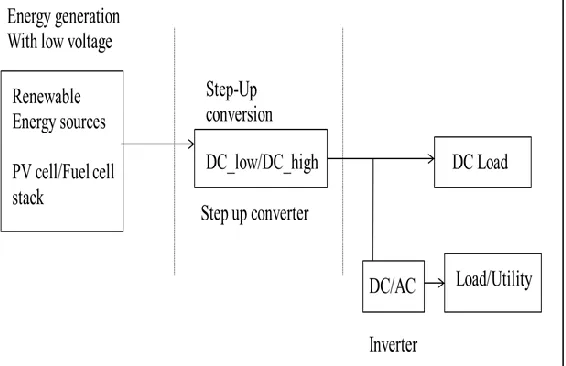
The renewable energy-based distributed generation systems are warmly welcomed and grown up rapidly in recent years, which are powered by multiple sources such as the fuel cells, photovoltaic (PV) panels. Unfortunately, the output voltage of most PV panel is lower than 50 V and the PV series-connected configuration is the commonly employed solution to satisfy the second-stage grid-connected inverter applications. Such systems transform energy from renewable sources into electrical energy, and convert low voltage into high voltage via a step-up converter, which can convert energy into electricity using a grid-by-grid inverter or DC-Micro grid. Theoretically step-up converters such as boost converter, flyback converters cannot achieve a high step-up conversion with high efficiency because of the elements of the resistances and leakage inductances also the voltage stresses are large. Thus in recent years many converters have been developed Conventional interleaved boost converter(IBC) is an excellent candidate for high-power applications and power factor correction (PFC)Theoretically, conventional step-up converters, such as the boost converter and flyback converter, cannot achieve a high step-up conversion with high efficiency because of the resistances of elements or leakage inductance, also the voltage stresses are large.
Unfortunately, the step-up gain is limited and the voltage stresses on the semiconductor devices are equal to output voltage. Hence based on the above considerations, to modify the conventional boost converter for high step-up and high power applications is a
To integrate switched capacitor into interleaved boost converter may make voltage gain reduplicate, but without employment of coupled-inductor causes the step-up voltage gain limited. Oppositely, to integrate only coupled coupled-inductor into interleaved boost converter is able to make voltage gain higher and adjustable, but without employment of switched capacitor causes the step- up voltage gain ordinary. Thus, the synchronous employment of coupled inductor and switched capacitor is a better concept, as well as the high step-up gain, high efficiency and low voltage stress are achieved even for high power applications.
The proposed converter is a conventional interleaved boost converter integrated with a voltage multiplier cell and thevoltage multiplier cell is composed of switched capacitors and coupled inductors. The coupled inductors can be designed to extend step-up gain, and the switched capacitors offers extra voltage conversion ratio. In addition, when one of the switches turns off, the energy stored in magnetizing inductor will transfer via three respective paths, thus, the current distribution not only decreases the conduction losses by lower effective current, but also makes currents through some diodes decreases to zero before they turn off, which alleviate diode reverse recovery losses.
The advantages of the proposed converter are as follows:
1) The proposed converter is characterized by low input current ripple and low conduction losses, which increases life time of renewable energy sources and makes it suitable for high power applications.
2) The converter achieves high step up gain that renewable energy systems require.
3) Due to the lossless passive clamp performance, the leakage energy recycled to the output terminal. Hence large voltage spike across the main switches are alleviated and the efficiency is improved.
4) Low cost and high efficiency are achieved by employment of the low voltage rated power switch with low voltage RDS(ON), also the voltage stresses on the main switches are substantially lower than the output voltage.
5) The inherent configuration of the proposed converter makes some diode decrease conduction losses and alleviate diode reverse recovery problems.
II.
INTERLEAVED BOOST CONVERTER
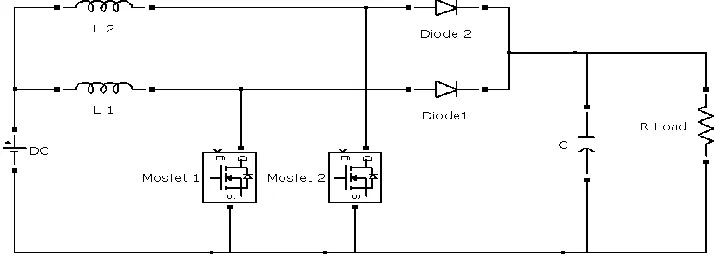
Boost power supplies are popular for creating higher DC voltages from low voltage inputs. As the power demands from these power supply increase, however a single power stage may be insufficient. To rectify this problem we go for interleaving concept. Interleave boost converter is defined as coupling the many stages of boost converter.
Fig. 2: Interleaved Boost Converter
Interleaving technique meritoriously increases the switching frequency without increases the switching frequency. This topology improves the converter performance at the cost of additional inductor power switching devices and output rectifiers and also it reduces the output capacitor current ripple as a function of duty cycle. Interleaved power converters can be very beneficial for high performance electrical equipment applications. Reductions in size and electromagnetic emission along with an increase in efficiency, transient response, and reliability are among the many advantages to using such converters. For high power applications single stage converter may not sufficient. In the interleaved boost converter two boost converters are connected in parallel manner. This type of converters mainly used in pv source and fuel cell technologies.
III.
VOLTAGE MULTIPLIER CELL
As it name suggests a voltage multiplier circuit is a circuit which has a multiplication factor 4. Voltage multiplier circuit are capable of producing output voltage in the range of few of few 100’s to ten’s of 1000’s of voltage depending upon their original input voltage with low current in milli ampere’s range. Fig 3 shows a voltage multiplier circuit. The output of this circuit is greater than the input that is four times greater than the input voltage value. During negative half cycle the diode D1 is forward biased and conducts charging up the capacitor C1 to the peak value of the input voltage. There is no path for capacitor C1 to discharge into, it remains fully charged and acts as a storage device in series with the voltage supply. At the same time the diode D2 conducts via D1, charging up the capacitor C2.
Then the voltage across C2 can be calculated as,
VOUT= 2Vin
This same procedure repeated for diode D3,D4 and capacitance C3,C4 then the final output from the C4 is calculated as, VOUT= 4Vin
Fig. 3: Voltage Multiplier Cell
IV.
OPERATING PRINCIPLES
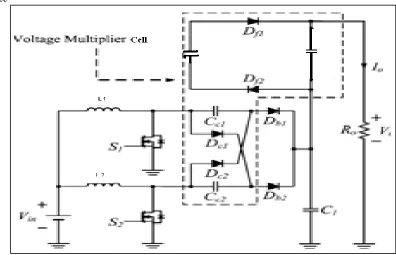
The proposed high step-up interleaved converter with voltage multiplier module is shown in Fig.2. The voltage multiplier module is composed of two coupled inductors and two switched capacitors, and is inserted between a conventional interleaved boost converter to form an modified boost-flyback-forward interleaved structure.
In fig2,
L1, L2 –inductors of IBC S1, S2-MOSFET switches
Cc1, Cc2, DCI, DC2- Voltage multiplier cell Components
R0- Load resistance
C- Capacitance
Fig. 4: Interleaved Boost Converter With Voltage Multiplier Cell
Mode I [t0, t1]:
At t=t0, the power switch S2 remains on-state, and other
power switch S1 begins to turn on. The diodes Dc1, Dc2, Db1,Db2 and Df1 are reversed-biased, The series leakage inductors
Ls quickly releases the stored energy to output terminal via flyback-forward diode Df2, and the current through series leakage inductors Ls decreases to zero.
Mode II [t1, t2]:
At t=t1, both of the power switches S1 and S2 remain on- state, and all diodes are reversed-biased,
Mode III [t2, t3]:
At t=t2, the power switch S1 remains on-state, and
other power switch S2 begins to turn off. The diodes Dc1, Db1 and Df2 are reversed-biased, The voltage stress on power switch S2 is clamped by clamp capacitor Cc1 which equals output voltage of boost converter. The input voltage source, magnetizing inductor Lm2, leakage inductor Lk2 and clamp capacitor Cc2 release energy to output terminal, thus VC1 obtains a double output voltage of boost converter.
Mode IV [t3, t4]:
At t=t3, the current iDc2 has naturally decreased to zero due
to the magnetizing current distribution, and hence diode reverse recovery losses are alleviated and conduction losses are decreased. Both power switches and all diodes remain previous state.
Mode V [t4, t5]:
At t=t4, the power switch S1 remains on-state, and other power switch S2 begins to turn on. The diodes Dc1, Dc2,
Db1,Db2 and Df2 are reversed-biased. The series leakage inductors Ls quickly releases the stored energy to output terminal via flyback-forward diode Df1, and the current through series leakage inductors decreases to zero
Mode VI [t5, t6]:
At t=t5, both of the power switches S1 and S2 remain on- state, and all diodes are reversed-biased.
Mode VI [t5, t6]:
At t=t5, both of the power switches S1 and S2 remain on- state, and all diodes are reversed-biased,
Mode VII [t6, t7]:
At t=t6, the power switch S2 remains on-state, and other power switch S1 begins to turn off. The diodes Dc2, Db2 and Df1 are reversed-biased
Mode VIII [t7, t8]:
At t=t7, the current iDc1 has naturally decreased to zero due to the magnetizing current distribution and hence the diode reverse recovery problems are alleviated and conduction losses are reduced.
V.
HARDWARE IMPLEMENTATION
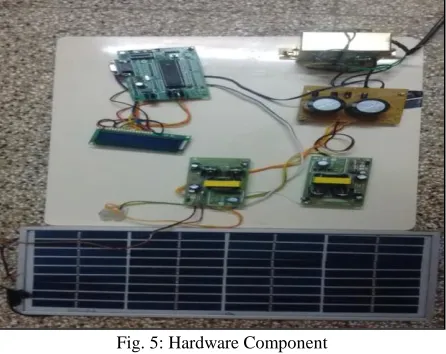
A hardware of interleaved boost converter consists of two boostconverter connected in parallel with voltage multiplier component. A sensor also included for an any emergency condition.
Fig. 5: Hardware Component
Hardware Specification: A.
Table – 1 Hardware Specification
Component Specification
Inductor 6.08 µH
Capacitor 56 µF
Micro controller PIC16FXX40
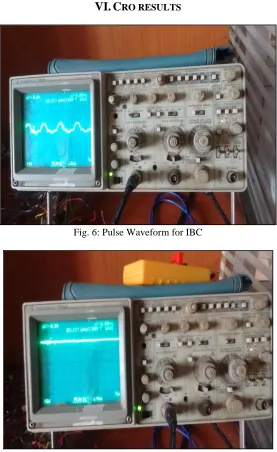
The pulse output also a ripple free form. The highest efficiency of this model is 98.56%. The output voltage is given by, Vs1=Vs2= Vin
VI.
CRO RESULTS
Fig. 6: Pulse Waveform for IBC
Fig. 7: Output Waveform for IBC with VMC
VII.
CONCLUSION
This paper has presented an efficient interleaved boost converter topology for renewable energy sources. This type of configuration suits for high power applications. The proposed converter has been successfully verified with the help of the hardware. Instead of boost converters, the proposed system will be used for renewable energy sources applications.
REFERENCES
[1] Weichen Li, Xin Xiang, Chushan Li, Wuhua Li, “Interleaved High Step-Up ZVT Converter With Built-In Transformer Voltage Doubler Cell for
Distributed PV Generation System,” IEEE Trans. Ind. Electron vol 25,Jan 2013.
[2] J. Selvaraj and N. A. Rahim, “Multilevel inverter for grid-connected PV system employing digital PI controller,” IEEE Trans. Ind. Electron IEEE Trans.
Ind. Electron Apr 2012.
[3] B. Yang, W. Li, Y. Zhao, and X. He, “Design and analysis of a gridconnected PV power system,” IEEE Trans. Power Electron., vol. 25,no. 4, Apr. 2010.
[4] Q. Li and P.Wolfs, “A review of the single phase photovoltaic module integrated converter topologies with three different DC link configurations,” IEEE
Trans. Power Electron., vol. 23, no. 3, May 2009.
[5] V. Scarpa, S. Buso, and G. Spiazzi, “Low-complexity MPPT technique exploiting the PV moduleMPP locus characterization,” IEEE Trans. Ind. Electron.,