Abstract
Drugs, natural medicinal plant, animals and mineral materials, have a large and various application in official pharmacy and medicine. Carriers of multilateral pharma-cological effects that those drugs shown, are chemically define as active components that are present in them. Methods of qualitative and quantitative analysis are used for the chemical investigation of components that drugs contain. Method of thin layer chromatography has been shown as very reliable.
According to the chemical investigation of single drugs, it is possible to define a group of compound or single compound comparing them with standards. Relating to the usage of method of thin layer chromatography, it has been carried out investigation on presence of coumarins and flavonoids in domestic plant material that have wide everyday usage. Coumarins and flavonoids from the point of view of chemical belonging are phenol deriva-tives with important pharmacological effects.
Applying method of thin layer chromatography, it is detected presence of coumarins and flavonoids sub-stances in plant material that has been tested. Anethi graveolens fructus et folium (fruit and leaf of dill), Anethum graveolens L., Apiaceae, Avenae sativae fructus (fruit of oats), Avena sativa L., Poaceae and Asperulae odoratae herba (sweet woodruff), Asperula odorata L., Rubiaceae. Chromatograms are developed in systems cyclohexane-ethylacetat (13:7) and toluene-ether (1:1) saturated with 10% acetic acid, and visualisation by observing on UV lamp (254 and 366 nm), spraying with reagents KOH (10% ethanol solution) and diphenylbory-loxyethylamine (1% methanol solution).
Key words: TLC, coumarins, flavonoids, dill, oats, sweet woodruff
Introduction
Chromatography belongs to the group of analytical sepa-ration methods that are applied for identification, purifi-cation and determination of contents of substances or preparations. The separation of different components using chromatography is based on dynamic distribution
of dissolve substance between two fazes that are unmixed and one of them must be mobile in relation to one other. The immobile faze slow down movement of the melted components, enabling single substances to be separated under certain conditions. Using chromatographic meth-ods makes possible to separate substances, which have small difference from the point of view of the chemical structure, because they have similar physical and chemi-cal properties, that chromatography put in advantage respect to other methods (1, 2).
Analysis of natural raw material, drugs and isolated sub-stances, according to principles of pharmacognosy is car-ried out mostly by using methods of thin layer chro-matography and column chrochro-matography (3, 4). They were applied for qualitative and quantitative analysis of drugs, natural products and preparation with natural com-ponents.
A series of advantages, respect to the other chromato-graphic methods, gives the priority in usage of thin layer chromatography in pharmacognostic and phytochemical analysis of drugs. It distinguished, in addition to relative-ly fast application, well separation that can be archived using small quantities of samples, and with thin layer of adsorbents, and the results obtained are reproducible under standardised conditions.
In that sense it was carry out analysis of chemical com-position of plant material using method of thin layer chromatography and that was shown in this work. It was carry out the analysis of following drugs Anethi graveolens fructus et folium (fruit and leaf of dill), Anethum graveolens L., Apiaceae, Avenae sativae fructus (fruit of oats), Avena sativa L., Poaceae and Asperulae odoratae herba (sweet woodruff), Asperula odorata L., Rubiaceae.
Dill is herbaceous annual plant that was grown as spice plant in the garden, but also in plantation. It is of use its mature fruit, leaf, but also the upper overgrown part of the plant in bloom as herbs. The fruits contain ethereous oil with carvone, limonene, than fatty oil, coumarin derivatives, and proteins. Leaf or herbs contain essential oil, vitamin C, pro-vitamin A, flavonoids. It is in use as carminative, stomachic, diuretic, bland sedative, lacto-gogue. Use of fruits extract as antispasmodic in light
Thin layer chromatography-application in
qualitative analysis on presence of coumarins
and flavonoids in plant material
Elvira E. Kova~-Be{ovi}, Kemal Duri}
Department of Pharmacognosy, Faculty of Pharmacy
forms of chronic coronary insufficiency, preventively against asthma and contraction of abdominal organs, is very important. As specie is in a large use (5, 6).
Oath is cultivated cereal that grows everywhere, even in a poor field. It is in use-husked fruit obtained from culti-vated plant. It contain silicon acid, flavonoids, avenacin, avenacoside, coumarins, vitamin C and B-complex, amide, proteins, lecithin, fatty oils, mineral material, especially iron, iodine, wax and sugars. It is in use as food, dietetic and medicine. It use as sedative and diuret-ic in homeopathdiuret-ic meddiuret-icine. It is very important as stim-ulant of immunity (6, 7).
Sweet woodruff is herbaceous plant wide spread in forest area especially in beech forests. It is useful over ground part of the plant during flowering period. Drug contains coumarins, iridoid glycosides, tannins, bitter substances and essential oil. Preparations with sweet woodruff are used as anti-inflammatory, lymphokinetic, antispasmodic and as diuretic, bland sedative and aromatic. The drug is not explored and used sufficiently (8, 9).
Investigation of the above mentioned drugs were carried out with thin layer chromatography method according to the principles of this method. Adsorbent was silica gel 60 F254, on which were applied methanolic extracts of drugs and respectively coumarins and flavonoids stan-dards. Chromatograms were developed in two systems that literatures cite for analysis of coumarins and flavonoids phenolic derivatives.
In this way we would like to ascertain possibly optimisa-tion in separaoptimisa-tion of these components that limit use of drugs that contain them (10, 11). Separated coumarins and flavonoids spots show blue-white and yellow fluo-rescence under UV-lamp on 254 and 366 nm that became more intense after spraying with reagents ethanolic potassium hydroxide and diphenylboryioxyethylamin. This is very evident after spraying with second reagent under UV-366 nm. The results we obtained were shown on photos and tables that contain Rf-values of separated spots.
Standard substances fraxin, fraxetin, aesculin, aesculetin were supplemented with coumarin substances obtained synthetically.
Their aim of usage is comparison between coumarin nucleus behaviours, such is contained in natural material and which is result of metabolic process of natural living
and plant environment, and those, which are, produced synthetically (12).
S-Synthetic samples
Standards of flavonoids compounds, quercetin and rutin were applied as natural raw material.
Material and methods
In this work the analysis have been carried out on pres-ence of coumarins and flavonoids in selected plant mate-rial by using method of thin layer chromatography. This method was used for qualitative chemical analysis. Plant species we utilized for analysis are: dill, Anetum grave-olens L., Apiaceae, oats, Avena sativa L., Poaceae and sweet woodruffAsperula odorata L., Rubiaceae. All of three plant species give drugs that are: dill, Anethi grave-olens fructus, fruit (Figure 1), Anethi gravegrave-olens folium, leaf (Figure 2), oats, Avenae sativae fructus, husked fruits (Figure 3) and sweet woodruff, Asperulae herba, over ground part (Figure 4). Fruit and leaf of dill had been col-lected in surroundings of Sarajevo and dried as drug. Leaf was dried binding over ground parts, herb, keeping it on dray and ventilated place. The fruit was collected in mature state, and was dried in thin layer on drayed and ventilated place. Along with draying of leaf of dill, it is necessary to conserve its green colour, while with its fruit the contact with humidity should be avoided. Mature fruits of oats were collected on ownership in surrounding of Sarajevo. Sweet woodruff was acquired as already pre-pared drug.
Method of thin layer chromatography was carried out under following conditions.
Figure 1.Anethi graveolens fructus, dill's fruits, Anethum graveolens L., Apiaceae
Figure 2.Anethi graveolens folium, (herba), (dill), Anethum graveolens L., Apiaceae
extracts are prepared and bring on chromatogram by fol-lowing sequence:
1.Anethi graveolens fructus, 2.Anethi graveolens folium, 3.Avenae sativae fructus, 4.Asperulae herba.
Methanolic solution (0.1%) of coumarins and flavonoids substances is used for standard, more precisely coumarin derivatives fraxin, fraxetin, aesculin, aesculetin and three coumarins as synthetic substances. Fraxin and aesculin are hetero-side compounds, fraxetin and aesculetin are their corresponding aglicons, which are liberated by hydrolysis of hetero-sides, during which glycolic part is separated. Synthetic coumarins are utilized as standards because of theirs coumarin structure which can give information in correlation with natural coumarin sub-stances from their analytics as well affects point of view.
Figure 3.Avenae sativae fructus, oats's fruits, Avena sativa L., Poaceae
Figure 4.Asperulae odoratae herba, sweet woodruff, Asperula odorataL., Rubiaceae
For standards substances of flavonoid structure are used methanolic solution (0.1%) of quercetin ("Kemika", Zagreb) and rutin ("Merck", Darmstadt).
Pre-coated TLC plates with adsorbent silica gel 60 F254, layer thickness 0.25, "Riedel-de-Haën" Seelze, Germany, dimension 20x20 cm are used.
Extracts were brought on thin layer with capillary, dotted with Nanomat IV "Camag", Muttenz, Switzerland.
Chromatograms are developed in systems of solvents, which are specific for coumarins and flavonoids sub-stances, cites in literature like that one (3).
Presence of those derivatives is investigated by develop-ing in systems
b) Toluene-ether (1:1), saturated with 10% acetic acid; developing values d2 is 14.5 cm (travelling of mobile phase was 55 min).
Detection of developed spots is carrying out according to the principles of visualisation of chromatograms. First, chromatograms are observed under UV-lamp on 2 stan-dard wavelengths, 254 nm and 366 nm. Fluorescence of separated spots in comparing to fluorescence of standards could be considered reliable information in identification of analysed coumarin and flavonoid derivatives. This substance gives intensive fluorescent spots of blue-white and yellow colour as standards and those corresponding spots got from drug's extracts.
Chromatograms are sprayed with reagents for identifica-tion, attaining reinforcement of intensity of fluorescence, thanks to them. Reagents are following:
a) KOH-ethanolic (10%), reagents for identification of presence of coumarins substances
b) Diphenylboryioxyethylamin (Merck, Darmstadt)-methanolic (1%), reagents for identification of flavonoids substances.
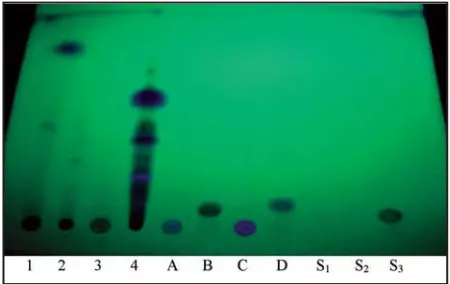
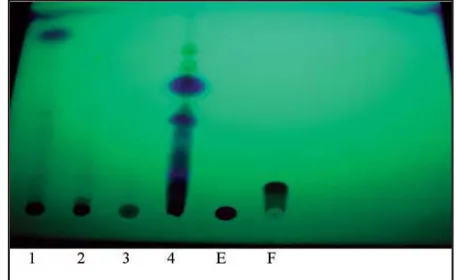
The chromatograms we obtained are presented in original photos made after developing and observing under UV-lamp before and after spaying with abovementioned regents (Figure 5,5a,5b,6,6a,6b,7,7a,7b,8,8a,8b).
Results and discussion
In this work chromatographic analysis have been carried out on presence of coumarins and flavonoids substances in selected plant material. Method of thin layer chro-matography, which is quoted in pharmacopoeia's regula-tions for analysis of drugs but also other substances, it is utilised for qualitative chemical analysis of drugs (13, 14). The plant material we analysed, leaf and fruit of dill, fruit of oats and sweet woodruff, are drugs in everyday usage and that is why chemical study represents an important information. Taking food into man's organism is not the only importance of this studies but also the pos-sibility of preparation of different pharmaceutical medicaments intended to the specific pharmacologic indication. From viewpoint of pharmacological affect, coumarins and flavonoids represent very important groups of pharmacologically active chemical compounds present in plant material, but also the substances that are obtained semi-synthetically or synthetically trying to meliorate pharmacological efficiency.
By chromatographic analysis of drugs, Anethi graveolens fructus, Anethi graveolens folium, Avenae sativae fructus and Asperulae herba, with corresponding standards, the chromatograms we obtained gives next results:
Figure 5. System, cyclohexane: ethylacetat (13:7); Visualization UV-254 nm
Figure 5a. System, cyclohexane: ethylacetat (13:7); Visualization UV-366 nm
Figure 5b. System, cyclohexane: ethylacetat (13:7); Visualization UV-366 nm, sprayed with KOH/EtOH (10%)
Figure 6. System, toluen:ether (1:1), saturated with acetic acid (10%); Visualization UV-254 nm
Figure 6a. System, toluen:ether (1:1), saturated with acetic acid (10%); Visualization UV-366 nm
Figure 6b. System, toluen:ether (1:1), saturated with acetic acid (10%); Visualization UV-366 nm, sprayed with KOH/EtOH (10%)
stances with basic coumarin nucleus. The same structure had the synthetic coumarin substances, which we used in experiment.
All samples we examined, on start line show the spots which correspond to standards of fraxin (A) and aesculin
Figure 7. System, cyclohexane:ethylacetat (13:7); Visualization UV-254 nm
Figure 7a. System, cyclohexane:ethylacetat (13:7); Visualization UV-366 nm
Figure 7b. System, cyclohexane:ethylacetat (13:7); Visualization UV-366 nm, sprayed with diphenylboryioxyethylamin
(UV-366 nm). Standard of aesculetin (D) has Rf-0.08, in zone of fluorescence 254 nm show blue spots, or blue-white fluorescents on 366 nm. From synthetic coumarin compounds, S3 show blue-brown fluorescence (UV-254 nm), Rf-0.05, as aesculetin. In system toluene-ether, sat-urated with acetic acid, synthesised compound remain on start line together with standards of fraxin and aesculin. As we mentioned before all comparative coumarin stan-dards has the basic coumarin structure. For the separation of coumarin substances, the system we applied on had shown to be good, apposite to system toluene-ether, sat-urated with acetic acid, a little bit better then system cyclohexane-ethylacetat (Figure 5, 5a, 5b, 6, 6a, 6b, Table 1).
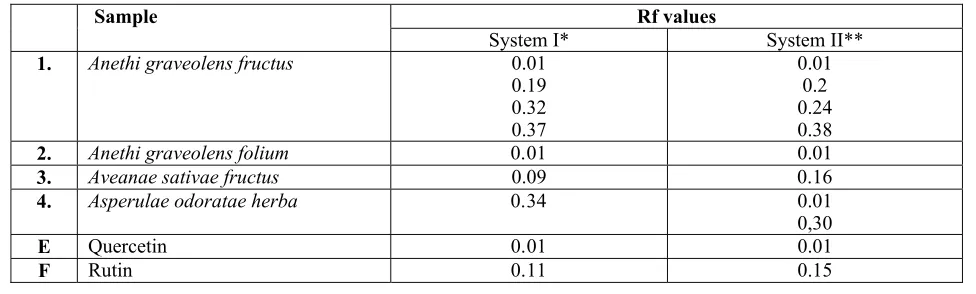
Methanolic extracts Anethi graveolens fructus, and Anethi graveolens foliumin system cyclohexane-ethylac-etat gives the spots of brown fluorescence (UV-254 nm) on start line, as standard quercetin, Rf-0.01. Dark-brown zone of fluorescence on Rf-0.15 show extract of Asperulae herba together with rutin standard (UV-254 nm). From extract of Avenae sativae fructusremain on start line spot of light-brown fluorescence (UV-254 nm), Rf-0.09, which is identical with behaviour of rutin stan-dard, Rf-0.11.
In zone UV-366 nm, fluorescence of spots is blue (Rf-0,01), and after spraying with reagents diphenylbo-ryioxyethylamin, the spots show intensive yellow fluo-rescence (Rf-0.01), and Rf-0.34 that is given from methanolic extract of Asperulae herba.
In system toluene-ether, saturated with acetic acid, from extract of Avenae sativae fructus the separated compo-nent in zone UV-366 nm show yellow fluorescence (Rf-0.16) the same as rutin (Rf-0.15), with close Rf values (Figure7, 7a,7b, 8, 8a, 8b, Table 2).
The results we obtained from chromatographic analysis of examined drugs, show that they contain coumarin and flavonoid substances, as part of there own metabolism, which is in correspondence with literature quotation From the type of coumarins and flavonoids point of view, especially their percentage contents, investigations con-tinue, by using other necessary methods of qualitative and especially quantitative analysis.
The results obtained, also, show the justify utilize of this drugs as medicament natural raw material, and especial-ly present contribution on better and bigger employment of sweet woodruff in pharmacy and medicine.
Figure 8. System, toluen:ether (1:1), saturated with acetic acid (10%); Visualization UV-254 nm
Figure 8a. System, toluen:ether (1:1), saturated with acetic acid (10%); Visualization UV-366 nm
Table 1. Rf-values of separated components (analyses of coumarins)
Table 2. Rf-values of separated components (analyses of flavonoids)
* System I - cyclohexane: ethylacetat (13:7)
References
1. Nyiredy, Sz. Planar Chromatography, A Retrospective View for the Third Millenium, Springer Scientific Publisher, Budakalász, Hungary, 2001
2. Nikolin, B. Analitika lijekova, Sarajevo Publishing, Sarajevo, 1998
3.Wagner, H., Bladt, S. Plant Drug Analysis, Springer-Verlag Berlin-Hedelberg-New York, 1996
4. Kova~-Be{ovi}, E. Metode u farmakognoziji, Sarajevo Publishing, Sarajevo, 2001
5. Hassanzadeh, M.K., Rahimizadeh, M. and Vaheddie, L., Constituents of the essential oils of aerial parts of dill (Anethum graveolens L.) herb., Oriental. J. Chemistry, 2000; 14:2, 217-220
6. Hagers Handbuch der Pharmazeutischen Praxis, Springer-Verlag Berlin-Heidelberg-New York, 1973
7. British Herbal Pharmacopoeia, British Herbal Medicine Association, England, 1995
8. Sticher, O. Iridoidglucoside aus Asperula odorata L., Galeopsis tetrahit L. und Thevetia peruviana (PERS.) K. SCHUM., Habilitationsschrift ETH Zürich, 1970
9. Sticher, O. Isolierung von Monotropein aus Asperula odorata L. (Rubiaceae), Pharm. Acta Helv. 1971; 46, 121
10. Galand, N., Pothier, J., Mason, V. and Viel, C. Separation of flavonoids, coumarins and antocyanins in plant extracts by Overpressure Layer Chromatography, Pharmayie, 1999; 54:6, 468-471
11. Budzianowski, J. Coumarins, caffeoyltartaric acids and their artifactual methyl esters from Taraxacum offic-inale leaves, Planta medica 1997; 63:3, 288.
12. Kova~-Be{ovi}, E., Zavr{nik, D. And Duri}, K. Phytochemical investigation of coumarines, 3rd Int. Symposium on Separation in BioSciences, Abstracts, Moscow, P85, 193, 2003
13. European Pharmacopeia, 3rd editon; Council of Europe, Strazburg, 1997